- recognise that an informal email is written to a friend or relative
- respond to all of the prompts given in the task
- use a friendly, personal tone that suits the reader
Writing an informal email
IGCSE English · Topic 3
 7:50
7:50
Writing an Informal Email
Two students answer the same task: write to your friend about a place you visited. Here is the first one. <slow>I visited a museum. It was good. I went with my…
English narration · English + 中文 subtitles burned in
3.1
Why and to whom you write

Syllabus
Source: Cambridge International syllabus
Imagine telling a friend about a school visit that did not go as planned. Your reader needs more than “It was good”. An informal email 非正式电子邮件 shares relevant news with someone you know, using an appropriate personal voice.
In Cambridge 0510 Paper 1 Exercise 5, write 120–160 words for the stated purpose and reader. Both the 2024–2026 and 2027–2029 syllabuses give up to 6 marks for content and 9 for language. These assess the response as a whole, including task fulfilment, development, appropriate style, accuracy and organisation. A phrase or extra sentence does not automatically earn a mark.
Cover every prompt
Read all the prompts 提示 and their command words. “Explain why” needs a reason; “describe” needs relevant information about what happened; “say what you enjoyed most” needs a clear choice. Address every requested point and develop it sufficiently. Missing a point weakens task fulfilment, but do not invent a fixed mark deduction without the actual scheme.
Original classroom task. You recently visited a science museum with your class. Something unexpected happened. Write an email to your friend Sam. Explain why your class chose the museum, describe the unexpected event and how you responded, and say what you enjoyed most and why. Write 120–160 words. You may invent plausible details consistent with this fictional task.
Planning attempt. Choose a reason, an unexpected event and a favourite activity. Can “I went on Friday; it was great” answer all three prompts? Decide what information is missing before adding more words.
Worked plan. Space lessons motivated the visit. A temporary lighting failure interrupted a demonstration; the group waited and asked the guide questions. A Mars journey-planning activity was the favourite because classmates could compare ideas. These are original fictional choices, not facts about a real museum. A date alone does not answer why the class chose it.
Use a friendly tone
An informal 非正式 tone 语气 suits the relationship. Contractions and natural questions can help, but there is no requirement to insert a question or exclamation mark into every email. Avoid copying a phrase such as “Thanks for your email” when no earlier message is established. Warm writing can still be grammatical and clear.

Vocabulary
Train
| English |
|---|
| informal email/ɪnˈfɔːml ˈiːmeɪl/ |
| prompts/prɒmpts/ |
| informal/ɪnˈfɔːml/ |
| tone/təʊn/ |
3.2
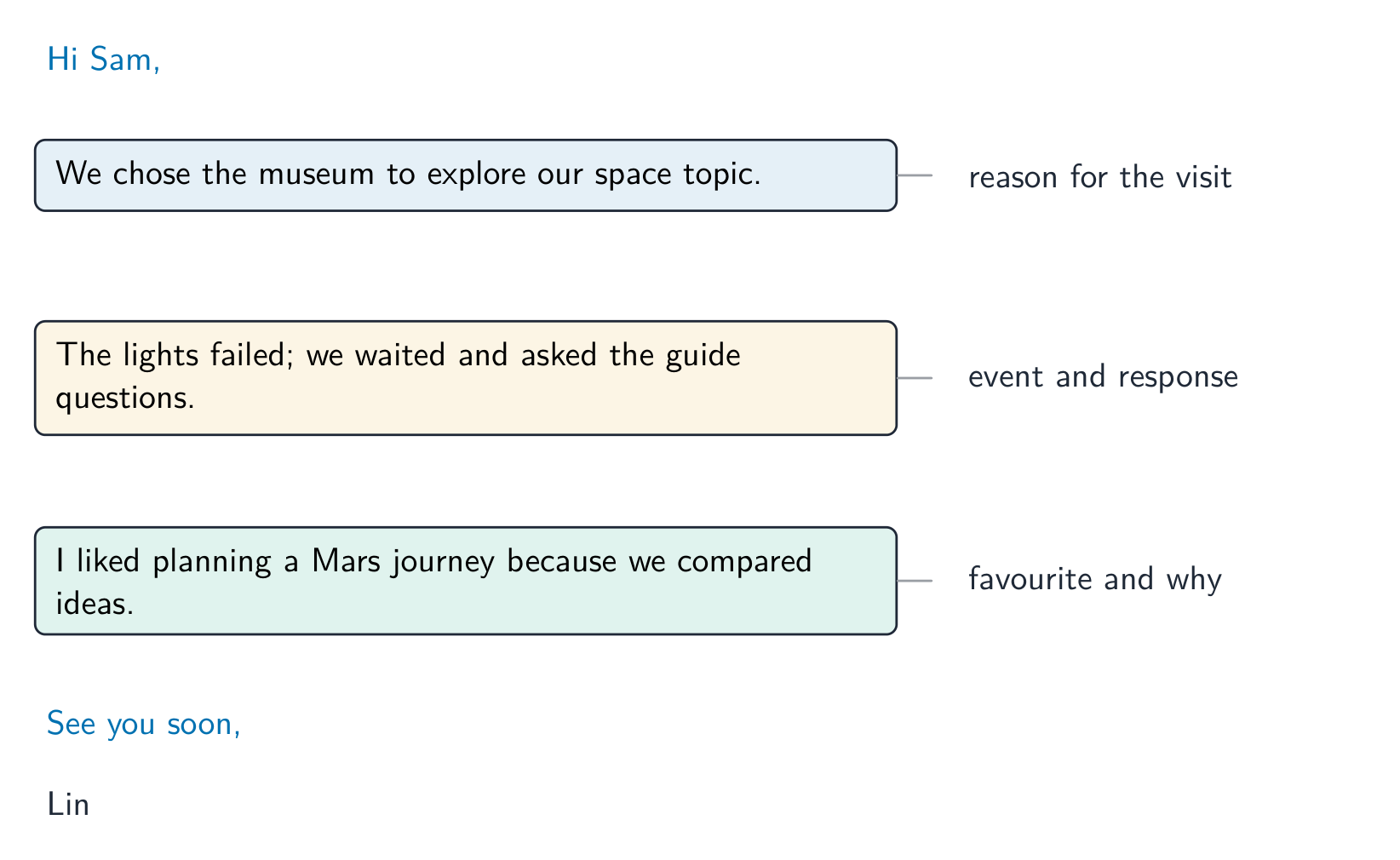
How to build your email
Syllabus
- open and close an informal email appropriately (for example: Hi … / Write back soon …)
- organise the email into short paragraphs, with one main idea per paragraph
- use informal language: contractions, friendly phrases and questions to the reader
Source: Cambridge International syllabus
Organise the response so the reader can follow the news and find every requested point. Cambridge’s guide recommends separate paragraphs for the prompts as a useful planning scaffold. It is advice, not a rule that every related idea must occupy its own paragraph.
Greeting and ending
A greeting 问候语 such as “Hi Sam,” or “Dear Sam,” can suit a friend. A friendly closing 结束语 such as “See you soon,” or “Best wishes,” can suit the situation. Use your name appropriately; first name is a natural choice here, not a universal ban on full names. “Dear” by itself does not make a message formal.
Original choice task. For the museum email, choose between “Dear Sir or Madam” and “Hi Sam”. Then choose between “See you soon” and “Yours faithfully”. Explain the fit to the actual relationship rather than memorising one greeting for every task.
Worked choice. “Hi Sam” and “See you soon” fit this friendly message. The traditional business-letter pairing would sound distant here. Other natural friendly pairs can also work.
Paragraphs
Use clear paragraphs 段落. For this task, a reason for the visit, the unexpected event and response, and the favourite activity form a useful sequence. Keep openings and endings brief enough to leave room for the requested content. Do not turn an email into headings or a bullet-point answer.
Useful language
Short forms 缩略形式 such as “I'm”, “didn't” and “we're” suit friendly writing; full forms remain grammatical.
Original register repair. Rewrite “Dear Sir. I am writing to inform you that I visited a museum.” for Sam. Keep the visit; add only plausible fictional details.
Possible revision. “Hi Sam, I went to the science museum with my class and wanted to tell you about it.” “Guess what!” is another possible opening when it fits the news, not a compulsory formula.
Vocabulary
Train
| English |
|---|
| greeting/ˈɡriːtɪŋ/ |
| closing/ˈkləʊzɪŋ/ |
| paragraphs/ˈpærəɡræfz/ |
| short forms/ʃɔːt fɔːmz/ |
3.3
Making your email better
Syllabus
- develop each idea with a reason, example or detail rather than just listing points
- vary your sentence openings and link ideas smoothly
- check the length (120–160 words), the tone and the accuracy before finishing
Source: Cambridge International syllabus
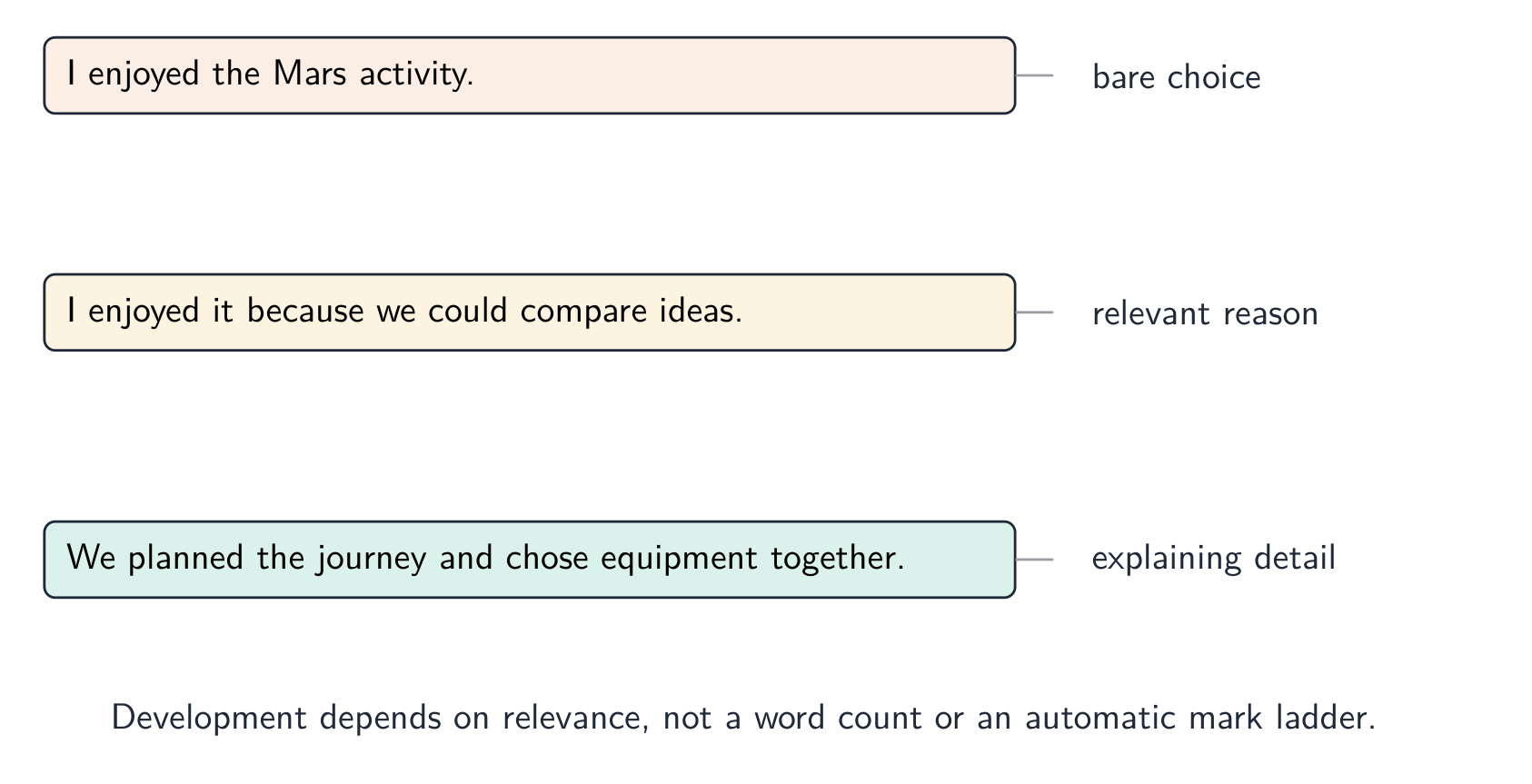
Ideas are developed 展开的 when relevant explanation helps the reader understand the point. Length alone does not establish development.
Develop your ideas
A reason 原因 answers why; an example 例子 makes an idea concrete; a detail 细节 gives relevant information. Add what the prompt needs. Repetition or an unrelated detail may add words without improving the answer.
Original development attempt. Improve “I enjoyed the Mars activity”. Explain what you did and why it was enjoyable. Then decide whether “My pencil was blue” helps answer the same prompt.
Worked revision. “I enjoyed planning a journey to Mars because we could compare ideas and choose the equipment together.” This connects the activity to the enjoyment. Pencil colour does not explain that enjoyment in the stated situation. Do not add invented real-world statistics to make the fictional account sound proven.
Check before you finish
Check every prompt, the consistency of events, word range and a suitable voice. Then check sentence boundaries, spelling, verb forms and links. For example, “Last Friday I have visited” should be “Last Friday I visited” in this completed-time account. Different tenses can be appropriate for background, earlier events and future plans; do not force one tense everywhere.
A model email
Write your response before reading this original teaching model. It is not an officially marked answer. Its fictional details follow the task above.
Hi Sam,
How are things? I went to the science museum with my class last Friday, and I’ve got to tell you about it. We chose the museum because we were studying space and wanted to see how astronauts live.
The visit didn’t start smoothly. Just as our guide began explaining a model spacecraft, the room lights went out. We waited in the corridor while the staff checked the problem. At first I was disappointed, but our guide used the time to answer our questions.
My favourite part came later, when we tried planning a journey to Mars. I enjoyed comparing ideas with my classmates rather than only looking at displays. It made our science lessons feel much more real.
Would you like to go together during the holidays? Let me know when you are free.
See you soon,
Lin
The body has 134 words by a space-separated count, excluding greeting, sign-off and name. The space topic explains the choice of museum. The lighting failure and corridor wait describe the event and response. The Mars activity and comparison of ideas explain the favourite part. The invitation fits the relationship but is not required by the three prompts. Full forms in this model are grammatical and do not by themselves make it a business letter.
Original review attempt. A different draft says: “Hi Sam, I went to a museum on Friday. There were many rooms and a café. The trip was great. See you soon.” Identify the unanswered prompts. Repair the content before adding decorative phrases.
Worked review. It does not explain why the class chose the museum, give the unexpected event and response, or identify the favourite activity with a reason. Saying the whole trip was great does not supply those specific answers. Use a plan to add relevant development rather than repeating “great”.
Vocabulary
Train
| English |
|---|
| developed/dɪˈveləpt/ |
| reason/ˈriːzn/ |
| example/eɡˈzæmpl/ |
| detail/ˈdiːteɪl/ |
3.3
Exam tips
Verified exam connection: June 2025 0510/12 Question 16 asks about a family weekend away, including why the family went, a problem and its effects. “What the problem was” and “how it affected the family” are separate demands. The official scheme assesses task fulfilment and development, not a guaranteed mark for each extra detail. Our museum model answers a different original practice task.
Cambridge’s informal-email guide recommends relevant development of all requested points, suitable personal language and clear organisation. It warns against unsuitable formal links, misused idioms and weak tense control. A friendly tone is more than spelling contractions or adding exclamation marks.
Independent original task. Write 120–160 words to a friend about helping at a school book exchange. Explain why you volunteered, describe a difficulty and your response, and say what you learned. Invent plausible details consistent with the scenario. Plan and draft before reviewing.
Possible plan, not a full answer. You wanted more students to find affordable reading; the labels were mixed up, so you helped sort books; you learned to give clear directions and check details. Other coherent accounts are valid. Review all prompts, relevant development, event consistency, voice and language. No checklist guarantees an official score.
Interactive lessons on this topic
Work through it step by step, with instant-check exercises.