- recognise when a task needs a formal or semi-formal response (for example, to a teacher or an event organiser)
- cover the purpose, format and audience information given in the task
- keep a polite, formal tone throughout
Writing a formal letter or email
IGCSE English · Topic 4
 8:04
8:04
Writing a Formal Letter or Email
A student finds that the new bus timetable makes her late for school every morning. She decides to write to the bus company. Her first draft says: <slow>This…
English narration · English + 中文 subtitles burned in
4.1
When to write formally

Syllabus
Source: Cambridge International syllabus
How would you ask a library manager to change opening hours? The reader needs to understand the situation, your reason and the action you request. Clear, respectful writing matters more than a collection of long phrases.
Formal 正式 correspondence is useful beyond the exam. This lesson is course writing practice, not a claim that a formal letter is a current Cambridge 0510 Paper 1 task. In both the 2024–2026 and 2027–2029 syllabuses, Exercise 5 requires an informal email; Exercise 6 requires a more formal article, report, essay or review. Follow the actual requested format. Do not add a letter greeting and sign-off to an essay or review.
Spot a formal task
The reader, relationship and purpose guide the style. You might write to a head teacher 校长, a manager 经理 or an event organiser 活动组织者. Knowing someone’s name does not automatically make the message informal. A familiar teacher can still need a respectful, clear request.
A semi-formal 半正式 email may be suitable for a professional reader you know. Use the task’s format 格式, purpose 目的 and audience rather than treating “unknown person” as the only test of formality.
Original task. Write to the named library manager, Ms Li, asking her to consider a four-week opening-hours trial. The library closes at 17:00; lessons end at 16:00; travel takes twenty minutes. Suggest opening until 19:00 on Tuesdays and Thursdays. Explain the benefit, acknowledge a possible staffing concern and ask whether the trial is possible. For this classroom practice, aim for 100–140 body words; this is not an official 0510 letter task or word limit.
Planning attempt. Identify the reader, purpose, supplied facts and requested action. How much study time remains under the current schedule? Which information would be invented if you added it: the journey time, or a survey claiming that every student wants longer opening?
Worked check. The reader is Ms Li in her role as manager. The purpose is to request a trial, not announce that it has been approved. Current study time is forty minutes after arrival at 16:20. A survey result is not supplied and must not be invented. Staffing is a possible concern, not a known budget figure.
Keep a polite tone
Be polite 礼貌: state facts accurately, explain their effect and ask clearly. Avoid insulting the reader or using slang 俚语 that does not suit the context. You can express disappointment respectfully; emotion itself is not forbidden.
Full forms such as “I am” are a cautious choice for a very formal task. A contraction is not a grammar error merely because it appears in correspondence: acceptable formality depends on context. Do not teach “never use contractions” as a universal law. Semi-formal professional emails may sound natural with some contractions.
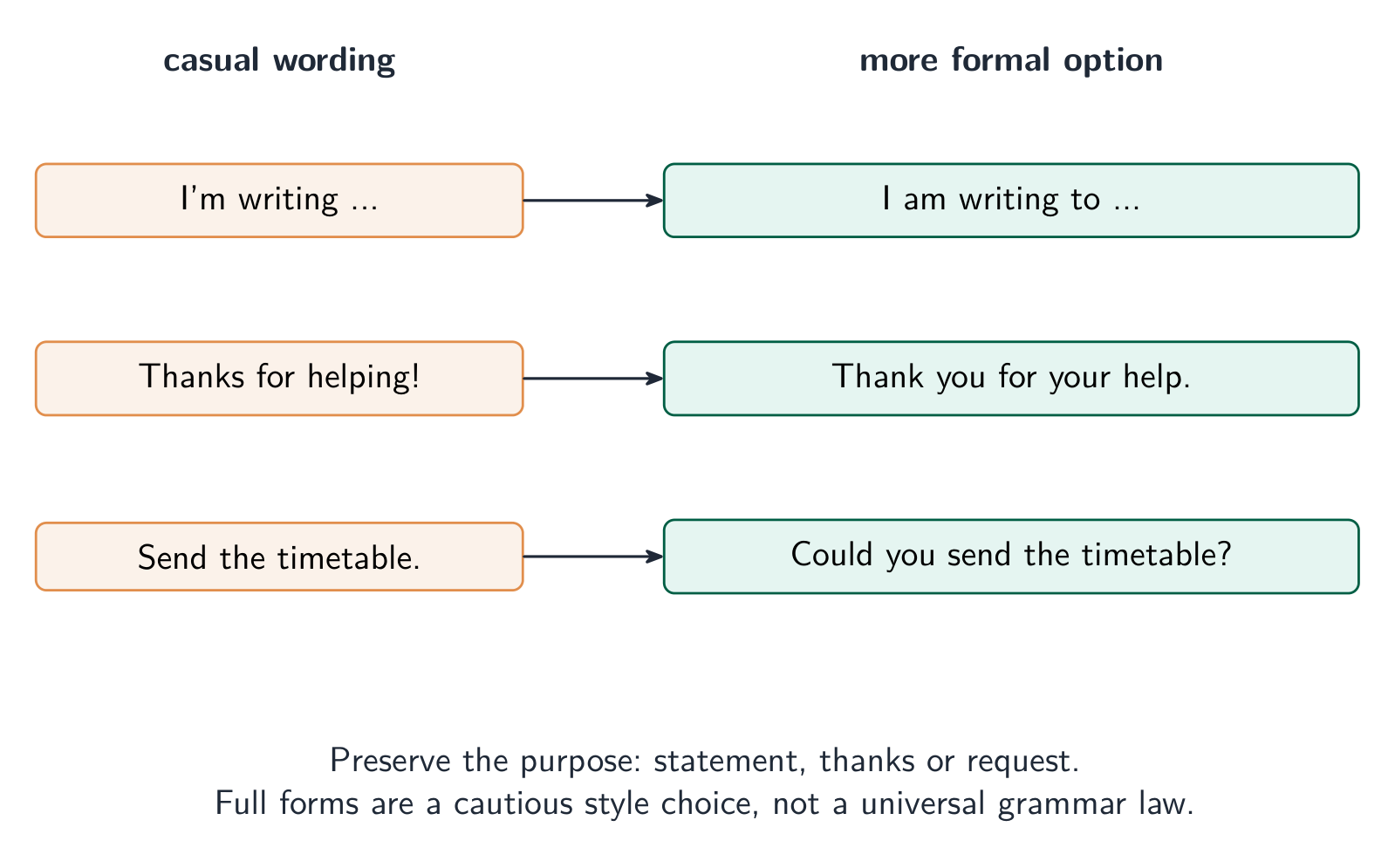
Original revision task. Improve “You people are useless. Send the timetable now!” Keep the request for the timetable but remove the personal attack. Do not add a deadline that the task has not supplied.
Worked revision. “Could you please send me the timetable?” If a genuine deadline is supplied, explain it. Politeness is not the same as vagueness, and adding “I would be grateful” cannot repair false facts or missing information.
Vocabulary
Train
| English |
|---|
| formal/ˈfɔːml/ |
| semi-formal/ˈsemi ˈfɔːml/ |
| head teacher/hed ˈtiːtʃə/ |
| manager/ˈmænɪdʒə/ |
| event organiser/ɪˈvent ˈɔːɡənaɪzə/ |
| format/ˈfɔːmæt/ |
| purpose/ˈpɜːpəs/ |
| polite/pəˈlaɪt/ |
| slang/slæŋ/ |
4.2
Building a formal letter or email
Syllabus
- open and close a formal letter or email appropriately (for example: Dear … / Yours sincerely …)
- organise your points into clear paragraphs with a beginning, middle and end
- use formal language and avoid contractions and slang
Source: Cambridge International syllabus
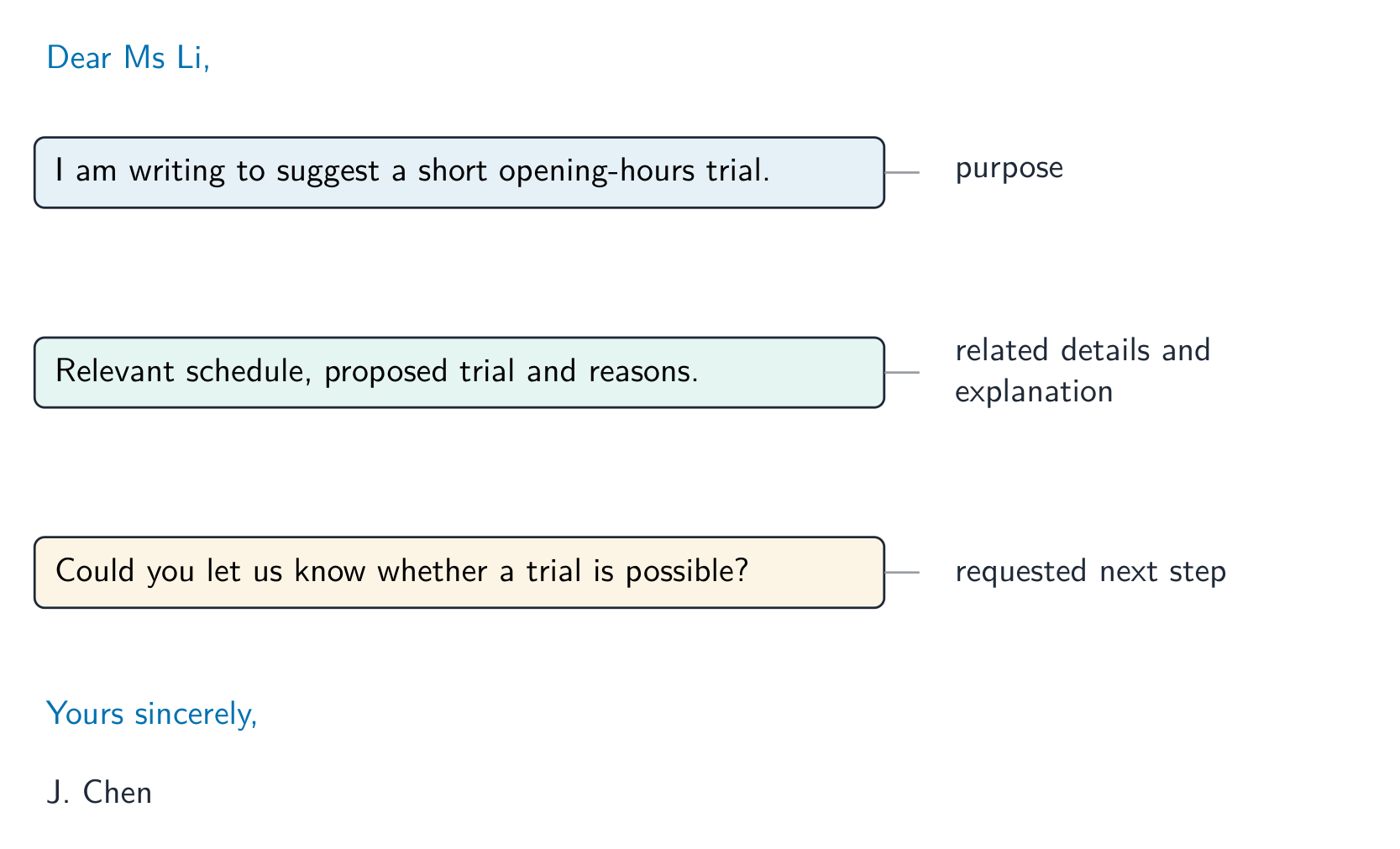
A useful order is greeting, purpose, relevant details and reasons, requested next step, and closing. Group related ideas into readable paragraphs. It is not compulsory to give every individual fact its own paragraph, and an informative reply may not need to request any new action.
Opening and closing
In a traditional British formal letter, “Dear Ms Li,” can pair with “Yours sincerely,”; “Dear Sir or Madam,” can pair with “Yours faithfully,”. Use a supplied title accurately rather than guessing it. These are conventions for this style, not universal laws for every country or email.
Professional emails may instead use “Dear Customer Services Team,” and “Kind regards,”. A short subject such as “Request for a library opening-hours trial” helps identify the purpose. Follow any specified house style or classroom task. Do not invent postal addresses or personal details merely to imitate a full letter layout.
Original choice task. Choose a greeting and ending for (1) a traditional British formal letter to Ms Li; (2) a traditional letter to an unnamed recipient; (3) a professional email to a customer services team. Explain why knowing the name does not decide whether the message is informal.
Possible answers. (1) Dear Ms Li / Yours sincerely. (2) Dear Sir or Madam / Yours faithfully. (3) Dear Customer Services Team / Kind regards. Role, relationship and purpose determine the tone.
Clear paragraphs
For the library request, first state the proposal and the existing schedule. Then explain the suggested trial and its benefit, while acknowledging a possible staffing concern. Finish by asking whether it can be considered. Keep the trial a proposal: “Could the library…?” does not mean “The library will…”.
Original ordering task. Arrange these moves: request a reply; explain the proposed trial and its benefit; state why you are writing and give the current schedule. Explain why “You have agreed to open later” would be inaccurate.
Worked order. Purpose and current schedule → proposed trial and reasons → request for a reply. Agreement has not been supplied. This sequence makes the request easy to understand without pretending the decision has already been made.
Formal language
“I am writing to…” identifies purpose. “Could you…?” makes a clear request. “I would be grateful 感激 if you could…” is another polite option, not a compulsory scoring phrase. Keep the meaning accurate: “Thank you for your help” expresses thanks, while “I would be grateful if you could help” asks for help.
Original grammar repair. Correct “I would be grateful if you can to send me the timetable.” Then complete “I am writing to…” with the actual library purpose rather than an unrelated application.
Worked repair. “I would be grateful if you could send me the timetable.” Use “send”, not “to send”, after “could”. For our library task: “I am writing to suggest a short trial of longer library opening hours.”
A model formal letter
Dear Ms Li,
I am writing to suggest a short trial of longer library opening hours. The library currently closes at 17:00. Our lessons finish at 16:00, and the journey to the library takes twenty minutes, leaving only forty minutes to study.
Could the library stay open until 19:00 on Tuesdays and Thursdays for four weeks? This would give students more time to use the books and work quietly. I understand that extra opening hours may require more staff time. A short trial would allow you to check how many students use the service before making a longer commitment.
I would be grateful if you could consider this suggestion and let the school know whether a trial is possible. Thank you for your time.
Yours sincerely,
J. Chen
This original teaching model is not officially marked. Its body has 121 words by a space-separated count, excluding greeting, sign-off and name. The first paragraph gives purpose and the current difficulty. The second proposes the trial, develops a benefit and acknowledges uncertainty. The final paragraph requests a response. No survey, staffing price or promise of approval is invented.
Original complaint task — all facts supplied. Order A104 was promised for 14:00 but arrived at 17:15. The customer paid £5 for timed delivery. Write a short professional email to Customer Services stating what happened and asking whether the delivery charge can be refunded. Do not claim that a refund is guaranteed, invent damage or add a missed event.
Worked email.
Subject: Timed-delivery query — order A104
Dear Customer Services Team,
I am writing about order A104. Delivery was promised for 14:00, but the parcel arrived at 17:15, three hours and fifteen minutes later. I paid £5 for timed delivery. Could you please explain the delay and let me know whether the delivery charge can be refunded?
Kind regards,
J. Chen
The wording is specific because the task supplies the times and charge. “I am disappointed that the parcel arrived late” would also be a reasonable statement of feeling. A request does not establish a legal entitlement or a promised outcome.
Vocabulary
Train
| English |
|---|
| grateful/ˈɡreɪtfl/ |
4.2
Exam tips
Check the actual exam’s requested format before applying correspondence conventions. The current 0510 informal-email task and more formal article/report/essay/review task assess relevant developed content, appropriate purpose and audience, language and organisation. A memorised greeting or request phrase earns no automatic mark and cannot turn the wrong format into the right one.
Independent original practice. Write a semi-formal email to an event organiser, Mr Chen, asking about a science workshop. The published notice gives Saturday 10:00–12:00 and a £6 fee, but says nothing about equipment or booking. Ask what to bring and how to reserve a place. Explain that you need these details before booking. Use only the supplied information; do not assert that lunch is included or that a place is already reserved.
Possible plan, not a full answer. Identify the workshop and your interest; ask the two missing questions; request a reply before you decide to book; use a suitable greeting and closing. Draft your own email, then check facts, purpose, questions, paragraphing, tone, grammar and spelling.
Vocabulary card meanings
semi-formal: A tone for a known adult who is not a close friend. head teacher: The person in charge of a school. manager: The person in charge of a team or a workplace. event organiser: The person responsible for running an occasion. format: The layout a particular kind of text is expected to follow. polite: Respectful in wording, especially when asking for something. grateful: Showing thanks.
Interactive lessons on this topic
Work through it step by step, with instant-check exercises.