- skim a text quickly to get the general idea, then scan to locate specific facts, names, numbers, times and places
- answer short questions with a single word or short phrase, using the exact detail from the text
- predict what kind of information a question is asking for before reading the text closely
Tips
IGCSE English as a Second Language (0510) is assessed on four skills: reading, writing, listening and speaking. The writing topics here are organised by the text type the exam asks for — informal email, formal letter, report, article, review, essay — because each has its own conventions and is marked against them.
For a second-language candidate, marks are rarely lost on ideas. They are lost on register (an informal email written formally), structure (an article with no headline or paragraphs), and accuracy in a few repeated patterns — articles, tenses, prepositions.
Fixing your own five recurring errors is worth more than learning new vocabulary.
-
1
Reading skills
Watch lesson1.1
Reading for specific information
Syllabus
Source: Cambridge International syllabus
In the exam you do not read every word slowly. You change your speed to fit your goal.
Skim first, then scan
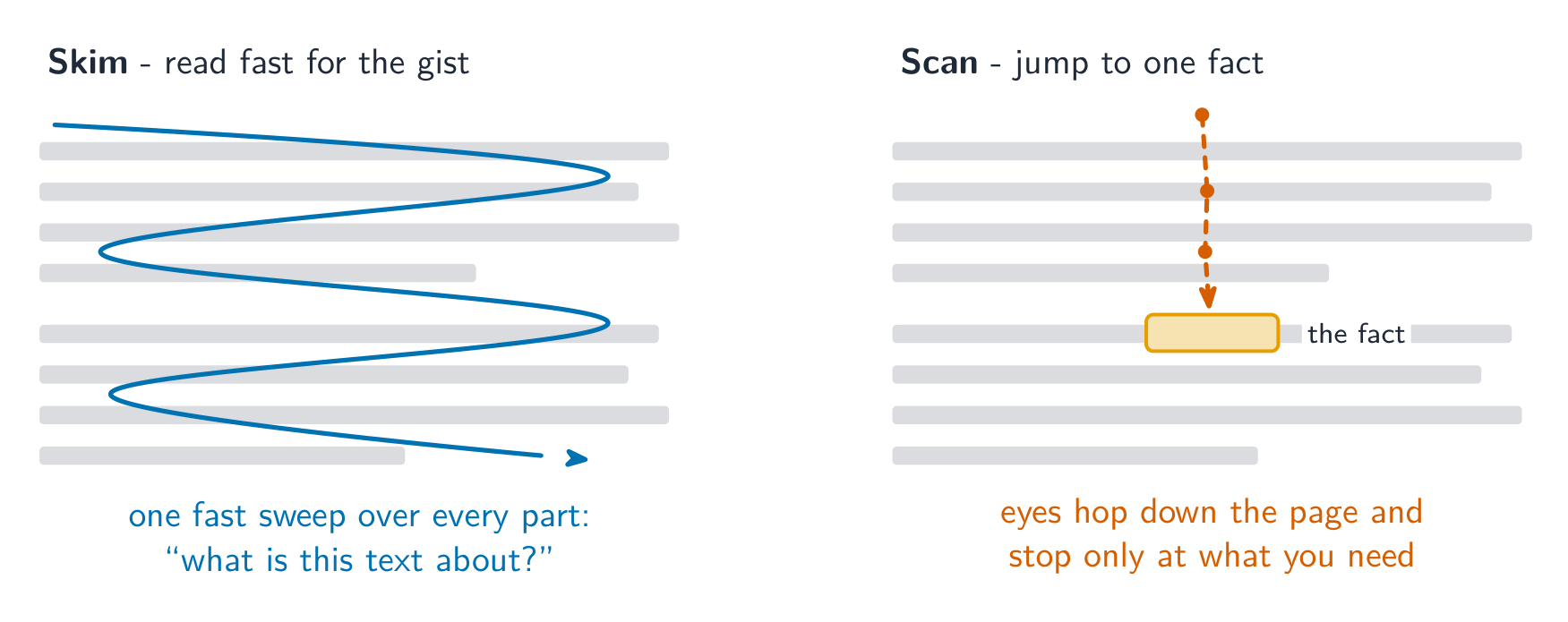
- First skim 略读 the text. Read it fast to get the gist 大意 — the general idea. Look at the title, the first line of each paragraph 段落, and any pictures.
- Then scan 扫读 to find one piece of information. Move your eyes quickly down the page. Do not read every word. Stop when you see what you need.
- Use scanning for facts like names, numbers, dates, times and places.
Skim sweeps over everything for the gist; scan jumps straight to one fact 
A departure board is a real text you scan: you do not read every line — you jump straight to the one flight time or gate you need Match the question to the text
- Read the question first. Decide what kind of answer it wants: a name? a number? a reason?
- Predict 预测 the answer before you look. This helps your eyes find it faster.
- Find the part of the text that talks about the same idea. The answer is usually there.
Write short, exact answers
- Here you write a single word or a short phrase 短语, not a full sentence.
- Copy the exact word from the text when you can.
- Answer only what the question asks. Extra words can lose the mark.
Vocabulary TrainEnglish skim/skɪm/ gist/dʒɪst/ paragraph/ˈpærəɡræf/ scan/skæn/ predict/prɪˈdɪkt/ phrase/freɪz/ 1.2
Connecting ideas across a text
Syllabus
- follow how ideas, opinions and attitudes in a text connect to one another
- match each question to the section or short text that contains the relevant idea (multiple matching)
- recognise words and phrases that signal time, cause and effect, addition and contrast
Source: Cambridge International syllabus
A long text is not just a list of facts. The ideas link to each other, and you must follow how.
Multiple matching
- In a multiple matching 多项匹配 task you read several short texts, or several parts of one text.
- Each question describes an idea. You choose the text or part that matches it.
- The words in the question are usually different from the words in the text. Look for the same meaning, not the same words. This is called a paraphrase 改写.
Signal words
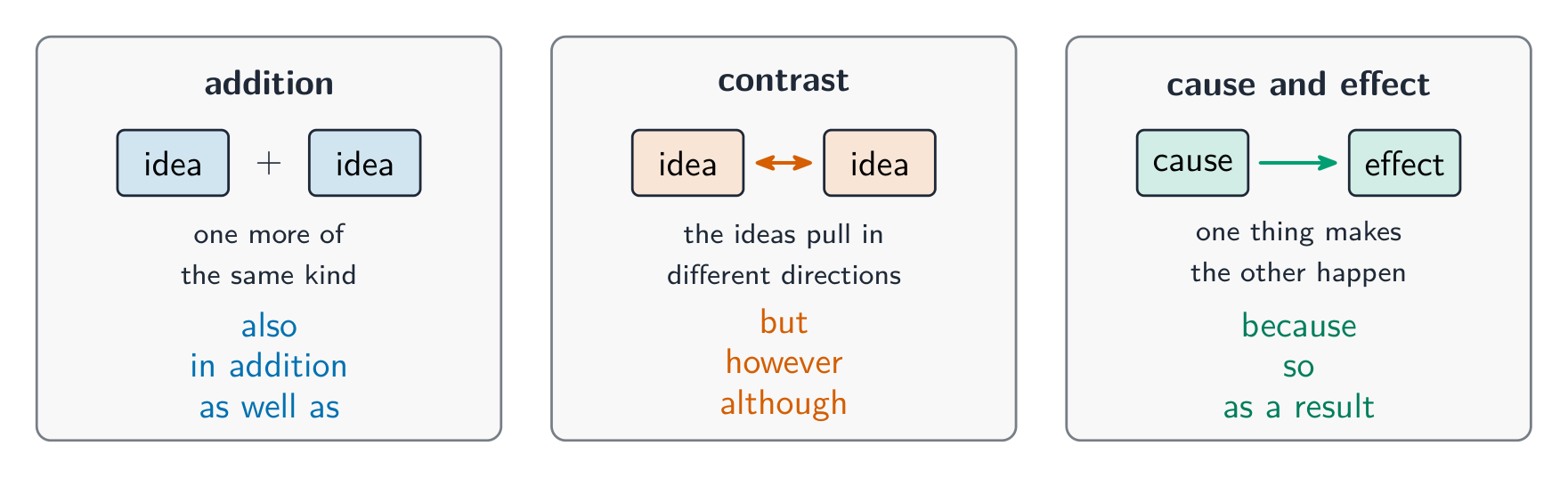
- Writers use small words to show how ideas connect. These are signal words 信号词.
- Some show addition 递进 (also, in addition, as well as). Some show contrast 对比 (but, however, although). Some show cause and effect 因果 (because, so, as a result).
- When you notice these words, you can see how the writer's ideas fit together.
The three signal-word families and what they do to ideas Vocabulary TrainEnglish multiple matching/ˈmʌltɪpl ˈmætʃɪŋ/ paraphrase/ˈpærəfreɪz/ signal words/ˈsɪɡnl wɜːdz/ addition/əˈdɪʃn/ contrast/ˈkɒntræst/ cause and effect/kɔːz ænd ɪˈfekt/ 1.3
Making notes and summaries
Syllabus
- select only the relevant points from a text for a given purpose
- complete a set of brief notes under headings, using short phrases rather than full sentences
- leave out examples and repetition, keeping just the key information
Source: Cambridge International syllabus
Sometimes you must take the main points out of a text and write them in a short form.
Note-making
- In a note-making 做笔记 task you complete notes under headings.
- Write short notes, not full sentences. A word or a short phrase is enough.
- Choose only the points that fit the heading. Leave out examples and extra detail.
Summary skills
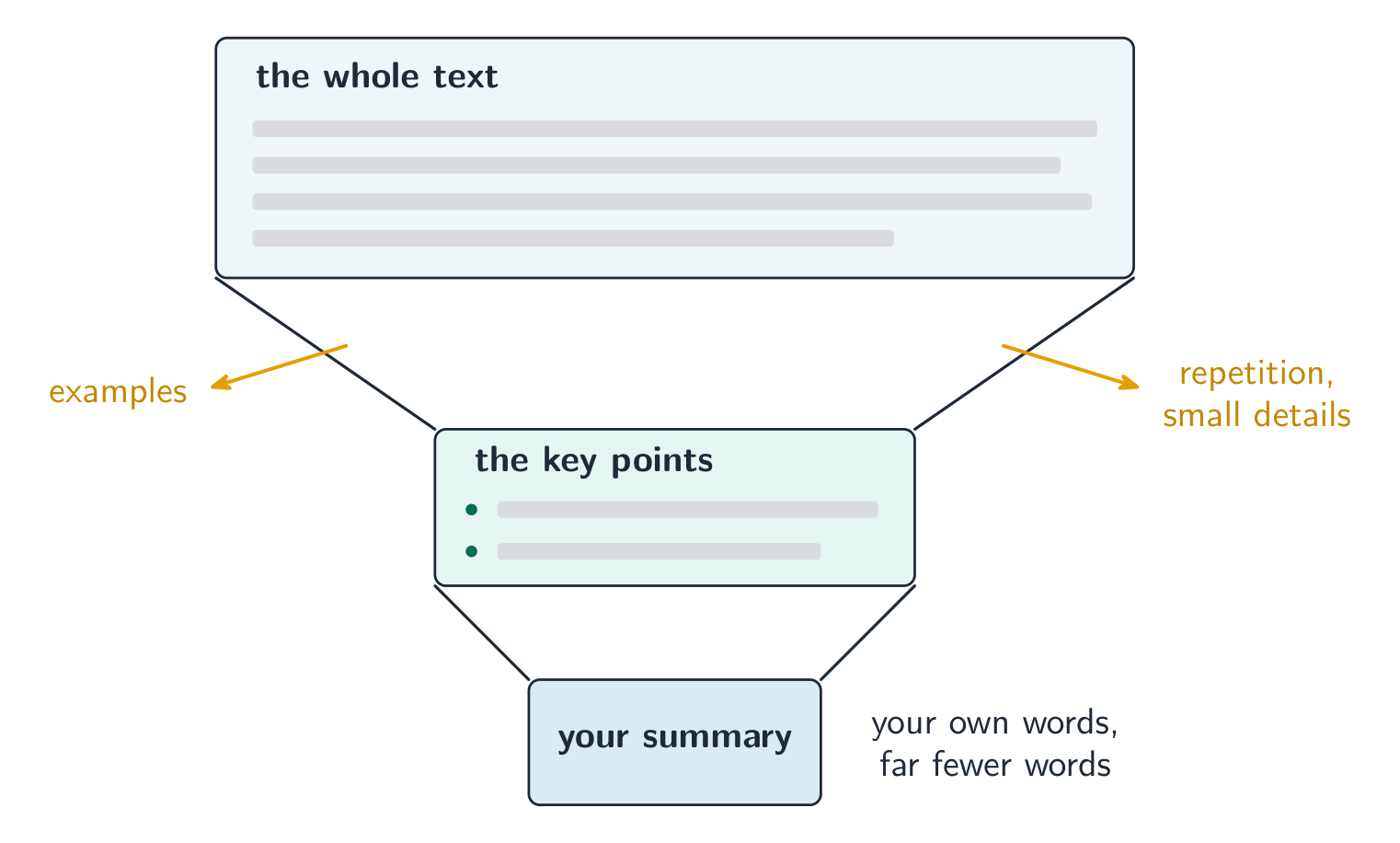
- A summary 概括 gives only the most important ideas, in fewer words.
- Find the key points. Ignore examples, repetition 重复 and small details.
- Use your own words where you can. Do not copy whole sentences.
A summary keeps only the key points, in your own words Vocabulary TrainEnglish note-making/nəʊt ˈmeɪkɪŋ/ summary/ˈsʌməri/ repetition/ˌrepəˈtɪʃn/ 1.4
Reading between the lines

Syllabus
- understand meaning that is implied but not directly stated
- work out a writer's opinion, attitude or feelings from the words and phrases they choose
- deduce the meaning of an unfamiliar word from the information around it
- answer multiple-choice questions about main ideas, details and attitudes
Source: Cambridge International syllabus
Reading closely: an inference answer comes from the words the writer chose, not from a sentence you can copy out Some answers are not written directly in the text. You must work them out. This is called inference 推断.
Implied meaning
- Sometimes the writer implies 暗示 something without saying it openly. The meaning is there, but it is hidden.
- Read the words around the idea. Ask: what does the writer want me to understand here?
The writer's attitude
- The writer's attitude 态度 is how they feel about the topic — for example, excited, worried, or unsure.
- You find the attitude in the writer's word choice 用词. Strong or emotional words show feelings.
- In a multiple-choice 选择题 question about attitude, read all the options. Choose the one that fits the whole text, not just one line.
Unfamiliar words
- You will meet words you do not know. Do not stop.
- Use the context 语境 — the words around it — to guess the meaning of the new word.
Vocabulary TrainEnglish inference/ˈɪnfərəns/ implies/ɪmˈplaɪz/ attitude/ˈætɪtjuːd/ word choice/wɜːd tʃɔɪs/ multiple-choice/ˈmʌltɪpl tʃɔɪs/ context/ˈkɒntekst/ 1.4
Exam tips
- Read the question before the text. Underline the key word: a name? a number? a reason?
- Answers usually come in the same order as the text, so do not hunt backwards for question 1.
- Copy the exact word from the text when you can; a changed word can lose the mark.
- Check how many answers the question wants: "Give TWO reasons" needs two, not one.
- In multiple matching, the text usually does not repeat the question's words. Hunt for the same idea said differently.
- Never leave an empty line. A guess can win a mark; a blank never can.
-
2
Writing: purpose, audience and accuracy
Watch lesson2.1
Purpose, audience and register

Syllabus
- identify the purpose of a piece of writing: to inform, to argue or to discuss
- think about the audience and how formal or informal the language should be
- choose a register and style that suit the purpose and the reader
Source: Cambridge International syllabus
Before you write, ask two questions: why am I writing, and who will read it?
Know your purpose
- Every writing task has a purpose 目的: to inform 告知, to argue 论证, or to discuss 讨论.
- The purpose decides what you write and how you write it.
- The task tells you the purpose. Read it carefully and underline it.
Know your audience
- The audience 读者 is the person who will read your writing — a friend, a teacher, or an event organiser.
- Write in a way that suits them. You write to a friend in a different way from a teacher.
Choose the right register
- Register 语域 means how formal 正式 or informal 非正式 your language is.
- Use informal language for a friend: short forms (I'm, don't) and friendly words.
- Use formal language for a teacher or a report: full forms (I am, do not) and polite words. No slang 俚语.
Purpose and audience together decide how formal your writing should be 
Writing at a desk: decide purpose and audience before you organise ideas on the page Vocabulary TrainEnglish purpose/ˈpɜːpəs/ inform/ɪnˈfɔːm/ argue/ˈɑːɡjuː/ discuss/dɪˈskʌs/ audience/ˈɔːdɪəns/ register/ˈredʒɪstə/ formal/ˈfɔːml/ informal/ɪnˈfɔːml/ slang/slæŋ/ 2.2
Organising your ideas
Syllabus
- plan what to include and the order in which to present it
- organise writing into clear paragraphs with a logical structure
- link ideas using devices for addition (in addition, moreover), contrast (however, although) and cause/effect (therefore, as a result)
Source: Cambridge International syllabus
Good writing is not just correct. It is also easy to follow.
Plan before you write
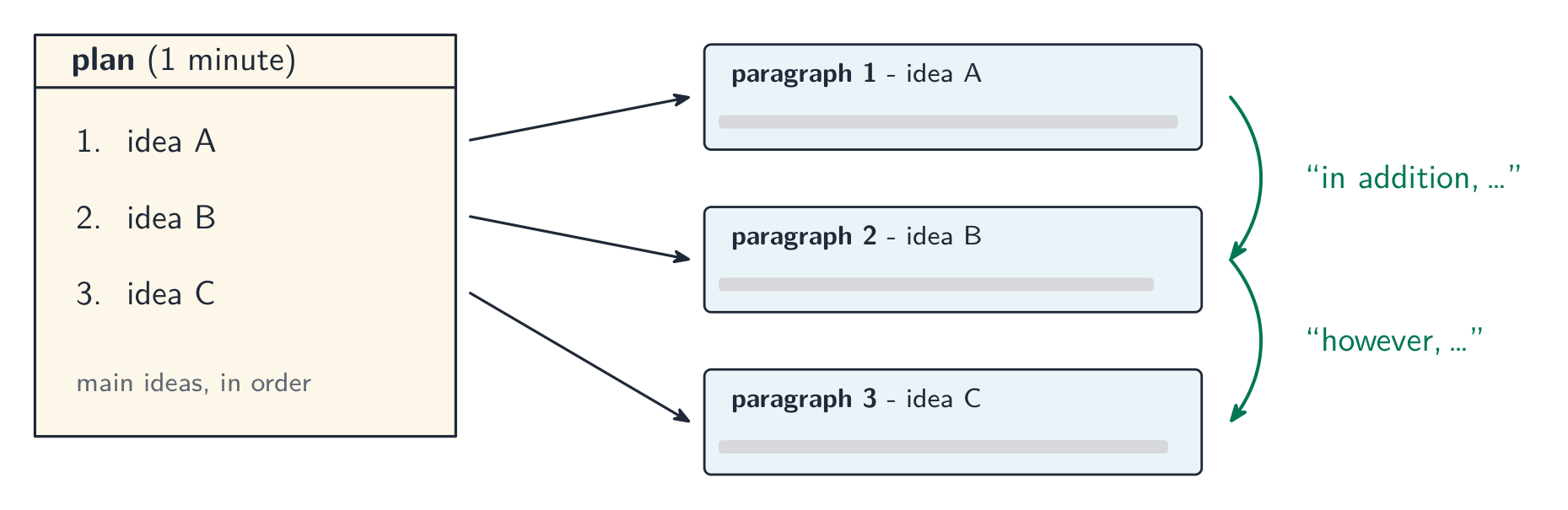
- Spend one minute on a plan 计划. Write down your main ideas and put them in order.
- A plan stops you from forgetting a point or repeating yourself.
A one-minute plan becomes your paragraphs: one idea each, joined by linking words Use paragraphs
- Put each main idea in its own paragraph 段落.
- Start a new paragraph for a new idea. This makes your writing clear.
Link your ideas
- Use linking words 衔接词 to join your ideas smoothly.
- For adding: in addition, also, as well as. For contrast: however, but, although. For results: so, therefore, as a result.
Vocabulary TrainEnglish plan/plæn/ paragraph/ˈpærəɡræf/ linking words/ˈlɪŋkɪŋ wɜːdz/ 2.3
Accuracy: grammar, vocabulary and checking
Syllabus
- use a range of grammatical structures: different verb forms and tenses, conditionals and varied sentence types
- use a range of vocabulary, including set phrases, collocations and synonyms to avoid repetition
- check your writing for accuracy in grammar, spelling and punctuation
Source: Cambridge International syllabus
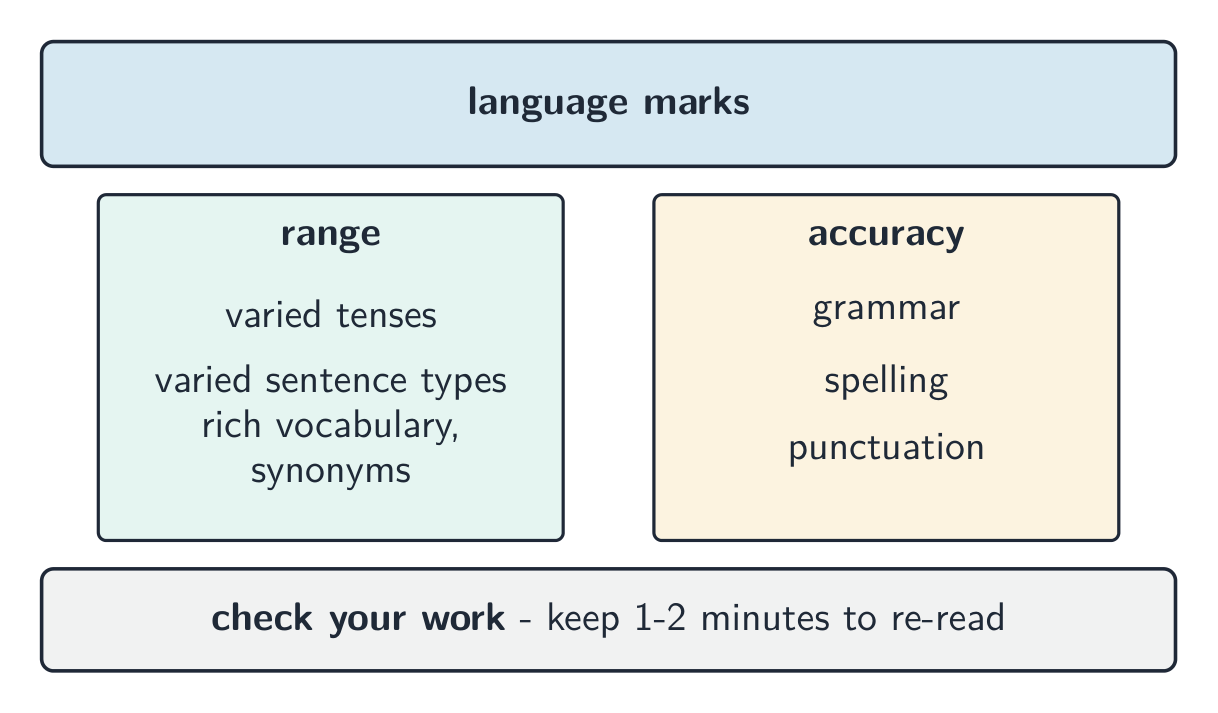
Language marks come from range 多样性 and accuracy 准确性.
Language marks rest on two pillars: range and accuracy Show a range
- Use different tenses 时态 and sentence types. Do not write every sentence the same way.
- Use a range of vocabulary 词汇. Choose a better word than the easy one, and use synonyms 同义词 to avoid repeating yourself.
Be accurate
- Check your grammar 语法, spelling 拼写 and punctuation 标点.
- Common errors are subject–verb agreement, verb tenses, and missing capital letters.
Check your work
- Leave one or two minutes to read your work again.
- Look for small mistakes you can fix quickly. Checking can save several marks.
Vocabulary TrainEnglish range/reɪndʒ/ accuracy/ˈækjʊrəsi/ tenses/ˈtensɪz/ vocabulary/vəʊˈkæbjʊləri/ synonyms/ˈsɪnənɪmz/ grammar/ˈɡræmə/ spelling/ˈspelɪŋ/ punctuation/ˌpʌŋktʃuːˈeɪʃn/ 2.3
Exam tips
- Before you write, say your job in one line: "an informal email to a friend, to invite him to a picnic".
- Cover every content point in the task. Examiners tick each point; a missing one costs marks at once.
- Learn what 120 to 160 words of your handwriting looks like, so you never count in the exam.
- Save the last five minutes to check your usual errors: verb -s, past forms, a / an / the.
- A short correct sentence beats a long broken one every time.
-
3
Writing an informal email
Watch lesson3.1
Why and to whom you write

Syllabus
- recognise that an informal email is written to a friend or relative
- respond to all of the prompts given in the task
- use a friendly, personal tone that suits the reader
Source: Cambridge International syllabus
The first writing task asks you to write an informal email 非正式电子邮件 to a friend or a family member.
Cover every prompt
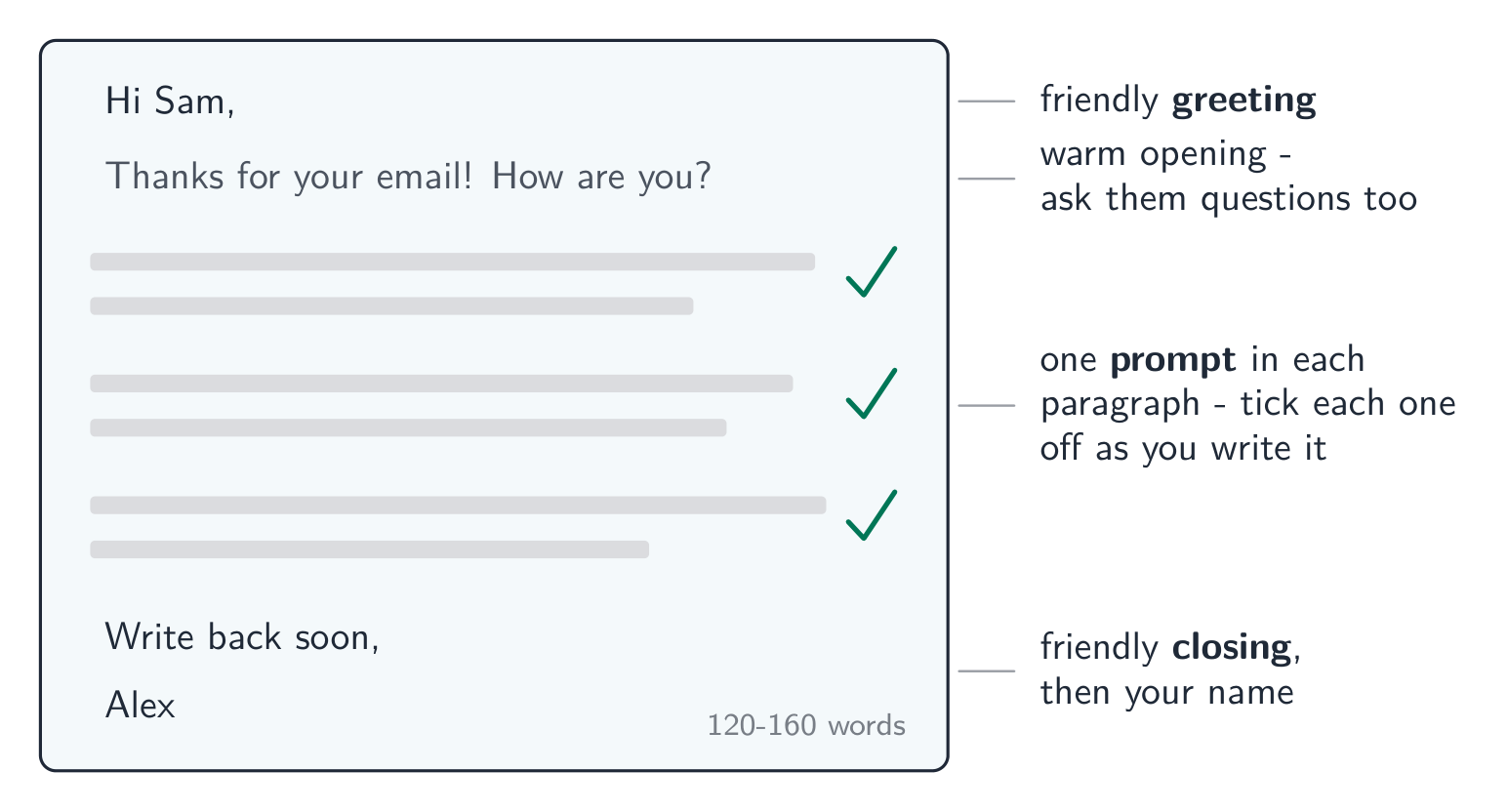
- The task gives you some prompts 提示 — short points you must write about.
- You must cover every prompt. If you miss one, you lose content marks.
- Tick each prompt as you write it, so you do not forget one.
Use a friendly tone
- An email to a friend is informal 非正式. Use a warm, friendly tone 语气.
- Write as if you are talking to the person. Ask them questions too.
This is who the email is for: someone who already knows you, so write the way you would talk to them 
Writing on a laptop: informal emails still need a clear purpose, order and friendly tone Vocabulary TrainEnglish informal email/ɪnˈfɔːml ˈiːmeɪl/ prompts/prɒmpts/ informal/ɪnˈfɔːml/ tone/təʊn/ 3.2
How to build your email
Syllabus
- open and close an informal email appropriately (for example: Hi … / Write back soon …)
- organise the email into short paragraphs, with one main idea per paragraph
- use informal language: contractions, friendly phrases and questions to the reader
Source: Cambridge International syllabus
A good email has a clear shape.
The shape of a good informal email Greeting and ending
- Start with a greeting 问候语: Hi Sam, or Dear Anna,
- End with a friendly closing 结束语: Write back soon, or See you soon, then your name.
Paragraphs
- Use short paragraphs 段落. Put one main idea in each one.
- Do not write one long block of text.
Useful language
- Informal language uses short forms 缩略形式: I'm, don't, can't.
- Friendly phrases help: Guess what! / How are you? / I can't wait to…
Vocabulary TrainEnglish greeting/ˈɡriːtɪŋ/ closing/ˈkləʊzɪŋ/ paragraphs/ˈpærəɡræfz/ short forms/ʃɔːt fɔːmz/ 3.3
Making your email better
Syllabus
- develop each idea with a reason, example or detail rather than just listing points
- vary your sentence openings and link ideas smoothly
- check the length (120–160 words), the tone and the accuracy before finishing
Source: Cambridge International syllabus
Content marks reward developed 展开的 ideas, not a list.
Develop your ideas
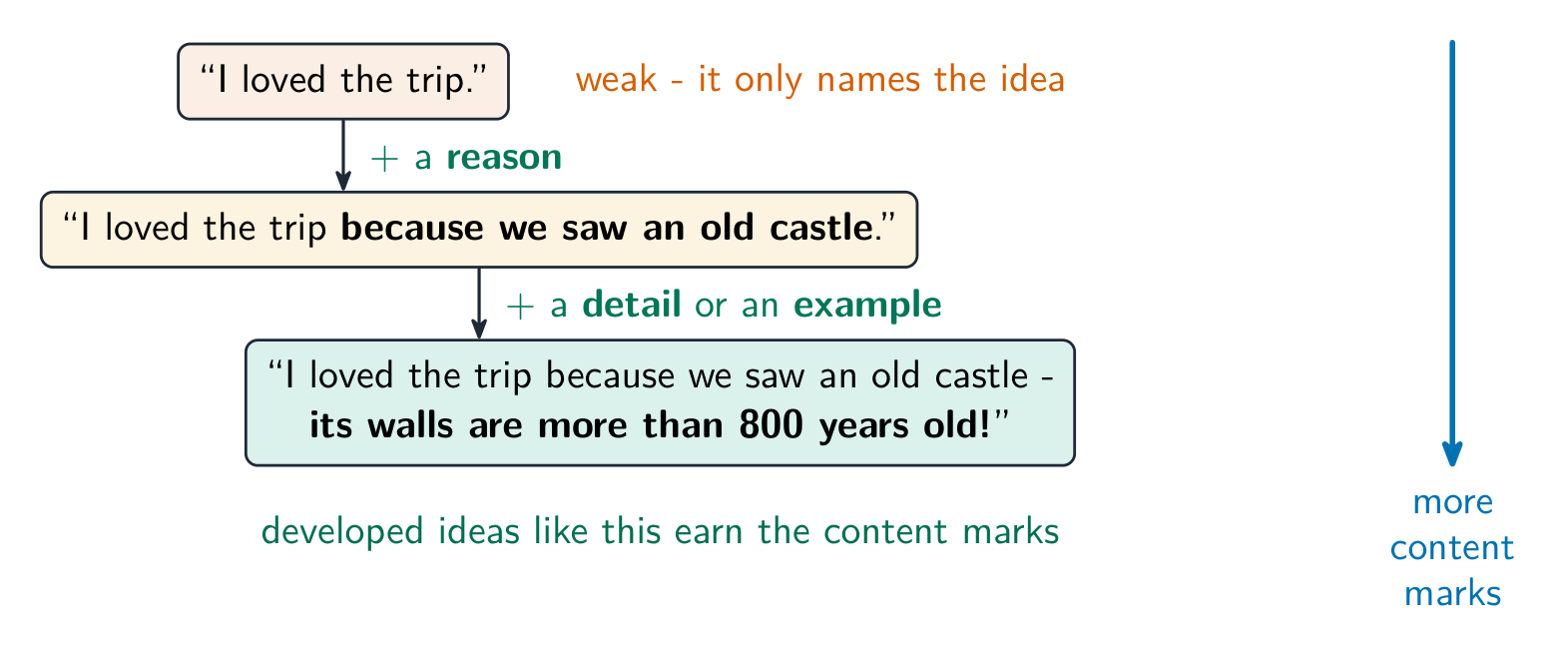
- Do not just name an idea. Add a reason 原因, an example 例子, or a detail 细节.
- "I loved the trip" is weak. "I loved the trip because we saw an old castle" is much better.
Each extra reason or detail makes the idea stronger Check before you finish
- Count your words: aim for 120 to 160 words.
- Check the tone is friendly, then fix small grammar and spelling mistakes.
A model email
See how the friendly tone and developed ideas work together.
Hi Sam,
Guess what — I finally visited the new science museum you told me about! I loved it, especially the space room, because you can sit in a real rocket seat and feel it shake. I went with my cousin, and we stayed until it closed.
How about you? Have you been yet? We really should go together in the summer.
Write back soon, Lin
Notice the warm greeting, one developed idea with a reason, a question back to Sam, and a friendly closing. It reads like a real message to a friend — and it covers every prompt.
Vocabulary TrainEnglish developed/dɪˈveləpt/ reason/ˈriːzn/ example/eɡˈzæmpl/ detail/ˈdiːteɪl/ 3.3
Exam tips
- Open warmly: "Thanks for your email!" or "Great to hear from you!" sets the informal tone at once.
- Use short forms (I'm, don't, can't). They are correct here and make you sound like a friend.
- Give each prompt in the task its own short paragraph, and add one detail or reason to each.
- Close like a friend: "Write back soon," plus your first name only, never a full name.
- Keep the style informal from the first line to the last; one "Dear Sir" in the middle breaks the whole email.
-
4
Writing a formal letter or email
Watch lesson4.1
When to write formally

Syllabus
- recognise when a task needs a formal or semi-formal response (for example, to a teacher or an event organiser)
- cover the purpose, format and audience information given in the task
- keep a polite, formal tone throughout
Source: Cambridge International syllabus
The second writing task sometimes asks for a formal 正式 or semi-formal 半正式 letter or email.
Spot a formal task
- A formal task is written to someone you do not know well — a head teacher 校长, a manager 经理, or an event organiser 活动组织者.
- The task tells you the format 格式, the purpose 目的 and the reader. Use all three.
A formal letter is read at a desk like this — by someone who does not know you, and who is busy Keep a polite tone
- Be polite 礼貌 and respectful. Do not use slang 俚语 or jokes.
- Do not use short forms. Write "I am", not "I'm".
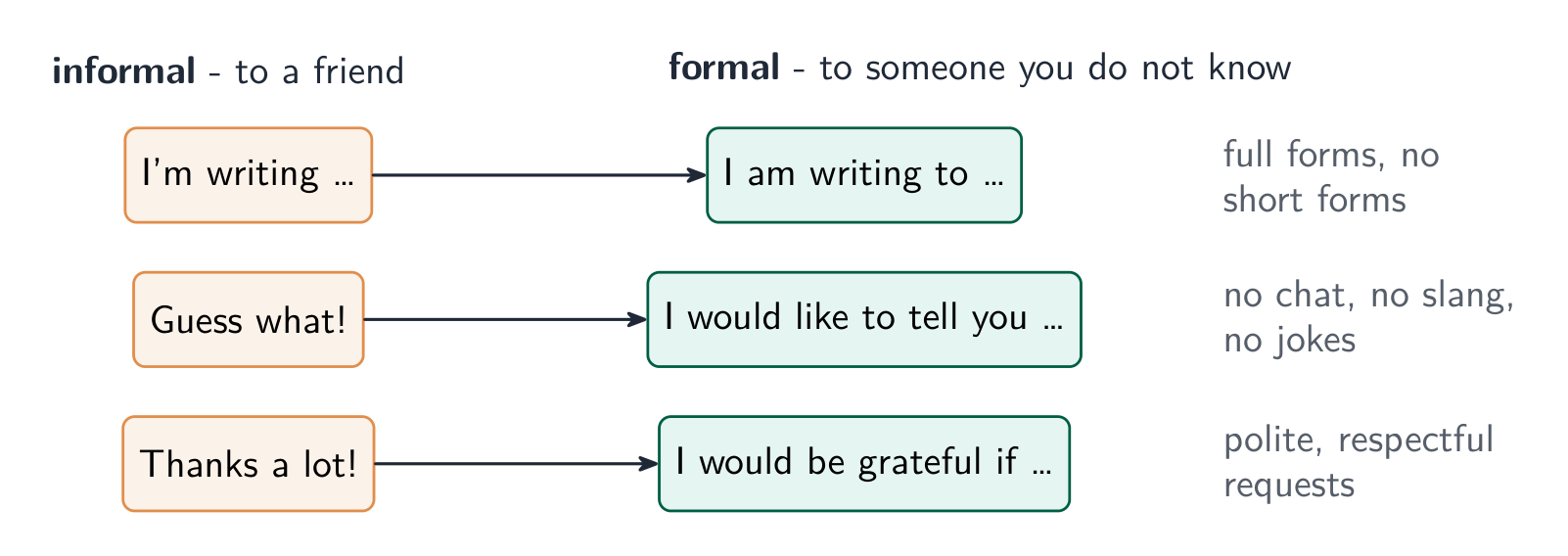
Turning friendly phrases into formal ones 
A formal letter: careful structure, polite register and a clear reason for writing Vocabulary TrainEnglish formal/ˈfɔːml/ semi-formal/ˈsemi ˈfɔːml/ head teacher/hed ˈtiːtʃə/ manager/ˈmænɪdʒə/ event organiser/ɪˈvent ˈɔːɡənaɪzə/ format/ˈfɔːmæt/ purpose/ˈpɜːpəs/ polite/pəˈlaɪt/ slang/slæŋ/ 4.2
Building a formal letter or email
Syllabus
- open and close a formal letter or email appropriately (for example: Dear … / Yours sincerely …)
- organise your points into clear paragraphs with a beginning, middle and end
- use formal language and avoid contractions and slang
Source: Cambridge International syllabus
A formal letter follows a clear order.
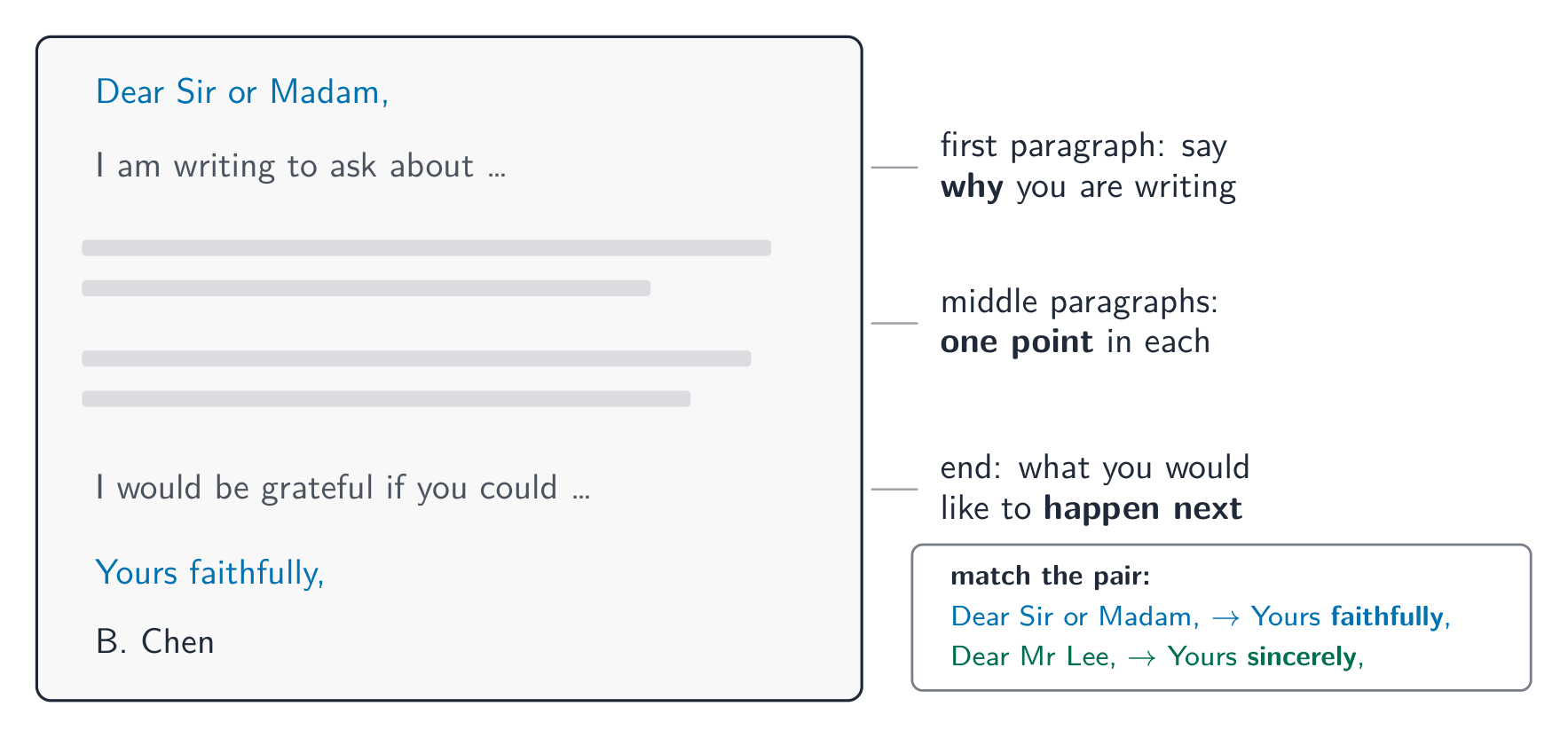
The shape of a formal letter - and the greeting decides the sign-off Opening and closing
- Open with Dear Sir/Madam, or Dear Mr Lee,
- If you start with a name, close with Yours sincerely,. If you start with Sir/Madam, close with Yours faithfully,.
Clear paragraphs
- First paragraph: say why you are writing.
- Middle paragraphs: give your points, one idea in each.
- Last paragraph: say what you would like to happen next.
Formal language
- Use formal phrases: I would like to…, I am writing to…, I would be grateful 感激 if…
- Keep sentences clear and complete. Check your grammar and spelling.
A model formal letter
See how a polite, complete opening sets the right tone.
Dear Sir or Madam,
I am writing to suggest an improvement to the town library. At present it closes at five o'clock, which is too early for students who finish school at four. I would be grateful if the council could consider opening it until seven in the evening on weekdays.
Thank you for taking the time to read my letter.
Yours faithfully, J. Chen
Notice the Dear Sir or Madam / Yours faithfully pair, the clear first line stating the purpose, the polite request, and the complete sentences with no short forms.
Vocabulary TrainEnglish grateful/ˈɡreɪtfl/ 4.2
Exam tips
- Match the greeting to the ending: Dear Mr Lee → Yours sincerely; Dear Sir or Madam → Yours faithfully.
- Say why you are writing in the first line: "I am writing to apply for…" saves words and sounds formal.
- Do not use short forms: write "I am" and "do not", never "I'm" or "don't".
- One paragraph per point, and end by naming the action you hope for: "I would be grateful if…".
- Stay polite even in a complaint: "I was disappointed to find…" wins marks; "This is terrible!" loses the tone.
-
5
Writing a report
Watch lesson5.1
What a report is for

Syllabus
- recognise that a report is written for a superior or a group about an event, experience or situation
- give factual information clearly and add suggestions or recommendations
- use a neutral, factual tone
Source: Cambridge International syllabus
A report 报告 gives information to a person in charge — a teacher, a manager, or a club leader. They will act 行动 on what you write, so be clear and honest.
Purpose and reader
- A report describes an event 事件, an experience, or a situation 情况.
- It gives facts 事实 clearly, then adds suggestions.
- The reader wants useful information, not a story. Keep the tone factual 事实性的 and clear.
A report gives facts the reader can use, not a story Format
- A report is usually semi-formal or formal.
- A title at the top tells the reader what the report is about.
A formal discussion: reports give clear facts so decision-makers can act on them 
A report organises facts for a clear purpose and a defined reader Vocabulary TrainEnglish report/rɪˈpɔːt/ act/ækt/ event/ɪˈvent/ situation/ˌsɪtʃuːˈeɪʃn/ facts/fækts/ factual/ˈfæktʃuːəl/ 5.2
How to organise a report
Syllabus
- organise a report using short headings or clearly separated sections
- separate facts from your own opinions and recommendations
- end with a clear recommendation or conclusion
Source: Cambridge International syllabus
A clear shape helps the reader find information fast.
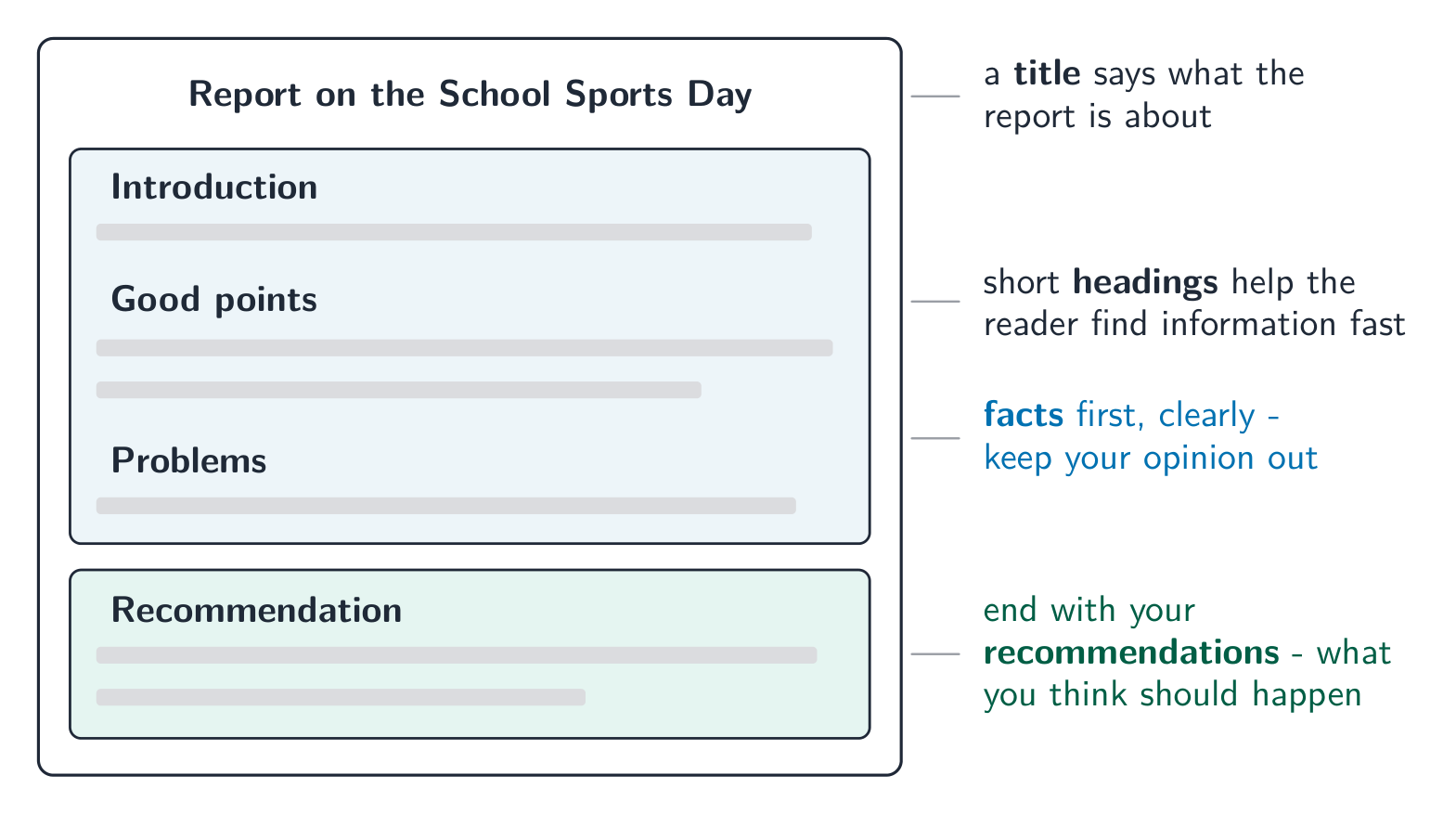
The shape of a report: facts under clear headings, recommendations at the end Use headings
- Break the report into sections with short headings 小标题.
- For example: Introduction, Good points, Problems, Recommendation.
Facts, then recommendations
- First give the facts. Keep your opinion 观点 out of this part.
- Then give your recommendations 建议 — what you think should happen.
End clearly
- Finish with a clear recommendation or conclusion 结论.
- Make your advice easy to follow.
Useful language
Keep a few report phrases 短语 ready. They make your writing sound organised and grown-up.
- To introduce: The aim 目的 of this report is to… / This report looks at…
- To give facts: At present… / The main problem is… / Many students felt that…
- To recommend: I recommend that… / It would help if… / The best solution 解决办法 is to…
Notice these are calm and impersonal. A report avoids strong words like "amazing" or "terrible".
A model report extract
Read how facts and a recommendation sit under clear headings.
Introduction This report looks at the school library and suggests ways to improve it.
Good points The library is quiet, and it has a wide range of science books. It opens every day after school.
Problems There are only two computers, and every table is full by four o'clock.
Recommendation The school should add five computers and open a second study room in the evening.
Each section is short. The first three give only facts; the last gives the advice. That split is what makes it a report, not a story.
Vocabulary TrainEnglish headings/ˈhedɪŋz/ opinion/əˈpɪnɪən/ recommendations/ˌrekəmenˈdeɪʃnz/ conclusion/kənˈkluːʒn/ phrases/ˈfreɪzɪz/ aim/eɪm/ solution/səˈluːʃn/ 5.2
Exam tips
- Start with To / From / Subject or a clear title. A report never opens with "Dear…".
- Use the introduction to say what the report covers and why, in one or two lines.
- Group the facts under short headings, and keep your opinion out of the findings.
- Save opinions for the end: one clear recommendation, "I recommend…" plus one action.
- Keep the style neutral and calm: no exclamation marks, no jokes, no chat.
-
6
Writing an article
Watch lesson6.1
What an article is for

Syllabus
- recognise that an article is written for a general audience to inform or entertain
- choose a title and an opening that catch the reader's interest
- keep the reader engaged with questions, examples and a clear point of view
Source: Cambridge International syllabus
A newsstand: every one of these is competing for the same reader, which is why an article has to open with a hook An article 文章 is written for a magazine, a newspaper, or a website. Many people read it.
Purpose
- An article informs 告知 or entertains 娱乐 a general reader.
- You usually give your own view on a topic, with reasons.
Engage the reader
- You must engage 吸引 the reader — make them want to keep reading.
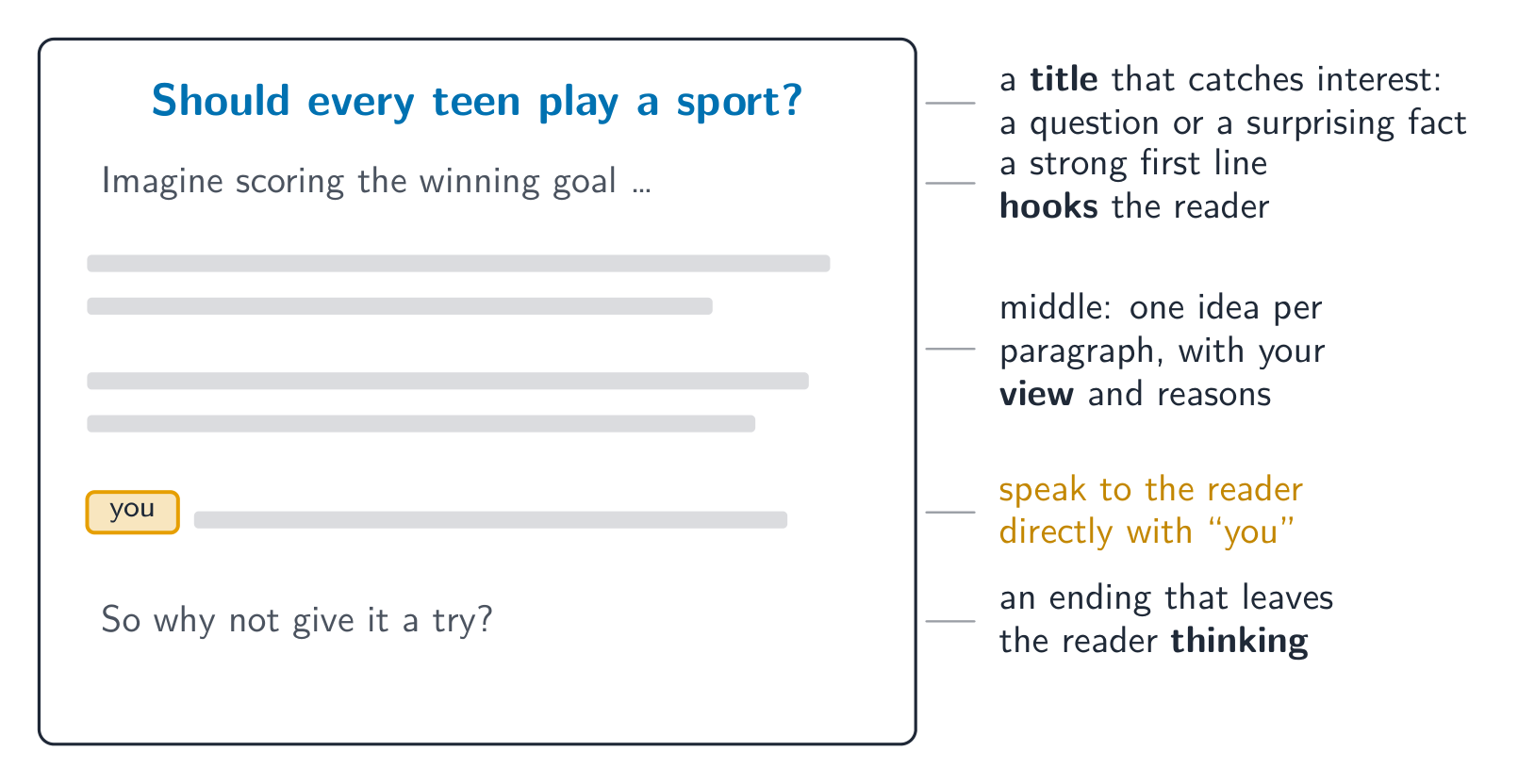
- A good title 标题 and a strong first line catch their interest 兴趣.
- Ask the reader a question, or start with a surprising fact.
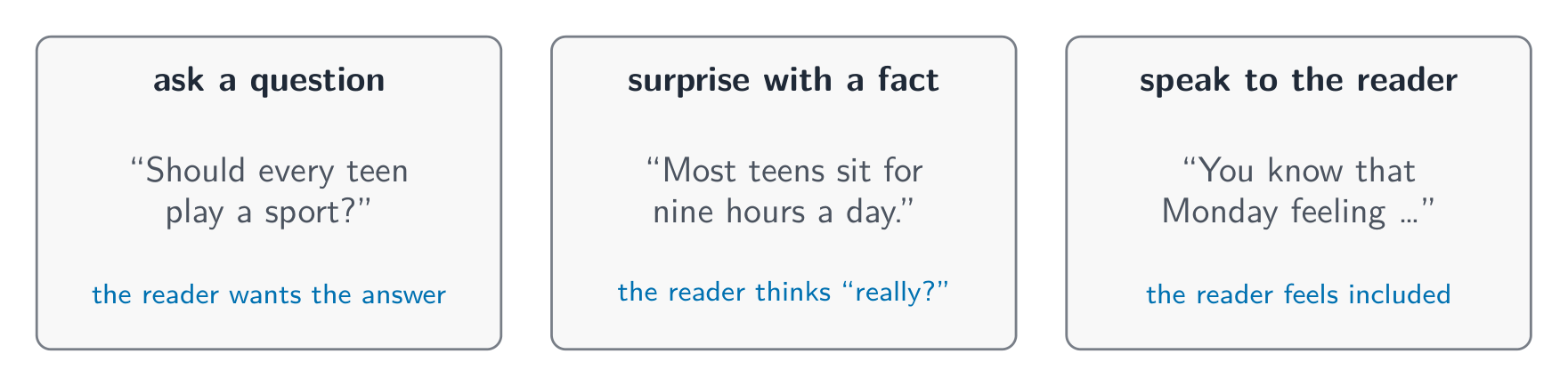
Three ways to catch the reader's interest in your first lines 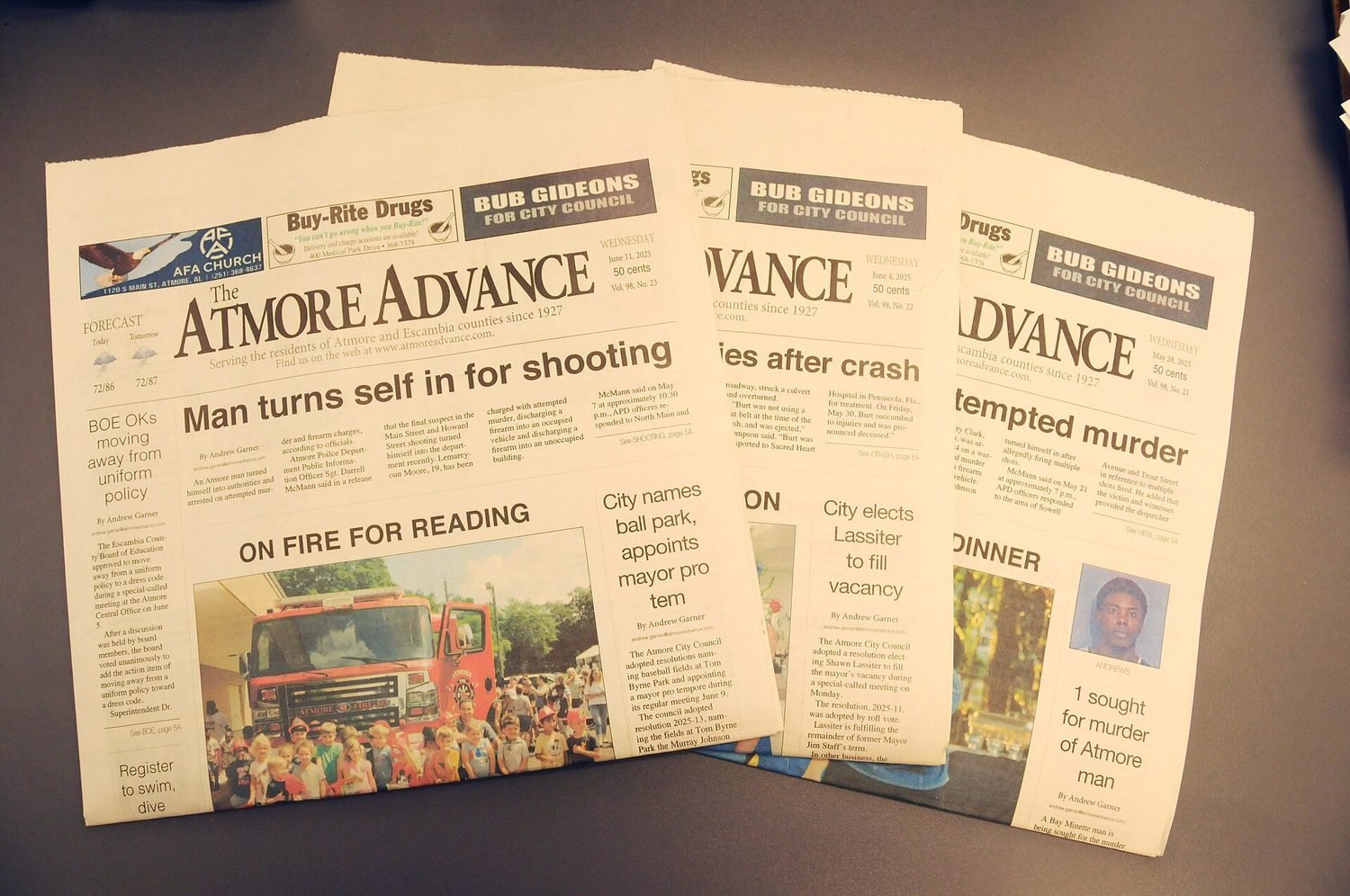
A newspaper front page: articles hook the reader, then inform and entertain with a clear angle Vocabulary TrainEnglish article/ˈɑːtɪkl/ informs/ɪnˈfɔːmz/ entertains/ˌentəˈteɪnz/ engage/enˈɡeɪdʒ/ title/ˈtaɪtl/ interest/ˈɪntrest/ 6.2
Writing a lively article
Syllabus
- organise the article into an introduction, development and conclusion
- use lively, varied language and a consistent tone
- address the reader directly where it suits the topic
Source: Cambridge International syllabus
An article should sound interesting, not flat.
The shape of a lively article: hook the reader, keep them, leave them thinking Structure
- Begin with an introduction 引言 that names the topic.
- Develop your points in the middle, one idea in each paragraph.
- End with a short conclusion 结论 that leaves the reader thinking.
Lively language
- Use varied 多样的 words and sentence lengths to keep the energy up.
- You can speak to the reader directly with "you".
- Keep the tone friendly, but not too casual.
Useful language
A few flexible phrases 短语 let you hook the reader and glide between ideas.
- To open with energy: Have you ever…? / Imagine you… / Last week, something odd happened to me.
- To move between ideas: What's more… / On the other hand… / The truth is…
- To speak to the reader: You might think… / We all know that… / Be honest —…
- To end memorably: So next time you… / Perhaps the real question is…
Vary how you open sentences. Ten sentences that all begin "I think" feel flat 平淡; mixing your openings keeps the reader awake.
A model opening
See how one opening hooks the reader, then points forward.
Have you ever tried to sleep with a phone glowing beside your pillow? Most of us have — and most of us wake up tired. This article asks a simple question: could a good night's sleep be the cheapest way to feel happier?
The question pulls the reader in, the honest detail keeps them, and the last line promises where the article is going. That is a lot of work for three sentences.
Vocabulary TrainEnglish introduction/ˌɪntrəˈdʌkʃn/ conclusion/kənˈkluːʒn/ varied/ˈveərid/ phrases/ˈfreɪzɪz/ flat/flæt/ 6.2
Exam tips
- Give the article a short, catchy title, then hook the reader with a question or surprise in the first lines.
- Talk to the reader: "Have you ever…?" An article is the one formal task where personality wins marks.
- One idea per paragraph, and make it real with a short example or a small story.
- Numbers and small facts make an article feel true: "three out of five students…".
- End with a line the reader remembers: a punchline, a question, or a call to act.
-
7
Writing a review
Watch lesson7.1
What a review does

Syllabus
- recognise that a review describes something you have experienced (a film, place or product) and gives your opinion
- balance description with personal opinion and reasons
- write for a general audience, for example of a magazine or website
Source: Cambridge International syllabus
A review 评论 tells readers about something you have tried — a film, a book, a restaurant, or a place. A good review helps the reader decide 决定 whether to try it too.
Describe and judge
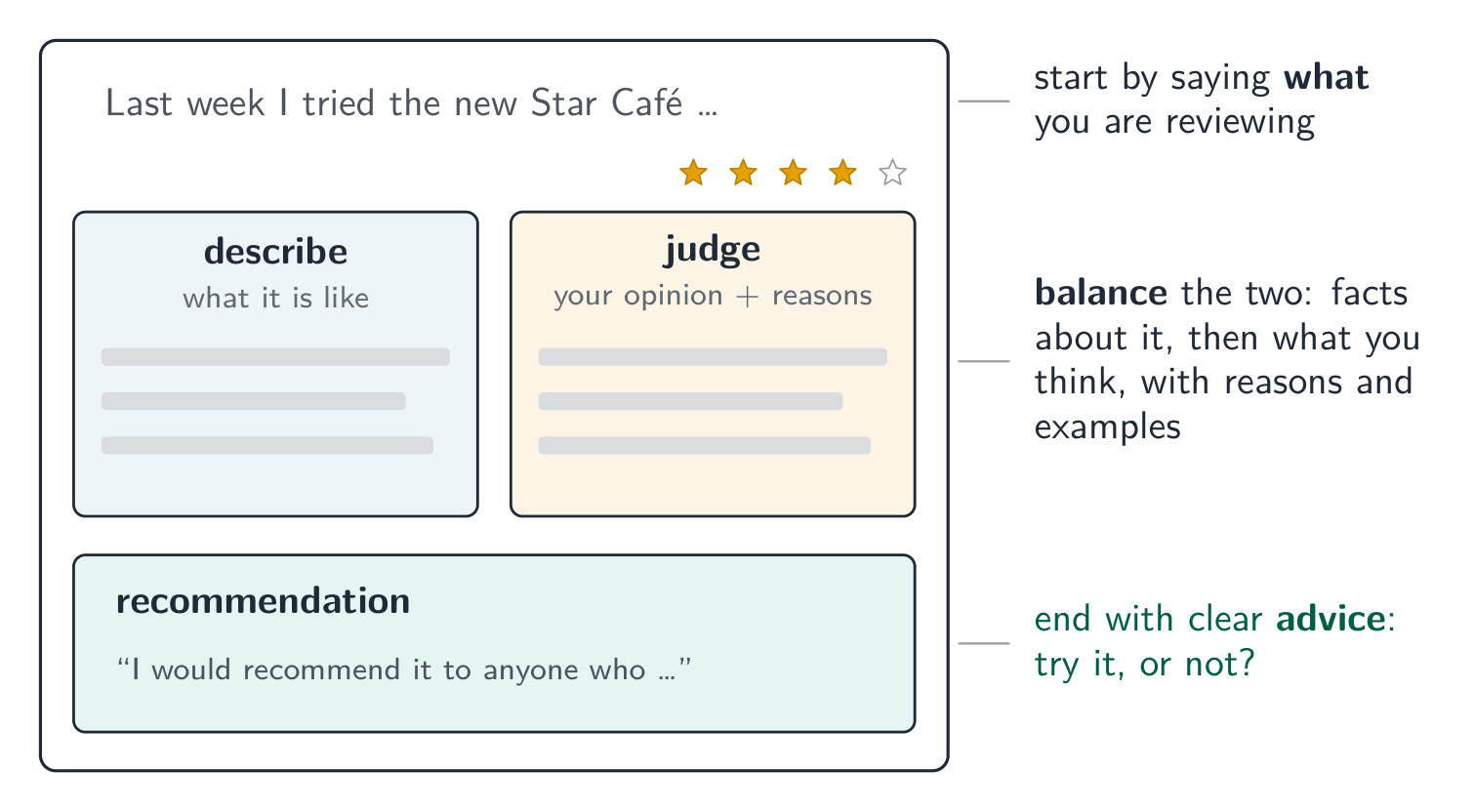
- A review does two things: it describes 描述 the thing, and it gives your opinion 观点 of it.
- Balance the two. Do not only describe, and do not only give opinions.
- Describing answers "What is it like?" Judging answers "Is it any good?" Move between the two, sentence by sentence.
An opinion stands on a reason and an example Support your opinions
- Give reasons for what you think. Say why it was good or bad.
- Use examples 例子 from your experience to make your view believable 可信.
- A weak review says "The food was nice." A strong review says "The soup was rich and warming, though the rice arrived cold." The detail is what convinces the reader.
Useful language
Learn a few phrases 短语 for each job. Then you never stare at a blank page.
- To describe: It is set in… / The story follows… / The dish combines… / What stands out is…
- To praise: The best part is… / I was impressed by… / It really succeeds in…
- To criticise 批评 (gently): The one weakness is… / It could have been better if… / At times it feels slow.
- To recommend: I would recommend it to… / It is well worth… / Don't miss…
Mix praise and criticism so the review sounds fair 公正. A review that is all praise, or all complaint, is hard to trust.

A theatre audience: reviews describe what you saw, give a clear opinion and support it with evidence Vocabulary TrainEnglish review/rɪˈvjuː/ decide/dɪˈsaɪd/ describes/dɪˈskraɪbz/ opinion/əˈpɪnɪən/ examples/eɡˈzæmplz/ believable/bɪˈliːvəbl/ phrases/ˈfreɪzɪz/ criticise/ˈkrɪtɪsaɪz/ fair/feə/ 7.2
How to build a review
Syllabus
- introduce what is being reviewed, then describe and evaluate it
- support your opinions with specific details and examples
- end with a clear recommendation to the reader
Source: Cambridge International syllabus
Readers want a clear, helpful review.
A review describes and judges, then ends with clear advice Structure
- Start by saying what you are reviewing, and give the reader the basic facts.
- In the middle, describe it and evaluate 评价 it — the good points and the weak points.
- Write for a general reader, in a friendly but clear tone 语气.
End with a recommendation
- Finish with a recommendation 建议: do you advise the reader to try it or not?
- Make your advice clear, for example: "I would recommend this film to anyone who likes adventure."
- You can add a condition: "…as long as you don't mind a slow start." This sounds honest and grown-up.
A model review
Read this short review of a film. Notice how each sentence either describes or judges.
Skyward is an adventure film about a girl who builds her own aircraft. The story is simple, but the flying scenes are breathtaking 惊人 and the young lead acts with real warmth. The middle drags a little, and a few jokes fall flat. Even so, it left the whole cinema smiling. I would recommend Skyward to any family looking for a bright, hopeful evening — just be ready for a slow first ten minutes.
Count the moves: it names the film, describes it, praises it, admits two faults, and ends with a clear, honest recommendation. That is a complete review in five sentences.

A restaurant interior: say what it is, describe it, judge the good and the weak, then recommend Vocabulary TrainEnglish evaluate/ɪˈvæljuːeɪt/ tone/təʊn/ recommendation/ˌrekəmenˈdeɪʃn/ breathtaking/ˈbreθteɪkɪŋ/ 7.2
Exam tips
- Name what you are reviewing and your overall feeling in the first paragraph; do not keep it secret.
- Do both jobs: describe it (what it is) and judge it (what is strong, what is weak).
- Strong adjectives are the fuel of a review: gripping, delicious, disappointing, unforgettable.
- Mention one weakness even in a good review; pure praise sounds like an advert.
- Finish with a clear recommendation: who should try it, who should not, and why.
-
8
Writing an essay
Watch lesson8.1
Two kinds of essay
Syllabus
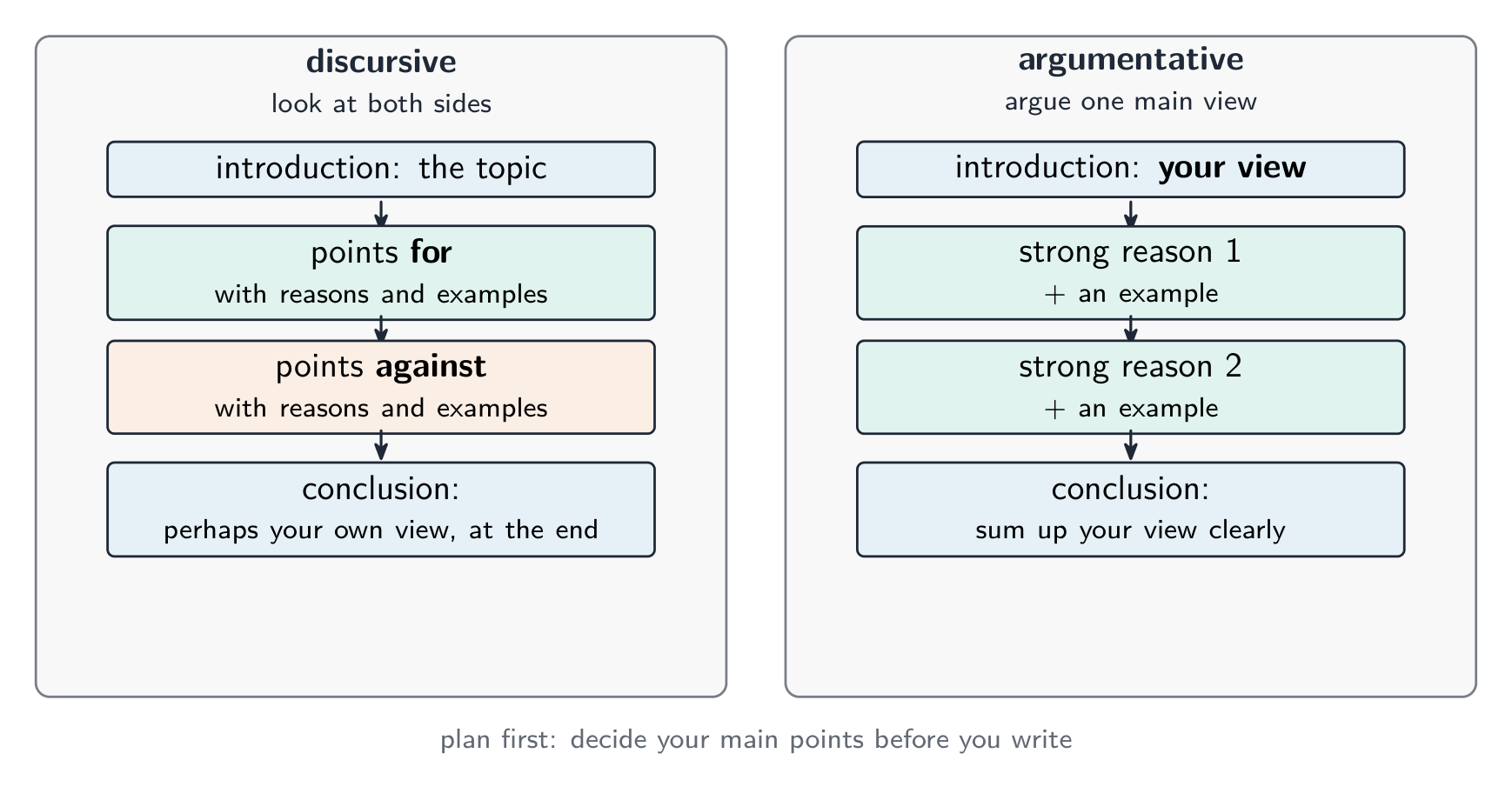
- tell the difference between a discursive essay (balanced, both sides) and an argumentative essay (one main view)
- plan the main points and the reasons or evidence for each
- keep a formal, organised style
Source: Cambridge International syllabus
An essay 议论文 gives your ideas about a topic in an organised way.
Two essay shapes: discursive weighs both sides; argumentative argues one view Discursive essays
- A discursive 论述的 essay looks at both sides of a topic.
- You give the points for and against, and perhaps your own view at the end.
Argumentative essays
- An argumentative 议论的 essay argues for one main view.
- You give strong reasons and examples to support your opinion.
Plan first
- Decide your main points and the reasons for each, before you write.
- A short plan keeps your essay organised.

A reading room full of books: essays need careful reading, planning and structured argument Vocabulary TrainEnglish essay/ˈeseɪ/ discursive/dɪˈskɜːsɪv/ argumentative/ˌɑːɡjuːˈmentətɪv/ 8.2
How to structure an essay

Syllabus
- introduce the topic and your approach in the introduction
- develop one main idea per paragraph in the body, with reasons and examples
- draw the ideas together in a clear conclusion
Source: Cambridge International syllabus
A clear shape makes your argument easy to follow.
Introduction
- The introduction 引言 names the topic and says how you will approach it.
- Keep it short — two or three sentences.
Body paragraphs
- Put one main idea in each body 主体 paragraph.
- Start the paragraph with the idea, then add reasons and examples.
A body paragraph: the idea first, then reasons, then an example Conclusion
- The conclusion 结论 brings your ideas together.
- Do not add a new point here. Sum up your view clearly.
Useful language
Linking words 衔接词 signal your reader where the argument turns. They are the road signs of an essay.
- To add a point: Firstly… / In addition… / Another reason is…
- To show the other side: However… / On the other hand… / Some people argue that…
- To give an example: For example… / For instance… / such as…
- To conclude: In conclusion… / Overall… / Weighing both sides…
Use them at the start of a sentence, and do not overuse one. Two or three well-placed links are enough for a paragraph.
A model body paragraph
Watch the three moves: idea, then reason, then example.
Firstly, homework teaches students to work alone. In class, a teacher is always nearby to help. At home, a student must solve the problem by themselves — and that is where real learning happens. For example, a maths question that felt easy in the lesson can teach far more when you meet it again, alone, at your desk.
The first sentence is the idea. The next two explain why. The last one makes it real with an example. Every body paragraph can follow this simple shape.

Plan structure first: clear points, examples, and a firm conclusion Vocabulary TrainEnglish introduction/ˌɪntrəˈdʌkʃn/ body/ˈbɒdi/ conclusion/kənˈkluːʒn/ linking words/ˈlɪŋkɪŋ wɜːdz/ 8.2
Exam tips
- Plan for three minutes before you write: your view, two reasons, one opposite view.
- First paragraph introduces the question; each middle paragraph carries exactly one argument.
- Signpost with linking words: First of all, However, On the other hand, In conclusion.
- Give the other side one fair paragraph, then answer it. Balance shows thinking and earns marks.
- The final paragraph states your opinion clearly. Do not sit on the fence.
-
9
Listening skills
Watch lesson9.1
Listening for facts

Syllabus
- listen for specific facts and details: places, names, times, dates and directions
- predict what kind of information you will hear before you listen
- select the correct multiple-choice option based on what the speaker says
Source: Cambridge International syllabus
In the listening exam you hear each recording 录音 twice. Use both chances well.
Predict before you listen
- Read the question before the recording starts.
- Predict 预测 what kind of answer you need: a place, a name, a number, a time?
Catch the detail
- Listen for specific 具体的 facts: places, names, dates, times and directions 方向.
- The answers usually come in the same order as the questions.
Use both playings
- On the first listening, choose your answer.
- On the second, check it. Do not change a right answer without a good reason.
Use the two playings differently: answer first, then check 
A radio studio: listening exams ask you to catch facts, attitudes and implied meaning across two playings 
Listening carefully: catch facts, attitudes, and what is only implied Vocabulary TrainEnglish recording/rɪˈkɔːdɪŋ/ predict/prɪˈdɪkt/ specific/spəˈsɪfɪk/ directions/daɪˈrekʃnz/ 9.2
Hearing opinions and attitudes
Syllabus
- understand speakers' ideas, opinions, feelings and attitudes
- follow how ideas connect across a longer talk or conversation
- notice the language that speakers use to express how they feel
Source: Cambridge International syllabus
Some questions ask how a speaker thinks or feels, not just what they say.
Opinions and feelings
- Listen for the speaker's opinion 观点 and feelings 感受.
- Notice the words they choose. Strong words show strong feelings.
Follow the connections
- In a longer talk, ideas connect 连接. Follow how one point leads to the next.
- Words like "but", "because" and "so" show how ideas link.
Vocabulary TrainEnglish opinion/əˈpɪnɪən/ feelings/ˈfiːlɪŋz/ connect/kəˈnekt/ 9.3
Listening between the lines
Syllabus
- understand what is implied but not directly stated
- work out a speaker's overall intention or attitude
- deduce the meaning of an unfamiliar word from the words around it
Source: Cambridge International syllabus
Not every answer is said directly.
Implied meaning
- Sometimes a speaker suggests 暗示 something without saying it openly.
- Think about what they really mean, not only the exact words.
Watch the distractors
- In multiple-choice 选择题 questions, the wrong options are called distractors 干扰项.
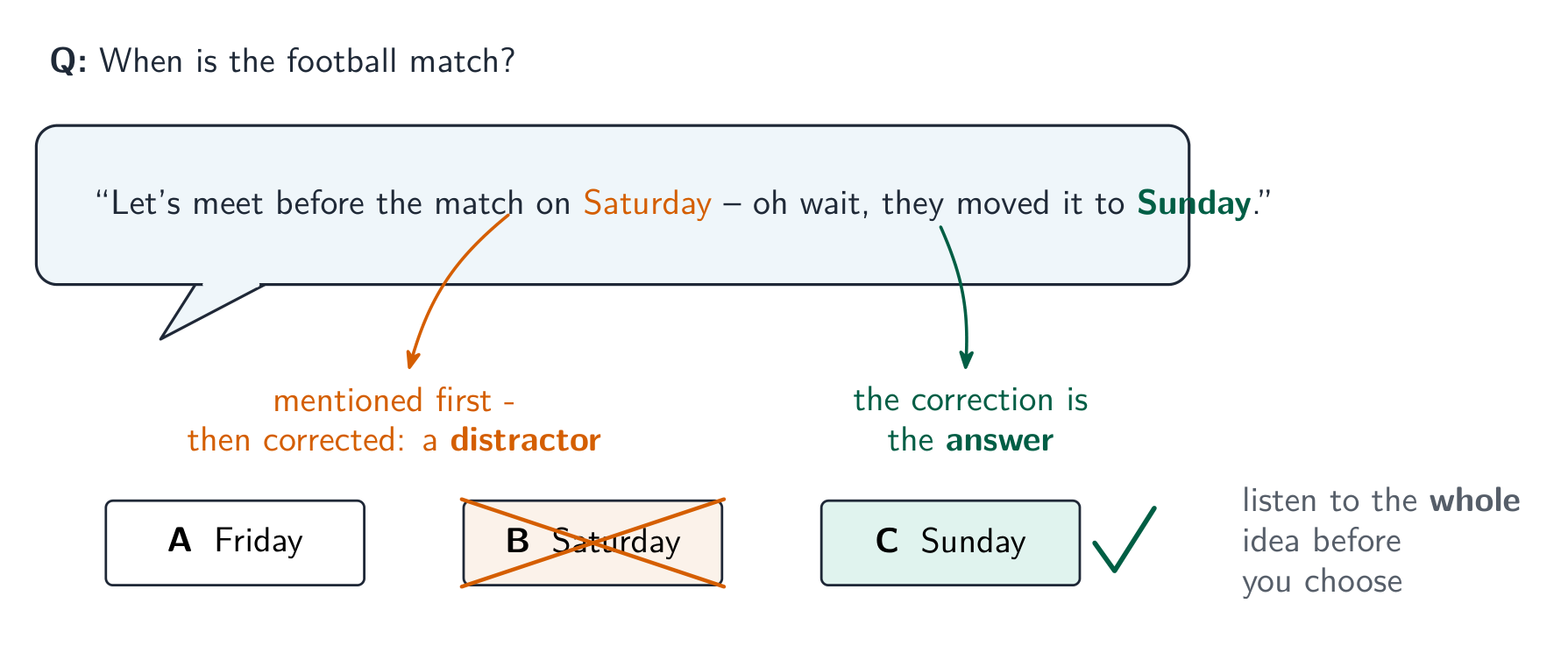
- A speaker may mention an option, then change their mind. Listen to the whole idea before you choose.
A distractor is mentioned first, then corrected - the correction is the answer Words that signal the answer
Trained ears listen for small words that point to the answer.
- A correction is coming: actually… / sorry, I mean… / on second thought… — the words after these usually hold the real answer, not the ones before.
- The key point: the main thing is… / what matters is… / above all…
- A feeling or attitude 态度: to be honest… / the trouble is… / I'm delighted that…
- Order of steps: first… next… finally… — these help you follow a sequence.
Catching one signal word can win you a mark. Note them down as you hear them.
Vocabulary TrainEnglish suggests/səˈdʒests/ multiple-choice/ˈmʌltɪpl tʃɔɪs/ distractors/dɪˈstræktəz/ attitude/ˈætɪtjuːd/ 9.3
Exam tips
- Read the questions before the audio starts and underline the key words in each one.
- You hear everything twice: answer what you can in round one, check and fill gaps in round two.
- Speakers often correct themselves with numbers, days and spellings. The last version is the answer.
- Missed one? Let it go and follow the next question; return to the gap in the second play.
- Write something for every question. There is no penalty for a wrong guess.
-
10
Speaking skills
Watch lesson10.1
Talking with the examiner
Syllabus
- take part in a conversation or interview, giving factual information and opinions
- respond to questions and develop your answers with reasons and examples
- use interactive skills: starting, responding, asking for clarification and taking turns
Source: Cambridge International syllabus
The speaking test is a friendly conversation 对话, not a test you fail by being nervous.
Take part fully
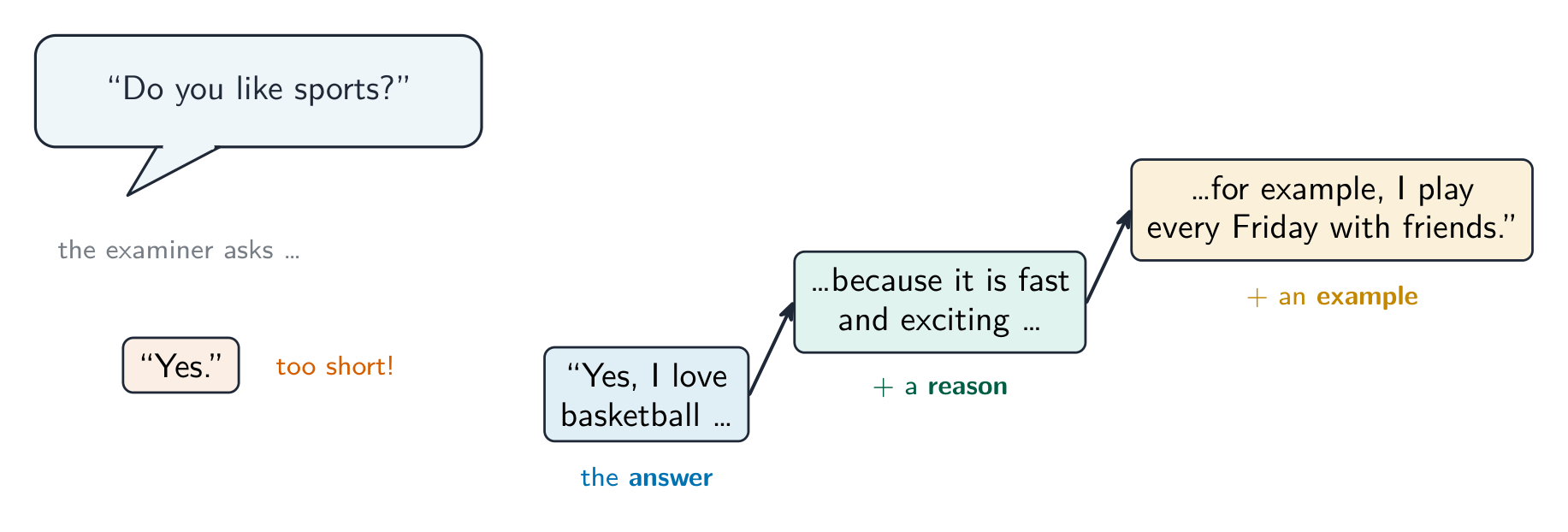
- Answer the question, then add more. A one-word answer is too short.
- Give reasons and examples. Show what you can do with English.
Answer, then add more: a reason and an example make a full turn Interact well
- Listen to the examiner and respond 回应 to what they say.
- If you do not understand, it is fine to ask: "Sorry, could you repeat that?"
- Take turns 轮流 naturally, as in a real conversation.
Develop answers in conversation: add reasons, examples, and a short opinion Vocabulary TrainEnglish conversation/kɒnvəˈseɪʃn/ respond/rɪˈspɒnd/ turns/tɜːnz/ 10.2
Giving a short talk
Syllabus
- give a short talk that describes an event or explains and justifies an opinion
- expand your answers by giving examples, justifying, comparing and speculating
- speak with control of vocabulary, grammar, pronunciation and intonation
Source: Cambridge International syllabus
You may be asked to talk about a topic for a short time.
Develop your ideas
- Do not just list points. Develop 展开 each one with a reason or an example.
- Use phrases like "for example", "that is why" and "I suppose" to extend your answers.
Speak clearly
- Speak with good pronunciation 发音 and natural intonation 语调.
- Do not rush. It is better to speak clearly than quickly.
- If you forget a word, say it another way. This is called paraphrasing 释义.
Useful language
Memorise a few phrases 短语 for each move. They keep you talking when your mind goes blank.
- To give an opinion: In my opinion… / I'd say… / For me,…
- To add detail: for example… / that's why… / what I mean is…
- To buy thinking time: That's a good question… / Well, let me think… / I suppose…
- To agree or disagree politely 礼貌: That's true, but… / I see what you mean, though…
A short pause with "Let me think…" sounds far better than silence. It shows control, not panic.
A model turn
See how one student turns a plain question into a full, natural answer.
Examiner: Do you enjoy studying at home?
Student: In my opinion, home is better for some subjects. For example, I revise 复习 maths well at home because it is quiet and nobody interrupts 打断 me. But I suppose group work is easier at school, where I can ask my friends straight away. So really, it depends on the task.
The student gives an opinion, backs it with an example, admits the other side, and finishes with a neat conclusion. That is a top-mark turn — and anyone can build it with these phrases.
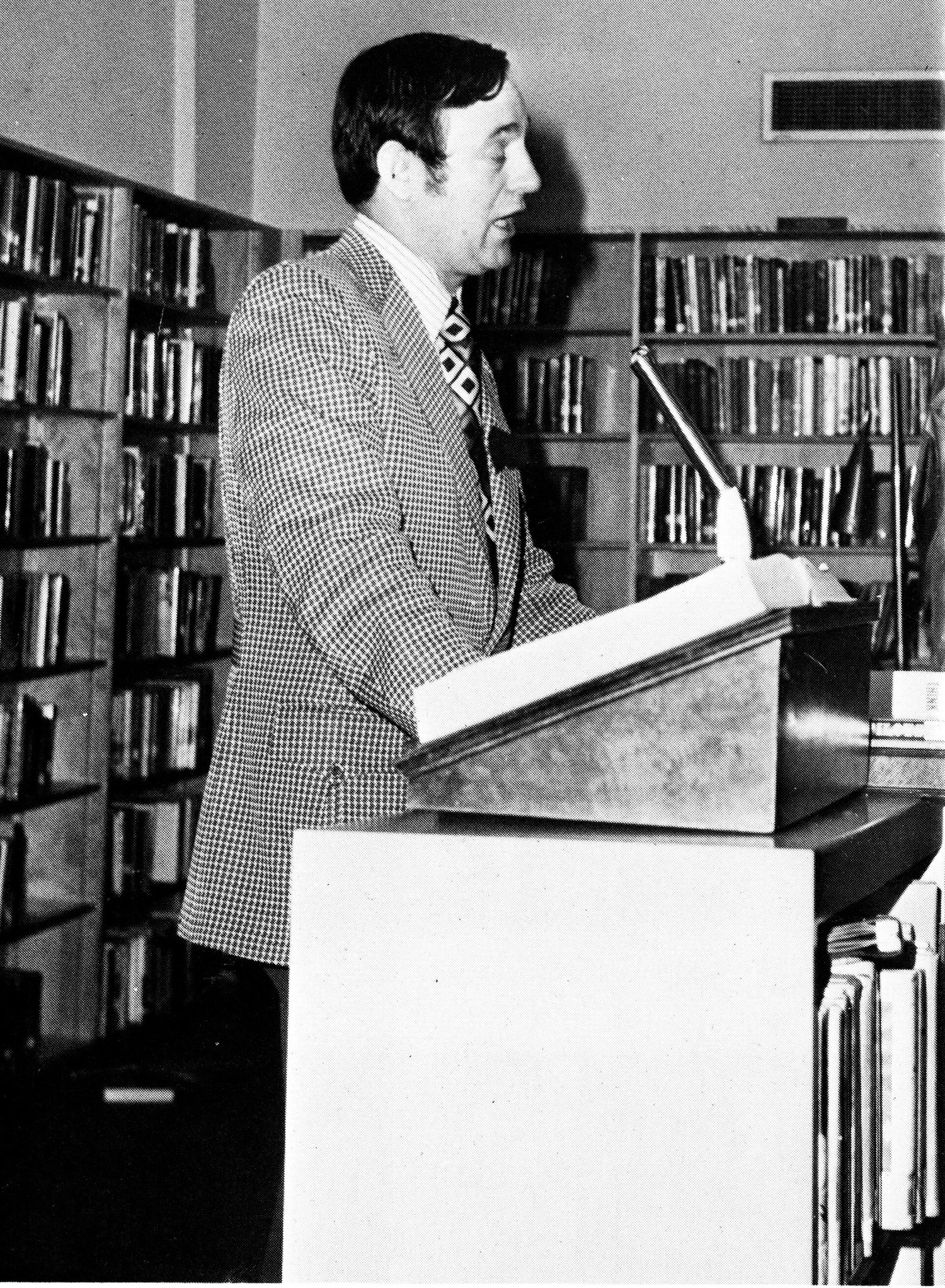
A short talk to a room: plan clear points, speak naturally, and answer follow-up questions Vocabulary TrainEnglish develop/dɪˈveləp/ pronunciation/prəˌnʌnsɪˈeɪʃn/ intonation/ˌɪntəˈneɪʃn/ paraphrasing/ˈpærəfreɪzɪŋ/ phrases/ˈfreɪzɪz/ politely/pəˈlaɪtli/ revise/rɪˈvaɪz/ interrupts/ˈɪntərʌpts/ 10.2
Exam tips
- The warm-up chat is not marked. Use it to relax and start talking, not to recite prepared lines.
- Never say memorised speeches. The examiner stops them, and real conversation earns more.
- Grow every answer: point, reason, example. "I like… because… for example…" fills a minute well.
- If you miss a question, ask: "Could you say that again, please?" That is good English, not a fault.
- Take each prompt on the card in order; every prompt can become a small topic of its own.
-
11
Vocabulary and text types
Watch lesson11.1
Growing your vocabulary

Syllabus
- learn new words together with their meaning, spelling and how they sound
- group vocabulary by topic and by everyday situation
- use set phrases, phrasal verbs and collocations naturally
Source: Cambridge International syllabus
A wide vocabulary 词汇 helps you in every part of the exam.
Learn words well
- Learn a new word with its meaning, its spelling, and how it sounds.
- Keep a vocabulary notebook. Group words by topic, such as travel or health.
Knowing a word well means knowing all of this Use natural phrases
- Learn words that go together. These are called collocations 词语搭配, like "make a decision" or "heavy rain".
- Learn set phrases 固定短语 and common phrasal verbs 短语动词, like "give up" or "look after".
- Using natural phrases makes your English sound fluent 流利.
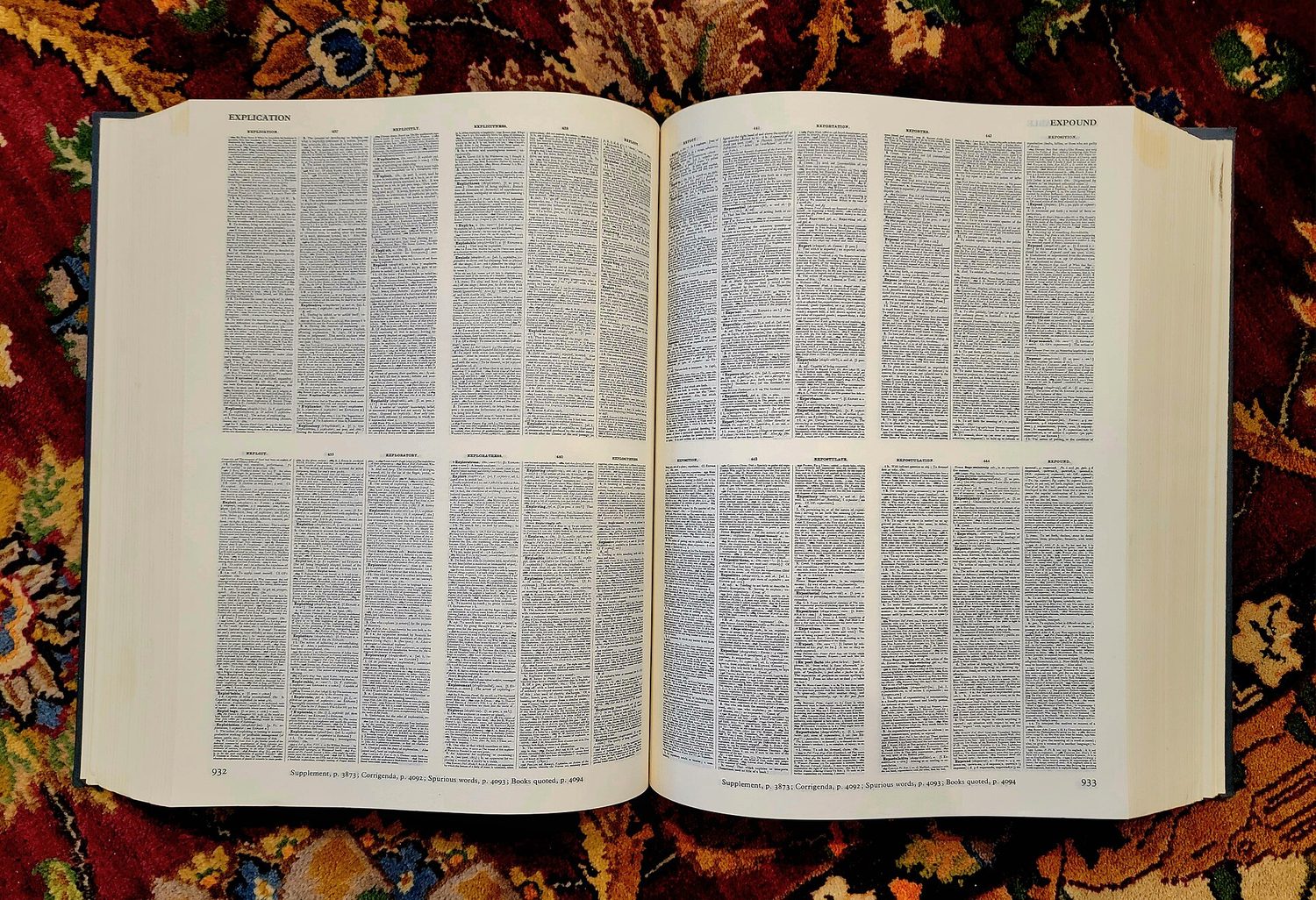
Growing vocabulary: notice useful words in every text type and practise them in your own writing Vocabulary TrainEnglish vocabulary/vəʊˈkæbjʊləri/ collocations/ˌkɒləʊˈkeɪʃnz/ set phrases/set ˈfreɪzɪz/ phrasal verbs/ˈfreɪzl vɜːbz/ fluent/ˈfluːənt/ 11.2
Knowing your text types

Syllabus
- recognise common text types: article, blog, email, essay, report, review, notice, leaflet and interview
- know the purpose and audience of each text type
- match the right style and format to each text type
Source: Cambridge International syllabus
Each writing task is a text type 文本类型 with its own rules.
Common text types
- An email is a message to one person; an article 文章 is for many readers; a report 报告 gives facts to a person in charge.
- A blog 博客 is a personal, informal online post – like an article but more personal and casual, so it sits near the informal end of the formality scale.
- A review 评论 gives an opinion about something you tried; an essay 议论文 argues a point of view.
- A notice 通知 and a leaflet 传单 give short, clear information.
Match style to type
- Each text type has its own purpose, reader and tone.
- Before you write, ask: what is this text type, and what style does it need?
Every text type sits somewhere on the line from informal to formal A vocabulary routine
Turn new words into words you truly own with four steps:
- Meet it — when you find a new word, write it down with one example sentence.
- File it — put it in your notebook under a topic group (travel, health, school).
- Test it — cover the meaning and try to recall it the next day, then again a week later. This spaced review 间隔复习 fixes words in your memory far better than reading a list once.
- Use it — put the word into your own writing or speaking within a few days, before you forget it.
Five words learned this way each day is over a thousand a year.
Vocabulary TrainEnglish text type/tekst taɪp/ article/ˈɑːtɪkl/ report/rɪˈpɔːt/ blog/blɒɡ/ review/rɪˈvjuː/ essay/ˈeseɪ/ notice/ˈnəʊtɪs/ leaflet/ˈliːflɪt/ spaced review/speɪst rɪˈvjuː/ 11.2
Exam tips
- Learn words in families, one family per text type: email openers, report verbs, review adjectives.
- In the writing exam, put the text type's fixed parts down first: greeting, title or headings. They are the easiest marks on the paper.
- Keep a personal word list. Five new words a day beats fifty words once a month.
- When a new word appears in the reading paper, guess it from the context and keep moving; never freeze on one word.