- identify the purpose of a piece of writing: to inform, to argue or to discuss
- think about the audience and how formal or informal the language should be
- choose a register and style that suit the purpose and the reader
Writing: purpose, audience and accuracy
IGCSE English · Topic 2
 7:50
7:50
Writing: Purpose, Audience and Accuracy
Two students want the same thing: permission to use the school hall on Saturday. Both write to the head teacher. The first one says: <slow>Hi, can we have the…
English narration · English + 中文 subtitles burned in
2.1
Purpose, audience and register
Syllabus
Source: Cambridge International syllabus
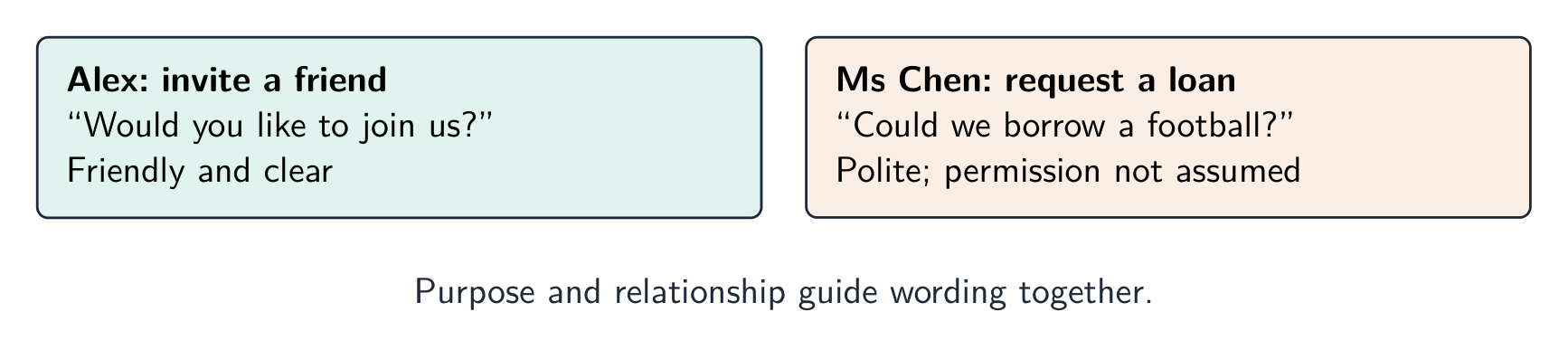
You want to invite Alex to a picnic and ask your head teacher to lend the group a school football. The event is the same, but the messages have different jobs. Good writing starts with what the reader needs to understand or do.
Know your purpose
Your purpose 目的 may be to inform 告知, invite, explain, argue 论证 for a change or discuss 讨论 different views. Read the actual command words; do not reduce every task to the same formula. For current Cambridge 0510 writing tasks, the whole response is assessed for content and language. Covering the task, developing ideas and choosing suitable style matter, alongside language range, accuracy and organisation.
Original invitation task. Write an email to your friend Alex inviting them to a picnic. Explain why you are organising it, say when and where it will take place, and tell Alex what to bring. Practise planning for a 120–160-word response. Use these fictional notes: Saturday at 14:00, Riverside Park, meet at the main gate; a chance for friends to relax after exams; you will bring sandwiches and want Alex to bring water. Weather is not confirmed and no indoor venue is booked.
Original planning attempt. State the job in one line. Identify every requested point. Does “Come on Saturday; it will be fun” answer the whole task?
Worked check. Invite a friend, explain the reason, give time and place, and ask Alex to bring water. “Saturday” alone misses the time and place; “fun” does not explain why you are organising this event. Keep supplied details consistent. An invitation to a stranger or a report about a completed picnic would answer a different task.
Know your audience
The audience 读者 is the intended reader, such as a friend, teacher or organiser. Consider the relationship and purpose together. A quick message to a familiar teacher can differ from a formal report to that same person. Do not assume every teacher is a stranger or that one reader title dictates every wording choice.
Choose the right register
Register 语域 includes how formal 正式 or informal 非正式 the writing sounds. A friendly invitation can use contractions and a personal voice. A formal request or report usually needs a more measured style. Full forms are not automatically better, and contractions are not universally ungrammatical in formal contexts. Avoid unfamiliar slang 俚语, text abbreviations and rude demands when they do not suit the reader and task.
Original register attempt. Compare “Hi Alex, would you like to join us?” with “Ms Chen, could we borrow a school football for our picnic?” Explain why both can be suitable. Repair “plz give us a ball now” for the head teacher. Permission has not yet been given.
Possible repair. “Dear Ms Chen, could we borrow a school football for our picnic on Saturday? We would return it on Monday.” This requests rather than assumes permission. The return date is a proposed arrangement. “Hi” is not inherently rude; the abrupt demand and text abbreviation are poor choices for this request. Do not invent a general rule that a greeting alone wins or loses marks.

Vocabulary
Train
| English |
|---|
| purpose/ˈpɜːpəs/ |
| inform/ɪnˈfɔːm/ |
| argue/ˈɑːɡjuː/ |
| discuss/dɪˈskʌs/ |
| audience/ˈɔːdɪəns/ |
| register/ˈredʒɪstə/ |
| formal/ˈfɔːml/ |
| informal/ɪnˈfɔːml/ |
| slang/slæŋ/ |
2.2
Organising your ideas

Syllabus
- plan what to include and the order in which to present it
- organise writing into clear paragraphs with a logical structure
- link ideas using devices for addition (in addition, moreover), contrast (however, although) and cause/effect (therefore, as a result)
Source: Cambridge International syllabus
Plan before you write
A brief plan 计划 helps check coverage and order. Practise a sensible division of writing time; there is no single official one-minute planning or five-minute checking rule. The task and your writing speed affect the balance. Keep time to review the whole response.
Original ordering attempt. Order the invitation’s ideas: what Alex should bring; reason for the picnic; invitation, time and place. What information does Alex need before deciding what to bring?
Possible order. Invite Alex and explain the reason, give the meeting details, then say what you will provide and ask Alex to bring water. Related ideas may share a paragraph 段落. A paragraph develops a connected point; it does not need to contain exactly one fact or one sentence.
Link your ideas
Linking words 衔接词 express relationships. “Also” adds; “however” contrasts; “so” can show a result or reason for a decision. Choose the meaning before the word. Do not put “however” between ideas merely to sound sophisticated.
Original linking attempt. Join these ideas accurately: “I will bring sandwiches. Please bring water.” Then repair “It may rain. Therefore, the weather will be sunny.” Why does the second link fail?
Possible answers. “I will bring sandwiches, so could you bring water?” connects sharing the preparations. “It may rain, so we should check the forecast before leaving” gives a reasonable next step. “Therefore” cannot turn possible rain into proof of sunshine. “Although it may rain, we still hope to meet” expresses contrast; it does not confirm the weather or an indoor booking.
Vocabulary
Train
| English |
|---|
| plan/plæn/ |
| paragraph/ˈpærəɡræf/ |
| linking words/ˈlɪŋkɪŋ wɜːdz/ |
2.3
Accuracy: grammar, vocabulary and checking

Syllabus
- use a range of grammatical structures: different verb forms and tenses, conditionals and varied sentence types
- use a range of vocabulary, including set phrases, collocations and synonyms to avoid repetition
- check your writing for accuracy in grammar, spelling and punctuation
Source: Cambridge International syllabus
Language assessment includes range 多样性, accuracy 准确性 and organisation. Use a range of structures and words appropriately, without sacrificing meaning. Checking can improve communication; do not promise a fixed number of extra marks for finding particular errors.
Show a range that fits the meaning
Different tenses 时态 serve different time meanings. A past account, present fact and future plan may need different forms, but do not force a tense change into each sentence. Use vocabulary 词汇 you understand. Synonyms 同义词 are not interchangeable in every context; repeating a clear key word can be better than changing its meaning.
Original range choice. Which fits our invitation: “We are meeting at two on Saturday” or “We had met at two on Saturday”? Explain from the intended future meeting. Does replacing “bring water” with “carry liquid” improve the message?
Worked check. Present continuous can describe this future arrangement. Past perfect would need a past reference point and does not express the intended invitation. “Carry liquid” is vague and unnatural here; “bring water” is precise. A longer or less common expression is not automatically stronger.
Repair an actual draft
Check grammar 语法, spelling 拼写 and punctuation 标点 alongside task coverage and tone. Read in two passes: first meaning and consistency, then sentence-level errors. Practise this short extract; it is not a complete exam response.
Original accuracy attempt. “hi Alex we is meeting at riverside Park on saturday at two. Please brings water. I will bring sandwishes, its going to be fun.” Identify errors and explain the repairs. Which parts of the original invitation task still need development?
Worked revision. “Hi Alex, we are meeting at Riverside Park on Saturday at two. Please bring water. I will bring sandwiches. It's going to be fun.” Capital letters mark the greeting, place and day. “We” takes “are”; an imperative uses “bring”, not “brings”. “Sandwiches” is the correct spelling. “It's” means “it is”; full stops separate sentences. The extract still needs the main-gate meeting detail and an explanation of relaxing together after exams. Correct grammar alone does not complete the task.
Check meaning as well as forms
Original consistency attempt. A later sentence says “Meet at the side gate at three.” Why is this a problem even if it is grammatically correct? Repair it. Then review “If it rains, we will meet in the booked hall” against the notes.
Worked check. Use the main gate at two to match the supplied arrangement. No hall is booked: “If rain is forecast, I will contact you about changing the plan” is a possible proposal, not a confirmed alternative venue. Good checking includes dates, places, requested points and supported claims.
Vocabulary
Train
| English |
|---|
| range/reɪndʒ/ |
| accuracy/ˈækjʊrəsi/ |
| tenses/ˈtensɪz/ |
| vocabulary/vəʊˈkæbjʊləri/ |
| synonyms/ˈsɪnənɪmz/ |
| grammar/ˈɡræmə/ |
| spelling/ˈspelɪŋ/ |
| punctuation/ˌpʌŋktʃuːˈeɪʃn/ |
2.3
Exam tips
Read the actual task before applying a template. The official 0510 criteria assess task fulfilment and development as a whole, rather than giving a universal fixed deduction per missed point. Range, accuracy and organisation work together; short correct sentences alone do not guarantee the strongest response, and uncontrolled complexity can obscure meaning.
Use the 120–160-word guidance for the relevant current writing tasks. Practise judging length, but do not forbid a brief count when needed. Plan, draft and review within the time available; choose a routine through practice rather than treating a particular number of minutes as an exam law.
Original independent task. Invite a friend to a school book exchange. Explain why you want to go together, give the time and place, and say what your friend should bring. Fictional notes: Friday at 16:00 in the library; meet at the entrance; students may exchange one book without payment; bring a book in good condition. Draft a complete 120–160-word email before reviewing it.
Possible review. Check all requested points and explain a relevant reason, such as helping each other choose books. Keep Friday, 16:00 and the library entrance consistent. Match the friendly audience, group related ideas, choose links by meaning and repair language. A greeting, a contraction or a new synonym cannot replace missing content. This lesson’s short extracts are practice steps; they are not full-length models to memorise.
Vocabulary card meanings
inform: To tell the reader something not already known. argue: To give reasons for a view one wants accepted. discuss: To treat more than one side of an issue. slang: Very informal words used among friends, out of place in a formal report. linking words: Words that join sentences and show their relationship. range: How many different words or structures a writer uses. tenses: Verb forms that place an action in time. spelling: Writing a word with the accepted letters. punctuation: Marks such as commas and full stops that organise sentences.
Interactive lessons on this topic
Work through it step by step, with instant-check exercises.