- skim a text quickly to get the general idea, then scan to locate specific facts, names, numbers, times and places
- answer short questions with a single word or short phrase, using the exact detail from the text
- predict what kind of information a question is asking for before reading the text closely
Reading skills
IGCSE English · Topic 1
 7:55
7:55
Reading Skills
Open the reading paper. You see a long text — six hundred words, maybe more — and a full page of questions. The clock says forty-five minutes. Many students…
English narration · English + 中文 subtitles burned in
1.1
Reading for specific information
Syllabus
Source: Cambridge International syllabus
An airport departure board contains many facts, but you usually need only one flight. Choose a reading method for your purpose, then check the detail carefully. This lesson prepares Cambridge IGCSE English as a Second Language 0510 reading skills, not First Language English 0500.
For the 2024–2026 syllabus, Paper 1 has four reading exercises: short answers, multiple matching, brief notes and multiple-choice questions. The 2027–2029 syllabus retains these reading task types. The summary-writing exam task was removed from 2024; summarising below is a useful study skill, not a current extra exam exercise. These mini practices are shorter than a full exam task.
Skim first, then scan
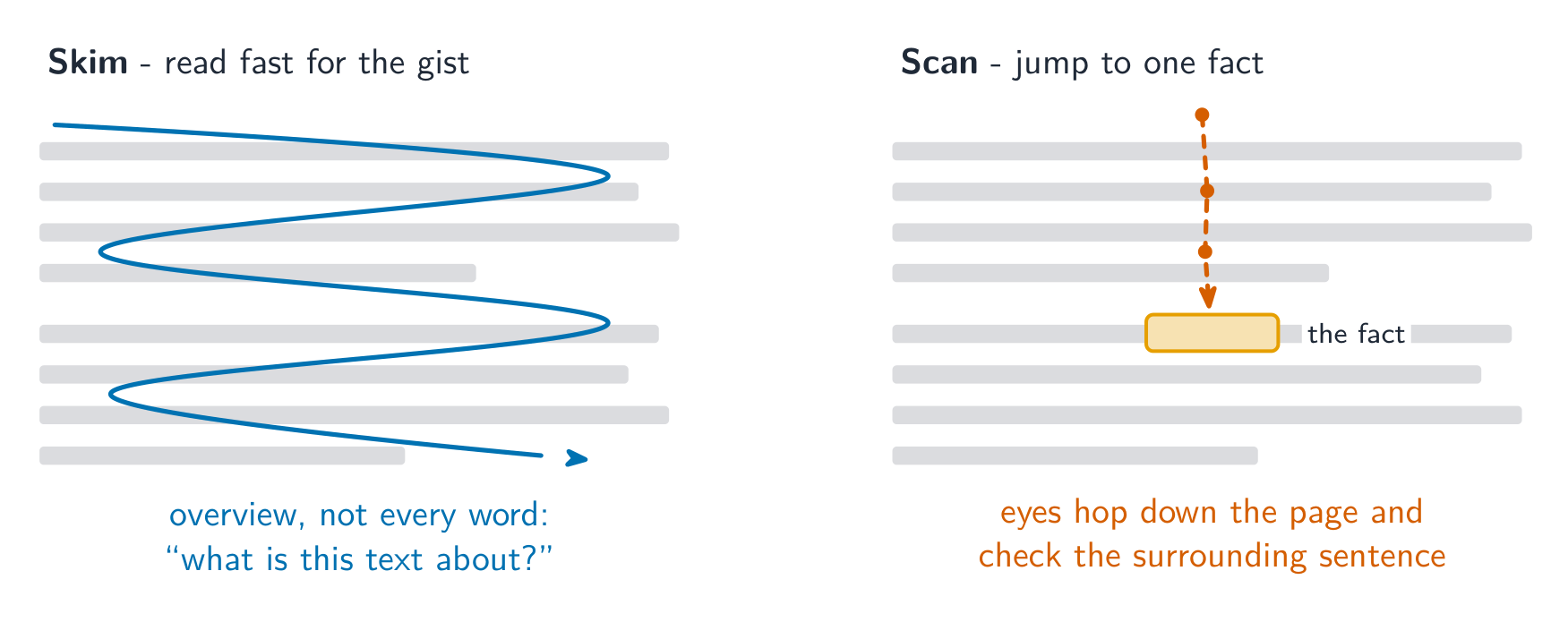
Skim 略读 for the gist 大意: use the title, opening, topic sentences and the shape of each paragraph 段落 to identify the main topic. You do not need to read every word or follow a fixed eye path. Scan 扫读 to locate a particular detail, such as a time or a phrase with the same meaning as the question. After locating it, read the surrounding sentence closely; nearby details may refer to something else.
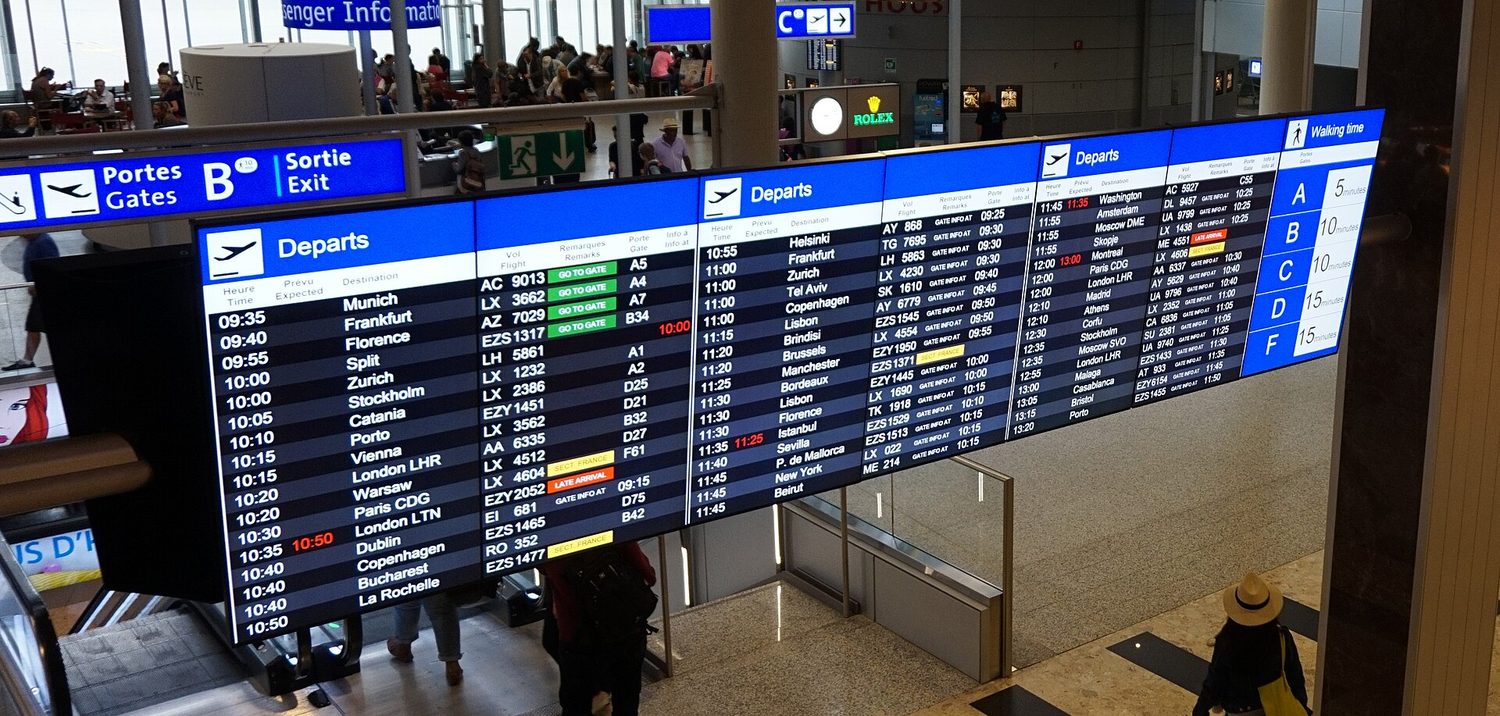
Original scanning practice — fictional board.
| Flight | Destination | Time | Gate |
|---|---|---|---|
| AB201 | Hanoi | 09:15 | 6 |
| AB218 | Hanoi | 10:05 | 9 |
| AB305 | Seoul | 09:40 | 4 |
Which gate serves AB218? 9. Finding “Hanoi” alone would leave two possible rows. Match the flight identifier, then read the gate in the same row. The earliest flight in this table is AB201 at 09:15; this does not claim anything about flights outside the table.
Match the question to the text
Predict 预测 the type of information required, not an unsupported answer. “When should students meet?” asks for a meeting time, which may differ from departure. “Why?” needs a reason. Use the question's limits: who, where, when, how many and which event?
Original short-answer practice.
The science club will visit the Greenwater Museum on Friday 14 May. Meet at the school gate at 8:20; the coach leaves at 8:30. Admission costs £6, but members pay £4. Return is planned for 16:00. Bring a notebook, a pencil and a packed lunch. The outdoor boat tour has been cancelled because the river is flooded. The indoor workshop will still take place. Book with Ms Chen by Tuesday 11 May.
Find the meeting time, the admission price for a club member, the reason the boat tour is cancelled, and the three things students should bring.
Worked check. Meeting: 8:20, not the 8:30 departure. Member price: £4, not the standard £6. Reason: the river is flooded, not the fact that the tour is cancelled. Items: a notebook; a pencil; a packed lunch. Each answer is checked against the relevant event or category.
Write short, exact answers
In Exercise 1, use a word or short phrase 短语 that gives the required meaning. Copying a suitable phrase can help, but there is no universal rule that every changed word loses a mark. Do not copy a whole paragraph or add alternatives that make the meaning unclear. Keep necessary qualifiers such as “furthest” or “on flat roads”. Follow the actual number of details requested.
Verified exam connection — 0510/12, May/June 2025. Question 4 requires the superlative idea that the Painted Lady travels furthest, and the official scheme accepts appropriate alternative verbs. Question 3 distinguishes adapt from adopt because the latter changes meaning. Question 6 asks for three protective features drawn from different parts of the article. Its scheme credits three distinct supported details, not three restatements of the same idea. This also shows why a later question may require searching back through a text.
Vocabulary
Train
| English |
|---|
| skim/skɪm/ |
| gist/dʒɪst/ |
| paragraph/ˈpærəɡræf/ |
| scan/skæn/ |
| predict/prɪˈdɪkt/ |
| phrase/freɪz/ |
1.2
Connecting ideas across a text
Syllabus
- follow how ideas, opinions and attitudes in a text connect to one another
- match each question to the section or short text that contains the relevant idea (multiple matching)
- recognise words and phrases that signal time, cause and effect, addition and contrast
Source: Cambridge International syllabus
Multiple matching
In multiple matching 多项匹配, match each question's whole meaning to the relevant text or section. A paraphrase 改写 changes wording while keeping meaning. The same letter may answer more than one question; do not use each text just once unless the instructions require that.
Original mini texts — songwriters.
A Mei: I write best alone. In a group I lose track of my ideas. A walk often gives me a melody; I add the words afterwards.
B Omar: Other people improve my ideas, so I prefer writing with friends. I start with words and create a tune later. Every Sunday I set aside an hour to write.
C Rosa: I begin with words, then add music on my own. Once a song is finished, I prefer to keep its original form rather than make new versions.
Who (1) creates better work with others, (2) has a regular writing routine, (3) avoids changing completed songs, and (4) develops the music before the words?
Worked check. 1 B: friends improve Omar's ideas. 2 B: every Sunday is a routine. 3 C: Rosa keeps the original form. 4 A: Mei starts with a melody. Mei mentions a group, but says it harms her concentration; matching a word alone would give the wrong answer. The repeated B is intentional. In the actual 2025 Q7, the official sequence also reuses letters across nine items.
Signal words
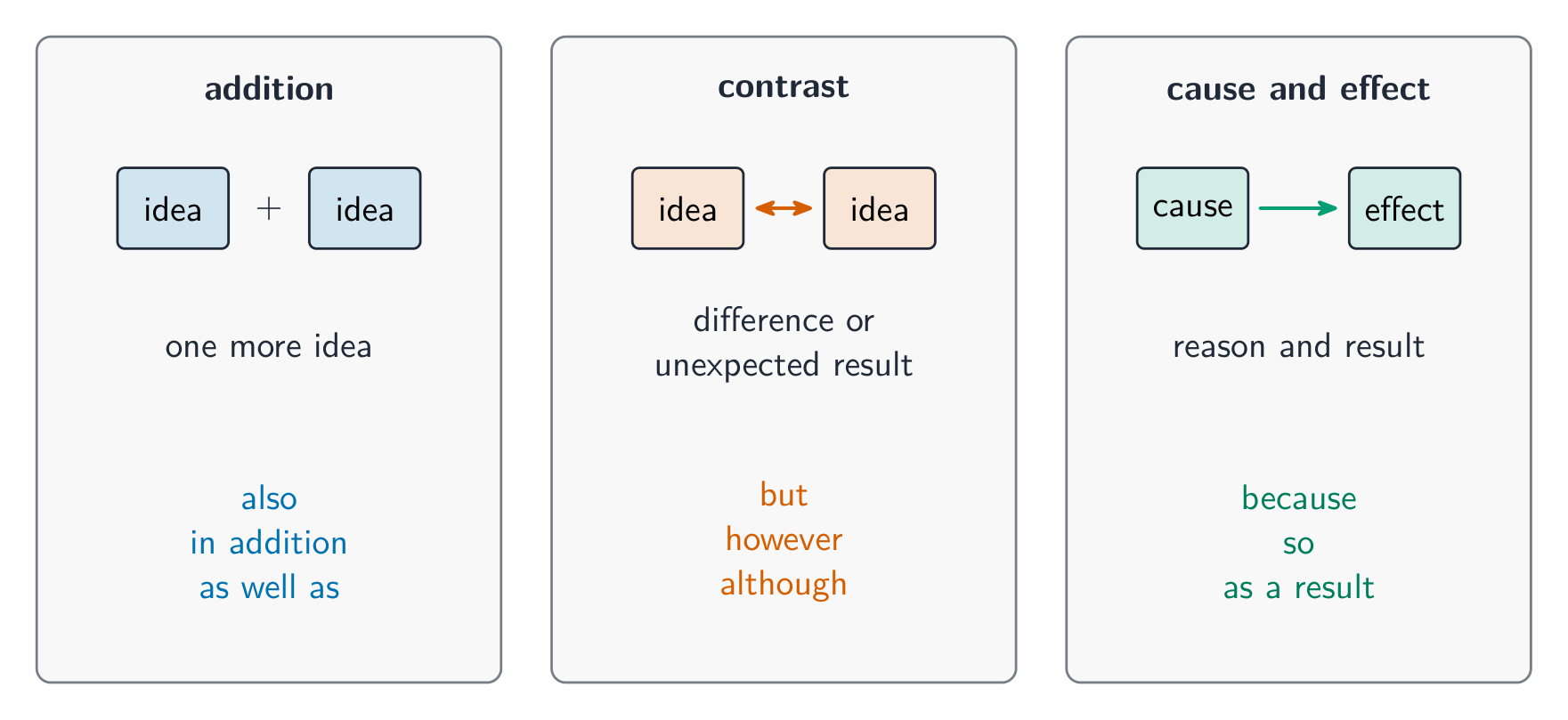
Signal words 信号词 can help reveal a connection: addition 递进 adds information; contrast 对比 shows a difference or an unexpected result; cause and effect 因果 connects a reason and consequence. Time words show sequence. They are clues, not automatic answer locations. Ideas can be connected without an obvious signal word.
Original connection task. “The club bought more cameras because membership grew. However, beginners still had to share them.” Membership growth is the stated reason for buying cameras. “However” contrasts the purchase with continued sharing; it does not prove that the writer is angry. “After the workshop, we reviewed the photos” gives a time sequence, not proof that the workshop caused the review.
Vocabulary
Train
| English |
|---|
| multiple matching/ˈmʌltɪpl ˈmætʃɪŋ/ |
| paraphrase/ˈpærəfreɪz/ |
| signal words/ˈsɪɡnl wɜːdz/ |
| addition/əˈdɪʃn/ |
| contrast/ˈkɒntræst/ |
| cause and effect/kɔːz ænd ɪˈfekt/ |
1.3
Making notes and summaries
Syllabus
- select only the relevant points from a text for a given purpose
- complete a set of brief notes under headings, using short phrases rather than full sentences
- leave out examples and repetition, keeping just the key information
Source: Cambridge International syllabus
Note-making
Note-making 做笔记 selects details for a specified heading and purpose. Write brief notes that retain the essential meaning. An example can be necessary if it is the detail requested; do not automatically discard all examples. Several phrases describing one benefit may still be only one point.
Original notes practice.
The school repair club meets on Wednesdays. Students learn practical repair skills and save money by fixing their own belongings. The club also helps keep usable items out of the rubbish. A blue toolbox is kept by the door. Places are limited because only two teachers can supervise. Students must bring damaged items from home; the school does not provide them.
Under Benefits, make three notes. Under Limits, make two notes.
Worked check. Benefits: learn repair skills; save money; reduce waste. Limits: limited places; must bring own damaged items. Wednesday is a meeting detail; the blue toolbox is equipment information. Neither fits these headings. “Cheaper repairs” repeats saving money rather than creating a fourth benefit.
Verified exam connection — 2025 Exercise 3. The recumbent-bike task asks for four advantages and three disadvantages. The scheme accepts short relevant phrases. It keeps the “flat roads” condition for rapid travel and distinguishes that from difficulty uphill. A detail that describes a bike is not automatically an advantage or disadvantage.
Summary skills
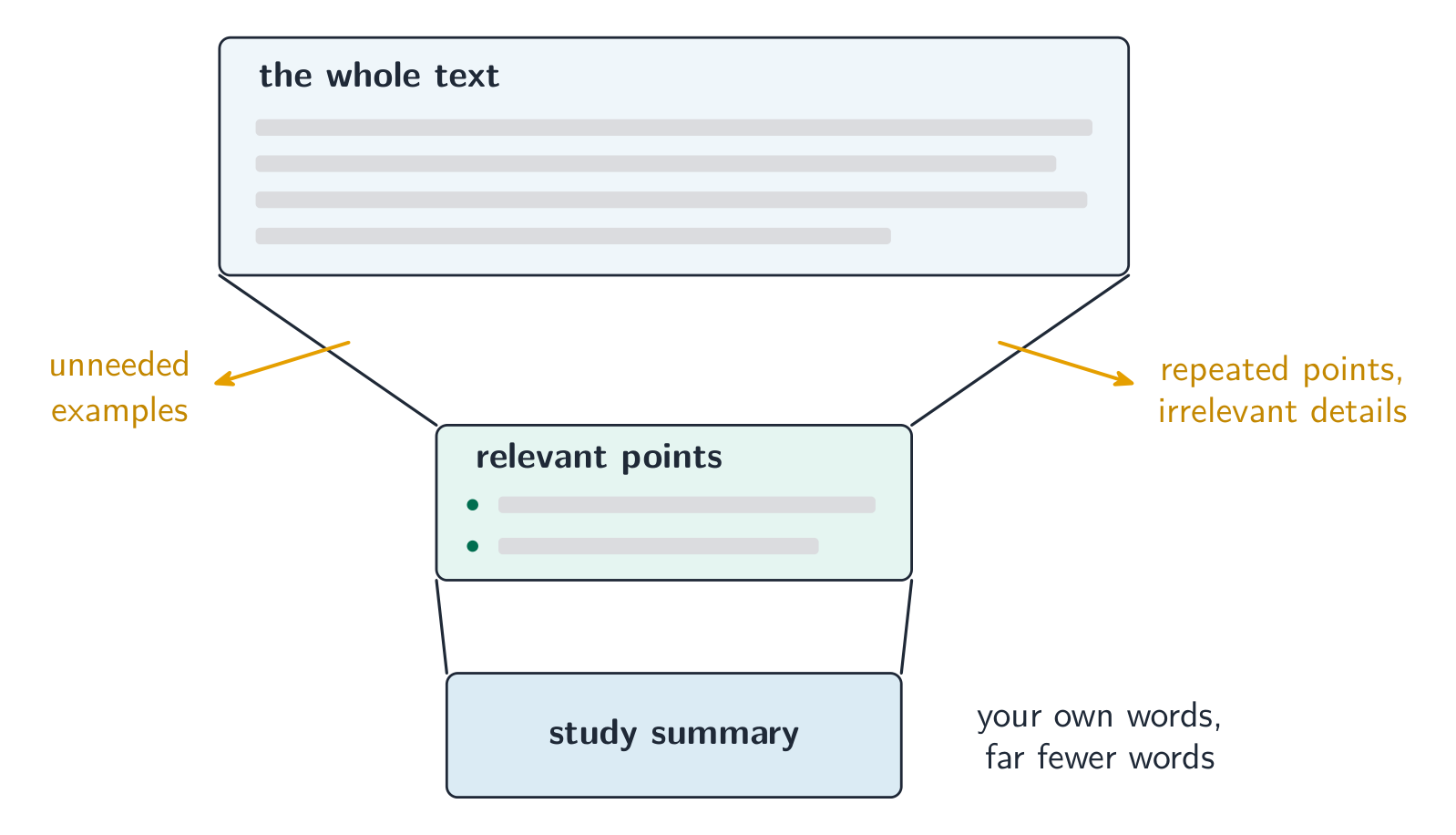
A summary 概括 gives the main relevant ideas in fewer words. Select for a purpose, combine related points, and avoid unnecessary repetition 重复. Use your own words where appropriate while preserving the original meaning and qualifications. Repetition in a source does not by itself make a point required. This is study practice; the current 0510 reading paper does not have a summary-writing exercise.
Original study summary. For the repair-club text, the purpose is “explain the benefits”. A model is: The repair club teaches useful skills, helps students save money and reduces waste. It omits the timetable, equipment and participation limits because the stated purpose asks only for benefits. A summary about joining the club would need a different selection.
Vocabulary
Train
| English |
|---|
| note-making/nəʊt ˈmeɪkɪŋ/ |
| summary/ˈsʌməri/ |
| repetition/ˌrepəˈtɪʃn/ |
1.4
Reading between the lines

Syllabus
- understand meaning that is implied but not directly stated
- work out a writer's opinion, attitude or feelings from the words and phrases they choose
- deduce the meaning of an unfamiliar word from the information around it
- answer multiple-choice questions about main ideas, details and attitudes
Source: Cambridge International syllabus
Inference 推断 is a supported conclusion beyond what is directly stated. A writer implies 暗示 a meaning through details and relationships. Use evidence, but do not invent a reason, motive or event. The writer's attitude 态度 is their view or feeling; word choice 用词 and the surrounding explanation can support it.
Original inference task. “Lin claimed she had finished the report. When her partner asked to see it, she closed her laptop and changed the subject.” This suggests doubt about whether the report is finished. It does not prove a broken laptop, a lie or a desk covered in unfinished work. “Claimed” alone is not a universal signal of dishonesty; the following behaviour supports the cautious inference here.
For a multiple-choice 选择题 question, compare every option with the relevant evidence. An option may use words from the text but change who acted, the time, the degree of certainty or the writer's attitude. Choose the best supported option, not the strongest sounding one. Follow the printed response instruction: the June 2025 reading Exercise 4 uses a tick in the chosen box; multiple matching uses letters.
Original attitude task. “I enjoyed the first workshop. The second was useful too, although I wish we had had more time to practise.” Best description: positive with one reservation. “Completely dissatisfied” ignores the praise; “pleased with every aspect” ignores the time criticism. Contrast does not erase the positive part.
Use context 语境 to infer an unfamiliar word. In “The room was cramped: twenty people had to squeeze around one small table”, cramped means too small or crowded. The explanatory detail supports it. Without enough context, keep the meaning tentative; you do not need to understand every word to answer a question about a different detail.
Vocabulary
Train
| English |
|---|
| inference/ˈɪnfərəns/ |
| implies/ɪmˈplaɪz/ |
| attitude/ˈætɪtjuːd/ |
| word choice/wɜːd tʃɔɪs/ |
| multiple-choice/ˈmʌltɪpl tʃɔɪs/ |
| context/ˈkɒntekst/ |
1.4
Exam tips
Read the actual task instruction, identify the information type and locate evidence. Then check the whole relevant sentence, including negation, comparisons and conditions. Keep answers brief but meaningful; give the required number of distinct details. Short-answer questions may often follow the text, but matching and whole-text detail questions require returning to different sections. For choices, select one response in the required form and use evidence to decide. Attempt all questions, but an unsupported guess is not a reading strategy. Summary work in this lesson is a labelled study skill, not a current 0510 exam task.
Vocabulary card meanings
skim: To move quickly through a text for the general idea. gist: The main idea, leaving out smaller details. predict: To say what is likely to come next, before reading on. multiple matching: A task that pairs several questions with several texts. paraphrase: A restatement that keeps the idea and changes the words. signal words: Words such as however or therefore that show a relationship. addition: A move that brings in a further point. contrast: A move that sets a difference against what came before. cause and effect: A link from a reason to what followed. note-making: Writing brief points while reading or listening. summary: A short account that keeps the main points only. implies: Hints at something without stating it directly. word choice: Which words a writer picks, and the effect of that pick. multiple-choice: A question that offers a fixed list of options.
Interactive lessons on this topic
Work through it step by step, with instant-check exercises.