- recognise that a review describes something you have experienced (a film, place or product) and gives your opinion
- balance description with personal opinion and reasons
- write for a general audience, for example of a magazine or website
Writing a review
IGCSE English · Topic 7
 7:37
7:37
Writing a Review
You are deciding where to eat, and you read two reviews of the same restaurant. The first review says: <slow>The food was nice and the staff were nice. I liked…
English narration · English + 中文 subtitles burned in
7.1
What a review does

Syllabus
Source: Cambridge International syllabus
A review 评论 tells readers about something you have tried — a film, a book, a restaurant, or a place. A good review helps the reader decide 决定 whether to try it too.
Describe and judge
- A review does two things: it describes 描述 the thing, and it gives your opinion 观点 of it.
- Balance the two. Do not only describe, and do not only give opinions.
- Describing answers "What is it like?" Judging answers "Is it any good?" Move between the two, sentence by sentence.
Support your opinions
- Give reasons for what you think. Say why it was good or bad.
- Use examples 例子 from your experience to make your view believable 可信.
- A weak review says "The food was nice." A strong review says "The soup was rich and warming, though the rice arrived cold." The detail is what convinces the reader.
Useful language
Learn a few phrases 短语 for each job. Then you never stare at a blank page.
- To describe: It is set in… / The story follows… / The dish combines… / What stands out is…
- To praise: The best part is… / I was impressed by… / It really succeeds in…
- To criticise 批评 (gently): The one weakness is… / It could have been better if… / At times it feels slow.
- To recommend: I would recommend it to… / It is well worth… / Don't miss…
Mix praise and criticism so the review sounds fair 公正. A review that is all praise, or all complaint, is hard to trust.

Vocabulary
Train
| English |
|---|
| review/rɪˈvjuː/ |
| decide/dɪˈsaɪd/ |
| describes/dɪˈskraɪbz/ |
| opinion/əˈpɪnɪən/ |
| examples/eɡˈzæmplz/ |
| believable/bɪˈliːvəbl/ |
| phrases/ˈfreɪzɪz/ |
| criticise/ˈkrɪtɪsaɪz/ |
| fair/feə/ |
7.2
How to build a review
Syllabus
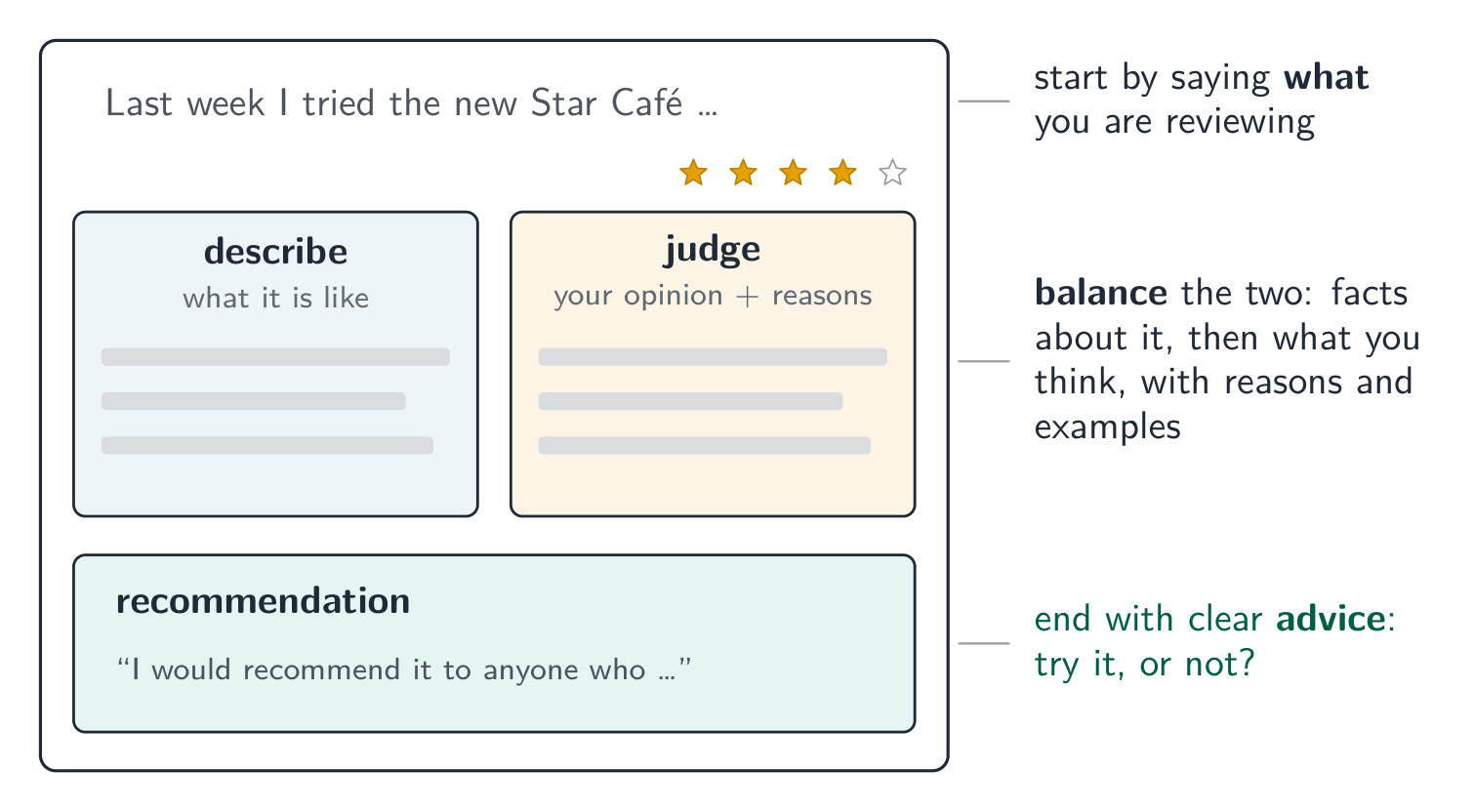
- introduce what is being reviewed, then describe and evaluate it
- support your opinions with specific details and examples
- end with a clear recommendation to the reader
Source: Cambridge International syllabus
Readers want a clear, helpful review.
Structure
- Start by saying what you are reviewing, and give the reader the basic facts.
- In the middle, describe it and evaluate 评价 it — the good points and the weak points.
- Write for a general reader, in a friendly but clear tone 语气.
End with a recommendation
- Finish with a recommendation 建议: do you advise the reader to try it or not?
- Make your advice clear, for example: "I would recommend this film to anyone who likes adventure."
- You can add a condition: "…as long as you don't mind a slow start." This sounds honest and grown-up.
A model review
Read this short review of a film. Notice how each sentence either describes or judges.
Skyward is an adventure film about a girl who builds her own aircraft. The story is simple, but the flying scenes are breathtaking 惊人 and the young lead acts with real warmth. The middle drags a little, and a few jokes fall flat. Even so, it left the whole cinema smiling. I would recommend Skyward to any family looking for a bright, hopeful evening — just be ready for a slow first ten minutes.
Count the moves: it names the film, describes it, praises it, admits two faults, and ends with a clear, honest recommendation. That is a complete review in five sentences.

Vocabulary
Train
| English |
|---|
| evaluate/ɪˈvæljuːeɪt/ |
| tone/təʊn/ |
| recommendation/ˌrekəmenˈdeɪʃn/ |
| breathtaking/ˈbreθteɪkɪŋ/ |
7.2
Exam tips
- Name what you are reviewing and your overall feeling in the first paragraph; do not keep it secret.
- Do both jobs: describe it (what it is) and judge it (what is strong, what is weak).
- Strong adjectives are the fuel of a review: gripping, delicious, disappointing, unforgettable.
- Mention one weakness even in a good review; pure praise sounds like an advert.
- Finish with a clear recommendation: who should try it, who should not, and why.
Interactive lessons on this topic
Work through it step by step, with instant-check exercises.