- tell the difference between a discursive essay (balanced, both sides) and an argumentative essay (one main view)
- plan the main points and the reasons or evidence for each
- keep a formal, organised style
Writing an essay
IGCSE English · Topic 8
 7:56
7:56
Writing an Essay
Two students answer the same essay question: should students have homework? Here is the first one. Homework is good. It helps you learn. Also some students do…
English narration · English + 中文 subtitles burned in
8.1
Two kinds of essay
Syllabus
Source: Cambridge International syllabus
Should a school keep its library open after lessons? A list of slogans will not persuade a reader. An essay 议论文 presents a view or an argument and develops it with relevant reasons and examples.
This lesson prepares Cambridge IGCSE English as a Second Language 0510. In both the 2024–2026 and 2027–2029 syllabuses, an essay is one possible Exercise 6 response, alongside an article, report or review. Follow the actual task: do not turn every writing question into an essay. The task requires 120–160 words, with up to 6 marks for content and 9 for language. Use a neutral or formal style for the stated reader.
Discursive essays
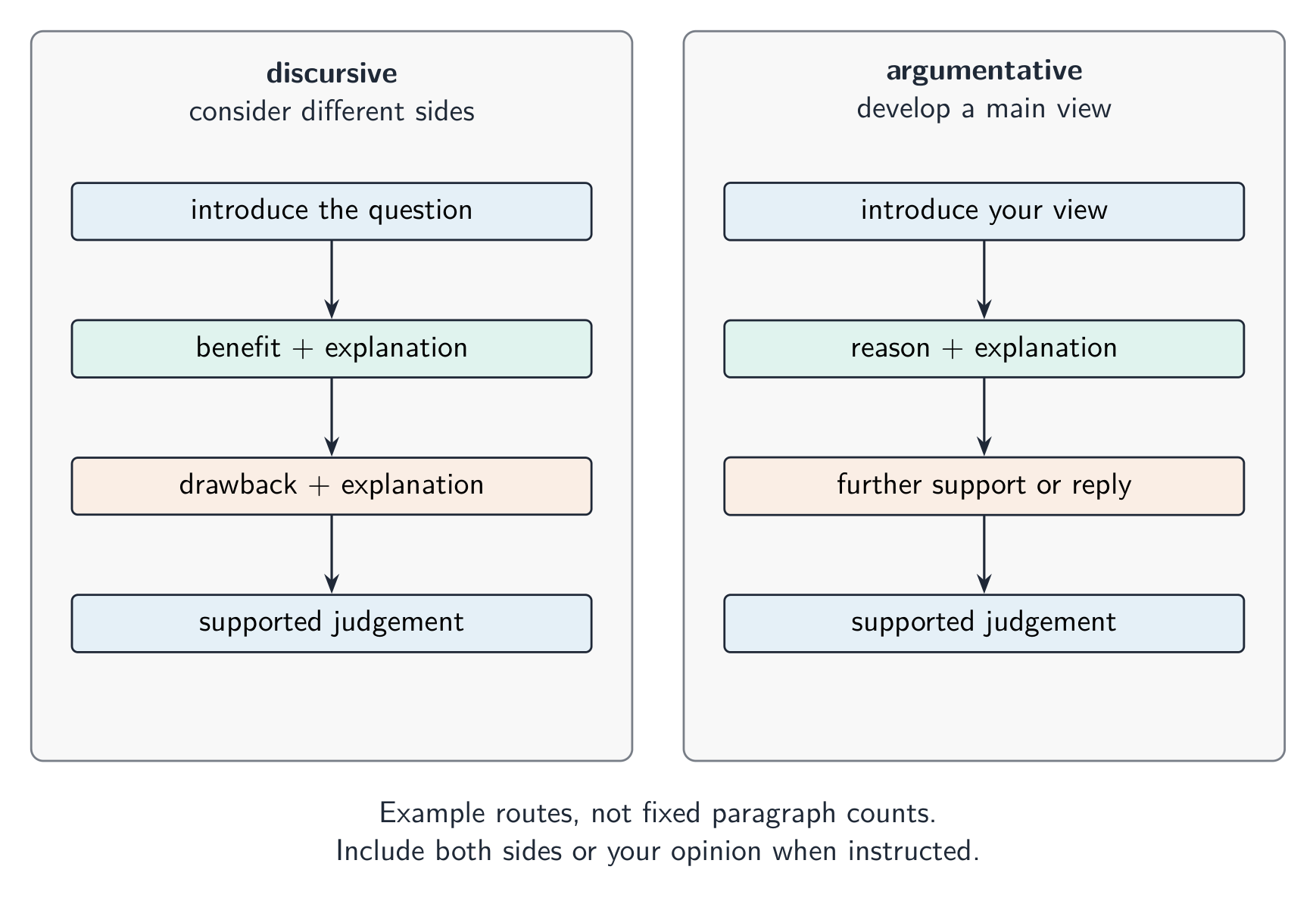
A discursive 论述的 approach considers different sides of an issue. Explain the benefits and drawbacks fairly rather than listing them. If the task asks for your opinion, give a supported judgement; considering both sides does not remove that requirement.
Argumentative essays
An argumentative 议论的 approach develops a main view. A relevant objection and reply can strengthen it, but a separate counterargument paragraph is not compulsory in every task. If the task explicitly asks for arguments for and against, include both. These are useful approaches, not two completely separate exam marking systems.
Plan first
Read the format, reader, purpose and exact question. Select a few relevant ideas that you can explain within the word range. Plan their order and your judgement. A short planning period helps; three minutes is a possible personal routine, not an official rule.
Original planning task. Your teacher asks for an essay giving your opinion on whether the school library should stay open after lessons. Write 120–160 words. Suggested comments: “We need a quiet place”; “Staffing will cost money”. Develop ideas in your own words and add an idea of your own.
Before drafting, decide which ideas belong: quiet study; extra supervision costs; a two-afternoon trial; the colour of the library walls. Explain your selection.
Worked plan. Support a limited trial. Explain how quiet space helps students with busy homes; consider supervision costs; propose two afternoons a week to test demand. Wall colour is irrelevant unless it contributes to the actual opening-hours argument. Do not invent a survey or statistics to make an example sound proven.

Vocabulary
Train
| English |
|---|
| essay/ˈeseɪ/ |
| discursive/dɪˈskɜːsɪv/ |
| argumentative/ˌɑːɡjuːˈmentətɪv/ |
8.2
How to structure an essay
Syllabus
- introduce the topic and your approach in the introduction
- develop one main idea per paragraph in the body, with reasons and examples
- draw the ideas together in a clear conclusion
Source: Cambridge International syllabus
A reader needs to understand the question, follow your reasons and see your conclusion. Paragraphs organise related ideas. There is no universal five-paragraph rule or requirement for exactly one argument in each paragraph.
Introduction
The introduction 引言 identifies the issue and sets up the approach. State your view if that helps answer the task. Keep enough space for developed ideas; “two or three sentences” is a possible guide, not a required count. A rhetorical question is optional, and no essay heading is required.
Original attempt. Improve this opening for the library task: “Since the beginning of time, libraries have been very important in the modern world. There are many advantages and disadvantages.”
Worked revision. “The school library currently closes after lessons. I believe it should stay open on two afternoons a week so students have somewhere quiet to study.” The revision addresses the actual policy and gives a clear direction. It avoids a memorised opening that could fit almost any topic.
Body paragraphs
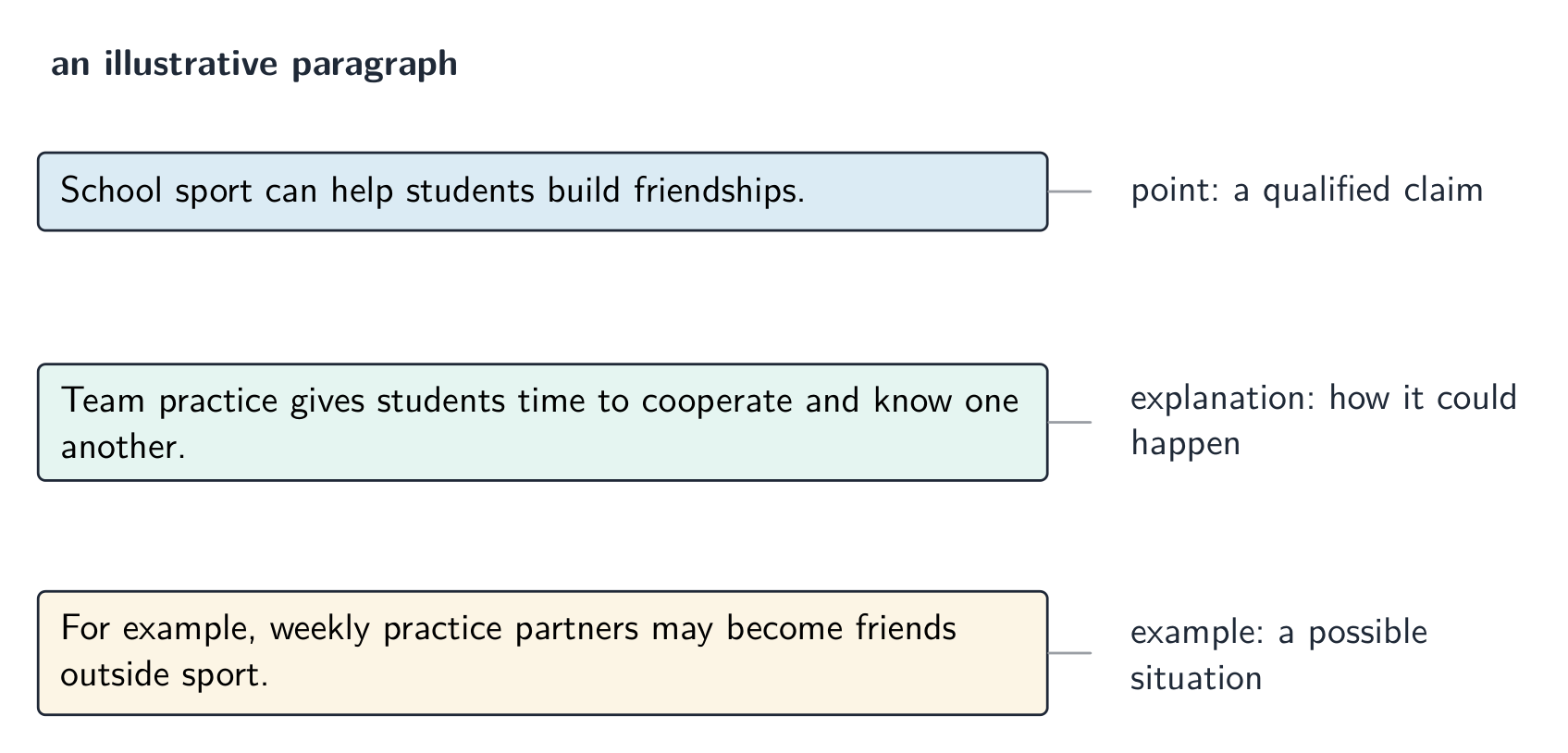
The body 主体 develops the argument. A topic sentence, explanation and example are a helpful scaffold, not a compulsory three-sentence formula. A paragraph may connect more than one related reason if the relationship stays clear.
Original development task. Improve “Homework is good because it is useful.” Explain a specific benefit and give a relevant example. Do not claim that all independent work succeeds or that real learning only happens at home.
Worked paragraph. “Short homework tasks can help students practise working independently. Without immediate teacher support, they need to choose a method and notice where they are stuck. For example, trying a new maths problem may reveal a question to ask in the next lesson.” The explanation shows how the benefit could arise; the example makes it concrete without proving that every task helps every student.
Original objection task. A writer says, “Library staff cost money. Therefore, the library must stay closed.” Keep the genuine concern but answer it with the limited-trial plan.
Worked reply. “Extra opening hours would require supervision. However, a trial on two afternoons a week would let the school check demand before paying for a daily service.” This responds to the concern. Simply calling opponents lazy or selfish does not answer their reason.
Conclusion
The conclusion 结论 draws together the argument and answers the task. A qualified view is still a clear view: “Open on two trial afternoons” is more precise than “Both sides have points”. Avoid introducing an important new reason that the body has not explained. Do not claim that every essay must choose an absolute yes or no.
Useful language
Linking words 衔接词 show relationships, but there is no compulsory number per paragraph or rule that every link starts a sentence. Pronouns, repeated key ideas and relative clauses also connect writing.
- Addition: “The library provides books. It also offers a quiet place to work.”
- Reason: “A trial is sensible because the school does not yet know the demand.”
- Contrast: “The service would be useful. However, supervision costs money.”
- Concession: “Although supervision costs money, a short trial could be affordable.”
- Example: “Some students need quiet space; for example, they may share a busy room at home.”
Original repair task. Correct “Although the library is useful. It costs money.” Then replace the wrong link in “Staff must be paid. Furthermore, the school cannot afford daily opening.”
Worked repair. “Although the library is useful, it costs money.” The although-clause needs a main clause; “although” and “however” do not have identical grammar. In the second example, “Therefore” fits if the staffing cost is the stated reason that daily opening is unaffordable; “furthermore” only adds another point. “However” instead fits a contrast such as “The school has a large budget. However, it has not funded longer opening hours.” Meaning decides the link.
A complete original model
Read the four paragraphs, then identify the view, a developed benefit, a genuine objection, the reply and the final judgement. This is a teaching model, not an officially marked candidate answer.
Should the school library stay open after lessons? I believe it should, because students need a quiet place to study. However, the school must consider the cost of keeping it open.
An open library would help students who share a busy room at home. They could finish homework without constant interruptions. For example, a student waiting for a later bus could use that time to read rather than sit outside.
There would be extra costs, since someone must supervise the room. Nevertheless, the school could begin with two afternoons a week instead of opening every day. This would allow it to check demand before spending more money.
Overall, a limited trial would be sensible. It would give students useful study time while helping the school decide whether longer opening hours are worth the cost.
The model has 134 words by a space-separated count. Its body explains quiet study and the cost concern; the trial provides the writer’s own proposal. The conclusion follows those reasons. Four paragraphs work here, but the number alone earns no guaranteed mark.

Vocabulary
Train
| English |
|---|
| introduction/ˌɪntrəˈdʌkʃn/ |
| body/ˈbɒdi/ |
| conclusion/kənˈkluːʒn/ |
| linking words/ˈlɪŋkɪŋ wɜːdz/ |
8.2
Exam tips
The official February/March 2025 0510/12 Question 17 asks for an essay for a teacher giving an opinion about teenagers doing exercise. It offers comments as starting ideas and also requests the candidate’s own ideas. The task is not a general description of sport. The official scheme assesses task fulfilment and development, appropriate style and audience, language range and accuracy, and organisation. It does not allocate an automatic mark for a counterargument, a fixed number of links or a fixed paragraph count.
Cambridge’s official essay guide likewise permits one-sided or balanced organisation depending on the instruction. Its examiner comments warn against too many undeveloped ideas, memorised openings, copied comments and a linking word at the start of every sentence.
Independent original task. Your teacher asks for an essay discussing the benefits and drawbacks of replacing one homework task each week with independent reading, and giving your opinion. Write 120–160 words. Comments: “Students could choose books”; “Some might not read”; “Teachers need to know what was learned”. Develop both sides, include an idea of your own and reach a supported judgement.
Possible plan, not a complete answer. Explain choice and interest; consider limited participation; propose a short reading record rather than assuming everyone will read; decide whether a trial is sensible. Other relevant supported views are valid. Write your own full response before checking it.
Check the actual format and question, relevant developed ideas, the required opinion or both sides, neutral/formal style, coherent order and natural links. Then check word range, verb forms, sentence boundaries, punctuation and spelling. No checklist guarantees a score; use the actual official criteria to review the whole response.
Vocabulary card meanings
discursive: Writing that explores an issue from several angles. argumentative: Writing that presses one side and answers objections.
Interactive lessons on this topic
Work through it step by step, with instant-check exercises.