Headings, facts and recommendations
IntroducedUse headings
- Break the report into short sections with headings.
- For example: Introduction, Problems, Recommendation.
- Headings help the reader find information fast.
Headings are signposts; they cannot do the walking for the evidence.
Layout of a report
A report is scannable: header line, introduction, findings under headings, one recommendation.
A principal wants to find the advice quickly. Which heading best identifies that section?
Recommendation names the advice section. A heading should accurately describe the content below it.
Facts first
- Give the facts clearly.
- Keep your opinion out of this part.
- A report is factual, not a story.
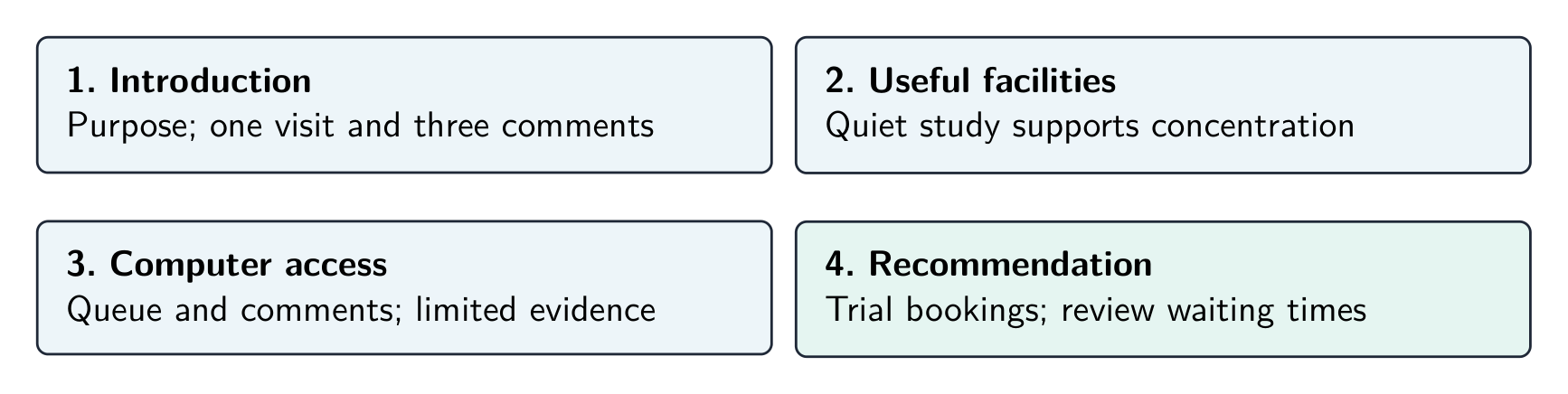
The shape of a report: facts under clear headings, recommendations at the end
The facts section should be full of your personal opinions.
Keep opinions out of the facts; save them for the recommendation.
End with a recommendation
- After the facts, give your recommendations.
- Say clearly what you think should happen.
- Finish with one clear recommendation.
A report ends with a clear ___ (advice on what to do).
End with a clear recommendation.
Write one recommendation for your school, starting with 'I recommend'.
Example: 'I recommend that the school adds more sports clubs.'
A report skeleton you can reuse
- To: the Principal · From: Li Hua · Subject: Canteen queues — a title line, not a greeting.
- Introduction: "This report summarises students' views on lunchtime queues."
- Findings: two or three facts, each in one clear sentence — headings keep them tidy.
- Recommendation: "I recommend opening a second till." — advice lives only here.
Put the report sections in order, top to bottom.
Header, introduction, findings, recommendation — the reader can jump straight to any part.
- Short headings organise a report.
- Facts first; keep opinions out of that part.
- End with a clear recommendation.