Structure and useful language
IntroducedGreeting and ending
- Start with a greeting: Hi Sam,
- End with a friendly closing: Write back soon, then your name.
- These frame your email.
A friendly closing is a door, not a second essay.
Practice
Put the parts of an informal email in order.
Greeting, message, friendly closing, then your name.
Practice
Write a friendly greeting line and the first sentence of an email to a friend.
Example: 'Hi Mia, I've got some exciting news!'
Short paragraphs
- Use short paragraphs, one idea each.
- Do not write one long block of text.
- This keeps the email easy to read.
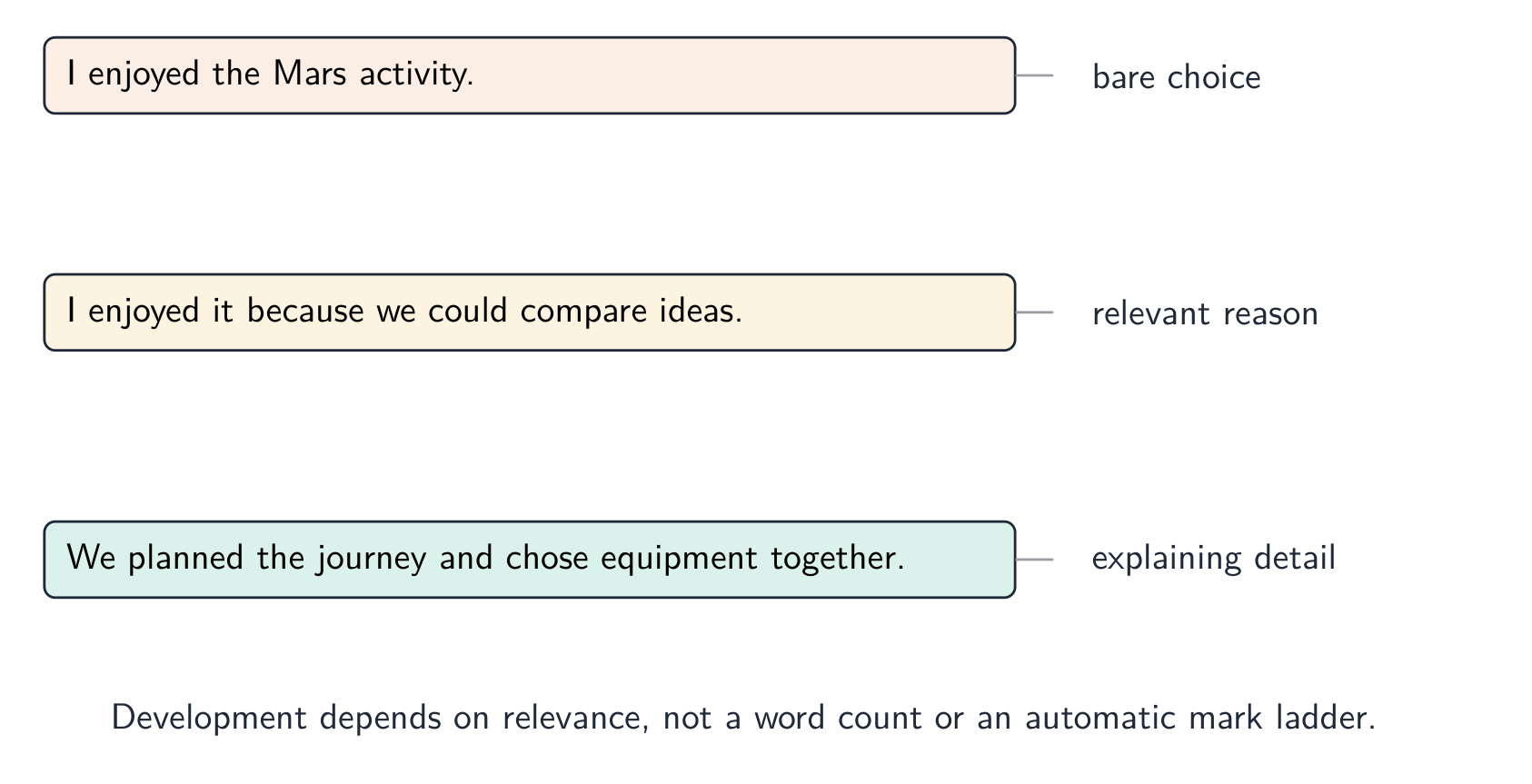
Each extra reason or detail makes the idea stronger
Friendly language
- Use short forms: I'm, don't, can't.
- Use friendly phrases: Guess what!, How are you?
- Ask the reader questions to sound natural.
Explore
Where does this phrase live?
Useful phrases belong to a place: openers up top, bridges in the middle, sign-offs at the end.
Practice
An informal email to a friend should sound…
Friends get a warm, friendly tone.
Practice
Make it informal: 'I ___ wait to see you!' (can't / cannot)
Informal writing uses short forms like 'can't'.
Steal this skeleton
- Hi ___, → Thanks for your email — great to hear from you!
- Middle: one prompt per paragraph, opened with chatty bridges: Anyway, you asked about…, The best part was…
- By the way, why don't you visit in July? — a question keeps the chat alive.
- Write back soon, + your name — frame closed, friend happy.
Practice
Match each chatty bridge to its job.
Bridges make an email feel like real conversation instead of a list of answers.
Key idea
- Greeting → short paragraphs → friendly closing.
- One idea per paragraph.
- Short forms and friendly phrases keep the tone warm.