Skip to content · ⁨Lompat ke konten⁩

Thermochemistry · ⁨Termokimia⁩

AP Chemistry · ⁨AP Kimia⁩ · Topic 6 · ⁨Topik 6⁩

Video lesson for this topic · ⁨Pelajaran video untuk topik ini⁩ Open the video page · ⁨Buka halaman video⁩
8:53

Termokimia

Peras kemasan ini dan dalam hitungan detik ia menjadi sangat dingin. Tidak ada yang membakar; tidak ada yang mendinginkannya dari luar. Zat padat sekadar larut dalam air di dalam…

English narration · English + 中文 subtitles burned in · ⁨Narasi bahasa Inggris · Subtitle bahasa Inggris + 中文 disematkan langsung⁩

6.1

Endothermic and Exothermic Processes · ⁨Proses Endotermik dan Eksotermik⁩

Syllabus · ⁨Silabus⁩
English

Learning Objective 6.1.A: Explain the relationship between experimental observations and energy changes associated with a chemical or physical transformation.

  • 6.1.A.1 Temperature changes in a system indicate energy changes.
  • 6.1.A.2 Energy changes in a system can be described as endothermic and exothermic processes such as the heating or cooling of a substance, phase changes, or chemical transformations.
  • 6.1.A.3 When a chemical reaction occurs, the energy of the system either decreases (exothermic reaction), increases (endothermic reaction), or remains the same. For exothermic reactions, the energy lost by the reacting species (system) is gained by the surroundings, as heat transfer from or work done by the system. Likewise, for endothermic reactions, the system gains energy from the surroundings by heat transfer to or work done on the system.
  • 6.1.A.4 The formation of a solution may be an exothermic or endothermic process, depending on the relative strengths of intermolecular/interparticle interactions before and after the dissolution process.
Bahasa Indonesia

Tujuan Pembelajaran 6.1.A: Menjelaskan hubungan antara pengamatan eksperimen dan perubahan energi yang terkait dengan transformasi kimia atau fisika.

  • 6.1.A.1 Perubahan suhu dalam suatu sistem menunjukkan adanya perubahan energi.
  • 6.1.A.2 Perubahan energi dalam suatu sistem dapat digambarkan sebagai proses endotermik dan eksotermik seperti pemanasan atau pendinginan suatu zat, perubahan fase, atau transformasi kimia.
  • 6.1.A.3 Ketika reaksi kimia terjadi, energi sistem dapat menurun (reaksi eksotermik), meningkat (reaksi endotermik), atau tetap sama. Untuk reaksi eksotermik, energi yang hilang oleh spesies yang bereaksi (sistem) diterima oleh lingkungan, baik melalui perpindahan panas maupun kerja yang dilakukan oleh sistem. Demikian pula, untuk reaksi endotermik, sistem menerima energi dari lingkungan melalui perpindahan panas ke sistem atau kerja yang dilakukan pada sistem.
  • 6.1.A.4 Pembentukan larutan dapat merupakan proses eksotermik atau endotermik, tergantung pada kekuatan relatif interaksi antar molekul/antar partikel sebelum dan setelah proses pelarutan.
Source: College Board AP Course and Exam Description · ⁨Sumber: Deskripsi Kursus dan Ujian College Board AP⁩

English

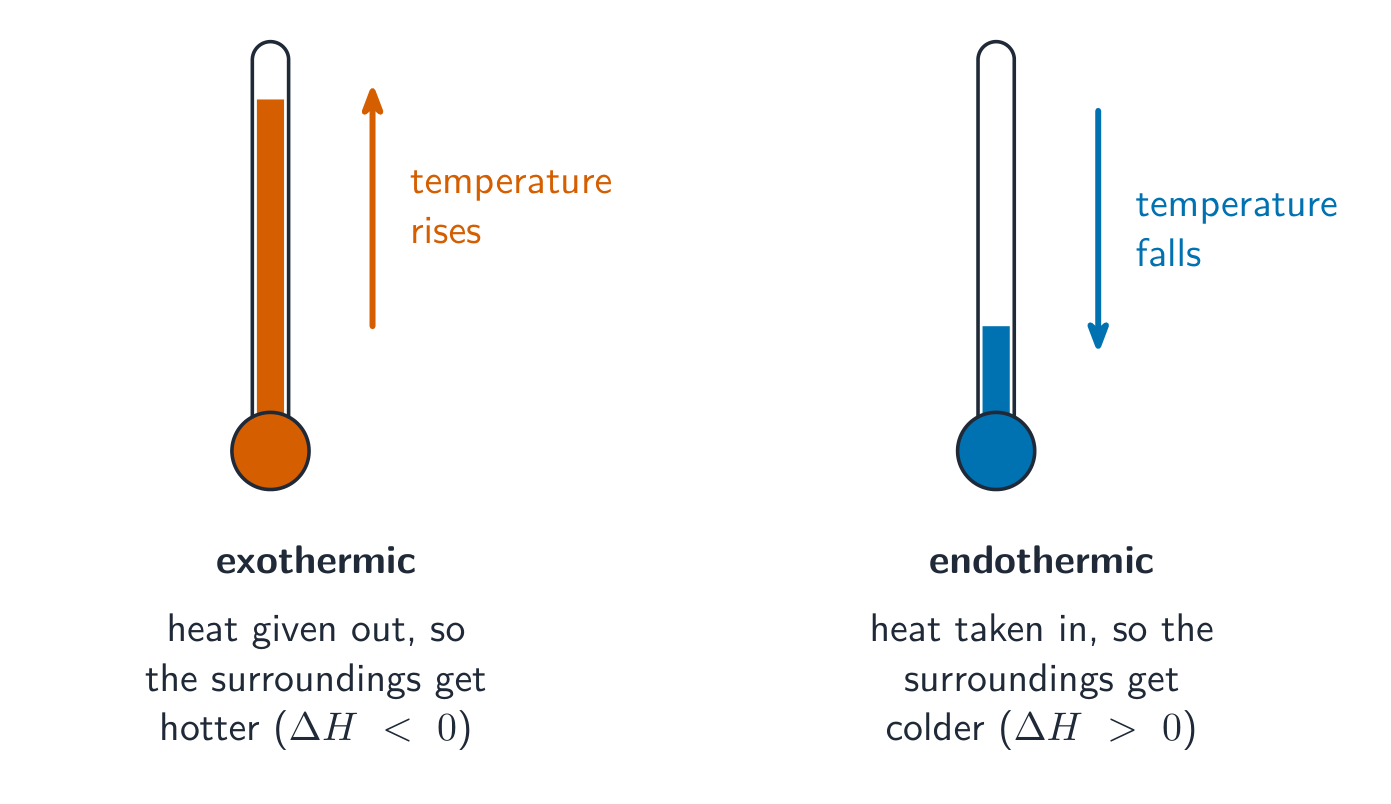
Thermochemistry 热化学 tracks energy in reactions. A process is exothermic 放热 if it releases energy to the surroundings (feels hot, $\Delta H<0$) and endothermic 吸热 if it absorbs energy (feels cold, $\Delta H>0$). Breaking bonds costs energy; forming bonds releases it – the net decides the sign.

Bahasa Indonesia
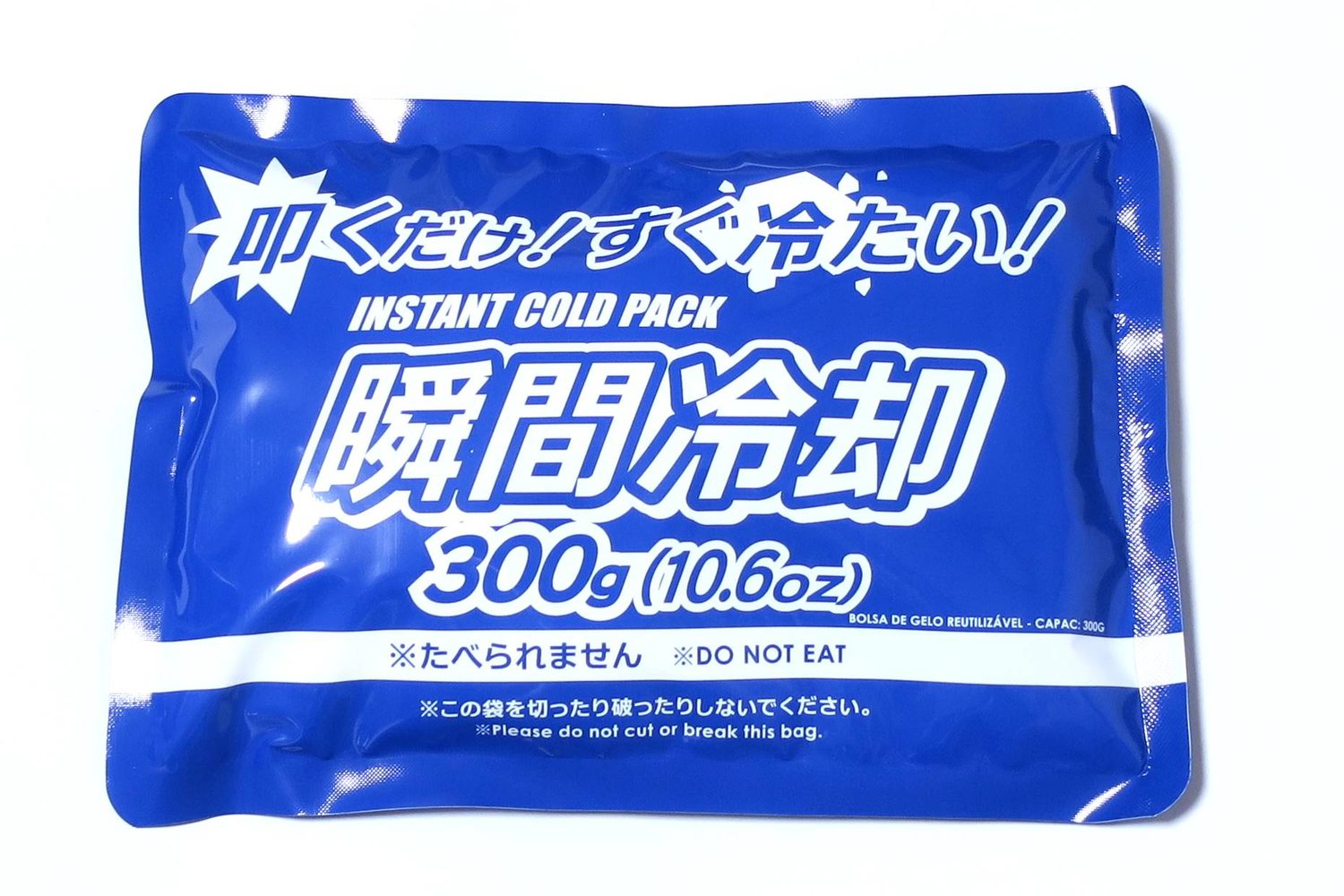
Tas dingin instan: proses endotermik menyerap panas dari lingkungan

Termokimia melacak energi dalam reaksi. Suatu proses eksotermik jika melepaskan energi ke lingkungan (terasa panas, $\Delta H<0$) dan endotermik jika menyerap energi (terasa dingin, $\Delta H>0$). Memutus ikatan membutuhkan energi; membentuk ikatan melepaskannya – neto yang menentukan tandanya.

Reaksi eksotermik menghangatkan lingkungan; endotermik mendinginkannya
Explore · ⁨Jelajahi⁩

Compare endothermic and exothermic profiles · ⁨Bandingkan profil endotermik dan eksotermik⁩

An exothermic reaction releases energy (products lower than reactants, $\Delta H<0$); an endothermic one absorbs it. The hump is the activation energy. · ⁨Reaksi eksotermik melepaskan energi (produk lebih rendah dari reaktan, $\Delta H<0$); reaksi endotermik menyerapnya. Puncaknya adalah energi aktivasi.⁩

6.2

Energy Diagrams · ⁨Diagram Energi⁩

Syllabus · ⁨Silabus⁩
English

Learning Objective 6.2.A: Represent a chemical or physical transformation with an energy diagram.

  • 6.2.A.1 A physical or chemical process can be described with an energy diagram that shows the endothermic or exothermic nature of that process.
Bahasa Indonesia

Tujuan Pembelajaran 6.2.A: Merepresentasikan transformasi kimia atau fisika dengan diagram energi.

  • 6.2.A.1 Suatu proses fisik atau kimia dapat dijelaskan dengan diagram energi yang menunjukkan sifat endotermik atau eksotermik dari proses tersebut.

Source: College Board AP Course and Exam Description · ⁨Sumber: Deskripsi Kursus dan Ujian College Board AP⁩

English

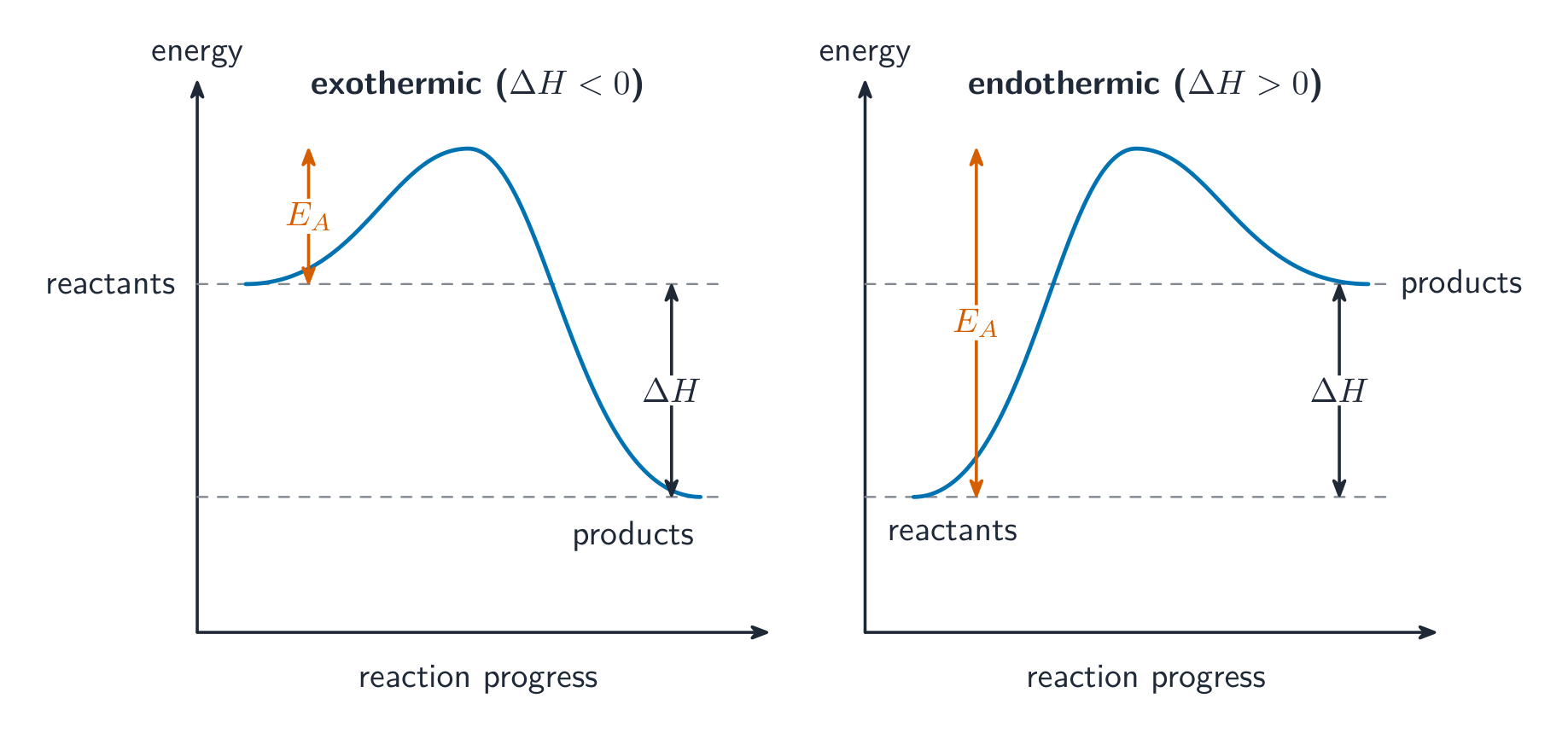
An energy diagram plots energy from reactants to products. Reactants above products means exothermic; below means endothermic. The vertical gap between them is the enthalpy change $\Delta H$.

Bahasa Indonesia

Diagram energi memplot energi dari reaktan hingga produk. Reaktan di atas produk berarti eksotermik; di bawah berarti endotermik. Selisih vertikal di antara keduanya adalah perubahan entalpi $\Delta H$.

Diagram energi: produk eksotermik berada di bawah reaktan, endotermik di atas
6.3

Heat Transfer and Thermal Equilibrium · ⁨Perpindahan Kalor dan Kesetimbangan Termal⁩

Syllabus · ⁨Silabus⁩
English

Learning Objective 6.3.A: Explain the relationship between the transfer of thermal energy and molecular collisions.

  • 6.3.A.1 The particles in a warmer body have a greater average kinetic energy than those in a cooler body.
  • 6.3.A.2 Collisions between particles in thermal contact can result in the transfer of energy. This process is called "heat transfer," "heat exchange," or "transfer of energy as heat."
  • 6.3.A.3 Eventually, thermal equilibrium is reached as the particles continue to collide. At thermal equilibrium, the average kinetic energy of both bodies is the same, and hence, their temperatures are the same.
Bahasa Indonesia

Tujuan Pembelajaran 6.3.A: Menjelaskan hubungan antara perpindahan energi termal dan tumbukan molekul.

  • 6.3.A.1 Partikel dalam tubuh yang lebih hangat memiliki rata-rata energi kinetik yang lebih besar daripada partikel dalam tubuh yang lebih dingin.
  • 6.3.A.2 Tumbukan antara partikel yang bersentuhan secara termal dapat menghasilkan perpindahan energi. Proses ini disebut "perpindahan panas", "pertukaran panas", atau "transfer energi sebagai panas".
  • 6.3.A.3 Pada akhirnya, kesetimbangan termal tercapai saat partikel terus menumbuk. Pada kesetimbangan termal, rata-rata energi kinetik kedua tubuh adalah sama, sehingga suhunya juga sama.

Source: College Board AP Course and Exam Description · ⁨Sumber: Deskripsi Kursus dan Ujian College Board AP⁩

English

Heat 热量 flows from hot to cold until objects reach thermal equilibrium 热平衡 (equal temperature). Energy is conserved: the heat lost by the hot object equals the heat gained by the cold one.

Bahasa Indonesia

Kalor mengalir dari panas ke dingin hingga benda mencapai kesetimbangan termal (suhu sama). Energi kekal: kalor yang hilang oleh benda panas sama dengan kalor yang diterima benda dingin.

6.4

Heat Capacity and Calorimetry · ⁨Kapasitas Kalor dan Kalorimetri⁩

Syllabus · ⁨Silabus⁩
English

Learning Objective 6.4.A: Calculate the heat $q$ absorbed or released by a system undergoing heating/cooling based on the amount of the substance, the heat capacity, and the change in temperature.

  • 6.4.A.1 The heating of a cool body by a warmer body is an important form of energy transfer between two systems. The amount of heat transferred between two bodies may be quantified by the heat transfer equation:

    • Equation: $q = mc\Delta T$.

    Calorimetry experiments are used to measure the transfer of heat.

  • 6.4.A.2 The first law of thermodynamics states that energy is conserved in chemical and physical processes.

  • 6.4.A.3 The transfer of a given amount of thermal energy will not produce the same temperature change in equal masses of matter with differing specific heat capacities.

  • 6.4.A.4 Heating a system increases the energy of the system, while cooling a system decreases the energy of the system.

  • 6.4.A.5 The specific heat capacity of a substance and the molar heat capacity are both used in energy calculations.

  • 6.4.A.6 Chemical systems change their energy through three main processes: heating/cooling, phase transitions, and chemical reactions.

  • 6.4.A.7 In calorimetry experiments involving dissolution, temperature changes of the mixture within the calorimeter can be used to determine the direction of energy flow. If the temperature of the mixture increases, thermal energy is released by the dissolution process (exothermic). If the temperature of the mixture decreases, thermal energy is absorbed by the dissolution process (endothermic).

Bahasa Indonesia

Tujuan Pembelajaran 6.4.A: Menghitung kalor $q$ yang diserap atau dilepaskan oleh sistem yang mengalami pemanasan/pendinginan berdasarkan jumlah zat, kapasitas kalor, dan perubahan suhu.

  • 6.4.A.1 Pemanasan tubuh dingin oleh tubuh yang lebih hangat merupakan bentuk penting perpindahan energi antara dua sistem. Jumlah kalor yang dipertukarkan antara dua tubuh dapat dikuantifikasi menggunakan persamaan perpindahan kalor:

    • Persamaan: $q = mc\Delta T$.

    Eksperimen kalorimetri digunakan untuk mengukur perpindahan kalor.

  • 6.4.A.2 Hukum pertama termodinamika menyatakan bahwa energi kekal dalam proses kimia dan fisik.

  • 6.4.A.3 Perpindahan sejumlah energi termal tertentu tidak akan menghasilkan perubahan suhu yang sama pada massa materi yang setara dengan kapasitas kalor spesifik yang berbeda.

  • 6.4.A.4 Memanaskan sistem meningkatkan energi sistem, sedangkan mendinginkan sistem menurunkan energi sistem.

  • 6.4.A.5 Kapasitas kalor spesifik suatu zat dan kapasitas kalor molar keduanya digunakan dalam perhitungan energi.

  • 6.4.A.6 Sistem kimia mengubah energinya melalui tiga proses utama: pemanasan/pendinginan, transisi fase, dan reaksi kimia.

  • 6.4.A.7 Dalam eksperimen kalorimetri yang melibatkan pelarutan, perubahan suhu campuran di dalam kalorimeter dapat digunakan untuk menentukan arah aliran energi. Jika suhu campuran meningkat, energi termal dilepaskan oleh proses pelarutan (eksotermik). Jika suhu campuran menurun, energi termal diserap oleh proses pelarutan (endotermik).

Source: College Board AP Course and Exam Description · ⁨Sumber: Deskripsi Kursus dan Ujian College Board AP⁩

English

The heat to change a substance's temperature is

$$q=mc\,\Delta T,$$
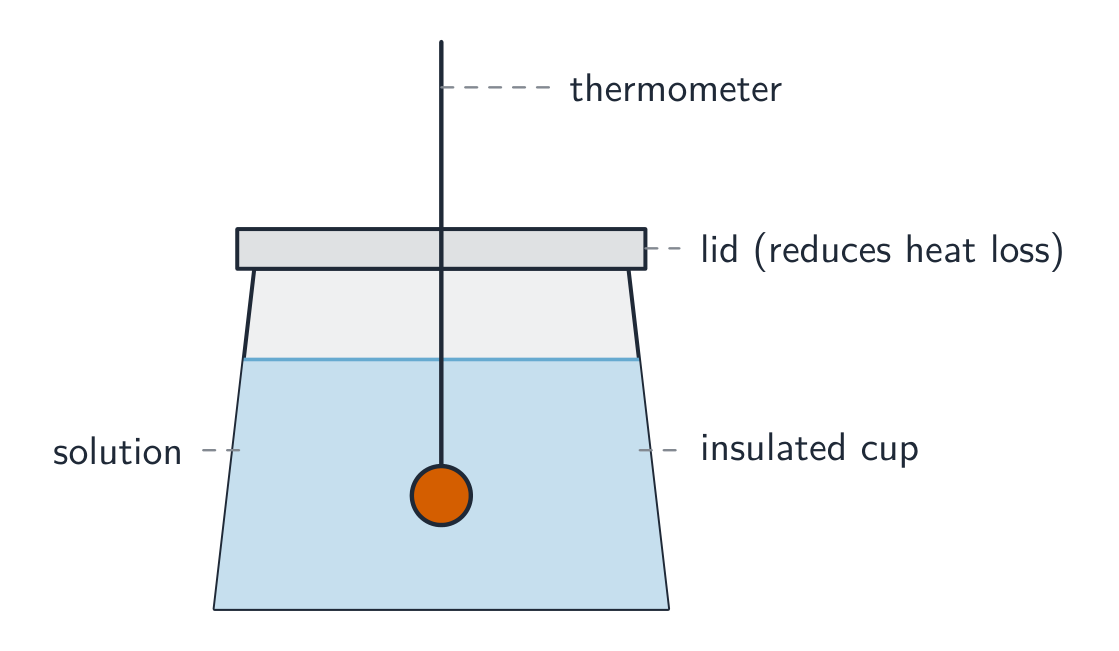
where $c$ is the specific heat 比热容 (energy per gram per degree). Calorimetry 量热法 measures a reaction's heat by tracking the temperature change of surrounding water: the heat the water gains equals the heat the reaction releases.

Worked example. A reaction in a coffee-cup calorimeter warms $100\ \text{g}$ of water by $8.0\,{}^{\circ}\text{C}$ ($c=4.18\ \text{J/(g}\,{}^{\circ}\text{C)}$). The heat absorbed by the water is

$$q=mc\,\Delta T=100\times4.18\times8.0=3.3\times10^{3}\ \text{J}.$$
By energy conservation the reaction released this $3.3\ \text{kJ}$, so it is exothermic ($q_{\text{rxn}}=-3.3\ \text{kJ}$).

Bahasa Indonesia

Kalor untuk mengubah suhu suatu zat adalah

$$q=mc\,\Delta T,$$
di mana $c$ adalah kapasitas kalor spesifik (energi per gram per derajat). Kalorimetri mengukur kalor reaksi dengan melacak perubahan suhu air di sekitarnya: kalor yang diterima air sama dengan kalor yang dilepaskan reaksi.

Kalorimetri: ukur perubahan suhu massa larutan yang diketahui

Contoh terarah. Reaksi dalam kalorimeter cangkir kopi menghangatkan $100\ \text{g}$ air sebanyak $8.0\,{}^{\circ}\text{C}$ ($c=4.18\ \text{J/(g}\,{}^{\circ}\text{C)}$). Kalor yang diserap air adalah

$$q=mc\,\Delta T=100\times4.18\times8.0=3.3\times10^{3}\ \text{J}.$$
Dengan kekekalan energi, reaksi melepaskan jumlah $3.3\ \text{kJ}$ ini, sehingga bersifat eksotermik ($q_{\text{rxn}}=-3.3\ \text{kJ}$).

Explore · ⁨Jelajahi⁩

Heat different materials · ⁨Pemanasan material berbeda⁩

$Q=mc\Delta T$: a high specific heat (like water's) means a lot of energy for a small temperature rise. Compare materials for the same heat input. · ⁨$Q=mc\Delta T$: kalor jenis tinggi (seperti air) berarti butuh banyak energi untuk kenaikan suhu kecil. Bandingkan material untuk input panas yang sama.⁩

Vocabulary · ⁨Kosa kata⁩ Train · ⁨Latih⁩
English Bahasa Indonesia
Thermochemistry/ˈθɜːməkemɪstri/ Termokimia
exothermic/eɡzəˈðɜːmɪk/ eksotermik
endothermic/ˌendəʊˈθɜːmɪk/ endotermik
Heat/hiːt/ Kalor
thermal equilibrium/ˈθɜːml ˌiːkwɪˈlɪbrɪəm/ kesetimbangan termal
specific heat/spəˈsɪfɪk hiːt/ kalor jenis
Calorimetry/ˌkælɔːˈrɪmətri/ Kalorimetri
phase change/feɪz tʃeɪndʒ/ perubahan fase
enthalpy of reaction/enˈθælpi ɒv rɪˈækʃn/ entalpi reaksi
state function/steɪt ˈfʌŋkʃn/ fungsi keadaan
standard enthalpy of formation/ˈstændəd enˈθælpi ɒv fɔːˈmeɪʃn/ entalpi pembentukan standar
Hess's law/ˈhesɪz lɔː/ Hukum Hess
6.5

Energy of Phase Changes · ⁨Energi Perubahan Fase⁩

Syllabus · ⁨Silabus⁩
English

Learning Objective 6.5.A: Explain changes in the heat $q$ absorbed or released by a system undergoing a phase transition based on the amount of the substance in moles and the molar enthalpy of the phase transition.

  • 6.5.A.1 Energy must be transferred to a system to cause a substance to melt (or boil). The energy of the system therefore increases as the system undergoes a solid-to-liquid (or liquid-to-gas) phase transition. Likewise, a system releases energy when it freezes (or condenses). The energy of the system decreases as the system undergoes a liquid-to-solid (or gas-to-liquid) phase transition. The temperature of a pure substance remains constant during a phase change.
  • 6.5.A.2 The energy absorbed during a phase change is equal to the energy released during a complementary phase change in the opposite direction. For example, the molar enthalpy of condensation of a substance is equal to the negative of its molar enthalpy of vaporization. Similarly, the molar enthalpy of fusion can be used to calculate the energy absorbed when melting a substance and the energy released when freezing a substance.
Bahasa Indonesia

Tujuan Pembelajaran 6.5.A: Menjelaskan perubahan kalor $q$ yang diserap atau dilepaskan oleh sistem yang mengalami transisi fase berdasarkan jumlah zat dalam mol dan entalpi molar transisi fase.

  • 6.5.A.1 Energi harus dipindahkan ke sistem untuk menyebabkan suatu zat meleleh (atau mendidih). Oleh karena itu, energi sistem meningkat saat sistem mengalami transisi fase dari padat ke cair (atau cair ke gas). Sebaliknya, sistem melepaskan energi ketika membeku (atau mengembun). Energi sistem menurun saat sistem mengalami transisi fase dari cair ke padat (atau gas ke cair). Suhu suatu zat murni tetap konstan selama perubahan fase.
  • 6.5.A.2 Energi yang diserap selama perubahan fase sama dengan energi yang dilepaskan selama perubahan fase komplementer ke arah berlawanan. Sebagai contoh, entalpi molar pengembunan suatu zat sama dengan negatif dari entalpi molar penguatannya. Demikian pula, entalpi fusi molar dapat digunakan untuk menghitung energi yang diserap saat melelehkan suatu zat dan energi yang dilepaskan saat membekukan suatu zat.

Source: College Board AP Course and Exam Description · ⁨Sumber: Deskripsi Kursus dan Ujian College Board AP⁩

English

During a phase change 相变 (melting, boiling) the temperature stays constant while heat goes into breaking intermolecular forces, not raising kinetic energy. The energy needed is $q=n\,\Delta H_{\text{fus}}$ (melting) or $q=n\,\Delta H_{\text{vap}}$ (boiling) – the flat steps on a heating curve.

Bahasa Indonesia

Selama perubahan fase (mencair, mendidih), suhu tetap konstan sementara panas digunakan untuk memutus gaya antarmolekul, bukan menaikkan energi kinetik. Energi yang dibutuhkan adalah $q=n\,\Delta H_{\text{fus}}$ (mencair) atau $q=n\,\Delta H_{\text{vap}}$ (mendidih) – langkah datar pada kurva pemanasan.

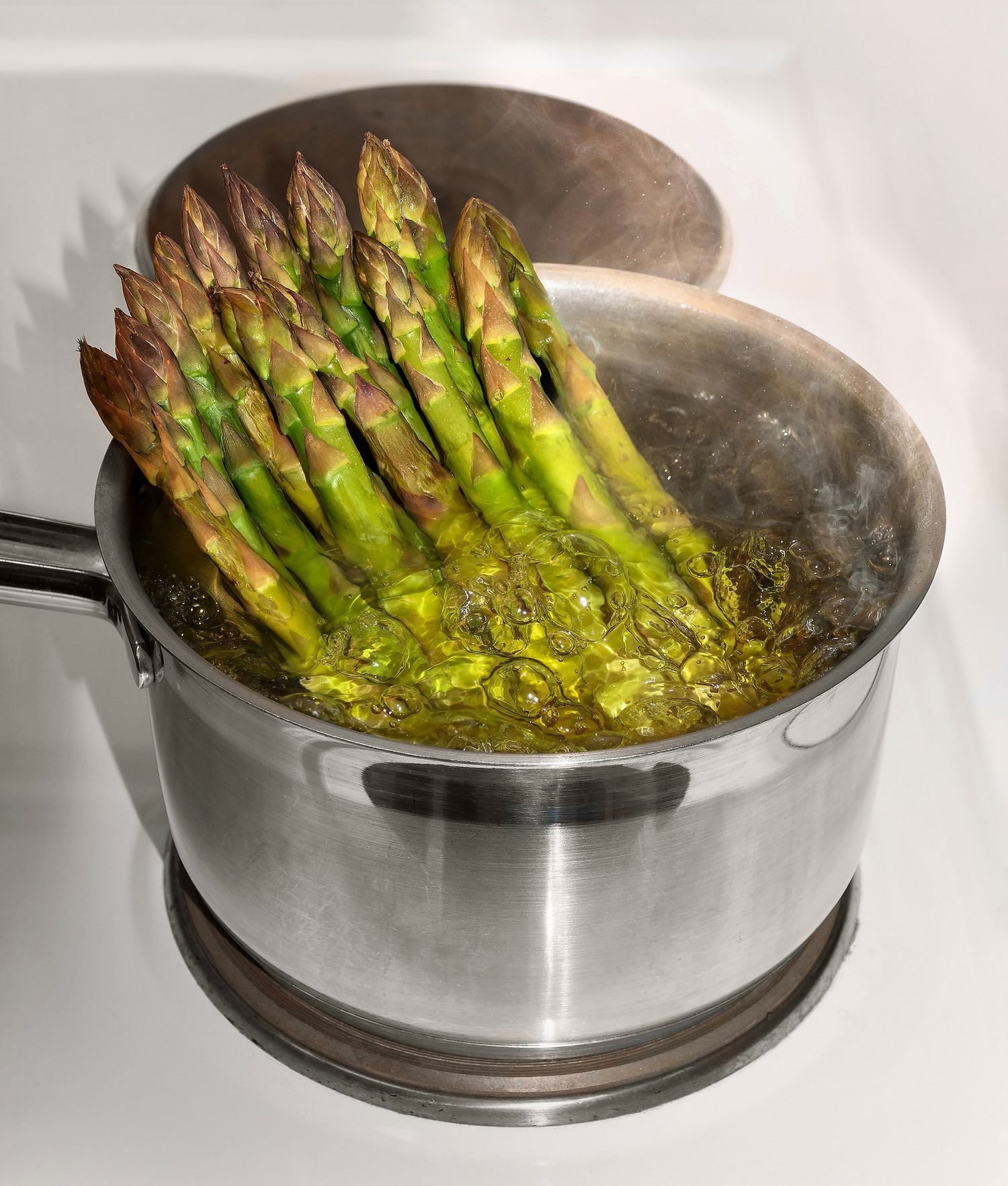
Uap dari air mendidih: perubahan fase menyerap atau melepaskan energi pada suhu konstan
Explore · ⁨Jelajahi⁩

Heat through a phase change · ⁨Panas melalui perubahan fase⁩

During a phase change the temperature holds flat while energy breaks bonds — the latent heat. Watch the plateaus at melting and boiling. · ⁨Selama perubahan fase, suhu tetap datar sementara energi memecah ikatan — kalor laten. Lihat dataran pada pelelehan dan pendidihan.⁩

6.6

Introduction to Enthalpy of Reaction · ⁨Pengenalan Entalpi Reaksi⁩

Syllabus · ⁨Silabus⁩
English

Learning Objective 6.6.A: Calculate the heat $q$ absorbed or released by a system undergoing a chemical reaction in relationship to the amount of the reacting substance in moles and the molar enthalpy of reaction.

  • 6.6.A.1 The enthalpy change of a reaction gives the amount of heat energy released (for negative values) or absorbed (for positive values) by a chemical reaction at constant pressure.
  • 6.6.A.2 When the products of a reaction are at a different temperature than their surroundings, they exchange energy with the surroundings to reach thermal equilibrium. Thermal energy is transferred to the surroundings as the reactants convert to products in an exothermic reaction. Thermal energy is transferred from the surroundings as the reactants convert to products in an endothermic reaction.
  • 6.6.A.3 The chemical potential energy of the products of a reaction is different from that of the reactants because of the breaking and forming of bonds. The energy difference results in a change in the kinetic energy of the particles, which manifests as a temperature change.
    • Exclusion Statement: The technical distinctions between enthalpy and internal energy will not be assessed on the AP Exam. Most reactions studied at the AP level are carried out at constant pressure, where the enthalpy change of the process is equal to the heat (and by extension, the energy) of reaction.
Bahasa Indonesia

Tujuan Pembelajaran 6.6.A: Hitung panas $q$ yang diserap atau dilepaskan oleh suatu sistem yang mengalami reaksi kimia dalam hubungannya dengan jumlah zat reaktan dalam mol dan entalpi molar reaksi.

  • 6.6.A.1 Perubahan entalpi dari suatu reaksi memberikan jumlah energi panas yang dilepaskan (untuk nilai negatif) atau diserap (untuk nilai positif) oleh reaksi kimia pada tekanan konstan.
  • 6.6.A.2 Ketika produk reaksi berada pada suhu yang berbeda dari lingkungannya, mereka bertukar energi dengan lingkungan untuk mencapai kesetimbangan termal. Energi termal dipindahkan ke lingkungan saat reaktan berubah menjadi produk dalam reaksi eksotermik. Energi termal dipindahkan dari lingkungan saat reaktan berubah menjadi produk dalam reaksi endotermik.
  • 6.6.A.3 Energi potensial kimia produk reaksi berbeda dari energi potensial kimia reaktan karena adanya pemutusan dan pembentukan ikatan. Perbedaan energi ini menghasilkan perubahan energi kinetik partikel, yang termanifestasi sebagai perubahan suhu.
    • Pernyataan Pengecualian: Perbedaan teknis antara entalpi dan energi internal tidak akan diujikan dalam Ujian AP. Sebagian besar reaksi yang dipelajari pada tingkat AP dilakukan pada tekanan konstan, di mana perubahan entalpi proses sama dengan panas (dan secara perluasan, energi) reaksi.

Source: College Board AP Course and Exam Description · ⁨Sumber: Deskripsi Kursus dan Ujian College Board AP⁩

English

The enthalpy of reaction 反应焓 $\Delta H_{\text{rxn}}$ is the heat released or absorbed at constant pressure. Because enthalpy is a state function 状态函数, $\Delta H$ depends only on the initial and final states, not the path taken – the key that makes the next three methods work.

Bahasa Indonesia

Entalpi reaksi $\Delta H_{\text{rxn}}$ adalah kalor yang dilepas atau diserap pada tekanan konstan. Karena entalpi adalah fungsi keadaan, $\Delta H$ hanya bergantung pada keadaan awal dan akhir, bukan lintasan yang diambil – kunci yang membuat tiga metode berikutnya berfungsi.

6.7

Bond Enthalpies · ⁨Entalpi Ikatan⁩

Syllabus · ⁨Silabus⁩
English

Learning Objective 6.7.A: Calculate the enthalpy change of a reaction based on the average bond energies of bonds broken and formed in the reaction.

  • 6.7.A.1 During a chemical reaction, bonds are broken and/or formed, and these events change the potential energy of the system.
  • 6.7.A.2 The average energy required to break all of the bonds in the reactant molecules can be estimated by adding up the average bond energies of all the bonds in the reactant molecules. Likewise, the average energy released in forming the bonds in the product molecules can be estimated. If the energy released is greater than the energy required, the reaction is exothermic. If the energy required is greater than the energy released, the reaction is endothermic.
Bahasa Indonesia

Tujuan Pembelajaran 6.7.A: Hitung perubahan entalpi reaksi berdasarkan energi ikatan rata-rata ikatan yang diputus dan terbentuk dalam reaksi tersebut.

  • 6.7.A.1 Selama reaksi kimia, ikatan-ikatan diputus dan/atau terbentuk, dan peristiwa-peristiwa ini mengubah energi potensial sistem.
  • 6.7.A.2 Energi rata-rata yang diperlukan untuk memutus semua ikatan dalam molekul reaktan dapat diestimasi dengan menjumlahkan energi ikatan rata-rata dari semua ikatan dalam molekul reaktan. Demikian pula, energi rata-rata yang dilepaskan dalam pembentukan ikatan pada molekul produk dapat diestimasi. Jika energi yang dilepaskan lebih besar daripada energi yang diperlukan, reaksi bersifat eksotermik. Jika energi yang diperlukan lebih besar daripada energi yang dilepaskan, reaksi bersifat endotermik.

Source: College Board AP Course and Exam Description · ⁨Sumber: Deskripsi Kursus dan Ujian College Board AP⁩

English

One way to estimate $\Delta H$: sum the energy to break all reactant bonds, then subtract the energy released forming product bonds:

$$\Delta H \approx \sum (\text{bonds broken}) - \sum (\text{bonds formed}).$$
This is an approximation, since bond enthalpies are averages.

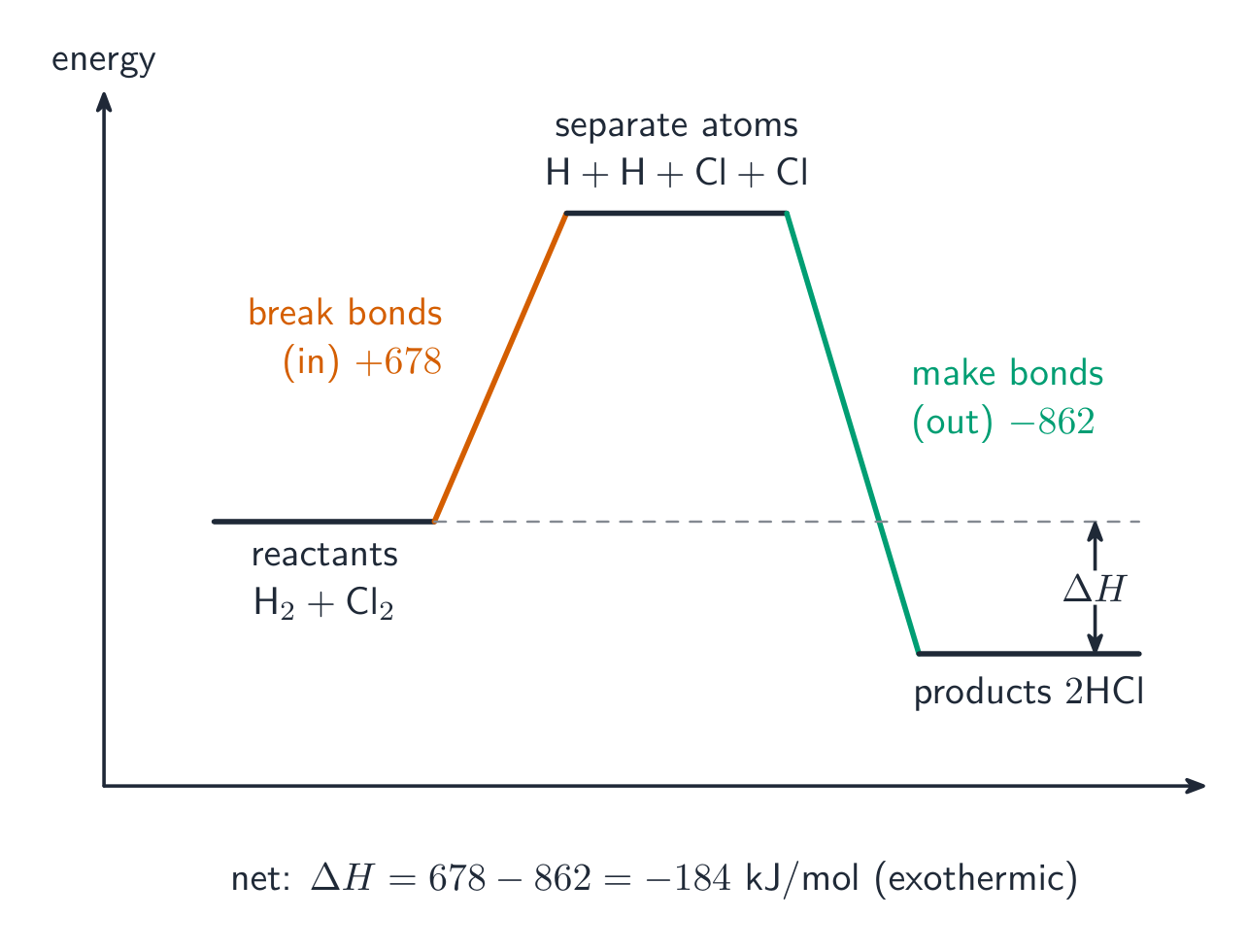
Worked example. Estimate $\Delta H$ for $\text{H}_2+\text{Cl}_2\rightarrow2\text{HCl}$ using bond enthalpies H–H $=436$, Cl–Cl $=242$, H–Cl $=431\ \text{kJ/mol}$. Break both reactant bonds ($436+242=678$) and form two H–Cl bonds ($2\times431=862$):

$$\Delta H\approx 678-862=-184\ \text{kJ},$$
exothermic, because the strong H–Cl bonds formed release more than the reactant bonds cost.

Bahasa Indonesia

Salah satu cara memperkirakan $\Delta H$: jumlahkan energi untuk memutus semua ikatan reaktan, lalu kurangkan energi dilepaskan saat membentuk ikatan produk:

$$\Delta H \approx \sum (\text{bonds broken}) - \sum (\text{bonds formed}).$$
Ini adalah pendekatan, karena entalpi ikatan merupakan rata-rata.

Memutus ikatan memerlukan energi; membentuk ikatan melepaskannya

Contoh terarah. Perkiraan $\Delta H$ untuk $\text{H}_2+\text{Cl}_2\rightarrow2\text{HCl}$ menggunakan entalpi ikatan H–H $=436$, Cl–Cl $=242$, H–Cl $=431\ \text{kJ/mol}$. Putuskan kedua ikatan reaktan ($436+242=678$) dan bentuk dua ikatan H–Cl ($2\times431=862$):

$$\Delta H\approx 678-862=-184\ \text{kJ},$$
eksotermik, karena ikatan H–Cl kuat yang terbentuk melepaskan lebih banyak daripada biaya ikatan reaktan.

6.8

Enthalpy of Formation · ⁨Entalpi Pembentukan⁩

Syllabus · ⁨Silabus⁩
English

Learning Objective 6.8.A: Calculate the enthalpy change for a chemical or physical process based on the standard enthalpies of formation.

  • 6.8.A.1 Tables of standard enthalpies of formation can be used to calculate the standard enthalpies of reactions.
    • Equation: $\Delta H^{\circ}_{reaction} = \Sigma \Delta H^{\circ}_{f\ products} - \Sigma \Delta H^{\circ}_{f\ reactants}$
Bahasa Indonesia

Tujuan Pembelajaran 6.8.A: Hitung perubahan entalpi untuk proses kimia atau fisik berdasarkan entalpi pembentukan standar.

  • 6.8.A.1 Tabel entalpi pembentukan standar dapat digunakan untuk menghitung entalpi reaksi standar.
    • Persamaan: $\Delta H^{\circ}_{reaction} = \Sigma \Delta H^{\circ}_{f\ products} - \Sigma \Delta H^{\circ}_{f\ reactants}$

Source: College Board AP Course and Exam Description · ⁨Sumber: Deskripsi Kursus dan Ujian College Board AP⁩

English

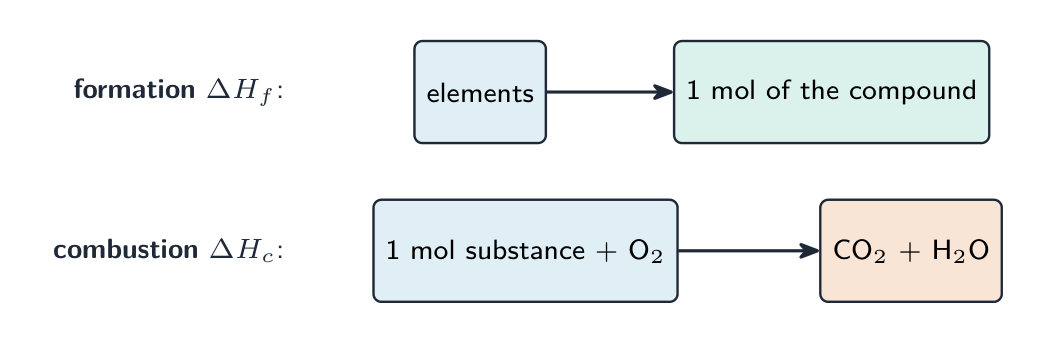
The standard enthalpy of formation 生成焓 $\Delta H_f^\circ$ is the enthalpy to make one mole of a compound from its elements (zero for an element in its standard state). Then

$$\Delta H_{\text{rxn}}^\circ = \sum \Delta H_f^\circ(\text{products}) - \sum \Delta H_f^\circ(\text{reactants}).$$

Worked example. Find $\Delta H_{\text{rxn}}^\circ$ for burning methane, $\text{CH}_4+2\text{O}_2\rightarrow\text{CO}_2+2\text{H}_2\text{O}$, given $\Delta H_f^\circ$: CH$_4=-75$, CO$_2=-394$, H$_2$O$=-286\ \text{kJ/mol}$ (O$_2=0$). Products minus reactants:

$$\Delta H_{\text{rxn}}^\circ=[-394+2(-286)]-[-75+0]=-966+75=-891\ \text{kJ},$$
a large release, as expected for a combustion.

Bahasa Indonesia

Entalpi pembentukan standar $\Delta H_f^\circ$ adalah entalpi untuk membuat satu mol senyawa dari elemen-elemennya (nol untuk elemen dalam keadaan standarnya). Maka

$$\Delta H_{\text{rxn}}^\circ = \sum \Delta H_f^\circ(\text{products}) - \sum \Delta H_f^\circ(\text{reactants}).$$

Pembentukan membuat senyawa dari elemennya; pembakaran membakar senyawa dalam oksigen

Contoh terarah. Temukan $\Delta H_{\text{rxn}}^\circ$ untuk pembakaran metana, $\text{CH}_4+2\text{O}_2\rightarrow\text{CO}_2+2\text{H}_2\text{O}$, diberikan $\Delta H_f^\circ$: CH$_4=-75$, CO$_2=-394$, H$_2$O$=-286\ \text{kJ/mol}$ (O$_2=0$). Produk dikurangi reaktan:

$$\Delta H_{\text{rxn}}^\circ=[-394+2(-286)]-[-75+0]=-966+75=-891\ \text{kJ},$$
pelepasan besar, sesuai dengan yang diharapkan untuk pembakaran.

6.9

Hess's Law · ⁨Hukum Hess⁩

Syllabus · ⁨Silabus⁩
English

Learning Objective 6.9.A: Represent a chemical or physical process as a sequence of steps.

  • 6.9.A.1 Many processes can be broken down into a series of steps. Each step in the series has its own energy change.

Learning Objective 6.9.B: Explain the relationship between the enthalpy of a chemical or physical process and the sum of the enthalpies of the individual steps.

  • 6.9.B.1 Because total energy is conserved (first law of thermodynamics), and each individual reaction in a sequence transfers thermal energy to or from the surroundings, the net thermal energy transferred in the sequence will be equal to the sum of the thermal energy transfers in each of the steps. These thermal energy transfers are the result of potential energy changes among the species in the reaction sequence; thus, at constant pressure, the enthalpy change of the overall process is equal to the sum of the enthalpy changes of the individual steps.
  • 6.9.B.2 The following are essential principles of Hess's law:
    • i. When a reaction is reversed, the enthalpy change stays constant in magnitude but becomes reversed in mathematical sign.
    • ii. When a reaction is multiplied by a factor $c$, the enthalpy change is multiplied by the same factor $c$.
    • iii. When two (or more) reactions are added to obtain an overall reaction, the individual enthalpy changes of each reaction are added to obtain the net enthalpy change of the overall reaction.
    • Exclusion Statement: The concept of state functions will not be assessed on the AP Exam.
Bahasa Indonesia

Tujuan Pembelajaran 6.9.A: Nyatakan proses kimia atau fisik sebagai serangkaian langkah.

  • 6.9.A.1 Banyak proses dapat diuraikan menjadi serangkaian langkah. Setiap langkah dalam seri tersebut memiliki perubahan energinya masing-masing.

Tujuan Pembelajaran 6.9.B: Jelaskan hubungan antara entalpi proses kimia atau fisik dengan jumlah entalpi dari langkah-langkah individu.

  • 6.9.B.1 Karena total energi kekal (hukum termodinamika pertama), dan setiap reaksi individu dalam sebuah seri memindahkan energi termal ke atau dari lingkungan, maka energi termal bersih yang ditransfer dalam seri tersebut akan sama dengan jumlah transfer energi termal pada setiap langkahnya. Transfer energi termal ini merupakan hasil dari perubahan energi potensial antar spesies dalam urutan reaksi; sehingga, pada tekanan konstan, perubahan entalpi proses keseluruhan sama dengan jumlah perubahan entalpi dari langkah-langkah individu.
  • 6.9.B.2 Berikut adalah prinsip-prinsip penting Hukum Hess:
    • i. Ketika reaksi dibalik, perubahan entalpinya tetap konstan dalam besaran tetapi berubah tanda secara matematis.
    • ii. Ketika reaksi dikalikan dengan faktor $c$, perubahan entalpinya dikalikan dengan faktor yang sama $c$.
    • iii. Ketika dua (atau lebih) reaksi ditambahkan untuk mendapatkan reaksi keseluruhan, perubahan entalpi individu dari setiap reaksi ditambahkan untuk mendapatkan perubahan entalpi bersih dari reaksi keseluruhan.
    • Pernyataan Pengecualian: Konsep fungsi keadaan tidak akan diujikan dalam Ujian AP.

Source: College Board AP Course and Exam Description · ⁨Sumber: Deskripsi Kursus dan Ujian College Board AP⁩

English
Hess's law: the route does not matter

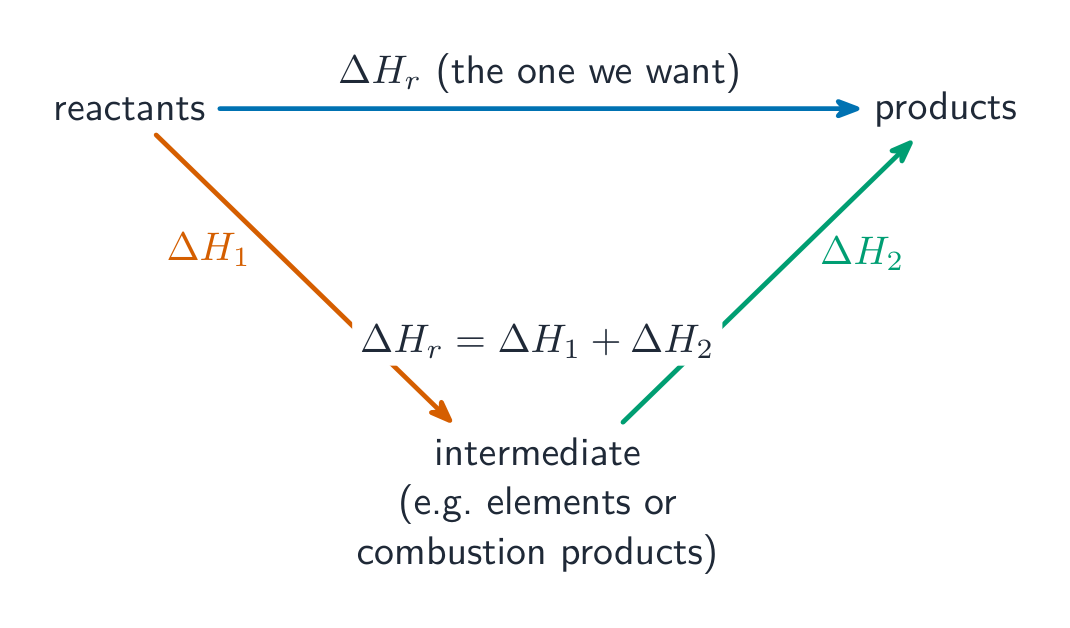
Hess's law 盖斯定律: if a reaction is the sum of several steps, its $\Delta H$ is the sum of the steps' $\Delta H$ values. Reverse a step and flip the sign; scale a step and scale its $\Delta H$. This lets you find a hard-to-measure $\Delta H$ by combining known reactions – a frequent exam calculation.

Bahasa Indonesia
Hukum Hess: rute tidak penting

Hukum Hess: jika suatu reaksi merupakan jumlah dari beberapa tahap, $\Delta H$-nya adalah jumlah nilai $\Delta H$ dari tahap-tahap tersebut. Baliklah sebuah tahap dan ubah tandanya; kalikan sebuah tahap dan kalikan juga $\Delta H$-nya. Ini memungkinkan Anda menemukan $\Delta H$ yang sulit diukur dengan menggabungkan reaksi-reaksi yang diketahui – sebuah perhitungan ujian yang sering muncul.

Hukum Hess: rute langsung dan tidak langsung menghasilkan perubahan entalpi total yang sama
6.9

Exam tips · ⁨Tips ujian⁩

English
  • An exothermic reaction has $\Delta H<0$ (feels hot); endothermic has $\Delta H>0$ — always give $\Delta H$ a sign and units.
  • In calorimetry use $q=mc\,\Delta T$ with the mass of the water/solution; the reaction releases what the water gains.
  • Bond enthalpies: $\Delta H\approx\sum(\text{bonds broken})-\sum(\text{bonds made})$ — breaking is endothermic, making is exothermic (the classic sign trap).
  • Hess's law: the total $\Delta H$ is the sum of the steps' — reverse a step and flip the sign, scale a step and scale $\Delta H$.
  • During a phase change the temperature stays constant while energy goes into the forces between particles.
Bahasa Indonesia
  • Reaksi eksoterm memiliki $\Delta H<0$ (terasa panas); endoterm memiliki $\Delta H>0$ — selalu berikan $\Delta H$ tanda dan satuan.
  • Dalam kalorimetri gunakan $q=mc\,\Delta T$ dengan massa air/larutan; reaksi melepaskan energi sebanyak yang diserap air.
  • Entalpi ikatan: $\Delta H\approx\sum(\text{bonds broken})-\sum(\text{bonds made})$ — pemutusan bersifat endoterm, pembentukan bersifat eksoterm (jebakan tanda klasik).
  • Hukum Hess: total $\Delta H$ adalah jumlah dari langkah-langkahnya — balikkan satu langkah dan ubah tandanya, kalikan satu langkah dan kalikan $\Delta H$-nya.
  • Selama perubahan fase suhu tetap konstan sementara energi masuk ke dalam gaya antar partikel.

Interactive lessons on this topic · ⁨Pelajaran interaktif untuk topik ini⁩

Work through it step by step, with instant-check exercises. · ⁨Kerjakan langkah demi langkah, dengan latihan pengecekan instan.⁩

Past Papers · ⁨Soal-Soil Masa Lalu⁩

More topics in AP Chemistry · ⁨AP Kimia⁩ · ⁨Topik lain dalam AP Chemistry · ⁨AP Kimia⁩⁩

Log in or create account · ⁨Masuk atau buat akun⁩

IGCSE, A-Level & AP