Dorong troli belanja, dan ia percepat. Dorong lebih keras, dan ia percepat lebih cepat. Dorong yang lebih berat dengan usaha yang sama, dan ia hampir tidak bergerak. Semua mekanika…
English narration · English + 中文 subtitles burned in · Narasi bahasa Inggris · Subtitle bahasa Inggris + 中文 disematkan langsung
English
This handout covers Topic 4: Mechanics 力学. It studies how forces make objects move. Throughout this topic, take the acceleration of free fall as $g = 10\ \text{m s}^{-2}$.
Bahasa Indonesia
Lembar kerja ini mencakup Topik 4: Mekanika. Materi ini mempelajari bagaimana gaya membuat benda bergerak. Sepanjang topik ini, anggap percepatan jatuh bebas sebagai $g = 10\ \text{m s}^{-2}$.
4.1
Forces and equilibrium · Gaya dan kesetimbangan
Syllabus · Silabus
English
Candidates should be able to:
Notes and examples
identify the forces acting in a given situation
e.g. by drawing a force diagram.
understand the vector nature of force, and find and use components and resultants
Calculations are always required, not approximate solutions by scale drawing.
use the principle that, when a particle is in equilibrium, the vector sum of the forces acting is zero, or equivalently, that the sum of the components in any direction is zero
Solutions by resolving are usually expected, but equivalent methods (e.g. triangle of forces, Lami's Theorem, where suitable) are also acceptable; these other methods are not required knowledge, and will not be referred to in questions.
understand that a contact force between two surfaces can be represented by two components, the normal component and the frictional component
use the model of a 'smooth' contact, and understand the limitations of this model
understand the concepts of limiting friction and limiting equilibrium, recall the definition of coefficient of friction, and use the relationship $F = \mu R$ or $F \leqslant \mu R$, as appropriate
Terminology such as 'about to slip' may be used to mean 'in limiting equilibrium' in questions.
use Newton's third law.
e.g. the force exerted by a particle on the ground is equal and opposite to the force exerted by the ground on the particle.
Bahasa Indonesia
Calon peserta harus mampu:
Catatan dan contoh
identifikasi gaya-gaya yang bekerja dalam situasi yang diberikan
mis. dengan menggambar diagram gaya.
pahami sifat vektor gaya, dan tentukan serta gunakan komponen dan resultan
Perhitungan selalu diperlukan, bukan solusi perkiraan dengan menggambar skala.
gunakan prinsip bahwa, ketika partikel berada dalam kesetimbangan, jumlah vektor gaya yang bekerja adalah nol, atau ekuivalennya, jumlah komponen dalam arah apa pun adalah nol
Solusi dengan menguraikan biasanya diharapkan, tetapi metode ekuivalen (misalnya segitiga gaya, Teorema Lami, jika sesuai) juga dapat diterima; metode lain ini tidak diperlukan sebagai pengetahuan, dan tidak akan dirujuk dalam soal.
pahami bahwa gaya kontak antara dua permukaan dapat direpresentasikan oleh dua komponen, yaitu komponen normal dan komponen gesekan
gunakan model 'permukaan licin', dan pahami keterbatasan model ini
pahami konsep gesekan batas dan kesetimbangan batas, ingat definisi koefisien gesekan, dan gunakan hubungan $F = \mu R$ atau $F \leqslant \mu R$, sesuai keadaan
Terminologi seperti 'akan tergelincir' mungkin digunakan untuk berarti 'dalam kesetimbangan batas' dalam soal.
gunakan hukum ketiga Newton.
mis. gaya yang diberikan partikel pada tanah sama besar dan berlawanan arah dengan gaya yang diberikan tanah pada partikel tersebut.
Source: Cambridge International syllabus · Sumber: Silabus Cambridge International
English
A force 力 is a push or a pull. It is a vector, so it has size and direction. Because it is a vector, you can split a force into components 分量 (usually horizontal and vertical), and you can add several forces into one resultant 合力.
A particle is in equilibrium 平衡 when the forces are balanced: the vector sum of the forces is zero. In practice this means the components in any direction add to zero.
Friction
When two surfaces touch, the contact force 接触力 between them has two parts: the normal reaction 法向反作用力$R$, at right angles to the surface, and the friction 摩擦力$F$, along the surface, which opposes sliding. A "smooth" surface is a model with no friction.
Friction can only grow up to a maximum. At that maximum the body is in limiting equilibrium 极限平衡, about to slip, and the friction is limiting friction 最大静摩擦力. The maximum is set by the coefficient of friction 摩擦系数$\mu$:
$$F \leqslant \mu R, \qquad \text{with } F = \mu R \text{ at the point of slipping}.$$
By Newton's third law 牛顿第三定律, the two surfaces push on each other with equal and opposite forces.
Worked example. A block of weight $20\text{ N}$ rests on a rough horizontal table with coefficient of friction $\mu = 0.4$. Find the largest horizontal force that can be applied before the block slides.
The table's normal reaction balances the weight, so $R = 20\text{ N}$. The block is on the point of slipping when friction reaches its maximum $F = \mu R = 0.4 \times 20 = 8\text{ N}$. In equilibrium the applied force equals the friction, so the largest force it can resist is $8\text{ N}$.
Bahasa Indonesia
Sebuah gaya adalah dorongan atau tarikan. Gaya merupakan vektor, sehingga memiliki besar dan arah. Karena merupakan vektor, Anda dapat memecah gaya menjadi komponen (biasanya horizontal dan vertikal), dan Anda dapat menggabungkan beberapa gaya menjadi satu resultan.
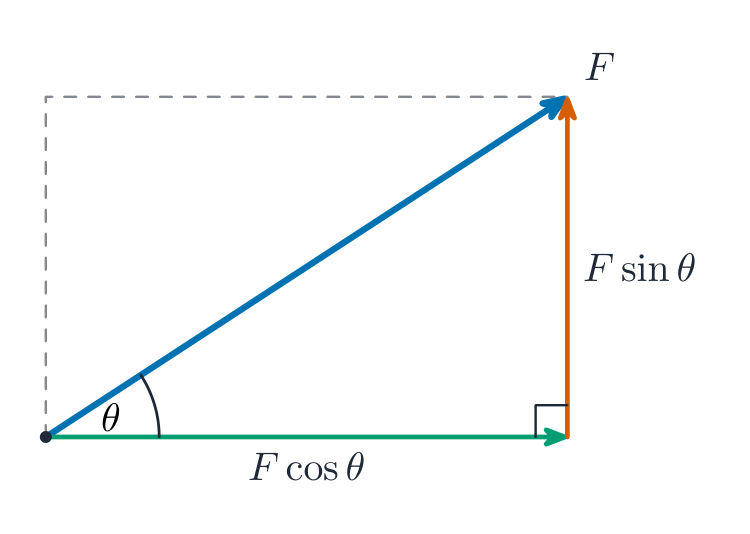
Gaya dengan sudut $\theta$ memiliki komponen horizontal $F\cos\theta$ dan komponen vertikal $F\sin\theta$.
Sebuah partikel berada dalam kesetimbangan ketika gaya-gayanya seimbang: jumlah vektor dari gaya-gaya tersebut adalah nol. Secara praktis, ini berarti komponen-komponennya dalam arah apa pun menjumlahkan nol.
Setiap masalah mekanika adalah gambar seperti ini. Tiga gaya bekerja pada pendaki — berat lurus ke bawah, tegangan sepanjang tali, dan dorongan dari batuan — dan karena mereka seimbang, pendaki tergantung diam dalam kesetimbangan. Menguraikan setiap gaya menjadi komponen horizontal dan vertikal mengubah gambar tersebut menjadi persamaan
Gesekan
Ketika dua permukaan bersentuhan, gaya kontak di antara keduanya memiliki dua bagian: reaksi normal$R$, tegak lurus terhadap permukaan, dan gesekan$F$, sejajar dengan permukaan, yang melawan geser. Permukaan "halus" adalah model tanpa gesekan.
Gesekan hanya dapat meningkat hingga suatu maksimum. Pada titik maksimum itu, benda berada dalam kesetimbangan batas, akan segera tergelincir, dan gesekannya disebut gesekan batas. Nilai maksimum ditentukan oleh koefisien gesekan$\mu$:
$$F \leqslant \mu R, \qquad \text{with } F = \mu R \text{ at the point of slipping}.$$
Di atas permukaan kasar, gaya kontak terurai menjadi reaksi normal $R$ dan gesekan $F$ (paling banyak $\mu R$).
Berdasarkan hukum ketiga Newton, kedua permukaan saling mendorong satu sama lain dengan gaya yang sama besar namun berlawanan arah.
Contoh terpecahkan. Sebuah balok dengan berat $20\text{ N}$ beristirahat di atas meja horizontal kasar dengan koefisien gesekan $\mu = 0.4$. Tentukan gaya horizontal terbesar yang dapat diterapkan sebelum balok bergeser.
Reaksi normal meja menyeimbangkan berat, sehingga $R = 20\text{ N}$. Balok berada pada titik akan tergelincir ketika gesekan mencapai nilai maksimumnya $F = \mu R = 0.4 \times 20 = 8\text{ N}$. Dalam kesetimbangan, gaya yang diberikan sama dengan gesekan, sehingga gaya terbesar yang dapat ditahannya adalah $8\text{ N}$.
Explore · Jelajahi
Adding forces · Penjumlahan gaya
resultant = a + b · resultan = a + b
Forces add tip-to-tail. They are in equilibrium when the resultant is zero. · Gaya ditambahkan ujung ke ujung. Mereka berada dalam kesetimbangan ketika resultannya nol.
Kinematics of motion in a straight line · Kinematika gerak lurus
Syllabus · Silabus
English
Candidates should be able to:
Notes and examples
understand the concepts of distance and speed as scalar quantities, and of displacement, velocity and acceleration as vector quantities
Restricted to motion in one dimension only. The term 'deceleration' may sometimes be used in the context of decreasing speed.
sketch and interpret displacement–time graphs and velocity–time graphs, and in particular appreciate that – the area under a velocity–time graph represents displacement, – the gradient of a displacement–time graph represents velocity, – the gradient of a velocity–time graph represents acceleration
use differentiation and integration with respect to time to solve simple problems concerning displacement, velocity and acceleration
Calculus required is restricted to techniques from the content for Paper 1: Pure Mathematics 1.
use appropriate formulae for motion with constant acceleration in a straight line.
Questions may involve setting up more than one equation, using information about the motion of different particles.
Bahasa Indonesia
Calon peserta harus mampu:
Catatan dan contoh
pahami konsep jarak dan kelajuan sebagai besaran skalar, serta perpindahan, kecepatan dan percepatan sebagai besaran vektor
Terbatas pada gerak satu dimensi saja. Istilah 'perlambatan' terkadang digunakan dalam konteks penurunan kelajuan.
sketsa dan tafsirkan grafik perpindahan–waktu dan grafik kecepatan–waktu, dan khususnya pahami bahwa – luas di bawah grafik kecepatan–waktu merepresentasikan perpindahan, – kemiringan grafik perpindahan–waktu merepresentasikan kecepatan, – kemiringan grafik kecepatan–waktu merepresentasikan percepatan
gunakan diferensiasi dan integrasi terhadap waktu untuk menyelesaikan masalah sederhana mengenai perpindahan, kecepatan dan percepatan
Kalkulus yang diperlukan terbatas pada teknik dari materi Paper 1: Matematika Murni 1.
gunakan rumus yang sesuai untuk gerak dengan percepatan konstan pada garis lurus.
Soal mungkin melibatkan penyusunan lebih dari satu persamaan, menggunakan informasi tentang gerak partikel berbeda.
Source: Cambridge International syllabus · Sumber: Silabus Cambridge International
English
Distance 距离 and speed 速率 are scalars (size only). Displacement 位移, velocity 速度 and acceleration 加速度 are vectors (size and direction).
On a velocity-time graph 速度时间图, the area under the graph is the displacement and the gradient is the acceleration (a negative acceleration is a deceleration 减速度). On a displacement-time graph, the gradient is the velocity. More generally, differentiate with respect to time to go from displacement to velocity to acceleration, and integrate to go back.
For motion with constant acceleration 匀加速, use these formulae (the "suvat" equations):
$$v = u + at, \qquad s = ut + \tfrac12 at^2, \qquad v^2 = u^2 + 2as, \qquad s = \tfrac12(u + v)t.$$
Worked example. A car starts from rest and accelerates at $2.5\ \text{m s}^{-2}$ for $4\ \text{s}$. Find its speed and the distance travelled.
Jarak dan kelajuan adalah besaran skalar (hanya ukuran). Pergeseran, kecepatan, dan percepatan adalah besaran vektor (ukuran dan arah).
Pada grafik kecepatan-waktu, luas di bawah grafik adalah pergeseran dan kemiringan adalah percepatan (percepatan negatif adalah perlambatan). Pada grafik perpindahan-waktu, kemiringan adalah kecepatan. Secara umum, turunkan terhadap waktu untuk berpindah dari perpindahan ke kecepatan ke percepatan, dan integralkan untuk kembali.
Area arsiran memberikan jarak tempuh; kemiringan garis memberikan percepatan.
Untuk gerak dengan percepatan konstan, gunakan rumus-rumus berikut (persamaan "suvat"):
$$v = u + at, \qquad s = ut + \tfrac12 at^2, \qquad v^2 = u^2 + 2as, \qquad s = \tfrac12(u + v)t.$$
Contoh terpecahkan. Sebuah mobil mulai dari keadaan diam dan dipercepat sebesar $2.5\ \text{m s}^{-2}$ selama $4\ \text{s}$. Tentukan kecepatannya dan jarak yang ditempuh.
Change the start velocity and acceleration. The gradient is the acceleration; the area under the line is the displacement. · Ubah kecepatan awal dan percepatan. Gradien adalah percepatan; luas di bawah garis adalah perpindahan.
use the definition of linear momentum and show understanding of its vector nature
For motion in one dimension only.
use conservation of linear momentum to solve problems that may be modelled as the direct impact of two bodies.
Including direct impact of two bodies where the bodies coalesce on impact. Knowledge of impulse and the coefficient of restitution is not required.
Bahasa Indonesia
Calon peserta harus mampu:
Catatan dan contoh
gunakan definisi momentum linear dan tunjukkan pemahaman atas sifat vektornya
Untuk gerak satu dimensi saja.
gunakan hukum kekekalan momentum linear untuk menyelesaikan masalah yang dapat dimodelkan sebagai benturan langsung dua benda.
Termasuk benturan langsung dua benda di mana benda-benda tersebut menyatu saat benturan. Pengetahuan tentang impuls dan koefisien restitusi tidak diperlukan.
Source: Cambridge International syllabus · Sumber: Silabus Cambridge International
English
The linear momentum 动量 of a body is $\text{mass} \times \text{velocity}$. It is a vector. In a direct collision of two bodies, the total momentum is unchanged. This is the conservation of linear momentum 动量守恒:
$$m_1 u_1 + m_2 u_2 = m_1 v_1 + m_2 v_2.$$
Worked example. A body of mass $2\ \text{kg}$ moving at $3\ \text{m s}^{-1}$ hits a stationary body of mass $1\ \text{kg}$, and they stick together. Find their common speed afterwards.
Pulau Newton mendemonstrasikan kekekalan momentum dalam tumbukan.
Momentum linear suatu benda adalah $\text{mass} \times \text{velocity}$. Ini adalah vektor. Dalam tabrakan langsung dua benda, total momentum tidak berubah. Ini adalah hukum kekekalan momentum linear:
$$m_1 u_1 + m_2 u_2 = m_1 v_1 + m_2 v_2.$$
Total momentum sama sebelum dan sesudah tabrakan.
Contoh terpecahkan. Benda bermassa $2\ \text{kg}$ bergerak dengan kecepatan $3\ \text{m s}^{-1}$ menabrak benda diam bermassa $1\ \text{kg}$, lalu mereka menyatu. Tentukan kecepatan bersama mereka afterwards.
Set each mass and speed and collide them. Total momentum stays the same before and after. · Setel massa dan kecepatan masing-masing dan tabrakan mereka. Total momentum tetap sama sebelum dan sesudah.
conservation of momentum/ˌkɒnsəˈveɪʃn ɒv məʊˈmentəm/
kekekalan momentum
Newton's laws of motion/ˈnjuːtnz lɔːz ɒv ˈməʊʃn/
Hukum-hukum gerak Newton
mass/mæs/
massa
weight/weɪt/
berat
tension/ˈtenʃn/
tegangan
4.4
Newton's laws of motion · Hukum-hukum gerak Newton
Syllabus · Silabus
English
Candidates should be able to:
Notes and examples
• apply Newton’s laws of motion to the linear motion of a particle of constant mass moving under the action of constant forces, which may include friction, tension in an inextensible string and thrust in a connecting rod
If any other forces resisting motion are to be considered (e.g. air resistance) this will be indicated in the question.
• use the relationship between mass and weight
$W = mg$. In this component, questions are mainly numerical, and use of the approximate numerical value $10\text{ (ms}^{-2}\text{)}$ for $g$ is expected.
• solve simple problems which may be modelled as the motion of a particle moving vertically or on an inclined plane with constant acceleration
Including, for example, motion of a particle on a rough plane where the acceleration while moving up the plane is different from the acceleration while moving down the plane.
• solve simple problems which may be modelled as the motion of connected particles.
e.g. particles connected by a light inextensible string passing over a smooth pulley, or a car towing a trailer by means of either a light rope or a light rigid tow-bar.
Bahasa Indonesia
Calon peserta harus mampu:
Catatan dan contoh
• terapkan hukum-hukum Newton tentang gerak pada gerak linear partikel bermassa konstan yang bergerak di bawah pengaruh gaya-gaya konstan, yang mungkin mencakup gesekan, tegangan pada tali tak elastis dan daya dorong pada batang penghubung
Jika ada gaya lain yang menahan gerak harus dipertimbangkan (mis. hambatan udara) hal ini akan ditunjukkan dalam soal.
• gunakan hubungan antara massa dan berat
$W = mg$. Dalam komponen ini, soal terutama bersifat numerik, dan penggunaan nilai numerik pendekatan $10\text{ (ms}^{-2}\text{)}$ untuk $g$ diharapkan.
• selesaikan masalah sederhana yang dapat dimodelkan sebagai gerak partikel yang bergerak vertikal atau pada bidang miring dengan percepatan konstan
Termasuk, misalnya, gerak partikel pada bidang kasar di mana percepatan saat bergerak naik bidang berbeda dari percepatan saat bergerak turun bidang.
• selesaikan masalah sederhana yang dapat dimodelkan sebagai gerak partikel terhubung.
mis. partikel yang dihubungkan oleh tali ringan tak elastis yang melintasi katrol licin, atau mobil yang menarik trailer dengan tali ringan atau batang penarik kaku ringan.
Source: Cambridge International syllabus · Sumber: Silabus Cambridge International
English
Newton's laws of motion 牛顿运动定律 connect force and acceleration. The key one is: resultant force $=$mass 质量$\times$ acceleration,
$$F = ma.$$
The weight 重力 of a body is the force of gravity on it: $W = mg$. Forces in a problem may include weight, friction, tension 张力 in a string, the thrust 推力 (push) in a rod, and air resistance 空气阻力.
For motion on an inclined plane 斜面, split each force into a part along the slope and a part at right angles to it, then apply $F = ma$ along the slope. For connected particles 连接质点 (joined by a string), apply $F = ma$ to each body, or to the whole system.
Worked example. A block of mass $12\ \text{kg}$ is pulled up a rough plane by a rope parallel to the slope. The plane is at $20^\circ$ to the horizontal, the coefficient of friction is $0.4$, and the acceleration is $2\ \text{m s}^{-2}$. Find the tension in the rope.
The normal reaction is $R = mg\cos 20^\circ = 120\cos 20^\circ = 112.8\ \text{N}$, so the friction is $F = \mu R = 0.4 \times 112.8 = 45.1\ \text{N}$. Along the slope, $T - mg\sin 20^\circ - F = ma$:
Hukum-hukum gerak Newton menghubungkan gaya dan percepatan. Hukum utamanya adalah: resultan gaya $=$massa$\times$ percepatan,
$$F = ma.$$
Berat suatu benda adalah gaya gravitasi yang bekerja padanya: $W = mg$. Gaya-gaya dalam sebuah masalah mungkin mencakup berat, gesekan, tegangan pada tali, dorong (push) pada batang, dan hambatan udara.
Untuk gerak pada bidang miring, uraikan setiap gaya menjadi komponen sejajar lereng dan tegak lurus lereng, lalu terapkan $F = ma$ sepanjang lereng. Untuk benda terhubung (dihubungkan dengan tali), terapkan $F = ma$ pada masing-masing benda, atau pada seluruh sistem.
Di atas bidang miring, uraikan gaya-gaya sepanjang lereng dan tegak lurus lereng.
Contoh terpecahkan. Balok bermassa $12\ \text{kg}$ ditarik ke atas bidang kasar oleh tali sejajar lereng. Bidang tersebut membentuk sudut $20^\circ$ terhadap horizontal, koefisien gesekannya $0.4$, dan percepatannya $2\ \text{m s}^{-2}$. Tentukan tegangan pada tali.
Reaksi normal adalah $R = mg\cos 20^\circ = 120\cos 20^\circ = 112.8\ \text{N}$, sehingga gesekannya adalah $F = \mu R = 0.4 \times 112.8 = 45.1\ \text{N}$. Sepanjang lereng, $T - mg\sin 20^\circ - F = ma$:
The resultant force sets the acceleration. Balanced forces ⇒ no acceleration. · Resultan gaya menyebabkan percepatan. Gaya seimbang ⇒ tidak ada percepatan.
Energy, work and power · Energi, usaha, dan daya
Syllabus · Silabus
English
Candidates should be able to:
Notes and examples
• understand the concept of the work done by a force, and calculate the work done by a constant force when its point of application undergoes a displacement not necessarily parallel to the force
$W = Fd \cos \theta$; Use of the scalar product is not required.
• understand the concepts of gravitational potential energy and kinetic energy, and use appropriate formulae
• understand and use the relationship between the change in energy of a system and the work done by the external forces, and use in appropriate cases the principle of conservation of energy
Including cases where the motion may not be linear (e.g. a child on a smooth curved ‘slide’), where only overall energy changes need to be considered.
• use the definition of power as the rate at which a force does work, and use the relationship between power, force and velocity for a force acting in the direction of motion
Including calculation of (average) power as
$$\frac{\text{Work done}}{\text{Time taken}}$$
$P = Fv$.
• solve problems involving, for example, the instantaneous acceleration of a car moving on a hill against a resistance.
Bahasa Indonesia
Calon peserta harus mampu:
Catatan dan contoh
• pahami konsep usaha yang dilakukan oleh gaya, dan hitung usaha yang dilakukan oleh gaya konstan ketika titik aplikasinya mengalami perpindahan yang tidak perlu sejajar dengan gaya
$W = Fd \cos \theta$; Penggunaan perkalian skalar tidak diperlukan.
• pahami konsep energi potensial gravitasi dan energi kinetik, dan gunakan rumus yang sesuai
• pahami dan gunakan hubungan antara perubahan energi suatu sistem dan usaha yang dilakukan oleh gaya eksternal, dan gunakan dalam kasus yang sesuai prinsip kekekalan energi
Termasuk kasus di mana gerak mungkin tidak linear (mis. anak di atas 'luncuran' lengkung licin), di mana hanya perubahan energi keseluruhan yang perlu dipertimbangkan.
• gunakan definisi daya sebagai laju gaya melakukan usaha, dan gunakan hubungan antara daya, gaya dan kecepatan untuk gaya yang bekerja searah gerak
Termasuk perhitungan (rata-rata) daya sebagai
$$\frac{\text{Work done}}{\text{Time taken}}$$
$P = Fv$.
• selesaikan masalah yang melibatkan, misalnya, percepatan sesaat mobil yang bergerak di tanjakan melawan hambatan.
Source: Cambridge International syllabus · Sumber: Silabus Cambridge International
English
The work done 功 by a constant force is the scalar product of force and displacement — the force times the distance moved in the direction of the force: $W = Fd\cos\theta$, where $\theta$ is the angle between the force and the motion. Work is measured in joules (J).
Energy comes in forms you can calculate:
Kinetic energy 动能 (energy of movement): $\text{KE} = \tfrac12 mv^2$.
Gravitational potential energy 重力势能 (energy of height): $\text{PE} = mgh$.
The work done by the outside forces equals the change in the total energy. When no friction acts, the total energy stays the same — the conservation of energy 能量守恒.
Power 功率 is the rate of doing work. For a force pulling in the direction of motion, $P = Fv$ (power $=$ force $\times$ velocity). Power is measured in watts (W).
Worked example. A car engine works at $12\ \text{kW}$ while the car moves at $20\ \text{m s}^{-1}$ on a level road. Find the driving force.
Luncuran bukit menukar energi potensial dengan energi kinetik saat naik dan turun.
Usaha yang dilakukan oleh gaya konstan adalah hasil kali skalar antara gaya dan perpindahan — yaitu gaya dikalikan jarak yang ditempuh searah gaya: $W = Fd\cos\theta$, di mana $\theta$ adalah sudut antara gaya dan gerakan. Usaha diukur dalam joule (J).
Energi hadir dalam bentuk yang dapat dihitung:
Energi kinetik (energi gerak): $\text{KE} = \tfrac12 mv^2$.
Energi potensial gravitasi (energi ketinggian): $\text{PE} = mgh$.
Usaha yang dilakukan oleh gaya luar sama dengan perubahan total energi. Ketika tidak ada gesekan, total energi tetap sama — hukum kekekalan energi.
Daya adalah laju melakukan usaha. Untuk gaya yang menarik searah dengan gerak, $P = Fv$ (daya $=$ gaya $\times$ kecepatan). Daya diukur dalam watt (W).
Contoh terpecahkan. Mesin mobil menghasilkan daya $12\ \text{kW}$ sementara mobil bergerak dengan kecepatan $20\ \text{m s}^{-1}$ di jalan datar. Tentukan gaya penggeraknya.
Drop the object and watch energy change form. With no friction, GPE + KE stays constant the whole way down. · Jatuhkan benda dan saksikan energi berubah bentuk. Tanpa gesekan, GPE + KE tetap konstan sepanjang jalan turun.
4.5
Exam tips · Tips ujian
English
Draw a clear force diagram and resolve into perpendicular components; for equilibrium, each direction sums to zero.
Use SUVAT only for constant acceleration and keep a consistent positive direction.
Apply $F = ma$ along the direction of motion, including friction ($F = \mu R$) on a rough surface.
State your assumptions (light inextensible string, smooth pulley, particle) — they are often worth a mark.
Bahasa Indonesia
Gambar diagram gaya yang jelas dan uraikan menjadi komponen tegak lurus; untuk kesetimbangan, jumlah setiap arah adalah nol.
Gunakan SUVAT hanya untuk percepatan konstan dan pertahankan arah positif yang konsisten.
Terapkan $F = ma$ sepanjang arah gerakan, termasuk gesekan ($F = \mu R$) pada permukaan kasar.
Nyatakan asumsi Anda (tali ringan tak kenyal, katrol halus, partikel) — hal ini sering bernilai poin.
Interactive lessons on this topic · Pelajaran interaktif untuk topik ini
Work through it step by step, with instant-check exercises. · Kerjakan langkah demi langkah, dengan latihan pengecekan instan.
Pick one and the site follows you — notes, papers, videos and practice all open on it. · Pilih satu dan situs mengikuti Anda — catatan, kertas, video, dan latihan semua terbuka di sana.
Type to search notes, lessons, code, vocabulary and past-paper questions across every subject. · Ketik untuk mencari catatan, pelajaran, kode, kosakata, dan pertanyaan soal lama di setiap mata pelajaran.