Besi yang ditinggalkan di luar membutuhkan bertahun-tahun untuk berkarat. Memantik korek api, dan hampir kimia yang sama — oksigen menyerang bahan bakar — selesai dalam kurang dari satu detik. Sama…
English narration · English + 中文 subtitles burned in · Narasi bahasa Inggris · Subtitle bahasa Inggris + 中文 disematkan langsung
8.1
Rate of reaction · Laju reaksi
Syllabus · Silabus
English
explain and use the term rate of reaction, frequency of collisions, effective collisions and non-effective collisions
explain qualitatively, in terms of frequency of effective collisions, the effect of concentration and pressure changes on the rate of a reaction
use experimental data to calculate the rate of a reaction
Bahasa Indonesia
jelaskan dan gunakan istilah laju reaksi, frekuensi tumbukan, tumbukan efektif dan tumbukan tidak efektif
jelaskan secara kualitatif, dalam hal frekuensi tumbukan efektif, efek dari perubahan konsentrasi dan tekanan terhadap laju reaksi
gunakan data eksperimen untuk menghitung laju reaksi
Source: Cambridge International syllabus · Sumber: Silabus Cambridge International
English
Collision theory: energy and orientation
The rate of reaction 反应速率 is how fast reactants turn into products. We measure it as the change in concentration (or amount) in each unit of time.
To react, particles must collide 碰撞. The collision frequency 碰撞频率 is how often the particles hit each other. But not every collision leads to a reaction:
an effective collision 有效碰撞 has enough energy and the correct direction, so a reaction happens.
a non-effective collision 无效碰撞 does not have enough energy, or the particles hit at the wrong angle, so nothing happens.
So the rate depends on the frequency of effective collisions — how many useful collisions happen each second.
Concentration and pressure
If you increase the concentration of a solution (or the pressure of a gas), the particles are packed closer together. They collide more often, so there are more effective collisions each second, and the rate goes up.
You can calculate a rate from experimental data — for example, the volume of gas made divided by the time taken.
Worked example. A reaction gives off carbon dioxide. In the first $30\ \text{s}$, $48\ \text{cm}^3$ of gas is collected. Find the average rate of reaction over this time.
The rate is fastest at the start (the graph is steepest there) because the reactants are most concentrated, then it slows as they are used up.
Bahasa Indonesia
Teori tumbukan: energi dan orientasi
Laju reaksi adalah seberapa cepat reaktan berubah menjadi produk. Kita mengukurnya sebagai perubahan konsentrasi (atau jumlah) dalam setiap satuan waktu.
Agar bereaksi, partikel harus bertumbukan. Frekuensi tumbukan adalah seberapa sering particles saling menabrak. Namun, tidak setiap tumbukan menghasilkan reaksi:
tumbukan efektif memiliki cukup energi dan arah yang benar, sehingga reaksi terjadi.
tumbukan tidak efektif tidak memiliki cukup energi, atau partikel menabrak pada sudut yang salah, sehingga tidak ada yang terjadi.
Jadi laju bergantung pada frekuensi tumbukan efektif — berapa banyak tumbukan bermanfaat yang terjadi setiap detik.
Tumbukan hanya bereaksi dengan orientasi yang benar dan energi yang cukup (ujung berwarna = bagian reaktif)
Konsentrasi dan tekanan
Jika Anda meningkatkan konsentrasi larutan (atau tekanan gas), partikel terkumpul lebih rapat. Mereka bertumbukan lebih sering, sehingga ada lebih banyak tumbukan efektif setiap detik, dan laju meningkat.
Lebih banyak partikel dalam volume yang sama bertumbukan lebih sering, sehingga laju meningkat
Anda dapat menghitung laju dari data eksperimen — misalnya, volume gas yang dihasilkan dibagi dengan waktu yang dibutuhkan.
Contoh terarah. Reaksi menghasilkan karbon dioksida. Dalam $30\ \text{s}$ pertama, $48\ \text{cm}^3$ gas dikumpulkan. Temukan rata-rata laju reaksi selama waktu ini.
Temperature and activation energy · Suhu dan energi aktivasi
Syllabus · Silabus
English
define activation energy, $E_A$, as the minimum energy required for a collision to be effective
sketch and use the Boltzmann distribution to explain the significance of activation energy
explain qualitatively, in terms both of the Boltzmann distribution and of frequency of effective collisions, the effect of temperature change on the rate of a reaction
Bahasa Indonesia
definisikan energi aktivasi, $E_A$, sebagai energi minimum yang diperlukan agar tumbukan menjadi efektif
sketsa dan gunakan distribusi Boltzmann untuk menjelaskan signifikansi energi aktivasi
jelaskan secara kualitatif, dalam hal distribusi Boltzmann dan frekuensi tumbukan efektif, efek dari perubahan suhu terhadap laju reaksi
Source: Cambridge International syllabus · Sumber: Silabus Cambridge International
English
Maxwell-Boltzmann distribution
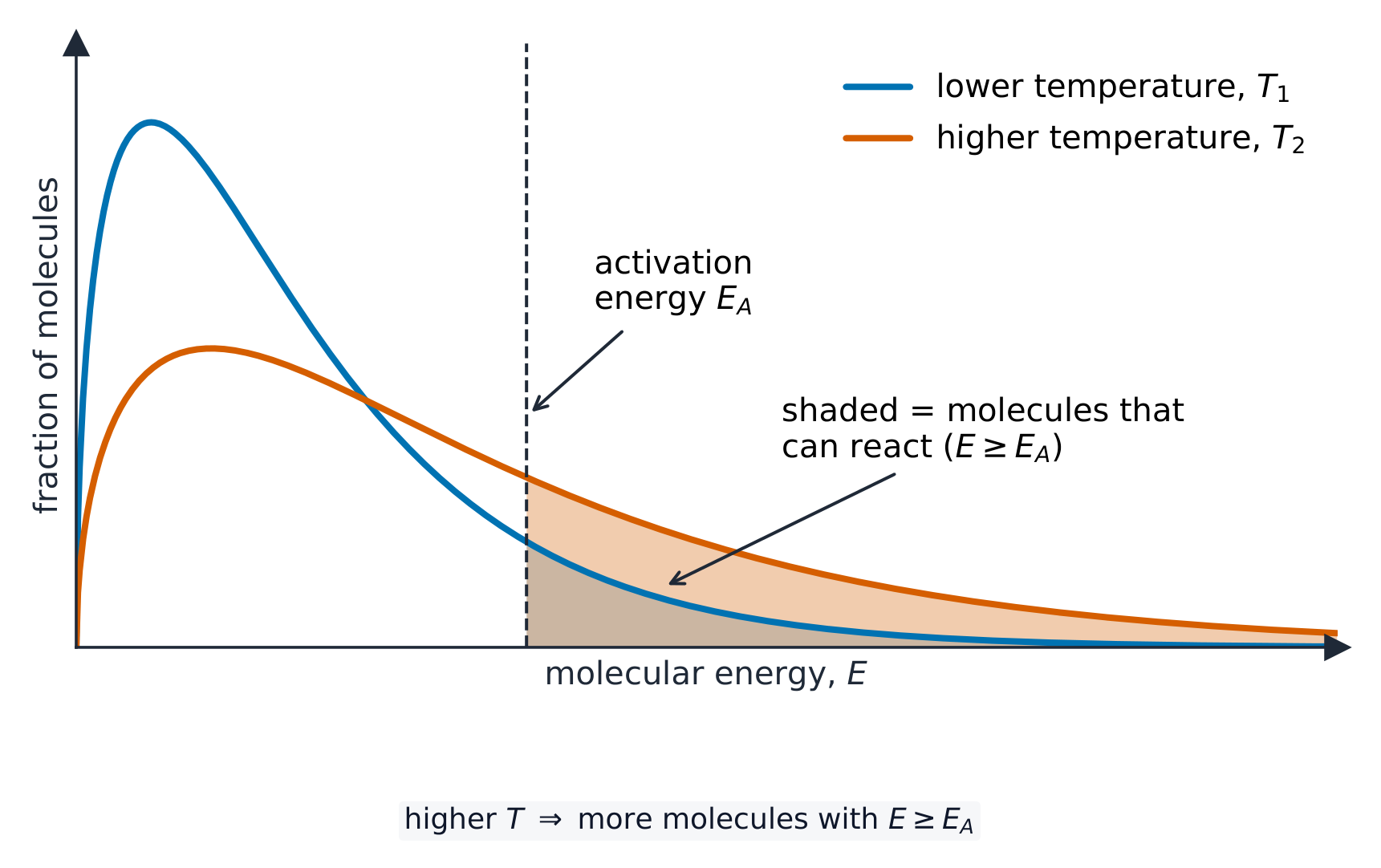
The activation energy 活化能 ($E_A$) is the minimum energy a collision needs in order to be effective.
The Boltzmann distribution 玻尔兹曼分布 is a graph showing how the energies of the molecules are spread out at one temperature. The curve starts at the origin, rises to a peak, then falls away in a long tail. The total area under the curve is the total number of molecules. Only the molecules to the right of $E_A$ have enough energy to react.
When you raise the temperature:
the curve flattens and spreads to the right, so a much larger fraction of molecules now have energy greater than $E_A$.
the molecules also move faster and collide more often.
The first effect is the bigger one. This is why a small rise in temperature gives a large rise in rate.
Bahasa Indonesia
Distribusi Maxwell-Boltzmann
Energi aktivasi ($E_A$) adalah energi minimum yang dibutuhkan sebuah tumbukan agar efektif.
Distribusi Boltzmann adalah grafik yang menunjukkan bagaimana energi molekul tersebar pada satu suhu. Kurva dimulai dari titik asal, naik ke puncak, lalu turun membentuk ekor panjang. Total area di bawah kurva adalah total jumlah molekul. Hanya molekul di sebelah kanan $E_A$ yang memiliki cukup energi untuk bereaksi.
Ketika Anda menaikkan suhu:
kurva meratakan diri dan melebar ke kanan, sehingga fraksi jauh lebih besar molekul kini memiliki energi lebih besar dari $E_A$.
molekul juga bergerak lebih cepat dan bertumbukan lebih sering.
Efek pertama adalah yang lebih besar. Ini sebabnya kenaikan kecil suhu memberikan peningkatan besar pada laju.
Suhu lebih tinggi membuat kurva melebar ke kanan, sehingga fraksi molekul yang dapat bereaksi lebih besar
Explore · Jelajahi
Why heat speeds up reactions · Mengapa panas mempercepat reaksi
Raise the temperature: the curve spreads right, so more molecules have at least the activation energy and can react. · Naikkan suhu: kurva menyebar ke kanan, sehingga lebih banyak molekul memiliki setidaknya energi aktivasi dan dapat bereaksi.
explain and use the terms catalyst and catalysis: (a) explain that, in the presence of a catalyst, a reaction has a different mechanism, i.e. one of lower activation energy (b) explain this catalytic effect in terms of the Boltzmann distribution (c) construct and interpret a reaction pathway diagram, for a reaction in the presence and absence of an effective catalyst
Bahasa Indonesia
jelaskan dan gunakan istilah katalis dan katalisis: (a) jelaskan bahwa, dengan kehadiran katalis, reaksi memiliki mekanisme yang berbeda, yaitu yang memiliki energi aktivasi lebih rendah (b) jelaskan efek katalitik ini dalam hal distribusi Boltzmann (c) susun dan interpretasikan diagram jalur reaksi, untuk reaksi dengan dan tanpa katalis efektif
Source: Cambridge International syllabus · Sumber: Silabus Cambridge International
English
Reaction profile: a catalyst's lower-energy route
A catalyst 催化剂 speeds up a reaction but is not used up itself. Catalysis 催化作用 is the name for this action.
A catalyst works by giving the reaction a different reaction mechanism 反应机理 — a new route with a lower activation energy. On the Boltzmann distribution, lowering $E_A$ moves the line to the left, so more molecules now have enough energy. This means more effective collisions each second, and a faster rate.
On a reaction pathway diagram 反应路径图, the catalysed route has a lower energy "hill". The enthalpy change of the reaction, $\Delta H$, is not changed by the catalyst.
There are two types:
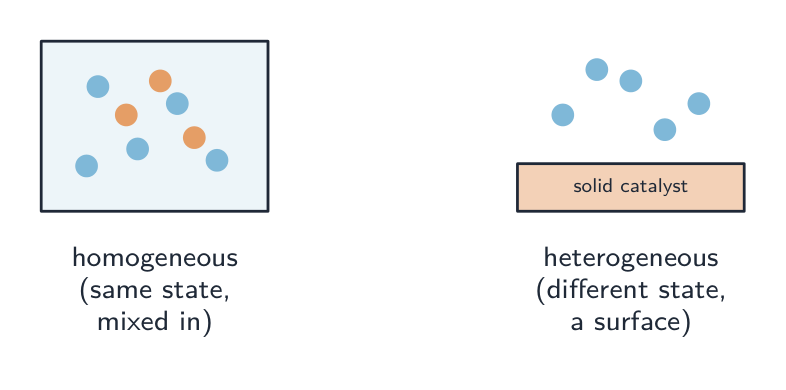
a homogeneous catalyst 均相催化剂 is in the same physical state as the reactants — for example, an acid catalyst dissolved in a solution of liquids.
a heterogeneous catalyst 多相催化剂 is in a different state from the reactants — for example, solid iron speeding up the reaction of gases in the Haber process.
Bahasa Indonesia
Profil reaksi: rute berenergi lebih rendah oleh katalisator
Katalisator mempercepat reaksi tetapi tidak habis sendiri. Katalisis adalah nama untuk tindakan ini.
Katalisator bekerja dengan memberikan reaksi mekanisme reaksi yang berbeda — rute baru dengan energi aktivasi lebih rendah. Pada distribusi Boltzmann, menurunkan $E_A$ memindahkan garis ke kiri, sehingga lebih banyak molekul kini memiliki cukup energi. Ini berarti lebih banyak tumbukan efektif setiap detik, dan laju lebih cepat.
Pada diagram jalur reaksi, rute yang dikatalisis memiliki "bukit" energi yang lebih rendah. Perubahan entalpi reaksi, $\Delta H$, tidak diubah oleh katalisator.
Katalis menyediakan jalur dengan energi aktivasi lebih rendah; perubahan entalpi tetap tidak berubah
Ada dua jenis:
katalisator homogen berada dalam keadaan fisik yang sama dengan reaktan — misalnya, katalisator asam yang dilarutkan dalam larutan cairan.
katalis heterogen berada dalam keadaan berbeda dari reaktan — misalnya, besi padat yang mempercepat reaksi gas dalam proses Haber.
Katalis homogen dicampur dengan reaktan (keadaan sama); katalis heterogen adalah permukaan terpisah (keadaan berbeda), tempat reaktan bertemu dan bereaksiKonverter katalitik mobil adalah katalis heterogen; sarang lebahnya memberikan luas permukaan yang sangat besar
Explore · Jelajahi
Catalysts · Katalisator
a catalyst lowers Ea · katalisator menurunkan Ea
A catalyst lowers Ea, so a bigger fraction of molecules can react — without heating. · Katalisator menurunkan Ea, sehingga fraksi yang lebih besar molekul dapat bereaksi — tanpa pemanasan.
Explore · Jelajahi
How a catalyst works · Bagaimana katalis bekerja
Add a catalyst and watch the activation-energy barrier drop — it gives an easier route, without changing ΔH. · Tambahkan katalis dan saksikan penghalang energi aktivasi turun — ini memberikan jalur yang lebih mudah, tanpa mengubah ΔH.
Explain rate changes with collision theory — more frequent and/or more energetic effective collisions.
On a Boltzmann distribution mark $E_A$, shade to its right, and show the curve flatten and shift right at higher temperature; it starts at the origin and never touches the axis.
A catalyst gives an alternative route with lower $E_A$ and does not change $\Delta H$.
Say why a small temperature rise gives a large rate rise: a much greater proportion of molecules now exceed $E_A$ (the main effect).
Bahasa Indonesia
Jelaskan perubahan laju dengan teori tumbukan — lebih sering dan/atau lebih energik tumbukan efektif.
Pada distribusi Boltzmann, tandai $E_A$, arsir ke kanannya, dan tunjukkan kurva memipih dan bergeser ke kanan pada suhu lebih tinggi; kurva dimulai dari titik asal dan tidak pernah menyentuh sumbu.
Katalis menyediakan jalur alternatif dengan $E_A$ yang lebih rendah dan tidak mengubah $\Delta H$.
Jelaskan mengapa kenaikan suhu kecil menyebabkan kenaikan laju besar: proporsi molekul yang jauh lebih besar kini melebihi $E_A$ (efek utama).
Interactive lessons on this topic · Pelajaran interaktif untuk topik ini
Work through it step by step, with instant-check exercises. · Kerjakan langkah demi langkah, dengan latihan pengecekan instan.
Pick one and the site follows you — notes, papers, videos and practice all open on it. · Pilih satu dan situs mengikuti Anda — catatan, kertas, video, dan latihan semua terbuka di sana.
Type to search notes, lessons, code, vocabulary and past-paper questions across every subject. · Ketik untuk mencari catatan, pelajaran, kode, kosakata, dan pertanyaan soal lama di setiap mata pelajaran.