הסתכל סביבך. רכב מאיץ. כדור נופל. כוס עומדת במקום על שולחן. הפיזיקה יכולה לתאר כל אחד מהם — במדויק, באמצעות מספרים. והכל מבוסס…
English narration · English + 中文 subtitles burned in · קריאת קול באנגלית · תרגום אנגלי + סינית שרוף בתוך הסרטון
1.1
Measurement 测量 · מדידות
Syllabus · סיילבוס
English
Core
Supplement
1 Describe the use of rulers and measuring cylinders to find a length or a volume
2 Describe how to measure a variety of time intervals using clocks and digital timers
3 Determine an average value for a small distance and for a short interval of time by measuring multiples (including the period of oscillation of a pendulum)
4 Understand that a scalar quantity has magnitude (size) only and that a vector quantity has magnitude and direction
5 Know that the following quantities are scalars: distance, speed, time, mass, energy and temperature
6 Know that the following quantities are vectors: force, weight, velocity, acceleration, momentum, electric field strength and gravitational field strength
7 Determine, by calculation or graphically, the resultant of two vectors at right angles, limited to forces or velocities only
עברית
ליבה
תוספת
1 תאר את השימוש בסרגלים ובמיכלי מדידה למציאת אורך או נפח
2 תאר כיצד למדוד מגוון מרווחי זמן באמצעות שעונים ומכשירי טיימר דיגיטליים
3 קבע ערך ממוצע למרחק קטן ולמרווח זמן קצר על ידי מדידת מכפלות (כולל תקופת התנודה של מתנדול)
4 הבן שגודל סקלארי הוא בעל הגדלה (גודל) בלבד, ואילו גודל וקטורי הוא בעל הגדלה וכיוון
5 דע שהגודלים הבאים הם סקלריים: מרחק, מהירות, זמן, מסה, אנרגיה וטמפרטורה
6 דע שהגודלים הבאים הם וקטורים: כוח, משקל, מהירות, תאוצה, תנע, עוצמת שדה חשמלי ועוצמת שדה כבידה
7 קבע, בחישוב או גרפית, את התוצרת של שני וקטורים בזווית ישרה, בהגבלה לכוחות או למהירויות בלבד
Source: Cambridge International syllabus · מקור: הסיילבוס הבינלאומי של קמבריד'ג'
English
Resolving a vector into components
Length and volume
Use a ruler 直尺 to measure length. Read the scale with your eye straight in front of the mark to avoid a reading error.
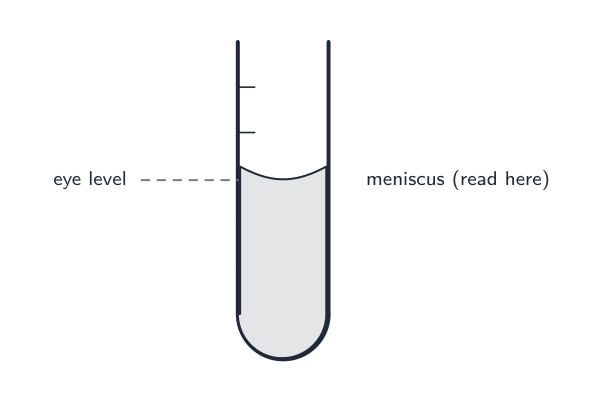
Use a measuring cylinder 量筒 to measure the volume of a liquid. Read the scale at the bottom of the curved surface (the meniscus 弯月面), with your eye level with it.
Measuring time
Use a stopwatch 秒表 or a digital timer 数字计时器 to measure a time interval. A clock is fine for long times (minutes or hours). A stopwatch is started and stopped by hand, so each reading has a reaction time 反应时间 error of about 0.2 s. To make this error matter less, time a long interval, or time many repeats and divide (see below).
Measuring small amounts
A single small length or a short time is hard to measure well. The trick is to measure many and divide 测多个再相除:
To find the thickness of one page, measure 100 pages and divide by 100.
To find the time for one swing of a pendulum 摆, measure the time for 20 swings and divide by 20. One full swing is called the period 周期.
This makes the uncertainty 不确定度 (the size of the error) much smaller.
Scalars and vectors
A scalar quantity 标量 has size (magnitude 大小) only. A vector quantity 矢量 has size and direction.
Scalars: distance, speed, time, mass 质量, energy 能量, temperature 温度.
Vectors: force 力, weight 重力, velocity 速度, acceleration 加速度, momentum 动量, electric field strength 电场强度, gravitational field strength 重力场强度.
To add two vectors at right angles (90°), draw them as two sides of a rectangle. The resultant 合矢量 is the diagonal. Find its size with Pythagoras and its direction with trigonometry.
$$R = \sqrt{a^2 + b^2}$$
עברית
פירוק וקטור למרכיבים
אורך ונפח
השתמש בסרגל למדידת אורך. קרא את הקנה מידה בעיני ישירות מול הסימן כדי למנוע טעות קריאה.
המים שגוף מוצק לא סדיר דוחף כלפי מעלה נותנים את נפחוקראו צילינדר מדידה בתחתית המניסקוס, כשהעיניים בגובה
השתמש בצילינדר מדידה למדידת נפח נוזל. קרא את הקנה מידה בתחתית הפני השטח המעוגלים (המניסקוס), עם עיניים בשורה עימו.
מדידת זמן
השתמש בשטיימר או בטיימר דיגיטלי כדי למדוד מרווח זמן. שעון מתאים לזמנים ארוכים (דקות או שעות). טיימר מופעל ומיוצר ידנית, ולכן לכל קריאה יש שגיאת תגובה של כ-0.2 שניות. כדי להקטין את השפעת שגיאה זו, מדוד מרווח זמן ארוך, או מדוד מספר רב של חזרות וחלק (ראו להלן).
מדידת כמויות קטנות
אורך אחד קטן או זמן קצר קשה למדוד היטב. הטריק הוא מדוד רבים וחלק:
כדי למצוא את עובי דף אחד, מדוד 100 דפים וחלק ב-100.
כדי למצוא את הזמן לנדודה אחת של מתלה, מדוד את הזמן ל-20 נדודות וחלק ב-20. נדודה מלאה אחת נקראת תקופה.
פעולה זו מקטינה משמעותית את אי-הוודאות (גודל השגיאה).
סקאלרים ווקטורים
כמות סקלרית היא בעלת גודל (גודל כמות) בלבד. כמות וקטורית היא בעלת גודל וגם כיוון.
וקטורים: כוח, משקל, מהירות, תאוצה, תנע, חוזק שדה חשמלי, חוזק שדה כבידה.
כדי לחבר שני וקטורים בזווית ישרה (90°), צייר אותם כשתי צלעות של מלבן. הווקטור התוצא הוא האלכסון. מצא את גודלו באמצעות משפט פיתגורס ואת כיוונו באמצעות טריגונומטריה.
$$R = \sqrt{a^2 + b^2}$$
שני וקטורים בזווית ישרה מתחברים לתוצרת $R$, האלכסון של המלבן
Explore · חקור
Scalars & vectors · סקאלרים ווקטורים
resultant = a + b · הכוח השקול = a + b
Add two vectors tip-to-tail to find the resultant. · הוסיפו שני וקטורים בקצה-בקצה כדי למצוא את הווקטור השקול.
1 Define speed as distance travelled per unit time; recall and use the equation
$$v = \frac{s}{t}$$
2 Define velocity as speed in a given direction
3 Recall and use the equation
$$\text{average speed} = \frac{\text{total distance travelled}}{\text{total time taken}}$$
9 Define acceleration as change in velocity per unit time; recall and use the equation
$$a = \frac{\Delta v}{\Delta t}$$
4 Sketch, plot and interpret distance–time and speed–time graphs
5 Determine, qualitatively, from given data or the shape of a distance–time graph or speed–time graph when an object is: (a) at rest (b) moving with constant speed (c) accelerating (d) decelerating
10 Determine from given data or the shape of a speed–time graph when an object is moving with: (a) constant acceleration (b) changing acceleration
6 Calculate speed from the gradient of a straight-line section of a distance–time graph
11 Calculate acceleration from the gradient of a speed–time graph
7 Calculate the area under a speed–time graph to determine the distance travelled for motion with constant speed or constant acceleration
12 Know that a deceleration is a negative acceleration and use this in calculations
8 State that the acceleration of free fall $g$ for an object near to the surface of the Earth is approximately constant and is approximately $9.8\text{ m/s}^2$
13 Describe the motion of objects falling in a uniform gravitational field with and without air/ liquid resistance, including reference to terminal velocity
עברית
ליבה
תוספת
1 הגדר מהירות כמרחק שנעבר ליחידת זמן; זכור והשתמש במשוואה
$$v = \frac{s}{t}$$
2 הגדר מהירות כמהירות בכיוון נתון
3 זכור והשתמש במשוואה
$$\text{average speed} = \frac{\text{total distance travelled}}{\text{total time taken}}$$
9 הגדר תאוצה כשינוי במהירות ליחידת זמן; זכור והשתמש במשוואה
$$a = \frac{\Delta v}{\Delta t}$$
4 שרטט, פלוט ופרש גרפים של מרחק–זמן וגרפים של מהירות–זמן
5 קבע, איכותית, מתוך נתונים נתונים או צורת גרף של מרחק–זמן או גרף של מהירות–זמן, מתי גוף נמצא: (א) במנוחה (ב) בתנועה עם מהירות קבועה (ג) בתאוצה (ד) בהאטה
10 קבע מתוך נתונים נתונים או צורת גרף של מהירות–זמן מתי גוף נמצא בתנועה עם: (א) תאוצה קבועה (ב) תאוצה משתנה
6 חשב מהירות מתוך שיפוע החלק הישר בגרף של מרחק–זמן
11 חשב תאוצה מתוך שיפוע גרף של מהירות–זמן
7 חשב את השטח מתחת לגרף של מהירות–זמן כדי לקבוע את המרחק שנעבר לתנועה עם מהירות קבועה או תאוצה קבועה
12 דע שהאטה היא תאוצה שלילית והשתמש בכך בחישובים
8 ציין שתאוצת הנפילה החופשית $g$ עבור גוף בקרבת פני כדור הארץ היא בקירוב קבועה והיא בקירוב $9.8\text{ m/s}^2$
13 תאר את תנועת גופים הצומחים בשדה כבידה אחיד עם או ללא התנגדות אוויר/נוזל, כולל התייחסות למהירות סופית
Source: Cambridge International syllabus · מקור: הסיילבוס הבינלאומי של קמבריד'ג'
English
Speed and velocity
Speed 速率 is the distance travelled per unit time.
$$v = \frac{s}{t}$$
Velocity is speed in a stated direction. So velocity is a vector but speed is a scalar.
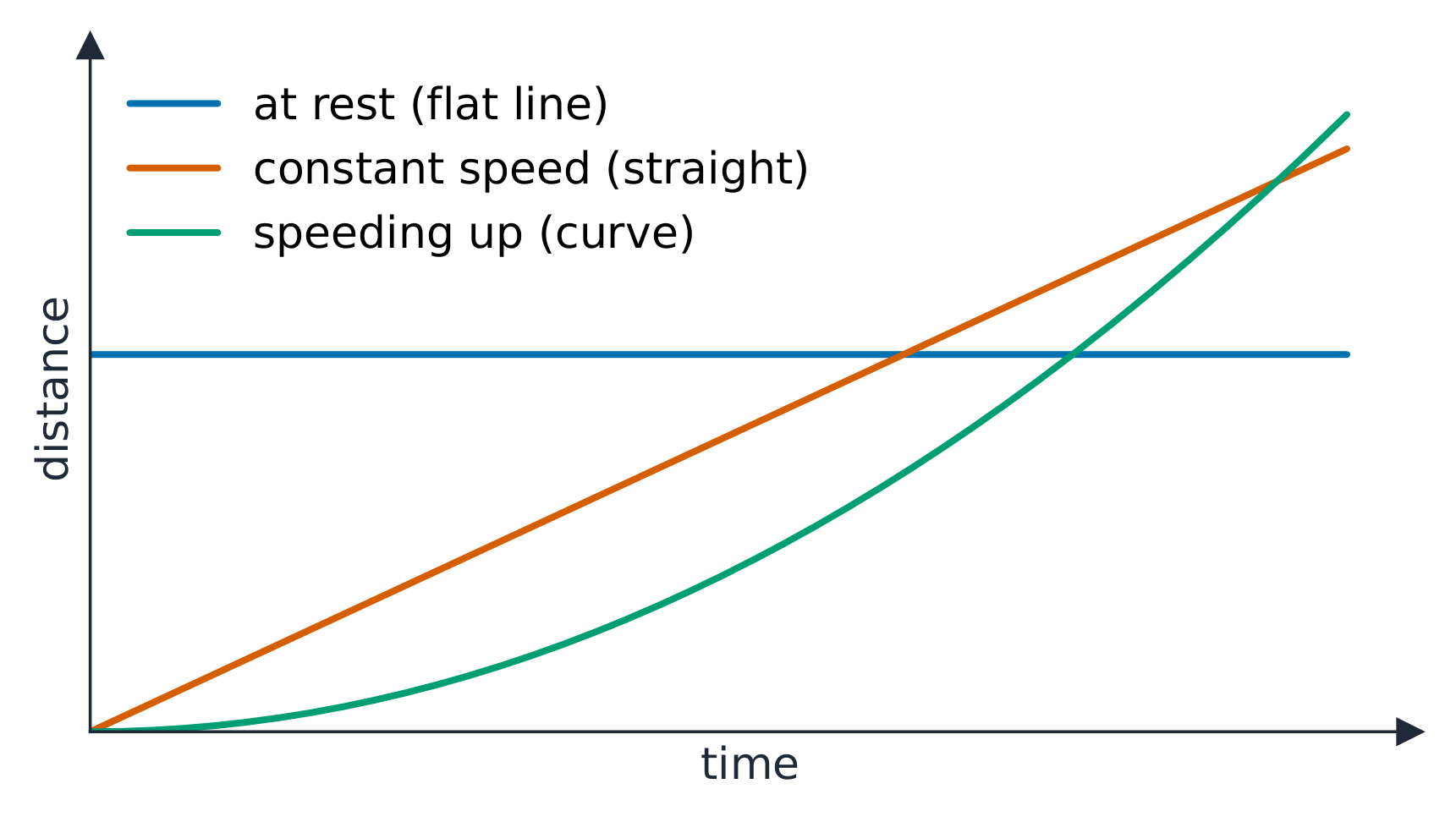
A distance–time graph 距离-时间图 shows how far an object has gone:
A flat (horizontal) line means the object is at rest 静止.
A straight slope means constant speed. The gradient 斜率 (steepness) is the speed.
A curve that gets steeper means the object is speeding up.
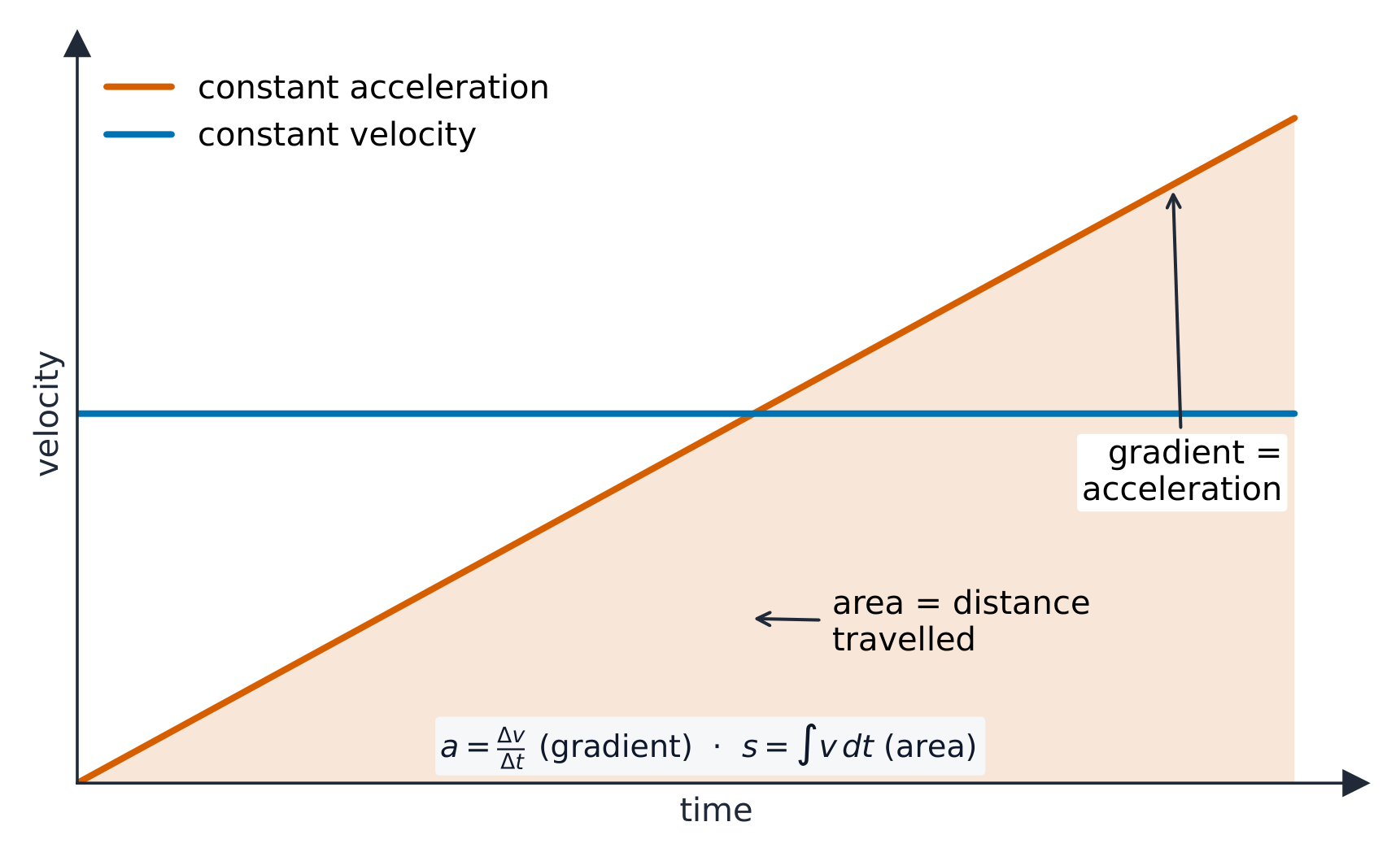
A speed–time graph 速度-时间图 shows how fast an object is going:
A flat line means constant speed.
A straight slope means constant acceleration. The gradient is the acceleration.
The area under the line 线下面积 is the distance travelled.
Falling objects
Near the Earth the gravitational field is uniform 均匀 (the same strength everywhere), so all objects speed up as they fall at the same rate. This is the acceleration of free fall 自由落体加速度, $g \approx 9.8\ \text{m/s}^2$.
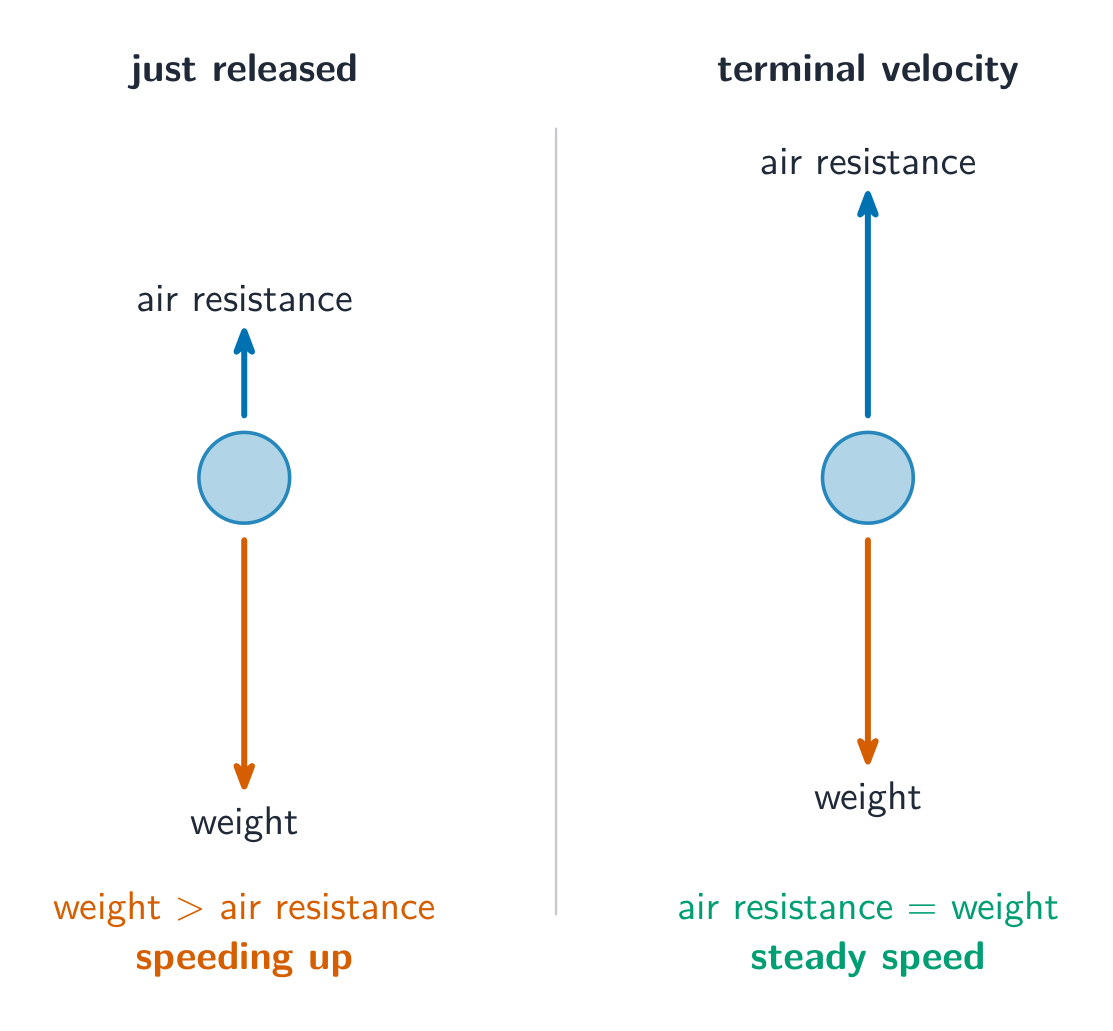
When an object falls through air, air resistance 空气阻力 (a drag force) acts upward. As it speeds up, air resistance grows. When air resistance equals the weight, the resultant force is zero and the object stops speeding up. It then falls at a steady terminal velocity 收尾速度.
עברית
מהירות וווקטור מהירות
מהירות היא המרחק הנעבר ליחידת זמן.
$$v = \frac{s}{t}$$
וקטור מהירות הוא מהירות בכיוון נתון. לכן וקטור מהירות הוא וקטור אך מהירות היא סקלרית.
שיפוע ישר מעיד על מהירות קבועה. השיפוע (תלילות) הוא המהירות.
עקומה הולכת ותלולה יותר מעידה על כך שהאובייקט מאיץ.
צורת הקו בגרף מרחב-זמן: קו שטוח פירושו רגיעה, שיפוע ישר פירושו מהירות קבועה, ועקומה עולה פירושו התאצה
גרף מהירות-זמן: מראה כמה האובייקט נוסע:
קו שטוח מעיד על מהירות קבועה.
שיפוע ישר מעיד על התאצה קבועה. השיפוע הוא ההתאצה.
השטח מתחת לקו הוא המרחב שנעבר.
בגרף מהירות-זמן, השיפוע מייצג את ההתאצה והשטח מתחת לקו מייצג את המרחב שנעבר
גוף נופל
קרוב לפני כדור הארץ, השדה הכבידתי אחיד (בעל אותה חוזקה בכל מקום), ולכן כל האובייקטים מאיצים בזמן הנפילה בקצב זהה. זוהי התאצת הנפילה החופשי, $g \approx 9.8\ \text{m/s}^2$.
כאשר אובייקט נופל דרך האוויר, התנגדות אוויר (כוח חיכוך) פועלת כלפי מעלה. ככל שהוא מאיץ, התנגדות האוויר גדלה. כאשר התנגדות האוויר שווה למשקלו, הכוח הנתון הוא אפס והאובייקט מפסיק להתאיץ. לאחר מכן הוא נופל במהירות סופית קבועה.
בתחילה המשקל גדול מההתנגדות האווירית ולכן האובייקט מאיץ; במהירות סופית שתי הכוחות שווים והמהירות קבועה
Explore · חקור
Velocity–time graph · גרף מהירות-זמן
Change u and a. The gradient is the acceleration; the area under the line is the distance travelled. · שנה את u ואת a. השיפוע הוא ההאצה; השטח מתחת לקו הוא המרחק שנסע.
acceleration of free fall/əkˌseləˈreɪʃn ɒv friː fɔːl/
תאוצת נפילה חופשית
air resistance/eə rɪˈzɪstəns/
התנגדות אוויר
terminal velocity/ˈtɜːmɪnl vəˈlɒsɪti/
מהירות סופית
matter/ˈmætə/
חומר
1.3
Mass and weight · מסה ומשקל
Syllabus · סיילבוס
English
Core
Supplement
1 State that mass is a measure of the quantity of matter in an object at rest relative to the observer
2 State that weight is a gravitational force on an object that has mass
5 Describe, and use the concept of, weight as the effect of a gravitational field on a mass
3 Define gravitational field strength as force per unit mass; recall and use the equation
$$g = \frac{W}{m}$$
and know that this is equivalent to the acceleration of free fall
4 Know that weights (and masses) may be compared using a balance
עברית
ליבה
תוספת
1 ציין כי מסה היא מדד לכמות החומר בגוף הנמצא במנוח ביחס לצופה
2 ציין כי משקל הוא כוח כבידה הפועל על גוף בעל מסה
5 תאר, והשתמש במונח משקל, כהשפעת שדה כבידה על מסה
3 הגדר את עוצמת השדה הכבידתי ככוח ליחידת מסה; זכור ושתמש במשוואה
$$g = \frac{W}{m}$$
ודע שהיא שקולה לתאוצת הנפילה החופשית
4 דע כי משקלים (ומסות) ניתן להשוות באמצעות מאזניים
Source: Cambridge International syllabus · מקור: הסיילבוס הבינלאומי של קמבריד'ג'
English
Mass is the amount of matter 物质 in an object. It is measured in kilograms (kg) and does not change when you move the object.
Weight is the force of gravity on a mass. It is measured in newtons (N). Weight can change: it is smaller on the Moon because the Moon's gravity is weaker.
Gravitational field strength is the force per unit mass:
$$g = \frac{W}{m}$$
This $g$ has the same value as the acceleration of free fall ($\approx 9.8\ \text{N/kg}$). You can compare masses with a balance 天平.
עברית
מסה היא כמות החומר באובייקט. היא נמדדת בקילוגרמים (kg) ואינה משתנה כאשר מזיזים את האובייקט.
משקל הוא כוח הכבידה הפועל על מסה. נמדד ביחידות ניוטון (N). המשקל יכול להשתנות: הוא קטן יותר בירח משום שכוח הכבידה שם חלש יותר.
עוצמת שדה כבידה היא הכוח ליחידת מסה:
$$g = \frac{W}{m}$$
ערך זה $g$ זהה לעצירת החופשי ($\approx 9.8\ \text{N/kg}$). ניתן להשוות מסות באמצעות מאזניים.
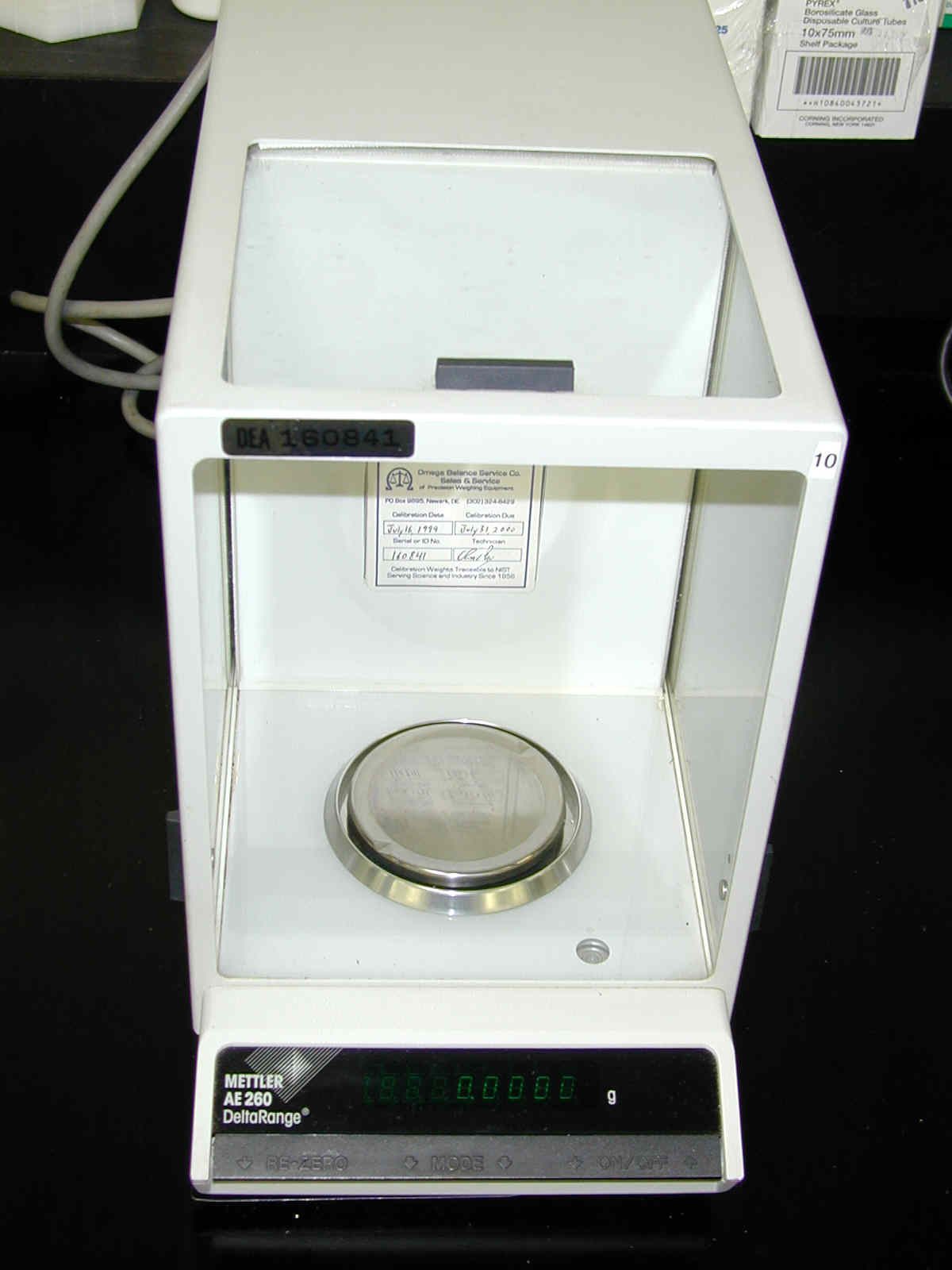
מאזני מעבדה נמדדים מסה; משקל הוא כוח הכבידה הפועל על המסה הזו
Explore · חקור
Weight and mass · משקל ומסה
W = mg
Weight is proportional to mass — the gradient is the gravitational field strength g (about 10 N/kg on Earth). · משקל יחסוני למסה — השיפוע הוא עוצמת השדה הכבידתי g (כ-10 N/kg בכדור הארץ).
1 Define density as mass per unit volume; recall and use the equation
$$\rho = \frac{m}{V}$$
2 Describe how to determine the density of a liquid, of a regularly shaped solid and of an irregularly shaped solid which sinks in a liquid (volume by displacement), including appropriate calculations
3 Determine whether an object floats based on density data
4 Determine whether one liquid will float on another liquid based on density data given that the liquids do not mix
עברית
ליבה
תוספת
1 הגדר צפיפות כמסה ליחידת נפח; זכור ושתמש במשוואה
$$\rho = \frac{m}{V}$$
2 תאר כיצד לקבוע את הצפיפות של נוזל, של מוצק בצורה סדירה ועל מוצק שאינו בצורה סדירה ושוקע בנוזל (נפח על ידי תזוזה), כולל חישובים מתאימים
3 קבע האם גוף מצטוף בהתבסס על נתוני צפיפות
4 קבע האם נוזל אחד יצטוף על פני נוזל אחר בהתבסס על נתוני צפיפות נתונים בתנאי שהנוזלים אינם מעורבים זה בזה
Source: Cambridge International syllabus · מקור: הסיילבוס הבינלאומי של קמבריד'ג'
English
Density is the mass per unit volume.
$$\rho = \frac{m}{V}$$
The symbol $\rho$ is the Greek letter "rho". The unit is $\text{kg/m}^3$ or $\text{g/cm}^3$.
To find density: measure the mass with a balance, find the volume, then divide.
Regular solid 规则固体 (like a box): measure the sides and calculate the volume.
Irregular solid 不规则固体 (a strange shape): lower it into water in a measuring cylinder. The rise in water level is its volume. This is the displacement method 排水法.
Liquid: put an empty measuring cylinder on the balance and read its mass. Pour in the liquid, read the volume on the cylinder, and read the mass again. The mass of the liquid is the difference between the two mass readings.
An object floats 漂浮 if its density is less than the density of the liquid. It sinks if its density is greater. In the same way, one liquid floats on top of another (if the two do not mix) when its density is lower: oil floats on water.
Worked example. A stone of mass $54\ \text{g}$ is lowered into a measuring cylinder. The water level rises from $20\ \text{cm}^3$ to $40\ \text{cm}^3$. Find the density of the stone.
The volume of the stone is the rise in water level, $40 - 20 = 20\ \text{cm}^3$, so
הסמל $\rho$ הוא האות היוונית "רואו". היחידה היא $\text{kg/m}^3$ או $\text{g/cm}^3$.
כדי למצוא צפיפות: מדוד את המסה במאזנים, מצא את הנפח, ואז חלק.
גוף מוצק קבוע (כמו קופסה): מדוד את הצדדים וחשב את הנפח.
גוף מוצק לא קבוע (צורה זרה): הרט אותו במים במכל מדידה. העלייה ברמת המים היא הנפח שלו. שיטה זו נקראת שיטת ההפרשה.
נוזל: הנח מאזן ריק על המאזניים וקרא את מססתו. יצוק לתוכו את הנוזל, קרא את הנפח במכל המדידה, וקרא את המסה שוב. מסת הנוזל היא ההפרש בין שתי הקריאות.
גוף צף אם הצפיפות שלו פחותה מצפיפות הנוזל. הוא שוקע אם הצפיפות שלו גדולה יותר. באופן דומה, נוזל אחד צף מעל השני (אם הם אינם מתערבבים) כאשר הצפיפות שלו נמוכה: שמן צף על מים.
דוגמה פתרונה. אבן בעלת מסה $54\ \text{g}$ הורדת למכל מדידה. רמת המים עלתה מ-$20\ \text{cm}^3$ ל-$40\ \text{cm}^3$. חשב את צפיפות האבן.
נפח האבן הוא עליית רמת המים, $40 - 20 = 20\ \text{cm}^3$, ולכן
סלע גלידי צף כשרוב נפחו מוסתר: קרח פחות צפוף מעט מהמים
Explore · חקור
Floating and density · צפיפה והתמצות
Change the object's density and the liquid: it floats if it's less dense, and the denser it is the more sits underwater. Iron sinks in water but floats on mercury. · שנו את צפיפות הגוף ואת הנוזל: גוף מתמצח אם צפיפותו נמוכה, וככל שהוא צפוף יותר כך יותר ממנו שוקע במים. ברזל טובע במים אך מתמצח על פני המרcury.
limit of proportionality/ˈlɪmɪt ɒv prəˌpɔːʃəˈnælɪti/
גבול פרופורציונליות
spring constant/sprɪŋ ˈkɒnstənt/
קבוע קפיץ
resultant force/rɪˈzʌltənt fɔːs/
כוח נטו
circular motion/ˈsɜːkjʊlə ˈməʊʃn/
תנועה מעגלית
radius/ˈreɪdɪəs/
רדיוס
friction/ˈfrɪkʃn/
חיכוך
1.5
Forces · כוחות
Syllabus · סיילבוס
English
1.5.1 Effects of forces
Core
Supplement
1 Know that forces may produce changes in the size and shape of an object
9 Define the spring constant as force per unit extension; recall and use the equation
$$k = \frac{F}{x}$$
2 Sketch, plot and interpret load–extension graphs for an elastic solid and describe the associated experimental procedures
10 Define and use the term ‘limit of proportionality’ for a load–extension graph and identify this point on the graph (an understanding of the elastic limit is not required)
3 Determine the resultant of two or more forces acting along the same straight line
11 Recall and use the equation $F = ma$ and know that the force and the acceleration are in the same direction
4 Know that an object either remains at rest or continues in a straight line at constant speed unless acted on by a resultant force
5 State that a resultant force may change the velocity of an object by changing its direction of motion or its speed
12 Describe, qualitatively, motion in a circular path due to a force perpendicular to the motion as: (a) speed increases if force increases, with mass and radius constant (b) radius decreases if force increases, with mass and speed constant (c) an increased mass requires an increased force to keep speed and radius constant ($F = \frac{mv^2}{r}$ is not required)
6 Describe solid friction as the force between two surfaces that may impede motion and produce heating
7 Know that friction (drag) acts on an object moving through a liquid
8 Know that friction (drag) acts on an object moving through a gas (e.g. air resistance)
1.5.2 Turning effect of forces
Core
Supplement
1 Describe the moment of a force as a measure of its turning effect and give everyday examples
2 Define the moment of a force as $\text{moment} = \text{force} \times \text{perpendicular distance from the pivot}$; recall and use this equation
3 Apply the principle of moments to situations with one force each side of the pivot, including balancing of a beam
5 Apply the principle of moments to other situations, including those with more than one force each side of the pivot
4 State that, when there is no resultant force and no resultant moment, an object is in equilibrium
6 Describe an experiment to demonstrate that there is no resultant moment on an object in equilibrium
1.5.3 Centre of gravity
Core
Supplement
1 State what is meant by centre of gravity
2 Describe an experiment to determine the position of the centre of gravity of an irregularly shaped plane lamina
3 Describe, qualitatively, the effect of the position of the centre of gravity on the stability of simple objects
עברית
1.5.1 השפעות של כוחות
ליבה
תוספת
1 דע כי כוחות עשויים לגרום לשינויים בגודל ובצורתו של גוף
9 הגדר את קבוע הקפיץ ככוח ליחידת הארכה; זכור ושתמש במשוואה
$$k = \frac{F}{x}$$
2 ערך טריס, גרף ופרשן גרפים של עומס-הארכה עבור מוצק אלסטי ותיאר את הנהלים הניסויים הקשורים
10 הגדר ושתמש במונח גבול הפרופורציונליות לגרף עומס-הארכה ואייל את נקודה זו בגרף (הבנת הגבול האלסטי אינה נדרשת)
3 קבע את הכוח השקול של שני כוחות או יותר הפועלים לאורך אותו קו ישר
11 זכור ושתמש במשוואה $F = ma$ ודע כי הכוח והתאוצה הם באותו כיוון
4 דע כי גוף נשאר במנוח או ממשיך בתנועה בקו ישר במהירות קבועה אלא אם כן הוא מושפע מכוח שקול
5 ציין כי כוח שקול יכול לשנות את המהירות של גוף על ידי שינוי כיוון התנועה שלו או את מהירותו
12 תאר, באופן איכותני, תנועה במסלול מעגלי בשל כוח אנכי לתנועה כדלקמן: (א) המהירות עולה כאשר הכוח עולה, עם מסה ורדיוס קבועים (ב) הרדיוס יורד כאשר הכוח עולה, עם מסה ומהירות קבועות (ג) מסה מוגברת דורשת כוח מוגבר כדי לשמור על מהירות ורדיוס קבועים ($F = \frac{mv^2}{r}$ אינו נדרש)
6 תאר חיכוך מוצק ככוח בין שתי משטחים שעשוי להעכב תנועה ולגרום לחימום
7 דע כי חיכוך (התנגדות נוזלים) פועל על גוף הנע בנוזל
8 דע כי חיכוך (התנגדות אוויר) פועל על גוף הנע בגז (למשל, התנגדות אוויר)
1.5.2 אפקט סיבובי של כוחות
ליבה
תוספת
1 תאר את מומנט של כוח כמידה להשפעת הסיבוב שלו ותן דוגמאות יומיומיות
2 הגדר את מומנט הכוח כ $\text{moment} = \text{force} \times \text{perpendicular distance from the pivot}$; זכור ושתמש במשוואה זו
3 השתמש בעקרון המומנטים במצבים עם כוח אחד בכל צד הציר, כולל איזון קורה
5 השתמש בעקרון המומנטים במצבים אחרים, כולל אלו עם יותר מכוח אחד בכל צד הציר
4 נסח כי כאשר אין כוח תוצא ואין מומנט תוצא, גוף נמצא באיזון
6 תאר ניסוי להראות שאין מומנט תוצא על גוף באיזון
1.5.3 מרכז הכובד
ליבה
תוספת
1 נסח מהו מרכז הכובד
2 תאר ניסוי לקביעת מיקום מרכז הכובד של לוח שטוח בעל צורה לא סדירה
3 תאר, באופן איכותי, את ההשפעה של מיקום מרכז הכובד על יציבותם של גופים פשוטים
Source: Cambridge International syllabus · מקור: הסיילבוס הבינלאומי של קמבריד'ג'
English
The principle of momentsHooke's law & the elastic limit
A force is a push or a pull. A force can change the shape 形状, the speed, or the direction of an object.
Stretching (Hooke's law)
When you hang a load on a spring, it stretches. The stretch is called the extension 伸长量.
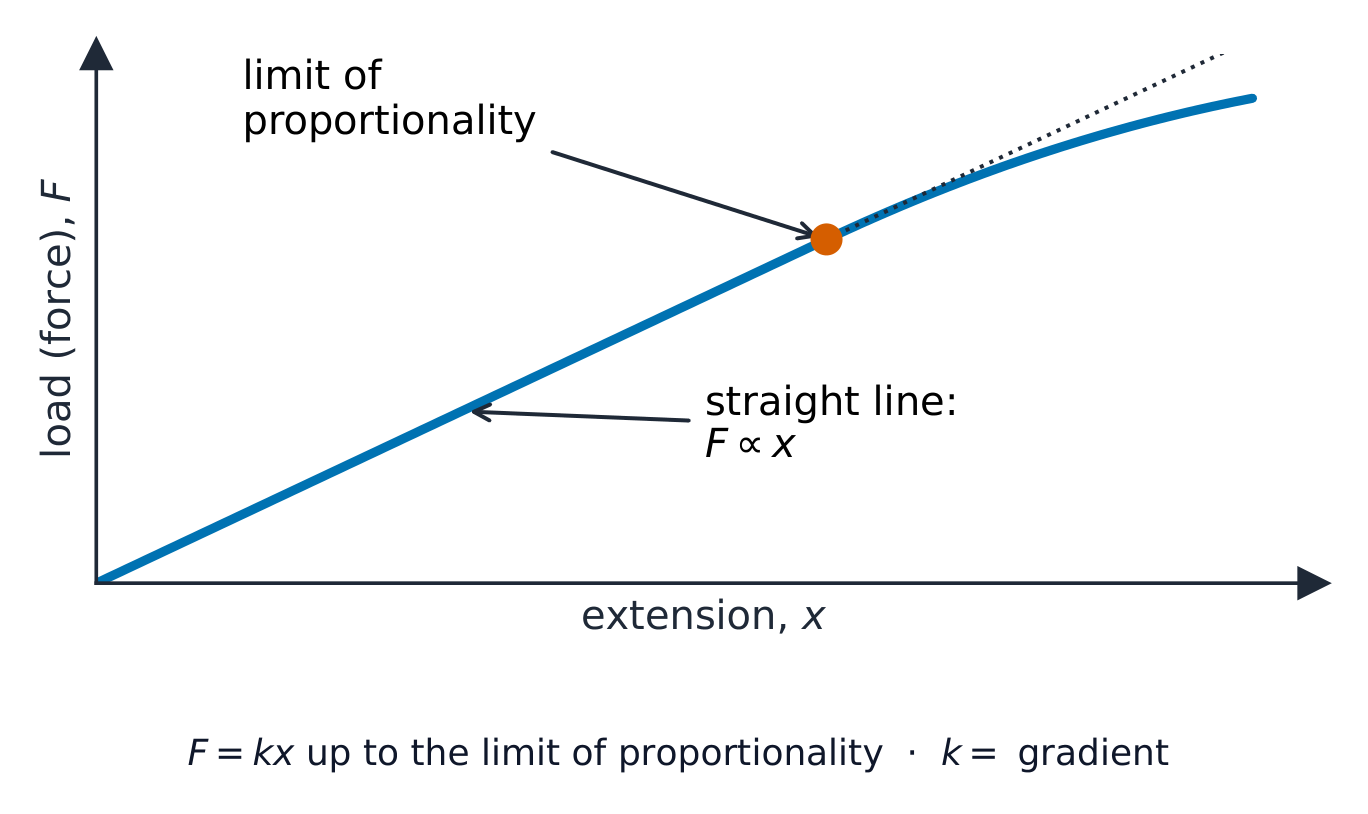
On a load–extension graph 载荷-伸长图 the line is straight at first: extension is proportional to load. The point where the line stops being straight is the limit of proportionality 比例极限.
The experiment. Hang the spring from a clamp and stand a ruler beside it. Read the position of the bottom of the spring with no load: this is the original length. Add loads one at a time (for example 1 N each) and record the new length each time. The extension is the new length minus the original length. Plot load on the y-axis against extension on the x-axis.
The spring constant 弹簧常数 is the force per unit extension:
$$k = \frac{F}{x}$$
A large $k$ means a stiff spring.
Resultant force and Newton's laws
Add forces on a straight line to get the resultant force 合力 (forces one way are positive, the other way negative).
If the resultant force is zero, the object stays at rest or keeps moving in a straight line at constant speed. (Newton's first law.)
If the resultant force is not zero, the object accelerates in the direction of the force:
$$F = ma$$
Worked example. A $1200\ \text{kg}$ car has a $3000\ \text{N}$ driving force and $600\ \text{N}$ of friction. Find its acceleration.
First find the resultant force: $3000 - 600 = 2400\ \text{N}$. Then
A resultant force at right angles to the motion does not change the speed. It changes the direction, so the object moves in a circle at a steady speed. This is circular motion 圆周运动. The force always points towards the centre of the circle: the pull of the string on a whirling ball, or the gravity of the Sun on a planet.
For an object moving in a circle:
a bigger force is needed to keep the same mass moving at a higher speed in a circle of the same radius 半径;
a bigger force makes the same mass at the same speed move in a smaller circle (a smaller radius);
a bigger mass needs a bigger force to keep the same speed and the same radius.
Friction
Friction 摩擦力 is the force between two surfaces that touch. It tries to stop motion and makes things heat up. Drag (friction in a liquid or gas, like air resistance) also slows objects down.
Moments — the turning effect
The moment 力矩 of a force is its turning effect about a pivot 支点.
$$\text{moment} = \text{force} \times \text{perpendicular distance from the pivot}$$
The unit is the newton metre (N m).
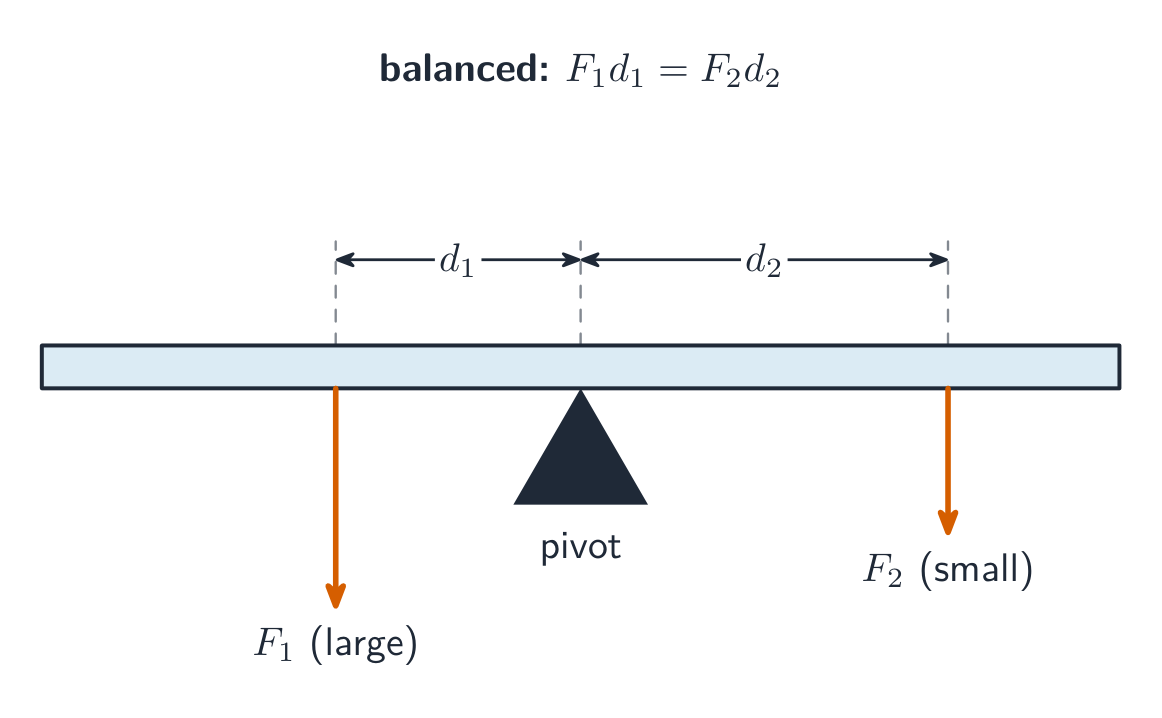
Principle of moments 力矩原理: when an object is balanced (in equilibrium 平衡),
An object is in equilibrium when there is no resultant force and no resultant moment.
Worked example. A $30\ \text{N}$ weight sits $0.20\ \text{m}$ to the left of a pivot. How far to the right must a $20\ \text{N}$ weight sit to balance the beam?
Balanced, so anticlockwise moment $=$ clockwise moment:
$$30 \times 0.20 = 20 \times d \quad\Rightarrow\quad d = \frac{6.0}{20} = 0.30\ \text{m}$$
Checking the principle by experiment. Balance a metre rule at its centre on a pivot. Hang a known weight on each side and move them until the rule balances again. Measure each distance from the pivot. Force × distance on the left equals force × distance on the right, within the small errors of measurement, so there is no resultant moment on a balanced object.
Centre of gravity
The centre of gravity 重心 is the single point where all the weight of an object seems to act.
For a flat shape (lamina 薄片), hang it from a pin and let it settle; draw a vertical line down from the pin using a plumb line. Repeat from another point. The centre of gravity is where the lines cross.
The stability 稳定性 of an object depends on where its centre of gravity is. An object is more stable 稳定 when its centre of gravity is low and its base is wide. It tips over when a vertical line down from the centre of gravity passes outside the base.
עברית
עקרון המומנטיםחוק הוק & הגבול האלסטי
כוח הוא דחיפה או משיכה. כוח יכול לשנות את הצורה, מהירות או כיוון של גוף.
מתיחה (חוק הוק)
כשתולת משקל בקפיץ, הוא נמתח. ההתארכות נקראת הארכה.
בערך גרף משקל-הארכה- הקו הוא ישר בהתחלה: ההארכה פרופורציונלית למשקל. הנקודה שבה הקו מפסיק להיות ישר היא גבול הפרופורציונליות.
העומס יחסי להארכה עד לגבול היחסיות, ולאחר מכן הקו מתעקם
הניסוי. תלה את הקפיץ בתופסן והניח סרגל לצדו. קרא את המיקום של תחתית הקפיץ ללא עומס: זהו האורך המקורי. הוסף עומסים אחד אחרי השני (למשל 1 N כל אחד) ורשום את האורך החדש בכל פעם. ההארכה היא האורך החדש פחות האורך המקורי. צייר גרף שבו העומס הוא על ציר ה-y וההארכה היא על ציר ה-x.
קביעת הקפיץ היא הכוח ליחידת הארכה:
$$k = \frac{F}{x}$$
ערך גדול של $k$ מצביע על קפיץ קשיח.
כוח resultant וחוקי ניוטון
חבר כוחות בקו ישר כדי לקבל את הכוח הresultant (כוחות בכיוון אחד חיוביים, באופן הפוך שליליים).
אם הכוח הresultant הוא אפס, הגוף נשאר במנוחה או ממשיך לנוע בקו ישר עם מהירות קבועה. (חוק ניוטון הראשון.)
אם הכוח הresultant אינו אפס, הגוף מאיצ בכיוון הכוח:
$$F = ma$$
תרשים הגוף החופשי מראה כל כוח המופעל על התיבה כחץ מסומן
דוגמה פתורה. מכונית בעלת $1200\ \text{kg}$ יש כוח הנעה של $3000\ \text{N}$ ועומס חיכוך של $600\ \text{N}$. מצא את ההאצה שלה.
תחילה מצא את הכוח הresultant: $3000 - 600 = 2400\ \text{N}$. לאחר מכן
כוח resultant מאונך לתנועה אינו משנה את המהירות. הוא משנה את הכיוון, ולכן הגוף נע במעגל במהירות יציבה. זוהי תנועה מעגלית. הכוח תמיד מצביע לכיוון מרכז המעגל: המשיכה של החוט על כדור מסתובב, או הכבידה של השמש על כוכב לכת.
לגוף הנע במעגל:
נדרש כוח גדול יותר כדי לשמור על אותה מסה הנעה במהירות גבוהה יותר במעגל בעל אותו רדיוס;
כוח גדול יותר גורם לאותה מסה באותה מהירות לנוע במעגל קטן יותר (רדיוס קטן);
מסה גדולה יותר דורשת כוח גדול יותר כדי לשמור על אותה מהירות ואותו רדיוס.
חיכוך
חיכוך הוא הכוח בין משטחים שונים המגע. הוא מנסה לעצור תנועה וגורם לחומרים להתחמם. גרירה (חיכוך בנוזל או בגז, כמו התנגדות אוויר) גם היא מאטה גופים.
מומנטים — אפקט סיבוב
המומנט של כוח הוא אפקט הסיבוב שלו סביב ציר סיבוב.
$$\text{moment} = \text{force} \times \text{perpendicular distance from the pivot}$$
גוף נמצא באיזון כאשר אין כוח נטו וגם אין מומנט נטו.
הקורה מאוזנת כאשר המומנט השעוני שווה למומנט נגד השעון
דוגמה פותרת. משקל $30\ \text{N}$ יושב במרחק $0.20\ \text{m}$ שמאלה לציר הסיבוב. כמה מרחק לימינה חייב לשבת משקל $20\ \text{N}$ כדי לאזן את הקורה?
מאוזן, ולכן מומנט נגד השעון $=$ מומנט שעוני:
$$30 \times 0.20 = 20 \times d \quad\Rightarrow\quad d = \frac{6.0}{20} = 0.30\ \text{m}$$
בדיקת העקרון בניסוי. האזן סרגל מטר במרכזו על ציר סיבוב. תלה משקל ידוע בכל צד והזז אותם עד שהסרגל מתאזן שוב. מדוד את כל המרחקים מציר הסיבוב. הכוח × המרחק בצד שמאל שווים לכוח × המרחק בצד ימין, בתוך שגיאות המדידה הקטנות, ולכן אין מומנט נטו בגוף מאוזן.
מרכז הכובד
מרכז הכובד הוא הנקודה היחידה בה כל משקל הגוף נראה כאילו פועל.
לצורה שטוחה (למינה), תלה אותה מעל סיכה ותינוחה להירגע; צייר קו אנכי מטה מהסיכה בעזרת תליון. חזור מכיוון אחר. מרכז הכובד הוא הנקודה בה הקווים נפגשים.
היציבות של גוף תלויה במיקום מרכז הכובד שלו. גוף יותר יציב כאשר מרכז הכובד שלו נמוך והבסיס שלו רחב. הוא נוטה להתהפך כאשר קו אנקי מטה ממרכז הכובד עובר מחוץ לבסיס.
Explore · חקור
Forces & Newton's laws · כוחות וחוקי ניוטון
F = ma (resultant) · F = ma (תוצאתית)
The resultant force sets the acceleration; balanced forces ⇒ none. · הכוח התוצאתי קובע את התאוצה; כוחות מאוזנים ⇒ אין תאוצה.
Source: Cambridge International syllabus · מקור: הסיילבוס הבינלאומי של קמבריד'ג'
English
Conservation of momentum in a collision
Momentum is mass times velocity. It is a vector.
$$p = mv$$
Impulse 冲量 is the force times the time it acts, and it equals the change in momentum:
$$\text{impulse} = F\,\Delta t = \Delta(mv)$$
So the resultant force is the change in momentum per unit time:
$$F = \frac{\Delta p}{\Delta t}$$
Conservation of momentum 动量守恒: when objects collide and no outside force acts, the total momentum before equals the total momentum after.
$$m_1 u_1 + m_2 u_2 = m_1 v_1 + m_2 v_2$$
(Here $u$ is a velocity before and $v$ is a velocity after.)
Worked example. A $2.0\ \text{kg}$ trolley moving at $3.0\ \text{m/s}$ hits a stationary $1.0\ \text{kg}$ trolley and they stick together. Find their common velocity afterwards.
הדחיפה היא הכוח כפול הזמן שבו הוא פועל, והיא שווה לשינוי בתנע:
$$\text{impulse} = F\,\Delta t = \Delta(mv)$$
לכן הכוח הנטו הוא שינוי התנע ליחידת זמן:
$$F = \frac{\Delta p}{\Delta t}$$
שימור התנע: כאשר גופים מתנגשים ואין כוח חיצוני הפועל, הסכום התנעים לפני ההתנגשות שווה לסכום התנעים אחרי ההתנגשות.
$$m_1 u_1 + m_2 u_2 = m_1 v_1 + m_2 v_2$$
(כאן $u$ היא מהירות לפני ההתנגשות ו$v$ היא מהירות אחרי ההתנגשות.)
דוגמה פותרת. עגלה $2.0\ \text{kg}$ הנעה במהירות $3.0\ \text{m/s}$ פוגעת בעגלה עומדת $1.0\ \text{kg}$ והן נדבקות יחד. מצאו את המהירות המשותפת שלהן לאחר מכן.
gravitational field strength/ˌɡrævɪˈteɪʃənl fiːld streŋθ/
חוזק שדה כבידה
impulse/ˈɪmpʌls/
תנע כוח
conservation of momentum/ˌkɒnsəˈveɪʃn ɒv məʊˈmentəm/
שימור תנע
stored/stɔːd/
ארוז
kinetic/kɪˈnetɪk/
קינטי
gravitational potential/ˌɡrævɪˈteɪʃənl pəˈtenʃl/
פוטנציאל כבידתי
chemical/ˈkemɪkl/
כימי
elastic (strain)/ɪˈlæstɪk/
אלסטי (עיוות)
nuclear/ˈnjuːklɪə/
גרעיני
electrostatic/ɪˌlektrəʊˈstætɪk/
אלסטטי
internal (thermal)/ɪnˈtɜːnl/
פנימי (תרמי)
transferred/trænsˈfɜːd/
מועבר
principle of conservation of energy/ˈprɪnsɪpl ɒv ˌkɒnsəˈveɪʃn ɒv ˈenədʒi/
עקרון שימור האנרגיה
Sankey diagram/ˈsæŋki ˈdaɪəɡræm/
תרשים סנקי
wasted/ˈweɪstɪd/
בוזבז
work done/wɜːk dʌn/
עבודה
joule/dʒuːl/
ג'ול
1.7
Energy, work and power · אנרגיה, עבודה והספק
Syllabus · סיילבוס
English
1.7.1 Energy
Core
Supplement
1 State that energy may be stored as kinetic, gravitational potential, chemical, elastic (strain), nuclear, electrostatic and internal (thermal)
2 Describe how energy is transferred between stores during events and processes, including examples of transfer by forces (mechanical work done), electrical currents (electrical work done), heating, and by electromagnetic, sound and other waves
4 Recall and use the equation for kinetic energy $E_k = \frac{1}{2}mv^2$
5 Recall and use the equation for the change in gravitational potential energy $\Delta E_p = mg\Delta h$
3 Know the principle of the conservation of energy and apply this principle to simple examples including the interpretation of simple flow diagrams
6 Know the principle of the conservation of energy and apply this principle to complex examples involving multiple stages, including the interpretation of Sankey diagrams
1.7.2 Work
Core
Supplement
1 Understand that mechanical or electrical work done is equal to the energy transferred
2 Recall and use the equation for mechanical working $W = Fd = \Delta E$
1.7.3 Energy resources
Core
Supplement
1 Describe how useful energy may be obtained, or electrical power generated, from: (a) chemical energy stored in fossil fuels (b) chemical energy stored in biofuels (c) water, including the energy stored in waves, in tides and in water behind hydroelectric dams (d) geothermal resources (e) nuclear fuel (f) light from the Sun to generate electrical power (solar cells) (g) infrared and other electromagnetic waves from the Sun to heat water (solar panels) and be the source of wind energy including references to a boiler, turbine and generator where they are used
4 Know that radiation from the Sun is the main source of energy for all our energy resources except geothermal, nuclear and tidal
2 Describe advantages and disadvantages of each method in terms of renewability, availability, reliability, scale and environmental impact
5 Know that energy is released by nuclear fusion in the Sun
6 Know that research is being carried out to investigate how energy released by nuclear fusion can be used to produce electrical energy on a large scale
3 Understand, qualitatively, the concept of efficiency of energy transfer
7 Define efficiency as: (a) $(\%) \text{ efficiency} = \frac{\text{(useful energy output)}}{\text{(total energy input)}} (\times 100\%)$ (b) $(\%) \text{ efficiency} = \frac{\text{(useful power output)}}{\text{(total power input)}} (\times 100\%)$ recall and use these equations
1.7.4 Power
Core
Supplement
1 Define power as work done per unit time and also as energy transferred per unit time; recall and use the equations (a) $P = \frac{W}{t}$ (b) $P = \frac{\Delta E}{t}$
עברית
1.7.1 אנרגיה
ליבה
תוספת
1 נסח כי אנרגיה עשויה להיות מאגרת כקינטית, פוטנציאלית כבידתית, כימית, אלסטית (עיוות), גרעינית, אלקטרוסטטית ופנימית (תרמית)
2 תאר כיצד אנרגיה מועברת בין אגרים במהלך אירועים ותהליכים, כולל דוגמאות להעברה על ידי כוחות (עבודה מכנית), זרמים חשמליים (עבודה חשמלית), חימום, ועל ידי גלים אלקטרומגנטיים, קוליים ואחרים
1 תאר כיצד ניתן לקבל אנרגיה שימושית, או ליצור הספק חשמלי, מ: (a) אנרגיה כימית האגורה בדלקים מאובנים (b) אנרגיה כימית האגורה ביו-דלקים (c) מים, כולל האנרגיה האגורה בגלים, בגאות ושפל ובמים מאחורי סכרים הידרו-אלקטריים (d) משאבים גיאותרמיים (e) דלק גרעיני (f) אור מהשמש לייצור הספק חשמלי (תאים סולאריים) (g) קרני אינפרא אדום ואחרות מקרינה אלקטרומגנטית מהשמש לחימום מים (פאנלים סולאריים) ולספק את אנרגיית הרוח, כולל הפניות למכל, טורבינה ומחולל כאשר הם משמשים
4 לדעת שהקרנה מהשמש היא המקור הראשי לאנרגיה עבור כל משאבי האנרגיה שלנו, למעט גיאותרמיים, גרעניים וגאות ושפל
2 תאר יתרונות וחסרונות של כל שיטה מבחינת התחדשות, זמינות, אמינות, קנה מידה והשפעה על הסביבה
5 לדעת שאנרגיה משתחררת על ידי היתוך גרעיני בשמש
6 לדעת שנערכות מחקרים כדי לחקור כיצד ניתן להשתמש באנרגיה המשחררת מהיתוך גרעיני לייצור חשמל בקנה מידה גדול
3 הבן, באופן איכותני, את מושג היעילות בהעברת אנרגיה
7 הגדר יעילות כ: (a) $(\%) \text{ efficiency} = \frac{\text{(useful energy output)}}{\text{(total energy input)}} (\times 100\%)$ (b) $(\%) \text{ efficiency} = \frac{\text{(useful power output)}}{\text{(total power input)}} (\times 100\%)$ זכור והשתמש במשוואות אלו
Source: Cambridge International syllabus · מקור: הסיילבוס הבינלאומי של קמבריד'ג'
English
Energy stores
Energy can be stored 储存 in different ways: kinetic 动能, gravitational potential 重力势能, chemical 化学能, elastic (strain) 弹性势能, nuclear 核能, electrostatic 静电能, and internal (thermal) 内能.
Energy is transferred 转移 between stores by forces (mechanical work), by electric currents, by heating, and by waves (such as light and sound).
Kinetic and potential energy
Kinetic energy is the energy of a moving object:
$$E_k = \frac{1}{2}mv^2$$
The change in gravitational potential energy when an object goes up or down by a height $\Delta h$:
$$\Delta E_p = mg\,\Delta h$$
Conservation of energy
The principle of conservation of energy 能量守恒定律 says energy is never made or destroyed; it only moves between stores. A falling object turns gravitational potential energy into kinetic energy. A Sankey diagram 桑基图 shows how the input energy splits into useful energy and wasted 浪费 energy.
Worked example. A $0.50\ \text{kg}$ ball is dropped from a height of $1.8\ \text{m}$. Ignoring air resistance, find its speed just before it lands. (Take $g = 10\ \text{m/s}^2$.)
All the gravitational potential energy becomes kinetic energy, so $\tfrac{1}{2}mv^2 = mg\,\Delta h$. The mass cancels, leaving $v^2 = 2g\,\Delta h$:
Because the mass cancels, every object dropped from this height would land at the same speed.
Work
Work done 做功 equals the energy transferred. When a force moves an object:
$$W = Fd = \Delta E$$
The unit of work and energy is the joule 焦耳 (J).
Power
Power 功率 is the work done (or energy transferred) per unit time.
$$P = \frac{W}{t} = \frac{\Delta E}{t}$$
The unit is the watt 瓦特 (W). $1\ \text{W} = 1\ \text{J/s}$.
Efficiency
Efficiency 效率 tells you how much of the input energy becomes useful energy.
$$\text{efficiency} = \frac{\text{useful energy output}}{\text{total energy input}} \times 100\%$$
Efficiency is always less than 100% because some energy is always wasted (usually as heat). The same idea works with power:
$$\text{efficiency} = \frac{\text{useful power output}}{\text{total power input}} \times 100\%$$
Worked example. A motor is supplied with $200\ \text{J}$ of electrical energy and lifts a load, giving it $150\ \text{J}$ of gravitational potential energy. Find its efficiency.
We generate electricity from many energy resources. Most spin a turbine that drives a generator – often by boiling water to make steam (fossil fuels, nuclear fuel, geothermal, biofuels), or directly by moving water or air (hydroelectric, waves, tides, wind). Solar cells make electricity from sunlight directly; solar panels heat water.
Resource
Renewable?
Notes
fossil fuels (coal, oil, gas)
no
reliable, high output, but CO₂ and pollution
nuclear fuel
no
huge output, no CO₂, but radioactive waste
biofuels
yes
roughly carbon-neutral if replanted
hydroelectric
yes
reliable, but a dam floods land
wind
yes
clean, but intermittent
solar
yes
clean, but only in daylight
geothermal / tidal
yes
reliable but limited to certain places
When you compare resources, use these five ideas: renewability 可再生性 (will it run out?), availability 可用性 (is it always there? the wind can drop and the Sun sets), reliability 可靠性 (does it give a steady output?), scale 规模 (how much energy can it supply?) and environmental impact 环境影响 (pollution, carbon dioxide, land flooded by a dam).
Most of these trace back to the Sun (fossil fuels are ancient stored sunlight; wind and waves come from solar heating) – the exceptions are geothermal, nuclear, and tidal energy. The Sun itself is powered by nuclear fusion 核聚变, joining hydrogen nuclei into helium. Scientists are researching how to use fusion in power stations on Earth, but no fusion reactor yet gives out more electrical energy than it uses.
עברית
מאגרי אנרגיה
אנרגיה יכולה להיות מוחזקת בדרכים שונות: אנרגיה קינטית, פוטנציאל כבידתית, כימית, אלסטית (עיוות), גרעינית, אלקטרוסטטית ופנימית (תרמית).
אנרגיה מועברת בין מלאגים על ידי כוחות (עבודה מכנית), על ידי זרמים חשמליים, על ידי חימום ועל ידי גלים (כמו אור וקול).
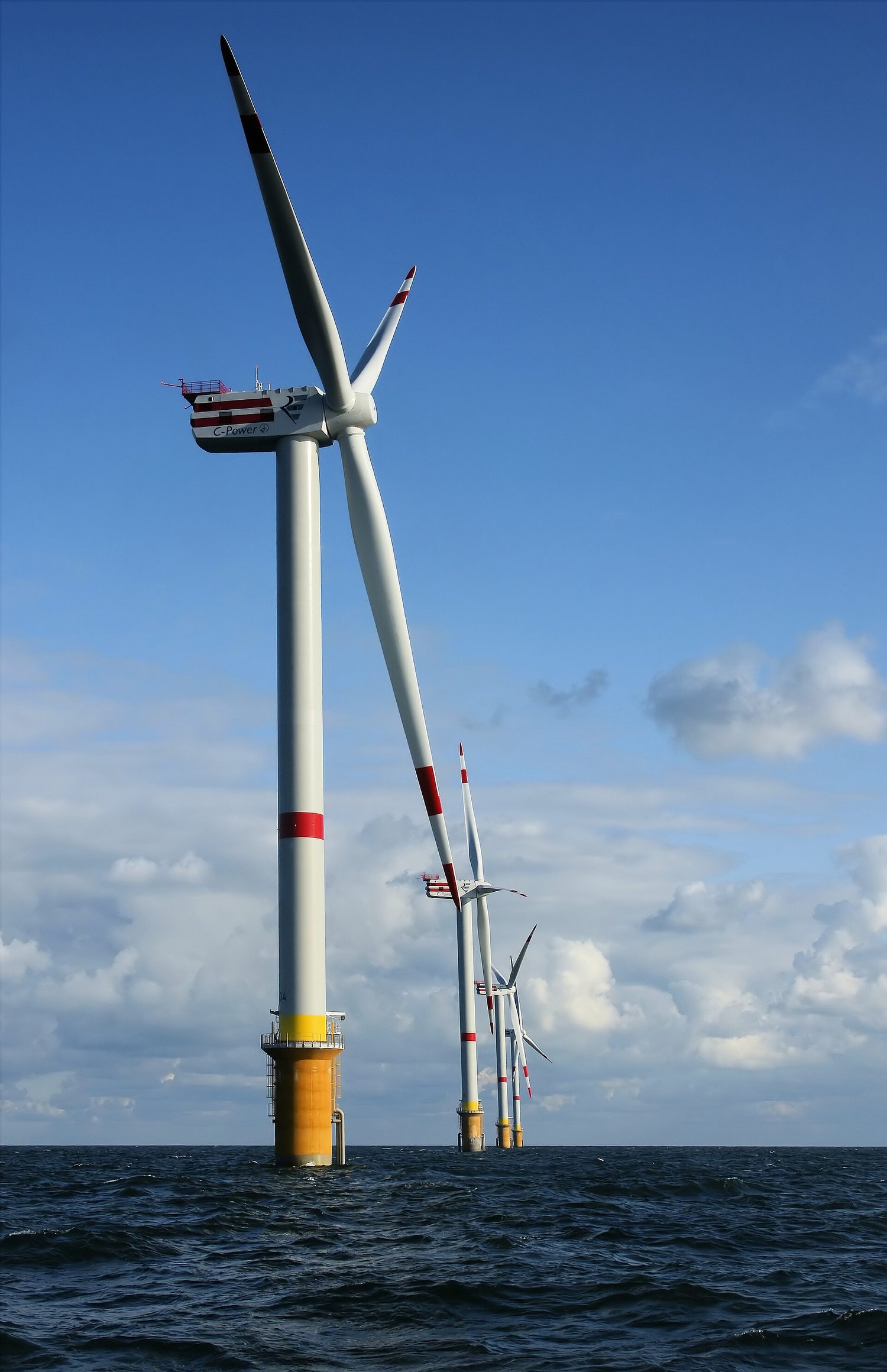
טורבינות רוח מעבירות אנרגיה מהמלאג הקינטי של האוויר הנע לחשמל
אנרגיה קינטית ופוטנציאלית
אנרגיה קינטית היא אנרגיה של גוף נע:
$$E_k = \frac{1}{2}mv^2$$
השינוי ב-אנרגיה פוטנציאלית כבידתית כאשר גוף עולה או יורד בגובה $\Delta h$:
$$\Delta E_p = mg\,\Delta h$$
שימור אנרגיה
ה-עקרון שימור האנרגיה אומר שאנרגיה לעולם אינה נוצרת או הופכת; היא רק עוברת בין מלאגים. גוף נופל ממיר את האנרגיה הפוטנציאלית הכבידתית לאנרגיה קינטית. דיאגרמת סנקי מראה כיצד האנרגיה הנכנסת מתפצלת לאנרגיה מועילה ואנרגיה מוסרת.
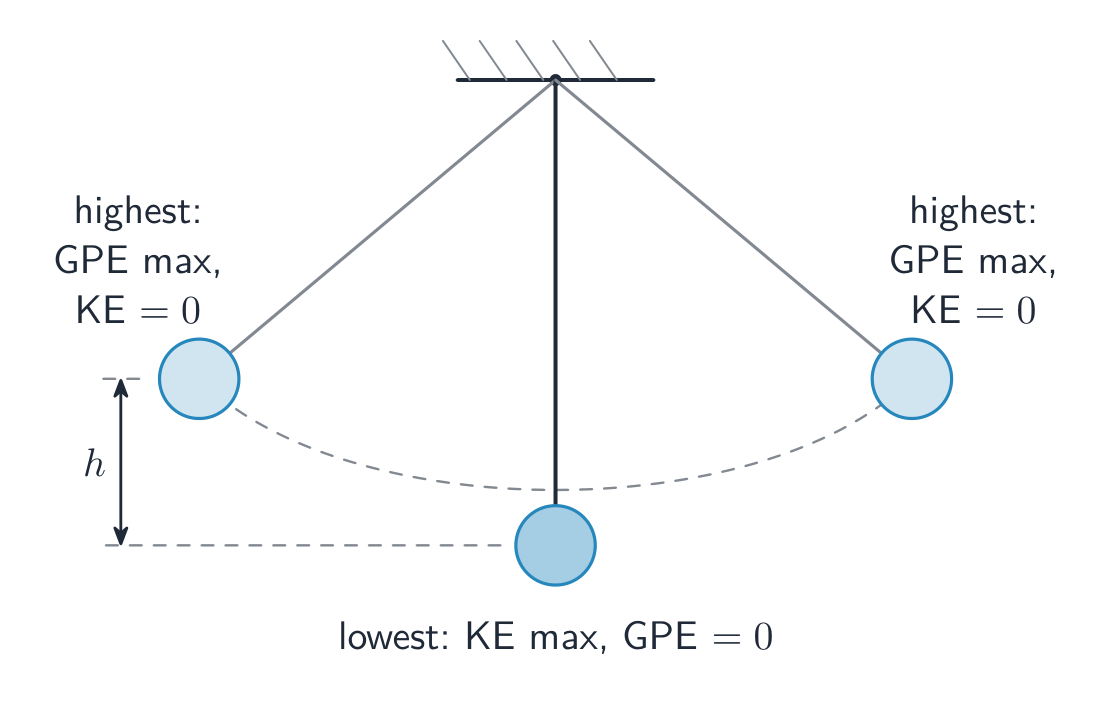
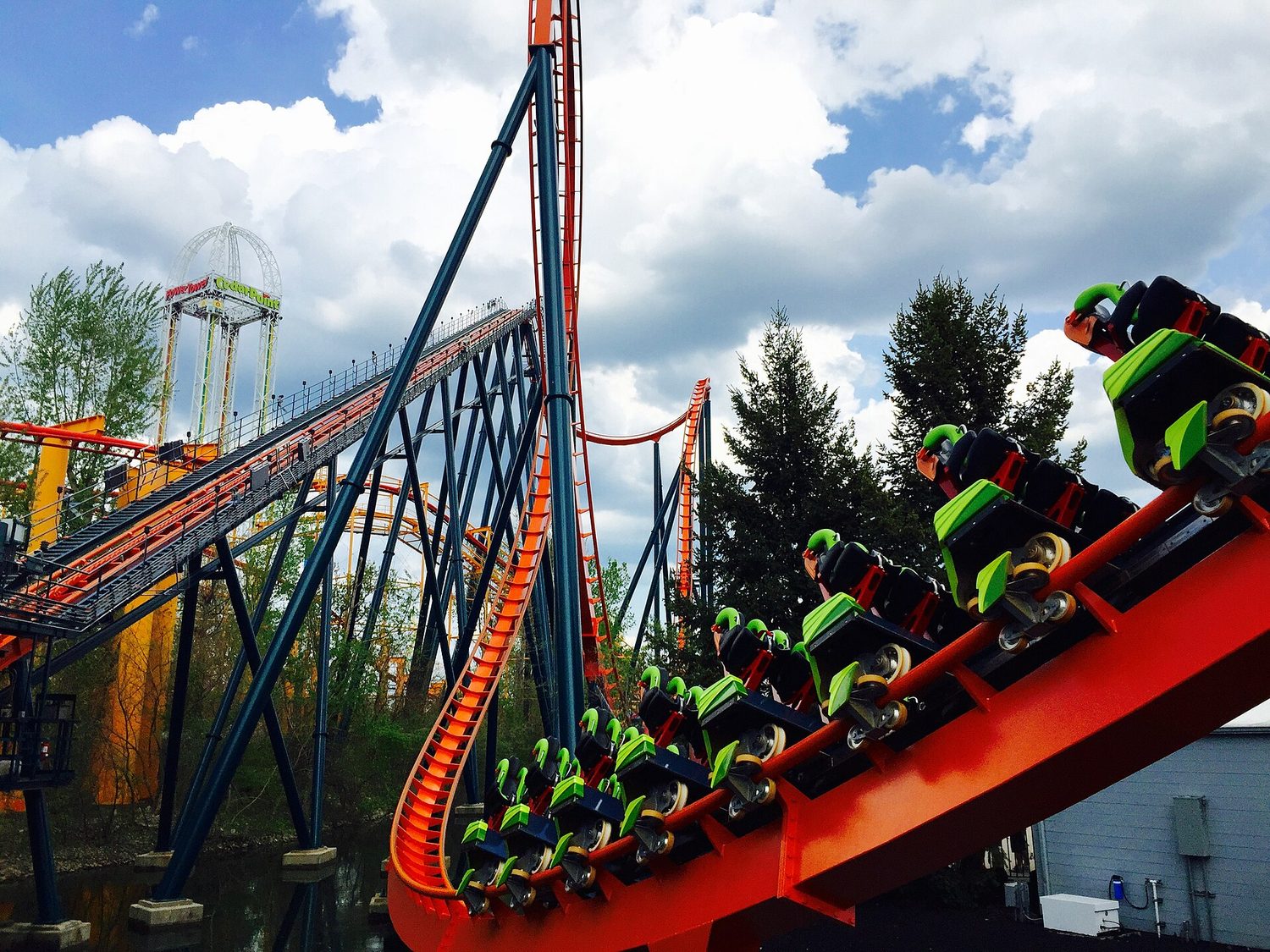
אנרגיה עוברת בין אנרגיה פוטנציאלית כבידתית (בנקודות הגבוהות ביותר) לאנרגיה קינטית (בנקודה הנמוכה ביותר)ברכבת הרים, אנרגיה פוטנציאלית כבידתית שהוחזקה בראש הגבעה הופכת לאנרגיה קינטית כאשר הרכבות מאיצות כלפי מטה
דוגמה מופעלת. כדור $0.50\ \text{kg}$ מושלך ממשפיל בגובה של $1.8\ \text{m}$. באי-התייחסות למתח אוויר, מצאו את מהירותו רגע לפני הנחיתה. (קבלו $g = 10\ \text{m/s}^2$.)
כל האנרגיה הפוטנציאלית הכבידתית הופכת לאנרגיה קינטית, לכן $\tfrac{1}{2}mv^2 = mg\,\Delta h$. המסה מתבטלת, ומותרת $v^2 = 2g\,\Delta h$:
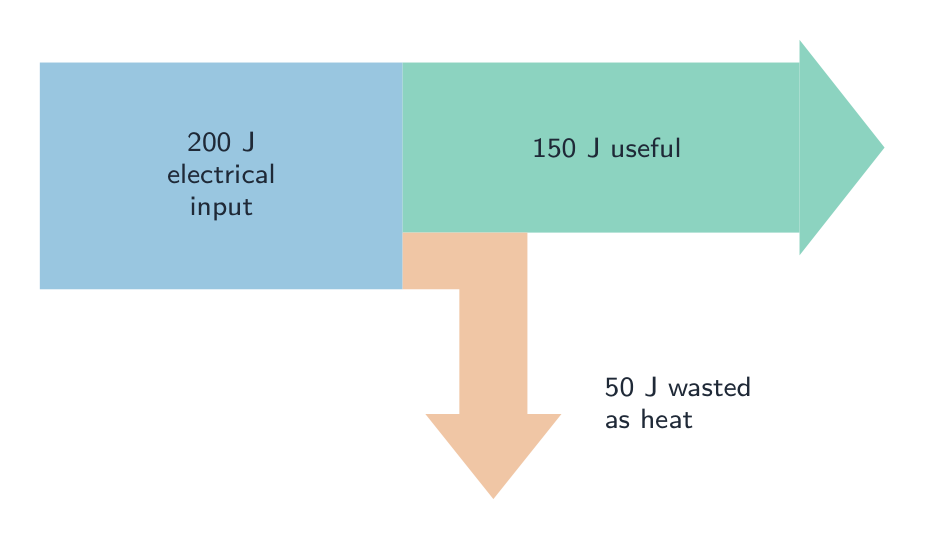
תרשים סנקי למנוע זה: רוחב הרצועות פרופורציונלי לאנרגיה, כך שהקלט של 200 J מתפצל ל-150 J מועילים ו-50 J מבזבזים כחום
משאבי אנרגיה
אנו מייצרים חשמל ממגוון משאבי אנרגיה. רובם מסובבים טורבינה המניעה גנרטור – לעיתים קרובות על ידי רתיחת מים ליצירת קיטור (דלקים מאובנים, דלק גרעיני, אנרגיה גיאותרמית, דלקים ביולוגיים), או ישירות על ידי תנועת מים או אוויר (חשמל הידרולי, גלים, גאות ושפל, רוח). תאים סולאריים מייצרים חשמל ישירות מאור שמש; פאנלים סולאריים מחממים מים.
משאב
מתחדש?
הערות
דלקים מאובנים (פחם, נפט, גז)
לא
אמין, תפוקה גבוהה, אך CO₂ וזיהום
דלק גרעיני
לא
תפוקה עצומה, אין CO₂, אך פסולת רادیולוגית
דלקים ביולוגיים
כן
בערך ניטרלי בפחמן אם נשתל מחדש
חשמל הידרולי
כן
אמין, אך סכך מציף אדמות
רוח
כן
נקי, אך תלוי ברוח
סולאריות
כן
נקי, אך רק ביום
גיאותרמי / גאות ושפל
כן
אמין אך מוגבל למיקומים מסוימים
כאשר אתם משווים משאבים, השתמשו בחמישה רעיונות אלו: מתחדשות (האם הוא ייגמר?), זמינות (האם הוא תמיד שם? הרוח יכולה להפסיק והשמש צוללת), אמינות (האם הוא מספק תפוקה יציבה?), גודל (כמה אנרגיה הוא יכול לספק?) והשפעה סביבתית (זיהום, פחמן דו-חמצני, אדמות שמוצפות על ידי סכך).
רוב המשאבים הללו נובעים מהשמש (דלקים מאובנים הם אור שמש עתיק שנשמר; רוח וגלים נובעים מחימום סולארי) – הדוחות הם אנרגיה גיאותרמית, גרעינית ואנרגיית גאות ושפל. השמש עצמה מופעלת על ידי היתוך גרעיני, בה אידי גרעיני של מימן מתחברים להליום. חוקרים מחקרים כיצד להשתמש בהיתוך בתחנות כוח על כדור הארץ, אך עדיין אין תגובה היתוך שמפיקה יותר אנרגיה חשמלית מאשר צורכת.
Explore · חקור
Energy flow & efficiency · זרימת אנרגיה ויעילות
Input energy splits into useful output and wasted energy; efficiency is the useful fraction, and the total is always conserved. · אנרגיה הנכנסת מתחלקת לתוצאה מועילה ולאנרגיה מאובדת; יעילות היא החלק המועיל, והסך הכל תמיד נשמר.
Explore · חקור
Conservation of energy · שימור אנרגיה
Drop the object: GPE turns into KE, and the total stays the same when there's no friction. · הרם את הגוף: אנרגיה פוטנציאלית גרavitציונית הופכת לאנרגיה קינטית, וה**סה
2 תאר כיצד הלחץ משתנה עם הכוח והשטח בהקשר של דוגמאות מהחיים היומיומיים
3 תאר, באופן איכותני, כיצד הלחץ מתחת לפני השטח של נוזל משתנה עם העומק והצפיפות של הנוזל
4 זכור והשתמש במשוואה לשינוי הלחץ מתחת לפני השטח של נוזל $\Delta p = \rho g \Delta h$
Source: Cambridge International syllabus · מקור: הסיילבוס הבינלאומי של קמבריד'ג'
English
Pressure is the force per unit area.
$$p = \frac{F}{A}$$
The unit is the pascal 帕斯卡 (Pa). $1\ \text{Pa} = 1\ \text{N/m}^2$.
A small area gives a large pressure (a sharp knife cuts well). A large area gives a small pressure (snowshoes stop you sinking).
Pressure in a liquid
In a liquid, pressure increases with depth 深度 and with the liquid's density:
$$\Delta p = \rho g \,\Delta h$$
This is why a dam is built thicker at the bottom, where the water pressure is greatest. Pressure in a liquid acts in all directions.
Worked example. Find the extra pressure at a depth of $2.0\ \text{m}$ in water (density $1000\ \text{kg/m}^3$, $g = 10\ \text{N/kg}$).
$$\Delta p = \rho g\,\Delta h = 1000 \times 10 \times 2.0 = 20\,000\ \text{Pa}$$
עברית
לחץ הוא הכוח ליחידת שטח.
$$p = \frac{F}{A}$$
היחידה היא פסקל (Pa). $1\ \text{Pa} = 1\ \text{N/m}^2$.
שטח קטן גורם ללחץ גבוה (סכין חדה חותכת היטב). שטח גדול גורם ללחץ נמוך (מגשי שלג מונעים השקעה).
לחץ בנוזל
בנוזל, הלחץ עולה עם עומק ועם צפיפות הנוזל:
$$\Delta p = \rho g \,\Delta h$$
מכאן שהסכר בונה עבה יותר בתחתיתו, שם הלחץ המיני הוא הגדול ביותר. לחץ בנוזל פועל בכל הכיוונים.
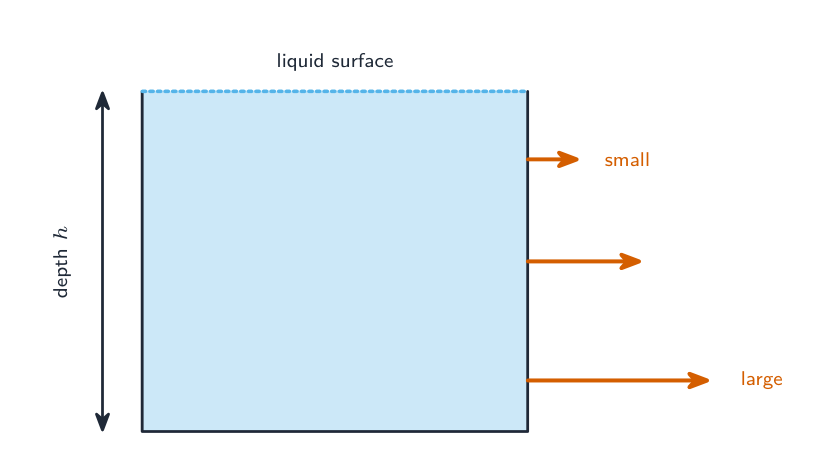
ככל שהנוזל עמוק יותר, כך הלחץ גדול יותר, ולכן הדחיפה החוצה לעבר הקיר עולה עם העומקסכר אמיתי בונה עבה הרבה יותר בתחתיתו, כי המים דוחפים בחוזקה רבה יותר ככל שהעומק גדול
דוגמה מוצאת. מצאו את הלחץ הנוסף בעומק $2.0\ \text{m}$ במים (צפיפות $1000\ \text{kg/m}^3$, $g = 10\ \text{N/kg}$).
$$\Delta p = \rho g\,\Delta h = 1000 \times 10 \times 2.0 = 20\,000\ \text{Pa}$$
Explore · חקור
Pressure · לחץ
p = ρg·h
Pressure in a liquid is proportional to depth. · לחץ בנוזל פרופורציונלי לעומק.
On a distance–time graph the gradient is the speed; on a speed–time graph the gradient is the acceleration and the area under the line is the distance travelled. Never read one graph as if it were the other.
Mass (kg) is the amount of matter and is the same everywhere; weight (N) is the force of gravity, $W = mg$. On the Moon your mass is unchanged but your weight is smaller.
Speed is a scalar; velocity is a vector. Something moving at steady speed around a curve is still accelerating, because its direction keeps changing.
In Hooke's law, load is proportional to extension only up to the limit of proportionality. Use the extension (stretched length − original length), never the whole length.
Momentum$p = mv$ is conserved in a collision. Give each velocity a $+$ or $-$ sign for its direction before you add them.
Convert units first (cm → m, g → kg). Use $p = F/A$ for a solid pressing on a surface, but $p = \rho g h$ for the pressure inside a liquid — they are different formulas.
עברית
בגרף מרחב–זמן השיפוע הוא המהירות; בגרף מהירות–זמן השיפוע הוא התאוצה והשטח מתחת לקו הוא המרחק שנסע. לעולם אל תקראו גרף אחד כאילו היה האחר.
מסה (ק"ג) היא כמות החומר והיא זהה בכל מקום; משקל (N) הוא כוח הכבידה, $W = mg$. על הירח המסה שלך אינה משתנה אך המשקל שלך קטן יותר.
מהירות היא גודל סקלארי; מהירות וקטורית היא גודל וקטורי. גוף הנע במהירות קבועה לאורך קשת עדיין מאיץ, מכיוון כיוונו משתנה באופן רציף.
בחוק הוק, העומס פרופורציונלי למתיחה רק עד הגבול הפרופורציונליות. השתמשו במתיחה (אורך מ伸 stretched − אורך מקורי), לעולם לא באורך הכולל.
תנע$p = mv$ נשמר בהתנגשות. תנו לכל מהירות $+$ או $-$ כסימן לכיוונה לפני שאתם מחברים אותן.
המירו יחידות תחילה (ס"מ → מ', ג' → ק"ג). השתמשו ב$p = F/A$ לגוף מוצק הלוחץ על משטח, אך ב$p = \rho g h$ ללחץ בתוך נוזל — מדובר בנוסחאות שונות.
Interactive lessons on this topic · שיעורים אינטראקטיביים בנושא זה
Work through it step by step, with instant-check exercises. · לעבור על הדברים צעד אחר צעד, עם תרגילים לבדיקה מיידית.
Pick one and the site follows you — notes, papers, videos and practice all open on it. · בחרו נושא אחד והאתר יעקוב אחריו — הערות, מסמכים, וידאו ותרגולים פתוחים בו.
Type to search notes, lessons, code, vocabulary and past-paper questions across every subject. · הקלד כדי לחפש הערות, שיעורים, קוד, אוצר מילים ושאלות מבחנים בכל הנושאים.