מגדל פיסה הנינוח מתכופף כבר מעל שמוئة שנים — ועם זאת הוא לא נושר. מדוע? כל משקל המגדל פועל בנקודה אחת: במרכז הכובד שלו…
English narration · English + 中文 subtitles burned in · קריאת קול באנגלית · תרגום אנגלי + סינית שרוף בתוך הסרטון
4.1
Turning effects of forces · אפקטים סיבוביים של כוחות
Syllabus · סיילבוס
English
understand that the weight of an object may be taken as acting at a single point known as its centre of gravity
define and apply the moment of a force
understand that a couple is a pair of forces that acts to produce rotation only
define and apply the torque of a couple
עברית
הבנה that משקל של גוף יכול להיחשב כפועל בנקודה אחת המכונה מרכז הכובד שלו
הגדרה ויישום ה-מומנט של כוח
הבנה that זוג כוחות הוא זוג כוחות הפועלים כדי ליצור סיבוב בלבד
הגדרה ויישום ה-מומנט של זוג כוחות
Source: Cambridge International syllabus · מקור: הסיילבוס הבינלאומי של קמבריד'ג'
English
The principle of moments
Centre of gravity
The weight 重力 of a large object can be treated as acting at one single point, called the centre of gravity 重心 (the same as the centre of mass 质心 in a uniform gravitational field). For a uniform, regular shape — a rectangle, a sphere, a uniform rod — the centre of gravity is at the middle.
When you draw a free-body diagram 受力图, always put the weight arrow at the centre of gravity.
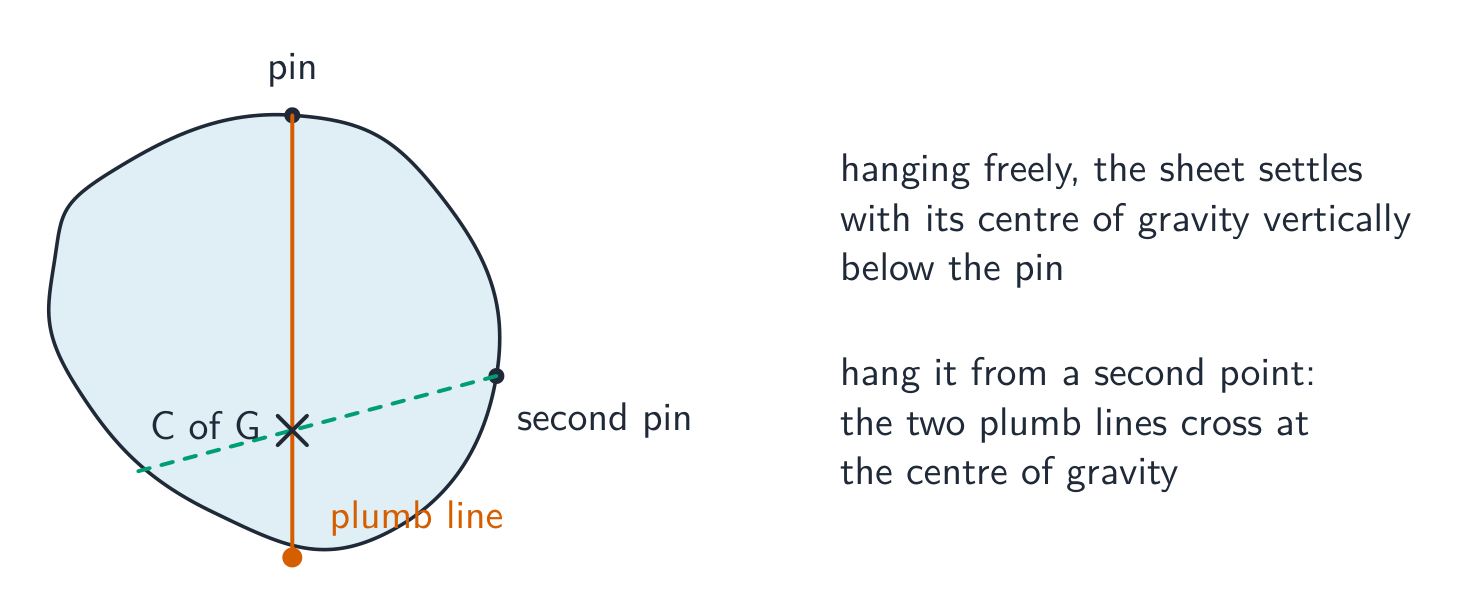
For an irregular shape, find the centre of gravity by experiment. Hang the object freely from a pin: in equilibrium it settles with its centre of gravity vertically below the pin, because only then does the weight have no moment about the pin. A plumb line 铅垂线 hung from the same pin marks that vertical. Hang the object from a second point and draw the second line; the centre of gravity is where the two lines cross. The same fact answers the exam's "explain why the sheet hangs like this": its centre of gravity is directly below the support, so the weight's line of action passes through the pivot and there is no resultant torque.
For a non-uniform 非均匀 bar, the centre of gravity is not at the middle. Find it by balancing the bar on a pivot, or by taking moments: if the bar's weight $W$ balances a known weight, the distance of its centre of gravity from the pivot is the one moment that makes the two sides equal.
Moment of a force
The moment 力矩 of a force about a point is
$$M = F \cdot d,$$
where $F$ is the size of the force 力 and $d$ is the perpendicular distance 垂直距离 from the point to the line of action 作用线 of the force. Unit: $\text{N m}$.
If the force acts at angle $\theta$ to a lever arm 力臂 of length $r$ from the pivot 支点, then $d = r\sin\theta$, so $M = F r\sin\theta$. Only the part of the force perpendicular 垂直 to the lever arm makes it turn.
Worked example. A force of $50\ \text{N}$ is applied to the end of a spanner $0.40\ \text{m}$ long, at $30°$ to the spanner. Find the moment of the force about the nut.
A moment is either clockwise 顺时针 or anticlockwise 逆时针 about the chosen point.
Couple and torque
A couple 力偶 is a pair of forces that are:
equal in size,
opposite in direction,
with their lines of action a perpendicular distance apart.
A couple makes the body turn only — its resultant force is zero, so it gives no straight-line acceleration.
The torque 力偶矩 of a couple is the turning effect it makes:
$$\tau = F \cdot d,$$
where $F$ is the size of one force and $d$ is the perpendicular distance between the two lines of action. Unit: $\text{N m}$. The torque is the same about any point — a special property of couples.
A common multiple-choice trap: two equal forces in the same direction are not a couple (they have a resultant force and cause translation 平动). A couple needs equal size and opposite direction.
Watch the distance in the formula. For a couple of two forces $F$ each acting a distance $d$ from a central pivot, on opposite sides, the perpendicular distance between the two lines of action is $2d$, so the torque is $F \times 2d = 2Fd$. Taking moments about the pivot gives the same answer, $Fd + Fd$. The two-mark definition wants both parts: the product of one of the forces and the perpendicular distance between the lines of action of the forces.
עברית
עקרון המומנטים
מרכז הכובד
הכובד של גוף גדול יכול להתפרש כאילו הוא פועל בנקודה אחת בלבד, הנקראת מרכז הכובד (זהה למרכז המסה בשדה כבידה אחיד). לגוף בעל צורה סדירה ואחידה — מלבן, כדור, מוט אחיד — מרכז הכובד נמצא במרכז.
כאשר אתה מצייר תרשים גוף חופשי, יש להציב תמיד את חץ הכובד במרכז הכובד.
לגוף בעל צורה לא-סדירה, ניתן למצוא את מרכז הכובד באמצעות ניסוי. תלו את הגוף בחופשיות מעל סיכה: במצב איזון הוא יתייצב כך שמרכז הכובד יהיה מתחת לסיכה בציר אנכי, משום שרק אז לכובד אין מומנט ביחס לסיכה. חוט עיגול (plumb line) התלוי מאותה סיכה מסמן קו אנכי זה. תלו את הגוף מנקודה שנייה ושרטטו את הקו השני; מרכז הכובד נמצא בנקודת החיתוך של שני הקווים. העובדה הזאת עצמה מהווה את התשובה לשאלת המבחן "הסבר מדוע הלוח תלוי如此": מרכז הכובד שלו נמצא בדיוק מתחת לתמיכה, ולכן קו הפעולה של הכובד עובר דרך ציר הסיבוב ואין מומנט נטו.
מציאת מרכז כובד: גוף שתלוי בחופשיות יתייצב כך שמרכז הכובד יהיה מתחת לו בסיכה, ולכן שני חוטי עיגול משני סיכות יחצו זה את זה במרכז הכובד
עבור מוטלא-אחיד, מרכז הכובד אינו נמצא במרכז. ניתן למצוא אותו על ידי איזון המוט על ציר סיבוב, או על ידי חישוב מומנטים: אם כובד המוט $W$ מאזן משקול ידוע, המרחק ממרכז הכובד עד ציר הסיבוב הוא המרחק שעושה את שני המומנטים שווים.
מומנט של כוח
המומנט של כוח ביחס לנקודה נתונה הוא
$$M = F \cdot d,$$
כאן $F$ היא גודל הכוח ו$d$ היא המרחק האנכי מהנקודה ועד קו הפעולה של הכוח. יחידה: $\text{N m}$.
אם הכוח פועל בזווית $\theta$ ביחס לזרוע מנוף באורך $r$ ממערכת הציר, אזי $d = r\sin\theta$, ולכן $M = F r\sin\theta$. רק רכיב הכוח האנכי לזרוע המנוף גורם לה להסתובב.
דוגמה פעילה. כוח בגודל $50\ \text{N}$ מופעל בקצה מפתח ברוך באורך $0.40\ \text{m}$, בזווית $30°$ ביחס למפתח. מצאו את המומנט של הכוח ביחס לאום.
המומנט תלוי במרחק האנכי $d$ מציר הסיבוב עד לקו הפעולה של הכוח
למומנט יש כיוון אחד: או שעון או נגד כיוון השעון ביחס לנקודה הנבחרת.
זוג כוחות ומומנט
זוג כוחות הוא זוג של כוחות שהם:
שווים בגודלם,
מנוגדים בכיוונם,
וקווי הפעולה שלהם נפרדים במרחב אנכי.
זוג כוחות גורם לגוף להסתובב בלבד — הכוח השקיף שלו הוא אפס, ולכן אינו גורם להאצה בקו ישר.
מומנט של זוג כוחות הוא ההשפעה הסיבובית שנוצרת:
$$\tau = F \cdot d,$$
כאשר $F$ הוא גודלו של אחד הכוחות ו$d$ הוא המרחב האנכי בין שני קווי הפעולה. יחידה: $\text{N m}$. למומנט אותו ערך בכל נקודה — תכונה ייחודית של זוגות כוחות.
זוג כוחות: שני כוחות שווים ומנוגדים, במופרדים במרחק, המייצרים מומנט
מלכדת בחירה רבה נפוצה: שני כוחות שווים באותו כיוון אינם מהווים זוג כוחות (יש להם כוח שקיף וגורמים לתנועת העברתית). זוג כוחות דורש שוויון בגודל וגם ניגודיות בכיוון.
שימו לב למרחב בנוסחה. עבור זוג כוחות של שני כוחות $F$ כל אחד הפועל במרחק $d$ מאמצע סיבוב, בצדדים מנוגדים, המרחב האנכי בין שני קווי הפעולה הוא $2d$, ולכן המומנט הוא $F \times 2d = 2Fd$. חישוב מומנטים סביב הציר הסיבובי נותן את אותה תשובה, $Fd + Fd$. הגדרה של שתי נקודות דורשת שתי החלקים: מכפלת אחד הכוחות והמרחב האנכי בין קווי הפעולה של הכוחות.
Explore · חקור
Balance the see-saw · אזנו את גלגל הגלילה
Put a weight on each side and slide it in or out. A small weight far from the pivot can balance a big weight close in — the beam is level when force × distance matches on both sides. · הניחו משקל בצד每个 וזזו אותו פנימה או החוצה. משקל קטן הרחק מהציר יכול לאזן משקל גדול קרוב — הקורה מישורשת כאשר כוח × מרחק מתאים בשני הצדדים.
understand that, when there is no resultant force and no resultant torque, a system is in equilibrium
use a vector triangle to represent coplanar forces in equilibrium
עברית
לנסח ולשמש בעיקרון המומנטים
להבין שכאשר אין כוח תוצאתי ואין מומנט תוצאתי, מערכת נמצאת בשיווי משקל
להשתמש במשולש וקטורים כדי לייצג כוחות קו-פלנריים בשיווי משקל
Source: Cambridge International syllabus · מקור: הסיילבוס הבינלאומי של קמבריד'ג'
English
Conditions for equilibrium
A body is in equilibrium 平衡 when:
the resultant force 合力 is zero (no straight-line acceleration), AND
the resultant moment about any point is zero (no angular acceleration 角加速度).
Both must hold. A body with no resultant force can still be turning; a body with no resultant moment can still be moving in a straight line.
The classic multiple-choice case: four forces, two equal pairs pointing in opposite directions but not along the same lines. The resultant force is zero, so the centre of mass does not accelerate, but the pairs form couples with a resultant torque, so the object spins faster and faster while its centre of mass moves at constant velocity. Only when both conditions hold is the body in equilibrium.
Principle of moments
For a body that is not turning, the total clockwise moment about any point equals the total anticlockwise moment about the same point. This is the principle of moments 力矩原理.
To solve a balance problem:
Choose a pivot — usually where an unknown force acts, so that force drops out (its distance is zero).
List every force and its perpendicular distance from the pivot.
Set $\sum M_{\text{clockwise}} = \sum M_{\text{anticlockwise}}$.
Use $\sum F = 0$ if you need a second equation.
A ruler balanced on a pivot with masses on each side is solved this way. For a heavy uniform rod, remember to include its weight acting at its centre of gravity. Stated for the marks: for a body in equilibrium, the sum of the clockwise moments about any point equals the sum of the anticlockwise moments about that same point.
Worked example. A uniform beam of length $4.0\ \text{m}$ is pivoted at its centre. A $40\ \text{N}$ weight hangs $1.5\ \text{m}$ from the pivot on one side. How far from the pivot, on the other side, must a $30\ \text{N}$ weight hang to balance the beam?
The beam's own weight acts at the centre (the pivot), so it has no moment. Setting clockwise $=$ anticlockwise moments:
$$40 \times 1.5 = 30 \times d \quad\Rightarrow\quad d = \frac{60}{30} = 2.0\ \text{m}.$$
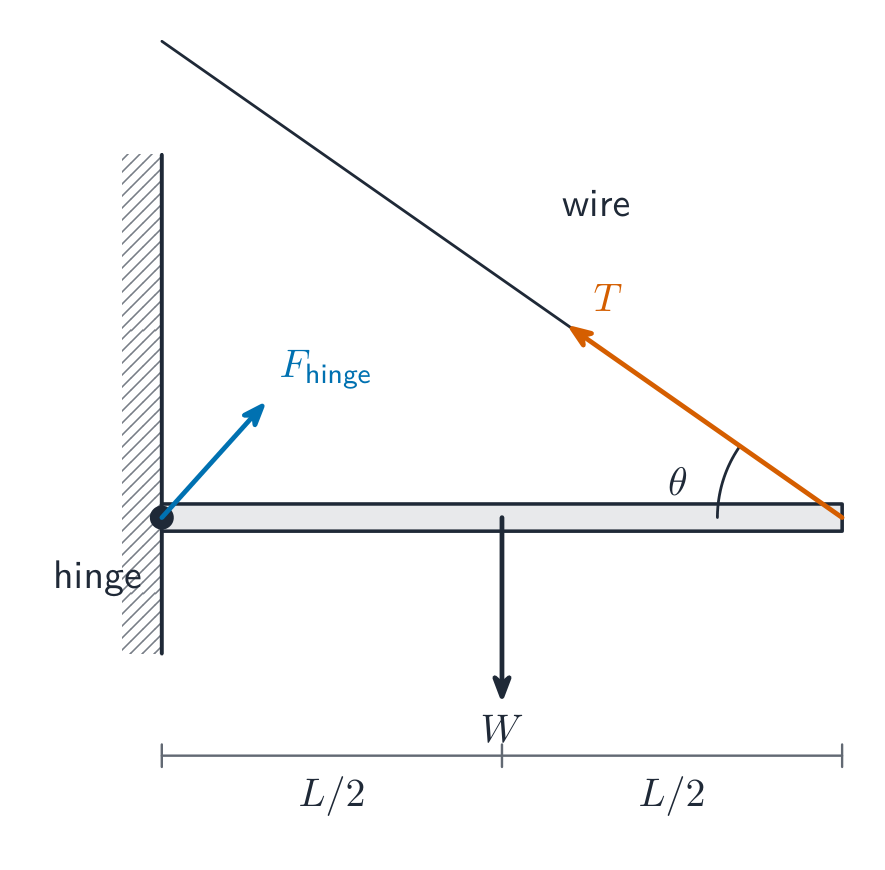
Worked example. A uniform rod of length $L$ and weight $W = 28\ \text{N}$ is hinged to a wall at one end and held horizontal by a wire from its other end. The wire makes $40°$ with the rod. Find the tension $T$ in the wire.
Take moments about the hinge, so the unknown hinge force drops out. The weight acts at the centre, a distance $L/2$ from the hinge: its moment is $W \times L/2$, clockwise. The tension acts at the end, but not at right angles to the rod, so its moment is $T\sin 40° \times L$, anticlockwise (only the component of $T$ perpendicular to the rod turns it). Equate them:
$$T \sin 40° \times L = W \times \frac{L}{2} \quad\Rightarrow\quad T = \frac{28}{2 \sin 40°} = 22\ \text{N}.$$
The length $L$ cancels, which is why the question need not give it. If a load hangs from the rod as well, add its moment on the clockwise side. This is the shape of almost every moments question: choose the pivot where the unknown force acts, use the perpendicular component of any angled force, and let unknown lengths cancel.
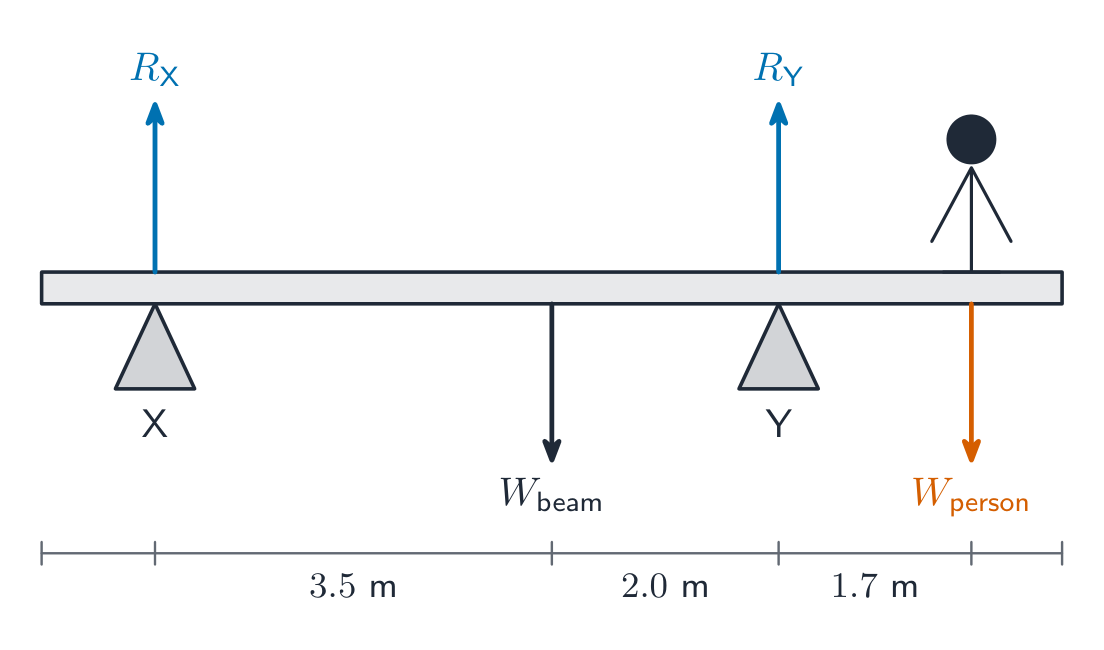
Worked example. A uniform beam of weight $200\ \text{N}$ and length $9.0\ \text{m}$ rests on two supports, X at $1.0\ \text{m}$ from the left end and Y at $6.5\ \text{m}$. A person of weight $700\ \text{N}$ stands $1.7\ \text{m}$ from Y, beyond it. Find the force from each support.
Two unknown forces, $R_{\text{X}}$ and $R_{\text{Y}}$, so take moments about X to remove $R_{\text{X}}$. The beam's weight acts at its centre, $3.5\ \text{m}$ from X; Y is $5.5\ \text{m}$ from X; the person is $7.2\ \text{m}$ from X:
Then the resultant force is zero: $R_{\text{X}} + R_{\text{Y}} = 200 + 700$, so $R_{\text{X}} = 900 - 1040 = -140\ \text{N}$. A negative answer means the beam would lift off X: with the person that far past Y, X must hold the beam down, not up. Questions often ask where a person can stand before the beam tips; that is the position at which $R_{\text{X}}$ becomes zero.
Vector triangle
Three forces in the same plane that are in equilibrium can be drawn as a closed vector triangle 矢量三角形 — drawn tip-to-tail, the three arrows come back to the start. This is a drawing method instead of splitting into components 分量.
Use the sine rule 正弦定理 or the cosine rule 余弦定理 on the triangle to find unknown sizes or directions, or draw the triangle to scale on graph paper.
You can also split each force into horizontal 水平 and vertical 竖直 components and set $\sum F_{x} = 0$ and $\sum F_{y} = 0$.
To draw the triangle for the marks: draw the weight first (vertical, to scale), then add the other two forces tip to tail in their real directions, so the third arrow closes the triangle; label every side with its force and mark the angles. For a block resting on a slope the three forces are the weight (vertical), the normal contact force (perpendicular to the slope) and friction (along the slope), so the triangle is right-angled with the weight as the hypotenuse. For a picture hanging from a string over a pin, the two equal tensions make an isosceles triangle with the weight. The test of any answer is that the triangle closes; if it does not, the object is not in equilibrium.
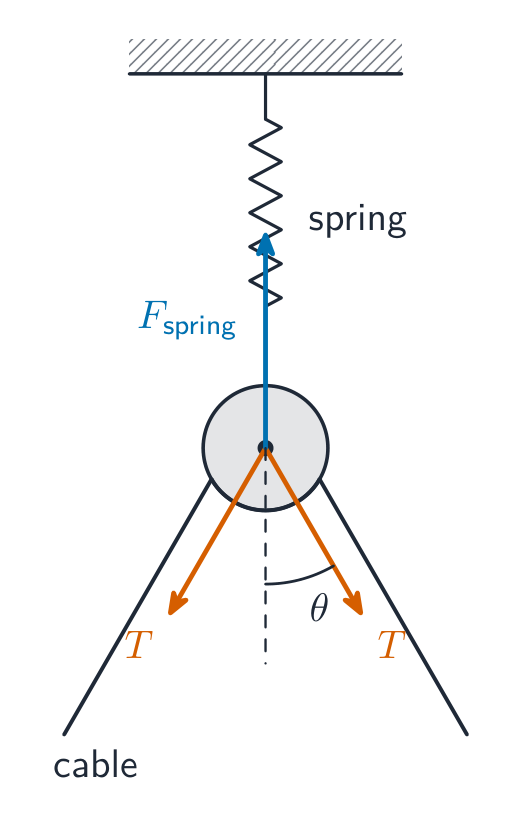
Worked example. A pulley of negligible weight is held by a spring. A single cable passes under the pulley, and each side of the cable makes $30°$ with the vertical. The tension in the cable is $T = 60\ \text{N}$. Find the force from the spring and the extension of the spring, given its spring constant is $2000\ \text{N m}^{-1}$.
Because it is one continuous cable, the tension is the same on both sides. The two tensions pull down and outwards; their horizontal components cancel and their vertical components add, so the spring must pull up with $F = 2T\cos 30° = 2 \times 60 \times 0.866 = 104\ \text{N}$. From Hooke's law (topic 6), $x = F / k = 104 / 2000 = 0.052\ \text{m}$. If the angle to the vertical grows, $\cos\theta$ falls, so the spring force and extension fall: the cable is pulling more sideways and less upwards.
עברית
תנאי איזון
גוף נמצא באיזון כאשר:
הכוח השקיף הוא אפס (אין האצה בקו ישר), AND
המומנט השקיף סביב כל נקודה הוא אפס (אין האצה זוויתית).
שניהם חייבים להתקיים. גוף ללא כוח שקיף עדיין יכול להתהפך; גוף ללא מומנט שקיף עדיין יכול לנוע בקו ישר.
המקרה הקלאסי בבחירה רבה: ארבעה כוחות, שני זוגות שווים המכוונים לכיוונים מנוגדים אך לא לאורך אותם קווים. הכוח השקיף הוא אפס, ולכן מרכז הכובד אינו מאיצ, אך הזוגות יוצרים זוגות כוחות עם מומנט שקיף, ולכן הגוף מסתובב בקצב הולך וגובר בעוד שמרכז הכובד נע במהירות קבועה. רק כאשר שני התנאים מתקיימים יחד הגוף נמצא באיזון.
עקרון המומנטים
עבור גוף שאינו מסתובב, סה"כ המומנטים השעוניים סביב כל נקודה שווה לסה"כ המומנטים נגד-שעוניים סביב אותה נקודה. זהו עקרון המומנטים.
כדי לפתור בעיית איזון:
בחרו נקודת סיבוב — לרוב שם כוח לא ידוע פועל, כך שכוח זה ייעלם (מרחקו אפס).
מדחף מאוזן על נקודת סיבוב עם מסות משני צדדיו פותרים באופן זה. לגבי מוט כבד אחיד, זכרו לכלול את משקלו הפועל במרכז הכובד שלו. כמוצא לציונים: גוף במצב איזון, סכום המומנטים השעוניים סביב כל נקודה שווה לסכום המומנטים נגד השעון סביב אותה נקודה.
דוגמה מפורטת. מוט אחיד באורך $4.0\ \text{m}$ מופעל בנקודת סיבוב במרכזו. משקל של $40\ \text{N}$ תלוי $1.5\ \text{m}$ מנקודת הסיבוב בצד אחד. כמה מנקודת הסיבוב, בצד השני, חייב לתלות משקל של $30\ \text{N}$ כדי לאזן את המוט?
משקל המוט עצמו פועל במרכז (נקודת הסיבוב), ולכן אין לו מומנט. בהגדרת מומנטים שעוניים $=$ מומנטים נגד השעון:
$$40 \times 1.5 = 30 \times d \quad\Rightarrow\quad d = \frac{60}{30} = 2.0\ \text{m}.$$
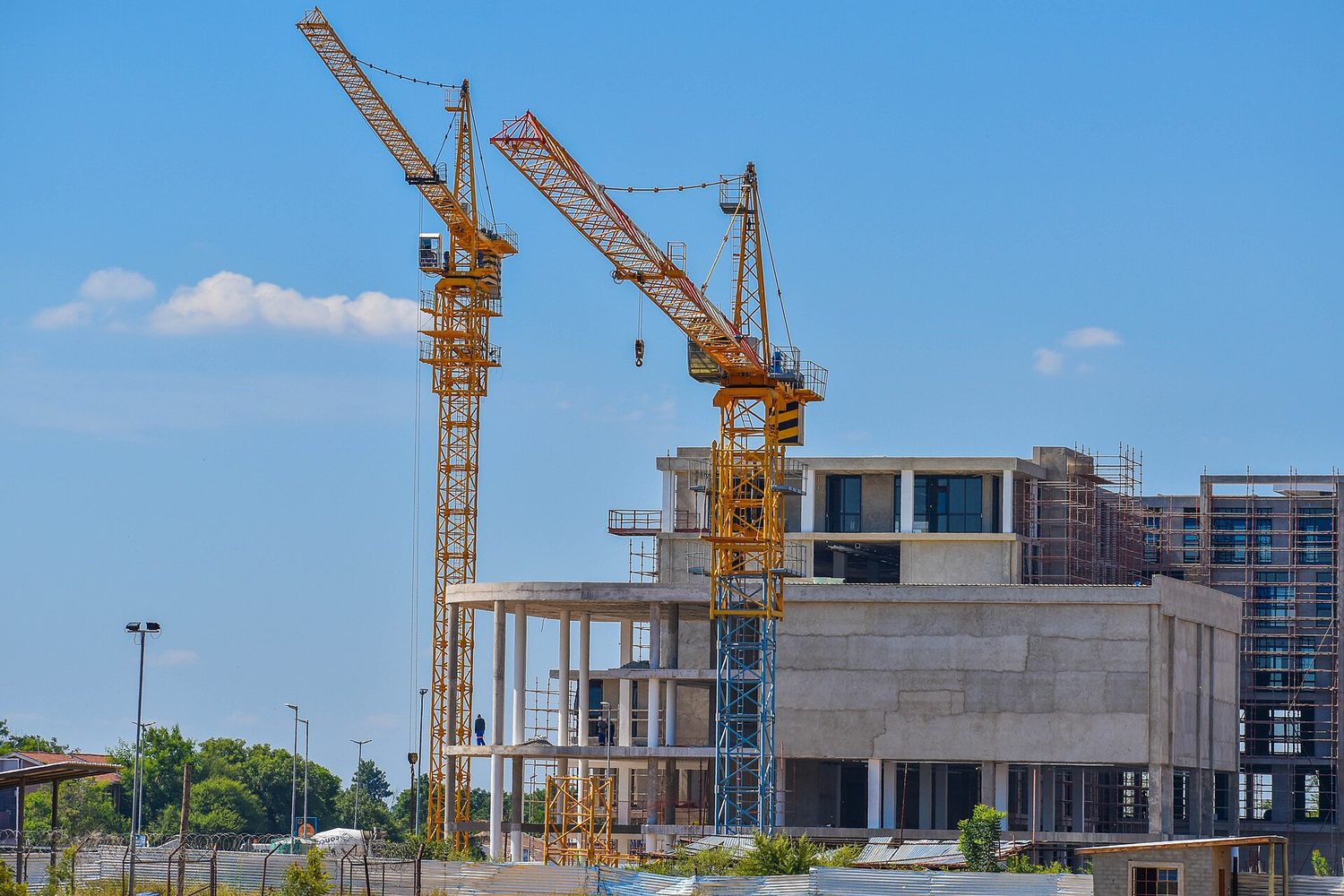
משקולות על סרגל מאוזן על ציר סיב — משמש לבדיקת עקרון המומנטיםמנוף עמוד הוא בעיית מומנטים: המומנט של משקל הנגד סביב העמודה מאזן את המומנט של העומס
דוגמה מפורטת. מוט אחיד באורך $L$ ומשקל $W = 28\ \text{N}$ מחובר בקרס לקיר בקצה אחד ותלוי אופקית על ידי חוט מהקצה השני. החוט יוצר זווית של $40°$ עם המוט. מצאו את מתח החוט $T$.
מוט מחובר בקרס ותלוי בחוט: קחי מומנטים סביב הקרס מבטלים את כוח הקרס הלא ידוע
קחו מומנטים לגבי הצירן, כך שכוח הצירן הלא ידוע מתבטל. המשקל פועל במרכז, במרחק $L/2$ מהצירן: המומנט שלו הוא $W \times L/2$, לפי כיוון השעון. המתח פועל בקצה, אך לא בניצוב למוט, ולכן המומנט שלו הוא $T\sin 40° \times L$, נגד כיוון השעון (רק הרכיב של $T$ הניצב למוט מסובב אותו). השווו ביניהם:
$$T \sin 40° \times L = W \times \frac{L}{2} \quad\Rightarrow\quad T = \frac{28}{2 \sin 40°} = 22\ \text{N}.$$
האורך $L$ מתבטל, ולכן אין צורך ששאלה תציינה אותו. אם תלוי עומד גם על המוט, הוסיפו את המומנט שלו לצד הפוך לשעון. זהו צורתה של כמעט כל שאלת מומנטים: בחרו בצירן שבו הפועל הלא ידוע, השתמשו ברכיב הניצב לכל כוח אלכסוני, ותנו לאורכים לא ידועים להתבטל.
דוגמה מפורטת. מדחף אחיד במשקל $200\ \text{N}$ ובאורך $9.0\ \text{m}$ נוח על שני תמיכות, X ב-$1.0\ \text{m}$ מקצה השמאלי ו-Y ב-$6.5\ \text{m}$. אדם במשקל $700\ \text{N}$ עומד $1.7\ \text{m}$ מ-Y, מעבר לו. מצאו את הכוח מכל תמיכה.
מדחף על שתי תמיכות: מומנטים סביב תמיכה אחת נותנים את כוח התמיכה השנייה; סכום הכוחות אז נותן את הראשונה
שני כוחות לא ידועים, $R_{\text{X}}$ ו$R_{\text{Y}}$, ולכן נקח מומנטים לגבי X כדי לבטל את $R_{\text{X}}$. משקל הקורה פועל במרכשו, במרחק $3.5\ \text{m}$ מ-X; Y נמצאת במרחק $5.5\ \text{m}$ מ-X; האדם נמצא במרחק $7.2\ \text{m}$ מ-X:
אז הכוח הכולל הוא אפס: $R_{\text{X}} + R_{\text{Y}} = 200 + 700$, ולכן $R_{\text{X}} = 900 - 1040 = -140\ \text{N}$. תשובה שלילית מעידה על כך שהקורה יתרומם מנקודת X: כאשר האדם נמצא כך רחוק מעבר לנקודה Y, נקודת X חייבת להחזיק את הקורה למטה, לא למעלה. שאלות לעיתים שואלות היכן אדם יכול לעמוד לפני שהקורה מתהפכת; זהו המיקום בו $R_{\text{X}}$ הופך לאפס.
משולש וקטורים
שלושה כוחות באותו מישור הנמצאים במצב איזון ניתן לצייר כ-משולש וקטורים סגור — אם משרטטים אותם בקצה-בקצה, שלושת החיצים חוזרים לנקודת ההתחלה. זוהי שיטת ציור במקום פירוק ל-מרכיבים.
שלושה כוחות באיזון יוצרים משולש וקטורים סגור
השתמש ב-חוק הסינוסים או ב-חוק הקוסינוסים במשולש כדי למצאת גדלים או כיוונים לא ידועים, או שרטט את המשולש בקנה מידה בדף גרף.
ניתן גם לפצל כל כוח ל-מרכיבים אופקיים ואנכיים ולהציב $\sum F_{x} = 0$ ו-$\sum F_{y} = 0$.
כדי לשרטט את המשולש עבור הניקודים: שרטט תחילה את המשקל (אנכי, בקנה מידה), ואז הוסף את שני הכוחות האחרים בקצה-בקצה בכיוונם האמיתי, כך שחץ שלישי יסגור את המשולש; סימן כל צד בכוחו ומark את הזוויות. לגוף השקוע על מדרון שלושת הכוחות הם המשקל (אנכי), כוח התמיכה (אנכי למדרון) והחיכוך (לאורך המדרון), ולכן המשולש הוא זווית ישרה עם המשקל כיתרה. לתמונה התלויה על חוט מעל סיכה, שני מתיחות שוות יוצרים משולש שווה שוקיים עם המשקל. הבדיקה לכל תשובה היא שהמשולש נסגר; אם הוא לא נסגר, הגוף אינו במצב איזון.
דוגמה עבודה. גלגלת בעלת משקל זניח נתמכת על ידי קפיץ. חבל אחד עובר מתחת לגלגלת, וכל צד מהחבל יוצר זווית של $30°$ עם האנכי. המתיחה בחבל היא $T = 60\ \text{N}$. מצא את הכוח ממנו הקפיץ וההתארכות של הקפיץ, בהינתן שקבוע הקפיץ הוא $2000\ \text{N m}^{-1}$.
גלגלת נתמכת על ידי קפיץ: שתי המתיחות בחבל אחד שוות, וכוח הקפי מאזן את המרכיבים האנכיים שלהן
מכיוון שזהו חבל רציף אחד, המתיחה זהה בשני הצדדים. שתי המתיחות מושכות כלפי מטה ובחוץ; המרכיבים האופקיים מבטלים זה את זה והמרכיבים האנכיים מחברים, ולכן הקפיץ חייב למשוך כלפי מעלה עם $F = 2T\cos 30° = 2 \times 60 \times 0.866 = 104\ \text{N}$. לפי חוק הוק (נושא 6), $x = F / k = 104 / 2000 = 0.052\ \text{m}$. אם הזווית לאנכי גדלה, $\cos\theta$ יורדת, ולכן כוח הקפיץ וההתארכות יורדים: החבל מושך יותר בצד ופחות למעלה.
Explore · חקור
Forces in equilibrium · איזון כוחות
When forces are balanced the resultant is zero — the vectors form a closed loop. Drag the arrows to keep them cancelling. · כאשר הכוחות מאוזנים, הווקטור הכולל הוא אפס — הווקטורים יוצרים לולאה סגורה. גררו את החצים כדי לשמור על ביטול זה של הכוחות.
derive, from the definitions of pressure and density, the equation for hydrostatic pressure$\Delta p = \rho g \Delta h$
use the equation $\Delta p = \rho g \Delta h$
understand that the upthrust acting on an object in a fluid is due to a difference in hydrostatic pressure
calculate the upthrust acting on an object in a fluid using the equation $F = \rho g V$ (Archimedes' principle)
עברית
להגדיר ולהשתמש בצפיפות
להגדיר ולהשתמש בלחץ
לגזור, מתוך הגדרות הלחץ והצפיפות, את המשוואה ללחץ הידרוסטטי$\Delta p = \rho g \Delta h$
להשתמש במשוואה $\Delta p = \rho g \Delta h$
להבין שהכוח הנושא הפועל על גוף בנוזל נובע ממנוכחות ההפרש בלחץ הידרוסטטי
לחשב את הכוח הנושא הפועל על גוף בנוזל באמצעות המשוואה $F = \rho g V$ (עקרון ארכימדס)
Source: Cambridge International syllabus · מקור: הסיילבוס הבינלאומי של קמבריד'ג'
English
Density 密度 is the mass per unit volume:
$$\rho = \frac{m}{V}.$$
Unit: $\text{kg m}^{-3}$ (or $\text{g cm}^{-3}$; $1\ \text{g cm}^{-3} = 1000\ \text{kg m}^{-3}$). Density is a scalar 标量.
Some useful densities to know:
water: $1000\ \text{kg m}^{-3}$
air at room conditions: $\sim 1.2\ \text{kg m}^{-3}$
iron / steel: $\sim 7800\ \text{kg m}^{-3}$
Measuring density is a practical question in disguise. For a cuboid, measure the mass on a balance and the three side lengths with a rule or calipers, then $\rho = m / (xyz)$. Because density is a product and quotient, the percentage uncertainty in $\rho$ is the sum of the percentage uncertainties in $m$, $x$, $y$ and $z$ (topic 1). A zero error on the balance, or a rule whose end is worn, is a systematic error; repeating the readings does not remove it, but subtracting the zero reading does.
Worked example. A block has mass $(120 \pm 1)\ \text{g}$ and sides $(4.0 \pm 0.1)\ \text{cm}$, $(3.0 \pm 0.1)\ \text{cm}$ and $(2.0 \pm 0.1)\ \text{cm}$. Find its density and the percentage uncertainty.
$\rho = 120 / (4.0 \times 3.0 \times 2.0) = 5.0\ \text{g cm}^{-3} = 5000\ \text{kg m}^{-3}$. The percentage uncertainties are $0.8\%$, $2.5\%$, $3.3\%$ and $5.0\%$, so the density is uncertain by $12\%$, about $\pm 600\ \text{kg m}^{-3}$. The shortest side contributes most, which is why a question asks which measurement to improve first.
עברית
מסה קרחית צפה עם רוב נפחה מוסתר: קרח צפוף מעט פחות ממים.
צפיפות היא המסה ליחידת נפח:
$$\rho = \frac{m}{V}.$$
יחידה: $\text{kg m}^{-3}$ (או $\text{g cm}^{-3}$; $1\ \text{g cm}^{-3} = 1000\ \text{kg m}^{-3}$). צפיפות היא סקלר.
חלק מצפיפויות שימוניות לדעת:
מים: $1000\ \text{kg m}^{-3}$
אוויר בתנאי חום החדר: $\sim 1.2\ \text{kg m}^{-3}$
ברזל / פלדה: $\sim 7800\ \text{kg m}^{-3}$
מדידת צפיפות היא שאלה מעשית במעיל. עבור קובייה, מדדו את המסה באוזן ושלושת אורכי הצלעות עם סרגל או מחוגה, ואז $\rho = m / (xyz)$. מכיוון שצפיפות היא מכפלה ומחלקת, החריגה האחוזית ב$\rho$ היא סכום החריגות האחוזיות ב$m$, $x$, $y$ וב$z$ (נושא 1). טעות אפס באוזן, או סרגל שקצהו שחוק, הם טעויות מערכת; חזרת הקריאות אינה מסירה אותן, אך חיסור קריאת האפס כן.
דוגמה מפורטת. בלוק בעל מסה $(120 \pm 1)\ \text{g}$ וצדדים $(4.0 \pm 0.1)\ \text{cm}$, $(3.0 \pm 0.1)\ \text{cm}$ ו$(2.0 \pm 0.1)\ \text{cm}$. מצאו את הצפיפות והסטייה האחוזית.
$\rho = 120 / (4.0 \times 3.0 \times 2.0) = 5.0\ \text{g cm}^{-3} = 5000\ \text{kg m}^{-3}$. החריגות האחוזיות הן $0.8\%$, $2.5\%$, $3.3\%$ ו$5.0\%$, ולכן לצפיפות יש חריגה של $12\%$, בערך $\pm 600\ \text{kg m}^{-3}$. הצלע הקצרה תורמת הכי הרבה, ולכן שאלה זו שואלת איזה מדיד יש לשפר תחילה.
Pressure 压强 is the force per unit area, where the force acts at right angles to the surface:
$$p = \frac{F}{A}.$$
Unit: $\text{Pa} = \text{N m}^{-2}$. Pressure is a scalar.
The force is the one pressing at right angles to the surface, and the area is the area of contact. A tree trunk of weight $9.0\ \text{kN}$ standing on a post of diameter $0.28\ \text{m}$ presses with $p = F / A = 9000 / (\pi \times 0.14^{2}) = 1.5 \times 10^{5}\ \text{Pa}$; the same weight on a wider post gives a smaller pressure. Convert diameters to radii, and centimetres to metres, before squaring.
Hydrostatic pressure
Take a column of fluid 流体 with density $\rho$, cross-sectional area 横截面积$A$ and height $\Delta h$. Its weight is
$$W = m g = (\rho \cdot A \cdot \Delta h) \cdot g.$$
This weight presses down on the area $A$ at the bottom, so the extra pressure at the bottom compared with the top is
$$\Delta p = \frac{W}{A} = \rho g \Delta h.$$
This is the hydrostatic pressure 流体静压强 equation. It depends only on the density of the fluid and the depth 深度 — the shape of the container does not matter.
Worked example. Find the extra pressure due to the water at the bottom of a swimming pool $2.5\ \text{m}$ deep. (Water density $1000\ \text{kg m}^{-3}$, $g = 9.81\ \text{m s}^{-2}$.)
$$\Delta p = \rho g \Delta h = 1000 \times 9.81 \times 2.5 \approx 2.5 \times 10^{4}\ \text{Pa}.$$
For a submarine at depth $h$ below the surface, the pressure from the water is $\rho_{\text{seawater}}\, g\, h$. For the total pressure, add the atmospheric pressure 大气压强 at the surface (about $1.0 \times 10^{5}\ \text{Pa}$).
Upthrust and Archimedes' principle
When an object is submerged 浸没 in a fluid, the pressure at the bottom of the object is greater than the pressure at the top (by $\rho g \Delta h$, where $\Delta h$ is the object's height). This difference gives a net upward force called the upthrust 浮力.
For an object of volume $V$ (the volume of fluid displaced 排开), the upthrust is
This is Archimedes' principle 阿基米德原理: the upthrust on a body in a fluid equals the weight of the fluid it pushes aside.
Worked example. A metal block of volume $2.0 \times 10^{-3}\ \text{m}^{3}$ is fully submerged in water. Find the upthrust on it. (Water density $1000\ \text{kg m}^{-3}$, $g = 9.81\ \text{m s}^{-2}$.)
For a fully submerged object, $V$ is its full volume. For a floating 漂浮 object, $V$ is only the volume below the surface — the object floats when the upthrust on the part below the surface equals its weight.
Whether an object floats at all depends on densities: for a fully submerged object the ratio of upthrust to weight is $\rho_{\text{fluid}} V g / \rho_{\text{object}} V g = \rho_{\text{fluid}} / \rho_{\text{object}}$, so it floats if it is less dense than the fluid and sinks if it is denser. Halving the object's density doubles that ratio; changing its volume or the depth changes nothing.
Worked example. A cylinder of mass $11\ \text{kg}$ and diameter $0.78\ \text{m}$ floats upright in water of density $990\ \text{kg m}^{-3}$. Find the depth $y$ of its base below the surface.
Floating means upthrust $=$ weight. The submerged volume is the base area times the depth, $A y$, with $A = \pi \times 0.39^{2} = 0.478\ \text{m}^{2}$:
$$\rho g A y = m g \quad\Rightarrow\quad y = \frac{m}{\rho A} = \frac{11}{990 \times 0.478} = 0.023\ \text{m}.$$
Each extra newton of load on the cylinder needs an extra $1 / (\rho g A)$ of depth, so the depth rises in a straight line with the added weight, wherever on the cylinder it is placed.
Force balance with upthrust
A block held under water by a string tied to the bottom of the container is in equilibrium under three vertical forces: weight (down), tension 张力 (down), upthrust (up). Set $F_{\text{upthrust}} = W + T$ to find the tension.
A submerged block hanging from a newton meter 弹簧测力计 reads less than its weight in air, because of the upthrust: reading $= W - F_{\text{upthrust}}$.
Worked example. A cylinder of weight $25.0\ \text{N}$ hangs from a newton meter fully submerged in water, and the meter reads $10.0\ \text{N}$. Find the volume of the cylinder.
The upthrust is the missing $15.0\ \text{N}$, and upthrust $= \rho g V$, so $V = 15.0 / (1000 \times 9.81) = 1.53 \times 10^{-3}\ \text{m}^{3}$. The same method finds the density of the cylinder: $25.0 / (9.81 \times 1.53 \times 10^{-3}) = 1670\ \text{kg m}^{-3}$.
The upthrust depends on the fluid density and the displaced volume, not on the object's material or depth (for an incompressible 不可压缩 fluid). On a planet with smaller $g$, the upthrust is smaller in the same ratio as the weight, so a floating object still floats with the same fraction below the surface.
עברית
לחץ הוא כוח ליחידת שטח, כאשר הכוח פועל מאונך למשטח:
$$p = \frac{F}{A}.$$
יחידה: $\text{Pa} = \text{N m}^{-2}$. לחץ הוא גודל סקלרי.
הכוח הוא זה לוחץ מאונך למשטח, והשטח הוא שטח המגע. עמוד עצם במשקל $9.0\ \text{kN}$ העומד על עמוד בקוטר $0.28\ \text{m}$ לוחץ ב-$p = F / A = 9000 / (\pi \times 0.14^{2}) = 1.5 \times 10^{5}\ \text{Pa}$; אותו משקל על עמוד רחב יותר יניב לחץ נמוך יותר. המירו קוטרים לקרניים, וסנטימטרים למטרים, לפני ההעלאה בריבוע.
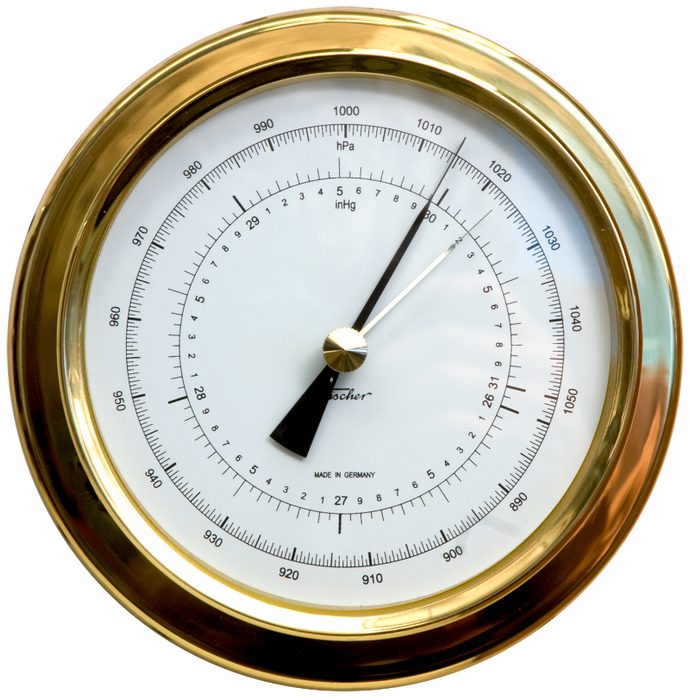
ברומטר אנרויד מדויק מודד לחץ אטמוספרי
לחץ הידרוסטטי
קחו עמוד של נוזל בצפיפות $\rho$, שטח חתך$A$ וגובה $\Delta h$. משקלו הוא
$$W = m g = (\rho \cdot A \cdot \Delta h) \cdot g.$$
משקל זה לוחץ מטה על השטח $A$ בתחתית, ולכן הלחץ הנוסף בתחתית לעומת העליון הוא
$$\Delta p = \frac{W}{A} = \rho g \Delta h.$$
זוהי משוואת הלחץ ההידרוסטטי. היא תלויה רק בצפיפות הנוזל וב-עומק — צורת הכלי אינה חשובה.
דוגמה מודגמת. מצאו את הלחץ הנוסף הנגרם על ידי המים בתחתית בריכת שחייה בעומק $2.5\ \text{m}$. (צפיפות המים $1000\ \text{kg m}^{-3}$, $g = 9.81\ \text{m s}^{-2}$.)
$$\Delta p = \rho g \Delta h = 1000 \times 9.81 \times 2.5 \approx 2.5 \times 10^{4}\ \text{Pa}.$$
עמודת נוזלים ששטחה $A$: משקלה קובע את הלחץ הנווסף בעומק שמטה
עבור צוללת בעומק $h$ מתחת לפני המים, הלחץ מהמים הוא $\rho_{\text{seawater}}\, g\, h$. עבור הלחץ הכולל, הוסיפו את הלחץ האטמוספרי בפני המים (בערך $1.0 \times 10^{5}\ \text{Pa}$).
כוח הדחיה ועקרון ארכימדס
כאשר גוף טבול בנוזל, הלחץ בתחתית הגוף גדול מהלחץ בחלקו העליון (על ידי $\rho g \Delta h$, כאשר $\Delta h$ הוא גובה הגוף). הפרש זה יוצר כוח נקי כלפי מעלה הנקרא כוח הדחיה.
כוח הדחיה נובע מכך שהלחץ בתחתית הגוף גדול מהלחץ בחלקו העליון
עבור גוף בנפח $V$ (הנפח של הנוזל המודח), כוח ההדחיה הוא
זהו עקרון ארכימדס: כוח ההדחיה על גוף בנוזל שווה למשקל הנוזל שהגוף דוחה החוצה.
דוגמה מפורשת. בלוק מתכת בנפח $2.0 \times 10^{-3}\ \text{m}^{3}$ טבול לחלוטין במים. מצאו את כוח ההדחיה עליו. (צפיפות המים $1000\ \text{kg m}^{-3}$, $g = 9.81\ \text{m s}^{-2}$.)
עבור גוף טבול לחלוטין, $V$ הוא נפחו המלא. עבור גוף צף, $V$ הוא רק הנפח מתחת לפני המים — הגוף צף כאשר כוח ההדחיה על החלק התחתון שווה למשקלו.
האם גוף צף תלוי בצפיפויות: עבור גוף טבול לחלוטין היחס בין כוח ההדחיה למשקל הוא $\rho_{\text{fluid}} V g / \rho_{\text{object}} V g = \rho_{\text{fluid}} / \rho_{\text{object}}$, ולכן הוא צף אם צפיפותו קטנה מזו של הנוזל וטובע אם היא גדולה. חציית צפיפות הגוף כופלת את היחס; שינוי בנפחו או בעומק אינו משנה דבר.
דוגמה מפורשת. צילינדר במסה $11\ \text{kg}$ ובקוטר $0.78\ \text{m}$ צף אנכית במים בצפיפות $990\ \text{kg m}^{-3}$. מצאו את העומק $y$ של בסיסו מתחת לפני המים.
צפייה פירושה כוח מוביל $=$ משקל. הנפח הטבול הוא שטח הבסיס כפול העומק, $A y$, כאשר $A = \pi \times 0.39^{2} = 0.478\ \text{m}^{2}$:
$$\rho g A y = m g \quad\Rightarrow\quad y = \frac{m}{\rho A} = \frac{11}{990 \times 0.478} = 0.023\ \text{m}.$$
כל ניוטון נוסף של עומס על הצילינדר דורש נוספת של $1 / (\rho g A)$ לעומק, ולכן העומק עולה בקו ישר בהתאם למשקל המוסף, ללא קשר למיקומו על הצילינדר.
גוף צף טובע עד שכוח ההדחיה על החלק הטבול שווה למשקלו
איזון כוחות עם כוח הדחיה
בלוק המוחזק מתחת למים על ידי חוט הקשור לתחתית המיכל נמצא באיזון תחת שלושה כוחות אנכיים: משקל (למטה), מתיחה (למטה), כוח הדחיה (למעלה). השוו $F_{\text{upthrust}} = W + T$ כדי למצוא את המתיחה.
בלוק טבול התלוי ממד כוח מציג קריאה נמוכה ממשקלו באוויר, בשל כוח ההדחיה: קריאה $= W - F_{\text{upthrust}}$.
דוגמה מופתרת. צילינדר במשקל $25.0\ \text{N}$ תלוי מדחוס ניוטון וטבול לחלוטין במים, והמדחוס מראה קריאה של $10.0\ \text{N}$. מצאו את נפח הצילינדר.
הכוח המהדק הוא ה$15.0\ \text{N}$ החסר, והכוח המהדק $= \rho g V$, ולכן $V = 15.0 / (1000 \times 9.81) = 1.53 \times 10^{-3}\ \text{m}^{3}$. אותה שיטה מוצאת את הצפיפות של הצילינדר: $25.0 / (9.81 \times 1.53 \times 10^{-3}) = 1670\ \text{kg m}^{-3}$.
הכוח המדחף תלוי בצפיפות הנוזל ובנפח המדוחה, ולא בחומר או בעומק של הגוף (עבור נוזל בלתי דחוס). בכוכב לכת עם $g$ קטן יותר, הכוח המדחף קטן באותו פרופורציה כמו המשקל, ולכן גוף צף עדיין עם אותה שברית מתחת לפני המים.
Explore · חקור
Pressure with depth · לחץ עם עומק
p = ρg·h
Pressure is proportional to depth — the gradient is ρg. · לחץ פרופורציונלי לעומק — השיפוע הוא ρg.
Definitions the examiner accepts · הגדרות מקובלות בקורס
English
A definition question is marked against fixed wording. Learn these exactly, and give one answer only.
Term
Definition
centre of gravity
the point at which the whole weight of an object may be considered to act
moment of a force
the product of the force and the perpendicular distance from the point to the line of action of the force
couple
a pair of equal and opposite forces whose lines of action do not coincide, which produces rotation only
torque of a couple
the product of one of the forces and the perpendicular distance between the lines of action of the forces
principle of moments
for a body in equilibrium, the sum of the clockwise moments about any point equals the sum of the anticlockwise moments about that point
equilibrium
the state of a body on which the resultant force and the resultant torque are both zero
density
mass per unit volume
pressure
force per unit area, where the force acts at right angles to the surface
upthrust
the upward force on a body in a fluid caused by the pressure being greater on its lower surface than on its upper surface
Archimedes' principle
the upthrust on a body in a fluid is equal to the weight of the fluid displaced by the body
עברית
שאלת הגדרה מוקדמת לפי טקסט קבוע. לימודן במדויק, ותן תשובה אחת בלבד.
מונח
הגדרה
מרכז כובד
הנקודה שבה ניתן להימנת כל משקלו של גוף כפעול עליו
רגע כוח
מכפלת העוצמה של הכוח במרחק האנכי מהנקודה לקו פעולתו של הכוח
זוג כוחות
זוג כוחות שווים ונגדיים שהקווים הפועלים עליהם אינם חופפים, והוא יוצר סיבוב בלבד
מומנט של זוג כוחות
מכפלת אחד מכוחות הזוג במרחק האנכי בין הקווים הפועלים על הכוחות
עקרון המומנטים
לגוף במצב איזון, סך המומנטים השעוניים סביב כל נקודה שווה לסך המומנטים נגד-שעוניים סביב אותה נקודה
איזון
מצבו של גוף שבו הכוח הרוכב וממומנט הרוכב הם שניהם אפס
צפיפות
מסה ליחידת נפח
לחץ
כוח ליחידת שטח, כאשר הכוח פועל מאונך לפני השטח
כוח מדחף
הכוח הפועל כלפי מעלה על גוף בנוזל כתוצאה מכך הלחץ גדול יותר על פני השטח התחתונים שלו מאשר על פני השטח העליונים
עקרון ארכימדס
הכוח המדחף על גוף בנוזל שווה למשקל הנוזל המודחף על ידי הגוף
4.3
Exam tips · טיפים לבחינות
English
Take moments about a chosen pivot; for equilibrium, total clockwise $=$ total anticlockwise moments and the resultant force is zero.
A body in equilibrium under three forces gives a closed triangle of forces.
Fluid pressure $= \rho g h$; upthrust $=$ weight of fluid displaced (Archimedes).
Distinguish mass, weight and density, and give the base unit each time.
Common mistakes
Resolving with $\cos\theta$ where the geometry needs $\sin\theta$. Draw the triangle and check which side the angle is next to before choosing.
Substituting the weight of the object where the question is about the upthrust on it. Upthrust is the weight of the fluid displaced, $\rho_{\text{fluid}} V g$.
Leaving out the weight of a uniform beam. It acts at the centre, and it has a moment about any pivot that is not at the centre.
Using the distance along the rod for an angled force. The moment needs the perpendicular distance, or the perpendicular component of the force.
Taking the torque of a couple as $Fd$ with $d$ measured from the pivot. The distance is between the two lines of action, so a symmetric couple gives $2Fd$.
עברית
לקחת מומנטים סביב ציר סיבוב שנבחר; עבור איזון, סך המומנטים השעוניים $=$ סך המומנטים נגד-שעוניים וגם הכוח הרוכב הוא אפס.
גוף במצב איזון תחת שלושה כוחות נותן משולש כוחות סגור.
לחץ נוזלי $= \rho g h$; כוח מהדק $=$ משקל הנוזל המודחק (ארכימדס).
להבחין בין מסה, משקל וצפיפות, ולהציג את היחידה הבסיסית בכל פעם.
טעויות נפוצות
פירוק עם $\cos\theta$ כאשר הגיאומטריה דורשת $\sin\theta$. יש לשרטט את המשולש ולבדוק לאילו צד זווית נמצאת סמוכה לפני הבחירה.
החלפת משקל הגוף במקום בו השאלה עוסקת בכוח המדחף עליו. כוח מדחף הוא משקל הנוזל המודחף, $\rho_{\text{fluid}} V g$.
להתעלם ממשקל קורה אחיד. הוא פועל במרכזו, ולו יש מומנט סביב כל ציר סיבוב שאינו במרכז.
השימוש במרחק לאורך המוט לכוח בזווית. המומנט דורש את המרחק האנכי, או את הרכב האנכי של הכוח.
חישוב המומנט של זוג כוחות כ$Fd$ כאשר ה$d$ נמדד מהציר. המרחק הוא בין שני קווי הפעולה, ולכן זוג כוחות סימטרי נותן $2Fd$.
Interactive lessons on this topic · שיעורים אינטראקטיביים בנושא זה
Work through it step by step, with instant-check exercises. · לעבור על הדברים צעד אחר צעד, עם תרגילים לבדיקה מיידית.
Pick one and the site follows you — notes, papers, videos and practice all open on it. · בחרו נושא אחד והאתר יעקוב אחריו — הערות, מסמכים, וידאו ותרגולים פתוחים בו.
Type to search notes, lessons, code, vocabulary and past-paper questions across every subject. · הקלד כדי לחפש הערות, שיעורים, קוד, אוצר מילים ושאלות מבחנים בכל הנושאים.