understand and use the terms displacement, amplitude, period, frequency, angular frequency and phase difference in the context of oscillations, and express the period in terms of both frequency and angular frequency
understand that simple harmonic motion occurs when acceleration is proportional to displacement from a fixed point and in the opposite direction
use $a = -\omega^2 x$ and recall and use, as a solution to this equation, $x = x_0 \sin \omega t$
use the equations $v = v_0 \cos \omega t$ and $v = \pm \omega \sqrt{x_0^2 - x^2}$
analyse and interpret graphical representations of the variations of displacement, velocity and acceleration for simple harmonic motion
עברית
הבן ושתמש במונחים הזזה, משרעת, תקופה, תדר, תדר זוויתי ו-הפרש פאזה בהקשר של תנודות, ובטא את התקופה בתלות גם בתדר וגם בתדר הזוויתי
הבן שתנועה הרמונית פשוטה מתרחשת כאשר האצה פרופורציונלית ל-הזזה מנקודה קבועה ובכיוון הנגדי
השתמש ב-$a = -\omega^2 x$ וזכור ושתמש, כפתרון למשוואה זו, ב-$x = x_0 \sin \omega t$
לנתח ולפרש ייצוגים גרפיים של השתנויות בהזזה, מהירות ותאוצה לתנועה הרמונית פשוטה
Source: Cambridge International syllabus · מקור: הסיילבוס הבינלאומי של קמבריד'ג'
English
SHM: spring, circle and graph in phase
A particle moves with simple harmonic motion 简谐运动 (SHM) when its acceleration 加速度 is:
proportional to its displacement from a fixed equilibrium 平衡 point, and
directed back towards that point — opposite in sign to the displacement.
The defining equation is
$$a = -\omega^{2} x,$$
where $x$ is the displacement 位移 from equilibrium and $\omega$ is a positive constant, the angular frequency 角频率. The minus sign means "directed back towards equilibrium".
The two-mark definition.Simple harmonic motion is motion in which the acceleration is proportional to the displacement from a fixed point and is always directed towards that point (in the opposite direction to the displacement). Both halves are needed. "The significance of the minus sign": the acceleration is in the opposite direction to the displacement — always towards the equilibrium position. "State what is meant by the frequency of the oscillations": the number of complete oscillations per unit time.
Many systems do this near a stable equilibrium: a mass on a spring 弹簧, a pendulum 单摆 (small swing), a floating block pushed down, the charge on a capacitor 电容器 in an LC circuit, atoms in a solid.
Key terms
displacement$x$ — distance from equilibrium at a moment (a vector along the line of motion).
amplitude 振幅$x_{0}$ — the largest displacement from equilibrium. Always positive.
period 周期$T$ — the time for one full oscillation.
frequency 频率$f$ — the number of oscillations per second; $f = 1/T$. Unit: Hz.
phase difference 相位差 — the fraction of a cycle (in radians) by which one oscillation leads or lags another. A quarter-cycle apart is a phase difference of $\pi/2$.
So $T = 2\pi/\omega$ and $f = \omega/(2\pi)$ — given any one of $\omega$, $f$, $T$ you can find the others.
Worked example. A mass on a spring oscillates with SHM of amplitude $0.050\ \text{m}$ and frequency $2.5\ \text{Hz}$. Find its maximum acceleration.
The angular frequency is $\omega = 2\pi f = 2\pi \times 2.5 = 15.7\ \text{rad s}^{-1}$. The acceleration is largest at the extremes, where $|a| = \omega^{2}x_{0}$:
The exam's favourite four-mark derivation, and the recipe is always the same: (1) displace the object by $x$ from equilibrium; (2) find the resultant restoring force, which comes out as $F = -(\text{constant}) \times x$; (3) apply Newton's second law, $a = F/m = -(\text{constant}/m)\,x$; (4) this has the form $a = -\omega^{2}x$, so the motion is simple harmonic with $\omega^{2} = \text{constant}/m$, and $T = 2\pi/\omega$. Say in words why the force points back towards equilibrium and why it is proportional to $x$ — those are the marks, not the algebra.
Worked example. A mass $m$ hangs from a spring of spring constant $k$. Show that, when displaced and released, it moves with simple harmonic motion, and find the period.
At equilibrium the spring tension balances the weight. Displace the mass a distance $x$ downwards: the tension increases by $kx$ (Hooke's law), so there is a resultant force $kx$upwards, towards equilibrium. Newton's second law: $a = -\dfrac{k}{m}x$. This is $a = -\omega^{2}x$ with $\omega^{2} = k/m$, so the motion is simple harmonic and $T = 2\pi/\omega = 2\pi\sqrt{m/k}$. (A trolley held between two identical springs has both pulling it back, $F = -2kx$, so $\omega^{2} = 2k/m$.)
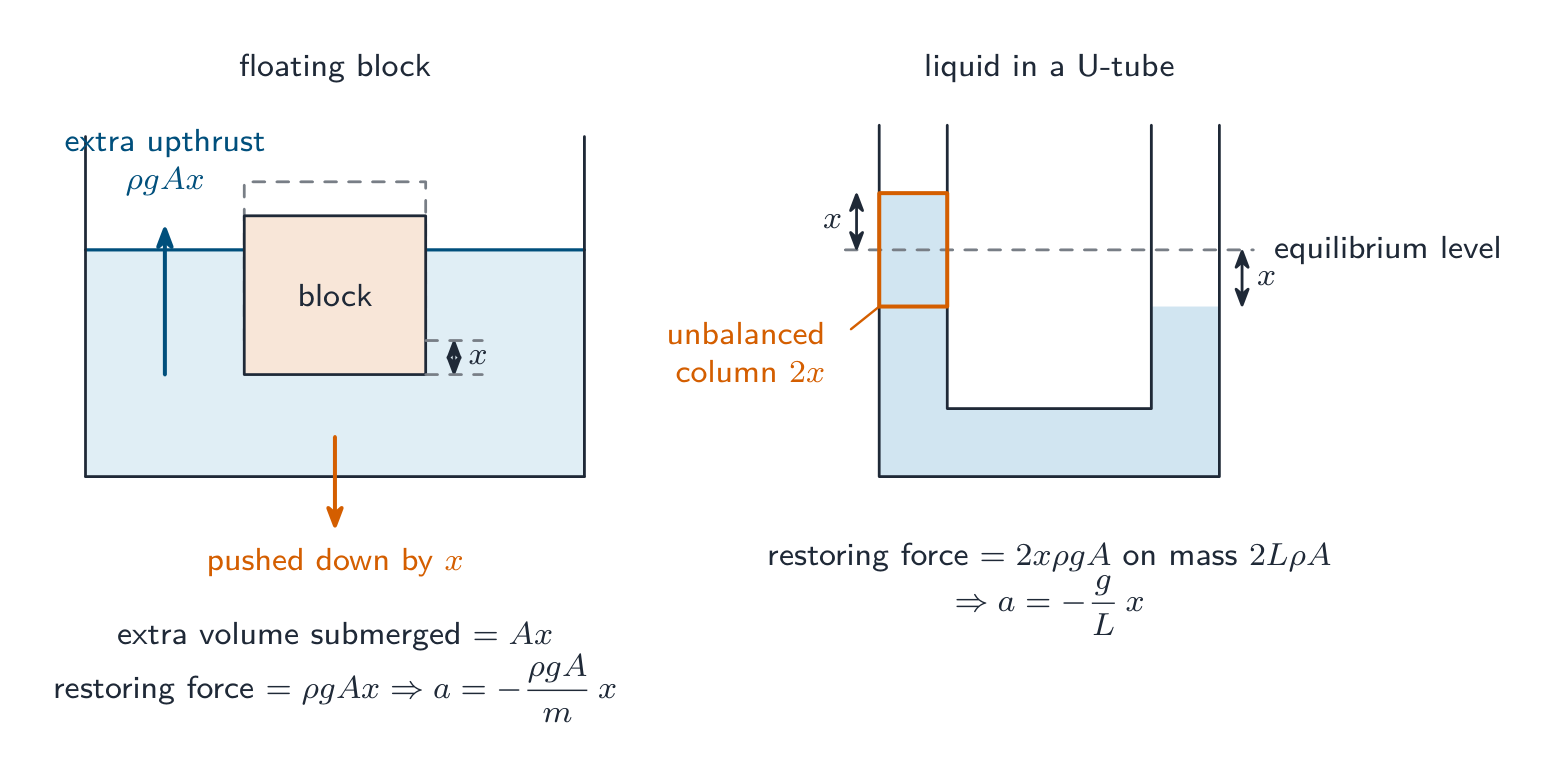
Worked example. A cuboidal block of cross-sectional area $A$ and mass $m$ floats in a liquid of density $\rho$ with its base a depth $h$ below the surface. It is pushed down a small distance $x$ and released. Show that it oscillates with simple harmonic motion and find the period in terms of $h$ and $g$.
When the block is pushed down by $x$ an extra volume $Ax$ is submerged, so the upthrust 浮力 increases by the weight of that extra liquid, $\rho g A x$; this extra force acts upwards, towards the equilibrium position. Hence $a = -\dfrac{\rho g A}{m}x$: proportional to $x$ and opposite in direction, so the motion is simple harmonic with $\omega^{2} = \rho g A/m$. At equilibrium the upthrust on the submerged volume $Ah$ equals the weight, $\rho g A h = mg$, so $m = \rho A h$ and $\omega^{2} = g/h$: $T = 2\pi\sqrt{h/g}$ — the same form as a pendulum of length $h$.
Worked example. A U-tube of cross-sectional area $A$ contains liquid of density $\rho$; the column in each arm has length $L$. The liquid is displaced so that one surface is $x$ above its equilibrium level and the other $x$ below. Show that the liquid oscillates with simple harmonic motion.
The two surfaces now differ in height by $2x$, so a column of liquid of height $2x$ is unbalanced: the restoring force on the liquid is the weight of that column, $2x\rho g A$, directed so as to level the surfaces. The mass being moved is the whole liquid, $2L\rho A$. So $a = -\dfrac{2x\rho g A}{2L\rho A} = -\dfrac{g}{L}x$: simple harmonic, with $\omega^{2} = g/L$ and $T = 2\pi\sqrt{L/g}$. Note that $\rho$ and $A$ cancel — the period depends on neither the liquid nor the tube.
עברית
תנודות הרמוניות פשוטות: קפיץ, עיגול וגרף בשלבשעון מטוטלה שומר על הזמן באמצעות תנודות הרמוניות פשוטות.
חלקיק נע ב-תנודות הרמוניות פשוטות (SHM) כאשר האצתה היא:
פרופורציונלית להזזה שלו מנקודת איזון קבועה, ו
מופנית בחזרה לכיוון הנקודה הזו — הפוכה בסימן להזזה.
המשוואה המגדירה היא
$$a = -\omega^{2} x,$$
כאשר $x$ היא ה-הזזה מאיזון ו-$\omega$ הוא קבוע חיובי, ה-תדר הזוויתי. הסימן השלילי אומר "מופנית בחזרה לכיוון האיזון".
הגדרה לשתי נקודות.תנועה הרמונית פשוטה היא תנועה שבה התאוצה פרופורציונלית להזזה ממקום קבוע ומופעלת תמיד לכיוון מקום זה (בכיוון הנגדי להזזה). יש צורך בשני החלקים. "משמעות הסימן השלילי": התאוצה בכיוון הנגדי להזזה — תמיד לעבר מיקום האיזון. "ציינו מה משמעות התדירות של התנודות": מספר התנודות המלאות ליחידת זמן.
מערכות רבות עושות זאת בסביבת איזון יציב: מסה על קפיץ, מטוטלה (תנודה קטנה), בלוק צף שנדחף למטה, המטען על קבל במעגל LC, אטומים במצוק מוצק.
התאוצה תמיד מצביעה חזרה לעבר האיזון, בניגוד להזזה
מונחים מרכזיים
הזזה$x$ — המרחק מאיזון בזמן נתון (וקטור לאורך קו התנועה).
אמפליטודה$x_{0}$ — ההזזה הגדולה ביותר מאיזון. תמיד חיובית.
תקופה$T$ — הזמן לנדידה מלאה אחת.
תדירות$f$ — מספר התנודות לשנייה; $f = 1/T$. יחידה: Hz.
הגזירה האהובה מבחינת בוחני הבגרות בערך ארבע נקודות, והמתכון תמיד זהה: (1) הזזו את הגוף ב$x$ מהאיזון; (2) מצאו את כוח ההשבה הכולל, שמגיע ל$F = -(\text{constant}) \times x$; (3) הפעילו את החוק השני של ניוטון, $a = F/m = -(\text{constant}/m)\,x$; (4) לצורה זו יש את הצורה $a = -\omega^{2}x$, ולכן התנועה היא הרמונית פשוטה עם $\omega^{2} = \text{constant}/m$, ועם $T = 2\pi/\omega$. אמרו במילים למה הכוח מופעל חזרה לעבר האיזון ולמה הוא פרופורציונלי ל$x$ — אלו הנקודות, לא האלגברה.
שתי סדנאות "הראו שזהו SHM": מצאו את הכוח הנוסף כאשר המערכת מוסטת ב$x$, והראו שהוא פרופורציונלי ל$x$ וממוקם חזרה,
דוגמה פתורה. מסה $m$ תלויה בקפיץ בעל קבוע כפייה $k$. הראו כי כאשר המסה מוסטת ומשומרת, היא זזה בתנועה חריגית פשוטה, ומצאו את תקופת התנודה.
במיקום שיווי משקל, מתיחת הקפיץ מאזנת את המשקל. הסטו את המסה במרחק $x$ כלפי מטה: המתיחה עולה ב$kx$ (חוק הוק), ולכן יש כוח רכב $kx$כלפי מעלה, לכיוון שיווי המשקל. החוק השני של ניוטון: $a = -\dfrac{k}{m}x$. משוואה זו היא $a = -\omega^{2}x$ עם $\omega^{2} = k/m$, ולכן התנועה היא חריגית פשוטה ו$T = 2\pi/\omega = 2\pi\sqrt{m/k}$. (קרונת מחזיק בין שני קפיצים זהים, ששניהם מושכים אותה חזרה, $F = -2kx$, ולכן $\omega^{2} = 2k/m$.)
דוגמה מפורטת. בלוק מלבני-גוף בעל שטח חתך $A$ ומסה $m$ צף בנוזל בצפיפות $\rho$, כאשר בסיסו במעמק $h$ מתחת לפני המים. הדחפו למטה מרחק קטן $x$ ושחררו. הוכיחו שהוא מתנוד בתנועה הרמונית פשוטה ומצאו את התקופה בתלות ב$h$ וב$g$.
כאשר הבלוק מוזז למטה ב$x$, נפח נוסף $Ax$ טבול, ולכן כוח הדחיפה עולה במשקל של הנוזל הנוסף, $\rho g A x$; כוח זה פועל כלפי מעלה, לכיוון מיקום שיווי המשקל. לפיכך $a = -\dfrac{\rho g A}{m}x$: פרופורציונלי ל$x$ ונגדי בכיוונו, ולכן התנועה היא חריגית פשוטה עם $\omega^{2} = \rho g A/m$. בשיווי משקל, כוח הדחיפה על הנפח הטבול $Ah$ שווה למשקל, $\rho g A h = mg$, ולכן $m = \rho A h$ ו$\omega^{2} = g/h$: $T = 2\pi\sqrt{h/g}$ — אותו צורה כמו מתנד באורך $h$.
דוגמה פתורה. צינור U בעל שטח חתך $A$ מכיל נוזל בצפיפות $\rho$; העמודה בכל זרוע היא באורך $L$. הנוזל מוסט כך שמשטח אחד גבוה ב$x$ מעל מפלס שיווי המשקל והאחר נמוך ב$x$ מתחת. הראו כי הנוזל מתנוד בתנועה חריגית פשוטה.
השני משטחים שונים כעת בגובה ב-$2x$, ולכן עמודת נוזל בגובה $2x$ אינה מאוזנת: כוח השחזור הפועל על הנוזל הוא משקל עמודה זו, $2x\rho g A$, הממוקם כדי לשוות את המשטחים. המסה הנעה היא כל הנוזל, $2L\rho A$. לכן $a = -\dfrac{2x\rho g A}{2L\rho A} = -\dfrac{g}{L}x$: חריגית פשוטה, עם $\omega^{2} = g/L$ ו$T = 2\pi\sqrt{L/g}$. שמו לב כי $\rho$ ו$A$ מבטלים זה את זה – התקופה לא תלויה באף אחד מהנוזל או בצינור.
Explore · חקור
Swing a pendulum · נער נדנדה
Set it swinging, then change the start angle — the time for one swing stays the same (that is what makes it a good clock). Now make the string longer, or move to the Moon, and watch the period change. · הפעל אותה לנדנדה, ולאחר מכן שנה את זווית ההתחלה — הזמן לנדנדה אחת נשאר זהה (זה מה שהופך אותה לשעון טוב). כעת הארך את החוט, או מעבר לירח, וצפה בשינוי התקופה.
which is the SHM defining equation again. (If the particle instead starts at the extreme position $x = x_{0}$ at $t = 0$, use $x = x_{0} \cos(\omega t)$. Choose the one that fits the start conditions.)
Velocity in terms of displacement
A useful relation that does not use time:
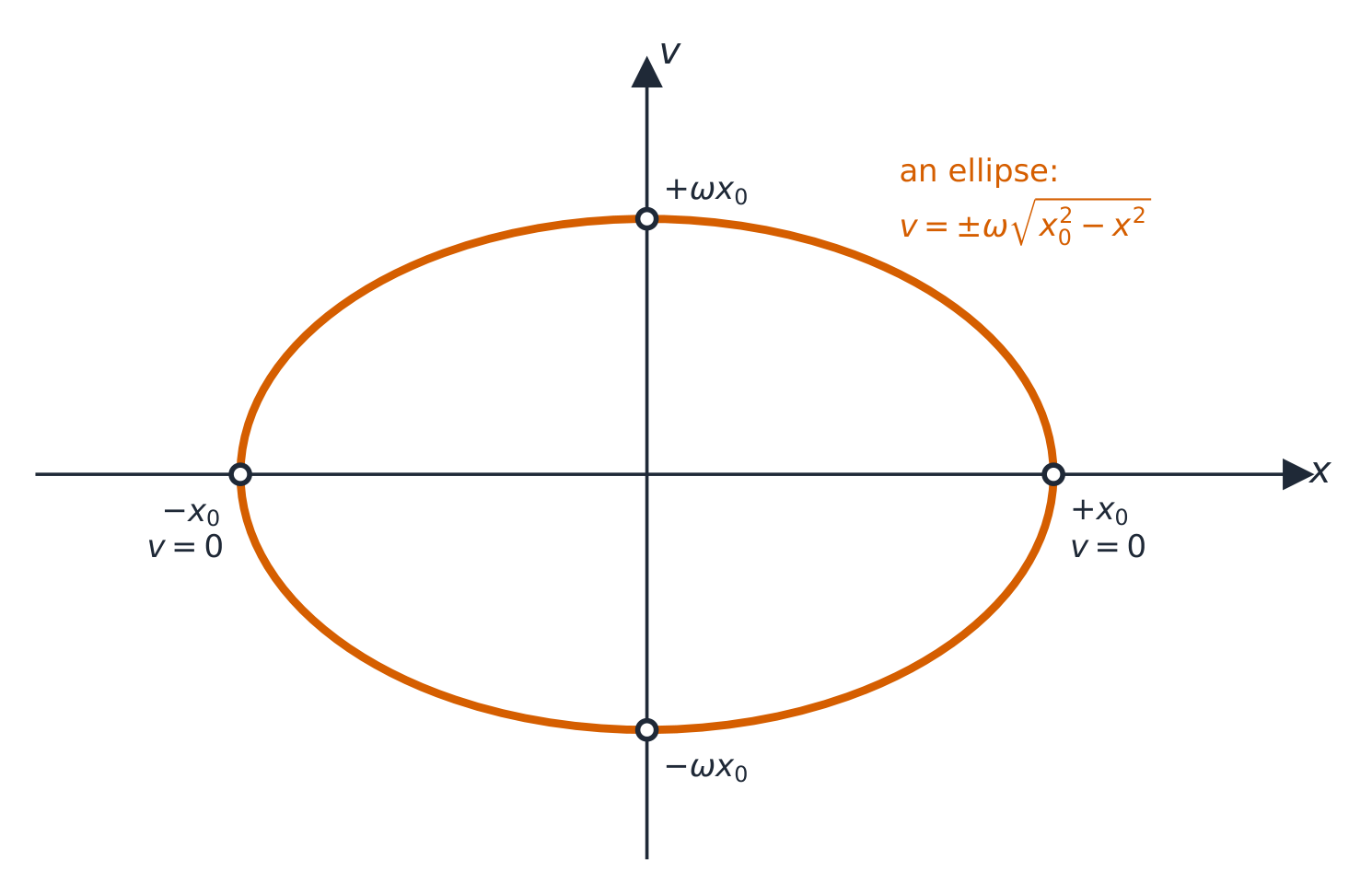
$$v = \pm \omega \sqrt{x_{0}^{2} - x^{2}}.$$
at equilibrium ($x = 0$): $v = \pm \omega x_{0}$ (maximum speed). Both signs, because the particle passes through equilibrium twice each cycle.
at the extremes ($x = \pm x_{0}$): $v = 0$ (at rest for an instant).
Worked example. The same oscillation has amplitude $x_{0} = 0.050\ \text{m}$ and angular frequency $\omega = 15.7\ \text{rad s}^{-1}$. Find the speed when the displacement is $x = 0.030\ \text{m}$.
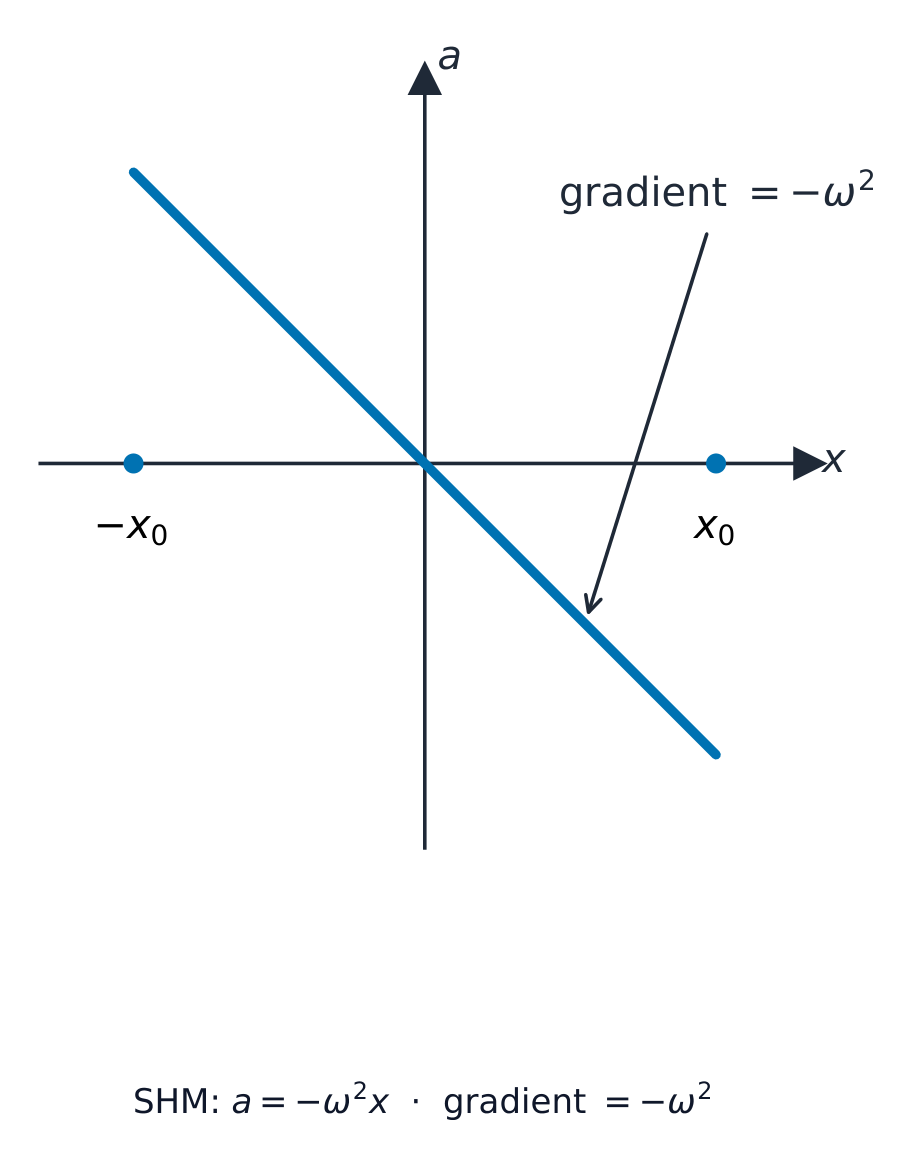
Reading the $v$–$x$ graph. Its width gives the amplitude ($x = \pm x_{0}$ where $v = 0$) and its height the maximum speed ($v = \pm\omega x_{0}$ at $x = 0$), so $\omega = v_{0}/x_{0}$ and the period follows. Asked to sketch $a$ against $x$ on the same axes, draw the straight line through the origin with negative gradient $-\omega^{2}$, reaching $\mp\omega^{2}x_{0}$ at $x = \pm x_{0}$.
Worked example. The velocity of an oscillating block varies with time as $v = 0.56\sin(5.1t)$, with $v$ in $\text{m s}^{-1}$ and $t$ in seconds. Find the amplitude, the period and the maximum acceleration.
Compare with $v = v_{0}\sin\omega t$: $v_{0} = 0.56\ \text{m s}^{-1}$ and $\omega = 5.1\ \text{rad s}^{-1}$. Since $v_{0} = \omega x_{0}$, the amplitude is $x_{0} = 0.56/5.1 = 0.11\ \text{m}$; $T = 2\pi/\omega = 1.2\ \text{s}$; $a_{\text{max}} = \omega^{2}x_{0} = \omega v_{0} = 5.1 \times 0.56 = 2.9\ \text{m s}^{-2}$. (Because this $v$ is a sine, the block was at an extreme at $t = 0$: its displacement is a cosine.)
SHM as the shadow of circular motion. A ball moving round a circle of radius $R$ at angular speed $\omega$, lit from the side, casts a shadow that moves back and forth with simple harmonic motion of amplitude $R$ and the same $\omega$: the shadow's displacement is $x = R\cos\omega t$ (if it starts at an extreme), its maximum speed is $R\omega$ and its maximum acceleration $R\omega^{2}$. For a circle of diameter $0.46\ \text{m}$ and $\omega = 1.9\ \text{rad s}^{-1}$ the shadow has amplitude $0.23\ \text{m}$, $v_{0} = 0.44\ \text{m s}^{-1}$ and $a_{\text{max}} = 0.83\ \text{m s}^{-2}$ — greatest in size at the two ends of its path and always directed back towards the centre.
Graphs against time
For $x = x_{0}\sin\omega t$:
$x$ vs $t$ — a sine curve, amplitude $x_{0}$, period $T = 2\pi/\omega$.
$v$ vs $t$ — a cosine curve, leading $x$ by $\pi/2$, amplitude $\omega x_{0}$.
$a$ vs $t$ — a negative sine curve, out of phase with $x$ by $\pi$ (180°), amplitude $\omega^{2} x_{0}$.
Graph of $a$ against $x$
A straight line through the origin with negative gradient$-\omega^{2}$. So you can read $\omega$ from the graph: gradient $= -\omega^{2}$, so $\omega = \sqrt{|\text{gradient}|}$, then $T = 2\pi / \omega$. This is a common exam pattern.
Worked example. A graph of the height $h$ of an object of mass $36\ \text{kg}$ undergoing vertical simple harmonic motion shows $h$ varying between $2\ \text{m}$ and $10\ \text{m}$, with one complete oscillation every $4.0\ \text{s}$. Find the amplitude, the angular frequency, the maximum speed, the maximum acceleration and the maximum kinetic energy.
Amplitude $x_{0} = (10 - 2)/2 = 4.0\ \text{m}$ (half the peak-to-peak range; the equilibrium height is $6\ \text{m}$). $\omega = 2\pi/T = 2\pi/4.0 = 1.57\ \text{rad s}^{-1}$. $v_{\text{max}} = \omega x_{0} = 6.3\ \text{m s}^{-1}$; $a_{\text{max}} = \omega^{2}x_{0} = 9.9\ \text{m s}^{-2}$; $E_{\text{K,max}} = \tfrac{1}{2}mv_{\text{max}}^{2} = \tfrac{1}{2} \times 36 \times 6.28^{2} = 7.1 \times 10^{2}\ \text{J}$. Reading the amplitude as the full height range instead of half of it is the commonest slip here.
Worked example. A small object rests on a horizontal platform that oscillates vertically with simple harmonic motion of amplitude $6.0\ \text{mm}$. Find the highest frequency at which the object stays in contact with the platform throughout, and state where in the motion contact is first lost.
The object leaves the platform when the platform's downward acceleration exceeds $g$ — at the top of the oscillation, where the acceleration is greatest and directed downwards: the platform then falls away faster than the object can. The limit is $\omega^{2}x_{0} = g$: $\omega = \sqrt{9.81/0.0060} = 40\ \text{rad s}^{-1}$, so $f = \omega/2\pi = 6.4\ \text{Hz}$. Below this the normal contact force at the top is small but positive; above it, zero.
עברית
אם החלקיק מתחיל ב$x = 0$ ונע בכיוון החיובי ב$t = 0$, אז
שהיא שוב משוואת ההגדרה לתנועה פשוטה הרמונית. (אם החלקיק מתחיל במקום הקיצוני $x = x_{0}$ בזמן $t = 0$, השתמש ב$x = x_{0} \cos(\omega t)$. בחר את זה שמתאים לתנאי ההתחלה.)
מהירות כפונקציה של מיקום
יחס שימושי שאינו תלוי בזמן:
$$v = \pm \omega \sqrt{x_{0}^{2} - x^{2}}.$$
במרכז ($x = 0$): $v = \pm \omega x_{0}$ (מהירות מקסימלית). לשני הסימנים, מכיוון שהחלקיק עובר דרך המרכז פעמיים בכל מחזור.
בקצוות ($x = \pm x_{0}$): $v = 0$ (עומד לרגע).
דוגמה מפורטת. אותה תנודה יש להיקף $x_{0} = 0.050\ \text{m}$ ותדירות זוויתית $\omega = 15.7\ \text{rad s}^{-1}$. חשב את המהירות כאשר המיקום הוא $x = 0.030\ \text{m}$.
מהירות מול מיקום היא אליפסה: $v = 0$ בקצוות ו$v = \pm\omega x_{0}$ במרכז — קרא $x_{0}$ ו$v_{0}$ מהנקודות בהן הגרף חותך את הצירים, ואז $\omega = v_{0}/x_{0}$
קריאת גרף $v$–$x$. רוחבו נותן את ההיקף ($x = \pm x_{0}$ כאשר $v = 0$) וגובהו את המהירות המקסימלית ($v = \pm\omega x_{0}$ ב$x = 0$), ולכן $\omega = v_{0}/x_{0}$ והתקופה נובעים מכך. כאשר מבקשים לשרטט גרף של $a$ מול $x$ באותו מערכת צירים, שרטט את הישר העובר דרך הראשית עם שיפוע שלילי $-\omega^{2}$, המגיע ל$\mp\omega^{2}x_{0}$ ב$x = \pm x_{0}$.
דוגמה מפורטת. מהירות בלוק מתנדנד משתנה עם הזמן לפי $v = 0.56\sin(5.1t)$, כאשר $v$ יחידות ב$\text{m s}^{-1}$ ו$t$ בשניות. מצא את ההיקף, התקופה והתאוצה המקסימלית.
השווה ל$v = v_{0}\sin\omega t$: $v_{0} = 0.56\ \text{m s}^{-1}$ ו$\omega = 5.1\ \text{rad s}^{-1}$. מכיוון ש$v_{0} = \omega x_{0}$, ההיקף הוא $x_{0} = 0.56/5.1 = 0.11\ \text{m}$; $T = 2\pi/\omega = 1.2\ \text{s}$; $a_{\text{max}} = \omega^{2}x_{0} = \omega v_{0} = 5.1 \times 0.56 = 2.9\ \text{m s}^{-2}$. (מכיוון ש$v$ זו פונקציית סינוס, הבלוק היה במקום קיצוני בזמן $t = 0$: המיקום שלו הוא פונקציית קוסינוס).
SHM כצל של תנועה מעגלית. כדור הנע בסביב עיגול ברדיוס של $R$ במהירות זוויתית של $\omega$, המואר מהצד, מטיל צל שמנוע קדימה ואחורה בתנועה הרמונית פשוטה של רוחב $R$ והאותה $\omega$: ההזזה של הצל היא $x = R\cos\omega t$ (אם היא מתחילה בקצה), מהירותה המקסימלית היא $R\omega$ והתאוצה המקסימלית שלה $R\omega^{2}$. לעיגול בקוטר של $0.46\ \text{m}$ ו-$\omega = 1.9\ \text{rad s}^{-1}$ לצל יש רוחב של $0.23\ \text{m}$, $v_{0} = 0.44\ \text{m s}^{-1}$ ו-$a_{\text{max}} = 0.83\ \text{m s}^{-2}$ — הגדול ביותר בגודלו בשני קצוות הדרך ובכל רגע מופנה החזרה אל המרכז.
גרפים מול זמן
עבור $x = x_{0}\sin\omega t$:
$x$ מול $t$ — עקומת סינוס, היקף $x_{0}$, תקופה $T = 2\pi/\omega$.
$v$ מול $t$ — עקומת קוסינוס, קדמית ב$x$ ב$\pi/2$, היקף $\omega x_{0}$.
$a$ מול $t$ — עקומת סינוס שלילית, בפרזיה מול $x$ ב$\pi$ (180°), היקף $\omega^{2} x_{0}$.
המיקום משתנה סינוסואידלית עם הזמן בתנועה פשוטה הרמוניתהמהירות חולקת רבע מחזור לפני ההזזה; התאוצה נמצאת בדיוק נגד-פאזה עם ההזזה
גרף של $a$ כנגד $x$
ישר העובר דרך הראשית עם שיפוע שלילי$-\omega^{2}$. לכן ניתן לקרוא את $\omega$ מהגרף: שיפוע $= -\omega^{2}$, ולכן $\omega = \sqrt{|\text{gradient}|}$, ואז $T = 2\pi / \omega$. זוהי דוגמא נפוצה במבחנים.
גרף התאוצה–הזזה הוא ישר העובר דרך הראשית עם שיפוע $-\omega^{2}$
דוגמה מופרדת. גרף הגובה $h$ של גוף בעל מסה $36\ \text{kg}$ הנע בתנודות הרמוניות פשוט אנכיות מראה כי $h$ משתנה בין $2\ \text{m}$ ל-$10\ \text{m}$, כאשר מחזור תנודה מלא מתרחש כל $4.0\ \text{s}$. מצאו את המשרעת, התדר הזוויתי, המהירות המקסימלית, התאוצה המקסימלית והאנרגיה הקינטית המקסימלית.
משרעת $x_{0} = (10 - 2)/2 = 4.0\ \text{m}$ (חצי הטווח מקצה לקצה; הגובה באיזון הוא $6\ \text{m}$). $\omega = 2\pi/T = 2\pi/4.0 = 1.57\ \text{rad s}^{-1}$. $v_{\text{max}} = \omega x_{0} = 6.3\ \text{m s}^{-1}$; $a_{\text{max}} = \omega^{2}x_{0} = 9.9\ \text{m s}^{-2}$; $E_{\text{K,max}} = \tfrac{1}{2}mv_{\text{max}}^{2} = \tfrac{1}{2} \times 36 \times 6.28^{2} = 7.1 \times 10^{2}\ \text{J}$. טעות נפוצה כאן היא לקרוא את המשרעת כטווח הגובה המלא במקום כחצי ממנו.
דוגמה מופרדת. גוף קטן שוכן על פלטפורמה אופקית המתנדדת אנכית בתנודות הרמוניות פשוטות עם משרעת $6.0\ \text{mm}$. מצאו את התדר הגבוה ביותר שבו הגוף נשאר במגע עם הפלטפורמה לאורך כל התנודה, וציינו באיזה שלב בתנועה נאבד המגע לראשונה.
הגוף נפרד מהפלטפורמה כאשר התאוצה המטה של הפלטפורמה עולה על $g$ — ב-פסגה התנודה, שם התאוצה היא הגדולה ביותר ומכוונת למטה: הפלטפורמה אז נופלת מהר יותר מהגוף יכול להגיע אליה. הגבול הוא $\omega^{2}x_{0} = g$: $\omega = \sqrt{9.81/0.0060} = 40\ \text{rad s}^{-1}$, ולכן $f = \omega/2\pi = 6.4\ \text{Hz}$. מתחת לגבול זה, כוח החיכוך הנורמלי בפסגה הוא קטן אך חיובי; מעליו, הוא אפס.
Energy in simple harmonic motion · אנרגיה בתנודות הרמוניות פשוטות
Syllabus · סיילבוס
English
describe the interchange between kinetic and potential energy during simple harmonic motion
recall and use $E = \frac{1}{2}m\omega^2x_0^2$ for the total energy of a system undergoing simple harmonic motion
עברית
תאר את ההחלפה בין אנרגיה קינטית ל-אנרגיה פוטנציאלית במהלך תנועה הרמונית פשוטה
זכור ושתמש ב-$E = \frac{1}{2}m\omega^2x_0^2$ עבור האנרגיה הכוללת של מערכת העוברת תנועה הרמונית פשוטה
Source: Cambridge International syllabus · מקור: הסיילבוס הבינלאומי של קמבריד'ג'
English
A simple harmonic oscillator keeps swapping energy between two forms:
kinetic energy 动能$E_{\text{K}} = \tfrac{1}{2} m v^{2}$.
potential energy$E_{\text{P}}$ (elastic for a spring, gravitational for a pendulum).
With no damping 阻尼, the total energy is constant (this is conservation of energy 能量守恒).
Maximum and minimum
at equilibrium ($x = 0$): $v$ is largest, so $E_{\text{K}}$ is largest and $E_{\text{P}}$ is smallest (zero, by choice).
at the extremes ($x = \pm x_{0}$): $v = 0$, so $E_{\text{K}} = 0$ and $E_{\text{P}}$ is largest.
Total energy
Using $v_{\text{max}} = \omega x_{0}$:
$$E_{\text{total}} = \tfrac{1}{2} m v_{\text{max}}^{2} = \tfrac{1}{2} m \omega^{2} x_{0}^{2}.$$
Two key facts: the total energy is proportional to the square of the amplitude (doubling $x_{0}$ gives four times the energy), and to $\omega^{2}$.
Energy against displacement
Using $v^{2} = \omega^{2}(x_{0}^{2} - x^{2})$:
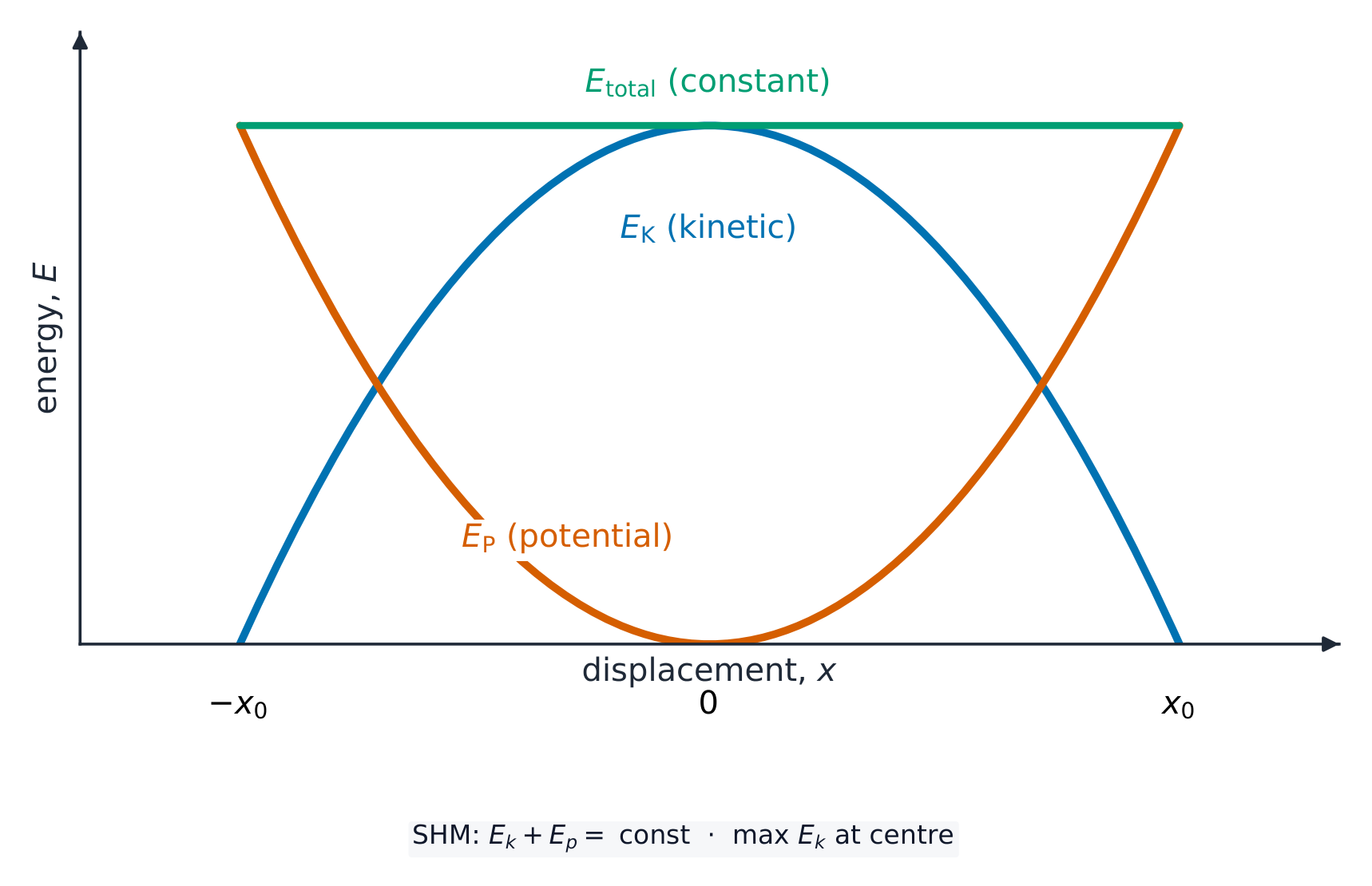
$$E_{\text{K}} = \tfrac{1}{2} m \omega^{2} (x_{0}^{2} - x^{2}), \qquad E_{\text{P}} = \tfrac{1}{2} m \omega^{2} x^{2}.$$
So $E_{\text{K}}$ is a downward parabola (peak at $x = 0$, zero at $x = \pm x_{0}$) and $E_{\text{P}}$ is an upward parabola (zero at $x = 0$, largest at $x = \pm x_{0}$). Their sum is constant.
Worked example. A $0.20\ \text{kg}$ mass oscillates with amplitude $x_{0} = 0.050\ \text{m}$ and angular frequency $\omega = 15.7\ \text{rad s}^{-1}$. Find the total energy of the oscillation.
The total energy equals the maximum kinetic energy, as the mass passes through $x = 0$ at $v_{\text{max}} = \omega x_{0}$:
This stays constant, swapping between kinetic and potential form twice each cycle.
Describing the interchange without calculation. At an extreme of the motion the oscillator is momentarily at rest: its kinetic energy is zero and its potential energy is a maximum. As it moves towards equilibrium the restoring force does work on it, so potential energy is converted to kinetic energy; at the equilibrium position the kinetic energy is a maximum and the potential energy a minimum. Beyond it the kinetic energy is converted back to potential energy until the other extreme. The total stays constant, and the exchange happens twice per oscillation, so the energy graphs against time have twice the frequency of the displacement graph.
Worked example. A pendulum bob of mass $0.81\ \text{kg}$ swings with small oscillations of amplitude $32\ \text{mm}$ and period $1.9\ \text{s}$. Find the total energy of the oscillation, and state what happens to it if the amplitude falls to $16\ \text{mm}$.
$\omega = 2\pi/1.9 = 3.31\ \text{rad s}^{-1}$; $E = \tfrac{1}{2}m\omega^{2}x_{0}^{2} = \tfrac{1}{2} \times 0.81 \times 3.31^{2} \times 0.032^{2} = 4.5 \times 10^{-3}\ \text{J}$. Halving the amplitude quarters the energy ($E \propto x_{0}^{2}$), to $1.1 \times 10^{-3}\ \text{J}$; the difference has been dissipated as thermal energy by air resistance.
עברית
מתנד הרמוני פשוט ממשיך לחלף אנרגיה בין שתי צורות:
אנרגיה קינטית$E_{\text{K}} = \tfrac{1}{2} m v^{2}$.
אנרגיה פוטנציאלית$E_{\text{P}}$ (אלסטית לקפיץ, כבידתית לתלוי).
ללא ריסון, האנרגיה הכוללת היא קבועה (זוהי שימור האנרגיה).
מקסימום ומינימום
באיזון ($x = 0$): $v$ הוא הגדול ביותר, ולכן $E_{\text{K}}$ הוא הגדול ביותר ו$E_{\text{P}}$ הוא הקטן ביותר (אפס, לפי בחירה).
בקצוות ($x = \pm x_{0}$): $v = 0$, ולכן $E_{\text{K}} = 0$ ו-$E_{\text{P}}$ הם הגדולים ביותר.
אנרגיה כוללת
בשימוש ב$v_{\text{max}} = \omega x_{0}$:
$$E_{\text{total}} = \tfrac{1}{2} m v_{\text{max}}^{2} = \tfrac{1}{2} m \omega^{2} x_{0}^{2}.$$
שתי עובדות מרכזיות: האנרגיה הכוללת פרופורציונלית לריבוע של המשרעת (הכפלת $x_{0}$ נותנת ארבע פעמים את האנרגיה), ופרופורציונלית ל$\omega^{2}$.
אנרגיה לעומת העתקה
בשימוש ב$v^{2} = \omega^{2}(x_{0}^{2} - x^{2})$:
$$E_{\text{K}} = \tfrac{1}{2} m \omega^{2} (x_{0}^{2} - x^{2}), \qquad E_{\text{P}} = \tfrac{1}{2} m \omega^{2} x^{2}.$$
לכן $E_{\text{K}}$ היא פרבולה הפונה כלפי מטה (שיא ב$x = 0$, אפס ב$x = \pm x_{0}$) ו$E_{\text{P}}$ היא פרבולה הפונה כלפי מעלה (אפס ב$x = 0$, הגדולה ביותר ב$x = \pm x_{0}$). סכמם הוא קבוע.
אנרגיה קינטית ופוטנציאלית מתחלפות במהלך מחזור בעוד שהאנרגיה הכוללת נשארת קבועה
דוגמה מוצגת. מסה $0.20\ \text{kg}$ רועדת עם משרעת $x_{0} = 0.050\ \text{m}$ ותדר זוויתי $\omega = 15.7\ \text{rad s}^{-1}$. מצאו את האנרגיה הכוללת של הרעידה.
האנרגיה הכוללת שווה לאנרגיה הקינטית המקסימלית, כאשר המסה עוברת דרך $x = 0$ ב$v_{\text{max}} = \omega x_{0}$:
זה נשאר קבוע, מתחלף בין צורה קינטית לפוטנציאלית פעמיים בכל מחזור.
תיאור ההחלפה ללא חישוב. בקצה התנועה המתנדן נמצא לרגע ברק: האנרגיה הקינטית שלו היא אפס והאנרגיה הפוטנציאלית מקסימלית. כשהוא נע לכיוון המשווה, הכוח המחזיר מבצע עבודה עליו, ולכן אנרגיה פוטנציאלית מומרת לאנרגיה קינטית; בנקודת השוויון האנרגיה הקינטית מקסימלית והאנרגיה הפוטנציאלית מינימלית. מעבר לה, האנרגיה הקינטית מומרת חזרה לאנרגיה פוטנציאלית עד לקצה השני. הסכום נשאר קבוע, וההחלפה מתרחשת פעמיים בכל תנודה, כך שגרפים של אנרגיה לעומת זמן יש להם פי שניים בתדר מאשר גרף ההעתקה.
דוגמה מוצגת. מטטלט של מדול בעל מסה $0.81\ \text{kg}$ מתנדנד עם תנודות קטנות של משרעת $32\ \text{mm}$ ומחזור $1.9\ \text{s}$. מצאו את האנרגיה הכוללת של הרעידה, וציינו מה קורה לה אם המשרעת יורדת ל$16\ \text{mm}$.
Energy in SHM · אנרגיה ב-NHR (תנועה הרמונית פשוטה)
Watch energy swap between kinetic and potential as the oscillator moves — fastest (max KE) at the centre, still (max PE) at the ends. · צפה על החלפת האנרגיה בין קינטית לפוטנציאלית כאשר המתנד נע — מהר ביותר (מקסימום אנרגיה קינטית) במרכז, ורוקן (מקסימום אנרגיה פוטנציאלית) בקצוות.
understand that a resistive force acting on an oscillating system causes damping
understand and use the terms light, critical and heavy damping and sketch displacement–time graphs illustrating these types of damping
understand that resonance involves a maximum amplitude of oscillations and that this occurs when an oscillating system is forced to oscillate at its natural frequency
עברית
להבין שכוח התנגדות הפועל על מערכת מתנדדת גורם לריכוך (damping)
להבין ולשתמש במונחים ריכוך קל, ריכוך קריטי וריכוך כבד ולשרטט גרפים של תזמון–הזזה הממחישים סוגים אלו של ריכוך
להבין שתהודה כרוכה במקסימום מודד של תנודות, וכך זה קורה כאשר מערכת מתנדדת מאולצת להתנדד בתדרה הטבעי
Source: Cambridge International syllabus · מקור: הסיילבוס הבינלאומי של קמבריד'ג'
English
A resistive force (friction 摩擦力, drag 阻力, air resistance 空气阻力) causes damping — the amplitude shrinks over time as energy is lost as heat. Three named cases:
Light damping
The amplitude shrinks slowly over many cycles (a light damping 轻阻尼 case). The system still oscillates near its natural frequency, but each cycle is smaller than the last. A car's suspension is light-to-medium damped, so bumps die away but the ride stays smooth.
Critical damping
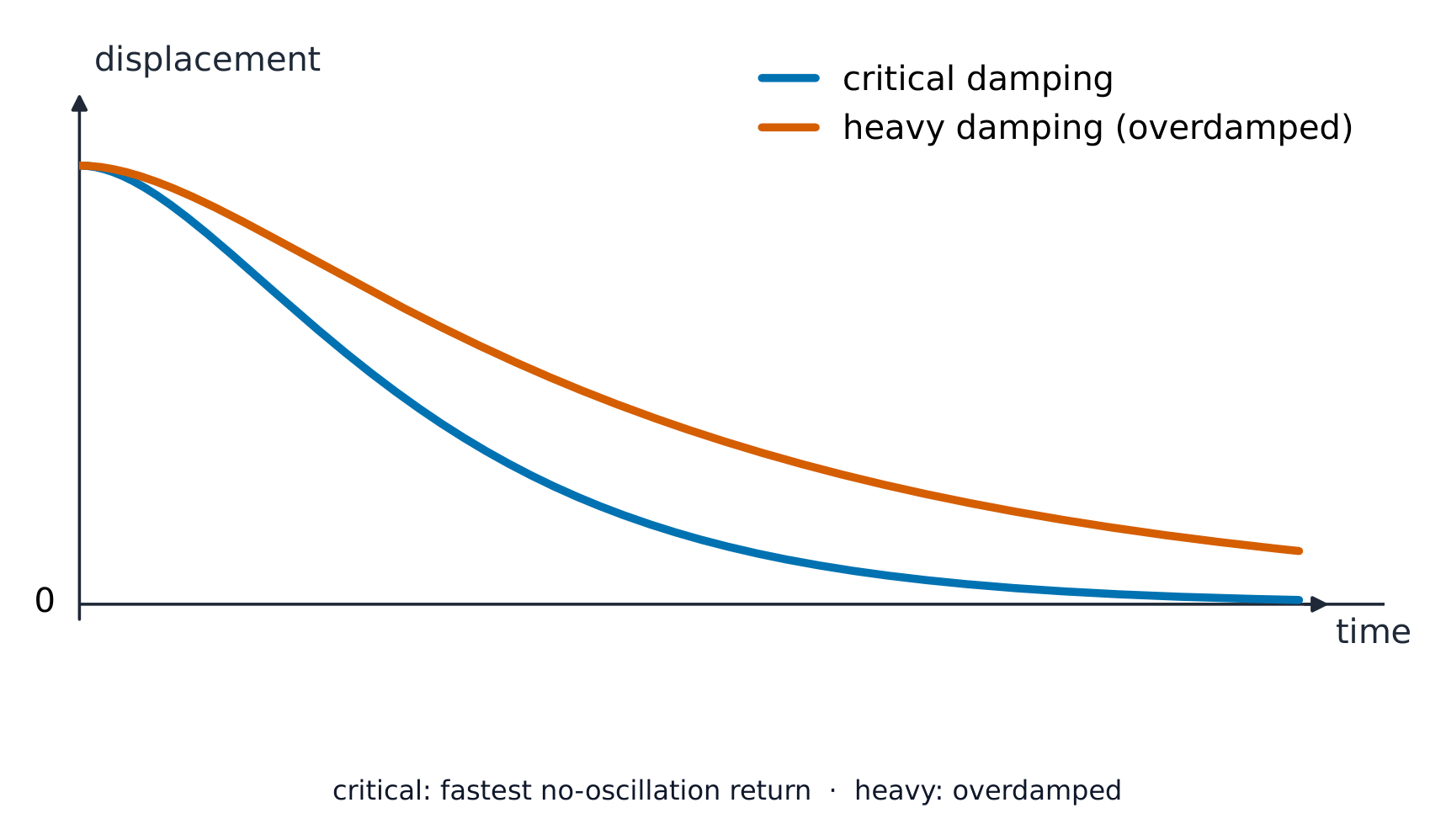
The least damping that brings the system back to equilibrium without overshooting and without oscillating — a critical damping 临界阻尼 case. It returns in the shortest time. A galvanometer 检流计 or analogue voltmeter 电压表 is critically damped so the needle settles quickly.
Heavy damping
So much resistance that the system returns slowly, with no oscillation, but more slowly than the critical case — a heavy damping 过阻尼 case. A door with a strong closer is heavily damped.
On a displacement–time graph: light damping is a wave whose size dies away smoothly; critical damping returns quickly with no overshoot; heavy damping returns slowly.
As the exam asks it.Damping is the decrease in the amplitude of an oscillation caused by a resistive force that dissipates the oscillator's energy. In light damping the system oscillates with an amplitude that decreases gradually (exponentially) with time; the period is almost unchanged. In critical damping the system returns to equilibrium in the shortest possible time without oscillating. In heavy damping it returns to equilibrium slowly, without oscillating. Sketching them: the light-damping curve is a sine wave inside a shrinking envelope; the critical and heavy curves both fall to zero without crossing the axis, the heavy one more slowly.
Worked example. A bar magnet hangs from a spring with one pole inside a coil that is connected through a switch to a resistor. The magnet is set oscillating. Explain why the oscillations die away more quickly when the switch is closed.
The moving magnet changes the magnetic flux linking the coil, so an e.m.f. is induced (Faraday's law); with the switch closed a current flows through the resistor and dissipates energy as heat. By Lenz's law the induced current opposes the motion of the magnet — an extra resistive force. That energy comes from the oscillation, so the amplitude decreases faster: the circuit adds damping. With the switch open there is an e.m.f. but no current, so no extra energy loss.
עברית
כוח התנגדות (חיכוך, התנגדות נוזלים, התנגדות אוויר) גורם לרידום – המשרעת צומצמת לאורך הזמן כאשר אנרגיה מאבדת כחום. שלושה מקרים מוגדרים:
רידום קל
המשרעת צומצמת לאט לאורך מחזורים רבים (מקרה של רידום קל). המערכת עדיין רועדת קרוב לתדר הטבעי שלה, אך כל מחזור קטן מהאחר. בליטי רכב הם רדומים בקלות עד בינונית, כך שהמכות נעלמות אך הרכיבה נשא חלקה.
*ברידום קל המשרעת נעלמת לאט לאורך מחזורים רבים
רידום קריטי
הרעילת המינימלית שמחזירה את המערכת לאיזון בלי עדיפת איזון ובלי תנודות — מקרה של רעילות קריטית. היא חוזרת בזמן הקצר ביותר. גלבנומטר או וולטמטר אנלוגי מורעלים בצורה קריטית כדי שהמחוג יתייצב במהירות.
רעילות כבדה
הרבה התנגדות כך שמערכת חוזרת לאיזון באיט, ללא תנודות, אך איטית יותר מהמקרה הקריטי — מקרה של רעילות כבדה. דלת עם סגן חזק מורעלת בצורה כבדה.
בעקרון זמנים-העתקים: רעילות קלה היא גל שגודלו דוהה בצורה חלקה; רעילות קריטית חוזרת במהירות ללא עדיפת איזון; רעילות כבדה חוזרת לאיזון באיט.
רעילות קריטית חוזרת לאיזון במהירות הרבה מבלי עדיפת איזון; רעילת יתר חוזרת לאיזון באיט יותר
כפי שנשאל בבחינה.רעילה היא ירידה בעוצמת תנודה הנגרמת מכוח התנגדות המפזר את אנרגיית המתנד. ברעילות קלה המערכת מתנודת בעוצמה הירודה בהדרגה (אקספוננציאלית) לאורך הזמן; התקופה נשארת כמעט ללא שינוי. ברעילות קריטית המערכת חוזרת לאיזון בקצב האפשרי הקצר ביותר ללא תנודות. ברעילות כבדה היא חוזרת לאיזון באיט, ללא תנודות. ציורן: העקום ברעילות קלה הוא גל סינוס בתוך מעטפת מצטמצמת; העקומים ברעילות הקריטית והכבדה שואפים לאפס ללא חציית הציר, הכבדה יותר איטית יותר.
דוגמה מופרדת. מקטב מוטח על קפיץ כאשר קוטב אחד שלו נמצא בתוך סליל המחובר דרך מתג למנגנון. המקטב מונע לתנודות. הסבר מדוע התנודות דועות מהר יותר כאשר המתג סגור.
המקטב הנע משנה את השטף המגנטי המחבר לסליל, ולכן נוצר כוח חשמלי מופעל (חוק פארדאי); כאשר המתג סגור זורם זרם דרך המנגנון ומפזר אנרגיה בחום. לפי חוק לנץ הזרם המופעל מתנגד לתנועת המקטב — כוח התנגדות נוסף. אנרגיה זו מגיעה מתנודות, ולכן העוצמה יורדת מהר יותר: המעגל מוסיף רעילה. כאשר המתג פתוח יש כוח חשמלי מופעל אך אין זרם, ולכן אין אובדן אנרגיה נוסף.
Forced oscillations and resonance · תנודות מאולצות ותהודה
English
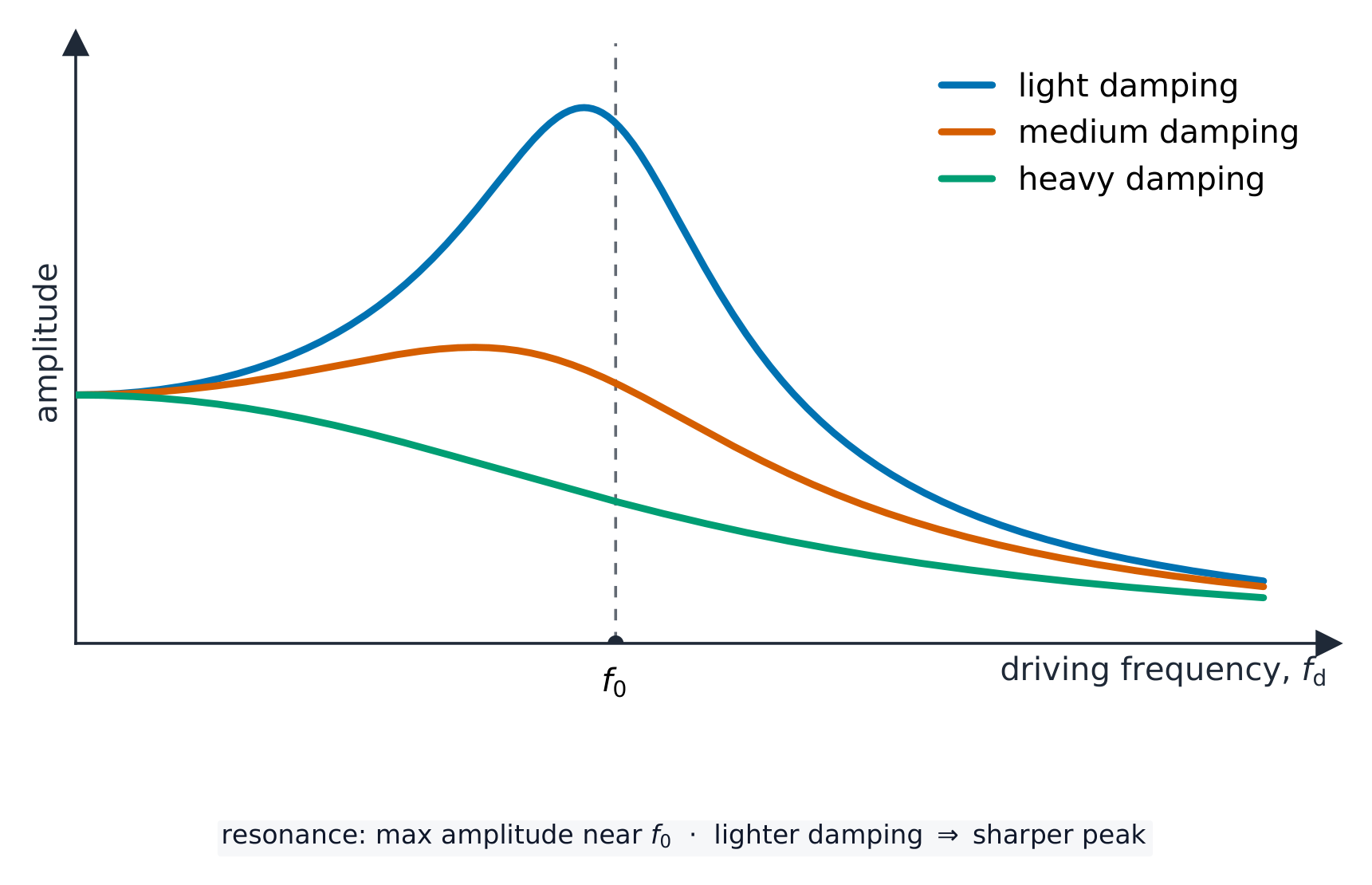
A forced oscillation 受迫振动 is driven by an outside periodic force at a frequency $f_{\text{d}}$ chosen by the experimenter. The system then oscillates at this driving frequency 驱动频率$f_{\text{d}}$, not at its own natural frequency. A plot of amplitude against $f_{\text{d}}$ is a resonance curve 共振曲线 with a peak.
Resonance
Resonance 共振 happens when the driving frequency equals the system's natural frequency 固有频率$f_{0}$. At resonance the amplitude is largest and the energy transfer from the driver is most efficient.
Examples:
a swing pushed at the right rate builds up a large amplitude.
a wine glass broken by a sound at its natural ringing frequency.
a building shaken by an earthquake whose frequency matches a natural frequency — engineers design buildings so their natural frequencies avoid the main earthquake range.
The peak's shape depends on damping: lighter damping → a sharper, higher peak; heavier damping → a broader, lower peak, shifted slightly to lower frequency.
The two-mark definition.Resonance is the condition in which a system is forced to oscillate at its natural frequency, and the amplitude of the oscillation is a maximum (the transfer of energy from the driver is greatest). Both parts — driving frequency equal to natural frequency, and maximum amplitude — are needed.
Worked example. A ball on a stretched string has a natural frequency of $4.0\ \text{Hz}$. The string is driven by a vibration generator whose frequency is increased slowly from $0$ to $10\ \text{Hz}$. Sketch the variation of the amplitude of the ball with the driving frequency, and state the effect of adding damping.
The curve starts at a small, non-zero amplitude at low frequency, rises to a sharp peak at $4.0\ \text{Hz}$, and falls away towards zero at high frequency; the peak is at the natural frequency, and only there is the amplitude a maximum. More damping makes the peak lower and broader and shifts it slightly to a lower frequency; the amplitude far from resonance hardly changes.
עברית
מיתר גיטרה המופעל רועד בתדירויות ההתהודה שלו.
תנודה מוצרת מופעלת על ידי כוח מחוזק מחוץ תקופתי בתדירות $f_{\text{d}}$ שנבחרה בידי המבחן. המערכת אז מתנוד בתדירות ההפעלה זו $f_{\text{d}}$, ולא בתדירות הטבעית שלה. גרף של אמפליטודה נגד $f_{\text{d}}$ הוא עקומת תהודה עם שיא.
תהודה
תהודה מתרחשת כאשר תדירות המניעה שווה לתדירות הטבעית$f_{0}$ של המערכת. בתהודה העוצמה היא הגדולה ביותר והעברת האנרגיה מהמניעה היעילה ביותר.
עוצמת תנודה מאולצת מגיעה לשיא בתהודה, כאשר תדירות המניעה שווה לתדירות הטבעיתתהודה יכולה להרוס. בשנת 1940 הרוח דחפה את גשר טקומה נארווס לקרבת תדירותו הטבעית; עם רעילות מינימלית הסיבוב גדל וגדל עד שהמשטח נקרע. מהנדסים מעצבים כיום גשרים ובניינים כך שתדירותיהם הטבעיות ימנעו מכוחות מניעה מסוג זה
דוגמאות:
נדנדה הדוחפת בקצב המתאים צוברת עוצמה גדולה.
כוס יין נשברת על ידי קול בתדירות הרזוננס הייחודית שלה.
מבנה רועד על ידי רעידת אדמה שדגשיתה תואמת לתדירות טבעית – מהנדסים מעצבים מבנים כך שתדריהם הטבעיים ימנעו את התחום העיקרי של רעידות האדמה.
צורת השיא תלויה בהרס: הרס קל → שיא חד וגבוה יותר; הרס כבד → שיא רחב ונמוך יותר, מוזז מעט לתדירות נמוכה.
הגדרה לשתי נקודות.רזוננס היא המצב שבו מערכת מחויבת לרסום בתדירות הטבעית שלה, והמשרעת של הרסון מקסימלית (המעבר של אנרגיה מהמניע הוא הגדול ביותר). שני חלקים – תדירות הנעה השווה לתדירות טבעית, ומשרעת מקסימלית – נדרשים שניהם.
דוגמה פתורה. כדור על מיתר מתוח יש לו תדירות טבעית של $4.0\ \text{Hz}$. המיתר מונע על ידי יצר רעידות whose תדירות מוגברת לאט מ$0$ ל$10\ \text{Hz}$. צייר את השינוי במשרעת הכדור כפונקציה של תדירות ההנעה, וחבר השפעת הוספת הרס.
העקומה מתחילה ממשרעת קטנה ואי-אפסית בתדירות נמוכה, עולה לשיא חד ב$4.0\ \text{Hz}$, ויורדת לכיוון אפס בתדירות גבוהה; השיא נמצא בתדירות הטבעית, ורק שם המשרעת היא מקסימלית. הרס נוסף גורם לשיא להיות נמוך ורחב יותר ומזיז אותו מעט לתדירות נמוכה; המשרעת הרחוקה מרזוננס משתנה רק מעט.
Explore · חקור
Resonance · תהודה
Drive the swing at different frequencies. Far from its natural frequency it barely moves; tune them to match and the amplitude explodes — resonance, the same effect that can shake a bridge apart. · הנע את הסחף בתדרים שונים. רחוק מהתדר הטבעי הוא barely זז; התאימתם להתאמה מלאה גורמת למשתנה להתפוצץ — תהודה, אותו אפקט שיכול לרסן גשר.
Definitions the examiner accepts · הגדרות מקובלות בקורס
English
A definition question is marked against fixed wording. Learn these exactly, and give one answer only.
Term
Definition
simple harmonic motion
motion in which the acceleration is proportional to the displacement from a fixed point and is always directed towards that point
amplitude
the maximum displacement from the equilibrium position
period
the time for one complete oscillation
frequency
the number of complete oscillations per unit time
angular frequency
$\omega = 2\pi f = 2\pi/T$; the rate at which the phase of the oscillation changes
phase difference
the fraction of a cycle, expressed as an angle, by which one oscillation leads or lags another
damping
the reduction in amplitude of an oscillation caused by a resistive force that dissipates its energy
critical damping
the damping that returns a displaced system to equilibrium in the shortest time without oscillation
natural frequency
the frequency at which a system oscillates when displaced and left to oscillate freely
resonance
the forced oscillation of a system at its natural frequency, at which the amplitude is a maximum
עברית
שאלת הגדרה מוקדמת לפי טקסט קבוע. לימודן במדויק, ותן תשובה אחת בלבד.
מונח
הגדרה
תנועה הרמונית פשוטה
תנועה שבה התאוצה פרופורציונלית להפרדה מנקודה קבועה וכיוונה תמיד כלפי נקודה זו
משרעת
ההפרדה המקסימלית ממיקום האיזון
תקופה
הזמן לקראת רסון מלא אחת
תדירות
מספר הרסונים המלאים ליחידת זמן
תדירות זוויתית
$\omega = 2\pi f = 2\pi/T$; הקצב שבו הפזה של הרסון משתנה
הבדל פזה
החלק משחזור, המבוייע כזווית, שבו רסון אחת מקדימה או מאחורי רסון אחר
הרס
הירידה במשרעת של רסון הנגרמת מכוח התנגדות המפזר את האנרגיה שלו
הרס קריטי
ההרס שמחזיר מערכת מוזזת לאיזון בזמן הקצר ביותר ללא רסון
תדירות טבעית
התדירות שבה מערכת רוסמת כאשר מוזזת ונשארת לרסון בחופשיות
רזוננס
הרסון מוכנה של מערכת בתדירות הטבעית שלה, שבו המשרעת היא מקסימלית
17.3
Exam tips · טיפים לבחינות
English
The SHM condition is $a = -\omega^2 x$ (acceleration proportional to displacement, directed back to equilibrium); to show a motion is SHM, find the restoring force, show it is proportional to $x$ and directed back, and read off $\omega^{2}$.
Learn $x = x_0\sin\omega t$ (or cos), $v_{max} = \omega x_0$, $a_{max} = \omega^2 x_0$ and $v = \pm\omega\sqrt{x_0^2 - x^2}$; KE and PE interchange with the total energy constant, $E = \tfrac{1}{2}m\omega^{2}x_{0}^{2} \propto x_{0}^{2}$.
Velocity is zero at the extremes and maximum at the centre; acceleration is greatest at the extremes and zero at the centre.
The amplitude is half the peak-to-peak range of a displacement graph; $\omega$ comes from the period, or from the gradient of $a$–$x$, or from $v_{0}/x_{0}$.
Resonance occurs when the driving frequency equals the natural frequency; damping lowers and broadens the peak.
Common mistakes
Defining SHM as "oscillation about an equilibrium position". The mark scheme wants acceleration proportional to displacement and directed towards the fixed point.
Saying the minus sign means the acceleration is negative. It means the acceleration is opposite in direction to the displacement.
Sketching $v$ against $x$ as a straight line. It is an ellipse; $a$ against $x$ is the straight line.
Taking the amplitude as the whole range of the displacement. It is half the range.
Defining resonance as "a large amplitude". It is forced oscillation at the natural frequency, giving the maximum amplitude.
Calling critical damping "no damping", or heavy damping "the fastest return". Critical damping is the fastest return without oscillation; heavy damping is slower.
עברית
תנאי THP הוא $a = -\omega^2 x$ (תאוצה פרופורציונלית להפרדה, מכוונת חזרה לאיזון); כדי להוכיח שרסון הוא THP, מצאו את הכוח המשחזר, הראו שהוא פרופורציונלי ל$x$ ומכוון חזרה, וקראו ↩️$\omega^{2}$.
למדו $x = x_0\sin\omega t$ (או cos), $v_{max} = \omega x_0$, $a_{max} = \omega^2 x_0$ ו$v = \pm\omega\sqrt{x_0^2 - x^2}$; KE וPE מתחלפים עם אנרגיה כוללת קבועה, $E = \tfrac{1}{2}m\omega^{2}x_{0}^{2} \propto x_{0}^{2}$.
המהירות היא אפס בקצוות ומקסימלית במרכז; התאוצה היא הגדולה ביותר בקצוות ואפס במרכז.
המשרעת היא חצי מתחום השיא-לשיא של גרף ההיסתות; $\omega$ נובע מהתקופה, או מהשיפוע של $a$–$x$, או מ$v_{0}/x_{0}$.
תהודה מתרחשת כאשר תדירות ההנעה שווה לתדירות הטבעית; הריכוך מוריד את הגובה ומרחיב את הפסגה.
טעויות נפוצות
הגדרת תנועה סזמוןית פשוטה (SHM) כ"תנועת תנודות סביב נקודת איזון". במפת הדירוג דורשים שהתאוצה תהיה פרופורציונלית להזזה ובאותו זמן מופנית לעבר הנקודה הקבועה.
טענה כי סימן המינוס מציעה שהתאוצה שלילית. זה אומר שהתאוצה מופנית בכיוון הפוך להזזה.
ציור $v$ מול $x$ כקו ישר. זהו אליפסה; $a$ מול $x$ הוא הקו הישר.
לקחת את האמפליטודה כטווח התנועה המלא. היא חצי מהטווח.
הגדרת תהודה כ"אמפליטודה גדולה". מדובר בתנועת תנודות מאולצת בתדירות הטבעית, המניקה את האמפליטודה המקסימלית.
כינוי ריכוך קריטי ל"ריכוך שאינו קיים", או ריכוך כבד ל"חזרה מהירה ביותר". ריכוך קריטי הוא החזרה המהירה ביותר ללא תנודות; ריכוך כבד איטי יותר.
Interactive lessons on this topic · שיעורים אינטראקטיביים בנושא זה
Work through it step by step, with instant-check exercises. · לעבור על הדברים צעד אחר צעד, עם תרגילים לבדיקה מיידית.
Pick one and the site follows you — notes, papers, videos and practice all open on it. · בחרו נושא אחד והאתר יעקוב אחריו — הערות, מסמכים, וידאו ותרגולים פתוחים בו.
Type to search notes, lessons, code, vocabulary and past-paper questions across every subject. · הקלד כדי לחפש הערות, שיעורים, קוד, אוצר מילים ושאלות מבחנים בכל הנושאים.


 שתי סדנאות "הראו שזהו SHM": מצאו את הכוח הנוסף כאשר המערכת מוסטת ב