דחפו עגלת קניות, והיא מאיצה. דחפו בחוזקה יותר, והיא מאיצה מהר יותר. דחפו עגלה כבדה יותר באותה מאמץ, והיא כמעט לא זזת. כל המכניקה…
English narration · English + 中文 subtitles burned in · קריאת קול באנגלית · תרגום אנגלי + סינית שרוף בתוך הסרטון
English
This handout covers Topic 4: Mechanics 力学. It studies how forces make objects move. Throughout this topic, take the acceleration of free fall as $g = 10\ \text{m s}^{-2}$.
עברית
חומר הדף עוסק בנושא 4: מכניקה. הוא לומד כיצד כוחות גורמים לגוף להזז. לאורך נושא זה, קבל את תאוצת הנפילה החופשית כ$g = 10\ \text{m s}^{-2}$.
4.1
Forces and equilibrium · כוחות ואיזון
Syllabus · סיילבוס
English
Candidates should be able to:
Notes and examples
identify the forces acting in a given situation
e.g. by drawing a force diagram.
understand the vector nature of force, and find and use components and resultants
Calculations are always required, not approximate solutions by scale drawing.
use the principle that, when a particle is in equilibrium, the vector sum of the forces acting is zero, or equivalently, that the sum of the components in any direction is zero
Solutions by resolving are usually expected, but equivalent methods (e.g. triangle of forces, Lami's Theorem, where suitable) are also acceptable; these other methods are not required knowledge, and will not be referred to in questions.
understand that a contact force between two surfaces can be represented by two components, the normal component and the frictional component
use the model of a 'smooth' contact, and understand the limitations of this model
understand the concepts of limiting friction and limiting equilibrium, recall the definition of coefficient of friction, and use the relationship $F = \mu R$ or $F \leqslant \mu R$, as appropriate
Terminology such as 'about to slip' may be used to mean 'in limiting equilibrium' in questions.
use Newton's third law.
e.g. the force exerted by a particle on the ground is equal and opposite to the force exerted by the ground on the particle.
עברית
המועמדים אמורים להיות מסוגלים:
הערות לדוגמאות
לזהות את הכוחות הפועלים במצב נתון
לדוגמה: על ידי ציור דיאגרמת כוחות.
להבין את האופי הווקטורי של הכוח, ולמצוא ולהשתמש ברכיבים ובתוצרים
נדרשים חישובים תמיד, ולא פתרונות מקורבים באמצעות ציור בקנה מידה.
להשתמש בעיקרון לפיו, כאשר חלקיק נמצא באיזון, הסכום הוקטורי של הכוחות הפועלים הוא אפס, או בשווה לכך, שהסכום הרכיבים בכל כיוון הוא אפס
בדרך כלל מצופים פתרונות באמצעות פירוק, אך שיטות מקבילות (לדוגמה: משולש כוחות, משפט למי, כאשר מתאים) מתקבלות גם כן; שיטות אלו אינן נדרשות ידע, ולא ייזכרו בשאלות.
להבין שכוח מגע בין משטחים שניים ניתן לייצוג על ידי שני רכיבים, הרכיב הנורמלי והרכיב החיכוקי
להשתמש בדגם של 'מגע חלק', ולהבין את הגבולות של דגם זה
להבין את המושגים של חיכוך סופי ואיזון סופי, לשחזר את ההגדרה של מקדם החיכוך, ולהשתמש בקשר $F = \mu R$ או $F \leqslant \mu R$, בהתאם
עשוי להשתמש במונח 'בסכנת החלקה' כדי להתייחס ל'איזון סופי' בשאלות.
להשתמש בחוק השלישי של ניוטון.
לדוגמה: הכוח שמפעיל חלקיק על הקרקע שווה בכמותו והפוך בכיוונו לכוח שמפעיל הקרקע על החלקיק.
Source: Cambridge International syllabus · מקור: הסיילבוס הבינלאומי של קמבריד'ג'
English
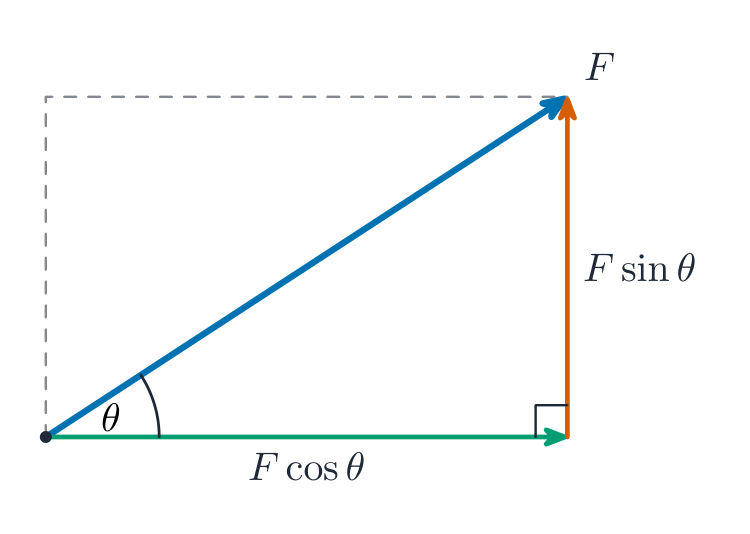
A force 力 is a push or a pull. It is a vector, so it has size and direction. Because it is a vector, you can split a force into components 分量 (usually horizontal and vertical), and you can add several forces into one resultant 合力.
A particle is in equilibrium 平衡 when the forces are balanced: the vector sum of the forces is zero. In practice this means the components in any direction add to zero.
Friction
When two surfaces touch, the contact force 接触力 between them has two parts: the normal reaction 法向反作用力$R$, at right angles to the surface, and the friction 摩擦力$F$, along the surface, which opposes sliding. A "smooth" surface is a model with no friction.
Friction can only grow up to a maximum. At that maximum the body is in limiting equilibrium 极限平衡, about to slip, and the friction is limiting friction 最大静摩擦力. The maximum is set by the coefficient of friction 摩擦系数$\mu$:
$$F \leqslant \mu R, \qquad \text{with } F = \mu R \text{ at the point of slipping}.$$
By Newton's third law 牛顿第三定律, the two surfaces push on each other with equal and opposite forces.
Worked example. A block of weight $20\text{ N}$ rests on a rough horizontal table with coefficient of friction $\mu = 0.4$. Find the largest horizontal force that can be applied before the block slides.
The table's normal reaction balances the weight, so $R = 20\text{ N}$. The block is on the point of slipping when friction reaches its maximum $F = \mu R = 0.4 \times 20 = 8\text{ N}$. In equilibrium the applied force equals the friction, so the largest force it can resist is $8\text{ N}$.
עברית
כוח הוא דחיפה או משיכה. זהו וקטור, ולכן יש לו גודל וכיוון. מכיוון שהוא וקטור, ניתן לפצל כוח ל-רכיבים (בדרך כלל רכיב אנכי ורכיב אופקי), ולסכום מספר כוחות ל-כוח resultant אחד.
כוח בזווית $\theta$ כולל חלק אופקי $F\cos\theta$ וחלק אנכי $F\sin\theta$.
נקודה נמצאת ב-איזון כאשר הכוחות מאוזנים: הסכום הווקטורי של הכוחות הוא אפס. בפועל, המשמעות היא שהרכיבים בכל כיוון מתאפסים.
כל בעיית מכניקה היא תמונה כזו. שלושה כוחות פועלים על המטפס — משקל הישר למטה, מתח לאורך הרצועה, ודחיפה מהסל — ומכיוון שהם מאוזנים, המטפס תלוי בשקט באיזון. פירוק כל כוח לחלקים אנכיים ואופקיים ממיר את התמונה למשוואות
חיכוך
כששתי משטחים נוגעים, ל-כוח המגע ביניהם יש שני חלקים: תגובה נורמלית$R$, מאונכת למשטח, וחיכוך$F$, לאורך המשטח, שמונע החלקה. משטח "חלק" הוא מודל שאין בו חיכוך.
החיכוך יכול לגדול רק עד למקסימום. במקסימום הזה הגוף נמצא ב-איזון סופי, מוכן להחליק, והחיכוך הוא חיכוך סופי. המקסימום נקבע על ידי מקדם החיכוך$\mu$:
$$F \leqslant \mu R, \qquad \text{with } F = \mu R \text{ at the point of slipping}.$$
על משטח מחוספסת, כוח המגע מתפרק לתגובה נורמלית $R$ ולחיכוך $F$ (עד מקסימום $\mu R$).
על פי חוק השלישי של ניוטון, שני המשטחים דוחפים זה את זה בכוחות שווים ובניגודים.
דוגמה מופיעה. בלוק במשקל $20\text{ N}$ מנוח על שולחן אופקי מחוספסת עם מקדם חיכוך $\mu = 0.4$. מצא את הכוח האופקי הגדול ביותר שיכול להיות מופעל לפני שהבלוק מחליק.
התגובה הנורמלית של השולחן מאזנת את המשקל, לכן $R = 20\text{ N}$. הבלוק על סף החלקה כאשר החיכוך מגיע למקסימום $F = \mu R = 0.4 \times 20 = 8\text{ N}$. באיזון, הכוח המופעל שווה לחיכוך, ולכן הכוח הגדול ביותר שהוא יכול לעמוד הוא $8\text{ N}$.
Explore · חקור
Adding forces · חיבור כוחות
resultant = a + b · הכוח השקול = a + b
Forces add tip-to-tail. They are in equilibrium when the resultant is zero. · כוחות מתחברים ראש-לאחור. הם באיזון כאשר הכוח השקול הוא אפס.
Kinematics of motion in a straight line · קינמטיקה של תנועה בקו ישר
Syllabus · סיילבוס
English
Candidates should be able to:
Notes and examples
understand the concepts of distance and speed as scalar quantities, and of displacement, velocity and acceleration as vector quantities
Restricted to motion in one dimension only. The term 'deceleration' may sometimes be used in the context of decreasing speed.
sketch and interpret displacement–time graphs and velocity–time graphs, and in particular appreciate that – the area under a velocity–time graph represents displacement, – the gradient of a displacement–time graph represents velocity, – the gradient of a velocity–time graph represents acceleration
use differentiation and integration with respect to time to solve simple problems concerning displacement, velocity and acceleration
Calculus required is restricted to techniques from the content for Paper 1: Pure Mathematics 1.
use appropriate formulae for motion with constant acceleration in a straight line.
Questions may involve setting up more than one equation, using information about the motion of different particles.
עברית
המועמדים אמורים להיות מסוגלים:
הערות לדוגמאות
להבין את המושגים של מרחק ומהירות כמוערכים סקלאריים, ושל הזחה, מהירות ותאוצה כמוערכים ווקטוריים
מוגבל לתנועה בממד אחד בלבד. המונח 'האטה' עשוי לעיתים להשתמש בהקשר של ירידה במהירות.
לעלות גרפים של הזחה–זמן ומהירות–זמן ולפרש אותם, ובמיוחד להבין כי – השטח מתחת לגרף מהירות–זמן מייצג הזחה, – השיפוע של גרף הזחה–זמן מייצג מהירות, – השיפוע של גרף מהירות–זמן מייצג תאוצה
להשתמש בגזירה ואינטגרציה ביחס לזמן לפתרון בעיות פשוטות הקשורות להזחה, מהירות ותאוצה
הקלקולוס הנדרש מוגבל לטכניקות מתוכן של Paper 1: Pure Mathematics 1.
להשתמש בנוסחאות המתאימות לתנועה עם תאוצה קבועה בקו ישר.
שאלות עשויות לכלול הערכת יותר ממשוואה אחת, בהשתמשת במידע על תנועת חלקיקים שונים.
Source: Cambridge International syllabus · מקור: הסיילבוס הבינלאומי של קמבריד'ג'
English
Distance 距离 and speed 速率 are scalars (size only). Displacement 位移, velocity 速度 and acceleration 加速度 are vectors (size and direction).
On a velocity-time graph 速度时间图, the area under the graph is the displacement and the gradient is the acceleration (a negative acceleration is a deceleration 减速度). On a displacement-time graph, the gradient is the velocity. More generally, differentiate with respect to time to go from displacement to velocity to acceleration, and integrate to go back.
For motion with constant acceleration 匀加速, use these formulae (the "suvat" equations):
$$v = u + at, \qquad s = ut + \tfrac12 at^2, \qquad v^2 = u^2 + 2as, \qquad s = \tfrac12(u + v)t.$$
Worked example. A car starts from rest and accelerates at $2.5\ \text{m s}^{-2}$ for $4\ \text{s}$. Find its speed and the distance travelled.
מרחק ומהירות הם סקלרים (גודל בלבד). הזזה, מהירות ותאוצה הם וקטורים (גודל וכיוון).
בגרף מהירות-זמן, השטח מתחת לגרף הוא ההזזה והשיפוע הוא התאוצה (תאוצה שלילית היא האטה). בגרף הזזה-זמן, השיפוע הוא המהירות. באופן כללי יותר, גזרו לפי הזמן כדי לעבור מהזזה למהירות ולאחר מכן לתאוצה, ואמננו כדי לחזור.
השטח הצלול מספק את המרחק שנסע; השיפוע של הקו מספק את התאוצה.
עבור תנועה עם האצה קבועה, השתמש בנוסחאות אלו (משוואות "suvat"):
$$v = u + at, \qquad s = ut + \tfrac12 at^2, \qquad v^2 = u^2 + 2as, \qquad s = \tfrac12(u + v)t.$$
דוגמה פותרת. רכב מתחיל ממצב רכישה ומאיץ ב$2.5\ \text{m s}^{-2}$ במשך $4\ \text{s}$. מצאו את מהירותו ואת המרחק שנסע.
Change the start velocity and acceleration. The gradient is the acceleration; the area under the line is the displacement. · שנה את מהירות ההתחלה והתאוצה. השיפוע הוא התאוצה; השטח מתחת לקו הוא ההזחה.
use the definition of linear momentum and show understanding of its vector nature
For motion in one dimension only.
use conservation of linear momentum to solve problems that may be modelled as the direct impact of two bodies.
Including direct impact of two bodies where the bodies coalesce on impact. Knowledge of impulse and the coefficient of restitution is not required.
עברית
המועמדים אמורים להיות מסוגלים:
הערות לדוגמאות
להשתמש בהגדרת תנע ליניארי ולהראות הבנה של אופיו הווקטורי
לתנועה בממד אחד בלבד.
להשתמש בשימור התנע הליניארי לפתרון בעיות שיכולות להיות מודליות כהתנגשות ישירה בין שני גוף.
כולל התנגשות ישירה בין שני גוף כאשר הגופים מתחברים זה לזה בהתנגשות. ידע באימפולס ובמקדם ההחזרה אינו נדרש.
Source: Cambridge International syllabus · מקור: הסיילבוס הבינלאומי של קמבריד'ג'
English
The linear momentum 动量 of a body is $\text{mass} \times \text{velocity}$. It is a vector. In a direct collision of two bodies, the total momentum is unchanged. This is the conservation of linear momentum 动量守恒:
$$m_1 u_1 + m_2 u_2 = m_1 v_1 + m_2 v_2.$$
Worked example. A body of mass $2\ \text{kg}$ moving at $3\ \text{m s}^{-1}$ hits a stationary body of mass $1\ \text{kg}$, and they stick together. Find their common speed afterwards.
התנע הליניארי של גוף הוא $\text{mass} \times \text{velocity}$. זהו וקטור. בהתנגשות ישירה בין שני גופים, התנע הכולל אינו משתנה. זוהי שימור התנע הליניארי:
$$m_1 u_1 + m_2 u_2 = m_1 v_1 + m_2 v_2.$$
התנע הכולל הוא אותו דבר לפני ואחרי ההתנגשות.
דוגמה פותרת. גוף בעל מסה $2\ \text{kg}$ הנע במהירות $3\ \text{m s}^{-1}$ פוגע בגוף עומד בעל מסה $1\ \text{kg}$, והם נדבקים יחד. מצאו את המהירות המשותפת שלהם לאחר מכן.
Set each mass and speed and collide them. Total momentum stays the same before and after. · הגדר את המסה ומהירות כל גוף והתרסק אותם. התנע הכולל נשאר זהה לפני ואחרי התנגשות.
conservation of momentum/ˌkɒnsəˈveɪʃn ɒv məʊˈmentəm/
שימור תנע
Newton's laws of motion/ˈnjuːtnz lɔːz ɒv ˈməʊʃn/
חוקי ניוטון לתנועה
mass/mæs/
מסה
weight/weɪt/
משקל
tension/ˈtenʃn/
מתח
4.4
Newton's laws of motion · חוקי התנועה של ניוטון
Syllabus · סיילבוס
English
Candidates should be able to:
Notes and examples
• apply Newton’s laws of motion to the linear motion of a particle of constant mass moving under the action of constant forces, which may include friction, tension in an inextensible string and thrust in a connecting rod
If any other forces resisting motion are to be considered (e.g. air resistance) this will be indicated in the question.
• use the relationship between mass and weight
$W = mg$. In this component, questions are mainly numerical, and use of the approximate numerical value $10\text{ (ms}^{-2}\text{)}$ for $g$ is expected.
• solve simple problems which may be modelled as the motion of a particle moving vertically or on an inclined plane with constant acceleration
Including, for example, motion of a particle on a rough plane where the acceleration while moving up the plane is different from the acceleration while moving down the plane.
• solve simple problems which may be modelled as the motion of connected particles.
e.g. particles connected by a light inextensible string passing over a smooth pulley, or a car towing a trailer by means of either a light rope or a light rigid tow-bar.
עברית
המועמדים אמורים להיות מסוגלים:
הערות לדוגמאות
• להפעיל את חוקי ניוטון לתנועה על תנועה ליניארית של חלקיק בעל מסה קבועה הנע בתחתית פעולת כוחות קבועים, שיכללו עשויה להיות חיכוך, מתח בחוט שאינו ניתן למתיחה וכוח דחיפה במוט חיבור
אם יש לקחת בחשבון כוחות נוספים המתנגדים לתנועה (למשל התנגדות אוויר) הדבר יצויין בשאלה.
• להשתמש בקשר בין מסה לבין משקל
$W = mg$. ברכיב זה, השאלות הן בעיקר מספריות, ומצופה שימוש בערך המספרי המשוער $10\text{ (ms}^{-2}\text{)}$ עבור $g$.
• לפתור בעיות פשוטות שיכולות להיות מודליות כתנועת חלקיק הנע אנכית או על משטח שיפל עם תאוצה קבועה
כולל, לדוגמה, תנועת חלקיק על משטח מחוספס שבו התאוצה בזמן העלייה על המישור שונה מהתאוצה בזמן הירידה על המישור.
• לפתור בעיות פשוטות שיכולות להיות מודליות כתנועת חלקיקים מחוברים.
לדוגמה: חלקיקים מחוברים בחוט קל שאינו ניתן למתיחה העובר על גלגלת חלקה, או רכב שמושך קרון באמצעות חבל קל או מוט גרירה קל וקשיח.
Source: Cambridge International syllabus · מקור: הסיילבוס הבינלאומי של קמבריד'ג'
English
Newton's laws of motion 牛顿运动定律 connect force and acceleration. The key one is: resultant force $=$mass 质量$\times$ acceleration,
$$F = ma.$$
The weight 重力 of a body is the force of gravity on it: $W = mg$. Forces in a problem may include weight, friction, tension 张力 in a string, the thrust 推力 (push) in a rod, and air resistance 空气阻力.
For motion on an inclined plane 斜面, split each force into a part along the slope and a part at right angles to it, then apply $F = ma$ along the slope. For connected particles 连接质点 (joined by a string), apply $F = ma$ to each body, or to the whole system.
Worked example. A block of mass $12\ \text{kg}$ is pulled up a rough plane by a rope parallel to the slope. The plane is at $20^\circ$ to the horizontal, the coefficient of friction is $0.4$, and the acceleration is $2\ \text{m s}^{-2}$. Find the tension in the rope.
The normal reaction is $R = mg\cos 20^\circ = 120\cos 20^\circ = 112.8\ \text{N}$, so the friction is $F = \mu R = 0.4 \times 112.8 = 45.1\ \text{N}$. Along the slope, $T - mg\sin 20^\circ - F = ma$:
חוקי התנועה של ניוטון מקשרים בין כוח לתאוצה. החוק המרכזי הוא: כוח תוצרת $=$מסה$\times$ תאוצה,
$$F = ma.$$
משקלו של גוף הוא הכוח הכבידתי הפועל עליו: $W = mg$. כוחות בבעיה עשויות לכלול משקל, חיכוך, מתח בחוט, דחיפה (דחיפה) בקורה, ועמידת אוויר.
בתנועה על מדרון, חלקו כל כוח למרכיב לאורך המדרון ולמרכיב מאונך אליו, ואז יישמו $F = ma$ לאורך המדרון. עבור חלקיקים מחוברים (מחוברים בחוט), יישמו $F = ma$ לכל גוף או לכל המערכת.
על מדרון, פתחו את הכוחות לאורך המדרון ולאנכי אליו.
דוגמה פותרת. בלוק בעל מסה $12\ \text{kg}$ נמשך מעלה על מדרון מחוספס על ידי חבל המקביל למדרון. המדרון נמצא בזווית $20^\circ$ לאופק, מקדם החיכוך הוא $0.4$, והתאוצה היא $2\ \text{m s}^{-2}$. מצאו את המתח בחבל.
התגובה הנורמלית היא $R = mg\cos 20^\circ = 120\cos 20^\circ = 112.8\ \text{N}$, ולכן החיכוך הוא $F = \mu R = 0.4 \times 112.8 = 45.1\ \text{N}$. לאורך המדרון, $T - mg\sin 20^\circ - F = ma$:
• understand the concept of the work done by a force, and calculate the work done by a constant force when its point of application undergoes a displacement not necessarily parallel to the force
$W = Fd \cos \theta$; Use of the scalar product is not required.
• understand the concepts of gravitational potential energy and kinetic energy, and use appropriate formulae
• understand and use the relationship between the change in energy of a system and the work done by the external forces, and use in appropriate cases the principle of conservation of energy
Including cases where the motion may not be linear (e.g. a child on a smooth curved ‘slide’), where only overall energy changes need to be considered.
• use the definition of power as the rate at which a force does work, and use the relationship between power, force and velocity for a force acting in the direction of motion
Including calculation of (average) power as
$$\frac{\text{Work done}}{\text{Time taken}}$$
$P = Fv$.
• solve problems involving, for example, the instantaneous acceleration of a car moving on a hill against a resistance.
עברית
המועמדים אמורים להיות מסוגלים:
הערות לדוגמאות
• להבין את מושג העבודה שנעשתה על ידי כוח, ולחשב את העבודה שנעשתה על ידי כוח קבוע כאשר נקודת הישומות שלו עוברת סטייה שאינה בהכרח מקבילה לכוח
$W = Fd \cos \theta$; שימוש במכפלה סקלרית אינו נדרש.
• להבין את מושגי אנרגיה פוטנציאלית כבידתית ואנרגיה קינטית, ולהשתמש בנוסחאות המתאימות
• להבין ולהשתמש בקשר בין השינוי באנרגיה של מערכת לבין העבודה שנעשתה על ידי הכוחות החיצוניים, ולהשתמש במקרים המתאימים בעקרון השימור האנרגיה
כולל מקרים שבהם התנועה עשויה לא להיות ליניארית (למשל ילד על 'מחליק' מעוגל וחלק), שבהם יש להתחשב רק בשינויים כוללים באנרגיה.
• להשתמש בהגדרת הספק כקצב ביצוע העבודה על ידי כוח, ולהשתמש בקשר בין הספק, כוח ומהירות עבור כוח הפועל בכיוון התנועה
כולל חישוב (ממוצע) הספק כ-
$$\frac{\text{Work done}}{\text{Time taken}}$$
$P = Fv$.
• לפתור בעיות הקשורות, לדוגמה, לתאוצה מיידינה של רכב הנע על גבעה נגד התנגדות.
Source: Cambridge International syllabus · מקור: הסיילבוס הבינלאומי של קמבריד'ג'
English
The work done 功 by a constant force is the scalar product of force and displacement — the force times the distance moved in the direction of the force: $W = Fd\cos\theta$, where $\theta$ is the angle between the force and the motion. Work is measured in joules (J).
Energy comes in forms you can calculate:
Kinetic energy 动能 (energy of movement): $\text{KE} = \tfrac12 mv^2$.
Gravitational potential energy 重力势能 (energy of height): $\text{PE} = mgh$.
The work done by the outside forces equals the change in the total energy. When no friction acts, the total energy stays the same — the conservation of energy 能量守恒.
Power 功率 is the rate of doing work. For a force pulling in the direction of motion, $P = Fv$ (power $=$ force $\times$ velocity). Power is measured in watts (W).
Worked example. A car engine works at $12\ \text{kW}$ while the car moves at $20\ \text{m s}^{-1}$ on a level road. Find the driving force.
מרכבת הרוסים ממירה אנרגיה פוטנציאלית לאנרגיה קינטית כשהיא עולה ויורדת.
העבודה שנעשתה על ידי כוח קבוע היא המכפלה הסקלרית של הכוח וההזזה — הכוח כפול המרחק שהתגלגל בכיוון הכוח: $W = Fd\cos\theta$, כאשר $\theta$ הוא הזווית בין הכוח לבין התנועה. עבודה נמדדת ביחידות ג'ול (J).
אנרגיה באה בצורות שניתן לחשב:
אנרגיה קינטית (אנרגיית תנועה): $\text{KE} = \tfrac12 mv^2$.
אנרגיה פוטנציאלית כבידתית (אנרגיית גובה): $\text{PE} = mgh$.
העבודה שבוצעו על ידי כוחות חיצוניים שווה לשינוי באנרגיה הכוללת. כאשר אין חיכוך, האנרגיה הכוללת נשארת זהה — שימור האנרגיה.
הספק הוא קצב ביצוע העבודה. עבור כוח שמושך בכיוון התנועה, $P = Fv$ (הספק $=$ כוח $\times$ מהירות). ההספק נמדד בוואט (W).
דוגמה מופת. מנוע רכב פועל ב$12\ \text{kW}$ בעוד שהרכב נע ב$20\ \text{m s}^{-1}$ על כביש אופקי. מצאו את כוח הנגידה.
Drop the object and watch energy change form. With no friction, GPE + KE stays constant the whole way down. · שחרר את הגוף וצפה בשינוי צורות האנרגיה. ללא חיכוך, GPE + KE נשארים קבועים לאורך כל הדרך למטה.
4.5
Exam tips · טיפים לבחינות
English
Draw a clear force diagram and resolve into perpendicular components; for equilibrium, each direction sums to zero.
Use SUVAT only for constant acceleration and keep a consistent positive direction.
Apply $F = ma$ along the direction of motion, including friction ($F = \mu R$) on a rough surface.
State your assumptions (light inextensible string, smooth pulley, particle) — they are often worth a mark.
עברית
ציירו תרשים כוחות ברור ופרקו למרכיבים מאונכים; בשיווי משקל, סכום הכוחות בכל כיוון הוא אפס.
השתמשו ב-SUVAT רק לתאוצה קבועה ושמרו על כיוון חיובי אחיד.
יישמו את $F = ma$ לאורך כיוון התנועה, כולל חיכוך ($F = \mu R$) על פני משטח מחוספס.
הצהירו את הנחותיכם (חוט קל ולא מתוח, גלגלת חלקה, חלקיק) — לעיתים קרובות הן זוכות לנקודה.
Interactive lessons on this topic · שיעורים אינטראקטיביים בנושא זה
Work through it step by step, with instant-check exercises. · לעבור על הדברים צעד אחר צעד, עם תרגילים לבדיקה מיידית.
Pick one and the site follows you — notes, papers, videos and practice all open on it. · בחרו נושא אחד והאתר יעקוב אחריו — הערות, מסמכים, וידאו ותרגולים פתוחים בו.
Type to search notes, lessons, code, vocabulary and past-paper questions across every subject. · הקלד כדי לחפש הערות, שיעורים, קוד, אוצר מילים ושאלות מבחנים בכל הנושאים.