כלכלה A-Level (9708) מחולקת לשניים. כלכלה מיקרו: מחסור, מערכת המחירים, אלסטיות, כשל בשוק, התערבות ממשלתית. כלכלה מקרו: הכנסה לאומית, מכפיל, אינפלציה, אבטלה, צמיחה, מדיניות ומסחר. A2 עובר לעומק באותו חומר ולא מוסיף חומר חדש.
המיומנות שנבדקת אינה זיכרון. היא צייר את הגרף, ואז הערך. תשובה שתתאר מדיניות תקבל ציון נמוך. תשובה שתגיד מה המדיניות עושה, צייר את הגרף, ואז תגיד מתי היא לא תעבוד תקבל ציון גבוה.
"זה תלוי ב-" אינו שימוש בהימורים כאן — התנאים הם בדיוק במקום שבו נמצאות נקודות ההערכה.
The fundamental economic problem · הבעיה הכלכלית היסודית
Syllabus · סיילבוס
English
explain the fundamental economic problem of scarcity arising from finite resources and unlimited wants
explain choice and opportunity cost for consumers, producers and governments
distinguish positive and normative statements in the context of choice
עברית
הסבר את הבעיה הכלכלית היסודית של מחסור הנובעת מ-משאבים סופיים ו-רצונות אינסופיים
הסבר בחירה ו-עלות הזדמנות עבור צרכנים, יצרנים וממשלות
הבדל בין ביטויים חיוביים ו-ביטויים נורמטיביים בהקשר של בחירה
Source: Cambridge International syllabus · מקור: הסיילבוס הבינלאומי של קמבריד'ג'
English
Economics starts with one big idea: scarcity 稀缺性. We never have enough to give everyone everything they want.
resources 资源 are the things we use to make goods and services. They are finite 有限的 — there is only a limited amount, so they are scarce 稀缺.
goods 物品 (things you can touch, like food) and services 服务 (work done for you, like a haircut) are what we make from resources.
human wants 欲望 are unlimited. People always want more.
Because wants are bigger than resources, this is called the economic problem 经济问题. Every society must answer three questions:
What to produce?
How to produce it?
For whom to produce it?
Choice and opportunity cost
Because resources are scarce, you must choose. Every choice means you give up something else.
opportunity cost 机会成本 — the next best alternative 替代选择 you give up when you make a decision.
Opportunity cost is faced by everyone:
consumers 消费者 (people who buy and use goods): buy a phone, and you give up the holiday that money could have paid for.
producers 生产者 and firms 企业 (the businesses that make goods): use a factory to make cars, and you give up the trucks it could have made.
governments 政府: spend tax money on hospitals, and you give up the schools that money could have built.
עברית
הכלכלה מתחילה ברעיון אחד גדול: מצוקה. לעולם אין לנו מספיק כדי לתת לכל אחד ממה שרוצים.
משאבים הם הדברים שאנחנו משמשים לייצור סחורות ושירותים. הם מוגבלים — יש כמות מוגבלת, ולכן הם מצומקים.
סחורות (דברים שאפשר לגעת בהם, כמו מזון) ו-שירותים (עבודה שנעשתה עבורכם, כמו גזירת שיער) הם מה שאנחנו מייצרים ממשאבים.
רצונות אנוניים הם אינסופיים. אנשים תמיד רוצים יותר.
מכיוון שרצונות גדלים מהמשאבים, זה נקרא ה-בעיה הכלכלית. כל חברה צריכה לענות על שלוש שאלות:
מה לייצר?
איך לייצר זאת?
למי לייצר זאת?
בחירה ועלות הזדמנות
מכיוון שמשאבים מצומקים, עליכם לבחור. כל בחירה פירושה שאתם מוותרים על דבר אחר.
עלות הזדמנות — האלטרנטיבה הטובה ביותר הבאה שהייתם מוותרים עליה כשאתם קובעים החלטה.
עלות הזדמנות נתונה לכל אחד:
צרכנים (אנשים הקונים ומשתמשים בסחורות): קונים טלפון, והייתם מוותרים על החופשה שהכסף היה יכול לממן.
מייצרים ו-חברות (העסקים המייצרים סחורות): משמשים מפעל לייצור מכוניות, והייתם מוותרים על המשאיות שהמפעל היה יכול לייצר.
ממשלות: מוציאות כסף ממסים על בתי חולים, והייתם מוותרים על בתי הספר שהכסף היה יכול לבנות.
1.2
Thinking like an economist · לחשוב כמו כלכלן
Syllabus · סיילבוס
English
explain economics as a social science and the use of the ceteris paribus assumption
distinguish positive and normative statements and the role of value judgements
distinguish microeconomics and macroeconomics
עברית
הסבר את הכלכלה כ-מדע חברתי ואת השימוש בהנחת קטריס פאריבוס
הבדל בין ביטויים חיוביים וביטויים נורמטיביים ובין התפקיד של שיפטים ערכיים
הבדל בין כלכלה מיקרוסקופית ו-כלכלה מקרוסקופית
Source: Cambridge International syllabus · מקור: הסיילבוס הבינלאומי של קמבריד'ג'
English
Economics as a social science
Economics is a social science 社会科学. It studies how people behave when they make choices. Like other sciences, it builds models 模型 (simple pictures of the real world) and tests them with data.
The real world is complex, so economists change one thing at a time and keep everything else fixed. This is the idea of ceteris paribus 其他条件不变 — a Latin phrase meaning "all other things stay the same". For example: "if the price of coffee rises, people buy less coffee, ceteris paribus".
Positive and normative statements
a positive statement 实证表述 is about fact. It can be tested as true or false. Example: "a higher price of petrol reduces the amount people buy."
a normative statement 规范表述 is about opinion. It says what should happen, and it cannot be tested as true or false. Example: "the government should make petrol cheaper."
Normative statements rest on a value judgement 价值判断 — a personal view about what is good or fair. Two people can agree on the facts and still disagree about what should be done.
Microeconomics and macroeconomics
microeconomics 微观经济学 studies single parts of the economy: one market, one firm, one consumer.
macroeconomics 宏观经济学 studies the whole economy together: total output 产出, jobs, and rising prices.
עברית
כלכלה כמדע חברתי
הכלכלה היא מדע חברתי. היא לומדת כיצד אנשים מתנהגים כאשר הם עושים בחירות. כמו מדעים אחרים, היא בונה מודלים (תמונות פשוטות של העולם האמיתי) ובוחנת אותם עם נתונים.
העולם האמיתי הוא מורכב, ולכן כלכלנים משנים דבר אחד בכל פעם ומשאירים את כל השאר קבוע. זו הרעיון של ceteris paribus — ביטוי לטיני שפירושו "הכל יתר נשאר אותו דבר". לדוגמה: "אם המחיר של קפה עולה, אנשים קונים פחות קפה, ceteris paribus".
טענות חיוביות ונורמטיביות
טענה חיובית עוסקת בעובדות. ניתן לבדוק האם היא נכונה או שגויה. דוגמה: "עליית מחיר הדלק מצמצמת את הכמות שאנשים קונים."
טענה נורמטיבית עוסקת בעמדה אישית. היא אומרת מה צריך לקרות, ואינה ניתנת לבדיקה כנכונה או שגויה. דוגמה: "הממשלה צריכה להוזיל את מחיר הדלק."
טענות נורמטיביות מתבססות על שיקום ערך — תפיסה אישית לגבי מה טוב או מה הוגן. שני אנשים יכולים להסכים על העובדות ולעודד להתנגד לגבי מה צריך לעשות.
טענה חיובית ניתנת לבדיקה; טענה נורמטיבית היא שיקום ערך
כלכלה מיקרו-כלכלה ומקרו-כלכלה
מיקרו-כלכלה לומדת חלקים בודדים בכלכלה: שוק אחד, חברה אחת, צרכן אחד.
מקרו-כלכלה לומדת את כלכלה כולה יחד: תוצר כולל, תעסוקה ועליית מחירים.
Explore · חקור
Economic method lab · מעבדת שיטה כלכלית
Classify statements by the role they play in economic reasoning. · סווגו את הטענות לפי התפקיד שיש להן במסקנה כלכלית.
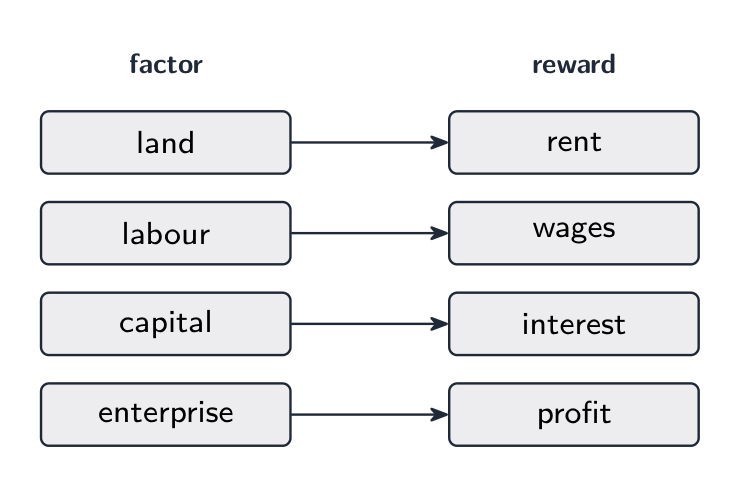
define land, labour, capital and enterprise and their rewards (rent, wages, interest, profit)
explain division of labour and specialisation and their advantages and disadvantages
explain the mobility of factors of production
עברית
הגדר אדמה, עבודה, הון ומארגנות והתגמולים שלהם (שכר הארץ, שכר עבודה, ריבית, רווח), ⟦number⟧
הסבר על חלוקת העבודה והתמחות ועל היתרונות והחסרונות שלהם, ⟦number⟧
הסבר על ניידות גורמי הייצור, ⟦number⟧
Source: Cambridge International syllabus · מקור: הסיילבוס הבינלאומי של קמבריד'ג'
English
The factors of production 生产要素 are the four kinds of resource used to make goods and services. Each one earns a reward 报酬.
Factor
What it is
Its reward
land 土地
natural resources (fields, water, oil, minerals)
rent 地租
labour 劳动
human work, both physical and mental
wages 工资
capital 资本
man-made things used to produce, like machines, tools and factories
interest 利息
enterprise 企业家才能
the skill of bringing the other three together and taking the risk
profit 利润
Land includes some non-renewable resources 不可再生资源 (like oil and coal) that can run out. Enterprise is supplied by the entrepreneur 企业家, the person who has the business idea and risks their own money.
Specialisation and division of labour
specialisation 专业化 is when a worker, firm or country makes only the things it is best at, then trades for the rest.
Inside a workplace, specialisation leads to the division of labour 劳动分工: a big job is split into small tasks, and each worker 工人 does one task again and again.
Advantages
Disadvantages
workers get faster and better at one task
doing one task is boring, so workers may quit
less time wasted moving between jobs
if one worker is absent, the whole line can stop
output per worker rises, so costs fall
workers learn only one narrow skill
Mobility of factors
mobility 流动性 means how easily a factor can move to a new use.
occupational mobility 职业流动性 — how easily a factor moves from one job or use to another. A teacher who retrains as a nurse is occupationally mobile.
geographical mobility 地理流动性 — how easily a factor moves from one place to another. Land cannot move at all, so it has no geographical mobility.
Labour is often not very mobile. Family ties, the cost of housing, and missing skills all make it hard for workers to move.
עברית
גורמי הייצור הם ארבעה סוגי משאבים המשמשים ליצירת סחורות ושירותים. כל אחד מהם מניב תמורה.
ארבעת גורמי ההפקה והתמורה שכל אחד מהם מרוויח
גורם
מה זה
התמורה שלו
אדמה
משאבים טבעיים (שדות, מים, נפט, מינרלים)
שכירות
עבודה
מאמץ אנושי, גם פיזי וגם מנטלי
שכר
הון
חפצים מעשה ידי אדם המשמשים לייצור, כמו מכונות, כלים ומפעלים
ריבית
יזמות
המיומנות להכנס את השלושה האחרים יחד ולקחת סיכון
רווח
לאדמה משויכים גם משאבים לא מתחדשים (כמו נפט ופחם) שעלולים להיסחר. את היזמות מספקת היזם, האדם שיש לו את הרעיון לעסק ומסיכן כסף משלו.
מכרה נחושת פתוח: אדמה כוללת את המשאבים הטבעיים (מינרלים, נפט, מים) שהחברות חושות.
התמחות וחלוקת עבודה
התמחות היא מצב שבו עובד, חברה או מדינה מייצרים רק את הדברים בהם הם הטובים ביותר, ולאחר מכן סוחרים על שאר המוצרים.
בתוך מקום העבודה, ההתמחות מובילה ל-חלוקת עבודה: משימה גדולה מחולקת למשימות קטנות, וכל עובד מבצע משימה אחת שוב ושוב.
יתרונות
חסרונות
עובדים הופכים מהירים וטובים יותר במשימה אחת
ביצוע משימה אחת משעמם, ולכן עובדים עשויים להתפטר
פחות זמן אבוד במעבר בין תפקידים
אם עובד אחד נעדר, כל הקו יכול להיעצר
התפוקה לעובד עולה, ולכן העלויות יורדות
עובדים לומדים רק כשרון צר ואחד
קו הרכבה של מכונית: הון (מכונות ורובוטים) בשילוב עם חלוקת עבודה, כאשר כל עובד חוזר על משימה אחת.
ניידות גורמים
ניידות מתייחסת לכך עד כמה גורם יכול לעבור בקלות לשימוש חדש.
ניידות מקצועית — עד כמה גורם יכול לעבור בקלות מ-תפקיד או שימוש אחד לאחר. מורה שנכנס לקורס הכשרה מחדש כדי להיות אחות הוא בעל ניידות מקצועית.
ניידות גיאוגרפית — עד כמה גורם יכול לעבור בקלות מ-מקום אחד לאחר. קרקע אינה יכולה לזוז כלל, ולכן אין לה ניידות גיאוגרפית.
כוח העבודה לעיתים אינו מאוד נייד. קשרי משפחה, עלות דיור והיעדר כישורים כולם הופכים עבור עובדים את מעברם לקשה.
Explore · חקור
Factors of production lab · מעבדת גורמי ייצור
Sort real resources by the factor of production they represent. · מיינו את המשאבים האמיתיים לפי גורם הייצור ש הם מייצגים.
explain how resources are allocated in market, planned and mixed economic systems
explain the role of the price mechanism (signalling, incentive, rationing) in allocating resources
evaluate the advantages and disadvantages of each system
עברית
הסבר כיצד מוקצים משאבים במערכות כלכליות של שוק, תכנון ומעורבת, ⟦number⟧
הסבר על תפקיד מנגנון המחיר (הודעה, הזרקה, הקצאה) בהקצאת משאבים, ⟦number⟧
הערכת יתרונות וחסרונות של כל מערכת, ⟦number⟧
Source: Cambridge International syllabus · מקור: הסיילבוס הבינלאומי של קמבריד'ג'
English
An economic system is the way a country decides how to allocate 配置 (share out) its scarce resources. There are three types.
a market economy 市场经济 — firms and people own resources, and prices decide what is made. The government does little.
a planned economy 计划经济 (also called a command economy 指令经济) — the government owns resources and decides what is made, how, and for whom.
a mixed economy 混合经济 — a blend of the two. The private sector 私营部门 (firms and households) and the public sector 公共部门 (the government) both make decisions. Almost every real country is mixed.
The price mechanism
In a market economy, resources are guided by the price mechanism 价格机制. Prices do three jobs:
signalling 信号传递 — a price tells buyers and sellers where resources are wanted. A rising price says "this is wanted — make more".
incentive 激励 — a higher price rewards producers, so they want to supply more of that good.
rationing 配给 — when a good is scarce, a higher price shares it out to those who are willing and able to pay.
Comparing the systems
System
Strengths
Weaknesses
market
choice, low prices, strong incentive to work and invent
large gap between rich and poor; some goods not supplied
planned
smaller gap between rich and poor; key goods provided for all
weak incentive; shortages and surpluses; slow to change
mixed
tries to keep the good points of both
the right balance is hard to find
In practice no country sits at a pure extreme. China's economy, for instance, is officially a socialist market economy, where markets set most prices while the government guides key sectors and owns major enterprises. Every real system mixes the two and sits somewhere on the spectrum below.
עברית
מערכת כלכלית היא הדרך שבה מדימה מחליטה כיצד להקצות (לחלק) את המשאבים הנדירים שלה. ישנם שלושה סוגים.
כלכלת שוק — חברות ואנשים בבעלות משאבים, והמחירים קובעים מה מיוצר. הממשלה פועלת באופן מינימלי.
כלכלת תכנון (נקראת גם כלכלת פיקוד) — הממשלה בבעלות המשאבים ומחליטה מה מיוצר, איך, ומי.
כלכלת מעורבת — שילוב של השניים. המגזר הפרטי (חברות ובתי משפחה) והמגזר הציבורי (הממשלה) שניהם קובעים החלטות. כמעט כל מדימה אמיתית היא מעורבת.
מכניזם המחיר
בכלכלת שוק, המשאבים מופעלים על ידי מנגנון המחירים. למחירים יש שלוש פונקציות:
סימון — מחיר מעיד לקונים ולמוכרים היכן נדרשים משאבים. עליית מחיר אומרת "דרישה לכך — ייצרו יותר".
הנעה — מחיר גבוה עושה ריגול למוצרים, ולכן הם רוצים לספק יותר מהמוצר הזה.
חלוקה — כאשר מוצר מוגבל, מחיר גבוה מחלק אותו לאלו המוכנים ויכולים לשלם עליו.
בשוק, המחיר מבצע שלוש פונקציות בו-זמנית: הוא מסמן, מעניק הנעה ומחלק את המוצר המוגבל
השוואת מערכות
מערכת
יתרונות
חסרונות
שוק
בחירה, מחירים נמוכים, הנעה חזקה לעבודה ולהמצאה
פערים גדולים בין עשירים לעניים; חוסר אספקה של מוצרים מסוימים
תכנון
פערים קטנים יותר בין עשירים לעניים; אספקת מוצרים מרכזיים לכל האוכלוסייה
הנעה חלשה; מחסור ועודפים; איטות בשינוי
מעורבת
מנסה לשמור על היתרונות של שתי המערכות
קשה למצוא את האיזון הנכון
במעשה, אין אף מדינה בשוליים הטהורים. כלכלת סין, לדוגמה, היא באופן רשמי כלכלת שוק סוציאליסטית, בה שוק קובע את רוב המחירים בעוד שהממשלה מדריכה תחומים מרכזיים ובעלת בתי-חרושת גדולים. כל מערכת אמיתית מערבבת את שתי העקרונות ושוכנת במקום כלשהו בספקטרום למטה.
מערכות כלכליות יוצרות ספקטרום: שוק טהור בקצה אחד, תכנון ממשלתי מלא בקצה השני, וכלכלות מעורבות באמצע.
Production possibility curves · עקומי אפשרויות ייצור
Syllabus · סיילבוס
English
draw and interpret PPCs to show opportunity cost, scarcity, choice and efficiency
explain movements along and shifts of the PPC and constant versus increasing opportunity cost
relate the PPC to economic growth and the allocation between capital and consumer goods
עברית
ציור ופרשנות של PPCs להדגמת עלות הזדמנות, מחסור, בחירה ויעילות, ⟦number⟧
הסבר על תנועות לאורך ומעברים של ה-PPC ועלות הזדמנות קבועה לעומת עולה, ⟦number⟧
קשר בין ה-PPC לבין צמיחה כלכלית ובין הון לסחורות צריכה, ⟦number
Source: Cambridge International syllabus · מקור: הסיילבוס הבינלאומי של קמבריד'ג'
English
The PPF and opportunity cost
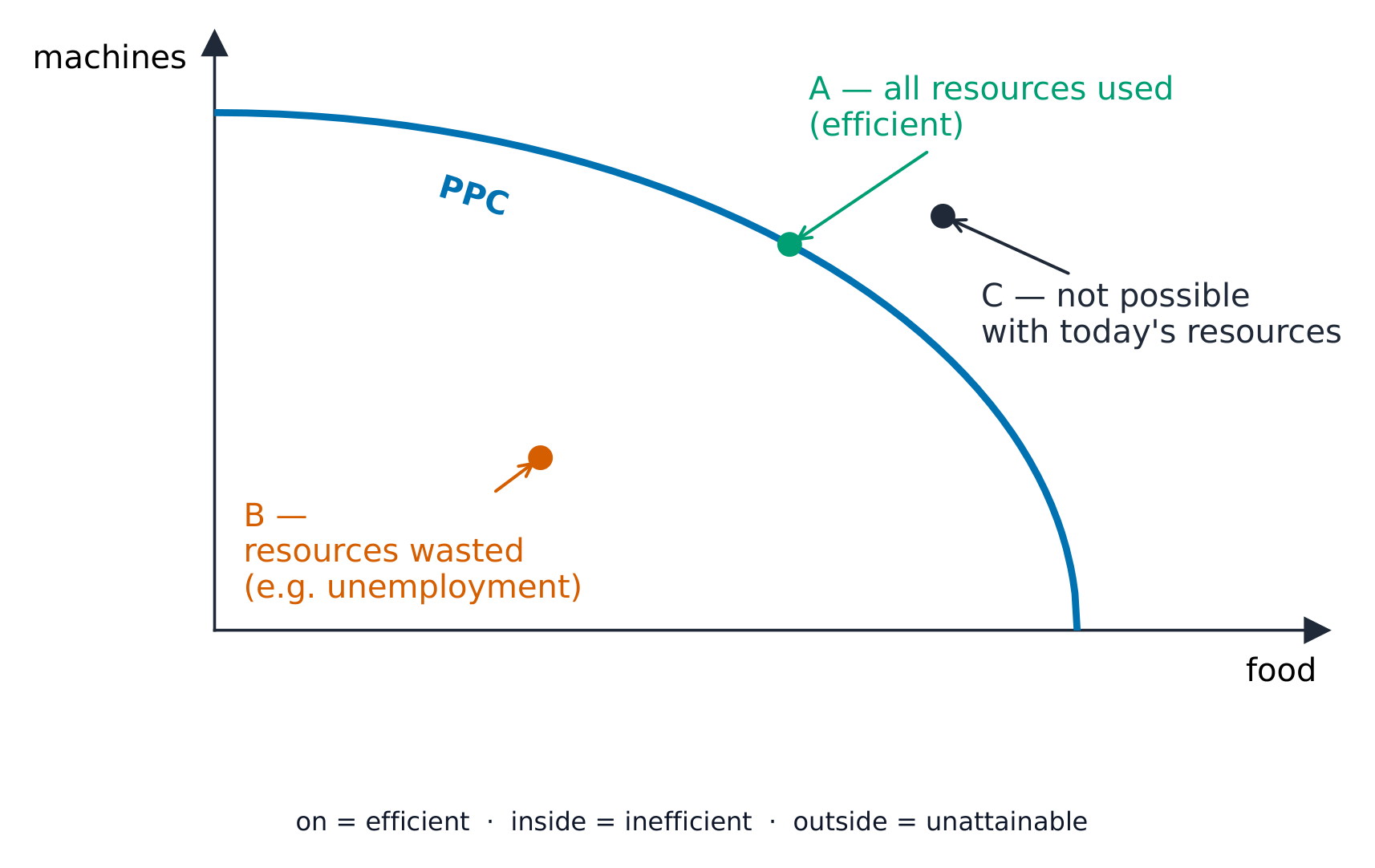
A production possibility curve 生产可能性曲线 (PPC) is a line showing the largest combinations of two goods an economy can make when all its resources are fully and well used.
Imagine an economy that makes only food and machines. The PPC is drawn with food on one axis and machines on the other.
a point on the curve: all resources are used with full efficiency 效率.
a point inside the curve: resources are wasted (for example, unemployment 失业 of workers). The economy could do better.
a point outside the curve: impossible today, because there are not enough resources. This shows scarcity.
Moving along the curve shows opportunity cost: to make more food, you must move resources away from machines, so you make fewer machines. This is the trade-off 取舍 between the two goods.
The shape of the curve shows how opportunity cost behaves:
a straight-line PPC means constant opportunity cost — each extra unit of food costs the same number of machines.
a curve that bows outwards means increasing opportunity cost — each extra unit of food costs more and more machines, because resources are not equally good at making both goods.
Shifts and growth
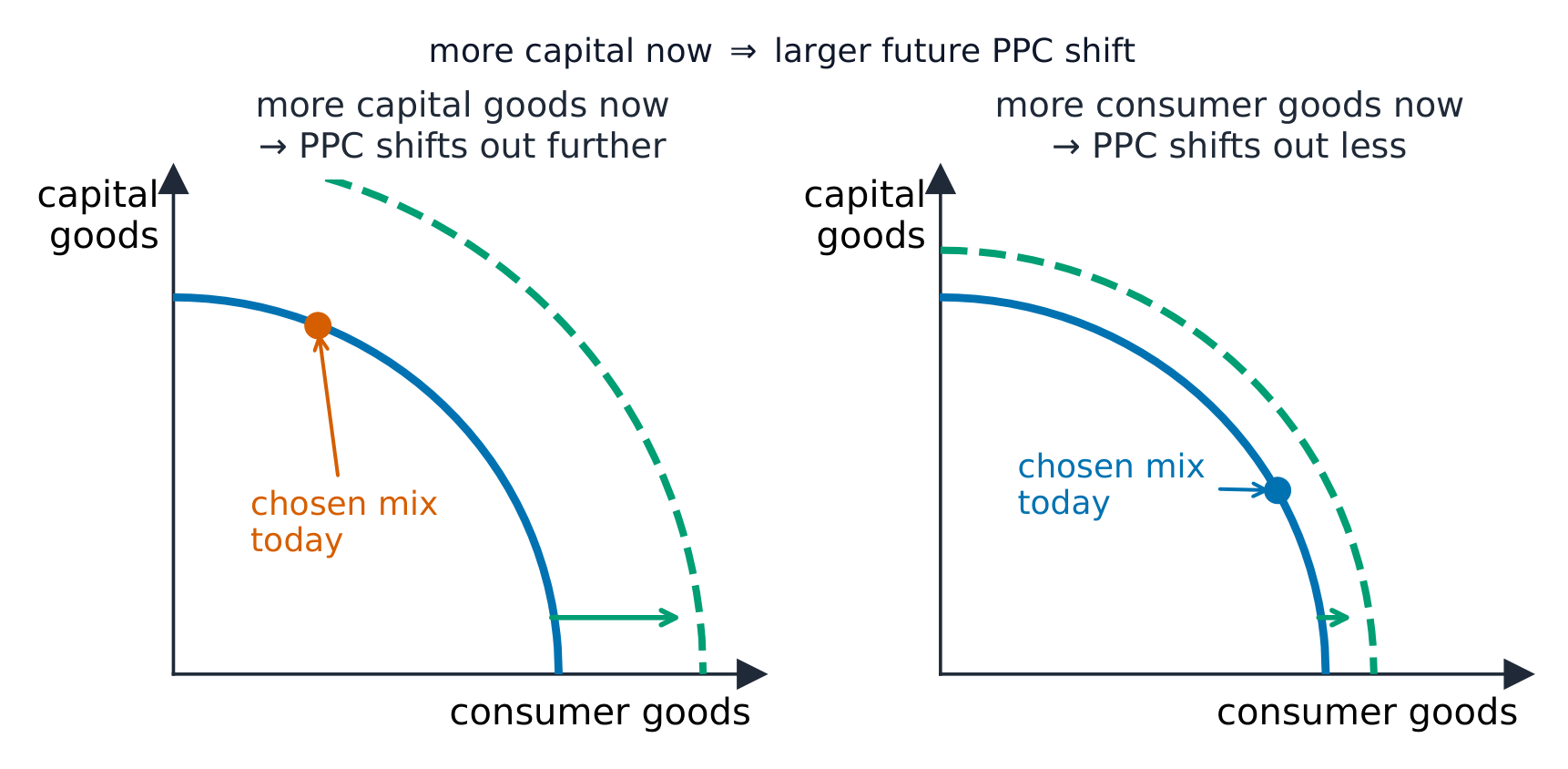
When the PPC moves outward (to the right), the economy can make more of both goods. This is economic growth 经济增长. It happens when there are more resources, or better ones (new technology 技术, a bigger or more skilled workforce). War or disaster can move the PPC inward — this is economic decline 经济衰退.
A country must also choose between two kinds of good now:
capital goods 资本品 — goods used to make other goods (machines, factories).
consumer goods 消费品 — goods people use directly (food, clothes).
Making more capital goods today means fewer consumer goods today. But more capital goods help the economy grow faster, so the PPC shifts out by more in the future.
Worked example. Why is a production possibility curve usually drawn concave (bowed outwards) rather than as a straight line? A straight line would mean the opportunity cost of each extra unit stays constant. The curve bows out because factors of production are not perfectly substitutable - they are specialised. Starting from all-food production, the first factors moved into making cars are the ones least suited to farming, so very little food is given up for a lot of cars. Keep going and you must move factors that are increasingly good at farming and increasingly bad at making cars, so each extra car costs more and more food. That rising cost is increasing opportunity cost, and the bowed shape is simply its picture. A straight-line PPC is not wrong - it just assumes factors are perfectly substitutable, and naming that assumption is what earns the mark.
עברית
PPF והעלות ההקפנית
עקום אפשרויות ייצור (PPC) הוא קו המציג את הקומבינציות הגדולות ביותר של שני מוצרים שאפשר ליצר בכלכלה כשהמשאבים שלה מועסקים במלואם וביעילות.
דמיינו כלכלה שמייצרת רק מזון ומכונות. ה-PPC מצויר כאשר המזון הוא ציר אחד והמכונות הן הציר השני.
נקודה על העקום: כל המשאבים מועסקים ביעילות מלאה.
נקודה בתוך העקומה: משאבים מושחתים (למשל, אבטלה של עובדים). האוכלוסייה הייתה יכולה להצליח יותר.
נקודה מחוץ לעקומה: בלתי אפשרי היום, מכיוון שאין מספיק משאבים. הדבר ממחיש מחסור.
נקודה על העקומה משתמשת בכל המשאבים (יעילות); נקודה בתוך העקומה מציינת השחתה, כגון אבטלה; נקודה מחוץ לעקומה אינה אפשרית עדיין.
הזזה לאורך העקומה מראה עלות הזדמנות: כדי לייצר יותר מזון, יש להעביר משאבים מהייצור של מכונות, ולכן ייוצרו פחות מכונות. זהו ה-היתרונות בין שני המוצרים.
הצורה של העקומה מראה כיצד מתנהגת עלות ההזדמנות:
PPC בקו ישר מציין עלות הזדמנות קבועה — כל יחידה נוספת של מזון עולה באותו מספר מכונות.
עקומה שעקומה החוצה מציין עלות הזדמנות עולה — כל יחידה נוספת של מזון עולה越来越更多 מכונות, מכיוון שהמשאבים אינם שווים ביכולתם לייצר את שני המוצרים.
PPC בקו ישר מציין שכל יחידה נוספת של מזון עולה אותו דבר; PPC שעקום מציין שכל יחידה נוספת עולה越来越更多 מכונות.
שינויים וגידול
כשה-PPC זז החוצה (מימינה), האוכלוסייה יכולה לייצר יותר משני המוצרים. זהו גידול כלכלי. הוא מתרחש כאשר ישנם יותר משאבים, או טובים יותר (טכנולוגיה חדשה, כוח עבודה גדול יותר או בעל מיומנויות גבוהות יותר). מלחמה או אסון יכולים להזיז את ה-PPC פנימה — זהו ירידה כלכלית.
יותר משאבים או משאבים טובים יותר מזיזים את כל ה-PPC החוצה (גידול); מלחמה או אסון מזיזים אותו פנימה (ירידה).
מדינה חייבת לבחור גם בין שני סוגי מוצרים כעת:
מוצרי הון — מוצרים המשמשים ליצירת מוצרים אחרים (מכונות, מפעלים).
מוצרי צריכה — מוצרים שאנשים משתמשים בהם ישירות (מזון, בגדים).
ייצור יותר מוצרי הון היום פירושו פחות מוצרי צריכה היום. אך יותר מוצרי הון עוזרים לאוכלוסייה לגדול מהר יותר, ולכן ה-PPC יזוז החוצה יותר בעתיד.
בחירה במוצרי הון יותר היום פירושו פחות מוצרי צריכה עכשיו, אך ה-PPC העתידי יזוז החוצה יותר.
דוגמה פתורה. מדוע קשת אפשרויות הייצור מצוירת בדרך כלל קעורה (בולטת החוצה) ולא כקו ישר? קו ישר היה אומר שעלות ההזדמנות של כל יחידה נוספת נשארת קבועה. הקשת בולטת החוצה כי גורמי הייצור אינם תחליפים מושלמים - הם מיוחדים. בהתחלה מייצרים רק מזון, הגורמים הראשונים שנעברים לייצור מכוניות הם אלו הכי פחות מתאימים לחקלאות, ולכן מוותרים על מעט מאוד מזון כדי לקבל הרבה מכוניות. המשך לכך וחייבים להעביר גורמים שהולכים ומתאימים יותר לחקלאות ופחות לייצור מכוניות, ולכן כל מכונית נוספת עולה יותר ויותר מזון. עלייה זו בעלות היא עלות הזדמנות עולה, והצורה הבולטת היא פשוט הדמיה שלה. PPC קו ישר אינו שגוי - הוא פשוט מניח שגורמים הם תחליפים מושלמים, ושם הנחה זו הוא מה שמביא נקודה.
Explore · חקור
The production possibility frontier · קו האפשרויות הייצור
Producing more of one good means giving up some of the other — that trade-off is the opportunity cost, shown by the slope of the frontier. · ייצור יותר של מוצר אחד פירונו ויתור על חלק ממוצר אחר — הפיצוי הזה הוא עלות הזדמנות, המוצג על ידי השיפוע של קו האפשרויות.
Explore · חקור
Allocating scarce resources · הקצאת משאבים דלים
An economy can't have more of everything: making more of one good means giving up some of another — the frontier's slope is that opportunity cost. · כלכלה לא יכולה להפיק יותר מכל דבר: ייצור יותר של סחורה אחת פירונו ויתור על חלק מסחורה אחרת — שיפוע הגבול הוא ערך ההזדמנות.
Explore · חקור
The production possibility curve · עקום אפשרויות הייצור
Move along the curve. Producing more of one good means producing less of the other — the curve shows opportunity cost and scarcity. · תנוע לאורך העקומה. ייצור יותר של מוצר אחד פירושה ייצור פחות של האחר — העקומה מראה עלות הזדמנות ומחסור.
Types of goods and services · סוגי סחורות ושירותים
Syllabus · סיילבוס
English
distinguish free goods and economic (private) goods
explain the characteristics of public goods (non-rivalry, non-excludability) and the free-rider problem
explain merit and demerit goods and the role of information and value judgements
עברית
הבדלה בין סחורות חינמיות וסחורות כלכליות (פרטיות), ⟦number⟧
הסבר על מאפייני סחורות ציבוריות (אי-תחרותיות, אי-השלכה) ובעיית המשתמש החופשי, ⟦number⟧
הסבר על סחורות פנאי וסחורות פגיעות ותפקיד המידע וההערכות הערכיות, ⟦number⟧
Source: Cambridge International syllabus · מקור: הסיילבוס הבינלאומי של קמבריד'ג'
English
Free goods and economic goods
a free good 免费物品 has no opportunity cost. Its supply is unlimited, so it has no price (for example, air or sunlight).
an economic good 经济物品 (also called a private good 私人物品) is scarce. Making it has an opportunity cost, so it has a price.
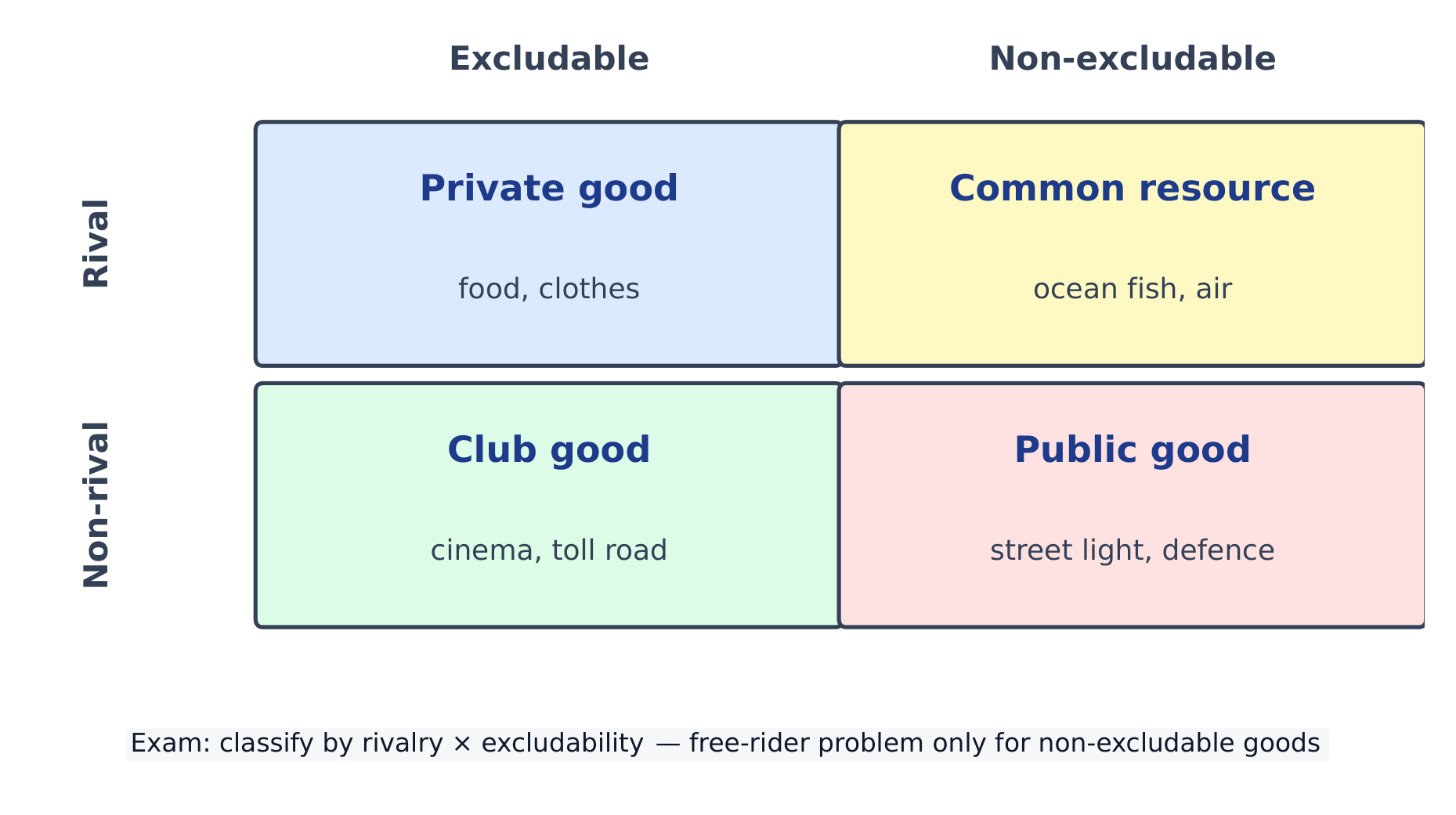
A private good has two features. It has rivalry 竞争性 (if I eat the apple, you cannot) and excludability 排他性 (the seller can stop you using it unless you pay).
Public goods
A public good 公共物品 is the opposite of a private good. It has two features:
non-rivalry 非竞争性 — one person using it does not reduce the amount left for others.
non-excludability 非排他性 — you cannot stop people who do not pay from using it.
Because of non-excludability, public goods suffer from the free-rider problem 搭便车问题: people enjoy the good without paying for it. So private firms cannot make a profit and will not supply it. The government must provide public goods instead — for example, street lighting and national defence 国防.
Merit and demerit goods
a merit good 优值品 is better for you (and for society) than you realise, so people buy too little of it. Examples: education and health care.
a demerit good 劣值品 is worse for you than you realise, so people buy too much of it. Examples: cigarettes and alcohol.
People misjudge these goods because of information failure 信息失灵 — they do not have, or do not use, the full facts about the benefit or harm.
Deciding what counts as a merit or demerit good is partly a value judgement, so people may disagree about which goods belong on each list.
עברית
סחורות חופשיות וסחורות כלכליות
סחורה חופשית אינה כרוכה בעלות הזדמנות. אספקתה אינסופית, ולכן אין לה מחיר (למשל, אוויר או אור שמש).
סחורה כלכלית (הנקראת גם סחורה פרטית) היא נדירה. יצירתה כרוכה בעלות הזדמנות, ולכן יש לה מחיר.
לסחורה פרטית יש שני מאפיינים. יש לה ריווליות (אם אני אוכל את התפוח, אתה לא תוכל) והפרדה (המוכר יכול למנוע ממך להשתמש בה אלא אם כן תשלם).
סחורה חופשית אין לה עלות הזדמנות ואין לה מחיר; סחורה כלכלית היא נדירה, ריוולית והפרדנית
סחורות ציבוריות
סחורה ציבורית היא ההפך מסחורה פרטית. יש לה שני מאפיינים:
אי-ריווליות – שימוש של אדם אחד בה לא מפחית את הכמות שנשארת לאחרים.
אי-הפרדה – אי אפשר למנוע מאנשים שלא משלמים להשתמש בה.
בגלל אי-הפרדה, סחורות ציבוריות סובלות מבעיית הרכבת החינם: אנשים נהנים מהסחורה ללא תשלום. לכן, חברות פרטיות לא יכולות להשיג רווח ולא יספקו אותה. הממשלה חייבת לספק סחורות ציבוריות במקום זאת – למשל, תאורת רחוב והגנה לאומית.
ריווליות והפרדה נותנות ארבעה סוגי סחורות: פרטית, מועדון, משאבים משותפים, וציבורית.
סחורות זכותיות וסחורות פסולתיות
סחורה זכותית טובה יותר עבורך (ועבור החברה) ממה שאתה מביט, כך שאנשים קונים מעט מדי ממנה. דוגמאות: חינוך וטיפול רפואי.
סחורה פסולתית רעה יותר עבורך ממה שאתה מביט, כך שאנשים קונים מעט מדי ממנה. דוגמאות: סיגריות ואלכוהול.
חינוך הוא סחורה זכותית קלאסית. הערך המלא שלה – תעסוקה טובה יותר וחברה מיומנת יותר – קל להעריך באופן שגוי, ולכן השארת עצמם אנשים קונים פחות ממנה ממה שהוא טוב עבורם או עבור המדינה. זהו הסיבה שהממשלות מספקות אותו ומסבסדות אותו
אנשים שוגים בהערכתם של סחורות אלו בשל כשל מידע — אין להם, או שהם אינם משתמשים, במידע המלא לגבי היתרון או הנזק.
החלטה על מה נחשב לסחורת יתרה או פגם היא חלקית שיפוט ערכי, ולכן אנשים עשויים להתחלוק בדעתם regarding איזה סחורות שייכות לכל רשימה.
Explore · חקור
Goods and services lab · מעבדת סחורות ושירותים
Classify examples by rivalry, excludability or whether they are services. · סווגו דוגמאות לפי התחרותיות, יכולת שילוח או אם מדובר בשירותים.
explain the determinants of demand and supply and distinguish movements along from shifts of the curves
derive individual and market demand and supply
explain the relationship between marginal utility and the demand curve
עברית
הסבר הגורמים המכתיבים את הביקוש ואת ההיצע, והבחנה בין תנועה לאורך העקומות לבין הזזתן
נגזור ביקוש והיצע פרטיים ושוקיים
הסבר הקשר בין תועלת שולית לבין עקום הביקוש
Source: Cambridge International syllabus · מקור: הסיילבוס הבינלאומי של קמבריד'ג'
English
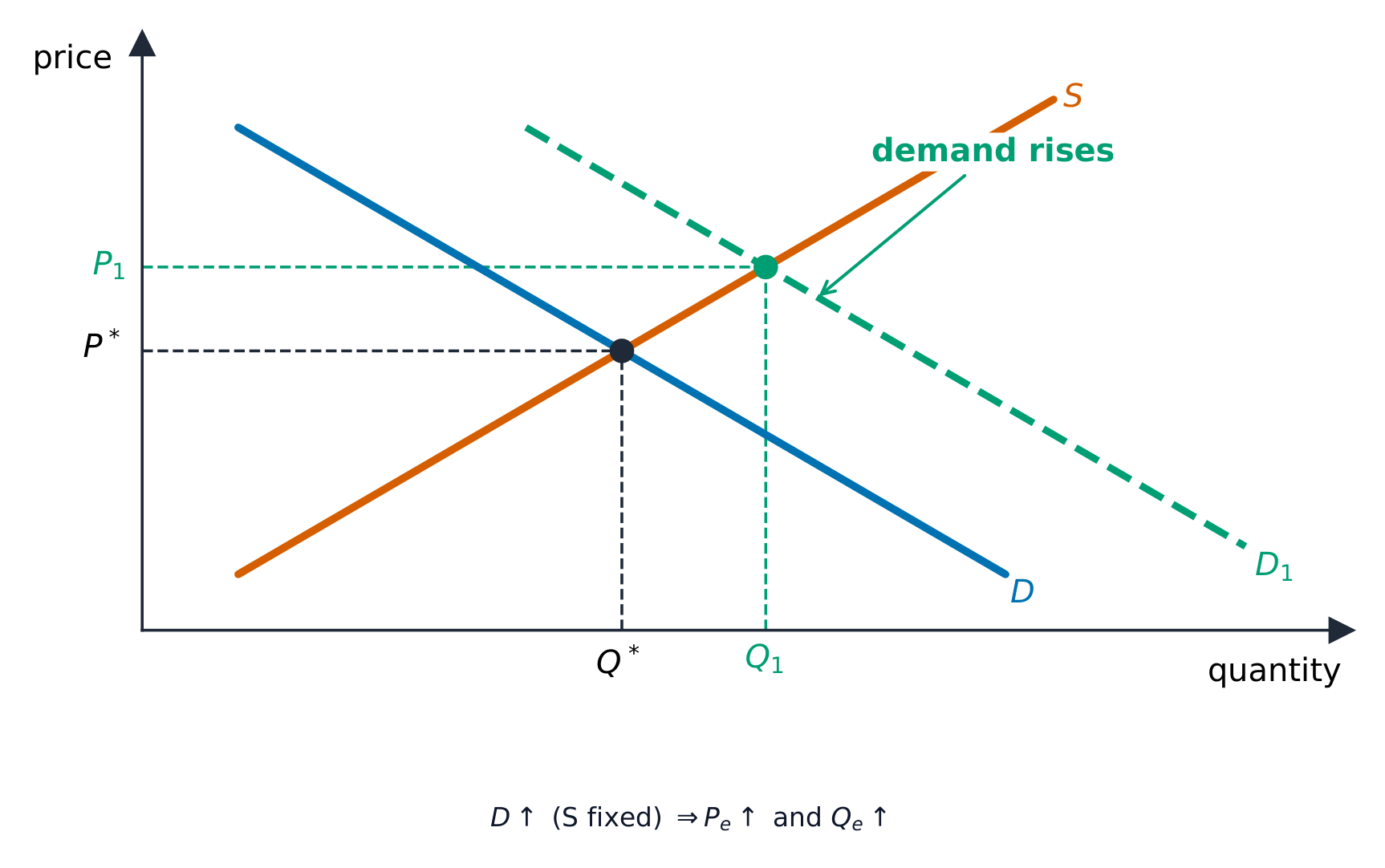
Demand shifts right: P and Q rise
demand 需求 is the quantity of a good that buyers are willing and able to buy at each price 价格 in a period of time. It is not just a wish — buyers must also be able to pay.
The law of demand says: when the price rises, the quantity demanded 需求量 falls; when the price falls, the quantity demanded rises. Price and quantity move in opposite directions.
So the demand curve 需求曲线 slopes downward, from top-left to bottom-right.
What shifts the demand curve
A change in the good's own price is shown as a movement along the demand curve. A change in any other cause shifts the whole curve to a new position — this is a shift 移动 of demand. The main causes (the determinants 决定因素) are:
income 收入 — for most goods, higher income raises demand.
the price of a substitute 替代品 — a good you can use instead (tea for coffee). If the substitute's price rises, demand for this good rises.
the price of a complement 互补品 — a good used together with this one (cars and petrol). If the complement's price rises, demand for this good falls.
tastes and fashion, the size of the population, and advertising.
Individual and market demand
One consumer 消费者 has an individual demand. The market demand 市场需求 is found by adding up the quantity that all consumers want at each price (adding the curves sideways).
Marginal utility and demand
utility 效用 is the satisfaction you get from consuming a good. marginal utility 边际效用 is the extra utility from one more unit.
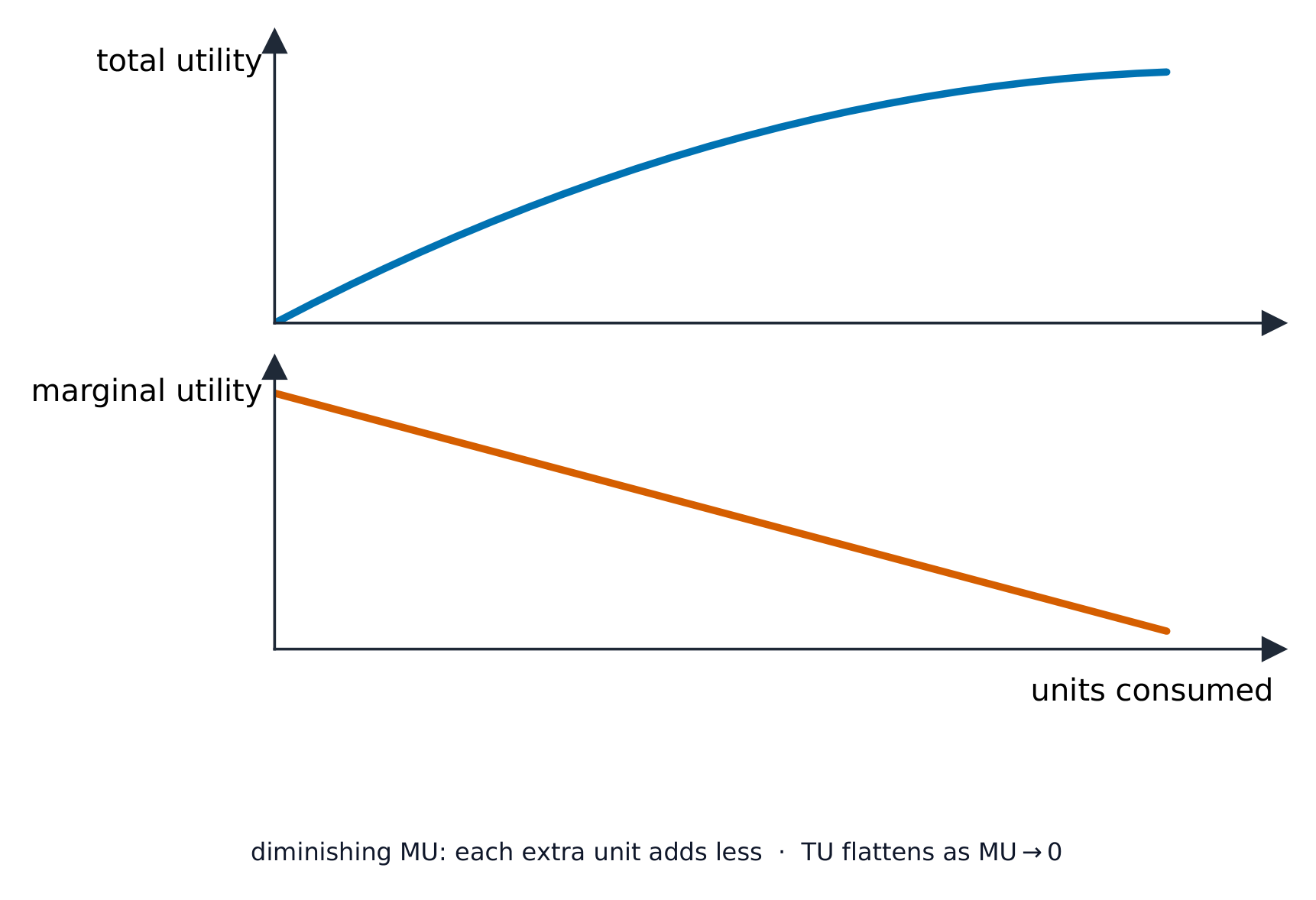
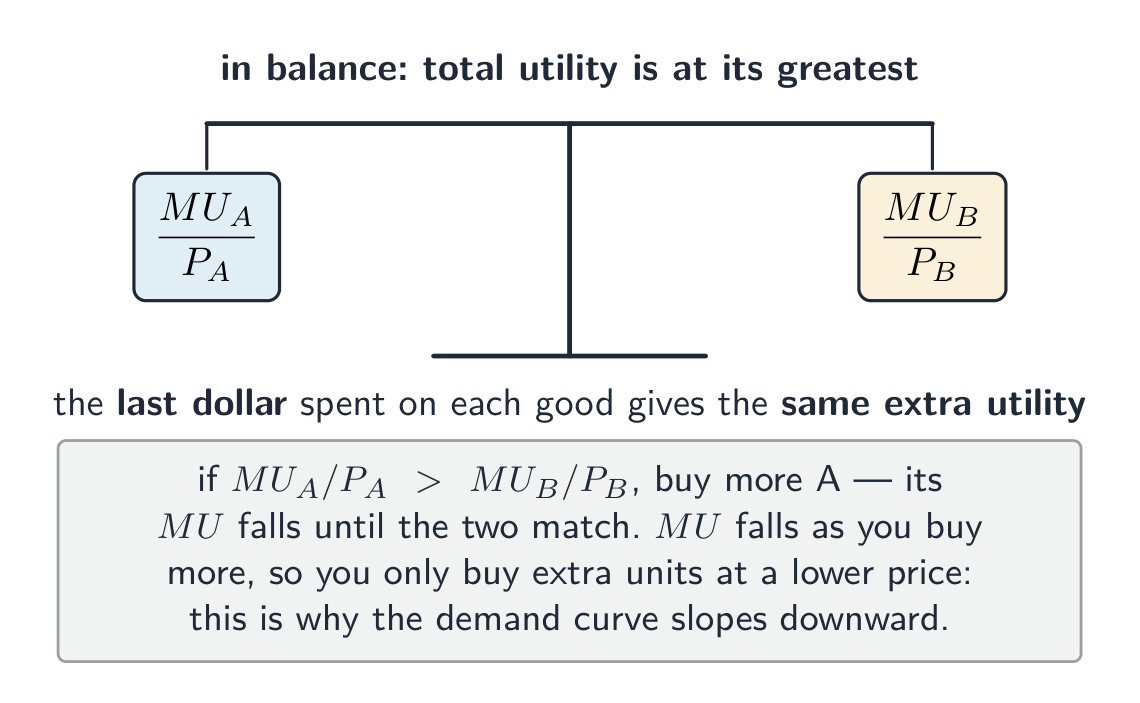
The law of diminishing marginal utility 边际效用递减 says each extra unit gives less extra satisfaction than the one before. Because later units are worth less to you, you will only buy them at a lower price. This is why the demand curve slopes downward.
עברית
הזזה של הביקוש ימינה: P ו-Q עולים
ביקוש הוא הכמות של סחורה שקונים מוכנים ויכולים לקנות בכל מחיר בתקופה נתונה. זו לא רק משאלה — הקונים גם צריכים להיות מסוגלים לשלם.
חוק הביקוש אומר: כאשר המחיר עולה, כמות הביקוש יורדת; כאשר המחיר יורד, כמות הביקוש עולה. המחיר והכמות זזים בכיוונים הפוכים.
לכן עקומת הביקוש בעלת נטייה יורדת, מפינה שמאלית-עליונה לימינה-תחתונה.
מה מזז את עקומת הביקוש
שינוי ב-מחיר עצמי של הסחורה מוצג כ-תנועה לאורך עקומת הביקוש. שינוי בכל גורם אחר מזיז את כל העקומה למיקום חדש — זהו שינוי בביקוש. הגורמים העיקריים (המכשירים) הם:
הכנסה — ברוב המקרים, הכנסה גבוהה מעלה את הביקוש.
המחיר של טוב جایز — טוב שתוכל להשתמש במקום (תה במקום קפה). אם המחיר של הטוב החלופי עולה, הביקוש לסחורה זו עולה.
המחיר של טוב משלים — טוב המשמש יחד עם זה (מכוניות ובנזין). אם המחיר של הטוב המשלים עולה, הביקוש לסחורה זו יורד.
טעמים ואופנה, גודל האוכלוסיה, ופרסום.
שינוי בהכנסה, טעמים או מחירים רלוונטיים מזיז את כל העקומה ($D_1$ ימינה, $D_2$ שמאלה); שינוי במחיר עצמי של הסחורה הוא תנועה לאורך העקומה.
ביקוש פרטי ושוקי
לצרכן אחד יש ביקוש פרטי. הביקוש השוקי נמצא על ידי סיכום הכמות שכל הצרכנים רוצים בכל מחיר (סיכום העקומות בצדדים).
תועלת שולית וביקוש
תועלת היא השביעות שמקבלים מצריכת סחורה. תועלת שולית היא התועלת הנוספת שמקבלים מרכישה של יחידה נוספת.
חוק התועלת השולית הפוחתת קובע שכל יחידה נוספת מספקת פחות שביעות מהיחידה שקדמה לה. מכיוון שבערך היחידות הבאות נמוך יותר עבורכם, תקנו אותן רק במחיר נמוך יותר. זוהי הסיבה לכיוון המורד של עקומת הביקוש.
כל יחידה נוספת מוסיפה פחות שביעות מהקודמת – ולכן קונים יוכנים לשלם פחות על יחידות מאוחרות יותר, דבר הגורם לעקומת הביקוש להיות בעלת שיפוע מורד
Explore · חקור
Demand & supply · ביקוש והיצע
Demand slopes down — a lower price, more is wanted. · ביקוש יורד — מחיר נמוך יותר, נדרשת כמות גדולה יותר.
supply 供给 is the quantity of a good that producers 生产者 are willing and able to sell at each price in a period of time.
The law of supply says: when the price rises, the quantity supplied 供给量 rises. Higher prices mean more profit 利润, so firms make more. So the supply curve 供给曲线 slopes upward.
What shifts the supply curve
A change in the good's own price is a movement along the supply curve. Other causes shift the whole curve:
costs of production 生产成本 — if wages, raw materials or rent get dearer, supply falls.
technology — better machines raise supply.
a subsidy 补贴 (government payment to producers) raises supply; an indirect tax lowers it.
the number of firms 企业 in the market, and weather (for farm goods).
Individual and market supply
The market supply 市场供给 is found by adding up the quantity all firms will sell at each price.
עברית
אספקה היא כמות הסחורה שהמייצרים מעוניינים ויכולים למכור בכל מחיר בתקופת זמן נתונה.
חוק האספקה קובע: כאשר המחיר עולה, הכמות המוצעת עולה. מחירים גבוהים משמעים רווח גדול יותר, ולכן חברות מייצרות יותר. לכן עקומת האספקה נוטה כלפי מעלה.
מה מזז את עקומת האספקה
שינוי במחירה של הסחורה עצמה גורם לתנועה לאורך עקומת האספקה. גורמים אחרים מזיזים את העקומה כולה:
עלויות ייצור — אם שכר, חומרי גלם או השכירות הופכים לבוהים, האספקה יורדת.
טכנולוגיה — מכשירים טובים מעלים את האספקה.
סבסוד (תשלום ממשלתי למייצרים) מעלה את האספקה; מיסוי עקיף מוריד אותו.
מספר החברות בשוק, ומזג האוויר (למוצרים חקלאיים).
עלויות נמוכות יותר, טכנולוגיה טובה יותר או סבסוד מזיזים את האספקה ימינה ($S_1$); עלויות גבוהות יותר או מיסוי מזיזים אותה שמאלה ($S_2$).
אספקה אישית ואספקת שוק
אספקת השוק נמצאת על ידי סיכום הכמות שכל החברות ימכרו בכל מחיר.
Explore · חקור
Demand & supply · ביקוש והיצע
Supply slopes up — a higher price, more is produced. · היצע נוטה לעלה — מחיר גבוה יותר, יותר מיוצר.
2.2
Price elasticity of demand · אלסטיות מחיר בביקוש
Syllabus · סיילבוס
English
define, calculate and interpret price elasticity of demand (PED), income elasticity (YED) and cross elasticity (XED)
explain the determinants of each and the relationship between PED and total revenue/expenditure
explain the usefulness of elasticities to firms and government
הסבר הגורמים המכתיבים כל אחד מהם, והקשר בין PED להכנסה כוללת/הוצאה
הסבר השימושיות של האלסטיות לחברות ולממשלה
Source: Cambridge International syllabus · מקור: הסיילבוס הבינלאומי של קמבריד'ג'
English
Supply shifts right: P falls, Q rises
price elasticity of demand 需求价格弹性 (PED) measures how much the quantity demanded responds when the price changes.
$$\text{PED} = \frac{\%\ \text{change in quantity demanded}}{\%\ \text{change in price}}$$
PED is normally negative (because of the law of demand), but we usually look at the size and drop the minus sign.
Worked example. The price of a good rises by 10% and the quantity demanded falls by 25%. Find the PED and classify the demand.
$$\text{PED} = \frac{-25}{10} = -2.5$$
Ignoring the minus sign, $2.5 > 1$, so demand is elastic — quantity responded much more than the price did.
Value
Name
Meaning
more than 1
elastic 富有弹性
quantity responds a lot
less than 1
inelastic 缺乏弹性
quantity responds a little
equal to 1
unit elastic 单位弹性
quantity changes by the same % as price
0
perfectly inelastic 完全无弹性
quantity does not change at all
infinity
perfectly elastic 完全有弹性
any price rise sends demand to zero
What makes demand elastic or inelastic
the number and closeness of substitutes (more substitutes → more elastic).
whether the good is a necessity 必需品 (inelastic) or a luxury 奢侈品 (elastic).
the share of income spent on the good (a large share → more elastic).
time — demand is more elastic in the long run, when buyers can find other options.
habit or addiction makes demand inelastic.
PED and total revenue
total revenue 总收益 is the money a firm earns: $\text{TR} = \text{price} \times \text{quantity}$. PED tells a firm what happens to revenue when it changes the price:
If demand is…
price rises
price falls
inelastic
total revenue rises
total revenue falls
elastic
total revenue falls
total revenue rises
unit elastic
total revenue stays the same
total revenue stays the same
This is useful to firms (how to price for more revenue) and to governments 政府 (a tax on an inelastic good, like petrol, raises a lot of revenue without cutting sales much).
עברית
העברת ה offers ימינה: P יורד, Q עולה
אלסטיות מחיר בביקוש (PED) מודדת עד כמה כמות הביקוש מגיבה לשינוי במחיר.
$$\text{PED} = \frac{\%\ \text{change in quantity demanded}}{\%\ \text{change in price}}$$
PED היא בדרך כלל שלילית (בגלל חוק הביקוש), אך אנו נוטים להסתכל על הגודל ולהתעלם מהסימן השלילי.
דוגמה פותרת. המחיר של סחרה עולה ב-10% והכמות המבוקשת יורדת ב-25%. מצאו את ה-PED וסווגו את הביקוש.
$$\text{PED} = \frac{-25}{10} = -2.5$$
ללא סימן השלילי, $2.5 > 1$, ולכן הביקוש אלסטי — הכמות הגיבה הרבה יותר מאשר המחיר.
לדלק יש ביקוש אלסטי למחיר: נהגים חייבים לקנות אותו, ולכן מחיר גבוה מקצר את הכמות הנקנית מעט.
ערך
שם
משמעות
יותר מ-1
אלסטי
הכמות מגיבה הרבה
פחות מ-1
אינאלסטי
הכמות מגיבה מעט
שווה ל-1
אלסטיות יחידה
הכמות משתנה באותה אחוז בדיוק כמו המחיר
0
אינאלסטיות מוחלטת
הכמות אינה משתנה כלל
אינסוף
אלסטיות מוחלטת
כל עליית מחיר מובילה לביקוש אפס
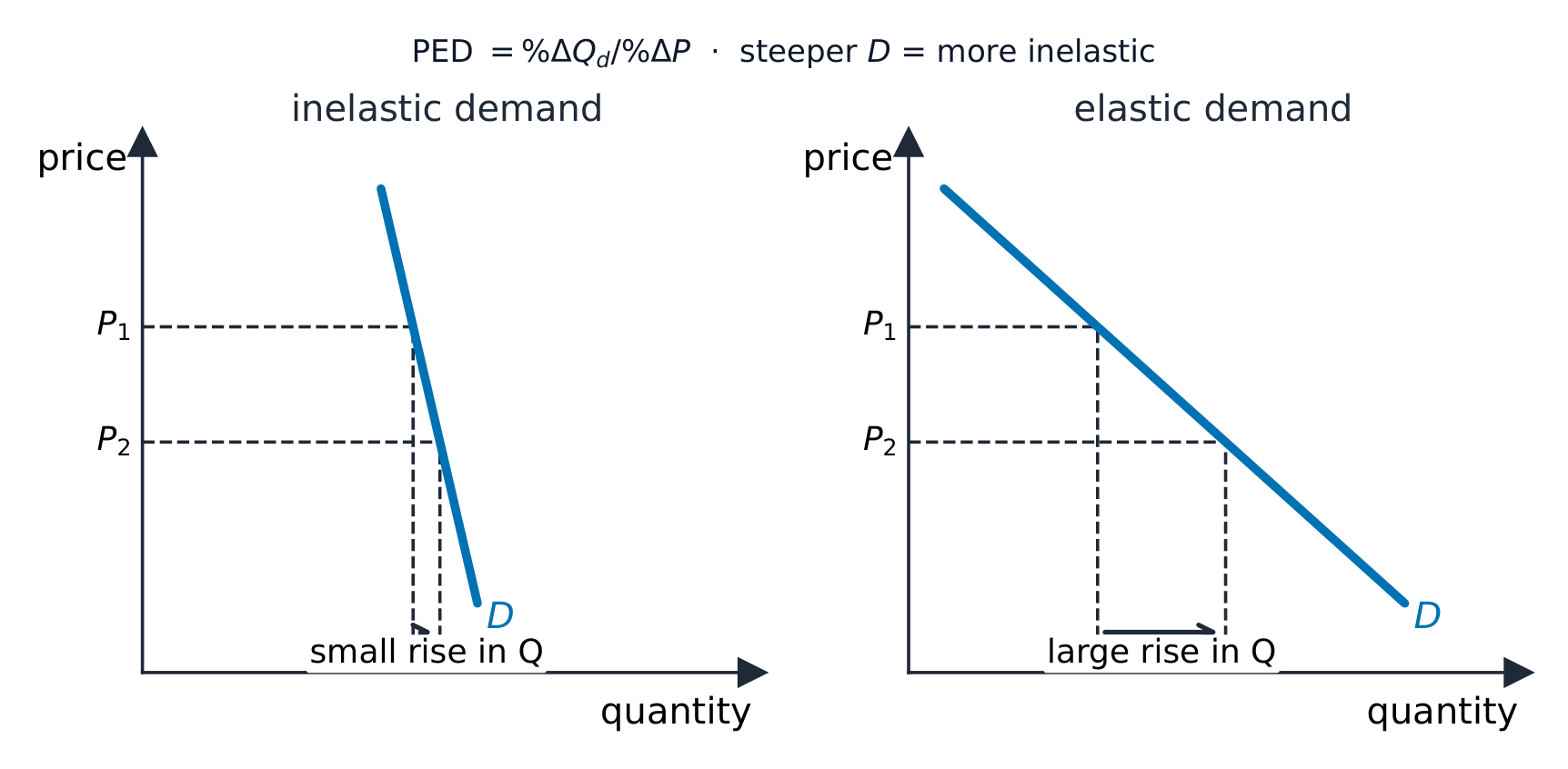
כאשר הביקוש אינאלסטי (תלול), שינוי במחיר זז מעט בכמות; כאשר הוא אלסטי (שטוח), אותו שינוי במחיר מזיז את הכמות הרבה.
מה גורם לביקוש להיות אלסטי או אינאלסטי
מספר הסוגרים ומידת הקרבה שלהם (יותר סוגרים → יותר אלסטיות).
האם הסחורה היא צורך יומיומי (אינאלסטי) או מוצר יוקרה (אלסטי).
החלק מההכנסה המופנה על הסחורה (חלק גדול → יותר אלסטיות).
זמן — הביקוש יותר אלסטי בטווח הארוך, כאשר קונים יכולים למצוא אלטרנטיבות אחרות.
הרגל או תלות גורמים לביקוש אלסטי.
אלסטיות מחיר והכנסה כוללת
הכנסה כוללת היא הסכום שמחלה מרוויחה: $\text{TR} = \text{price} \times \text{quantity}$. PED מסביר למחלה מה קורה להכנסה כאשר משנה את המחיר:
אם הביקוש…
המחיר עולה
המחיר יורד
אלסטי
ההכנסה כוללת עולה
ההכנסה כוללת יורדת
אלסטי
ההכנסה כוללת יורדת
ההכנסה כוללת עולה
אחיד-אלסטי
ההכנסה כוללת נשארת זהה
ההכנסה כוללת נשארת זהה
דבר זה שימושי למחלות (איך לקבוע מחיר להכנסה גבוהה יותר) ולממשלות (מס על מוצר אלסטי, כמו בנזין, מייצר הכנסה רבה מבלי לצמצם מכירות באופן משמעותי).
The interaction of demand and supply · האינטראקציה בין ביקוש והיצע
Syllabus · סיילבוס
English
explain equilibrium price and quantity and how shifts in demand and supply change equilibrium
explain disequilibrium (excess demand and excess supply) and the functions of the price mechanism
apply demand and supply analysis to product, factor and foreign exchange markets
עברית
הסבר מחיר וכמות איזון ואופן השפעת הזזות בביקוש והיצע על האיזון
הסבר אי-איזון (ביקוש עודף והיצע עודף) ותפקודיו של מנגנון המחירים
יישום ניתוח ביקוש והיצע לשווקי מוצרים, גורמים ומטבעות זרות
Source: Cambridge International syllabus · מקור: הסיילבוס הבינלאומי של קמבריד'ג'
English
Equilibrium
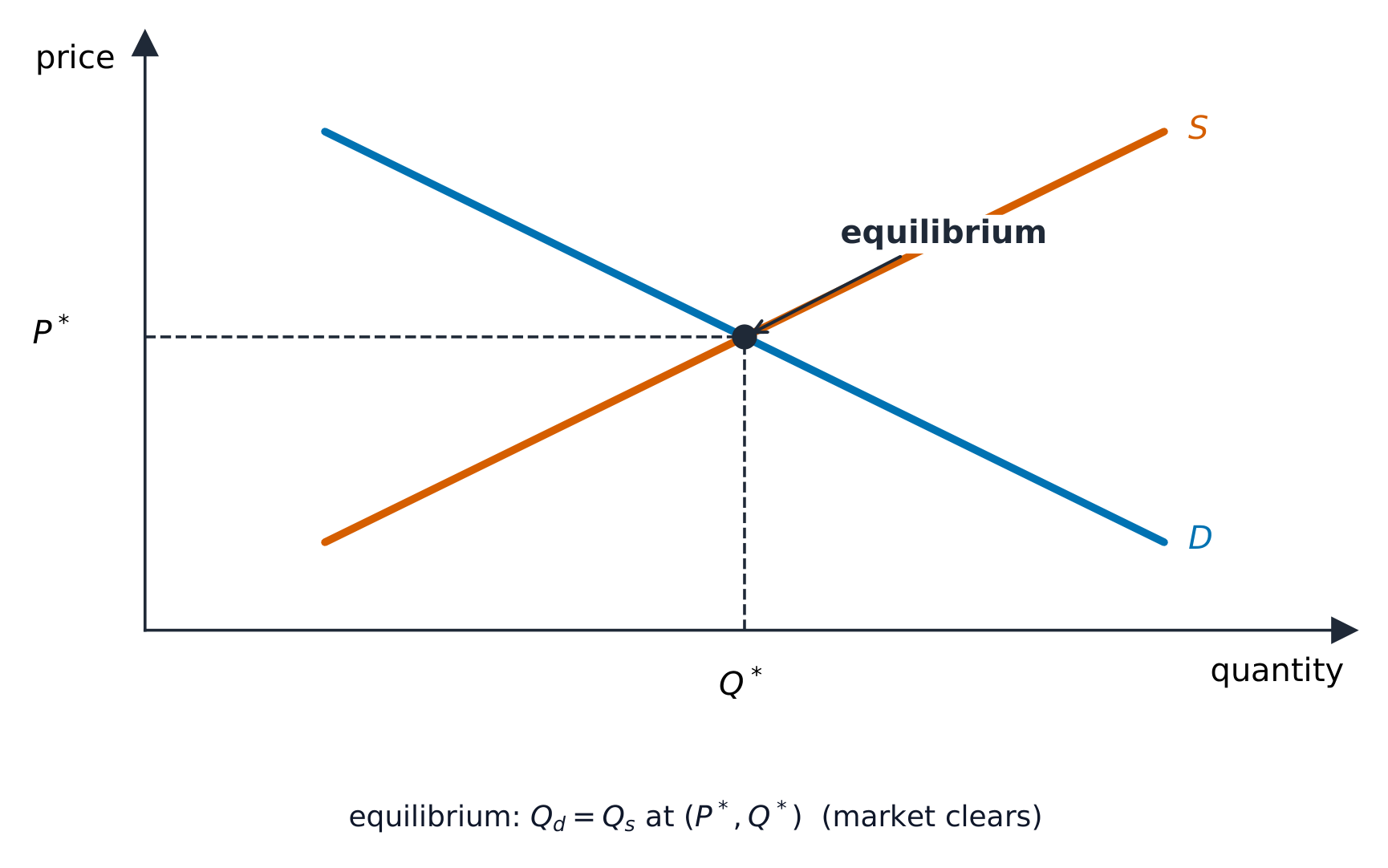
The market is in equilibrium 均衡 where the demand curve crosses the supply curve. Here demand equals supply. This gives the equilibrium price 均衡价格 and the equilibrium quantity 均衡数量. There is no pressure for the price to change.
Disequilibrium
When the price is not at equilibrium, the market is in disequilibrium 非均衡:
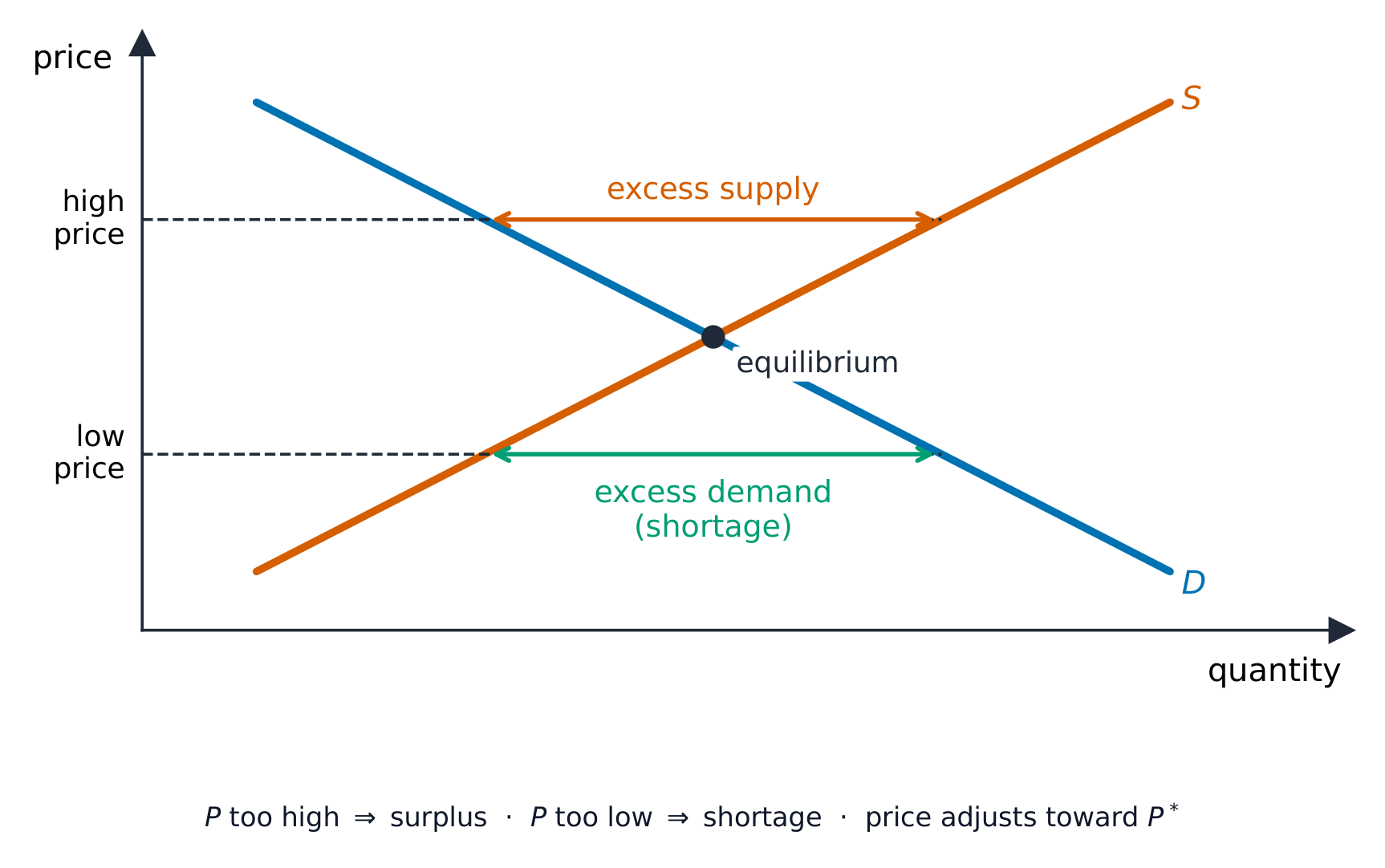
if the price is too low, there is excess demand 超额需求 (a shortage 短缺). Buyers compete, so the price is pushed up.
if the price is too high, there is excess supply 超额供给. Sellers cannot sell everything, so the price is pushed down.
In both cases the price moves back to equilibrium. This shows the price mechanism doing its jobs of signalling, rationing and giving an incentive.
How shifts change the equilibrium
Change
Effect on price
Effect on quantity
demand rises (shifts right)
rises
rises
demand falls (shifts left)
falls
falls
supply rises (shifts right)
falls
rises
supply falls (shifts left)
rises
falls
Demand and supply in different markets
The same analysis works in many markets:
in product markets 产品市场, demand and supply set the price of goods and services.
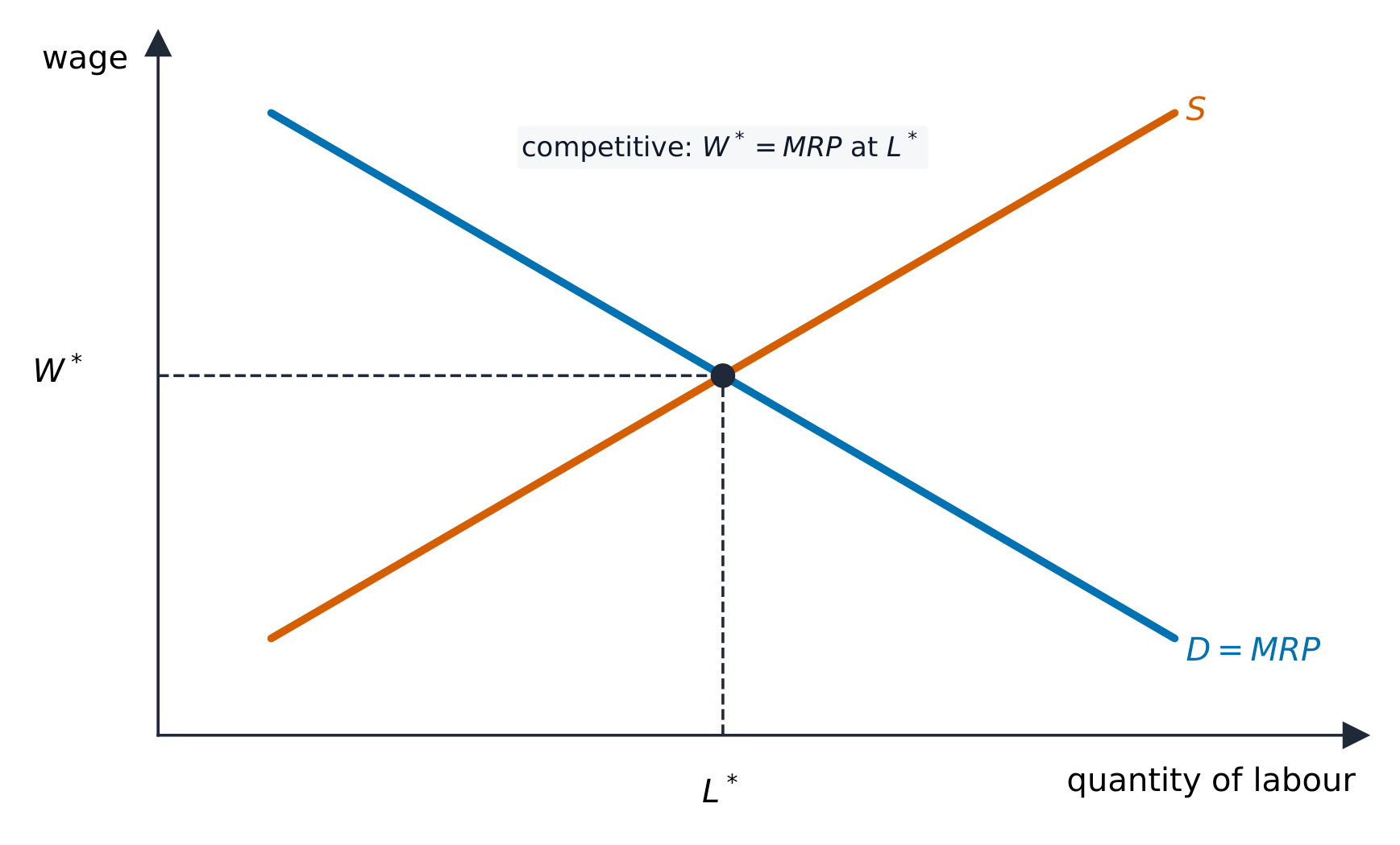
in factor markets 要素市场, they set the price of factors — for example, the demand for and supply of labour set the wage 工资.
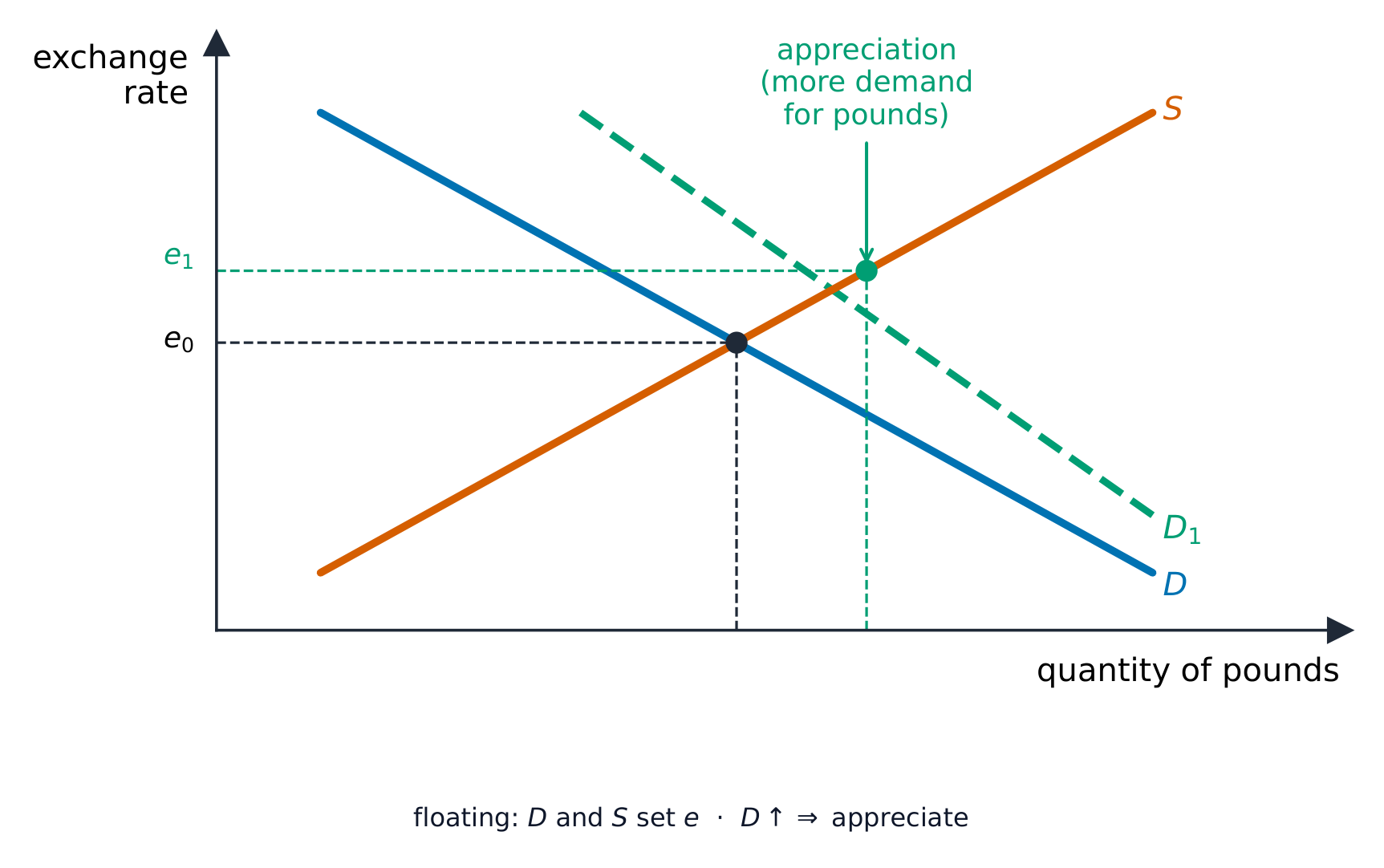
in the foreign exchange market 外汇市场, the demand for and supply of a currency set the exchange rate 汇率 (the price of one currency in terms of another).
עברית
בשוק, קונים ומוכרים נפגשים והמחיר נקבע שם שבו הביקוש שווה להיצע
איזון
לשוק יש איזון כאשר עקומת הביקוש חוצה את עקומת ההיצע. כאן הביקוש שווה להיצע. הדבר נותן את מחיר האיזון ואת כמות האיזון. אין לחץ למחיר להשתנות.
במחיר האיזון $P^*$ ובכמות $Q^*$ העקומות נפגשות, ולכן הכמות המבוקשת שווה לכמות המוצעת.
אי-איזון
כאשר המחיר אינו ברמת האיזון, לשוק יש אי-איזון:
אם המחיר נמוך מדי, יש ביקוש עודף (חסר). קונים מתחרים זה בזה, ולכן המחיר מועלה.
אם המחיר גבוה מדי, יש היצע עודף. סוחרים לא מצליחים למכור הכל, ולכן המחיר מופרך.
בשני המקרים המחיר חוזר לאיזון. הדבר מראה את מנגנון המחיר מבצע את משימותיו של סימון, הקצאה ומתן激励 (עיוד).
מעל מחיר האיזון יש היצע עודף; מתחת לו יש ביקוש עודף (חסר). בכל מקרה המחיר מופרך חזרה לאיזון.
כיצד שינויים משנים את האיזון
שינוי
השפעה על המחיר
השפעה על הכמות
הביקוש עולה (זז ימינה)
עולה
עולה
הביקוש יורד (זז שמאלה)
יורד
יורד
ההיצע עולה (זז ימינה)
יורד
עולה
ההיצע יורד (זז שמאלה)
עולה
יורד
בהינתן שחילוץ קבוע, עלייה בביקוש ($D \to D_1$) מעלה גם את מחיר האיזון וגם את כמות האיזון.
ביקוש וחילוץ בשווקים שונים
הניתוח הזה חל על שווקים רבים:
בשווקי מוצרים, הביקוש והחילוץ קובעים את מחיר הסחורות והשירותים.
בשווקי גורמים, הם קובעים את מחיר הגורמים — למשל, הביקוש והחילוץ בעבודה קובעים את השכר.
בשוק המטבע החוץ-ארצי, הביקוש והחילוץ במטבע קובעים את מחיר ההחלפה (מחירו של מטבע אחד ביחס למטבע אחר).
Explore · חקור
Demand & supply · ביקוש והיצע
Where demand meets supply sets the equilibrium price and quantity. · היכן demand פוגשת offer קובעת את מחיר האיזון וכמותו.
Explore · חקור
Finding the equilibrium price · מציאת מחיר האיזון
Shift demand or supply and watch the equilibrium price and quantity move to where the two lines cross. · הזז ביקוש או הצעה והצפה איך מחיר הכמות האיזון משתנים לנקודה שבה שתי הקווים נחתכים.
Consumer and producer surplus · עודף צרכני ועודף מייצר
Syllabus · סיילבוס
English
define and identify consumer surplus and producer surplus on a diagram
explain how changes in demand, supply and price affect consumer and producer surplus
עברית
הגדר וזהה עודף צרכנים ועודף יצרנים בתרשים
הסבר כיצד שינויים בביקוש, היצע ומחיר משפיעים על עודף הצרכנים ועודף היצרנים
Source: Cambridge International syllabus · מקור: הסיילבוס הבינלאומי של קמבריד'ג'
English
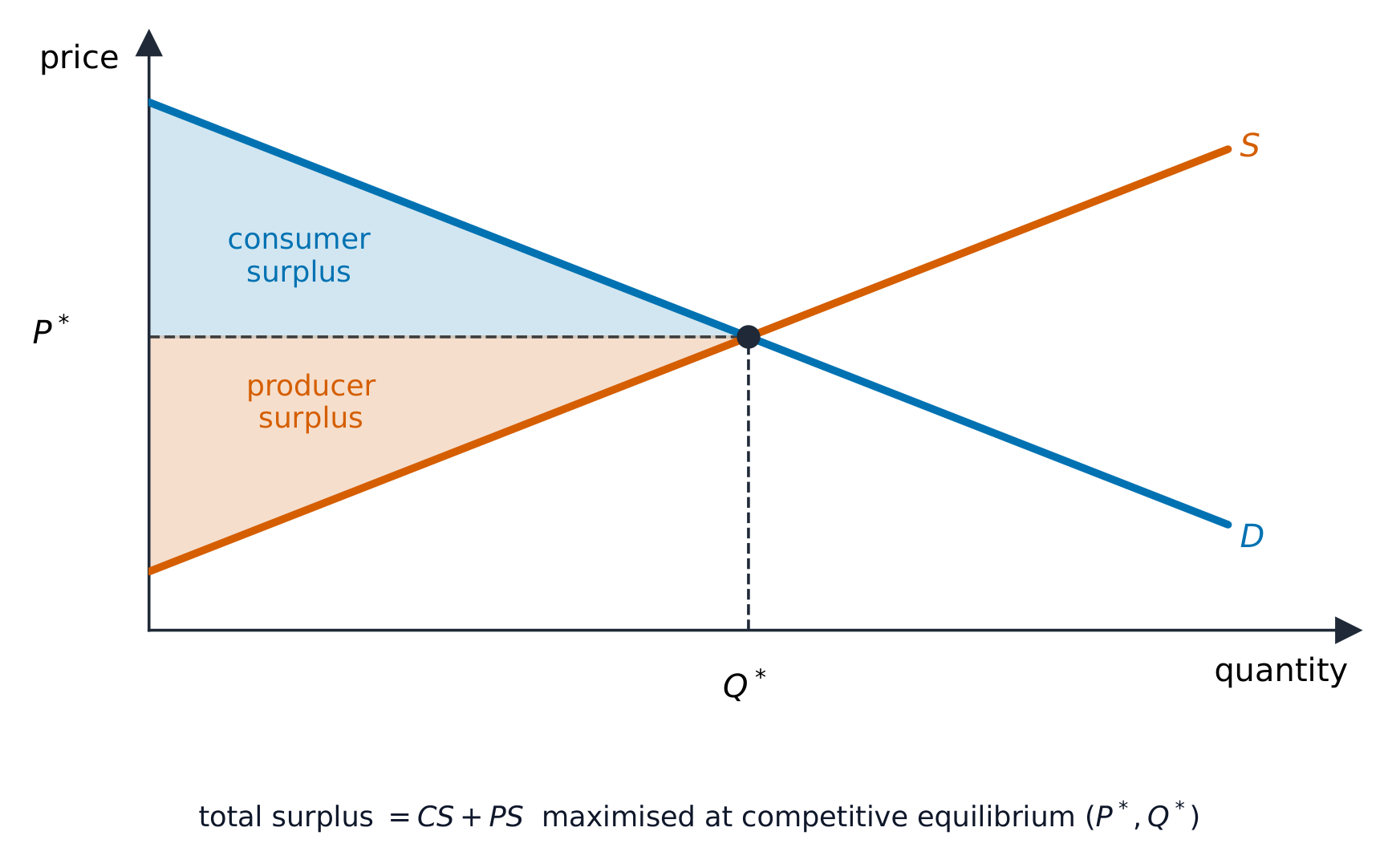
consumer surplus 消费者剩余 is the gain to buyers. It is the difference between the most a consumer was willing to pay and the price actually paid. On a diagram it is the area below the demand curve and above the price line.
producer surplus 生产者剩余 is the gain to sellers. It is the difference between the price a producer receives and the lowest price the producer would have accepted. On a diagram it is the area above the supply curve and below the price line.
How they change:
if demand rises, the price and quantity rise, so producer surplus rises and consumer surplus usually rises too.
if supply rises, the price falls and quantity rises, so consumer surplus rises.
a higher price (with the curves fixed) raises producer surplus but lowers consumer surplus.
Together, consumer surplus plus producer surplus is the total welfare 福利 (gain to society) from the market. It is largest at the free-market equilibrium.
עברית
עודף צרכני הוא התועלת לרוכשים. זהו ההפרש בין המקסימום שהצרכן היה מוכן לשלם לבין המחיר ששולם בפועל. בגרף, זהו השטח מתחת לעקומת הביקוש ומעל קו המחיר.
עודף מייצר הוא התועלת למכר们. זהו ההפרש בין המחיר שמייצר מקבל לבין המחיר הנמוך ביותר שהמייצר היה מסכים לקבל. בגרף, זהו השטח מעל עקומת החילוץ ומתחת לקו המחיר.
עודף צרכני הוא השטח מתחת לביקוש ומעל המחיר; עודף מייצר הוא השטח מעל חילוץ ומתחת למחיר.
כיצד הם משתנים:
אם הביקוש עולה, המחיר והכמות עולים, ולכן העודף המייצר עולה והעודף הצרכני בדרך כלל עולה גם כן.
אם החילוץ עולה, המחיר יורד והכמות עולה, ולכן העודף הצרכני עולה.
מחיר גבוה יותר (כאשר העקומות קבועות) מעלה את העודף המייצר אך מפחית את העודף הצרכני.
יחד, העודף הצרכני פלוס העודף המייצר מהווים את הרווח (התועלת לחברה) הכולל מהשווק. הוא גדול ביותר באיזון שוק חופשי.
Explore · חקור
Demand & supply · ביקוש והיצע
Surplus sits between the curves and the going price. · עודף ממוקם בין העקומות לבין המחיר הנדון.
explain market failure as the failure to achieve an efficient allocation of resources
explain the reasons for intervention: externalities, public goods, merit/demerit goods, monopoly power, inequality, asymmetric information
עברית
הסבר כשל שוק ככשל בהשגת הקצאה יעילה של משאבים
הסבר הסיבות להתערבות: חיצוניות, סחורות ציבוריות, סחורות פנימיות/חיצוניות, כוח מונופולי, אי-שוויון, מידע א-סימטרי
Source: Cambridge International syllabus · מקור: הסיילבוס הבינלאומי של קמבריד'ג'
English
A free market often gives a good result, but not always. market failure 市场失灵 is when the market does not allocate 配置 (share out) resources efficiently — too much or too little of a good is made. Then the government may step in.
There are several reasons for market failure.
Externalities
An externality 外部性 is a cost or a benefit that falls on a third party 第三方 — someone who is not the buyer or the seller.
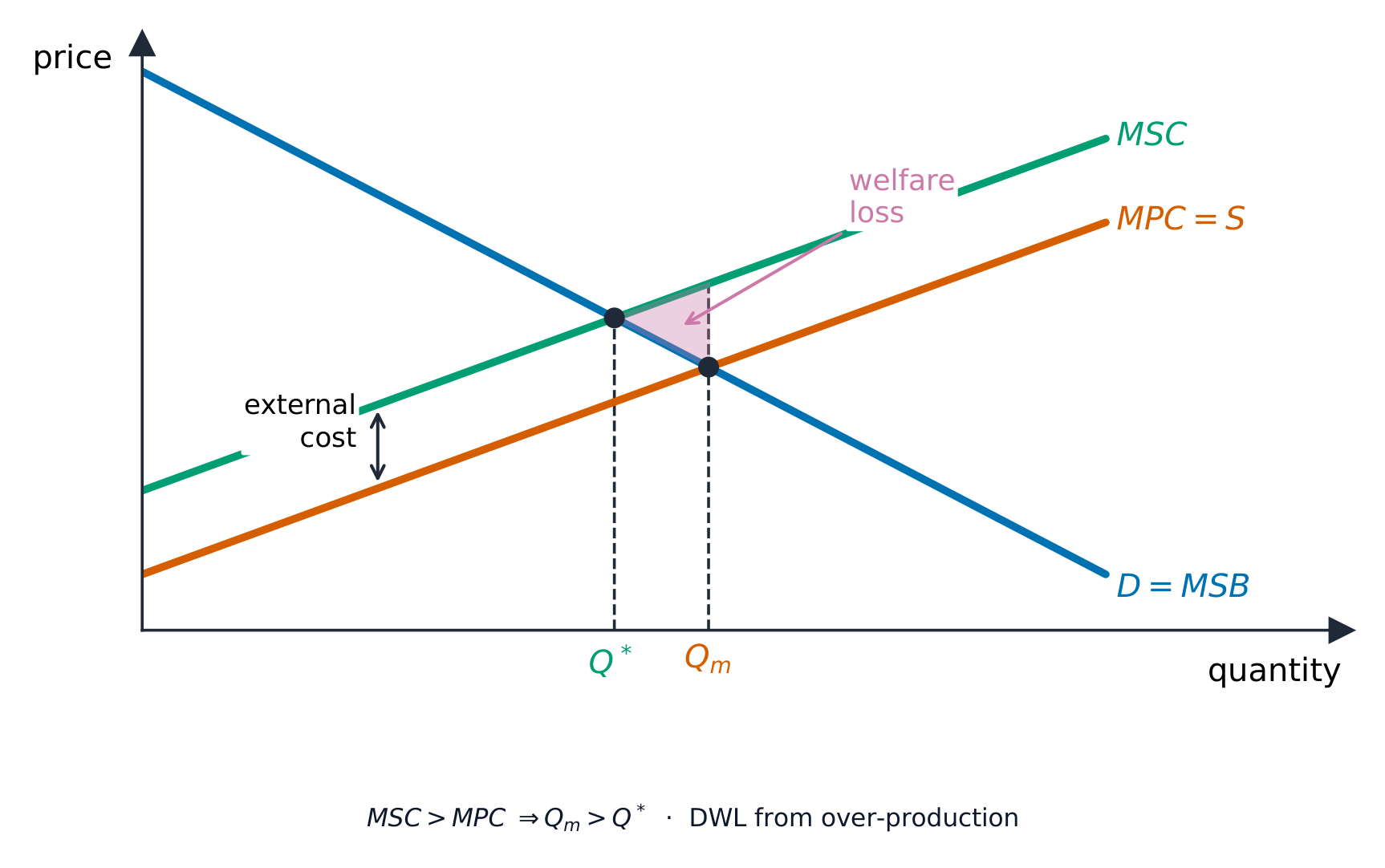
a negative externality 负外部性 is an external cost 外部成本 paid by others, like the pollution from a factory. The social cost 社会成本 (the cost to all of society) is bigger than the private cost 私人成本 (the cost to the producer). When people ignore the external cost, the market makes too much of the good.
a positive externality 正外部性 is an external benefit 外部收益 enjoyed by others, like the protection that vaccination gives to everyone. Here the market makes too little, because buyers ignore the benefit to others.
Public goods
A public good 公共物品 (like street lighting or national defence) has non-rivalry 非竞争性 and non-excludability 非排他性. Because non-payers cannot be shut out, there is a free-rider problem 搭便车问题, so private firms make no profit and supply none. The market fails completely.
Merit and demerit goods
A merit good 优值品 (like education) is under-consumed; a demerit good 劣值品 (like cigarettes) is over-consumed. People misjudge them because of information failure 信息失灵 — they do not know, or do not use, the true benefit or harm.
Monopoly power
monopoly 垄断 means one firm dominates a market. A firm with monopoly power 垄断势力 can cut output and raise the price above the competitive level. This wastes resources and harms consumers.
Inequality and asymmetric information
the market rewards people who own resources, so it can produce great inequality 不平等 — some people are left with too little to live on.
asymmetric information 信息不对称 is when one side of a deal knows more than the other (a used-car seller knows the faults; the buyer does not). This leads to poor decisions and unfair deals.
עברית
שווק חופשי מניב לעיתים קרובות תוצאה טובה, אך לא תמיד. כשל שוק הוא מצב שבו השוק אינו מקצה (חלק) משאבים ביעילות — מיוצרת כמות רבה מדי או מעטה מדי של סחורה. אז הממשלה עשויה להתערב.
ישנם מספר סיבות לכשל שוק.
תחנת כוח פחם: ייצור חשמל עלול להטיל חיצונייה שלילית כמו זיהום על אנשים שאינם חלק מהעסקה.
חיצוניויות
חיצוניות היא עלות או תועלת החלות על צד שלישי — מישהו שאינו הקונה ואינו המוכר.
חיצונייה שלילית היא עלות חיצונית שמשלמים אחרים, כמו הזיהום מפרי קבלן. ה-עלות החברתית (העלות לכלל החברה) גדולה מה-עלות הפרטית (העלות ליצרן). כאשר אנשים מתעלמים מעלות החיצונית, השוק מייצר יותר מדי מהסחורה.
חיצונייה חיובית היא תועלת חיצונית הנהנית ממנה אחרים, כמו ההגנה שהחיסון מספק לכלל האנשים. כאן השוק מייצר פחות מדי, מכיוון שקונים מתעלמים מהתועלת לאחרים.
עם חיצונייה שלילית, העלות החברתית (MSC) נמצאת מעל העלות הפרטית (MPC), ולכן השוק מייצר יותר מדי ב-$Q_m$ במקום באופטימום החברתי $Q^*$; המשולש המוצל הוא אובדן הרווחה.עם חיצונייה חיובית, התועלת החברתית (MSB) נמצאת מעל התועלת הפרטית (MPB), ולכן השוק מייצר פחות מדי ב-$Q_m$ במקום באופטימום החברתי $Q^*$.
סחורות ציבוריות
טוב ציבורי (כמו תאורת רחוב או הגנה לאומית) מאפיין אי-תחרותיות ואי-חסימות. מכיוון שלא ניתן לחסום את הללא-משתלמים, קיים בעיית המסע ללא תשלום, ולכן חברות פרטיות אינן מרוויחות ומספקות אפס. השוק כושל לחלוטין.
סחורות זכותיות וסחורות פסולתיות
טוב זכות (כמו חינוך) נצרך בכמות מופחתת; טוב פגם (כמו סיגריות) נצרך בכותרת מוגזמת. אנשים מקרים אותם בשל כשל מידע — הם אינם יודעים, או אינם משתמשים, בתועלת או ברעה האמיתיות.
כוח מונופולי
מונופול פירוט שחברה אחת שולטת בשוק. לחברה עם כוח מונופולי יש אפשרות להקטין את הייצור ולהעלות את המחיר מעל הרמה התחרותית. הדבר מבזבז משאבים וגורם נזק לצרכנים.
אי-שוויון ומידע אסימטרי
השוק מעניק פרסים לאנשים בעלי משאבים, ולכן הוא עלול לייצר אי-שוויון גדול — חלק מהאנשים נשארים עם פחות מדי למחייה.
מידע אסימטרי הוא מצב שבו צד אחד בעסקה יודע יותר מהצד השני (מוכר רכב יד שנייה יודע את הפגמים; הקונה אינו יודע). הדבר מוביל להחלטות גרועות ועסקאות לא הוגנות.
Explore · חקור
The market and where it fails · השוק ואين הוא כושל
Supply and demand set the market price and quantity at their intersection. Market failure is when this free-market outcome is not the best one for society. · ההיצע והביקוש קובעים את מחיר השוק וכמותו בנקודת החיתוך. כישלון שוק הוא מצב שבו תוצאת שוק חופשי זו אינה הטובה ביותר לחברה.
Methods of government intervention · שיטות התערבות ממשלתית
Syllabus · סיילבוס
English
explain methods of intervention: indirect taxes, subsidies, maximum and minimum prices, buffer stocks, regulation, provision, tradable permits
analyse the effects of intervention, including the incidence of indirect taxes and the concept of government failure
עברית
הסבר שיטות התערבות: מיסים עקיפים, סבסודים, מחיר מקסימום ומינימום, מלאי בטיחות, ויסות, ספק, היתרי מסחר
ניתוח ההשפעות של ההתערבות, כולל נשיאת מיסים עקיפים וקונספט כשל ממשלתי
Source: Cambridge International syllabus · מקור: הסיילבוס הבינלאומי של קמבריד'ג'
English
A maximum price creates a shortage
Indirect taxes
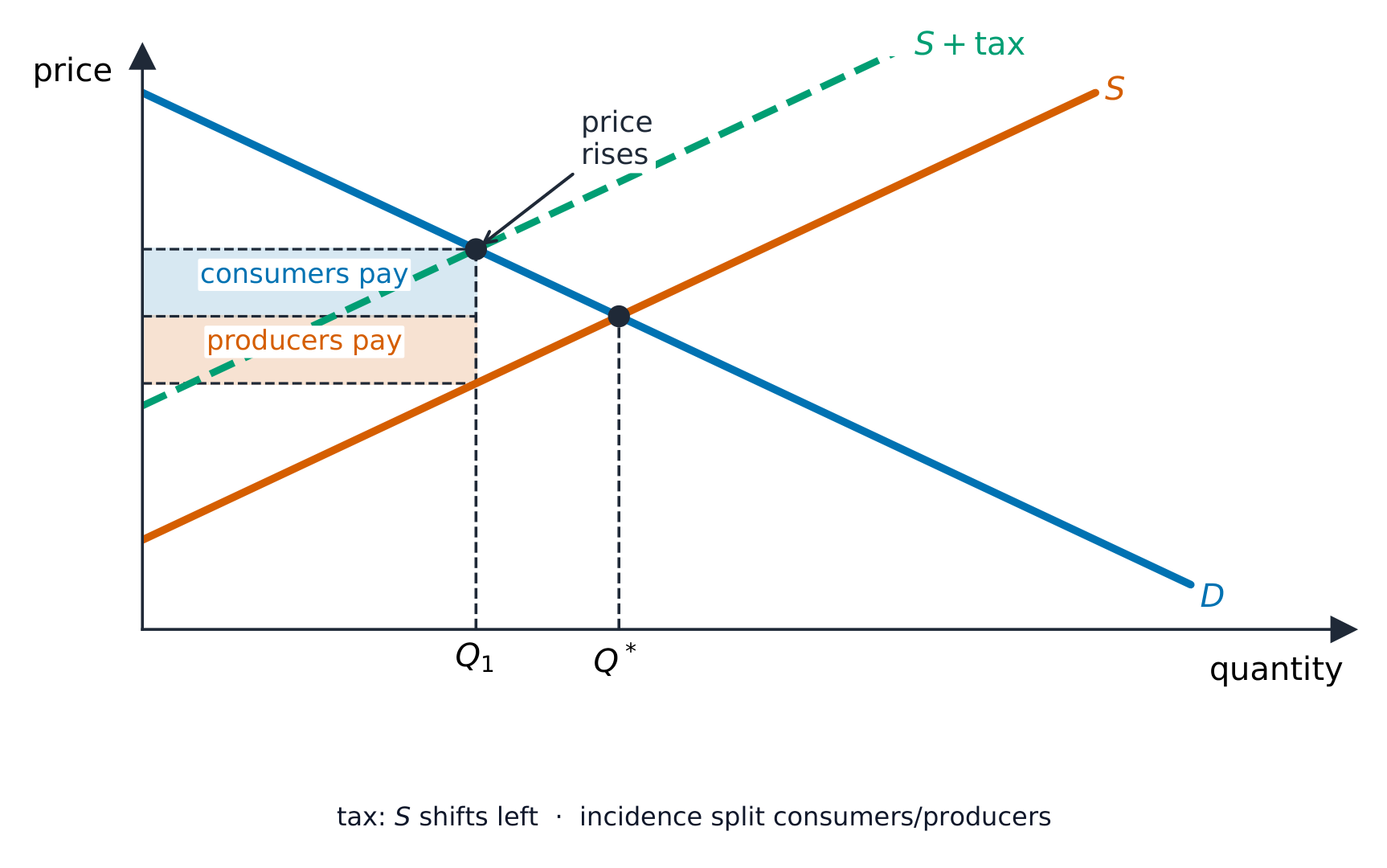
An indirect tax 间接税 is a tax on spending. It raises a firm's costs, shifts the supply curve to the left, and so raises the price and cuts the quantity. Governments tax demerit goods (like tobacco) and goods with negative externalities to make people use less.
The incidence of a tax 税收归宿 is who really pays it. This depends on elasticity:
if demand is inelastic 缺乏弹性, consumers pay most of the tax (the price rises by nearly the full tax).
if demand is elastic 富有弹性, producers pay most of the tax (they cannot pass it on).
Subsidies
A subsidy 补贴 is a government payment to producers. It lowers their costs, shifts the supply curve to the right, and so lowers the price and raises the quantity. Subsidies are used for merit goods and goods with positive externalities.
Maximum and minimum prices
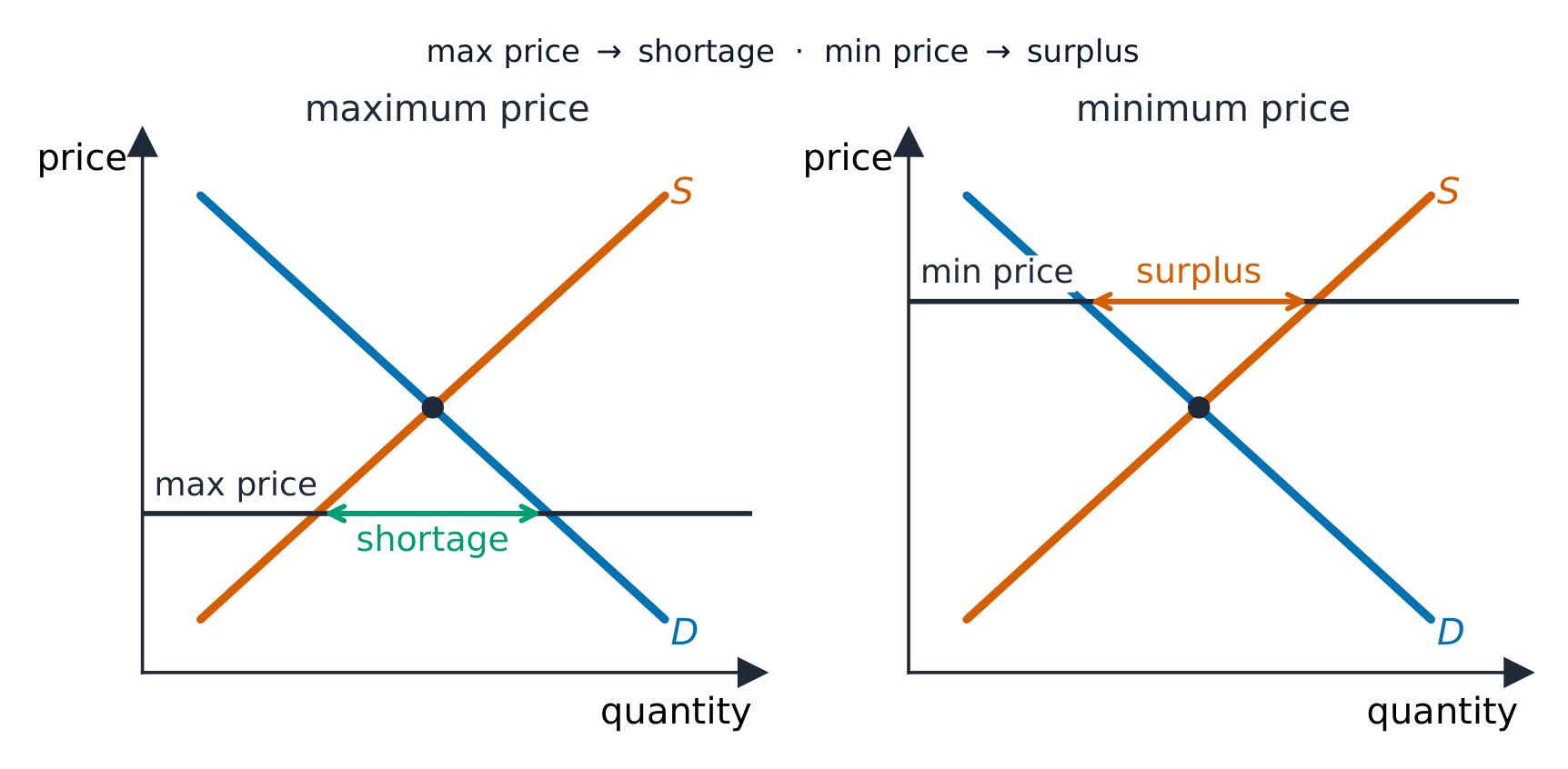
a maximum price 最高限价 is a legal top price, set below equilibrium (for example, rent control). Because the price is held down, quantity demanded is greater than quantity supplied, so there is a shortage 短缺.
a minimum price 最低限价 is a legal bottom price, set above equilibrium (for example, a minimum wage, or a floor for farm prices). Because the price is held up, quantity supplied is greater than quantity demanded, so there is excess supply 超额供给.
Buffer stocks
A buffer stock 缓冲库存 is used to steady the price of farm goods. The government buys and stores the good when the price is low, and sells from the store when the price is high. This keeps the price inside a target band.
Regulation, provision and permits
regulation 管制 means rules and laws — bans, age limits, safety standards, or pollution limits.
state provision 政府提供 means the government 政府 supplies a good directly, often free at the point of use (public goods and merit goods like schools and hospitals).
tradable permits 可交易许可证 set a total cap on pollution and give firms permits to pollute. Firms that pollute less can sell spare permits to firms that pollute more. This caps total pollution at the lowest cost.
Government failure
Intervention does not always help. government failure 政府失灵 is when the government's action makes the use of resources worse, not better. Common causes:
poor information, so the government sets the wrong tax or subsidy.
high cost of running the policy.
unintended results — for example, a maximum price can create an illegal black market 黑市.
decisions made for political reasons rather than for efficiency.
Worked example. A government puts a £2 per-packet tax on cigarettes, whose demand is very price-inelastic. Who really pays it, and what does that mean for the policy's two aims? The incidence falls mainly on whichever side is less able to respond - the more inelastic one. Because smokers keep buying almost the same quantity as the price rises, producers can pass most of the tax on, so consumers bear most of the incidence: the price might rise by about £1.80, with producers absorbing only about £0.20. That creates the tension the question is really testing. As a revenue raiser the tax succeeds: quantity barely falls, so revenue is large and steady. As a way of cutting consumption it largely fails - for exactly the same reason. And because poorer smokers spend a larger share of their income on it, the tax is regressive. Argue from elasticity to incidence, then judge each aim separately.
עברית
מחיר מקסימום יוצר מחסור
מסים עקיפים
מס עקיף הוא מס על הוצאה. הוא מעלה את העלויות של החברה, מזיז את עקומת ההיצע שמאלה, ולכן מעלה את המחיר ומצמצם את הכמות. הממשלות מטילות מסים על סחורות פוגעניות (כמו טבק) ועל סחורות עם חוץ-אפקטים שליליים כדי להפחית את השימוש בהן.
סיגריות הן סחורה פוגענית — נצרכות בעודף מכיוון שאנשים מעריכים שגוה את הנזק — ולכן הממשלות מטילות עליהן מס כבד.
השכימת המס היא מי משלם אותו בפועל. הדבר תלוי בגמישות:
אם הביקוש הוא אלסטי, הצרכנים משלמים את רוב המס (המחיר עולה בקרוב לסכום המס כולו).
אם הביקוש הוא גמיש, היצרנים משלמים את רוב המס (הם אינם יכולים להעביר אותו).
מס עקיף מזיז את ההיצע כלמעלה ל$S+\text{tax}$, מעלה את המחיר ומצמצם את הכמות; המעמ מתחלק בין צרכנים ליצרנים.
סבסודים
סבסוד הוא תשלום ממשלתי ליצרנים. הוא מפחית את עלויותיהם, מזיז את עקומת ההיצע לימין, ולכן מפחית את המחיר ומגדיל את הכמות. סבסודים משמשים לעידוד סחורות בונות וסחורות עם חוץ-אפקטים חיוביים.
סבסוד מזיז את ההיצע כלמטה ל$S+\text{subsidy}$, מפחית את המחיר ומגדיל את הכמות הנסחרת.
מחירים מקסימום ומינימום
מחיר מקסימום הוא גבול מחיר חוקי, קבוע מתחת למחיר השוויון (למשל, בקרת שכירות). מכיוון שהמחיר מוחזק ברמה נמוכה, הכמות המבוקשת גדולה מהכמות המוצעת, ולכן נוצר מחסור.
מחיר מינימום הוא גבול מחיר חוקי, קבוע מעל מחיר השוויון (למשל, שכר מינימום, או רצפת מחירים לחקלאות). מכיוון שהמחיר מוחזק ברמה גבוהה, הכמות המוצעת גדולה מהכמות המבוקשת, ולכן נוצר עודף אספקה.
מחיר מקסימום שנקבע מתחת למחיר שיווי משקל גורר מחסור; מחיר מינימום שנקבע מעל מחיר שיווי המשקל גורר עודף.
מלאי ביטחון
ממלאי ביטחון משמש ליצבת המחיר של מוצרי חקלאות. הממשלה רוכשת ואוגרת את המוצר כאשר המחיר נמוך, ומכירה ממנו כאשר המחיר גבוה. כך נשמר המחיר בתוך מגמה יעודה.
מלאי ביטחון שומר על המחיר בתוך מגמה: הממשלה קונה כשהוא פוגע ברצפה ומוכר כשהוא פוגע בתקרה
רגולציה, אספקה ורישיונות
רגולציה פירוניה חוקים ותקנות — איסורים, הגבלות גיל, סטנדרטי בטיחות או הגבלות זיהום.
אספקה ממשלתית פירוניה שהממשלה מספקת מוצר ישירות, לעיתים ללא תשלום בנקודת השימוש (ציבוריים וטובים מרווחים כמו בתי ספר ובתי חולים).
רישיונות מסחר קובעים סقف כולל לזיהום ומעניקים לחברות רישיונות לזהום. חברות שמזהמות פחות יכולות למכור רישיונות עודפים לחברות שמזהמות יותר. כך נקבע סף לזיהום כולל בעלות הנמוכה ביותר.
כשל ממשלתי
התערבות אינה תמיד מועילה. כשל ממשלתי הוא מצב שבו פעולת הממשלה גורמת להיעילות בשימוש המשאבים להיות פחות טובה, ולא טובה יותר. סיבות נפוצות:
מידע לקוי, ולכן הממשלה קובעת מס או סובsidia שגוי.
עלות גבוהה להפעלת המדיניות.
תוצאות בלתי צפויות – לדוגמה, מחיר מקסימום עלול ליצור שוק שחור בלתי חוקי.
החלטות שנלקחות מסיבות פוליטיות ולא מסיבות יעילות.
דוגמה מפורטת. ממשלה מטילה מס של £2 לכל חבילת סיגריות, שביקוש אליה הוא אלסטי במחיר (inelastic) מאוד. מי באמת משלם אותו, ומה המשמעות לשני היעדים של המדיניות? העומס המסוי נוטה בצורה מרכזית לצד שהוא פחות מסוגל להגיב – הצד האלסטי יותר. מכיוון שמעשנים ממשיכים לקנות כמות דומה כמעט כשהמחיר עולה, יצרנים יכולים להעביר את רוב המס, ולכן הצרכנים נושאים ברוב העומס: המחיר עשוי לעלות בכ-£1.80, בעוד שהיצרנים סופגים רק כ-£0.20. זאת יוצרת את המתח ששאלה זו really בודקת. כמייצר הכנסות, המס מצליח: הכמות יורדת מעט בלבד, ולכן ההכנסה גדולה ויציבה. ככלי לצמצום צריכה, הוא כשל לגמרי – בדיוק מאותה סיבה. וכיוון שעשנים בעלי הכנסה נמוכה מוציאים אחוז גדול יותר מההכנסה שלהם על זה, המס הוא מס הולך. יש לטעון מאלסטיות לעומס המסוי, ואז לשפוט כל יעד בנפרד.
Explore · חקור
Reasons for intervention · סיבות להתערבות
Governments step into markets when the free-market equilibrium isn't the best outcome for society. · ממשלות נכנסות לשוקים כאשר איזון השוק החופשי אינו התוצאה הטובה ביותר לחברה.
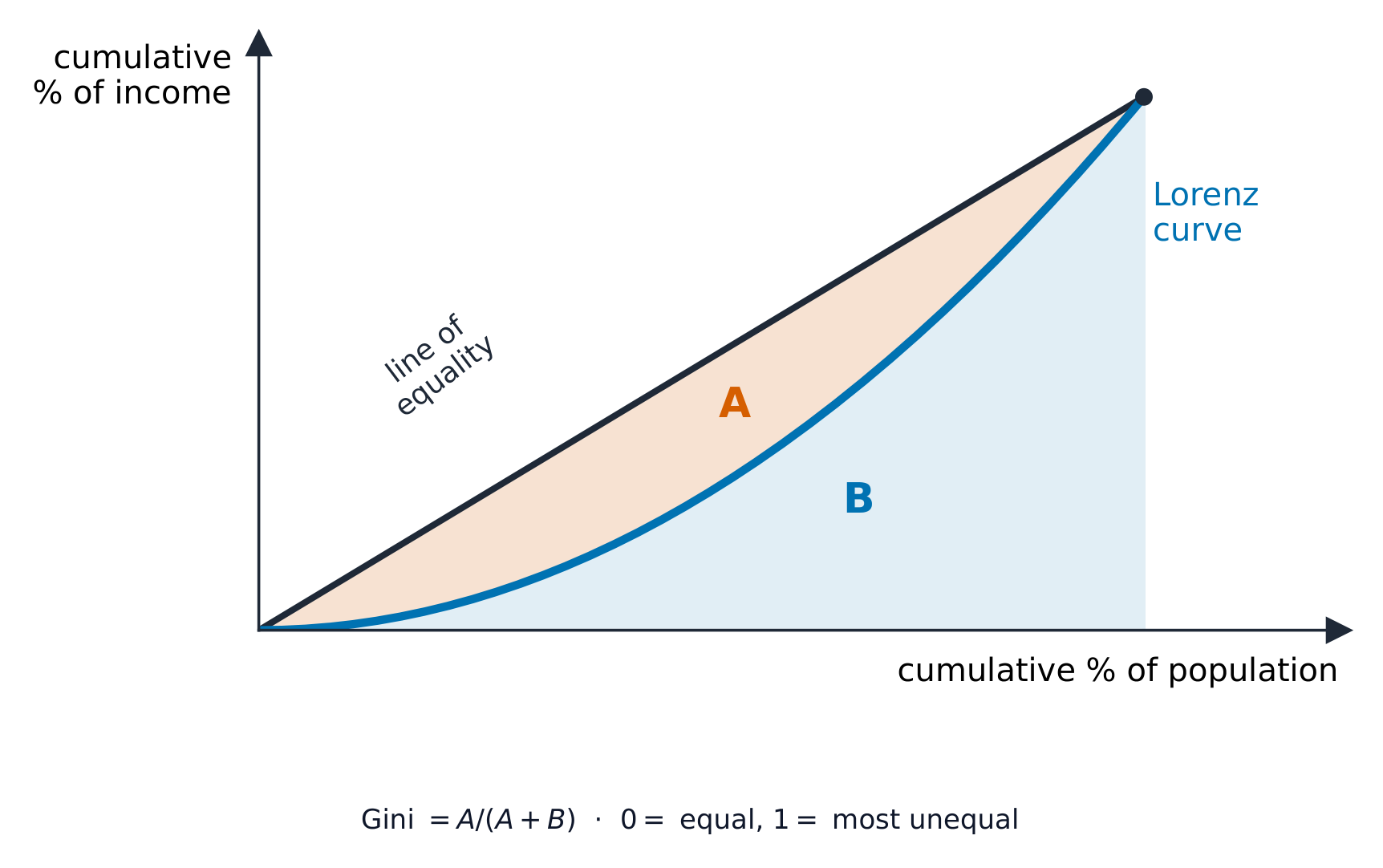
Income and wealth inequality · אי-שוויון הכנסה ועושר
Syllabus · סיילבוס
English
distinguish income and wealth and explain the causes of inequality
explain policies to redistribute income and wealth (progressive taxation, benefits, provision of services) and their effects
עברית
הבדל בין הכנסה לעושר והסבר הסיבות לאי-שוויון
הסבר מדיניות להעברת הכנסה ועושר (מיסוי הדרגתי, תשלומי סוציאליים, מתן שירותים) והשפעותיהן
Source: Cambridge International syllabus · מקור: הסיילבוס הבינלאומי של קמבריד'ג'
English
It helps to separate two ideas:
income 收入 is a flow 流量 — money received over a period, such as wages, rent and interest.
wealth 财富 is a stock 存量 — the value of assets owned at a point in time, such as houses, shares and savings.
Wealth produces income (savings earn interest), and income can be saved to build wealth, so the two are linked. Inequality has many causes: differences in skills and wages, the ownership of wealth, inheritance, and unemployment.
Policies to reduce inequality
a progressive tax 累进税 takes a larger percentage 百分比 from higher incomes than from lower incomes. This narrows the gap after tax.
benefits 福利金 (also called transfer payments 转移支付) are money paid by the government to the poor, the old, and the unemployed.
state provision of free services, like education and health care, raises the real living standards of poorer people.
Together these policies bring about redistribution 再分配 — moving income and wealth from richer to poorer people. But there is a trade-off 取舍: very high taxes and large benefits may weaken the incentive 激励 to work and to invest.
עברית
מועיל להפריד בין שני מושגים:
הכנסה היא זרימה – כסף שהתקבל בתקופה מסוימת, כגון שכר, שכירות וריבית.
עושר הוא מלאי – ערך הנכסים שברשות אדם בנקודת זמן נתונה, כגון נכסים, מניות וחיסכון.
עושר מייצר הכנסה (חסכונות מרוויחים ריבית), והכנסה יכולה להיות חסכונית כדי לבנות עושר, ולכן שניהם קשורים. לא-שוויון יש לו הרבה סיבות: הבדלים במיומנויות ודירות, רכישת עושר, ירושה, ואבטלה.
מדיניות להפחתת אי-שוויון
מס הולך ועולה נוטל אחוז גדול יותר מהכנסות גבוהות מאשר מהכנסות נמוכות. זה מצמצם את הפער לאחר המיסוי.
תשלומי סוציאליים (נקראים גם תשלומי העברה) הם כסף שממשלה משלמת לעניים, לקשישים ולמובטלים.
מתן מצב של שירותים חינם, כמו חינוך ובריאות, מרים את רמת החיים האמיתית של אנשים בעלי הכנסה נמוכה.
ביחד מדיניות אלו מובילות להעברת הכנסות — הזזת הכנסה ועושר מאנשים עשירים לאנשים בעלי הכנסה נמוכה. אבל יש תמורה: מיסים גבוהים מאוד ותשלומים גדולים עלולים לחלש את המotive לעבוד ולהשקיע.
עושר ועוני לצד זה: שוק לבדו עשיר להשאיר אי-שוויון הכנסה גדול ללא מענה
Explore · חקור
Inequality policy route · מסלול מדיניות לאי-שוויון
Follow how policy can change disposable income and opportunity. · עקוב אחר כך שמדיניות יכולה לשנות את ההכנסה הניתנת לשימוש והזדמנויות.
Macroeconomics 宏观经济学 looks at the whole economy at once: its total output, its jobs, and its prices. This handout covers how we measure the economy and the main problems it can face.
עברית
כלכלה מקרוסקופית בוחנת את כלכלה כולה בו-זמנית: את התפוקה הכוללת שלה, את התעסוקה ואת המחירים. חומר זה מכסה כיצד אנו מדדו את הכלכלה ובעיות ראשיות שהיא עלולה להתמודד איתן.
4.1
National income statistics · סטטיסטיקות הכנסה לאומית
Syllabus · סיילבוס
English
define GDP, GNI and national income and distinguish nominal and real, and total and per capita values
explain the uses and limitations of national income statistics for measuring living standards and making comparisons
עברית
הגדרת **ת
הסבר השימושים והמגבלות של סטטיסטיקות הכנסה לאומית למדידת רמת החיים ולביצוע השוואות
Source: Cambridge International syllabus · מקור: הסיילבוס הבינלאומי של קמבריד'ג'
English
To judge how an economy is doing, we measure its national income 国民收入 — the total value of everything it produces in a year.
gross domestic product 国内生产总值 (GDP) is the value of all goods and services made inside a country in a year.
gross national income 国民总收入 (GNI) is GDP plus the income a country's people and firms earn abroad, minus income foreigners earn inside it.
Two important differences:
nominal 名义 values are measured at current prices. real 实际 values are adjusted to remove the effect of rising prices, so they show the true change in output. Always compare real values over time.
total values cover the whole country. per capita 人均 values are divided by the population, so they show the average per person.
Uses and limitations
National income is used to measure the standard of living 生活水平 and to compare countries. But it has limits:
it ignores the distribution 分配 of income — a high average can hide great inequality.
it leaves out unpaid work (housework) and the informal economy 非正规经济 (hidden, untaxed activity).
it says nothing about pollution, leisure time, or health.
So a higher GDP per capita usually means a better life, but not always.
עברית
כדי לשפוט כיצד כלכלה מתפקדת, אנו מדדו את ההכנסה הלאומית שלה — הערך הכולל של כל מה שהיא מייצרת בשנה.
ההכנסה הלאומית (GDP) היא ערך כל הסחורות והשירותים שארץ מייצרת בשנה.
תוצר פנימי ברוטו (GDP) הוא ערך כל הסחורות והשירותים שנעשו בתוך ארץ בשנה.
הכנסה לאומית ברוטו (GNI) היא GDP plus the income a country's people and firms earn abroad, minus income foreigners earn inside it.
שתי הבדלים חשובים:
ערכים נומינליים נמדדים במחירים הנוכחיים. ערכים ריאליים מותאמים כדי להסיר את השפעת העלייה במחירים, ולכן הם מציגים את השינוי האמיתי בייצור. יש תמיד להשוות ערכים ריאליים לאורך זמן.
ערכים כוללים מכסים את כל המדינה. ערכים לקבלת מחולקים באוכלוסייה, ולכן הם מציגים את הממוצע לכל אדם.
שימושים ומגבלות
ההכנסה הלאומית משמשת למדידת רמת החיים ולהשוואה בין מדינות. אך יש לה מגבלות:
היא מתעלמת מהחלוקה ההכנסה — ממוצע גבוך יכול להסתיר אי-שוויון עצום.
היא מאבדת עבודה ללא תשלום (עבודת בית) ואת הכלכלה האפורת (פעילות מוסתרת שאינה חייבת מס).
היא אינה אומרת דבר על זיהום, זמן פנאי או בריאות.
לכן, GDP לקבלת גבוה יותר מעיד בדרך כלל על חיים טובים יותר, אך לא תמיד.
GDP לקבלת מראה הכנסה וייצור ממוצעים, אך מפספס חלוקה, עבודה ללא תשלום וזיהום
Explore · חקור
National income flow · זרימת הכנסה לאומית
Watch spending become income, output and expenditure in the circular flow. · צפו להפכת הוצאות להכנסה, תפוקה והוצאה במחזור ההיקף.
The circular flow of income · הזרם המחזורי של ההכנסה
Syllabus · סיילבוס
English
explain the circular flow of income with injections (investment, government spending, exports) and leakages (saving, taxation, imports)
explain equilibrium in the circular flow and the distinction between a closed and open economy
עברית
הסבר זרימת הכנסה המחזורית עם הזרקות (השקעה, הוצאות ממשלתיות, יצוא) ודליפות (חסכון, מיסוי, יבוא)
הסבר איזון בזרימת הכנסה וההבחנה בין כלכלה סגורה לכלכלה פתוחה
Source: Cambridge International syllabus · מקור: הסיילבוס הבינלאומי של קמבריד'ג'
English
The circular flow of income
The circular flow of income 收入循环流 shows money moving around the economy. Households 家庭 supply factors of production to firms 企业 and receive income (wages, rent, interest, profit). They spend that income on goods and services, and the money flows back to firms.
Money also leaves and enters this flow:
leakages 漏出 take money out of the flow: saving 储蓄, taxation 税收, and spending on imports 进口.
injections 注入 put money into the flow: investment 投资, government spending 政府支出, and exports 出口.
The flow is in equilibrium 均衡 when total injections equal total leakages. If injections are greater, the economy grows; if leakages are greater, it shrinks.
A closed economy 封闭经济 has no trade with other countries. An open economy 开放经济 trades, so it has exports and imports.
עברית
הזרם המחזורי של ההכנסה
הזרם המחזורי של ההכנסה מראה כסף זז סביב הכלכלה. בתי המשפחה מספקים גורמי ייצור לחברות ומקבלים הכנסה (שכר, שכירות, ריבית, רווח). הם מוצאים את ההכנסה הזו על מוצרים ושירותים, והכסף זורם חזרה לחברות.
כסף גם יוצא ונכנס לזרם זה:
דליפות לוקחות כסף מחוץ לזרם: חסכון, מסים והוצאה על יבוא.
הזרקות מכניסות כסף לתוך הזרם: השקעה, הוצאה ממשלתית ויצוא.
הזרם נמצא באיזון כאשר סך ההזרקות שווה לסך הדליפות. אם ההזרקות גדולות יותר, הכלכלה צומחת; אם הדליפות גדולות יותר, היא צטמצמת.
הכסף לוחץ בין בתי משפחה לחברות; דליפות (חסכון, מסים, יבוא) מנקות אותו, בעוד שהזרקות (השקעה, הוצאה ממשלתית, יצוא) מוסיפות אליו.
כלכלה סגורה אינה סוחרת עם מדינות אחרות. כלכלה פתוחה סוחרת, ולכן יש לה יצוא ויבוא.
Explore · חקור
Injections & leakages · הזרקות ודליפות
Money loops between households and firms. Injections grow national income, leakages shrink it; they are equal at equilibrium. · כסף לולא בין משקי הבית לחברות. הזרקות מגדילות את ההכנסה הלאומית, דליפות מצמצמות אותה; הן שוות במצב איזון.
Explore · חקור
The circular flow of income · הזרימה המחזורית של ההכנסה
Money flows in a loop: households earn income from firms, then spend it back on the firms' goods. Step round the cycle. · כסף זורם במעגל: משקי הבית מרוויחים הכנסה מחברות, ולאחר מכן משקיעים אותה בחזרה בקניית המוצרים של החברות. צעדו סביב המחזור.
4.3
Aggregate demand and aggregate supply · ביקוש ו Offer מצטברים
Syllabus · סיילבוס
English
define the components of aggregate demand (C + I + G + (X−M)) and explain the shape of the AD curve
explain short-run and long-run aggregate supply and the determinants of AD and AS
use AD/AS analysis to determine macroeconomic equilibrium and the price level and real output
עברית
הגדרת רכיבי הביקוש הכללי (C + I + G + (X−M)) והסבר הצורה של עקומת הביקוש הכללי
הסבר ההיצע הכללי קצר-טווח וההיצע הכללי ארוך-טווח וגורמי הקביעה של הביקוש וההיצע הכלליים
שימוש בניתוח AD/AS לקביעת איזון מקרו-כלכלי ברמת המחירים ובתפוקה האמיתית
Source: Cambridge International syllabus · מקור: הסיילבוס הבינלאומי של קמבריד'ג'
English
Aggregate demand and supply
Aggregate demand
aggregate demand 总需求 (AD) is the total spending on a country's goods and services at each price level. It has four parts:
$$AD = C + I + G + (X - M)$$
C is consumption 消费 — spending by households.
I is investment — spending by firms on capital.
G is government spending.
(X − M) is net exports 净出口 — exports minus imports.
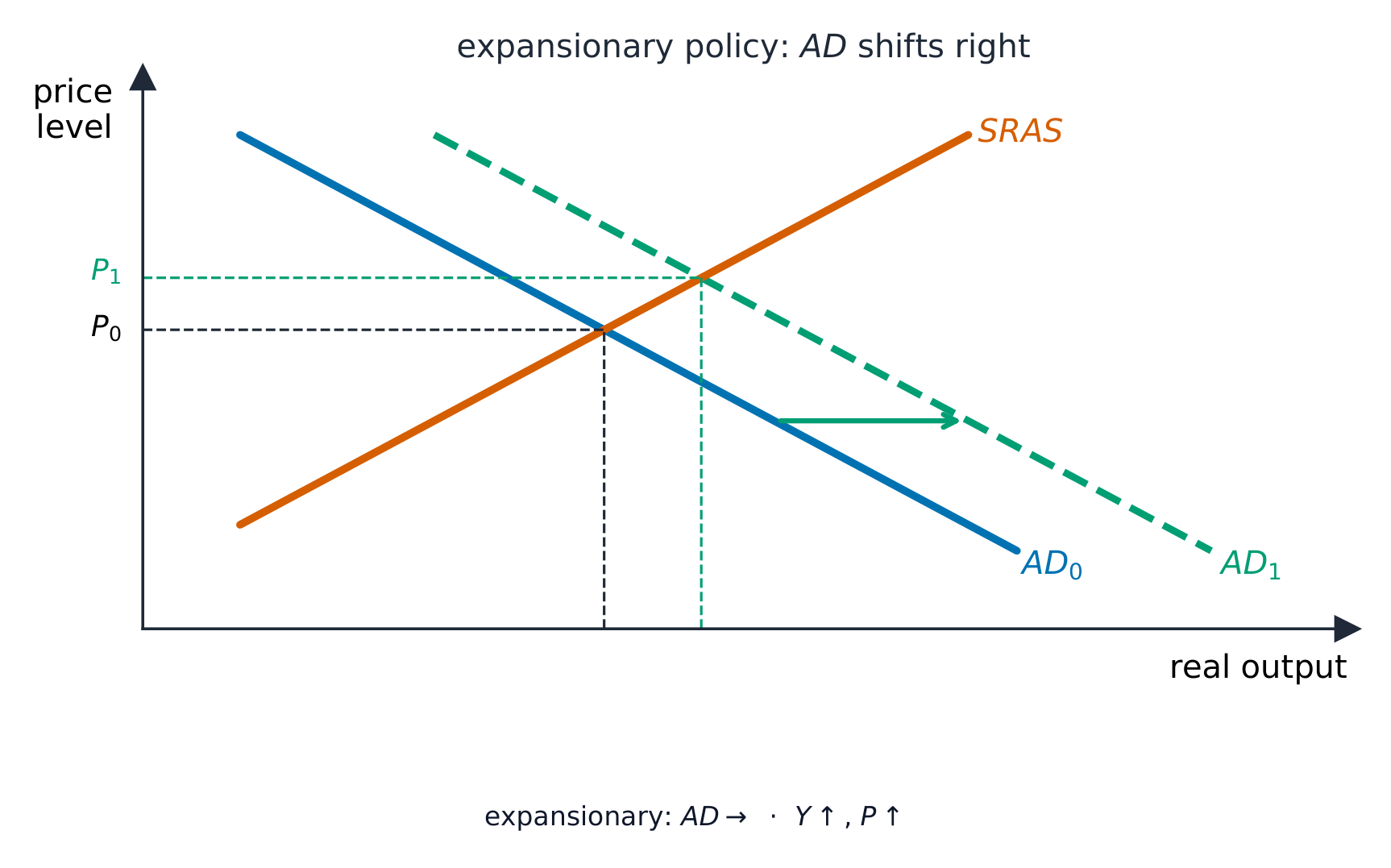
The AD curve slopes downward: a lower price level means higher real spending, so a greater real output is demanded. AD shifts when any of its four parts changes (for example, a tax cut raises C).
Aggregate supply
aggregate supply 总供给 (AS) is the total output firms are willing to make at each price level.
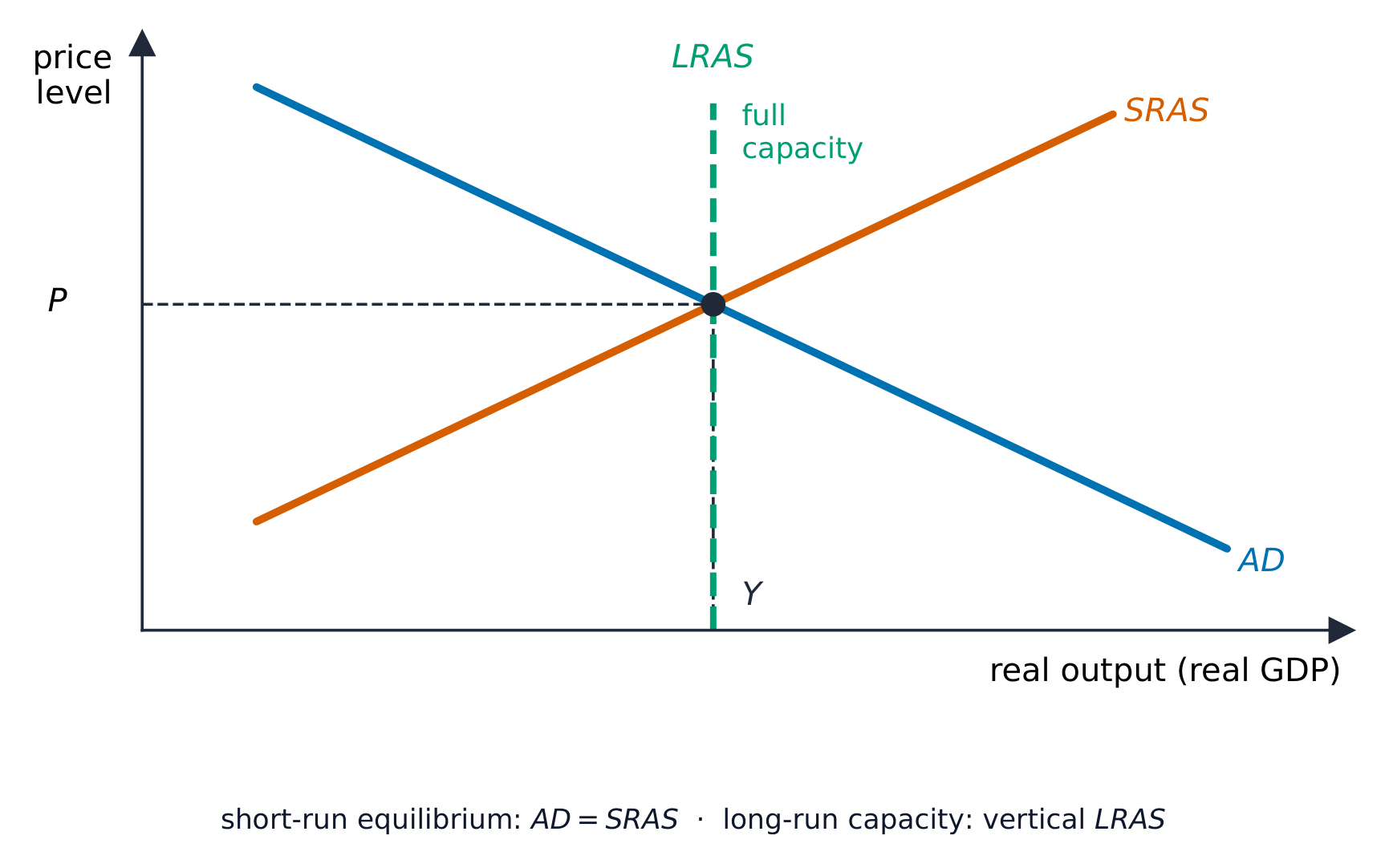
short-run aggregate supply 短期总供给 (SRAS) slopes upward. In the short run, higher prices make production more profitable, so firms supply more. SRAS shifts when costs change (wages, raw materials, taxes).
long-run aggregate supply 长期总供给 (LRAS) shows the economy's full productive capacity 生产能力. It shifts only when the quantity or quality of factors changes.
Macroeconomic equilibrium
macroeconomic equilibrium 宏观经济均衡 is where AD crosses AS. It sets the price level 价格水平 and the real output 实际产出 of the economy. A shift in AD or AS changes both.
עברית
ביקוש ו Offer מצטברים
ביקוש מצטבר
ביקוש מצטבר (AD) הוא הסכום הכולל של הוצאות על סחורות ושירותי המדינה בכל רמת מחיר. הוא מורכב מארבעה חלקים:
$$AD = C + I + G + (X - M)$$
C היא צריכה — הוצאות של משקי הבית.
I היא השקעה — הוצאות של חברות על הון.
G היא הוצאות ממשלתיות.
(X − M) הם יצוא נטו — יצוא פחות יבוא.
הביקוש המצטבר הוא ההוצאה הכוללת: צריכה, השקעה, הוצאות ממשלתיות ויצוא נטו
עקומת AD נוטה למטה: רמת מחירים נמוכה יותר פירושה הוצאות אמיתיות גבוהות יותר, ולכן נדרש תפוקה אמיתית גדולה יותר. AD זז כאשר אחד מחלקיו הארבעה משתנה (למשל, קיצוץ במיסים מעלה את C).
Offer מצטבר
Offer מצטבר (AS) הוא התפוקה הכוללה שהחברות מוכנות לייצר בכל רמת מחיר.
Offer מצטבר לטווח קצר (SRAS) נוטה למעלה. בטווח הקצר, מחירים גבוהים יותר הופכים את הייצור לרווחי יותר, ולכן החברות מספקות יותר. SRAS זז כאשר העלויות משתנות (שכר, חומרי גלם, מיסים).
Offer מצטבר לטווח ארוך (LRAS) מראה את היכולת הפורייטיבית המלאה של הכלכלה. הוא זז רק כאשר כמות או איכות הגורמים משתנים.
איזון מקרו-כלכלי
איזון מקרו-כלכלי הוא הנקודה שבה AD חוצה את AS. הוא קובע את רמת המחירים ואת התפוקה האמיתית של הכלכלה. שינוי ב-AD או ב-AS משנה את שניהם.
שיווי משקל קובע את רמת המחירים $P$ והתפוקה הממשית $Y$ כאשר AD חוצה AS קצר-טווח; LRAS אנכית מסמלת יכולת מלאה.
AD and AS cross at the price level and national output. · AD ו-AS נחתכים ברמת המחיר ובתל
4.4
Economic growth · צמיחה כלכלית
Syllabus · סיילבוס
English
distinguish actual and potential growth and explain the causes of economic growth
explain the costs and benefits of economic growth and the business (trade) cycle
עברית
להבדיל בין צמיחה בפועל וצמיחה פוטנציאלית ולהסביר את גורמי הצמיחה הכלכלית
להסביר את העלויות והתועלות של צמיחה כלכלית ואת המחזור העסקי (הכלכלי)
Source: Cambridge International syllabus · מקור: הסיילבוס הבינלאומי של קמבריד'ג'
English
economic growth 经济增长 is a rise in a country's real output (real GDP) over time.
actual growth 实际增长 is the rise in output that really happens (a movement to a point further out, or from inside the LRAS towards it).
potential growth 潜在增长 is the rise in the economy's capacity (the LRAS shifting outward).
Growth is caused by more or better factors of production: a bigger or more skilled workforce, more investment in capital, new technology, and higher productivity 生产率 (output per worker).
The business cycle
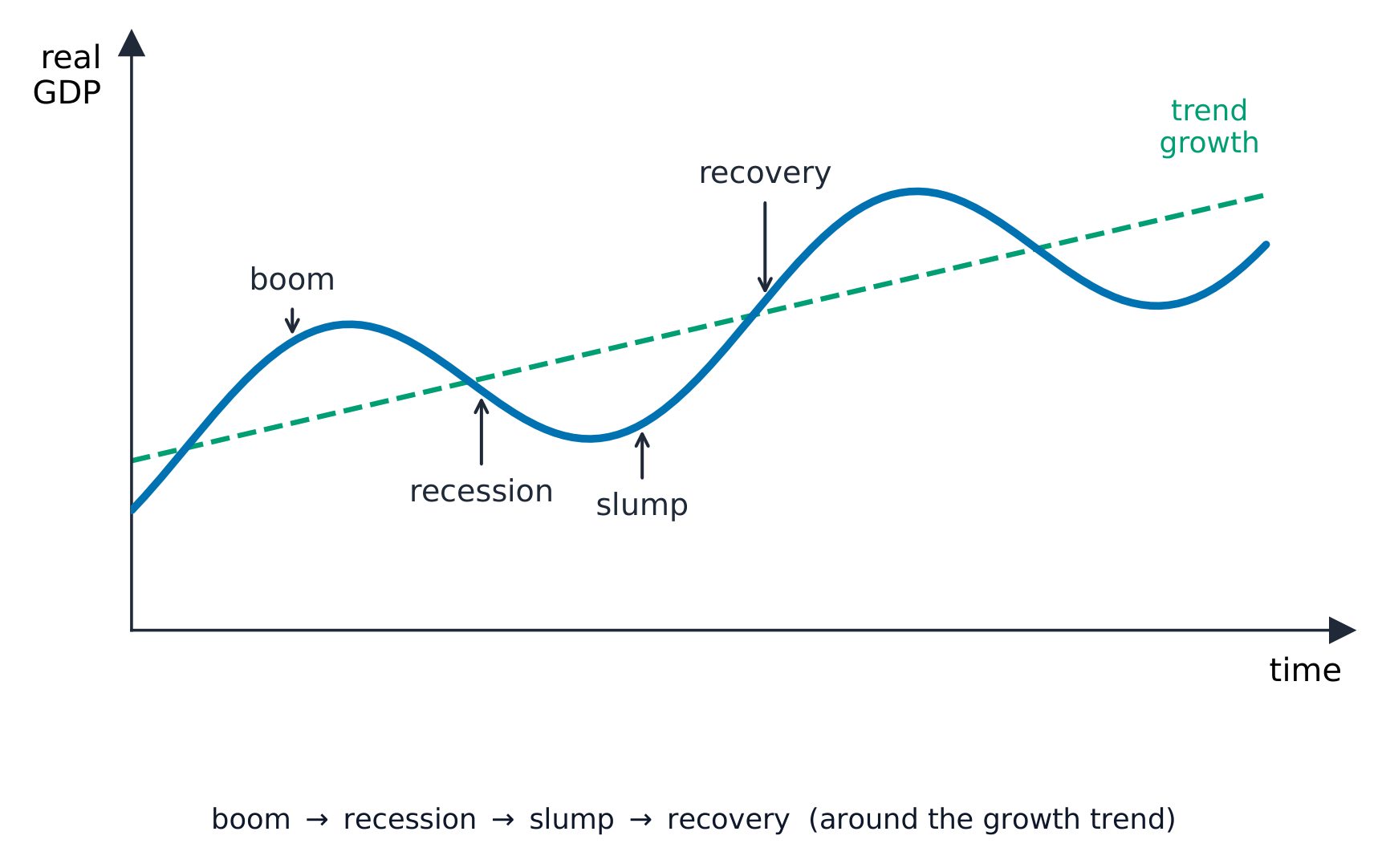
Real output does not grow smoothly. The business cycle 经济周期 (also called the trade cycle) is the up-and-down pattern of output over the years. It has four phases: boom 繁荣 (fast growth), recession 衰退 (falling output), slump 萧条 (the low point), and recovery 复苏.
Costs and benefits of growth
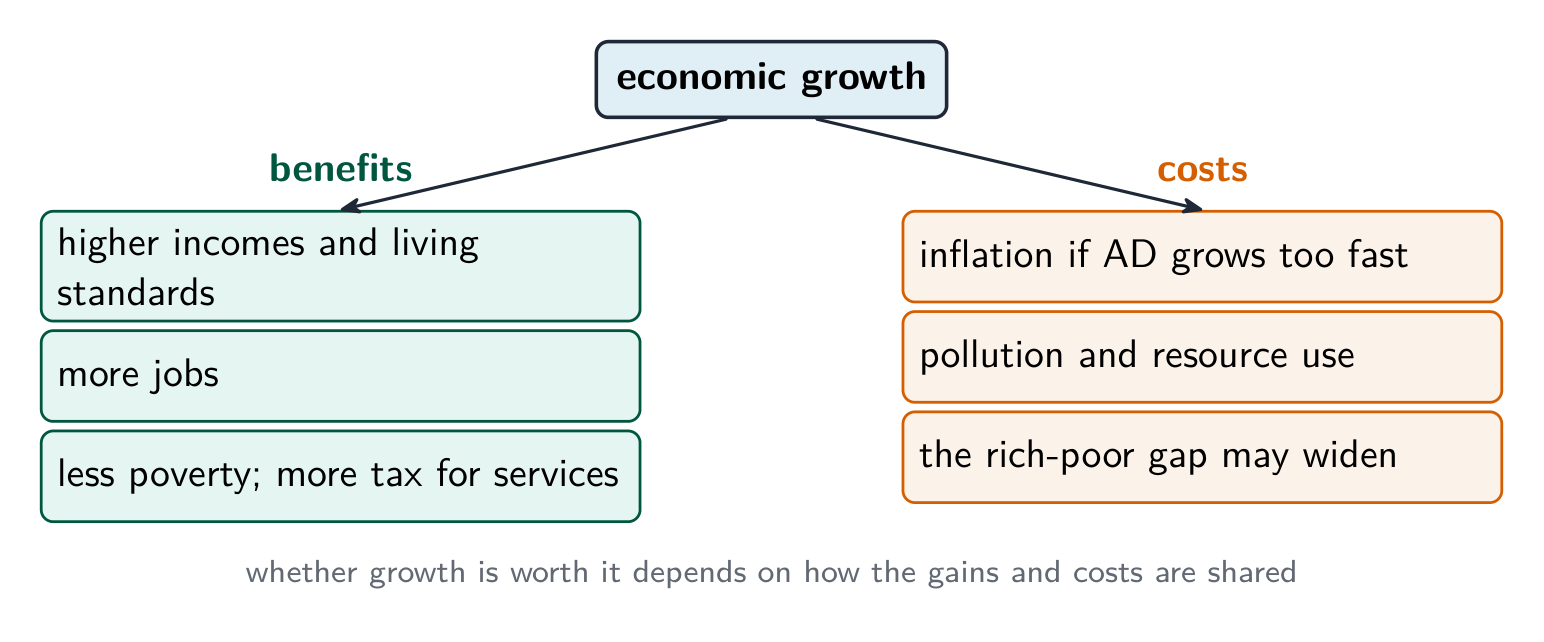
Benefits
Costs
higher incomes and living standards
can cause inflation if AD grows too fast
more jobs
pollution and use of resources
less poverty; more tax for public services
the gap between rich and poor may widen
עברית
צמיחה כלכלית היא עלייה בתפוקה הממשית של ארץ לאורך זמן (GDP ממשי).
צמיחה בפועל היא העלייה בתפוקה שמתרחשת באמת (תנועה לנקודה הרחוקה יותר, או מתוך ה-LRAS לעברו).
צמיחה פוטנציאלית היא עלייה ביכולת הכלכלה (הזזה החוצה של ה-LRAS).
הצמיחה נובעת ממספר גדול יותר או איכותיים יותר של גורמי ייצור: כוח עבודה גדול יותר או בעל מיומנויות גבוהות יותר, השקעות מוגברות בון הון, טכנולוגיה חדשה ותפוקה גבוהה יותר (פרודוקטיביות: תפוקה לעובד).
מחזור עסקים
התפוקה הממשית אינה צומחת בצורה חלקה. מחזור עסקים (כמו כן נקרא מחזור סחר) הוא הדפוס העולה-ורודף של התפוקה לאורך השנים. יש לו ארבעה שלבים: שיא (צמיחה מהירה), ריסון (ירידת תפוקה), מצוקה (הנקודה הנמוכה ביותר), והתאוששות. *
GDP ממשי נודד בין שיא, ריסון, מצוקה והתאוששות סביב המגמה הארוכת-טווח העולה שלו.
עלויות וbenefits של צמיחה
benefits
עלויות
הכנסות גבוהות יותר ורמת חיים
עלול לגרום למחירים אם AD צומחת מדי מהר
תעסוקה מוגברת
זיהום ושימוש במשאבים
עוני פחות; מיסים מוגברים לשירותי ציבור
הפער בין עשירים לעניים עשוי להתרחב
צמיחה כלכלית מביאה הכנסות גבוהות יותר ותעסוקה, אך עלולה להביא מחירים, זיהום ואי-שוויון
Explore · חקור
Economic growth shifts the frontier out · צמיחה כלכלית מזיזה את העקומה החוצה
Growth means the economy can produce more of BOTH goods — the whole frontier moves outward as resources or technology improve. · צמיחה אומרת שהכלכלה יכולה לייצר יותר מ-שתי הסוגים — העקומה כולה זזה החוצה כאשר המשאבים או הטכנולוגיה משתפרים.
define and measure unemployment (claimant count and labour force survey)
explain the types and causes of unemployment (frictional, structural, cyclical, seasonal) and its consequences
עברית
להגדיר ולמדוד אבטלה (מניית תובעים וסקירת כוח העבודה)
להסביר את סוגי האבטלה וגורמיה (חיכוך, מבני, מחזורי, עונתי) ואת השפעותיה
Source: Cambridge International syllabus · מקור: הסיילבוס הבינלאומי של קמבריד'ג'
English
unemployment 失业 means people who are able and willing to work, and are looking for a job, but cannot find one.
Measuring unemployment
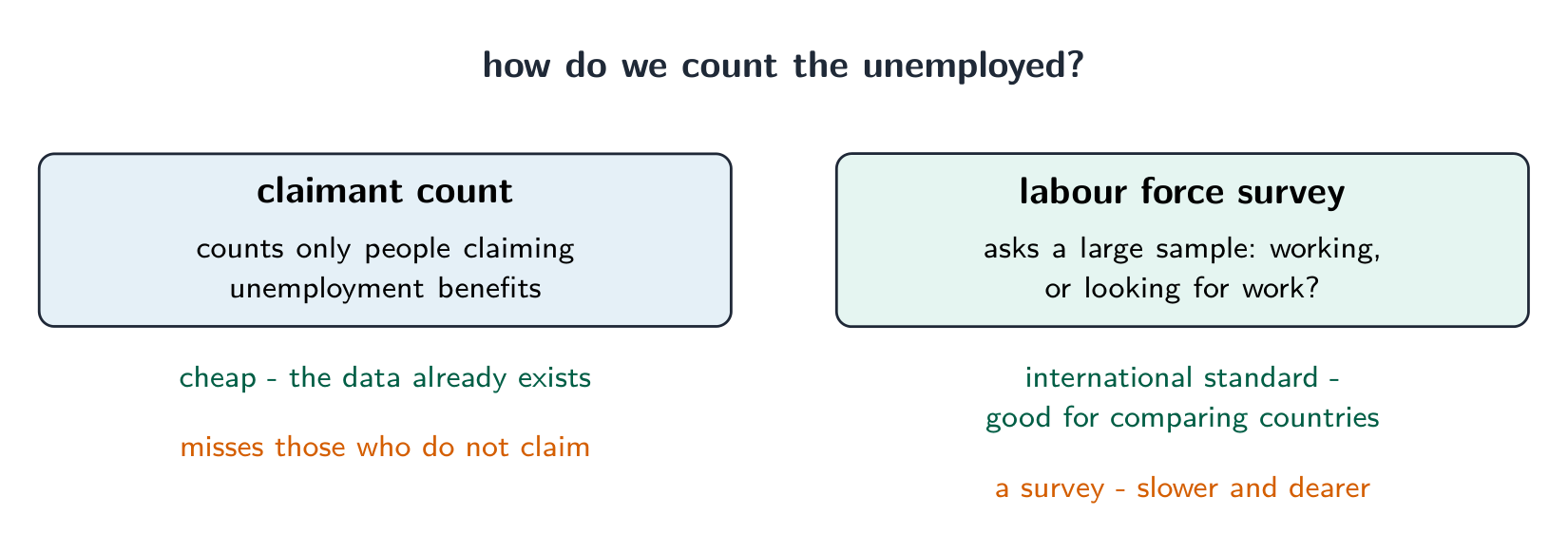
the claimant count 申领救济人数 counts only people claiming unemployment benefits. It is cheap but misses those who do not claim.
the labour force survey 劳动力调查 asks a large sample whether they are working or seeking work. It follows an international standard, so it is better for comparing countries. The labour force 劳动力 is everyone working or looking for work.
Types and causes
frictional unemployment 摩擦性失业 — short-term, while people move between jobs.
structural unemployment 结构性失业 — when an industry declines and workers' skills no longer match the jobs available.
cyclical unemployment 周期性失业 — caused by low AD in a recession. This is usually the largest type.
seasonal unemployment 季节性失业 — when work is only available at certain times of the year (such as farming or tourism).
Consequences
Unemployment wastes output (the economy produces inside its PPC), lowers incomes, and costs the government (more benefits, less tax). It also harms families and can raise crime and ill health.
עברית
אבטלה מתייחסת לאנשים שיש להם יכולת ורצון לעבוד, מחפשים מקום עבודה, אך אינם מוצאים.
מדידת אבטלה
מניית המבקשים סופרת רק אנשים התומכים בביטוח אבטלה. היא זולה אך מחמיצה את אלו שאינם תומכים.
סקר כוח העבודה שואל דגימה גדולה האם הם עובדים או מחפשים עבודה. הוא עוקב אחרי תקן בינלאומי, ולכן טוב יותר להשוות בין מדינות. כוח העבודה הוא כל מי שעובד או מחפש עבודה.
שתי דרכים לספור את האבטלים - ומה שכל אחת מהן מחמיצה
סוגים וגורמים
אבטלת חיכוך — קצרה טווח, בעוד אנשים מעברים ממשרה למשרה.
אבטלה מבנית — כאשר תעשייה נמצאת בדעיכה ומיומנויות העובדים אינן תואמות את המשרות הזמינות.
אבטלה מחזורית — נגרמת על ידי AD נמוך בשפל כלכלי. זהו בדרך כלל הסוג הגדול ביותר.
אבטלה עונתית — כאשר עבודה זמינה רק בזמן מסוים בשנה (כגון חקלאות או תיירות).
שלושה סוגי אבטלה: חיכונית, מבנית וציקלית
השלכות
אבטלה משחיתה תפוקה (הכלכלה מייצרת בתוך ה-PPC שלה), מפחיתה הכנסות ועולה לממשלה (יותר הטבות, פחות מיסים). היא גם פוגעת במשפחות ועלולה להעלות את הפשיעה והמחלות.
Explore · חקור
Unemployment in the labour market · אבטלה בשוק העבודה
If the wage is stuck ABOVE the equilibrium, more workers want jobs than firms will hire — that gap is unemployment. · אם השכר נתקע מעל רמת האיזון, יותר עובדים מחפשים תפקידים מאשר החברות מוכנות להעסיק — הפער הזה הוא אבטלה.
define inflation, deflation and disinflation and explain how the price level is measured
explain the causes (demand-pull and cost-push) and consequences of inflation and deflation
עברית
להגדיר אינפלציה, היסתלקות ודיס-אינפלציה ולהסביר כיצד נמדדת רמת המחירים
להסביר את הגורמים (ביקוש-מומשך ועלות-מומשך) והשפעות האינפלציה וההסתלקות
Source: Cambridge International syllabus · מקור: הסיילבוס הבינלאומי של קמבריד'ג'
English
Inflation, deflation and disinflation
inflation 通货膨胀 is a sustained rise in the general price level. Money then buys less, so its purchasing power 购买力 falls.
deflation 通货紧缩 is a sustained fall in the general price level.
disinflation 反通货膨胀 is when inflation is still positive but is slowing down (prices rise, but more slowly).
The price level is measured with the consumer price index 消费者价格指数 (CPI). A typical household's spending is used to build a "basket" of goods. Each good is given a weight 权重 for how much is spent on it, and the change in the basket's cost from year to year is the inflation rate:
$$\text{inflation rate} = \frac{\text{change in index}}{\text{starting index}} \times 100\%.$$
Worked example. A country's CPI rises from $100$ to $104$ over one year, then to $107$ the year after. Find the inflation rate in each year.
Year 1: $\dfrac{104 - 100}{100} \times 100\% = 4\%$. Year 2: $\dfrac{107 - 104}{104} \times 100\% = 2.9\%$.
Notice that prices are still rising in year 2, just more slowly — this fall in the inflation rate (from $4\%$ to $2.9\%$) is disinflation, not deflation.
Worked example. A worker's wage rises from $\text{\pounds} 500$ to $\text{\pounds} 520$ a week (a $4\%$ rise) while the CPI rises by $4\%$. What happens to the real wage?
Money (nominal) pay is up $4\%$, but prices are also up $4\%$, so the real wage — what the pay can actually buy — is unchanged. A pay rise only raises living standards if it beats inflation.
Causes of inflation
demand-pull inflation 需求拉动型通货膨胀 — AD rises faster than AS, so "too much money chases too few goods".
cost-push inflation 成本推动型通货膨胀 — firms' costs rise (wages or raw materials), so they raise prices, shifting SRAS to the left.
Consequences
Inflation lowers purchasing power, especially for people on fixed incomes. It creates uncertainty, can make a country's exports dearer, and helps borrowers but harms savers. Deflation sounds good but can be harmful: people delay buying (waiting for lower prices), so AD falls, firms cut output, and unemployment rises.
עברית
אינפלציה, היפוך מחירים ואינפלציה מצטמצמת
אינפלציה היא עלייה מתמשכת ברמת המחירים הכללית. כסף אז קונה פחות, ולכן הכוח הקנייתי שלו יורד.
היפוך מחירים היא ירידה מתמשכת ברמת המחירים הכללית.
אינפלציה מצטמצמת היא מצב שבו האינפלציה עדיין חיובית אך מאטה (המחירים עולים, אך בהדרגה פחות).
האינפלציה נמדדת מהמחיר של סל מוצרי צריכה שוטפים כמו אלו.
רמת המחירים נמדדת באמצעות מדד מחירי הצרכן (CPI). נעשה שימוש בהוצאות של משק בית אופייני לבניית "סל" מוצרים. לכל מוצר מוקצה משקל לפי כמות ההוצאה עליו, והשינוי בעלות הסל משנה לשנה הוא קצב האינפלציה:
$$\text{inflation rate} = \frac{\text{change in index}}{\text{starting index}} \times 100\%.$$
דוגמה מוצגת. מדד מחירי הצרכן של מדינה עלה מ-$100$ ל-$104$ במשך שנה אחת, ולאחר מכן ל-$107$ בשנה שלאחר מכן. מצאו את קצב האינפלציה בכל שנה.
שנה 1: $\dfrac{104 - 100}{100} \times 100\% = 4\%$. שנה 2: $\dfrac{107 - 104}{104} \times 100\% = 2.9\%$.
שים לב שמחירים עדיין עולים בשנה 2, אך בקצב איטי יותר — ירידת קצב האינפלציה (מ-$4\%$ ל-$2.9\%$) היא דיסאינפלציה, ולא דפליציה.
דוגמה מפורטת. השכר של עובד עולה מ-$\text{\pounds} 500$ ל-$\text{\pounds} 520$ בשבוע (גידול של $4\%$), בעוד שה-CPI עולה ב-$4\%$. מה קורה לשכר האמיתי?
התשלום הכספי (נומינלי) עלה ב-$4\%$, אך המחירים גם הם עלו ב-$4\%$, ולכן השכר האמיתי – מה שהתשלום יכול באמת לקנות – נותר ללא שינוי. עליית שכר מעלה את רמת החיים רק אם היא גבוהה יותר מקצב האינפלציה.
סיבות לאינפלציה
אינפלציית דחיפה בביקוש — הביקוש הכולל (AD) עולה מהר יותר מההיצע הכולל (AS), כך ש"יש יותר כסף שאורח אחרים סחורים".
אינפלציית דחיפת עלויות – עלויות העסקים עולות (שכר או חומרי גלם), ולכן הן מעלות מחירים, ומזיזות את ה-SRAS שמאלה.
אינפלציית דחיפה בביקוש נובעת מהזזה ימינה של AD; אינפלציית דחיפת עלויות נובעת מהזזה שמאלה של SRAS. שתיהן מביאות לעלייה ברמת המחירים.
השלכות
אינפלציה מפחיתה את כוח הקניה, במיוחד עבור אנשים עם הכנסות קבועות. היא יוצרת אי-וודאות, יכולה להפוך את היצוא של המדינה למיוקר יותר, ועוזרת לחייבים אך פוגעת בחוסכים. דפליציה נשמעת טובה אך יכולה להיות מזיקה: אנשים מעכבים קניות (מחכים למחירים נמוכים יותר), ולכן AD יורד, חברות מקצצות בתפוקה והאבטלה עולה.
Explore · חקור
Aggregate demand and supply · ביקוש וספק הכוללים
The overall price level sits where aggregate demand meets aggregate supply — a shock to either moves prices and output. · רמת המחירים הכללית נמצאת בנקודה שבה הביקוש וההיצע הכוללים נפגשים — זעזוע באלה משנה את המחירים ואת התוצאה.
Governments try to steer the whole economy. This handout covers what they aim for and the three sets of tools they use.
עברית
ממשלות מנסות לכוון את הכלכלה כולה. תרגיל זה מכסה את מה שהן שואפות להשיג ואת שלושה סוגי הכלים שהן משתמשות בהם.
5.1
Macroeconomic policy objectives · מטרות מדיניות מקרו-כלכלית
Syllabus · סיילבוס
English
state the macroeconomic policy objectives: stable low inflation, full employment, economic growth, balance of payments stability, redistribution of income
explain potential conflicts between objectives
עברית
לציין את מטרות המדיניות המקרו-כלכלית: אינפלציה נמוכה ויציבה, עסוקות מלאה, צמיחה כלכלית, יציבות במאזן התשלומים, **העברת הכנסות
להסביר את הסתירות האפשריות בין המטרות
Source: Cambridge International syllabus · מקור: הסיילבוס הבינלאומי של קמבריד'ג'
English
A government usually has five main aims:
price stability 物价稳定 — low and steady inflation 通货膨胀 (often a target of about 2% a year).
full employment 充分就业 — jobs for almost everyone who wants to work.
economic growth 经济增长 — a rising real output over time.
balance of payments 国际收支 stability — not importing far more than the country exports for years on end.
redistribution of income 收入再分配 — narrowing the gap between rich and poor.
Conflicts between objectives
The aims can conflict 冲突 — reaching one can hurt another:
growth versus inflation: fast growth raises aggregate demand 总需求, which can pull prices up.
growth versus the balance of payments: as incomes rise, people buy more imports, worsening the trade balance.
unemployment versus inflation: cutting unemployment by raising demand can cause more inflation.
growth versus the environment: more output often means more pollution.
The government has three sets of tools. Fiscal and monetary policy are demand-side policies 需求侧政策 (they work on AD). Supply-side policy works on aggregate supply 总供给.
עברית
לממשלה יש בדרך כלל חמישה מטרות עיקריות:
יציבות מחירים – אינפלציה נמוכה ויציבה (אינפלציה) (לרוב מטרה של כ-2% בשנה).
עסוקות מלאה – תעסוקה לכל מי שרוצה לעבוד.
צמיחה כלכלית – עלייה בתפוקה האמיתית לאורך זמן.
איזון תשלומים יציב — לא להעמיס על הייבוא הרבה יותר ממה שמייצאת המדינה בשנים רבות ברצף.
התאמת הכנסות — הצרת הפער בין עניים לעניים.
סתירות בין מטרות
המטרות יכולות להסתיר — השגחת אחת עלולה לפגוע באחרת:
צמיחה מול אינפלציה: צמיחה מהירה מעלה את הביקוש הכולל, שיכול להרים את המחירים.
צמיחה מול איזון התשלומים: כשהכנסות עולות, אנשים קונים יותר ממוצרי ייבוא, ומצב המסחר מתחמץ.
אבטלה מול אינפלציה: הורדת האבטלה על ידי העלאת הביקוש עלולה לגרום לאינפלציה נוספת.
צמיחה מול הסביבה: יותר תוצר לרוב פירושו זיהום רב יותר.
הרצה אחר צמיחה מהירה עלול לסתור ליציבות מחירים, לאיזון התשלומים ולסביבה
לממשלה יש שלושה סוגי כלים. מדיניות פיסקאלית ומוניטארית הן מדיניות דורשת-צד (היא פועלת על AD). מדיניות מציעת-צד פועלת על היצע הכולל.
מדיניות פיסקאלית ומוניטארית פועלות על הביקוש הכולל; מדינית מציעת-צד פועלת על ההיצע הכולל
Explore · חקור
Macro objective lab · מעבדת מטרות מקרו-כלכליות
Classify policy examples by the macroeconomic objective they target. · סווגו דוגמאות למדיניות לפי המטרה המקרו-כלכלית שהיא שואפת להשיג.
explain fiscal policy (government spending and taxation) and the budget balance
distinguish direct and indirect taxes and progressive, proportional and regressive taxes
explain the use and effectiveness of fiscal policy
עברית
להסביר את המדינית הפיסקלית (הוצאות ממשלתיות ומיסוי) ואת היתר/החוסר בתקציב
להבדיל בין מיסים ישירים ומיסים עקיפים ובין מיסים הולכים ועולים, מיסים פרופורציונליים ומיסים הולכים ויורדים
להסביר את השימוש ביעילות המדינית הפיסקלית
Source: Cambridge International syllabus · מקור: הסיילבוס הבינלאומי של קמבריד'ג'
English
fiscal policy 财政政策 is the use of government spending and taxation to influence the economy.
The budget 预算 compares the two:
a budget deficit 预算赤字 is when spending is greater than tax revenue. The government must borrow, adding to the national debt 国债.
a budget surplus 预算盈余 is when tax revenue is greater than spending.
Types of tax
a direct tax 直接税 is paid straight to the government on income or profit (income tax, corporation tax).
an indirect tax 间接税 is a tax on spending (added to the price of goods).
Taxes are also grouped by how the rate changes with income:
Type
How it works
progressive tax 累进税
the rate rises as income rises (the rich pay a larger share)
proportional tax 比例税
the rate stays the same at every income
regressive tax 累退税
the rate falls as income rises (the poor pay a larger share)
Using fiscal policy
expansionary 扩张性 fiscal policy raises government spending or cuts taxes. This raises AD, to fight a recession and unemployment.
contractionary 紧缩性 fiscal policy cuts spending or raises taxes. This lowers AD, to fight inflation.
Effectiveness. Fiscal policy can act fast on AD, but it has problems: time lags (a budget is set once a year), large deficits and debt, and crowding out 挤出效应 — when heavy government borrowing pushes up interest rates and reduces private investment.
עברית
מדיניות פיסקאלית היא השימוש בהוצאות הממשלתיים ובמיסים כדי להשפיע על הכלכלה.
ממשלות משמשות במדיניות פיסקאלית — הוצאות ממשלתיות ומיסים, הקבועים דרך הרשות המחוקקת — כדי להוביל את הכלכלה.
התקציב משווה בין שניהם:
הפרש תקציבי הוא כאשר ההוצאות גדולות מההכנסות ממיסים. הממשלה חייבת להתחייב, מה שמגדיל את החוב הלאומי.
עודף תקציבי הוא כאשר ההכנסות ממיסים גדולות מההוצאות.
סוגי מסים
מס ישיר הוא מס המיועד ישירות לממשלה על הכנסה או רווח (מס הכנסה, מס חברה).
מס עקיף הוא מס על הוצאות (מוסיף לעלות של מוצרים).
מיסים מדורגים גם לפי האופן שבו השיעור משתנה בהתאם להכנסה:
סוג
אופן פעולה
מס הולך וגובר
השיעור עולה ככל שההכנסה עולה (העשירים משלמים אחוז גבוה יותר)
מס פרופורציונלי
השיעור נשאר זהה בכל רמת ההכנסה
מס יורד
השיעור יורד ככל שההכנסה עולה (העניים משלמים אחוז גבוה יותר)
תחת מס הולך וגובר, שיעור המס הממוצע עולה עם ההכנסה; תחת מס פרופורציונלי, הוא נשאר קבוע; תחת מס יורד, הוא יורד.
שימוש במדיניות פיסקלית
מדיניות פיסקלית הרחבתית מעלה את ההוצאה הממשלתית או מקטרת את המיסים. זאת מגבירה את ביקוש הסוחרים (AD), כדי להתמודד עם מרדף ובעיות תעסוקה.
מדיניות פיסקלית צמצומית מקטרת את ההוצאה או מעלה את המיסים. זאת מורידה את ביקוש הסוחרים (AD), כדי להתמודד עם אינפלציה.
מדיניות פיסקלית או מוניטרית הרחבתית מזיזה את AD ימינה, מה שמעלה את התפוקה והרמה הכללית של המחירים; מדיניות צמצומית עושה את ההפך.
יעילות. מדיניות פיסקלית יכולה לפעול במהירות על AD, אך יש לה בעיות: השהיית זמן (תקציב נקבע פעם בשנה), גירעונות גדולים וחוב, ו-הדחפה — כאשר השאלה הממשלתית הגדולה מורמת את שיעורי הריבית ומפחיתה את ההשקעה הפרטית.
Explore · חקור
Fiscal policy shifts AD · מדינית פיסקלית מזיזה את הביקוש הכולל
Government spending and taxes move aggregate demand (AD). Drag AD to see real output and the price level change. · הוצאות ממשלתיות ומיסים משנים את הביקוש הכולל (AD). גרור את AD כדי לראות את השינוי בתוצא האמיתי וברמת המחירים.
explain monetary policy (interest rates, money supply, exchange rate) and the role of the central bank
explain the transmission mechanism and the effectiveness of monetary policy
עברית
להסביר את המדינית המונית (ריבית, כמות כסף, שיעור החילוף) ואת תפקיד הבנק המרכזי
להסביר את מנגנון ההעברה ואת יעילות המדינית המונית
Source: Cambridge International syllabus · מקור: הסיילבוס הבינלאומי של קמבריד'ג'
English
monetary policy 货币政策 is run by the central bank 中央银行. Its main tool is the interest rate 利率, but it can also change the money supply 货币供给 or influence the exchange rate 汇率.
The transmission mechanism
The transmission mechanism 传导机制 is how a change in the interest rate reaches the wider economy. If the central bank raises the interest rate:
borrowing becomes dearer, so households and firms spend and invest less.
saving is rewarded, so people spend less.
the currency tends to rise, so exports fall.
All of these lower AD, which slows inflation. A cut in the interest rate does the opposite, raising AD.
Effectiveness. Monetary policy is flexible (the rate can change at any time), but it works with a time lag of a year or more. In a deep slump, even very low rates may not make worried firms and households borrow.
עברית
מדיניות מונית מנוהלת על ידי הבנק המרכזי. הכלי העיקרי שלה הוא שיעור הריבית, אך היא יכולה לשנות גם את הספק המוני או להשפיע על המטבע החוץ-ארצי.
בנק מרכזי, כמו בנק אנגליה, קובע את שיעור הריבית — הכלי העיקרי של המדינית המונית.
מנגנון העברת השפעה
מנגנון העברת השפעה הוא האופן שבו שינוי בריבית משפיע על שאר הכלכלה. אם הבנק המרכזי מעלה את הריבית:
ההשאלות נהיות יקרות יותר, ולכן המשפחות והחברות צורכות ומשקיעות פחות.
החיסכון מקבל עידוד, ולכן אנשים צורכים פחות.
המטבע נוטה לעלות, ולכן היצוא יורד.
כל אלו מפחיתים את ביקוש הכולל (AD), מה שמאט את האינפלציה. הורדת ריבית עושה את ההפך, ומגבירה את הביקוש הכולל.
ריבית גבוהה פועלת דרך שלושה ערוצים כדי להפחית צריכה, השקעות ויצוא, ולהפחית את הביקוש הכולל ולאוט את האינפלציה.
יעילות. מדיניות מוניטרית היא גמישה (הריבית יכולה להשתנות בכל עת), אך יש לה זמן תגובה של שנה או יותר. במצוקה עמוקה, גם ריבית נמוכה מאוד עשויה לא לגרום לחברות ולמשפחות חוששות להשתאלף.
Explore · חקור
Monetary policy shifts AD · מדיניות מונוטארית מזיזה את AD
Changing interest rates moves aggregate demand. Lower rates → more borrowing and spending → AD shifts right. · שינוי בריבית מניעה ביקוש כולל. ריביות נמוכות יותר → יותר הלוואות והוצאות → AD זזה ימינה.
explain supply-side policies (market-based and interventionist: education and training, incentives, privatisation, deregulation, infrastructure)
explain the use and effectiveness of supply-side policy
עברית
להסביר את מדיניות צד האספקה (בסיס שוק והתערבות: חינוך והכשרה, אינטראנטיבים, פרטיזציה, הסרת ויסות, תשתיות)
הסבר על השימוש והיעילות של מדיניות צד האספקה
Source: Cambridge International syllabus · מקור: הסיילבוס הבינלאומי של קמבריד'ג'
English
supply-side policy 供给侧政策 tries to raise the economy's productive capacity 生产能力 — to shift long-run aggregate supply to the right. It aims to make markets work better and raise productivity 生产率.
There are two kinds.
Market-based policies let markets work more freely:
cutting income tax and benefits to strengthen the incentive 激励 to work.
privatisation 私有化 — selling state firms to private owners, who run them for profit.
deregulation 放松管制 — removing rules that block competition.
Interventionist policies use the government directly:
spending on education and training 培训 to raise workers' skills.
spending on infrastructure 基础设施 — roads, ports and broadband.
support for research and new technology.
Effectiveness. Supply-side policy is powerful because it can raise growth and lower inflation at the same time, with no trade-off. But it is slow (education takes years to pay off), costly, and some measures, like cutting benefits, can widen inequality.
Worked example. An economy is in a deep recession with a large output gap, and interest rates are already near zero. Which policy should the government use, and why is the other one weak here? Monetary policy is weak: with the base rate already near zero there is almost no room to cut further, and even cheap credit will not make firms invest when they expect no demand. Fiscal policy is stronger: government spending raises aggregate demand directly, without waiting for anyone to choose to borrow, and the multiplier means each pound spent raises national income by more than a pound as it is re-spent. Weigh the costs against it - a bigger budget deficit and rising debt, plus time lags on large projects. Match the policy to the constraint named in the question: here it is the zero lower bound, and that is precisely what makes fiscal policy the answer.
עברית
מדיניות צד האספקה שואפת להגביר את הקיבולת המייצרת של הכלכלה – להזיז את ספק האגרגטיבי לטווח הארוך (LRAS) ימינה. היא שואפת לשפר את פעילות השווקים ולהגביר את התפוקה.
מדיניות צד האספקה מגבירה את הקיבולת, מזיזה את LRAS ימינה: התפוקה בפועל עולה ורמת המחירים יורדת – צמיחה עם אינפלציה נמוכה יותר.
ישנם שני סוגים.
מדיניות מבוססת שוק מאפשרת לשווקים לפעול בחופשיות גדולה יותר:
הורדת מס הכנסה והטבות כדי לחזק את העימות לעבודה.
פרטיזציה – מכירת חברות ממשלתיות לבעלים פרטיים, המנהלים אותן למטרות רווח.
הסדרה – הסרת כללים החוסמים תחרות.
מדיניות התערבותית משתמשת בממשלה ישירות:
הוצאות על חינוך והכשרה כדי להגביר את כישורי העובדים.
הוצאות על תשתיות — כבישים, נמלים ורשת רחבה.
תמיכה במחקר ובטכנולוגיה חדשה.
יעילות. מדיניות צד האספקה היא עוצמתית משום שהיא יכולה להגביר את הצמיחה וגם להוריד את האינפלציה בו-זמנית, ללא פשרה. אך היא איטית (השקעה בחינוך דורשת שנים לפני ההחזר), יקרה, וחלק מהאמצעים, כמו גיזוז זכויות, עלולים להעמיק את אי-השוויון.
דוגמה מופרדת. כלכלה נמצאת בשפל עמוק עם פערי תפוקה גדולים, והריבית כבר קרובה לאפס. אילו מדיניות עליה לממשלה להשתמש, ולמה השנייה חלשה כאן? המדיניות המונטרית חלשה: מכיוון שהריבית הבסיסית כבר קרובה לאפס, אין כמעט מקום לגזירה נוספת, ואף האשראי הזול לא יגרום לחברות להשקיע כאשר הן מצפות לבקשה שאינה קיימת. המדיניות הפיסקלית חזקה יותר: הוצאות הממשלה מגבירות את הביקוש הכולל ישירות, מבלי להמתין לכך שמישהו יבחר להלוות, וה-מכפילה משמעותה שכל לيرة הנשקעת מעלה את התפוקה הלאומית ביותר מלيرة אחת כשהיא מושקעת מחדש. יש לאזן את העלויות מול היתרונות – גירעון תקציבי גדול יותר ועלייה בהחוב, בנוסף ל-הפרשי זמן בפרויקטים גדולים. התאם את המדיניות ל-המגבלה המוזכרת בשאלה: במקרה זה מדובר בגבול התחתון של אפס, וזה בדיוק מה שהופך את המדיניות הפיסקלית לתשובה המתאימה.
Explore · חקור
Supply-side policy shifts AS · מדיניות צד האספקה מזיזת את ⟦AS⟧
Supply-side policies raise the economy's productive capacity — aggregate supply (AS) shifts right, lowering the price level at higher output. · מדיניות צד האספקה מגבירה את היכולת הפרודוקטיבית של הכלכלה — האספקה הכוללת (AS) זזה ימינה, ומורידה את רמת המחירים ברמת תפוקה גבוהה יותר.
explain absolute and comparative advantage and the gains from specialisation and trade
explain the terms of trade and the benefits and limitations of trade theory
עברית
הסבר על יתרון מוחלט ויתרון יחסי, ועל התועלת מההתמחות בסחר
הסבר על תנאי הסחר ועל היתרונות והמגבלות של תורת הסחר
Source: Cambridge International syllabus · מקור: הסיילבוס הבינלאומי של קמבריד'ג'
international trade 国际贸易 lets countries buy and sell with each other. Trade lets each country specialise 专业化 in what it makes best, so the world makes more in total.
A container port: international trade moves goods between countries in huge volumes
Absolute and comparative advantage
a country has an absolute advantage 绝对优势 in a good if it can make more of it with the same resources than another country.
a country has a comparative advantage 比较优势 in a good if it can make it at a lower opportunity cost 机会成本 than another country.
Comparative advantage is the key idea: a country should make the goods it gives up least to produce, and trade for the rest. Look at this example, where each country uses the same resources:
Country
Wine (units)
Cloth (units)
Country A
20
10
Country B
5
5
Country A is better at both (absolute advantage in both). But think about opportunity cost:
in A, making 1 cloth means giving up 2 wine.
in B, making 1 cloth means giving up 1 wine.
So B gives up less to make cloth — B has the comparative advantage in cloth. A has it in wine. If A makes only wine and B makes only cloth, and they trade, both can end up with more than before.
Country A can make more of both goods, but its PPC is steeper: it gives up 2 wine per cloth, while B gives up only 1, so B has the comparative advantage in cloth.
Terms of trade
The terms of trade 贸易条件 measure the price of a country's exports compared with the price of its imports. It is worked out as an index:
$$\text{terms of trade} = \frac{\text{index of export prices}}{\text{index of import prices}} \times 100.$$
If export prices rise faster than import prices, the terms of trade "improve" — the country can buy more imports for the same exports.
Worked example. Over a year, a country's export price index rises from $100$ to $110$, while its import price index rises from $100$ to $105$. Find the new terms of trade.
$$\text{terms of trade} = \frac{110}{105} \times 100 = 104.8.$$
The figure is above $100$, so the terms of trade have improved: each unit of exports now buys about $4.8\%$ more imports than before.
Limits of the theory
The gains are real, but the simple theory assumes no transport costs, no trade barriers, and that costs do not change with output. In the real world these do not fully hold, and specialising in one good is risky if its price falls.
Explore · חקור
Why countries trade · מדוע מדינות סוחרות
Each country specialises where its opportunity cost is lowest, then trades — both can consume beyond their own frontier. · לכל מדינה יש יתרון יחסי במקום שבו העלות האופציונלית נמוכה ביותר, ולאחר מכן היא סוחרת — כך ששתי המדינות יכולות לצרוך מעבר לגבול הייצור האישי שלהן.
describe tools of protection (tariffs, quotas, subsidies, embargoes, administrative barriers)
explain the arguments for and against protectionism and its effects on stakeholders
עברית
תיאור כלי הגנה (מכסים, מכמות יבוא, סובsidies, אמברגו, חוסמים מינהליים)
הסבר על הטענות בעד ונגד הגנה ועל השפעתם על בעלי העניין
Source: Cambridge International syllabus · מקור: הסיילבוס הבינלאומי של קמבריד'ג'
protectionism 贸易保护主义 means a government protecting home producers from foreign competition. The main tools:
Three tools of protection: tariffs, quotas and subsidies
a tariff 关税 — a tax on imports, which raises their price.
a quota 配额 — a legal limit on the quantity of a good that may be imported.
a subsidy 补贴 to home producers, so they can sell more cheaply than foreign rivals.
an embargo 禁运 — a complete ban on trade with a country or in a good.
administrative barriers 行政壁垒 — extra paperwork and tough standards that make importing hard.
A tariff raises the price from the world price to "world price + tariff": domestic supply rises, demand falls, and imports shrink; the shaded box is the government's tariff revenue.
For and against
Arguments for protection include protecting an infant industry 幼稚产业 (a young industry that needs time to grow), saving jobs, and stopping dumping 倾销 (foreign firms selling below cost to destroy local rivals).
Arguments against are strong: protection raises prices for consumers, protects weak firms so they stay inefficient, and can lead to retaliation 报复 — other countries hitting back with their own barriers.
Effects on stakeholders
A tariff affects each stakeholder 利益相关者 differently: home producers gain, the government gains tariff revenue, but consumers lose (higher prices, less choice) and foreign producers lose sales.
Explore · חקור
Protectionism in the market · פרוטקציוניזם בשוק
A tariff or quota shifts effective supply and raises the domestic price, protecting home producers but costing consumers. Shift the lines to see it. · מכס או קוטה משנים את ההיצע היעיל ומעלים את המחיר הפנימי, תוך הגנה על יצרנים מקומיים אך בגזעל צרכנים. הזזו את הקווים כדי לראות זאת.
describe the structure of the balance of payments and the components of the current account (trade in goods and services, primary and secondary income)
explain the causes and consequences of current account deficits and surpluses
עברית
תיאור המבנה של מאזן התשלומים ורכיבי החשבון הנוכח (סחר בסחורות ושירותים, הכנסה ראשונית ומשנית)
הסבר על הסיבות וה consequences של גירעונות ועודפים בחשבון הנוכח
Source: Cambridge International syllabus · מקור: הסיילבוס הבינלאומי של קמבריד'ג'
The balance of payments 国际收支 is a record of all money flows between one country and the rest of the world. Its most-studied part is the current account 经常账户, which has four parts:
trade in goods 货物贸易 — exports and imports of physical goods.
trade in services 服务贸易 — exports and imports of services (tourism, banking).
primary income 初次收入 — income from work and investment abroad (wages, profit, interest).
secondary income 二次收入 — transfers with nothing given back, like foreign aid.
The current account adds up four flows: trade in goods and services, plus primary income (from work and investment) and secondary income (transfers)
A current account deficit 经常账户赤字 means a country buys more from abroad than it sells. A current account surplus 经常账户盈余 is the opposite. A long deficit can mean rising debt to other countries; a large surplus can mean the country saves a lot but consumes little.
Explore · חקור
Current account flow · זרימת חשבון הזרמים הנוכחי
Track exports, imports and income flows into the current account. · מעקב אחר זרימות יצוא, יבוא והכנסה אל תוך חשבון הזרמים הנוכחי.
explain the determination of floating exchange rates by demand and supply of currency, and fixed and managed systems
explain the causes and effects of appreciation and depreciation on the economy
עברית
הסבר על קביעת שיערי חילוף צף על ידי ביקוש ו Offer של מטבע, ומערכות קבועות ומונהלות
הסבר על הסיבות וה effects של הערכת ערך והורדת ערך על הכלכלה
Source: Cambridge International syllabus · מקור: הסיילבוס הבינלאומי של קמבריד'ג'
Exchange rates: appreciation
An exchange rate 汇率 is the price of one currency in terms of another. There are three main systems.
A currency exchange: the exchange rate is the price of one currency in terms of another.
a floating exchange rate 浮动汇率 is set freely by the demand for and supply of the currency. If more people want a currency (to buy its exports), its value rises.
a fixed exchange rate 固定汇率 is held at a set value by the central bank, which buys and sells the currency to keep it there.
a managed exchange rate 管理浮动汇率 mostly floats, but the central bank steps in now and then to steady it.
A floating exchange rate is set where demand for the currency meets supply. More demand for pounds ($D \to D_1$) raises the rate — an appreciation.
Appreciation and depreciation
Under floating rates:
appreciation 升值 is a rise in the currency's value. Exports become dearer for foreigners, and imports become cheaper.
depreciation 贬值 is a fall in the currency's value. Exports become cheaper, and imports become dearer.
A depreciation can therefore raise export sales and cut imports, helping the current account — but it can also raise inflation, because imports cost more.
Worked example. Suppose the exchange rate is $\text{\pounds} 1 = \$1.40$.
A UK exporter's $\text{\pounds} 200$ machine costs an American buyer $\text{\pounds} 200 \times 1.40 = \$280$. If the pound then appreciates to $\text{\pounds} 1 = \$1.60$, the same machine costs $\text{\pounds} 200 \times 1.60 = \$320$ — dearer for the American, so fewer are sold. Going the other way, a $\$700$ invoice from a US supplier costs a UK firm $\$700 \div 1.40 = \text{\pounds} 500$.
Explore · חקור
The foreign-exchange market · שוק המטבע החו
A currency has its own market. More demand for £ (or less supply) pushes the exchange rate up — it appreciates. · לכל מטבע יש שוק משלו. ביקוש מוגבר ל£ (או אספקה מופחתת) דוחף את שיער ההמרה למעלה — הוא מתחזק.
explain expenditure-switching and expenditure-reducing policies and supply-side measures to correct a deficit
evaluate the effectiveness of these policies
עברית
הסבר על מדיניות העברת הוצאה וצמצום הוצאה ואמצעי צד האספקה לתיקון גירעון
הערכת היעילות של מדיניות זו
Source: Cambridge International syllabus · מקור: הסיילבוס הבינלאומי של קמבריד'ג'
A government can use three kinds of policy to cut a deficit:
expenditure-reducing 支出减少 policies lower total demand (higher taxes or interest rates), so people buy fewer imports. But they also slow growth and raise unemployment.
expenditure-switching 支出转换 policies move spending away from imports towards home goods (a tariff, or a lower exchange rate). But they can cause retaliation or inflation.
supply-side policies raise the competitiveness 竞争力 of home firms (better skills and technology), so exports rise. These work best in the long run but are slow.
Trade flows at a container port: a current account deficit means imports of goods and services exceed exports
Explore · חקור
Current account flow · זרימת חשבון הזרמים הנוכחי
Track exports, imports and income flows into the current account. · מעקב אחר זרימות יצוא, יבוא והכנסה אל תוך חשבון הזרמים הנוכחי.
This topic looks more deeply at consumers, costs and firms.
עברית
נושא זה בוחן לעומק צרכנים, עלויות וחברות.
7.1
Utility and consumer choice · תועלת ובחירת הצרכן
Syllabus · סיילבוס
English
explain total and marginal utility and the law of diminishing marginal utility
derive the equi-marginal principle and explain how it relates to the demand curve, including the limitations of the marginal utility approach
עברית
הסבר על תועלת כוללת ותועלת שולית ועל חוק התועלת השולית הפוחתת
נגזור את עקרון השוויון השולי והסבר על הקשר שלו לעקומת הביקוש, כולל מגבלות הגישה התועלת-שולית
Source: Cambridge International syllabus · מקור: הסיילבוס הבינלאומי של קמבריד'ג'
English
utility 效用 is the satisfaction a consumer gets from a good.
total utility 总效用 is the satisfaction from all the units consumed.
marginal utility 边际效用 is the extra satisfaction from one more unit.
The law of diminishing marginal utility 边际效用递减 says each extra unit gives less extra satisfaction. Total utility still rises, but more and more slowly.
The equi-marginal principle
A consumer with a fixed budget gets the most total utility when the last dollar spent on each good gives the same extra utility. This is the equi-marginal principle 等边际原则:
$$\frac{MU_A}{P_A} = \frac{MU_B}{P_B}$$
Because marginal utility falls as you buy more, you only buy extra units when the price falls. This is why the demand curve 需求曲线 slopes downward.
Limitations
The approach is hard to use in practice: utility cannot really be measured in numbers, and people do not calculate like this. It also ignores habit and advertising.
עברית
תועלת היא השביעות שהצרכן מקבל ממוצר.
צרכנים מוצאים הכנסה מוגבלת כדי להשיג את התועלת (השביעות) הגבוהה ביותר האפשרית.
תועלת כוללת היא השביעות מכל היחידות שנצרכו.
תועלת שולית היא השביעות הנוספת מיחידה נוספת.
חוק התועלת השולית הפוחתת אומר שכל יחידה נוספת מספקת פחות שביעות נוספת. התועלת הכוללת עדיין עולה, אך בצורה מתונה יותר.
ככל שנצרך יותר, התועלת הכוללת עולה אך משטחת, מכיוון שתועלת שולית יורדת — כל יחידה נוספה מוסיפה פחות שביעות.
עקרון השוויון השולי
לצרכן עם תקציב קבוע ישנה תועלת כוללת מקסימלית כאשר הדולר האחרון שנופל על כל מוצר מייצר אותה תועלת שולית. זהו עקרון השוויון השולי:
$$\frac{MU_A}{P_A} = \frac{MU_B}{P_B}$$
מכיוון שתועלת שולית יורדת כשקונים יותר, קונים רק יחידות נוספות כאשר המחיר יורד. זוהי הסיבה שעקומת הביקוש נוטה מטה.
התועלת מקסימלית כאשר הדולר האחרון על כל מוצר מייצר אותה תועלת שולית
מגבלות
הגישה קשה לשימוש בפועל: תועלת לא ניתן למדוד באמת במספרים, ואנשים אינם מחשבים כך. כמו כן, גישה זו מתעלמת מהרגלים ומהפרסום.
Indifference curves and budget lines · עקומות אי-הבחירה וקווי תקציב
Syllabus · סיילבוס
English
explain indifference curves and budget lines and consumer equilibrium
explain income and substitution effects for normal, inferior and Giffen goods
עברית
הסבר עקומות אידיאליות וקווי תקציב ואיזון הצרכן
הסבר השפעת הכנסה והשפעת החלפה עבור סחורות רגילות, נמוכות וג'יפן
Source: Cambridge International syllabus · מקור: הסיילבוס הבינלאומי של קמבריד'ג'
English
An indifference curve 无差异曲线 shows all the combinations of two goods that give a consumer the same total utility. It slopes downward (more of one good means less of the other) and bows in towards the origin.
A budget line 预算线 shows all the combinations the consumer can just afford with their income, at the current prices.
consumer equilibrium 消费者均衡 is the best the consumer can do: the point where the budget line just touches the highest possible indifference curve.
Income and substitution effects
When the price of a good falls, the consumer buys more for two reasons:
the substitution effect 替代效应 — the good is now cheaper than others, so the consumer switches towards it.
the income effect 收入效应 — the consumer's money now buys more, so real income has risen.
These effects work differently for different goods:
for a normal good 正常品, both effects raise the quantity bought.
for an inferior good 低档品, the income effect works the other way (higher real income lowers demand), but it is usually weaker, so demand still rises when price falls.
a Giffen good 吉芬品 is a rare, very inferior good where the income effect is so strong that demand actually falls when the price falls. Its demand curve slopes upward.
עברית
עקומת אי-הבדל מציגה את כל השילובים של שני סוגי סחורות המעניקים לצרכן אותו תועלת כוללת. היא נוטה כלפי מטה (ככל שיש יותר מסחורה אחת, יש פחות מהשנייה) ומתעגלת לכיוון הראשית.
קו תקציב מציג את כל השילובים שהצרכן יכול להרשות לעצמו בדיוק עם הכנסתו, במחירים הנוכחיים.
איזון צרכן הוא הטוב ביותר שיכול להשיג הצרכן: הנקודה שבה קו התקציב נוגע בדיוק בעקומת האי-הבדל הגבוהה האפשרית.
הבחירה הטובה ביותר של הצרכן היא במקום שבו קו התקציב נוגע בעקומת האי-הבדל הגבוהה ביותר שהניתן להגיע אליה; עקומה גבוהה יותר אינה בהישג ידו.
אפקטים של הכנסה והחלפה
כאשר המחיר של סחורה יורד, הצרכן קונה יותר משתי סיבות:
אפקט ההחלפה — הסחורה הפכה עכשיו זולה יותר מאחרות, ולכן הצרכן מתמקד בה.
אפקט ההכנסה — כסף של הצרכן קונה עכשיו יותר, ולכן ההכנסה הריאלית עלתה.
אפקטים אלו פועלים בצורה שונה עבור סחורות שונות:
עבור סחורה רגילה, שני האפקטים מגדילים את כמות הקניה.
עבור סחורה נמוכה, אפקט ההכנסה פועל בכיוון ההפוך (הכנסה ריאלית גבוהה מפחיתה בביקוש), אך הוא בדרך כלל חלש יותר, ולכן הביקוש עדיין עולה כאשר המחיר יורד.
סחורת גיפן היא סחורה נמוכה מאוד ונדירה שבה אפקט ההכנסה חזק enough כך שביקוש למעשה יורד כאשר המחיר יורד. עקום הביקוש שלה נוטה כלפי מעלה.
Explore · חקור
Budget line lab · מעבדת קו תקציב
good B = income / priceB - slope x good A · good B = הכנסה / מחירB - שיפוע x good A
Move quantity of one good and see the trade-off with the other good. · זז בכמות של סחורה אחת והסתכל על הפיצוי עם הסחורה השנייה.
Efficiency and market failure · יעילות וכשל בשוק
Syllabus · סיילבוס
English
explain productive and allocative efficiency, Pareto optimality and dynamic efficiency
explain market failure, including from monopoly, externalities, public goods, information failure and factor immobility
עברית
הסבר יעילות ייצורית ויעילות הקצאה, אופטימליות פארטו ויעילות דינמית
הסבר כשל שוק, כולל ממנופול, חיצוניות, סחורות ציבוריות, כשל מידע וחוסר גמישות גורמים
Source: Cambridge International syllabus · מקור: הסיילבוס הבינלאומי של קמבריד'ג'
English
Economists judge how well resources are used.
productive efficiency 生产效率 — making goods at the lowest possible cost (using the fewest resources).
allocative efficiency 配置效率 — making the goods people most want, where price equals marginal cost.
Pareto optimality 帕累托最优 — a point where no one can be made better off without making someone else worse off.
dynamic efficiency 动态效率 — improving over time through new technology and better products.
market failure 市场失灵 happens when the free market does not reach an efficient result. The main causes are monopoly power, externalities 外部性, public goods 公共物品, information failure 信息失灵, and factor immobility 要素不流动性 (factors cannot move quickly to where they are needed).
עברית
כלכלנים שופטים עד כמה המשאבים משמשים בצורה טובה.
יעילות פרודוקטיבית היא העלות הנמוכה ביותר; יעילות הקצאה היא ייצור מה שאנשים רוצים
יעילות ייצורית — ייצור סחורות בעלות מינימלית אפשרית (שימוש במשארים המינימליים).
יעילות הקצאה — ייצור הסחורות שאנשים רוצים הכי הרבה, שבו המחיר שווה לעלות השולית.
אופטימליות פרטו — נקודה שבה אף אחד לא יכול להיות מרווח יותר מבלי לפגוע באחר.
יעילות דינמית — שיפור לאורך זמן דרך טכנולוגיה חדשה ומוצרים טובים יותר.
כישלון שוק מתרחש כאשר השוק החופשי אינו מגיע לתוצאה יעילה. הסיבות העיקריות הן כוח מונופולי, חיצוניות, סחרים ציבוריים, כשל מידע ואי-ניידות גורמים (גורמים אינם יכולים להזיז מהר למקומות בהם הם נדרשים).
Explore · חקור
Allocative efficiency · יעילות הקצאה
The market is allocatively efficient where supply meets demand — price equals marginal cost. Market failure pushes it away from that point. · השוק יעיל בהקצאה כאשר ההיצע פוגש את הביקוש — המחיר שווה לעלות השולית. כישלון שוק מרחיק אותו מנקודה זו.
Externalities and social costs and benefits · חיצוניות ועלויות ורווחים חברתיים
Syllabus · סיילבוס
English
distinguish private, external and social costs and benefits
analyse positive and negative externalities of production and consumption using marginal analysis and explain deadweight welfare loss
עברית
הבדלה בין עלויות ורווחים פרטיים, חיצוניים וחברתיים
ניתוח חיצוניות חיובית ושלילית בייצור ובצריכה באמצעות ניתוח שולי והסבר הפסד רווחה אובדני
Source: Cambridge International syllabus · מקור: הסיילבוס הבינלאומי של קמבריד'ג'
English
Some costs and benefits fall on people outside the deal. We separate three levels:
a private cost 私人成本 or private benefit 私人收益 falls on the buyer or seller.
an external cost 外部成本 or external benefit 外部收益 falls on a third party.
the social cost 社会成本 is private cost plus external cost; the social benefit 社会收益 is private benefit plus external benefit.
Marginal analysis
We study externalities with marginal analysis 边际分析, using these curves:
marginal private cost 边际私人成本 (MPC) and marginal social cost 边际社会成本 (MSC).
marginal private benefit 边际私人收益 (MPB) and marginal social benefit 边际社会收益 (MSB).
The best outcome for society is where MSC = MSB. But the market produces where MPC = MPB. The gap between these creates lost welfare.
a negative externality 负外部性 (like pollution) means MSC is above MPC. The market makes too much.
a positive externality 正外部性 (like education) means MSB is above MPB. The market makes too little.
The lost welfare from making too much or too little is the deadweight welfare loss 无谓损失 — the triangle on the diagram between the social and private curves.
עברית
חלק מעלויות ורווחים נופלים על אנשים מחוץ לעסקה. אנו מבדילים בין שלושה רמות:
עלות פרטית או רווח פרטי נופלים על הקונה או המוכר.
עלות חיצונית או רווח חיצוני נופלים על צד שלישי.
העלות החברתית היא סך העלות הפרטית והעלות החיצונית; הרווח החברתי הוא סך הרווח הפרטי והרווח החיצוני.
ניתוח שולין
אנו לומדים על חיצוניות באמצעות ניתוח שולין, תוך שימוש בעקומות הבאות:
עלות שולית פרטית (MPC) ועלות שולית חברתית (MSC).
רווח שולית פרטי (MPB) ורווח שולית חברתי (MSB).
התוצאה הטובה ביותר לחברה היא במקום בו MSC = MSB. אך השוק מייצר במקום בו MPC = MPB. הפער בין שתי הנקודות הללו יוצר איבוד רווחה.
חיצוניות שלילית (כמו זיהום) משמעותה שה-MSC נמצאת מעל ה-MPC. השוק מייצר יותר מדי.
חיצוניות חיובית (כמו חינוך) משמעותה שה-MSB נמצאת מעל ה-MPB. השוק מייצר פחות מדי.
הרווחה האבודה כתוצאה מייצור יותר מדי או פחות מדי היא איבוד רווחה מתבוסס — המשולש בתרשים בין העקומה החברתית לעקומה הפרטית.
זיהום תעשייתי: חיצוניות שלילית שבה העלות החברתית עולה על העלות הפרטית
Explore · חקור
Externalities shift the social curve · חיצוניויות מזיזות את הגרף החברתי
A negative externality means the social cost is above the private supply curve; the free-market quantity is then too high. · חיצונייה שלילית אומרת שהעלות החברתית נמצאת מעל עקומת האספקה הפרטית; כמות השוק החופשי היא אז גבוהה מדי.
Costs, revenue and profit · עלויות, הכנסות ורווחים
Syllabus · סיילבוס
English
explain fixed, variable, total, average and marginal cost and short-run and long-run production (law of diminishing returns, returns to scale)
explain total, average and marginal revenue and normal, supernormal (abnormal) and subnormal profit
עברית
הסבר עלות קבועה, משתנה, כוללת, ממוצעת ושולית ותהליך ייצור בטווח קצר וארוך (חוק הריבועים הפוגעים), תשואות למידת התרחבות)
הסבר הכנסה כוללת, ממוצעת ושולית ורווח רגיל, עודף (בלתי רגיל) ורווח נמוך
Source: Cambridge International syllabus · מקור: הסיילבוס הבינלאומי של קמבריד'ג'
English
Economies of scale: average cost falls
Costs
In the short run 短期, at least one factor is fixed; in the long run 长期, all factors can change.
Cost
Meaning
fixed cost 固定成本
does not change with output (rent on a factory)
variable cost 可变成本
changes with output (raw materials)
total cost 总成本
fixed cost plus variable cost
average cost 平均成本
total cost per unit: $AC = TC / Q$
marginal cost 边际成本
the cost of one more unit: $MC = \Delta TC / \Delta Q$
Worked example. Making $10$ units costs £500 in total; making $11$ units costs £540. Find the average cost at $10$ units and the marginal cost of the 11th unit.
Here $MC$ ($\text{\pounds} 40$) is below $AC$ ($\text{\pounds} 50$), so making the 11th unit pulls the average cost down — whenever marginal cost is below average cost, average cost falls.
In the short run, output is limited by the law of diminishing returns 边际报酬递减: as you add more of a variable factor (workers) to a fixed factor (machines), each extra worker eventually adds less output. This makes marginal cost rise.
In the long run, all factors vary, so we look at returns to scale 规模报酬. As a firm grows, it can gain economies of scale 规模经济 (lower average cost from buying in bulk, using big machines, and specialising). If it grows too big, it may suffer diseconomies of scale 规模不经济 (poor communication and control), and average cost rises.
Revenue
Revenue
Meaning
total revenue 总收益
all money from sales: $TR = P \times Q$
average revenue 平均收益
revenue per unit, which equals the price
marginal revenue 边际收益
the revenue from one more unit: $MR = \Delta TR / \Delta Q$
Worked example. A firm sells $10$ units at £50 each. To sell an 11th unit it must lower the price to £48 on every unit. Find the total revenue at each output and the marginal revenue of the 11th unit.
The marginal revenue ($\text{\pounds} 28$) is well below the £48 price, because the lower price applies to all $11$ units, not just the extra one.
Profit
Profit is total revenue minus total cost. Economists include the opportunity cost of the owner's resources in cost, so:
normal profit 正常利润 is just enough profit to keep the firm in the industry. It counts as a cost.
supernormal profit 超常利润 (also called abnormal profit) is profit above normal.
subnormal profit 次正常利润 is profit below normal — the firm may leave in the long run.
A firm makes the most profit at the output where $MR = MC$.
Worked example. At its best output a firm makes $100$ units, sells each for £12 (its average revenue), and has an average cost of £9. Find the supernormal profit.
Because average revenue (£12) is above average cost (£9), the firm earns supernormal profit. If instead $AR = AC$, it would make only normal profit; if $AR < AC$, it would make a loss.
עברית
חסכוניות בקנה מידה: עלות ממוצעת יורדת
עלויות
בתקופת השורה הקצרה, לפחות גורם אחד קבוע; בתקופת השורה הארוכה, כל הגורמים יכוליםשתנות.
מפעל פלדה גדול: חברות גדולות נהנות ממחירי יחידה, כך שהעלות הממוצעת יורדת כשהתפוקה עולה.
עלות
משמעות
עלות קבועה
אינה משתנה בהתאם לתפוקה (שכירות מפעל)
עלות משתנה
משתנה בהתאם לתפוקה (חומרי גלם)
עלות כוללת
עלות קבועה פלוס עלות משתנה
עלות ממוצעת
עלות כוללת ליחידת מוצר: $AC = TC / Q$
עלות שולית
העלות של יחידה נוספת: $MC = \Delta TC / \Delta Q$
דוגמה מפורטת. ייצור $10$ יחידות עולה £500 בסך הכל; ייצור $11$ יחידות עולה £540. מצאו את העלות הממוצעת ב-$10$ יחידות ואת העלות השולית של היחידה ה-11.
כאן $MC$ ($\text{\pounds} 40$) נמוך מ-$AC$ ($\text{\pounds} 50$), ולכן ייצור היחידה ה-11 מוריד את העלות הממוצעת — כל עוד העלות השולית נמוכה מהעלות הממוצעת, העלות הממוצעת יורדת.
בתקופה הקצרה, התפוקה מוגבלת על ידי חוק התגמולים הדוחים: כאשר מוסיפים יותר של גורם משתנה (עובדים) לגורם קבוע (מכונות), כל עובד נוסף מוסיף לבסוף פחות תפוקה. דבר זה גורם לעלות השולית לעלות.
העלות השולית, העלות הכוללת הממוצעת והעלות המשתנה הממוצעת כולן בצורת U; ה-MC חותך את שתי עקומות הממוצע בנקודות הנמוכות ביותר שלהן.
בתקופה הארוכה, כל הגורמים משתנים, ולכן אנו מסתכלים על תגמולי סקאלה. כאשר החברה גדלה, היא יכולה להשיג חסכי סקאלה (עלות ממוצעת נמוכה יותר מהזמנת כמויות גדולות, שימוש במכונות גדולות והתמחות). אם היא גדלה מדי, היא עלולה לסבול מ-חוסרי סקאלה (תקשורת ושליטה לקויה), והעלות הממוצעת עולה.
העלות הממוצעת בטווח הארוך יורדת בזמן חסכי סקאלה, מגיעה למינימום, ואז עולה בזמן חוסרי סקאלה.
הכנסה
הכנסה
משמעות
הכנסה כוללת
כל הכסף מהמכירות: $TR = P \times Q$
הכנסה ממוצעת
הכנסה ליחידת מוצר, ששווה למחיר
הכנסה שולית
ההכנסה מייחידה נוספת: $MR = \Delta TR / \Delta Q$
דוגמה מופתרת. חברה מוכרת $10$ יחידות במחיר של £50 כל אחת. כדי למכור את היחידה ה-11, עליה להוריד את המחיר ל-£48 על כל היחידות. מצאו את ההכנסה הכוללת בכל רמת תפוקה ואת ההכנסה השולית של היחידה ה-11.
ההכנסה השולית ($\text{\pounds} 28$) נמוכה משמעותית ממחיר ה-£48, מכיוון שהמחיר הנמוך חל על כל $11$ היחידות, ולא רק על היחידה הנוספת.
רווח
הרווח הוא ההכנסה הכוללה פחות העלות הכוללת. כלכלנים כוללים בעלות את עלות ההזדמנות של המשאבים של בעל העסק, ולכן:
רווח רגיל הוא בדיוק הסכום הדרוש כדי לשמור על החברה בתחום זה. הוא נחשב לעלות.
רווח מעל-רגיל (נרשה גם כרווח חריג) הוא רווח הגבוה מן הרגיל.
רווח מתחת-רגיל הוא רווח נמוך מן הרגיל — ייתכן שהחברה תצטרף מהשוק בטווח הארוך.
חברה מקסימה את הרווח שלה ברמת התפוקה שבה $MR = MC$.
דוגמה מופתרת. ברמת התפוקה הטובה ביותר, חברה מייצרת $100$ יחידות, מוכרת כל אחת ב-£12 (ההכנסה הממוצעת שלה), והעלות הממוצעת שלה היא £9. מצאו את הרווח המעל-רגיל.
מכיוון שההכנסה הממוצעת (£12) גבוהה מהעלות הממוצעת (£9), החברה מרוויחה רווח מעל-רגיל. אם במקום זאת $AR = AC$, היא הייתה מרוויחה רק רווח רגיל; אם $AR < AC$, היא היית נגרם הפסד.
Explore · חקור
Revenue & profit · הכנסות ורווחים
y = ax² + bx + c
Total revenue rises then falls as price changes. · הכנסה כוללת עולה ולאחר מכן יורדת כאשר המחיר משתנה.
Explore · חקור
Costs and the firm · עלויות וחברה
Average cost is U-shaped; marginal cost cuts it at the minimum. Different market structures price relative to these curves. · העלות הממוצעת היא בצורת U; העלות השולית חותכת אותה בנקודת המינימום. מבני שוק שונים קובעים מחירים ביחס לעקומות אלו.
Explore · חקור
Average and marginal cost · עלות ממוצעת ועלות שולית
Change output. Marginal cost cuts average cost at its lowest point — the heart of the theory of the firm. · שנה תפוקה. עלות שולית חותכת את העלות הממוצעת בנקודה הנמוכה ביותר שלה — ליבת תורת החברה.
explain the assumptions, behaviour and outcomes of perfect competition, monopolistic competition, oligopoly and monopoly
explain price and non-price competition, collusion, price discrimination and the efficiency of each market structure
עברית
הסבר ההנחות, ההתנהגות והתוצאות של תחרות מושלמת, תחרות מונופוליסטית, אוליגופול ומונופול
הסבר תחרות מחיר ולא-מחיר, קולוזיה, הבחנת מחירים ויעילות כל מבנה שוק
Source: Cambridge International syllabus · מקור: הסיילבוס הבינלאומי של קמבריד'ג'
English
A market structure 市场结构 describes a market by the number of firms, the barriers to entry, and the type of product.
Structure
Firms
Barriers
Product
Long-run profit
perfect competition 完全竞争
very many
none
identical
normal only
monopolistic competition 垄断竞争
many
low
slightly different
normal
oligopoly 寡头垄断
a few
high
varies
often supernormal
monopoly 垄断
one
very high
unique
supernormal
in perfect competition, each firm is a tiny price taker 价格接受者 — it must accept the market price. Firms make only normal profit in the long run, and the market is both productively and allocatively efficient.
in monopolistic competition, many firms sell slightly different products (product differentiation 产品差异化), so each has a little price-setting power, but free entry competes profit away.
in an oligopoly, a few large firms dominate. They watch each other closely. They may compete hard on price, or they may agree to fix prices — this is collusion 合谋, and a group that does so is a cartel 卡特尔.
a monopoly is a single seller protected by high barriers to entry 进入壁垒. It can earn supernormal profit for a long time but is usually inefficient.
Price and non-price competition
price competition 价格竞争 means cutting prices to win customers.
non-price competition 非价格竞争 means competing in other ways — advertising, quality, branding and service.
Price discrimination
price discrimination 价格歧视 is charging different consumers different prices for the same good (for example, cheaper train tickets for students). It needs price-setting power, groups with different elasticities, and a way to stop resale between groups. It raises the firm's profit.
עברית
מבנה שוק מתאר שוק לפי מספר החברות, מחסומי הכניסה ומיני סוג המוצר.
מבנה
חברות
מחסומים
מוצר
רווח בטווח הארוך
תחרות מושלמת
רבות מאוד
אין
זהה
רק רגיל
תחרות מונופוליסטית
רבות
נמוכים
דומה מעט
רגיל
אוליגופול
מעטות
גבוהים
משתנה
לעיתים קרובות מעל-רגיל
מונופול
אחת
גבוהים מאוד
ייחודי
מעל-רגיל
ארבעת המבנים ממוקמים על ספקטרום של תחרות: חברות רבות בקצה אחד (תחרות מושלמת), וחברה אחת בקצה השני (מונופול)
בתחרות מושלמת, כל חברה היא קבלנית מחיר זעירה — היא חייבת לקבל את מחיר השוק. בחברות אלו יש רק רווח רגיל בטווח הארוך, והשוק יעיל גם ייצורית וגם הקצאה.
ב-תחרות מונופוליסטית, מספר רב של חברות מוכרות מוצרים הדומים זה לזה (הבחנה בין מוצרים), ולכן לכל אחת יש מעט כוח לקבוע מחירים, אך כניסה חופפת מתחרה על הרווחים.
ב-אוליגופול, מספר מעט של חברות גדולות שולטות. הן צופות זו אחר קרוב. הן עשויות להתחרות בחריפות על מחיר, או להסכים לקבוע מחירים – זהו שיתוף פעולה, והקבוצה העושה זאת נקראת קרטהל.
מונופול הוא מוכר יחיד המוגן על ידי מחסומי כניסה גבוהים. יכול להרוויח רווח מעל-רגיל לאורך זמן, אך בדרך כלל אינו יעיל.
באיזון ארוך טווח, חברה בתחרות מושלמת מייצרת במקום בו MC = MR בבסיס ATC, ומרוויחה רק רווח רגיל.המונופול מייצר במקום בו MC = MR, ולאחר מכן מטיל את המחיר הגבוה ביותר שאנשים מוכנים לשלם (נקרא מהcurve AR), ושמור על רווח מעל-רגיל.
תחרות במחיר ותחרות שאינה במחיר
תחרות במחיר פירוניה הורדת מחירים כדי למשוך לקוחות.
תחרות שאינה במחיר פירוניה התחרות בדרכים אחרות – דרך פרסום, איכות, מיתוג ושירות.
הבדלת מחירים
הבדלת מחירים היא גביית מחירים שונים מצרכנים שונים עבור אותו מוצר (למשל, כרטיסי רכבת זולים יותר לסטודנטים). היא דורשת כוח לקבוע מחירים, קבוצות בעלות אלסטיות שונה, ודרך למנוע מכירה חוזרת בין הקבוצות. היא מגבירה את הרווח של החברה.
Explore · חקור
Pricing and competition · קביעת מחירים ותחרות
How a firm prices depends on demand and supply; with market power it can charge above the competitive level. · כיצד חברה קובעת מחיר תלויה בביקוש ובהצעה; עם כוח שוק היא יכולה לגבות מעל הרמה התחרותית.
The growth and survival of firms · צמיחה ושרדות של חברות
Syllabus · סיילבוס
English
explain why firms grow (internal and external — horizontal, vertical, conglomerate integration) and why some remain small
explain barriers to entry and exit and the survival of small firms
עברית
הסבר מדוע חברות צומחות (פנימית וחיצונית — שילוב אופקי, אנכי, קונגלומרט) ומדוע חלקן נשארות קטנות
הסבר מחסומי כניסה ויציאה ושרדות של חברות קטנות
Source: Cambridge International syllabus · מקור: הסיילבוס הבינלאומי של קמבריד'ג'
English
Firms grow in two ways:
internal growth 内部增长 (organic) — growing bigger by selling more.
external growth 外部增长 — joining with another firm through a merger 合并 or takeover. Types:
horizontal integration 横向一体化 — joining a firm at the same stage of the same industry (two car makers).
vertical integration 纵向一体化 — joining a firm at a different stage (a car maker buys a tyre maker).
conglomerate integration 混合一体化 — joining a firm in a different industry, to spread risk.
Why some firms stay small
Many firms stay small because the market is small (local services), the owner wants to keep control, or there are few economies of scale. They survive by offering personal service or filling a niche 利基市场.
Firms also face barriers to entry and barriers to exit 退出壁垒 (such as costly machines that cannot be sold). High exit barriers can trap a firm in a loss-making market.
עברית
חברות צומחות בשתי דרכים:
צמיחה פנימית (אורגנית) – גדילה על ידי מכירת יותר.
צמיחה חיצונית – הצטרפות לחברה אחרת דרך מיזוג או השתלטות. סוגים:
שילוב אופקי – הצטרפות לחברה באותה רמה באותו תעשייה (שתי יצרניות רכב).
שילוב אנכי – הצטרפות לחברה ברמה שונה (יצרן רכבים קונה יצרן צמיגים).
שילוב קונגלומרט – הצטרפות לחברה בתעשייה אחרת, כדי לפזר סיכון.
חברות רבות נשארות קטנות משום שהשוק קטן (שירותים מקומיים), המנהל/הבעלים רוצה לשמור על שליטה, או שיש מעט כלכלת סולידיות. הן שורדות על ידי הצעת שירות אישי או תפיסת נישה.
חברות פוגשות גם בחסמי כניסה ובחסמי יציאה (כמו ציוד יקר שאינו ניתן למכירה). חסימת יציאה גבוהה יכולה לתפוס חברה בשוק מפיק מכסאות.
Explore · חקור
Firm objective lab · מעבדת מטרת חברה
Classify real firm decisions by the objective they reveal. · מיון החלטות של חברות אמיתיות לפי המטרה שהן חושפות.
explain alternative objectives of firms: profit maximisation, revenue maximisation, sales maximisation, satisficing
explain the divorce of ownership from control (principal–agent problem) and its consequences
עברית
הסבר מטרות חלופיות לחברות: מקסימום רווח, מקסימום הכנסה, מקסימום מכירות, שביעות רצון
הסבר הפרדת בעלות משליטה (בעיית סוכן–מקפל) והשלכותיה
Source: Cambridge International syllabus · מקור: הסיילבוס הבינלאומי של קמבריד'ג'
English
Not every firm simply chases the most profit.
profit maximisation 利润最大化 — producing where MR = MC. The traditional aim.
revenue maximisation 收益最大化 — producing where MR = 0, perhaps to grow market share.
sales maximisation 销售最大化 — selling as much as possible while still making normal profit.
satisficing 满意化 — aiming for "good enough" results that keep owners, workers and customers all reasonably happy.
Divorce of ownership from control
In large companies the owners (shareholders) are not the managers. This divorce of ownership from control 所有权与控制权分离 creates the principal-agent problem 委托代理问题: managers (the agents) may pursue their own aims — bigger salaries or an easier life — instead of the owners' aim of maximum profit.
עברית
לא כל חברה רודפת רק אחרי הרווח הגדול ביותר.
מקסום רווח — ייצור ברמה שבה MR = MC. המטרה המסורתית.
מקסום הכנסה — ייצור ברמה שבה MR = 0, אולי כדי לגדול את נתח השוק.
מקסום מכירות — מכירת כמות האפשרית הגדולה ביותר תוך שמירה על רווח רגיל.
שביעות רצון — מטרה להשיג תוצאות "טובות מספיק" שמאפשרות לבעלים, לעובדים וללקוחות להיות מרוצים במידה סבירה.
הפרדה בין זכות לניהול
בחברות גדולות הבעלים (המשקיעים) אינם המנהלים. הפרדה זו בין זכות לניהול יוצרת את בעיית הסוכן: המנהלים (הסוכנים) עשויים לרדוף אחרי מטרות משלהם – שכר גבוה יותר או חיים נעימים יותר – במקום למטרת הבעלים למקסום הרווח.
Explore · חקור
Firm objective lab · מעבדת מטרת חברה
Classify real firm decisions by the objective they reveal. · מיון החלטות של חברות אמיתיות לפי המטרה שהן חושפות.
Calculate AC, MC, TR and MR, and remember a firm maximises profit where $MR = MC$.
Distinguish the market structures (perfect competition, monopolistic competition, oligopoly, monopoly) by number of firms, barriers and price-setting power.
Distinguish normal from supernormal profit and link long-run entry and exit to it.
On a cost diagram, note that MC cuts AC at the minimum of AC.
עברית
לחשב AC, MC, TR ו-MR, ולהזכיר כי חברה מקסימה רווח כאשר $MR = MC$.
להבדיל בין מבני שוק (תחרות מושלמת, תחרות מונופוליסטית, אוליגופוליה, מונופול) לפי מספר חברות, חסמים וכוח קביעת מחירים.
להבדיל בין רווח רגיל לבין רווח מעל-רגיל ולקשר את הכניסה והיציאה באורך טווח לכך.
בגרף העלויות, יש לשים לב כי MC חותך את AC בנקודה הנמוכה ביותר של AC.
8
Government microeconomic intervention (A Level) · התערבות ממשלתית בכלכליה המיקרו-כלכלית (A Level)
This topic looks at how governments correct market failure 市场失灵, make incomes fairer, and act in the labour market.
עברית
נושא זה בוחן כיצד ממשלות מתקנות כשל שוק, מבטיחות התייחסות הוגנת להכנסות ומפעילות בשוק העבודה.
8.1
Correcting market failure · תיקון כשל שוק
Syllabus · סיילבוס
English
explain policies to correct market failure: taxes, subsidies, price controls, tradable permits, regulation, provision, nationalisation and privatisation
explain competition policy and the concept of government failure
עברית
הסבר על מדיניות לתיקון כשל שוק: מסיים, סובסידיות, בקרת מחירים, רישיונות סחר, וויסות, אספקה, לאומיזציה ופרטיזציה
הסבר על מדיניות תחרות ועל מושג כשל ממשלתי
Source: Cambridge International syllabus · מקור: הסיילבוס הבינלאומי של קמבריד'ג'
English
A government has many tools to push a market towards a better use of resources.
an indirect tax 间接税 on a good with a negative externality (like fuel) raises its price and cuts the quantity used.
a subsidy 补贴 for a good with a positive externality (like solar panels) lowers its price and raises the quantity.
a price control 价格管制 sets a legal maximum or minimum price.
tradable permits 可交易许可证 cap total pollution and let firms buy and sell the right to pollute.
regulation 管制 uses rules and laws, such as bans, safety standards and pollution limits.
state provision 政府提供 means the government supplies a good directly, often free (schools, hospitals, defence).
nationalisation 国有化 is taking an industry into government ownership; privatisation 私有化 is selling a state industry to private owners.
Competition policy
A firm with monopoly power 垄断势力 can raise prices and cut output. competition policy 竞争政策 is the set of laws used to protect competition — for example, blocking mergers that create too much power, banning price-fixing, and fining firms that abuse their position.
Government failure
Intervention can backfire. government failure 政府失灵 is when the government's action leads to a worse use of resources than before — through poor information, high costs, long time lags, or unintended effects (such as a black market caused by a price control).
עברית
לממשלה יש מגוון כלים לדחוף את השוק לכיוון שימוש טוב יותר במשאבים.
מס עקיף על מוצר עם חיצוניות שלילית (כמו דלק) מרים את המחיר ומפחית את הכמות המשמשת.
סובסידיה עבור מוצר עם חיצוניות חיובית (כמו פאנלים סולאריים) מפחיתה את מחירו ומגבירה את הכמות.
בקרת מחירים קובעת מקום משפטי למקסימום או מינימום המחיר.
רישיונות מסחר מגדילים את הסך הכולל של זיהום ומאפשרים לחברות לקנות ולמכור את הזכות לזהום.
וויסות משתמש בחוקים ותקנות, כגון איסורים, תקני בטיחות וגבולות זיהום.
אספקה ציבורית פירושה שהממשלה מספקת מוצר ישירות, לעיתים קרובות בחינם (בתי ספר, בתי חולים, הגנה).
לאומיזציה היא העברת תעשייה למלכות המדינה; פרטיזציה היא מכירת תעשייה ממשלתית לבעלים פרטיים.
מדיניות תחרות
חברה בעלת כוח מונופולי יכולה להעלות מחירים ולהפחית את ההיצע. מדיניות תחרות היא סדרת החוקים המשמשים להגנת התחרות — לדוגמה, חסימת מיזוגים היוצרים יותר מדי כוח, איסור על קביעת מחירים וטילת קנסות על חברות שמנצלות את מעמדן.
כשל ממשלתי
ההתערבות עשויה לגרום לתוצאה הפוכה. כשל ממשלתי מתרחש כאשר פעולת הממשלה מובילה לשימוש גרוע יותר במשאבים מאשר לפני כן — באמצעות מידע לקוי, עלויות גבוהות, הליכי זמן ארוכים או השפעות לא רצויות (כמו שוק שחור הנגרם מבקרת מחירים).
סחורות נזירות כמו סיגריות נצרכות יתר על המידה כאשר עלויות חיצוניות מתעלמים מהן — כשל שוק קלאסי
Explore · חקור
When a market fails · כאשר שוק נכשל
An externality (like pollution) means the market price ignores a real cost — output ends up above the efficient level. Add the external cost to see the gap. · חיצוניות (כמו זיהום) פירושה שהמחיר בשוק מתעלם מעלות אמיתית – ההיצר מסתיים מעל הרמה היעילה. יש להוסיף את העלות החיצונית כדי לראות את הפער.
distinguish equity, equality, and the difference between income and wealth
explain the Lorenz curve and Gini coefficient and policies to redistribute income and wealth (taxation, benefits, the difficulty of redistributing wealth)
עברית
הבחנה בין צדק, שוויון וההבדל בין הכנסה לבין עושר
הסבר על עקומת לורנץ ומדד גיני ומדיניות להפחתת הכנסות ועושר (מסיים, תגמולים, קושי ההפחתה של עושר)
Source: Cambridge International syllabus · מקור: הסיילבוס הבינלאומי של קמבריד'ג'
English
It is important to separate two words that sound alike:
equity 公平 means fairness — people getting what is fair, which may not be an equal share.
equality 平等 means everyone getting the same.
A fair (equitable) outcome is not always an equal one. Most governments worry about too much inequality 不平等.
Remember the difference between the two things being shared:
income 收入 is a flow received over time (wages, rent, interest).
wealth 财富 is a stock of assets owned (houses, shares, savings).
Measuring inequality
the Lorenz curve 洛伦兹曲线 is a graph. It plots the share of total income against the share of the population, from poorest to richest. A straight diagonal line would mean perfect equality. The further the curve bends below the line, the more unequal the country.
the Gini coefficient 基尼系数 turns this into one number between 0 and 1. Zero means perfect equality; one means one person has everything. A higher number means more inequality.
Policies to redistribute
a progressive tax 累进税 takes a larger share from higher incomes.
benefits 福利金 (also called transfer payments 转移支付) give money to the poor, the old and the unemployed.
free state services (education, health care) raise the real living standards of the poor.
These bring about redistribution 再分配 — moving income from richer to poorer people. Wealth is harder to redistribute than income, because the rich can hide assets or move them abroad, and wealth taxes are hard to collect.
Worked example. Country X has a Gini coefficient of 0.25 and country Y one of 0.48. What does that mean, and what does each Lorenz curve look like? The Gini runs from 0 (perfect equality) to 1 (one person has everything), so a higher number means more unequal: country Y at 0.48 is markedly more unequal than X at 0.25. On the graph, Y's Lorenz curve sags further below the 45° line of equality, while X's hugs it more closely. The Gini is exactly the area between the line of equality and the Lorenz curve, as a fraction of the whole triangle beneath that line - which is why a bigger sag gives a bigger number. One caution is worth stating: the Gini measures relative inequality only. It says nothing about absolute living standards, so a poor country and a rich one can share the same Gini.
עברית
חשוב להבחין בין שני מילים שנשמעות זהה:
צדק (equity) פירושה הגיוניות — אנשים מקבלים את מה שהוגן להם, שאינו בהכרח חלק שווה.
שוויון (equality) פירושה שכל אחד מקבל את אותו דבר.
שוויון נותן לכל אחד את אותו דבר; צדק נותן לכל אחד את מה שהוא הוגן לו — ולכן תוצאה הוגנת אינה תמיד שוויונית.אי-שוויון הכנסות: התנחלויות לא רשמיות ממוקמות לעיתים קרובות בסמיכות לאזורי עושר רב יותר.
תוצאה הוגנת (צדקנית) אינה תמיד שוויונית. רוב הממשלות מוטרדות מיותר אי-שוויון.
זכור את ההבדל בין שני הדברים המשותפים:
הכנסה היא זרימה המתקבלת לאורך זמן (שכר, שכירות, ריבית).
עושר הוא מלאכת נכסים בבעלות (בתים, מניות, חיסכון).
מדידת אי-שוויון
עקומת לורנץ היא גרף. היא מציגה את חלקה של ההכנסה הכוללת לעומת חלקה האוכלוסייה, מעניים לעשירים ביותר. קו אלכסוני ישר would משמעותו שוויון מושלם. ככל שעקומת לורנ츠 פונה יותר מתחת לקו, כך האי-שוויון במדינה גדול יותר.
מדד גיני ממיר זאת למספר אחד בין 0 ל-1. אפס משמעותו שוויון מושלם; אחד משמעותו שאדם אחד יש לו הכל. מספר גבוה יותר משמעותו אי-שוויון גדול יותר.
עקומת לורנ茨 מציגה את חלק ההכנסה הצטברית לעומת חלק האוכלוסייה הצטברית; ככל שהיא פונה יותר מתחת לקו השוויון, כך מדד גיני גבוה יותר.
מדיניות להעברת עושר
מס הולך ועולה תופס חלק גדול יותר מההכנסות הגבוהות.
מענקים (הקרויים גם תשלומי העברה) נותנים כסף לעניים, לקשישים ולמובטלים.
שירותי מדינה חינם (חינוך, טיפול רפואי) מגבירים את רמת החיים האמיתית של העניים.
מיס הדרגתי גובה אחוז גבוה יותר מהכנסות גבוהות
אלו מובילות להעברת עושר – העברת הכנסה מאנשים עשירים לאנשים עניים. עושר קשה יותר להעביר מאשר הכנסה, כי עשירים יכולים להסתיר נכסים או להעביר אותם לחו"ל, ומסי עושר קשים לגבייה.
דוגמה פתורה. המדינה X יש לה מדד גיני של 0.25 והמדינה Y אחת של 0.48. מה זה אומר, ואיך נראית כל עקומת לורנ茨? מדד גיני נע בין 0 (שוויון מושלם) לבין 1 (אדם אחד יש לו הכל), אז מספר גבוה יותר משמעותו יותר אי-שוויון: המדינה Y ב-0.48 היא משמעותית יותר לא-שוויונית מאשר X ב-0.25. בגרף, עקומת לורנ茨 של Y פונה יותר מתחת לקו השוויון ב-45°, בעוד ש-X צמודה אליה יותר. מדד גיני הוא בדיוק השטח בין קו השוויון ועקומת לורנ茨, כשבר משטח המשולש כולו מתחת לקו – ולכן סטייה גדולה יותר נותנת מספר גדול יותר. נקודה אחת שחשוב לציין: מדד גיני מודד יחסית בלבד אי-שוויון. הוא לא אומר דבר על רמות חיים מוחלטות, אז מדינה ענייה ומדינה עשירה יכולות לשמור על אותו מדד גיני.
Explore · חקור
Inequality policy route · מסלול מדיניות לאי-שוויון
Follow how policy can change disposable income and opportunity. · עקוב אחר כך שמדיניות יכולה לשנות את ההכנסה הניתנת לשימוש והזדמנויות.
Explore · חקור
Bend the Lorenz curve · כופף את עקומת לורנץ
Drag each economy's top-20% income share — the curve that hugs the line of equality has the lower Gini, and the quintile chips give the exam-table numbers. · גרור אתpart העליון-20% בשיתוף הכנסה של כלכלה כלשהי — העקומה שמחזיקה בקו השוויון היא בעלת מדד ג'יני נמוך יותר, וחליפות הרביעיות מספקות את המספרים בטבלת הבחינה.
explain the demand for and supply of labour, marginal revenue product (MRP) and wage determination in competitive labour markets
explain monopsony, trade unions, the national minimum wage, wage differentials and discrimination, and government intervention
עברית
הסבר על ביקוש לעבודה והיצע עבודה, מוצר הכנסה שולית (MRP) וקביעת שכר בשווקי עבודה תחרותיים
הסבר על מונופסון, איגודי עובדים, שכר מינימום לאומי, שונות בשכר והיבדלים, והתערבות הממשלה
Source: Cambridge International syllabus · מקור: הסיילבוס הבינלאומי של קמבריד'ג'
English
A wage is just a price — the price of labour — so we use demand and supply to study the labour market 劳动力市场.
The demand for labour
The demand for labour 劳动力需求 is a derived demand 派生需求: firms want workers not for their own sake, but to make goods that sell. So labour demand depends on the marginal revenue product 边际收益产品 (MRP) — the extra revenue one more worker brings in. A worker is worth hiring while the MRP is at least as big as the wage.
The supply of labour
The supply of labour 劳动力供给 to a job rises when the wage 工资 rises, and also depends on training needed, working conditions, and how many people have the right skills.
In a competitive labour market, the wage settles where the demand for labour equals the supply of labour.
When the market is not competitive
a monopsony 买方垄断 is a single, dominant buyer of labour (for example, the only large employer in a town). It can pay a wage below the competitive level and hire fewer workers.
a trade union 工会 is an organised group of workers that bargains for higher pay. A union can push the wage above the competitive level, but this may reduce the number of jobs.
a national minimum wage 全国最低工资 is a legal lowest wage. Set above the market wage, it raises low pay but may cause some unemployment. Interestingly, in a monopsony it can raise both the wage and employment.
Wage differentials and discrimination
Wages differ between jobs — this is a wage differential 工资差异. The main reasons are differences in MRP (skilled work is more productive), the training and qualifications needed, and the risk or unpleasantness of the work.
Some wage gaps come from discrimination 歧视 — paying people differently because of gender, race or age rather than their productivity. Governments use equal-pay laws and anti-discrimination laws to reduce this.
עברית
שכר הוא פשוט מחיר – מחיר העבודה – אז אנחנו משתמשים בביקוש ובעיכול כדי ללמוד את שוק העבודה.
בשוק העבודה, חברות מבקשות עובדים והשכר הוא מחיר העבודה.
ביקוש לעבודה
הביקוש לעבודה הוא ביקוש נגזר: חברות מעוניינות בעובדים לא בשל עצמם, אלא כדי לייצר סחורות שנמכרות. לכן, ביקוש לעבודה תלוי בתוצר המרווח השולי (MRP) — ההכנסה הנוספת שמעסיק אחד מביא. עובד שווה להשכרה כל עוד ה-MRP גדול או שווה לשכר.
אספקת העבודה
האספקה לעבודה לתפקיד מסוים עולה כאשר השכר עולה, והיא תלויה גם באימונים הנדרשים, בתנאי העבודה ובמספר האנשים בעלי הכישורים המתאימים.
בשוק עבודה תחרותי, השכר נקבע במקום בו הביקוש לעבודה שווה לאספקת העבודה.
בשוק עבודה תחרותי, השכר $W^*$ והעסקה $L^*$ נקבעים במקום בו ביקוש לעבודה (MRP) פוגש את אספקת העבודה.
כאשר השוק אינו תחרותי
מונופסון הוא קונה יחיד ודומיננטי של עבודה (למשל, המעסיק הגדול היחיד בעיר). הוא יכול לשלם שכר מתחת לרמת התחרות ולהעסיק פחות עובדים.
איגוד עובדים הוא קבוצה מאורגנת של עובדים המנהלים משא ומתן עבור שכר גבוה יותר. איגוד יכול להרים את השכר מעל רמת התחרות, אך דבר זה עלול להפחית את מספר תפקדי העבודה.
שכר מינימום הוא שכר חוקי נמוך ביותר. כאשר הוא נקבע מעל השכר בשוק, הוא מגביר את השכר הנמוך אך עלול לגרום לאבטלה מסוימת. מעניין כי במונופסון הוא יכול להגביר גם את השכר וגם את העסקה.
שכר מינימום הנקבע מעל השכר האיזון פירושו שעובדים רבים יותר רוצים תפקדים מאשר החברות מעוניינות להעסיק, מה שהשאיר אבטלה.
הבדלי שכר ואפליה
שכר משתנה בין תפקדים — זהו הבדל שכר. הסיבות העיקריות הן הבדלים ב-MRP (עבודות מיומנות מניבות יותר), האימונים וההסמכות הנדרשים, והסיכון או הרצחונות של העבודה.
חלק מהפערי השכר נובעים מ-אפליה — תשלום שונה לאנשים בגלל מגדר, גזע או גיל ולא לפי פרודוקטיביות. ממשלות משתמשות בחוקי שוויון שכר וחוקי אנטי-אפליה לצמצום דבר זה.
Explore · חקור
The labour market · שוק העבודה
Wages are a price. The demand for labour (from firms) and the supply of labour (from workers) set the equilibrium wage. · שכר הוא מחיר. הביקוש לעבודה (על ידי חברות) וההיצע של עבודה (על ידי עובדים) קובעים את שכר האיזון.
This topic studies the wider economy at A Level depth: how spending multiplies, how growth links to the environment, the jobs–prices link, and money.
9.1
The circular flow and the multiplier
Syllabus · סיילבוס
English
explain the circular flow of income, injections and leakages, and the multiplier (including the marginal propensities)
explain the accelerator and the determinants of consumption, saving and investment
עברית
הסבר על זרימת הכנסה המחזורית, הזרקות ודליפות, והמכפיל (כולל הנטייות לצרוך ולחסוך שוליות)
הסבר על המאיץ וגורמים המשפיעים על צריכה, חסכון והשקעה
Source: Cambridge International syllabus · מקור: הסיילבוס הבינלאומי של קמבריד'ג'
The multiplier effect
The circular flow of income 收入循环流 shows money passing between households and firms. injections 注入 add money to the flow (investment, government spending, exports); leakages 漏出 take it out (saving, taxation, imports).
Income circulates between households and firms, with injections and leakages
The multiplier
An injection raises income by more than the first amount. This is the multiplier 乘数. When a firm builds a factory, the builders earn income, and they spend part of it, which becomes someone else's income, and so on.
How much is spent again depends on the marginal propensity to consume 边际消费倾向 (MPC) — the fraction of extra income that people spend on home goods. The rest leaks out. In a simple model:
$$\text{multiplier} = \frac{1}{1 - MPC}$$
A bigger MPC (smaller leakages) gives a bigger multiplier. The main leakages are measured by the marginal propensity to save 边际储蓄倾向 (MPS) and the marginal propensity to import 边际进口倾向 (MPM).
Worked example. In an economy the MPC is $0.8$. Find the multiplier, then the effect of a $\text{\pounds} 10$ billion rise in investment.
National income therefore rises by $5 \times \text{\pounds} 10\text{ billion} = \text{\pounds} 50\text{ billion}$ — five times the original injection. (Because all income is either spent or saved, $\text{MPC} + \text{MPS} = 1$, so here $\text{MPS} = 0.2$ and the multiplier is also $1/\text{MPS}$.)
An injection is spent round after round (each smaller by the MPC), so total income rises by a multiple of the first injection.
The accelerator
The accelerator 加速数 says that investment 投资 depends on the rate of change of output. When demand is rising quickly, firms need lots of new capital, so investment jumps. When demand merely stays high, investment falls back.
What drives consumption, saving and investment
consumption 消费 and saving 储蓄 depend on disposable income 可支配收入 (income after tax), wealth, interest rates, and confidence.
investment depends on interest rates, expected profit, technology, and business confidence.
Explore · חקור
The circular flow and the multiplier · הזרימה המחזורית והמכפיל
Income circles between households and firms. An injection (e.g. investment) is re-spent again and again — the multiplier effect. · הכנסה זורמת בין בתים ובעסקים. הזרקה (למשל השקעה) מושקעת שוב ושוב – אפקט המכפיל.
Explore · חקור
The multiplier, round by round · המכפיל, מחזור אחר מחזור
Drag the injection and the MPC, then press Play — each spending round is MPC times the last, and the total settles at k × the injection. · גרור את ההזרקה ואת ה-MPC, ואז לחץ על השמעה — כל מחזור הוצאה הוא MPC כפול הקודם, והסה"כ מתייצב ב-n × ההזרקה.
marginal propensity to consume/ˈmɑːdʒɪnl prəˈpensɪti tə kənˈsjuːm/
הטייה שולית לצריכה
marginal propensity to save/ˈmɑːdʒɪnl prəˈpensɪti tə seɪv/
הנטייה השולית לחיסכון
marginal propensity to import/ˈmɑːdʒɪnl prəˈpensɪti tʊ ɪmˈpɔːt/
נטייה שולית ליצוא
accelerator/əkˈseləreɪtə/
מצעין
investment/ɪnˈvestmənt/
השקעה
consumption/kənˈsʌmpʃn/
צריכה פרטנית
saving/ˈseɪvɪŋ/
חסכון
disposable income/dɪˈspəʊzəbl ˈɪŋkʌm/
הכנסה נטו
9.2
Economic growth and sustainability
Syllabus · סיילבוס
English
distinguish actual and potential growth, output gaps and sustainable growth
explain the costs and benefits of growth and the relationship between growth and sustainability
עברית
הבחנה בין צמיחה בפועל לבין צמיחה פוטנציאלית, פערי תוצר וצמיחה בסיסטית
הסבר על הוצאות התועלת הצמיחה ועל הקשר בין צמיחה לבין שימושיות
Source: Cambridge International syllabus · מקור: הסיילבוס הבינלאומי של קמבריד'ג'
economic growth 经济增长 is a rise in real output.
Investment in new buildings and capital is a key driver of economic growth.
actual growth 实际增长 is the real rise in output that happens.
potential growth 潜在增长 is the rise in the economy's capacity.
The output gap 产出缺口 is the difference between actual output and potential output. A positive gap (actual above potential) tends to cause inflation; a negative gap (actual below potential) means spare capacity and unemployment.
Actual output swings around potential output; above it is a positive (inflationary) gap, below it a negative gap with spare capacity.
Sustainability
sustainable growth 可持续增长 is growth that meets today's needs without harming the ability of future generations to meet theirs. Fast growth can use up non-renewable resources and cause pollution, which threatens sustainability 可持续性. So a country must weigh growth today against the environment and resources of tomorrow.
The wind these turbines use is never used up, and they burn no fuel. Switching output from coal and oil to renewables like this lets an economy keep growing without spending the resources — or filling the air with the pollution — that would rob future generations
Explore · חקור
Economics case lab · מעבדת מקרים בכלכלה
Classify real examples by the economic idea they show. · סווג דוגמאות אמיתיות לפי הרעיון הכלכלי שהן מדגישות.
explain the measurement, types and causes of unemployment and the natural rate of unemployment
explain the relationship between unemployment and inflation (the Phillips curve, short run and long run)
עברית
הסבר על המדידה, הסוגים והגורמים של אבטלה ועל שיעור האבטלה הטבעי
הסבר על הקשר בין אבטלה ואינפלציה (עקומת פיליפס, קצר טווח וארוך טווח)
Source: Cambridge International syllabus · מקור: הסיילבוס הבינלאומי של קמבריד'ג'
unemployment 失业 is measured in two ways: the claimant count 申领救济人数 (people claiming benefits) and the wider labour force survey 劳动力调查 (a sample asked about work).
Four types of unemployment: frictional, structural, cyclical and seasonal
Types
frictional unemployment 摩擦性失业 — short spells between jobs.
structural unemployment 结构性失业 — skills no longer match the jobs, as industries decline.
cyclical unemployment 周期性失业 — caused by low demand in a recession.
seasonal unemployment 季节性失业 — work only at certain times of year.
The natural rate and the Phillips curve
The natural rate of unemployment 自然失业率 is the unemployment left when the labour market is in balance (mainly frictional and structural). It cannot be removed just by raising demand.
The Phillips curve 菲利普斯曲线 shows the link between unemployment and inflation:
in the short run, there is a trade-off: lower unemployment comes with higher inflation, because strong demand pushes up wages and prices.
in the long run, the curve is vertical at the natural rate. Once people expect inflation, there is no lasting trade-off — pushing unemployment below the natural rate only speeds up inflation.
The short-run Phillips curve shows a trade-off between unemployment and inflation; the long-run curve is vertical at the natural rate.
Explore · חקור
Development chain lab · מעבדת שרשרת הפיתוח
Follow how policy and resources can change living standards. · עקבו אחר כך המדיניות והמשאבים יכולים לשנות את רמת החיים.
natural rate of unemployment/ˈnætʃərəl reɪt ɒv ʌnemˈplɔɪmənt/
שיעור אבטלה טבעי
Phillips curve/ˈfɪlɪps kɜːv/
עקום פיליפס
9.4
Money and banking
Syllabus · סיילבוס
English
explain the functions and characteristics of money and the role of the central bank and commercial banks
explain the demand for money (liquidity preference), the money supply, and the determination of interest rates, including moral hazard
עברית
הסבר על הפונקציות והמאפיינים של מטבע ותפקיד הבנק המרכזי והבנקים המסחריים
הסבר על ביקוש לכסף (העדפת לזרימות), היצע הכסף וקביעת שיעורי הריבית, כולל סיכון מוסרי
Source: Cambridge International syllabus · מקור: הסיילבוס הבינלאומי של קמבריד'ג'
What money does
money 货币 is anything widely accepted in payment. It has four jobs:
a medium of exchange 交换媒介 — used to buy and sell, avoiding barter.
a store of value 价值储藏 — it keeps its worth over time, so you can save it.
a unit of account 记账单位 — a common way to measure and compare prices.
a standard of deferred payment 延期支付标准 — it lets people borrow and repay later.
Money does four jobs at once — without it, trade would fall back on slow, awkward barter
Good money is durable, easy to carry, easy to divide, hard to fake, and limited in supply.
Banks
the central bank 中央银行 issues notes, runs monetary policy, holds the country's reserves, and acts as lender of last resort 最后贷款人 to banks in trouble.
commercial banks 商业银行 take deposits and make loans. By lending out most of what is deposited, the banking system creates money.
Commercial banks take deposits and make loans — and by lending, the banking system creates most of the money in the economy.
The demand for money and interest rates
People hold money rather than other assets for its liquidity 流动性 (it can be spent at once). The demand for money 货币需求 — also called liquidity preference 流动性偏好 — comes from the need to make everyday payments, to keep a safety buffer, and to be ready to buy assets.
The interest rate 利率 is the price of borrowing money. It is set where the demand for money meets the money supply 货币供给. A larger money supply tends to lower the interest rate.
The interest rate is set where the demand for money meets the money supply; a larger money supply lowers it.
Moral hazard
moral hazard 道德风险 is the danger that banks take bigger risks because they expect to be rescued if things go wrong. If a bank believes the government will bail it out, it may lend recklessly — knowing it keeps the gains but passes losses to others.
Explore · חקור
Economics case lab · מעבדת מקרים בכלכלה
Classify real examples by the economic idea they show. · סווג דוגמאות אמיתיות לפי הרעיון הכלכלי שהן מדגישות.
This topic pulls the macroeconomics together: the goals a government has, how they clash, and how well its tools work.
עברית
נושא זה מקבל את המקרו-כלכלה יחד: המטרות שהממשלה שואפת אליהן, כיצד הן מתנגשות, וכיצד כלים שלה עובדים.
10.1
Objectives and the tools to reach them · מטרות הכלים להשגתן
Syllabus · סיילבוס
English
state and explain the macroeconomic policy objectives and how they are measured
explain the use of fiscal, monetary and supply-side policy to achieve the objectives
עברית
ניסוח והסבר על מטרות המדיניות הכלכלית-מקרו וכיצד נמדדות, ⟦number⟧
הסבר על שימוש במדיניות פיסקלית, מונეტארית וצד האספקה להשגת המטרות, ⟦number⟧
Source: Cambridge International syllabus · מקור: הסיילבוס הבינלאומי של קמבריד'ג'
English
Governments aim at several macroeconomic objectives 宏观经济目标 at once:
Objective
How it is measured
economic growth 经济增长
the % change in real GDP
price stability 物价稳定 (low inflation 通货膨胀)
the % change in the consumer price index
full employment 充分就业
the unemployment rate
balance of payments 国际收支 stability
the current account balance
To reach these goals, the government uses three sets of tools:
fiscal policy 财政政策 — changing government spending and taxes.
monetary policy 货币政策 — changing the interest rate 利率 and the money supply.
supply-side policy 供给侧政策 — raising the economy's capacity and productivity.
Fiscal and monetary policy mainly work on aggregate demand 总需求, so they are quick but can cause inflation. Supply-side policy works on capacity, so it is slow but lasting.
עברית
ממשלות שואפות למספר מטרות מקרו-כלכליות בו-זמנית:
מדיניות פיסקלית ומונטרית פועלות על ביקוש; מצד offers על קיבולתארבעת המטרות המקרו-כלכליות
מטרה
כיצד היא נמדדת
צמיחה כלכלית
השינוי באחוזים ב-MPIP אמיתי
יציבות מחירים (אינפלציה נמוכה)
השינוי באחוזים במדד מחירי הצרכן
תעסוקה מלאה
שיעור האבטלה
יציבות איזון התשלומים
מאזן החשבון הזורם
כדי להגיע למטרות אלו, הממשלה משתמשת בשלושה סוגי כלים:
מדיניות פיסקלית — שינוי בהוצאות הממשלה ובמיסים.
מדיניות מונוטארית — שינוי בשיערי הריבית ובאספקת המזומן.
מדיניות צד האספקה — העלאת היכולת והפרודוקטיביות של הכלכלה.
מדיניות פיסקלית ומונוטארית פועלות בעיקר על ביקוש כולל, ולכן הן מהירות אך עשויות לגרום לאינפלציה. מדיניות צד האספקה פועלת על יכולת, ולכן היא איטית אך מתמשכת.
הבנקים המרכזיים, כמו הבנק המרכזי האירופי, הם כלי מרכזי במדיניות מקרו-כלכלית.
Explore · חקור
Macro objective lab · מעבדת מטרות מקרו-כלכליות
Classify policy examples by the macroeconomic objective they target. · סווגו דוגמאות למדיניות לפי המטרה המקרו-כלכלית שהיא שואפת להשיג.
10.2
Links and trade-offs between objectives · קשרים ומעורבים בין מטרות
Syllabus · סיילבוס
English
explain the links and trade-offs between macroeconomic problems (e.g. growth and inflation, unemployment and inflation, growth and the balance of payments)
analyse the interrelatedness of macroeconomic objectives
עברית
הסבר על הקשרים והחלפות בין בעיות כלכליות-מקרו (למשל: צמיחה ודחיפת, אבטלה ודחיפת, צמיחה ומאזן התשלומים), ⟦number⟧
ניתוח הקשרים הדדיים בין מטרות כלכליות מקרו
Source: Cambridge International syllabus · מקור: הסיילבוס הבינלאומי של קמבריד'ג'
English
The objectives are interrelated — reaching one can move another. Often there is a trade-off 取舍, a conflict 冲突 where gaining on one goal costs you on another.
unemployment versus inflation. Raising demand to cut unemployment tends to push prices up. The Phillips curve 菲利普斯曲线 shows this short-run trade-off. (In the long run it may disappear.)
growth versus inflation. Fast demand-led growth can overheat the economy and cause inflation.
growth versus the balance of payments. As incomes rise, people buy more imports, so the current account can worsen.
growth versus the environment. More output often means more pollution and use of resources.
growth versus equality. Growth does not always reach everyone, so the income gap can widen.
Because the goals are linked, a government must often accept "second best" on one aim to protect another. A clever policy mix tries to ease the trade-offs — for example, supply-side policy can raise growth and lower inflation, easing the usual clash.
עברית
המטרות קשורות זו לזו — השגחת אחת עשויה להניע את השנייה. לעיתים קיימת מעורבות, סכסוך שבו הצלחה במטרה אחת גורמת לפספוס במטרה אחרת.
אבטלה מול אינפלציה. הרחבת ביקוש כדי לצמצם את האבטלה נוטה להרים את המחירים. עקומת פיליפס מדגימה מעורבות זו בטווח הקצר. (בטווח הארוך היא עשויה להיעלם.)
צמיחה מול אינפלציה. צמיחה מהירה המונעת מביקוש עלולה לחמם יתר על המידה את הכלכלה ולגרום לאינפלציה.
צמיחה מול מאזן התשלומים. כאשר ההכנסות עולות, אנשים קונים יותר מיובאים, ולכן החשבון הנוכח עלול להחמיר.
צמיחה מול הסביבה. תוצר גבוה יותר משמעותו לרוב זיהום רב יותר ושימוש מוגבר במקורות.
צמיחה מול שוויון. צמיחה אינה מגיעה תמיד לכל אחד, ולכן הפער בין ההכנסות עלול להתרחב.
המטרות נוגדות זו לזו, ולכן על הממשלה לוותר על אחת מול אחרת – נדיר מאוד שקיים דרך להצליח בכל המטרות בו-זמנית.
מכיוון שהמטרות קשורות, על הממשלה לעיתים לקבל "השני הטוב ביותר" במטרה אחת כדי להגן על אחרת. ערכה חכמה של מדיניות מנסה להקל על המעורבות – לדוגמה, מדיניות צד האספקה יכולה להגדיל צמיחה וגם להפחית אינפלציה, ולהקל על הסכסוך המקובל.
Explore · חקור
Macro objective lab · מעבדת מטרות מקרו-כלכליות
Classify policy examples by the macroeconomic objective they target. · סווגו דוגמאות למדיניות לפי המטרה המקרו-כלכלית שהיא שואפת להשיג.
הסבר על מגבלות המדיניות (השהיות זמן, סתירות, הדחפה, עקומת לפר), מדיניות
Source: Cambridge International syllabus · מקור: הסיילבוס הבינלאומי של קמבריד'ג'
English
Each tool has strengths and weaknesses.
Fiscal policy
It can act directly and powerfully on demand, and it can target particular groups or regions. But:
it suffers time lags 时滞 — a budget is set once a year, and the effects take time.
large deficits add to the national debt 国债.
it can cause crowding out 挤出效应 — heavy government borrowing raises interest rates and reduces private investment.
The Laffer curve 拉弗曲线 is a useful warning. It shows that as the tax rate rises, tax revenue 税收收入 first rises but then falls: very high rates discourage work and encourage tax avoidance, so revenue drops. There is a tax rate that raises the most revenue, and going above it is self-defeating.
Monetary policy
It is flexible — the interest rate can be changed at any time. But it also works with a long time lag, and in a deep slump even very low rates may fail to make worried firms and households borrow.
Supply-side policy
It is the only tool that can raise growth and lower inflation together, with no trade-off. But it is slow (education and training take years), it is costly, and some measures (like cutting benefits) can widen inequality.
Putting it together
No single policy can hit every target. The objectives conflict, the effects come with delays, and the future is uncertain. So governments usually combine demand-side policies 需求侧政策 (fiscal and monetary) for the short term with supply-side policy for the long term, and accept that some goals must be traded against others.
Worked example. A government cuts interest rates to reduce unemployment. Which other objective is put at risk, and why? Lower rates make borrowing cheaper and saving less attractive, so consumption and investment rise: aggregate demand rises, output rises, and unemployment falls. But that same rise in demand pulls prices up, especially as the economy nears full capacity - so the objective at risk is low inflation. This is the classic Phillips curve trade-off: lower unemployment bought at the price of higher inflation. It also tends to worsen the current account, because richer consumers buy more imports. Name the objective at risk and the mechanism joining the two - and remember that a supply-side policy is the one tool that can improve both objectives at once, which is usually the evaluation the question is fishing for.
עברית
לכל כלי יש יתרונות וחסרונות.
שוקי הכסח מגיבים במהירות לשינויים במדיניות, מה שמשפיע על יעילות המדינית.
מדיניות פיסקלית
יכולה לפעול ישירות וחזק על הביקוש, ויכולה להתמקד בקבוצות או אזורות ספציפיים. אך:
היא סובלת מעיכובים זמניים — התקציב נקבע פעם בשנה, והאפקטים לוקחים זמן.
גירעונות גדולים מגדילים אתהחוב הלאומי.
היא עלולה לגרום להצפה — השאלת ממשלה כבדה מעלה את שיעורי הריבית ומפחיתה את ההשקעה הפרטית.
השאלת ממשלה כבדה מזיזה את הביקוש לקרנות להלוואה ימינה, מעלה את שיעור הריבית ($r_0 \to r_1$) ומצפה את ההשקעה הפרטית.
עקום לפר הוא אזהרה שימושה. הוא מראה כי ככל שהשורה עולה, ההכנסות המיסיות עולות תחילה אך לאחר מכן יורדות: שורות גבוהות מאוד מניעות עבודה ומעודדות הימנעות ממיסים, ולכן ההכנסות יורדות. קיימת שורה שמניבה את ההכנסות המקסימליות, ועלייה מעבר אליה פוגעת ביעילות עצמה.
ההכנסות המיסיות הן אפס גם בשער מיס 0% וגם בשער מיס 100%; הן מגיעות לשיא בשער $t^*$, והגדרת שעורים מעל $t^*$ למעשה מפחיתה את ההכנסות.
מדיניות מוניטארית
היא גמישה — ניתן לשנות את שיעור הריבית בכל עת. אך היא also פועלת עם עיכוב זמנים ארוך, ובשפל עמוק אף שיעורי ריבית נמוכים מאוד עשויים לכשל בהרגעת חברות ומשקים חיוטיים לקחת הלוואות.
מדיניות צד האספקה
היא הכלי היחיד שיכול להגדיל את הגידול ולהנמיא את האינפלציה בו-זמנית, ללא תמורה. אך היא איטית (חינוך ואימון לוקחים שנים), היא יקרה, וחלק מהצעדים (כמו קיצוץ הטבות) יכולים להרחיק את אי-השוויון.
סיכום הדברים
אין מדינית אחת שיכולה לפגוע בכל המטרות. המטרות נמצאות בסתירה, האפקטים באים בעיכובים, והעתיד הוא לא ודאי. לכן ממשלות בדרך כלל משלבות מדיניות צד הביקוש (פיסקלית ומוניטארית) לטווח הקצר עם מדינית צד האספקה לטווח הארוך, ומקבלות בחשבון שחלק מהמטרות יצטרכו להיות מופקעות זו מול הזו.
דוגמה מפורטת. ממשלה מקצצת את שיעורי הריבית כדי להפחית את האבטלה. איזו מטרה אחרת מסוכנת, ולמה? שיעורי ריבית נמוכים הופכים הלוואה זולה יותר וחיסכון פחות משתלם, ולכן הצריכה וההשקעה עולות: הביקוש הכולל עולה, התוצר עולה, והאבטלה יורדת. אך אותה עלייה בביקוש מושכת אתהמחירים למעלה, במיוחד כאשר הכלכלה מתקרבת ליכולת מלאה - ולכן המטרה הסוכנת היא אינפלציה נמוכה. זוהי תמורה קלאסית שלעקום פיליפס: אבטלה נמוכה שנרכשת במחיר אינפלציה גבוהה. זה גם נוטה להחמיר אתחשבון הזרמים הנוכח, כי צרכנים עשירים קונים יותר יבוא. נסו לזהות אתהמטרה הסוכנת ואתהמנגנון המקשר בין השתיים - וזכרו שמדיניתצד האספקה היא הכלי היחיד שיכול לשפר את שתי המטרות בו-זמנית, וזה בדרך כלל ההערכה שהשאלה מחפש.
Explore · חקור
Economics case lab · מעבדת מקרים בכלכלה
Classify real examples by the economic idea they show. · סווג דוגמאות אמיתיות לפי הרעיון הכלכלי שהן מדגישות.
This final topic covers trade imbalances, exchange rates in depth, and how countries develop and connect.
עברית
נושא זה עוסק בחוסר איזון במסחר, שיערי חילוף לעומק, ובאופן שבו מדינות מתפתחות ומתחברות.
11.1
Correcting a balance of payments imbalance · תיקון חוסר איזון בתשלומים
Syllabus · סיילבוס
English
explain expenditure-switching and expenditure-reducing policies and the Marshall–Lerner condition and J-curve effect
evaluate policies to correct a current account imbalance
עברית
הסבר על מדיניות החלפת הוצאות ומדינית צמצום הוצאות ותנאי מארשל–לרנר ואפקט עקומת J
הערכת מדיניות לתיקון חוסר איזון בחשבון הנוכח
Source: Cambridge International syllabus · מקור: הסיילבוס הבינלאומי של קמבריד'ג'
English
A country with a large balance of payments 国际收支 problem — usually a deficit on the current account 经常账户 — can use two kinds of policy.
expenditure-reducing 支出减少 policies cut total demand (higher taxes or interest rates). With less spending, people buy fewer imports. But growth slows and unemployment may rise.
expenditure-switching 支出转换 policies move spending away from imports towards home goods. The main tool is a lower exchange rate 汇率 — a depreciation 贬值 under floating rates, or a devaluation 法定贬值 under a fixed system — which makes exports cheaper and imports dearer.
The Marshall–Lerner condition and the J-curve
A lower exchange rate only improves the current account if buyers respond enough. The Marshall-Lerner condition 马歇尔勒纳条件 says the sum of the price elasticities of demand for exports and imports must be greater than one:
Worked example. After a depreciation, the demand for a country's exports has $PED = 0.6$ and its demand for imports has $PED = 0.7$. Will the current account improve?
$$0.6 + 0.7 = 1.3 > 1,$$
so the Marshall-Lerner condition is met, and the depreciation should improve the current account in the long run. (If the two elasticities had summed to less than $1$ — for example $0.3 + 0.4 = 0.7$ — a depreciation would make the deficit worse.)
Even when this holds, the gain takes time. The J-curve effect J曲线效应 describes what happens: just after a depreciation, the current account first gets worse (imports cost more straight away, but trade volumes are slow to change), then later improves as buyers adjust — tracing the shape of a letter J.
עברית
מדינה עם בעיית איזון תשלומים גדולה — לרוב גירעון ב-חשבון הנוכחי — יכולה להשתמש בשני סוגים של מדיניות.
מדיניות צמצום הוצאות מקצרת את הביקוש הכולל (מיסים או שיערי ריבית גבוהים יותר). עם פחות הוצאות, אנשים קונים פחות יבוא. אך הגידול מאט והאבטלה עלולה לעלות.
מדיניות העברת הוצאות מרחיקה הוצאות מיבוא למוצרים מקומיים. הכלי העיקרי הוא שיער חילוק נמוך יותר — שחיקה תחת שיטה צפה, או שחיקה תחת מערכת קבועה — מה שהופך ייצוא לזול ויבוא למהיר.
שתי דרכים ליציאה מגירעון: להוציא פחות כולל, או להעביר הוצאות למוצרים מקומיים
תנאי מarshal-Lerner ועקומת J
שיער חילוק נמוך יותר משפר את החשבון הנוכחי רק אם הקונים מגיבים מספיק. תנאי Marshall-Lerner אומר שמספר אלסטיות המחירים בביקוש ליצוא וליבוא חייב להיות גדול מאחד:
דוגמה מפורטת. לאחר שחיקה, הביקוש ליצוא של המדינה הוא $PED = 0.6$ והביקוש ליבוא הוא $PED = 0.7$. האם החשבון הנוכחי ישפר?
$$0.6 + 0.7 = 1.3 > 1,$$
ולכן תנאי Marshall-Lerner מתקיים, ושחיקה אמורה לשפר את החשבון הנוכחי בטווח הארוך. (אילו שני האלסטיות היו מחשיבות לפחות מ$1$ — לדוגמה $0.3 + 0.4 = 0.7$ — השחיקה היחמירה את הגירעון).**
גם כאשר הדבר מתקיים, הרווח לוקח זמן. אפקט עקומת J מתאר מה קורה: מיד לאחר שחיקה, החשבון הנוכחי לראשונה מתחמם (היבוא עולה מיד, אך נפחי הסחר משתנים לאט), ולאחר מכן משתפר כאשר הקונים מתכווננים — ומצייר את צורת האות J.
לאחר שחיקה, החשבון הנוכחי לראשונה מתחמם (היבוא עולה מיד), ולאחר מכן משתפר כאשר נפחי הסחר מתכווננים — ומצייר אות J.
Explore · חקור
Economics case lab · מעבדת מקרים בכלכלה
Classify real examples by the economic idea they show. · סווג דוגמאות אמיתיות לפי הרעיון הכלכלי שהן מדגישות.
11.2
Exchange rates · שער החילוף
Syllabus · סיילבוס
English
explain nominal, real and trade-weighted (effective) exchange rates and how they are determined
explain fixed, floating and managed exchange rate systems, devaluation/revaluation and the effects of exchange rate changes
עברית
הסבר על שיעורי החלפה נומינליים, ריאליים ומשוקלי מסחר (אפקטיביים) וכיצד הם נקבעים
הסבר על מערכות שיעורי החלפה קבועות, צפות ומונהלות, הערכה/רישוי והשפעות השינויים בשיעורי החלפה
Source: Cambridge International syllabus · מקור: הסיילבוס הבינלאומי של קמבריד'ג'
English
Exchange rates: appreciation
An exchange rate is the price of one currency in terms of another. There is more than one way to measure it:
the nominal exchange rate 名义汇率 is the everyday market rate between two currencies.
the real exchange rate 实际汇率 adjusts the nominal rate for differences in prices between the countries, so it shows true competitiveness.
the trade-weighted exchange rate 贸易加权汇率, also called the effective exchange rate 有效汇率, is an average of a currency's value against all its trading partners, weighted by how much trade is done with each.
The three systems
a floating exchange rate 浮动汇率 is set by the demand for and supply of the currency.
a fixed exchange rate 固定汇率 is held at a set value by the central bank.
a managed exchange rate 管理浮动汇率 mostly floats, with the central bank stepping in at times.
Under floating rates, a rise in value is an appreciation 升值 and a fall is a depreciation. Under a fixed system, a deliberate rise is a revaluation 法定升值 and a deliberate fall is a devaluation. A weaker currency tends to raise exports and inflation; a stronger currency does the opposite.
עברית
שיעורי חילוף: הערכת ערך
שיער חילוק הוא המחיר של מטבע אחד ביחס למטבע אחר. קיימות יותר מדרך אחת למדידתו:
שיער חילוק נומינלי הוא שיער השוק היומיומי בין שני מטבעות.
שיער חילוק אמיתי מתקן את השיער הנומינלי עבור הבדלים במחירים בין המדינות, ולכן הוא מראה תחרותיות אמיתית.
שיער חילוק משקל-סחר, הנקרא גם שיער חילוק אפקטיבי, הוא ממוצע של ערך המטבע מול כל שותפי הסחר שלו, משוקל לפי נפח הסחר עם כל אחד מהם.
שלושת המערכות
שיער חילוק צף נקבע על ידי הביקוש וההיצע של המטבע.
שיעור חילוף קבוע נשמר על ערך קבוע על ידי הבנק המרכזי.
שיעור חילוף מנוהל צף בעיקר, כאשר הבנק המרכזי נכנס לתמוכה לעיתים.
תחת שיעורי ציפה, עלייה בערך היא התחזקות וירידה היא התעלמות. תחת מערכת קבועה, עלייה מתוכננת היא שערות מחדש וירידה מתוכננת היא שערות מחדש. מטבע חלש נוטה להגביר יצוא ותאורה; מטבע חזק עושה את ההפך.
שלושת מערכות שער החילוף, והמונחים לעלייה או ירידה בכל אחת
Explore · חקור
Exchange rates in the FX market · מחירי החילוף בשוק המטבעות
The exchange rate is set by the demand for and supply of the currency. Shift either to see the rate appreciate or depreciate. · מחיר החילוף נקבע על ידי ביקוש והיצע המטבע. הזז את אחד מהם כדי לראות את המחיר מתחזק או מתחלש.
Human Development Index/ˈhjuːmən dɪˈveləpmənt ˈɪndeks/
מדד הפיתוח האנושי
11.3
Economic development
Syllabus · סיילבוס
English
distinguish economic growth and economic development and explain the characteristics of development
explain indicators of development including the Human Development Index (HDI) and other measures
עברית
הבחנה בין צמיחה כלכלית לבין פיתוח כלכלי והסבר על מאפייני הפיתוח
הסבר על מדדי פיתוח כולל מדד הפיתוח האנושי (HDI) ומדדים אחרים
Source: Cambridge International syllabus · מקור: הסיילבוס הבינלאומי של קמבריד'ג'
English
It is important not to confuse two ideas:
economic growth 经济增长 is simply a rise in real output.
economic development 经济发展 is wider. It is about people's standard of living 生活水平 — their health, education, and freedom of choice, not just their income.
A country can grow without developing much (if the extra income goes to a few people). Development usually means rising incomes plus better health, more schooling, and less poverty.
Measuring development
The best-known measure is the Human Development Index 人类发展指数 (HDI). It combines three things into one number between 0 and 1:
income (GNI per person),
health (life expectancy 预期寿命 at birth),
education (mean and expected years of schooling 受教育年限).
Other useful signs of development include access to clean water, the number of doctors per person, and mobile-phone and internet use.
עברית
It is important not to confuse two ideas:
גידול הוא יותר הכנסה; פיתוח הוא גם רווחה רחבה יותר
צמיחה כלכלית היא פשוט עלייה בתוצרת בפועל.
התפתחות כלכלית רחבה יותר. מדובר ברמת החיים של אנשים — הבריאות שלהם, החינוך והחופץ לבחירה שלהם, לא רק ההכנסה שלהם.
הפיתוח הכלכלי רחב יותר מצמיחה: מדובר ברמת מחיה בכלכלה מתפתחת בצמיחה מהירה.
מדינה יכולה לצמוח מבלי לפתח הרבה (אם ההכנסה הנוספת הולכת לקבוצה קטנה של אנשים). פיתוח בדרך כלל משמעו עלייה בהכנסות ב plus בריאה טובה יותר, לימודים מוגברים, ואבטלה פחותה.
Measuring development
מדד המפורסם ביותר הוא מדד הפיתוח האנושי (HDI). הוא משלב שלושה דברים במספר אחד בין 0 ל-1:
income (GNI per person),
health (life expectancy at birth),
education (mean and expected years of schooling).
ה-HDI מקבל את ההכנסה, הבריאות והחינוך וממזג אותם למספר אחד — ולכן הוא תופס את רמת החיים הרבה טוב יותר מהכנסה בלבד
סימנים אחרים מועילים להתפתחות כולל גישה למי שתייה נקי, מספר הרופאים לאדם ומשתמש בטלפון נייד ובאינטרנט.
Explore · חקור
Development chain lab · מעבדת שרשרת הפיתוח
Follow how policy and resources can change living standards. · עקבו אחר כך המדיניות והמשאבים יכולים לשנות את רמת החיים.
Comparing countries at different levels of development · השוואת מדינות ברמות התפתחות שונות
Syllabus · סיילבוס
English
compare the economic and demographic characteristics of countries at different levels of development (income, population, employment structure, education, health)
explain the factors that influence the level of development
עברית
השוואת המאפיינים הכלכליים והדמוגרפיים של מדינות ברמות פיתוח שונות (הכנסה, אוכלוסייה, מבנה התעסוקה, חינוך, בריאות)
הסבר על הגורמים המשפיעים על רמת הפיתוח
Source: Cambridge International syllabus · מקור: הסיילבוס הבינלאומי של קמבריד'ג'
English
We often compare a developed country 发达国家 (high income, like Germany) with a developing country 发展中国家 (lower income, like Kenya). They differ in clear ways:
Feature
Developed
Developing
income per person
high
low
birth rate 出生率 and population growth
low
often high
life expectancy
high
lower
share of workers in farming
small
large
The employment structure 就业结构 also differs. As a country develops, workers move out of the primary sector 第一产业 (farming and mining), into the secondary sector 第二产业 (making goods), and later into the tertiary sector 第三产业 (services).
Many things shape development: savings and investment, the quality of education and health, infrastructure, stable government and law, and access to world markets.
עברית
אנו משווה לעיתים קרובות מדינה מפותחת (הכנסה גבוהה, כמו גרמניה) ל-מדינה מתפתחת (הכנסה נמוכה יותר, כמו קניה). הן נבדלות בברור:
מאפיין
מפותחת
מתפתחת
הכנסה לאנש
גבוהה
נמוכה
קצב לידה וגודל האוכלוסייה
נמוך
לעיתים קרובות גבוה
תוחלת חיים
גבוהה
נמוכה יותר
חלק העובדים בחקלאות
קטן
גדול
גם מבנה התעסוקה שונה. כשמדינה מתפתחת, עובדים עוברים מה-תחום הראשוני (חקלאות וכרייה), לתוך התחום השני (ייצור סחורות), ולאחר מכן לתוך התחום השלישי (שירותים).
כשמדינה מתפתחת, עובדים עוברים החוצה מתחום ראשוני ואל תחום שני ולאחר מכן אל תחום שלישי (שירותים).
דברים רבים מעצבים את ההתפתחות: חיסכון והשקעה, איכות החינוך והבריאות, תשתיות, ממשלה יציבה וחוק, וגישה לשווקים עולמיים.
Explore · חקור
Economics case lab · מעבדת מקרים בכלכלה
Classify real examples by the economic idea they show. · סווג דוגמאות אמיתיות לפי הרעיון הכלכלי שהן מדגישות.
Relationships between countries · קשרים בין מדינות
Syllabus · סיילבוס
English
explain the relationship between developed and developing countries through trade, aid, debt, foreign direct investment and multinationals, and migration/remittances
evaluate the impact of these relationships on development
עברית
הסבר על הקשר בין מדינות מפותחות למתפתחות דרך מסחר, סיוע, חוב, **השקעה ישירה מהחו
הערכת ההשפעה של קשרים אלו על התהליך הפיתוחי
Source: Cambridge International syllabus · מקור: הסיילבוס הבינלאומי של קמבריד'ג'
English
Richer and poorer countries are linked in several ways, each with good and bad sides.
trade can raise incomes, but many developing countries rely on a few primary exports whose prices swing sharply.
foreign aid 援助 can fund schools and roads, but it may create dependency or be wasted.
debt 债务 owed to other countries can pay for development, but repaying it can drain a poor country's budget.
foreign direct investment 外国直接投资 (FDI) by a multinational corporation 跨国公司 brings money, jobs and technology, but profits may flow back abroad and workers may be poorly treated.
migration 移民 of workers can ease unemployment and bring in remittances 侨汇 (money sent home), but it can also drain a country of its most skilled people.
עברית
מדינות עשירות ועניות קשורות זו בזו בדרכים שונות, לכל אחת מהן יש צדדים טובים ורגעים רעים.
סחר יכול להעלות הכנסות, אך מדינות מתפתחות רבות נשענות על ייצוא ראשוני בודד שערכים שלו זזים בתנודות חדות.
סיוע חוץ יכול לממן בתי ספר וכבישים, אך הוא עלול ליצור תלות או להיות מבוזבז.
חוב לחובות למדינות אחרות יכול לממן פיתוח, אך תשלום החוב עלול לגרור תקציב של מדינה עניירה.
השקעה ישירה מחו"ל (FDI) על ידי חברה רב-לאומית מביאה כסף, תעסוקה וטכנולוגיה, אך רווחים עלולים לזרום חזרה לחו"ל ועובדים עלולים לקבל טיפול גרוע.
הגירה של עובדים יכולה להקל על האבטלה ולהביא מערכות (כסף שנשלח הביתה), אך היא יכולה גם לגרור ממדינה את אנשי המקצוע היקרים ביותר שלה.
Explore · חקור
Economics case lab · מעבדת מקרים בכלכלה
Classify real examples by the economic idea they show. · סווג דוגמאות אמיתיות לפי הרעיון הכלכלי שהן מדגישות.
11.6
Globalisation · עולמisation
Syllabus · סיילבוס
English
explain globalisation and its causes and the role of multinational corporations and trade blocs
evaluate the benefits and costs of globalisation for developed and developing economies
עברית
הסבר גלובליזציה וסיבותיה, ותפקידם של חברות רב-לאומיות ובלוטים סחר
הערכת היתרונות והעלויות של גלובליזציה עבור כלכלות מפותחות ומתפתחות
Source: Cambridge International syllabus · מקור: הסיילבוס הבינלאומי של קמבריד'ג'
English
globalisation 全球化 is the growing links between countries — in trade, money, technology and people — so that the world acts more like one market. Its causes include cheaper transport and communication, free trade 自由贸易 agreements, and the spread of multinational firms.
Countries often join a trade bloc 贸易集团 — a group that trades freely among themselves (like the European Union).
Benefits and costs
Benefits
Costs
lower prices and more choice
some industries and jobs are lost to cheaper countries
faster growth and technology transfer
the gap between rich and poor can widen
larger markets for firms
more pollution and use of resources
poorer countries can industrialise
powerful multinationals may avoid tax and dodge protectionism 贸易保护主义 rules
Globalisation helps developed and developing economies in different ways, but the gains are not shared evenly, which is why it remains so argued about.
עברית
העולמization היא החיבור הגובר בין מדינות — במסחר, כסף, טכנולוגיה ואנשים — כך שהעולם פועל יותר כמו שוק אחד. הסיבות לכך כוללות תחבורה ותקשורת זולה יותר, הסכמי מסחר חופשי, והתפשטות חברות רב-לאומיות.
מדינות לרוב מצטרפות לבלוק כלכלי (או בלוק מסחרי) — קבוצה המסחרת בחופשיות זו עם זו (כמו האיחוד האירופי).
העולמization: ירידת עלויות המסחר והתחבורה מקשרת את הכלכלות הלאומיות זו לזו.
תועלות ועלויות
benefits
עלויות
מחירים נמוכים ובחירה מוגברת
חלק מתעשיות ומשרות אבדו למדינות בעלות עלויות נמוכות יותר
צמיחה מהירה והעברת טכנולוגיה
הפער בין עניים לעניים יכול להתרחב
שווקים גדולים יותר לחברות
זיהום מוגבר וצריכה של משאבים
מדינות עניות יכולות לתעשיין
חברות רב-לאומיות חזקות עשויות להימנע מתשלום מיסים ולעקוף כללי הגנה
העולמization מסייעת לכלכלות מפותחות ולוחצות באופן שונה, אך הרווחים אינם חלוקים באופן שווה, ולכן היא עדיין נושא למחלוקת רבה.
Explore · חקור
Open economy lab · מעבדת כלכלה פתוחה
See how trade or exchange-rate pressure changes domestic outcomes. · הבן כיצד לחץ מסחר או שער החילוף משנים תוצאות מקומיות.
Pick one and the site follows you — notes, papers, videos and practice all open on it. · בחרו נושא אחד והאתר יעקוב אחריו — הערות, מסמכים, וידאו ותרגולים פתוחים בו.
Type to search notes, lessons, code, vocabulary and past-paper questions across every subject. · הקלד כדי לחפש הערות, שיעורים, קוד, אוצר מילים ושאלות מבחנים בכל הנושאים.