כל רגע בגופך נמצא רק כ-50 גרם ATP. עם זאת, במהלך יום אחד תייצר ותפנה כמשקל גופך המלא של חומר זה. אותו…
English narration · English + 中文 subtitles burned in · קריאת קול באנגלית · תרגום אנגלי + סינית שרוף בתוך הסרטון
12.1
Why living things need energy · מדוע ישने חיים זקוקים לאנרגיה
Syllabus · סיילבוס
English
outline the need for energy in living organisms, as illustrated by active transport, movement and anabolic reactions, such as those occurring in DNA replication and protein synthesis
describe the features of ATP that make it suitable as the universal energy currency
state that ATP is synthesised by: • transfer of phosphate in substrate-linked reactions • chemiosmosis in membranes of mitochondria and chloroplasts
explain the relative energy values of carbohydrates, lipids and proteins as respiratory substrates
state that the respiratory quotient (RQ) is the ratio of the number of molecules of carbon dioxide produced to the number of molecules of oxygen taken in, as a result of respiration
calculate RQ values of different respiratory substrates from equations for respiration
describe and carry out investigations, using simple respirometers, to determine the RQ of germinating seeds or small invertebrates (e.g. blowfly larvae)
עברית
סקר את הצורך באנרגיה באורגניזמים חיים, כפי שממחיש הובלה פעילה, תנועה ותגובות אנאבוליות, כמו אלו המתרחשות בריפוי DNA ובסינתזת חלבונים
מתאר את מאפייני ATP המעניקים לו התאמה כמטבע האנרגיה הגלובלי
ציין כי ATP מוסת על ידי: • העברת פוספט בתגובות קשורות-לתת-מוצר • כימיוסמוזה בממברנות של מיטוכונדריות וכלורופלטות
הסבר את ערכי האנרגיה היחסיים של פחמימות, ליפידים וחלבונים כתת-מוצרים נשימתיים
ציין כי המקדם הנשימתי (RQ) הוא היחס בין מספר מולקולות דו-חמצן הפקוט להסתלקות מספר מולקולות חמצן כתוצאה מהנשימה
חשב ערכי RQ עבור תת-מוצרים נשימתיים שונים מהמשוואות לנשימה
מתאר ומבצע בדיקות, באמצעות רספירומטרים פשוטים, כדי לקבוע את ה-RQ של זרעים מזרזים או בעלי חיים ללא עמוד שדרה קטנים (למשל, זחלים של זבוב הבית)
Source: Cambridge International syllabus · מקור: הסיילבוס הבינלאומי של קמבריד'ג'
English
Cells need a steady supply of energy 能量, which they get from respiration 呼吸作用. Energy is needed for:
active transport 主动运输 (moving substances against a gradient),
movement (for example muscle contraction),
anabolic 合成代谢 reactions — the building of large molecules, such as in DNA replication and protein synthesis.
עברית
תאים זקוקים לספק אנרגיה מתמיד, שהם מקבלים מנשימה. אנרגיה נדרשת עבור:
הובלה פעילה (הזזת חומרים נגד גרדינט),
תנועה (למשל כיווץ שרירים),
תגובות אנבוליות — בניית מולקולות גדולות, כמו בשכפול DNA ובסינתוז חלבונים.
*במהלך פעילות גופנית, שרירים זקוקים לספק אנרגיה מתמיד המשתחרר מהנשימה
12.1
ATP — the energy currency · ATP — מטבע האנרגיה
English
ATP is the molecule that carries energy to where it is needed. It is made from ADP and a phosphate group; when it loses that phosphate again, it releases a small, usable burst of energy. ATP suits this job well, so we call it the universal energy currency:
it releases energy quickly, in small amounts that match a cell's needs.
it is easily made and re-made, again and again.
it is small and soluble, so it moves easily around the cell.
ATP is made in two ways: by direct transfer of a phosphate group in phosphorylation 磷酸化 reactions, and by chemiosmosis 化学渗透 across the membranes of mitochondria 线粒体 and chloroplasts.
עברית
ATP הוא המולקולה שמעבירה אנרגיה למקום שבו היא נדרשת. היא מיוצרת מ-ADP ומקבוצת פוספט; כאשר מאבדת את הפוספט הזה שוב, היא משחררת זרם אנרגיה קטן ושימושי. ל-ATP יש תכונה זו היטב, ולכן אנו מכנים אותו את מטבע האנרגיה הכללי:
הוא משחרר אנרגיה במהירות, בכמויות קטנות המתאימות לצרכי תא.
הוא נוצר מחדש בקלות, שוב ושוב.
הוא קטן ונתמס, ולכן הוא זז בקלות בתוך התא.
*הנשימה מוסיפה פוספט ליצירת ATP; התא מפרק אותו חזרה כדי לשחרר אנרגיה
ATP נוצר בשתי דרכים: על ידי העברה ישירה של קבוצת פוספט בתגובות פוספורילציה, ובאמצעות כימיוסמוזה על פני ממברנות מיטוכונדריות וכלורופלאסטים.
Explore · חקור
The ATP cycle · מחזור ה-ATP
Step around the loop. ATP is split to release a small burst of energy, then rebuilt by respiration — over and over. · צעד סביב המחזור. ה-ATP מתפרק כדי לשחרר זרימת אנרגיה קטנה, ולאחר מכן מוקם מחדש על ידי נשימה – וזה חוזר ונחזור.
12.1
Respiratory substrates and RQ · מצע נשימתי ומדד נשימה (RQ)
English
A respiratory substrate 呼吸底物 is a molecule that is broken down to release energy. Per gram, lipids release the most energy (they have the most hydrogen), proteins are next, and carbohydrates the least.
The respiratory quotient 呼吸商 (RQ) compares the gases exchanged:
$$\text{RQ} = \frac{\text{molecules of carbon dioxide produced}}{\text{molecules of oxygen taken in}}$$
You can work out the RQ from a respiration equation. Carbohydrates give an RQ of about 1.0, lipids about 0.7 and proteins about 0.9.
Worked example. Find the RQ for the aerobic respiration of glucose: $\text{C}_6\text{H}_{12}\text{O}_6 + 6\text{O}_2 \rightarrow 6\text{CO}_2 + 6\text{H}_2\text{O}$.
This is why an RQ near $1.0$ suggests the organism is respiring carbohydrate; a lower RQ (about $0.7$) suggests it is using lipid, which needs more oxygen per molecule of $\text{CO}_2$.
A respirometer 呼吸计 measures the oxygen 氧气 taken in by living things, such as germinating 萌发 seeds or small invertebrates 无脊椎动物, and is used to find their RQ.
עברית
מצע נשימתי הוא מולקולה שנשברת כדי לשחרר אנרגיה. לכל גרם, ליפידים משחררים הכי הרבה אנרגיה (יש להם הכי הרבה מימן), חלבונים הם השני בדרגתם, ופחמימות הן הפחותות ביותר.
ליפידים משחררים את הכמות הגדולה ביותר של אנרגיה לגרם, אחר כך חלבונים, ואחרי כן פחמימות
המדד הנשימתי (RQ) משווה בין הגזים המוחלפים:
$$\text{RQ} = \frac{\text{molecules of carbon dioxide produced}}{\text{molecules of oxygen taken in}}$$
ניתן לחשב את RQ מתוך משוואת נשימה. פחמימות נותנות RQ של כ-1.0, ליפידים כ-0.7 וחלבונים כ-0.9.
דוגמה מודגמת. מצאו את RQ לנשימה אווירית של גלוקוז: $\text{C}_6\text{H}_{12}\text{O}_6 + 6\text{O}_2 \rightarrow 6\text{CO}_2 + 6\text{H}_2\text{O}$.
מכאן שאם RQ קרוב ל$1.0$, זה מעיד שהאורגניזם נושם פחמימות; אם RQ נמוך יותר (כ-$0.7$), זה מעיד שהוא משתמש בליפיד, שדורש יותר חמצן לכל מולקולה של $\text{CO}_2$.
נשימטר מדוד את החמצן הנבלע על ידי בעלי חיים, כמו זרעים מנבבים או בעלי חוליות קטנים, ונועד למצוא את RQ שלהם.
*הסודה לאמה סופחת את ה-CO₂ שמשתחרר, ולכן נפח הגז יורד רק בגלל החמצן שנצרך — והחרוז נע פנימה במרחק זה
Explore · חקור
Respiratory quotient lab · מעבדת מדד נשימה
RQ = CO2 produced / O2 used · RQ = CO2 שיוצר / O2 שנצרך
Change oxygen use and see how RQ compares fuels. · שנוי צריכת החמצן ובדיקת השוואת RQ בין חומרי גלם.
electron transport chain/ɪˈlektrɒn ˈtrænspɔːt tʃeɪn/
שרשרת הובלת אלקטרונים
proton/ˈprəʊtɒn/
פרוטון
ATP synthase/ˌeɪ tiː ˈpiː ˈsɪnθeɪs/
ATP סינתאזה
cristae/ˈkrɪstiː/
כרסות
fermentation/fɜːmənˈteɪʃn/
תסיסה
lactate/ˈlækteɪt/
לקטט
yeast/jiːst/
שמרים
ethanol/ˈeθənɒl/
אתנול
12.2
Aerobic respiration: the four stages · נשימה אווירית: ארבעת השלבים
Syllabus · סיילבוס
English
State where each of the four stages in aerobic respiration occurs in eukaryotic cells: • glycolysis in the cytoplasm • link reaction in the mitochondrial matrix • Krebs cycle in the mitochondrial matrix • oxidative phosphorylation on the inner membrane of mitochondria
outline glycolysis as phosphorylation of glucose and the subsequent splitting of fructose 1,6-bisphosphate (6C) into two triose phosphate molecules (3C), which are then further oxidised to pyruvate (3C), with the production of ATP and reduced NAD
explain that, when oxygen is available, pyruvate enters mitochondria to take part in the link reaction
describe the link reaction, including the role of coenzyme A in the transfer of acetyl (2C) groups
outline the Krebs cycle, explaining that oxaloacetate (4C) acts as an acceptor of the 2C fragment from acetyl coenzyme A to form citrate (6C), which is converted back to oxaloacetate in a series of small steps
explain that reactions in the Krebs cycle involve decarboxylation and dehydrogenation and the reduction of the coenzymes NAD and FAD
describe the role of NAD and FAD in transferring hydrogen to carriers in the inner mitochondrial membrane
explain that during oxidative phosphorylation: • hydrogen atoms split into protons and energetic electrons • energetic electrons release energy as they pass through the electron transport chain (details of carriers are not expected) • the released energy is used to transfer protons across the inner mitochondrial membrane • protons return to the mitochondrial matrix by facilitated diffusion through ATP synthase, providing energy for ATP synthesis (details of ATP synthase are not expected) • oxygen acts as the final electron acceptor to form water
describe the relationship between the structure and function of mitochondria using diagrams and electron micrographs
outline respiration in anaerobic conditions in mammals (lactate fermentation) and in yeast cells (ethanol fermentation)
explain why the energy yield from respiration in aerobic conditions is much greater than the energy yield from respiration in anaerobic conditions (a detailed account of the total yield of ATP from the aerobic respiration of glucose is not expected)
explain how rice is adapted to grow with its roots submerged in water, limited to the development of aerenchyma in roots, ethanol fermentation in roots and faster growth of stems
describe and carry out investigations using redox indicators, including DCPIP and methylene blue, to determine the effects of temperature and substrate concentration on the rate of respiration of yeast
describe and carry out investigations using simple respirometers to determine the effect of temperature on the rate of respiration
עברית
ציין היכן מתרחשת כל אחת מארבעת השלבים בנשימה אווירית בתאים איקאריאטיים: • גליקוליזה בציטופלזמה • תגובת הקישור במטריקס המיטוכונדרי • מחזור קרבס במטריקס המיטוכונדרי • פוספורילציה אוקסידטיבית על הממברנה הפנימית של המיטוכונדריה
סקר גליקוליזה כפוספורילציה של גלוקוז והפרדה subsequent של פרוקטוז 1,6-ביספוספט (6C) לשתי מולקולות טריוז פוספט (3C), שנאוצבות לאחר מכן לפירובט (3C), עם ייצור של ATP ו-NAD מופחת
הסבר כי כאשר חמצן זמין, פירובט נכנס למיטוכונדריה כדי להשתתף בתגובת הקישור
תאר את תהליך הקישור, כולל התפקיד של קואנזימה A בהעברת קבוצות אצטיל (2C)
סקר מחזור קרbs, והסבר כי וקסלו-אצטט (4C) פועל כמקבל של הקטע ה-2C מקואנזימה אצטיל כדי ליצור ציטרט (6C), המיוצר חזרה לוקסלו-אצטט בסדרה של צעדים קטנים
הסבר כי תגובות במחזור קרbs כוללות דקרבוקסילציה ו-דטהידרוגנציה והפחתה של הקואנזימים NAD ו-FAD
תאר את תפקידם של NAD ו-FAD בהעברת מימן למשארים בממברנה הפנימית של המיטוכונדריות
הסבר כי במהלך פוספורילציה אוקסידטיבית: • אטומי מימן מתפרקים לפרוטונים ואלקטרונים אנרגטיים • אלקטרונים אנרגטיים משחררים אנרגיה כאשר הם עוברים דרך שרשרת העברת האלקטרונים (פרטי המשארים אינם נדרשים) • האנרגיה השחררת משמשת להעברת פרוטונים אל מעבר לממברנה הפנימית של המיטוכונדריות • פרוטונים חוזרים למטריקס המיטוכונדריאלי באמצעות דיפוזציה מוּקלת דרך ATP סינתאזה, ומספקים אנרגיה לקבלת ה-ATP (פרטי ה-ATP סינתאזה אינם נדרשים) • חמצן פועל כמקבל אלקטרונים אחרון כדי ליצור מים
תאר את הקשר בין מבנה לתפקוד של המיטוכונדריות על ידי שימוש בתרשימים ותמונות מיקרוסקופ אלקטרונים
סקר נשימה בתנאי חסר חמצן בגבי ממישתיים (תפיח לקטטי) ובתאים של שמרים (תפיח אתנולי)
הסבר מדוע התפוקת האנרגיה מנשימה בתנאי אוויר היא הרבה גבוהה יותר מאשר התפוקת האנרגיה מנשימה בתנאי חסר חמצן (תיאור מפורט של התפוקה הכוללת של ATP מנשימת גלוקוז אווירית אינו נדרש)
הסבר כיצד אורז מותאם לגדילה עם שורשיו טבולים במים, בעיקר באמצעות פיתוח של אארונימה בשורשים, תפיח אתנולי בשורשים וגידול מהיר יותר של הגבעולים
תאר ונצל בחקירות באמצעות אינדicators אדוקס, כולל DCPIP ו-מתילן בלו, כדי לקבוע את השפעת הטמפרטורה והריכוז של החומר המזין על קצב הנשימה של שמרים
תאר ונצל בחקירות באמצעות רספירומטרים פשוטים כדי לקבוע את השפעת הטמפרטורה על קצב הנשימה
Source: Cambridge International syllabus · מקור: הסיילבוס הבינלאומי של קמבריד'ג'
English
Aerobic 有氧 respiration (with oxygen) has four stages, each in a set place in the cell:
Stage
Where it happens
glycolysis 糖酵解
the cytoplasm 细胞质
link reaction 连接反应
the matrix 基质 of the mitochondria
Krebs cycle 克雷布斯循环
the matrix of the mitochondria
oxidative phosphorylation 氧化磷酸化
the inner membrane of the mitochondria
Glycolysis
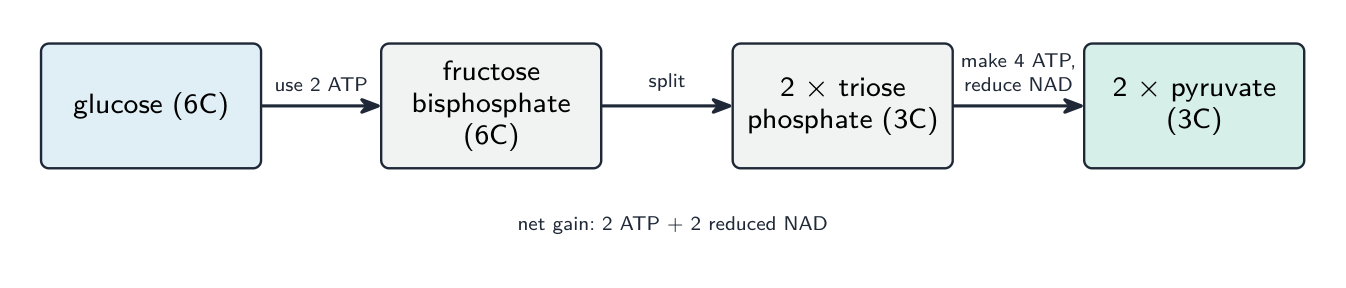
Glucose 葡萄糖 (6 carbons) is first phosphorylated, using 2 ATP, to form fructose bisphosphate (6C). This 6C molecule is split into two triose phosphate molecules (3C each). These are then oxidised 氧化 to pyruvate 丙酮酸 (3C). Glycolysis makes a net gain of 2 ATP and some reduced 还原 NAD (NAD is a coenzyme 辅酶, a helper molecule).
The link reaction
When oxygen is available, pyruvate enters the mitochondria. There each pyruvate loses a carbon dioxide 二氧化碳 and is turned into a 2-carbon acetyl 乙酰基 group. This group is carried by coenzyme A 辅酶A to form acetyl coenzyme A. Some carbon dioxide is released and NAD is reduced.
The Krebs cycle
The 2C acetyl group joins a 4-carbon molecule, oxaloacetate 草酰乙酸, to make a 6-carbon molecule, citrate 柠檬酸. Citrate is then changed back to oxaloacetate in a series of small steps, ready to accept the next acetyl group. During these steps:
decarboxylation 脱羧 removes carbon as carbon dioxide.
dehydrogenation 脱氢 removes hydrogen, which reduces the coenzymes NAD and FAD.
The reduced NAD and FAD then carry the hydrogen to the carriers in the inner mitochondrial membrane.
Oxidative phosphorylation
This stage makes most of the ATP:
the hydrogen atoms split into protons 质子 and energetic electrons 电子.
the electrons pass along the electron transport chain 电子传递链, releasing energy as they go.
this energy is used to pump protons across the inner membrane.
the protons flow back into the matrix through a channel called ATP synthase ATP合酶. This flow provides the energy to make ATP (this is chemiosmosis).
oxygen is the final electron acceptor: it joins with electrons and protons to form water.
The structure of mitochondria
The inner membrane is folded into cristae 嵴, giving a large surface for the electron transport chain and ATP synthase. The matrix inside holds the substances and helpers for the link reaction and the Krebs cycle.
עברית
נשימה אווירית (עם חמצן) כוללת ארבעה שלבים, כל אחד במקום ספציפי בתוך התא:
שלב
מקום发生的
גליקוליזה
הציטופלזמה
תגובת קישור
המטריצה של המיטוכונדריה
מחזור קרbs
המטריקס של המיטוכונדריה
פוספורילציה אוקסידטיבית
הממברנה הפנימית של המיטוכונדריה
ארבעת השלבונים ואתר כל אחד מהם; NAD ומFAD מצומצמים מובילים מימן לממברנה הפנימית שבה מיוצר רוב ה-ATP
גליקוליזה
גלוקוז (6 פחמנים) מופזפטול ראשית באמצעות שימוש ב-2 ATP ליצירת פרוקטוז ביספוספט (6C). מולקולה זו בעלת 6C מתפצלת לשני מולקולות טריוז פוספט (3C כל אחת). אלו בהמשך מועכשות ל-פרוביווט (3C). הגליקוליזה מייצרת יתרון נקי של 2 ATP וכמות מסוימת של NAD מצומצם (NAD הוא קואנזים, מולקולה עוזרת).
הגליקוליזה משקיעה 2 ATP כדי להתחיל אך מייצרת 4, ולכן היתרון הנקי הוא 2 ATP (עוד NAD מצומצם) — והיא אינה דורשת חמצן
תגובת הקישור
כאשר חמצן זמין, הפרוביווט נכנס למיטוכונדריה. ש там כל פרוביווט מאבד דיออกسيد הפחמן ומתמ化为 2-פחמנים אצטיל קבוצה. קבוצה זו מובילה על ידי קואנזים AA ליצירת אצטיל קואנזים A. כמות מסוימת של דיאוקסיד פחמן משוחררת ו-NAD מצומצם.
מחזור קרbs
ה-2C אצטיל קבוצה מתחברת עם 4-פחמנים מולקולה, אוקסאלואצטט, ליצירת 6-פחמנים מולקולה, ציטרט. ציטרט בהמשך משתנה חזרה לאוקסאלואצטט בסדרה של צעדים קטנים, מוכן לקבל את האצטיל הבא. במהלך צעדים אלו:
דקרבוקסילציה מסירה פחמן כדיאוקסיד פחמן.
דהידרוגנציה מסירה מימן, שמצמצם את הקואנזים NAD ו-FAD.
ה-NAD וה-FAD המצומצמים בהמשך מובילים את המימן למשאבים בממברנה הפנימית של המיטוכונדריה.
כל סיב משחרר דיאוקסיד פחמן (דקרבוקסילציה) ו-NAD ו-FAD מצומצמים (דהידרוגנציה)
האלקטרונים עוברים לאורך שרשרת העברת האלקטרונים, משחררים אנרגיה בזמן מעברם.
אנרגיה זו משמשת למשוך פרוטונים אל מעבר לממברנה הפנימית.
הפרוטונים זורמים חזרה לתוך המטריקס דרך ערוץ הנקרא ATP סינתאז. זרימה זו מספקת את האנרגיה ליצירת ATP (תהליך זה נקרא כימיוסמוזה).
חמצן הוא מקבל האלקטרונים הסופי: הוא מצטרף לאלקטרונים ופרוטונים כדי ליצור מים.
אלקטרונים משלחים פרוטונים (H⁺) לחלל בין-ממברנלי; הם זורמים חזרה דרך ATP סינתאז כדי לייצר ATP (כימיוסמוזה)
מבנה המיטוכונדריה
הממברנה הפנימית מתקפלת ל-קריסטות, מה שמעניק שטח גדול לאמצע ההובלה של אלקטרונים ול-ATP סינתאז. המטריקס הפנימי מכיל את החומרים והמסייעים לתגובת הקישור ולמחזור קרבס.
שני מיטוכונדריה אמיתיים, מצולמים במיקרוסקופ אלקטרוני. הפסים הכהים החוצים את הפנים הן הקריסטות — כל התקפלות זו היא מה שמייצר את השטח הגדול למערכת הובלת האלקטרונים.
Explore · חקור
Glycolysis · גליקוליזה
Step through it. Glucose is split in the cytoplasm into two pyruvate, for a small net gain of ATP and reduced NAD. · עבורו שלב אחר. גלוקוז מתפרק בציטופלזמה לשני מולקולות פירוביט, תוך רכישת נטו קטנה של ATP ו-NAD מופחת.
Explore · חקור
The four stages of respiration · ארבעת שלבי הנשימה
Step through where ATP comes from. Glucose is broken down in stages; most ATP is made at the last stage. · צעדו את המקור של ATP. גלוקוז מתפרק בשלבים; רוב ה-ATP מיוצר ב-שלב האחרון.
When there is no oxygen, only glycolysis can run. To keep glycolysis going, the cell must use up the reduced NAD. This happens by fermentation 发酵:
in mammals, pyruvate is turned into lactate 乳酸 (lactate fermentation). The lactate is later broken down when oxygen returns.
in yeast 酵母, pyruvate is turned into ethanol 乙醇 and carbon dioxide (ethanol fermentation).
Anaerobic 无氧 respiration gives far less energy than aerobic respiration. Aerobic respiration also runs the Krebs cycle and oxidative phosphorylation, which release a lot more ATP, while anaerobic respiration gains only the small amount from glycolysis.
עברית
כאשר אין חמצן, רק גליקוליזה יכולה להתרחש. כדי לשמור על המשך הגליקוליזה, התא צריך להשתמש ב-NAD המופחת. תהליך זה מתרחש דרך תסיסה:
בעכבריים, פירובט הופך ל-לקטט (תסיסת לקטט). הלקטט נשבר מאוחר יותר כאשר חמצן חוזר.
בשמרים, פירובט הופך לאתנול ובדי оксיד פחמן (תסיסת אתנול).
ללא חמצן, פירובט הופך ללקטט (בעכבריים) או אתנול (בשמרים); תהליך זה מחדש את ה-NAD לגליקוליזה.
נשימה אל-חמצנית מייצרת הרבה פחות אנרגיה מאשר נשימה אווירית. נשימה אווירית גם מפעילה את מחזור קרבס והפוספורילציה האוקסידטיבית, המשוחררים כמות הרבה יותר גדולה של ATP, בעוד שנשימה אל-חמצנית מייצרת רק את הכמות הקטנה מגליקוליזה.
Explore · חקור
Why fermentation matters · למה תחליבה חשובה
Step through it. Without oxygen, fermentation regenerates NAD so glycolysis can keep making a little ATP. · עברו על זה. ללא חמצן, תחליבה מחודשת את ה-NAD כדי שגליקוליזה תוכל להמשיך לייצר מעט ATP.
Rice and waterlogged roots · אורז ושורשים טבועים במים
English
Rice can grow with its roots under water, where there is little oxygen. It is adapted in three ways: it develops aerenchyma 通气组织 (air-filled spaces) in the roots to carry air down; the roots use ethanol fermentation to keep making some ATP; and the stems grow faster to reach the air above the water.
עברית
אורז יכול לגדול עם שורשים מתחת למים, שם יש מעט חמצן. הוא מותאם בשלושה דרכים: הוא מפתח אראנכימה (חללים מלאי אוויר) בשורשים כדי להוביל אוויר למטה; השורשים משתמשים בתסיסת אתנול כדי להמשיך לייצר מעט ATP; וגבעולים גדלים מהר יותר כדי להגיע לאוויר מעל פני המים.
שורש של צמח הגדל במים, הנראה בחצי-חיתוך. החללים הלבנים הגדולים הם האראנכימה — תעלות אוויר מקושרות המאפשרות לחמצן לדפוף עד לשורשים הישבים במשקע עניין בחמצן.
Investigating the rate of respiration · חקירת קצב הנשימה
English
A redox indicator 指示剂 such as DCPIP or methylene blue loses its colour when it gains hydrogen from respiring cells. The faster the colour is lost, the faster the yeast is respiring, so you can test the effect of temperature or substrate concentration. A respirometer can also be used to measure how temperature changes the rate of oxygen uptake.
עברית
אינדיקטור רדוקס-אוקסידציה כמו DCPIP או כחול מתילן מאבד את צבעו כאשר הוא מקבל מימן מהתאים הנשמים. ככל שהצבע נעלם מהר יותר, כך התפיחה נושמת מהר יותר, ולכן ניתן לבדוק את השפעת הטמפרטורה או ריכוז החומר המזין. ניתן להשתמש גם ברספירומטר למדוד כיצד שינויי טמפרטורה משפיעים על קצב ספיגת החמצן.
12.2
Exam tips · טיפים לבחינות
English
State where each stage happens and its ATP yield: glycolysis (cytoplasm), link reaction + Krebs (matrix), oxidative phosphorylation (inner membrane, most ATP).
Explain the roles of NAD/FAD (carry hydrogen to the electron transport chain) and of oxygen (the final electron acceptor).
RQ$=$ CO2 produced $\div$ O2 used ($\approx 1.0$ carbohydrate, $0.7$ lipid); know how a respirometer measures it.
Anaerobic respiration gives lactate (animals) or ethanol + CO2 (yeast/plants) and far less ATP (glycolysis only).
עברית
ציין היכן מתרחש כל שלב ומהי תפוקת ה-ATP שלו: גליקוליזה (ציטופלזמה), תגובת חיבור + מחזור קרbs (מטריקס), פוספורילציה אוקסידטיבית (ממברנה פנימית, הכי הרבה ATP).
הסבר את תפקידי NAD/FAD (מכילים מימן לשלוח שרשרת העברת האלקטרונים) ותפקיד החמצן (קולט האלקטרונים הסופי).
RQ$=$ CO2 מיוצר $\div$ O2 בוצע ($\approx 1.0$ פחמימות, $0.7$ ליפידים); לדעת איך רספירומטר מודד זאת.
נשימה אנאירובית מייצרת לקטט (בעלי חיים) או אתנול + CO2 (תפיחה/צמחים) ומייצרת הרבה פחות ATP (רק גליקוליזה).
Interactive lessons on this topic · שיעורים אינטראקטיביים בנושא זה
Work through it step by step, with instant-check exercises. · לעבור על הדברים צעד אחר צעד, עם תרגילים לבדיקה מיידית.
Pick one and the site follows you — notes, papers, videos and practice all open on it. · בחרו נושא אחד והאתר יעקוב אחריו — הערות, מסמכים, וידאו ותרגולים פתוחים בו.
Type to search notes, lessons, code, vocabulary and past-paper questions across every subject. · הקלד כדי לחפש הערות, שיעורים, קוד, אוצר מילים ושאלות מבחנים בכל הנושאים.