Skip to content · ⁨الانتقال إلى المحتوى⁩

Writing a formal letter or email · ⁨كتابة رسالة رسمية أو بريد إلكتروني رسمي⁩

IGCSE English · ⁨IGCSE اللغة الإنجليزية⁩ · Topic 4 · ⁨الموضوع 4⁩

Video lesson for this topic · ⁨درس فيديو لهذا الموضوع⁩ Open the video page · ⁨افتح صفحة الفيديو⁩
8:04

كتابة رسالة أو بريد إلكتروني رسمي

طالب تكتشف أن جدول الحافلة الجديد يجعلها متأخرة عن المدرسة كل صباح. تقرر كتابة رسالة لشركة الحافلات. مسودتها الأولى تقول: <slow>هذا…

English narration · English + 中文 subtitles burned in · ⁨سرد باللغة الإنجليزية · ترجمة مدمجة بالإنجليزية + الصينية⁩

4.1

When to write formally · ⁨متى تكتب بشكل رسمي⁩

Syllabus · ⁨المنهج⁩
English
  1. recognise when a task needs a formal or semi-formal response (for example, to a teacher or an event organiser)
  2. cover the purpose, format and audience information given in the task
  3. keep a polite, formal tone throughout
العربية
  1. تعرف متى تتطلب المهمة ردًا رسميًا أو شبه رسمي (على سبيل المثال، لمعلم أو منظم حدث)
  2. غطِ المعلومات الخاصة بالغرض والتنسيق والجمهور المعطاة في المهمة
  3. حافظ على نبرة مهذبة ورسمية طوال الوقت
Source: Cambridge International syllabus · ⁨المصدر: منهج كامبريدج الدولي⁩

English

The second writing task sometimes asks for a formal 正式 or semi-formal 半正式 letter or email.

Spot a formal task

  • A formal task is written to someone you do not know well — a head teacher 校长, a manager 经理, or an event organiser 活动组织者.
  • The task tells you the format 格式, the purpose 目的 and the reader. Use all three.

Keep a polite tone

  • Be polite 礼貌 and respectful. Do not use slang 俚语 or jokes.
  • Do not use short forms. Write "I am", not "I'm".
العربية

المهمة الثانية للكتابة قد تطلب أحياناً رسالة 正式 أو بريد إلكتروني شبه رسمي 半正式.

حدد المهمة الرسمية

  • المهمة الرسمية تُكتب لشخص لا تعرفه جيداً - مدير مدرسة 校长، أو مدير 经理، أو منظم حدث 活动组织者.
  • ستخبرك المهمة بـ الشكل 格式، والغرض 目的 والقارئ. استخدم الثلاثة.
A tidy office desk with a computer, a plant and a wall calendar, nobody sitting at it
رسالة رسمية تُقرأ على مكتب كهذه - بواسطة شخص لا يعرفك، وهو مشغول

حافظ على نبرة مهذبة

  • كن مهذباً 礼貌 ومحترماً. لا تستخدم العامية 俚语 أو النكات.
  • لا تستخدم الأشكال المختصرة. اكتب "I am"، وليس "I'm".
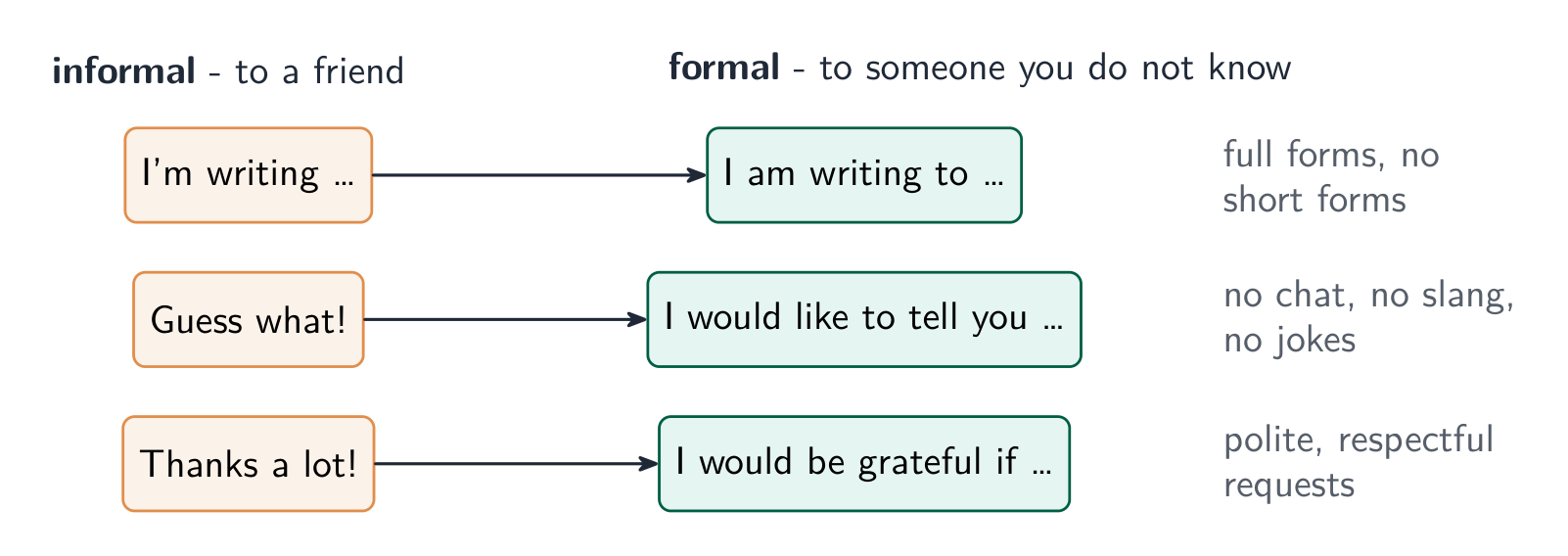
Three informal phrases turn into formal ones: I'm writing becomes I am writing to, Guess what becomes I would like to tell you, Thanks a lot becomes I would be grateful if
تحويل العبارات الودية إلى رسمية
A formal letter: careful structure, polite register and a clear reason for writing
رسالة رسمية: هيكل دقيق، مسجل مهذب، وسبب واضح للكتابة
Vocabulary · ⁨مفردات⁩ Train · ⁨تدريب⁩
English العربية
formal/ˈfɔːml/ رسمية
semi-formal/ˈsemi ˈfɔːml/ شبه رسمي
head teacher/hed ˈtiːtʃə/ مدير المدرسة
manager/ˈmænɪdʒə/ المختبر
event organiser/ɪˈvent ˈɔːɡənaɪzə/ منظم الفعاليات
format/ˈfɔːmæt/ الصيغة
purpose/ˈpɜːpəs/ الغرض
polite/pəˈlaɪt/ مهذب
slang/slæŋ/ عامية
4.2

Building a formal letter or email · ⁨بناء رسالة أو بريد إلكتروني رسمي⁩

Syllabus · ⁨المنهج⁩
English
  1. open and close a formal letter or email appropriately (for example: Dear … / Yours sincerely …)
  2. organise your points into clear paragraphs with a beginning, middle and end
  3. use formal language and avoid contractions and slang
العربية
  1. افتح وأغلق رسالة أو بريدًا إلكترونيًا رسميًا بطريقة مناسبة (على سبيل المثال: Dear … / Yours sincerely …)
  2. نظّم نقاطك في فقرات واضحة تبدأ وتنتهي بشكل مناسب
  3. استخدم اللغة الرسمية وتجنب الاختصارات العامية

Source: Cambridge International syllabus · ⁨المصدر: منهج كامبريدج الدولي⁩

English

A formal letter follows a clear order.

Opening and closing

  • Open with Dear Sir/Madam, or Dear Mr Lee,
  • If you start with a name, close with Yours sincerely,. If you start with Sir/Madam, close with Yours faithfully,.

Clear paragraphs

  • First paragraph: say why you are writing.
  • Middle paragraphs: give your points, one idea in each.
  • Last paragraph: say what you would like to happen next.

Formal language

  • Use formal phrases: I would like to…, I am writing to…, I would be grateful 感激 if…
  • Keep sentences clear and complete. Check your grammar and spelling.

A model formal letter

See how a polite, complete opening sets the right tone.

Dear Sir or Madam,

I am writing to suggest an improvement to the town library. At present it closes at five o'clock, which is too early for students who finish school at four. I would be grateful if the council could consider opening it until seven in the evening on weekdays.

Thank you for taking the time to read my letter.

Yours faithfully, J. Chen

Notice the Dear Sir or Madam / Yours faithfully pair, the clear first line stating the purpose, the polite request, and the complete sentences with no short forms.

العربية

تتبع الرسالة الرسمية ترتيباً واضحاً.

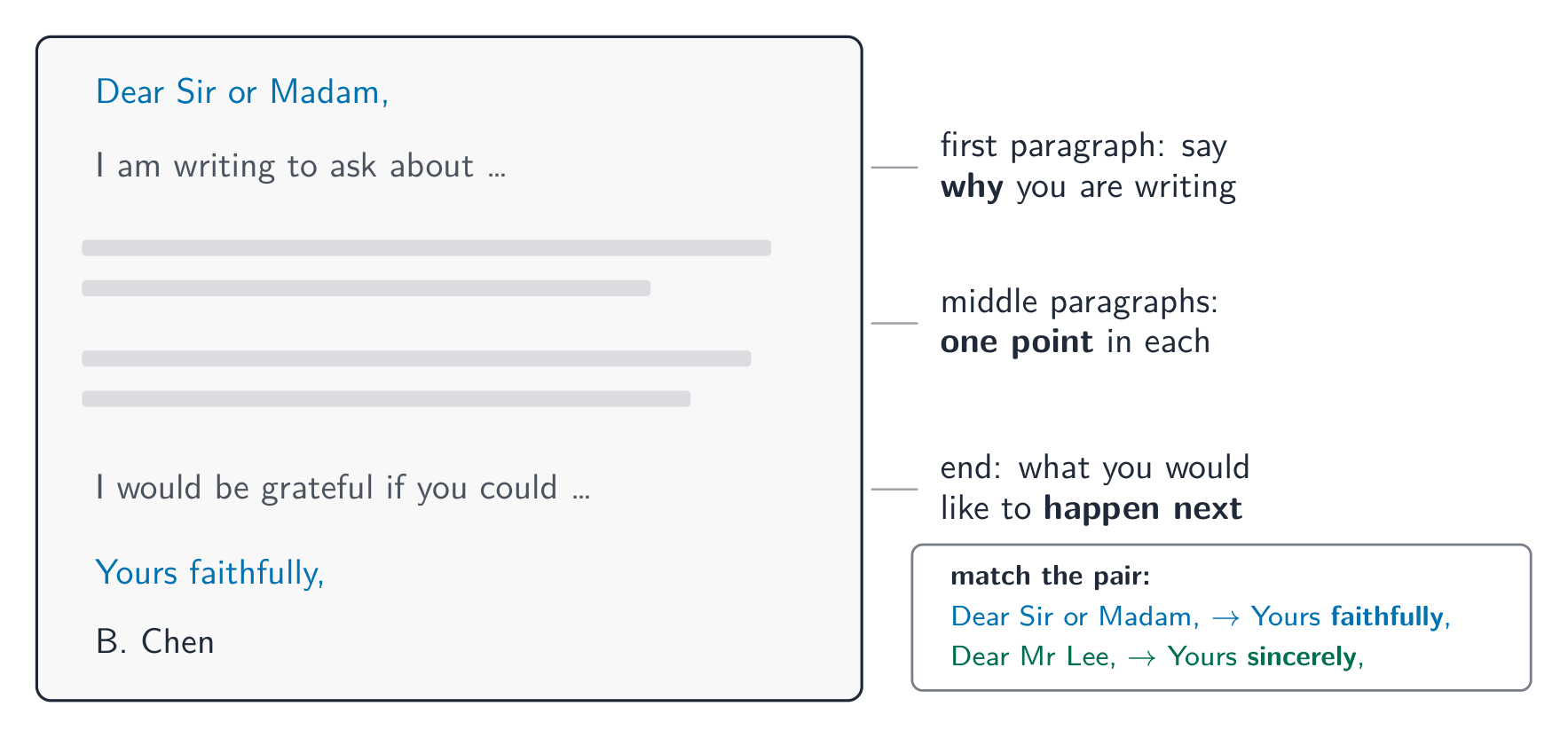
A formal letter with labels: the first paragraph says why you are writing, middle paragraphs give one point each, the end says what you would like to happen, and a box shows that Dear Sir or Madam pairs with Yours faithfully while Dear Mr Lee pairs with Yours sincerely
شكل الرسالة الرسمية - والتحية تحدد الخاتمة

الافتتاح والختام

  • افتح بـ Dear Sir/Madam, أو Dear Mr Lee,
  • إذا بدأت باسم، ختم بـ Yours sincerely,. وإذا بدأت بـ Sir/Madam، ختم بـ Yours faithfully,.

فقرات واضحة

  • الفقرة الأولى: قل لماذا تكتب.
  • الفقرات الوسطى: قدم نقاطك، فكرة واحدة في كل فقرة.
  • الفقرة الأخيرة: قل ما تود أن يحدث بعد ذلك.

لغة رسمية

  • استخدم عبارات رسمية: I would like to…, I am writing to…, I would be grateful 感激 if…
  • حافظ على جمل واضحة وكاملة. تحقق من قواعدك وإملائك.

نموذج لرسالة رسمية

شاهد كيف يضع الافتتاح المهذب والكامل النبرة الصحيحة.

Dear Sir or Madam,

I am writing to suggest an improvement to the town library. At present it closes at five o'clock, which is too early for students who finish school at four. I would be grateful if the council could consider opening it until seven in the evening on weekdays.

Thank you for taking the time to read my letter.

Yours faithfully, J. Chen

لاحظ تطابق Dear Sir or Madam / Yours faithfully، والسطر الأول الواضح الذي يوضح الغرض، والطلب المهذب، والجمل الكاملة بدون أشكال مختصرة.

Vocabulary · ⁨مفردات⁩ Train · ⁨تدريب⁩
English العربية
grateful/ˈɡreɪtfl/ ممتن / شاكر
4.2

Exam tips · ⁨نصائح للامتحان⁩

English
  • Match the greeting to the ending: Dear Mr Lee → Yours sincerely; Dear Sir or Madam → Yours faithfully.
  • Say why you are writing in the first line: "I am writing to apply for…" saves words and sounds formal.
  • Do not use short forms: write "I am" and "do not", never "I'm" or "don't".
  • One paragraph per point, and end by naming the action you hope for: "I would be grateful if…".
  • Stay polite even in a complaint: "I was disappointed to find…" wins marks; "This is terrible!" loses the tone.
العربية
  • طابق التحية بالخاتمة: Dear Mr Lee → Yours sincerely؛ Dear Sir or Madam → Yours faithfully.
  • قل لماذا تكتب في السطر الأول: "I am writing to apply for…" يوفر الكلمات ويبدو رسمياً.
  • لا تستخدم الأشكال المختصرة: اكتب "I am" و "do not"، ولا "I'm" أو "don't".
  • فقرة واحدة لكل نقطة، وانتهِ بتسمية الإجراء الذي تتوقعه: "I would be grateful if…".
  • حافظ على الأدب حتى في الشكاوى: "I was disappointed to find…" يكسب درجات؛ "This is terrible!" يفقد النبرة.

Interactive lessons on this topic · ⁨دروس تفاعلية حول هذا الموضوع⁩

Work through it step by step, with instant-check exercises. · ⁨ا-working عليه خطوة بخطوة، مع تمارين تحقق فوري.⁩

Past Papers · ⁨أوراق الامتحانات السابقة⁩

More topics in IGCSE English · ⁨IGCSE اللغة الإنجليزية⁩ · ⁨المزيد من المواضيع في IGCSE English · ⁨IGCSE اللغة الإنجليزية⁩⁩

Log in or create account · ⁨تسجيل الدخول أو إنشاء حساب⁩

IGCSE, A-Level & AP