Writing a formal letter or email
IntroducedWhen to be formal
- Some tasks ask for a formal letter or email.
- The reader is someone you do not know well — a manager or a head teacher.
- Use the format, purpose and reader given in the task.
Formal does not mean sounding as if a dictionary swallowed you.
Formal language
- Be polite and respectful; no slang or jokes.
- No short forms: write I am, not I'm.
- Useful phrases: I would like to…, I am writing to…
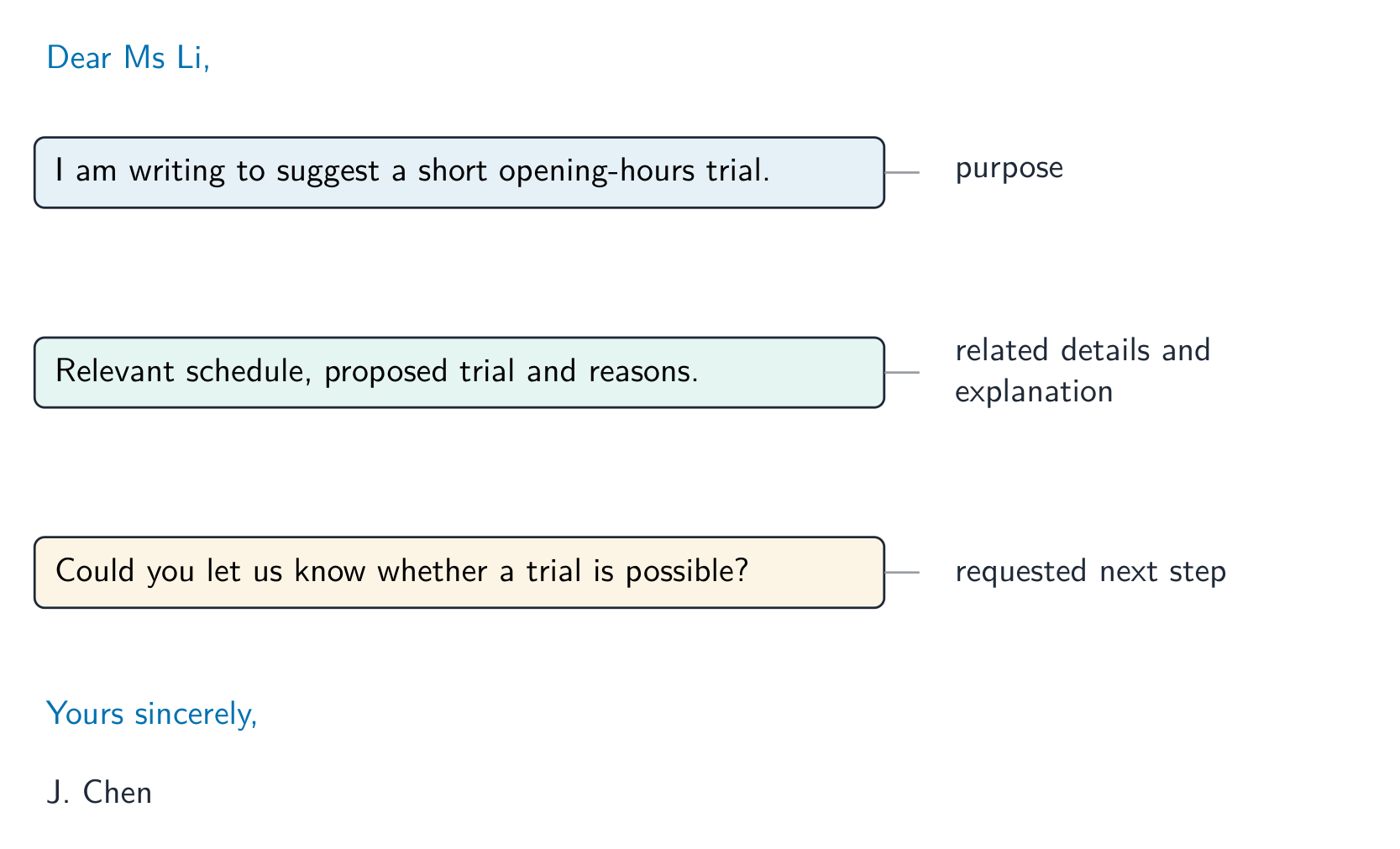
The shape of a formal letter- and the greeting decides the sign-off
Keep it or replace it?
Train your ear: formal phrases stay, casual ones get upgraded before they reach the letter.
In a formal email you can write 'I'm' and 'don't'.
No — use full forms: 'I am', 'do not'.
Make it formal: 'I ___ writing to ask about the job.'
Formal writing uses the full form 'am', not ''m'.
Open and close
- Dear Mr Lee, → close with Yours sincerely,
- Dear Sir/Madam, → close with Yours faithfully,
- One idea per paragraph; clear, complete sentences.
You begin 'Dear Sir/Madam,'. How should you end?
No name in the greeting → 'Yours faithfully,'.
Write the opening line of a formal email asking about a summer job. Be polite and formal.
Example: 'I am writing to ask whether you have any summer jobs available.'
From chat to formal, line by line
- Too casual: "Hi! I wanna know if you've got any summer jobs going."
- Formal: "Dear Sir or Madam, I am writing to enquire whether any summer positions are available."
- The swaps that did the work: Hi → Dear Sir or Madam, wanna know → am writing to enquire, jobs going → positions available.
- The message is identical — only the register moved.
Match the casual phrase to its formal upgrade.
Formal English says the same thing with full forms and polite distance.
- Formal = polite, full forms, no slang.
- Match the closing to the opening.
- Clear paragraphs; check your grammar.