Skip to content · ⁨الانتقال إلى المحتوى⁩

Thermochemistry · ⁨الكيمياء الحرارية⁩

AP Chemistry · ⁨AP الكيمياء⁩ · Topic 6 · ⁨الموضوع 6⁩

Video lesson for this topic · ⁨درس فيديو لهذا الموضوع⁩ Open the video page · ⁨افتح صفحة الفيديو⁩
8:53

الكيمياء الحرارية

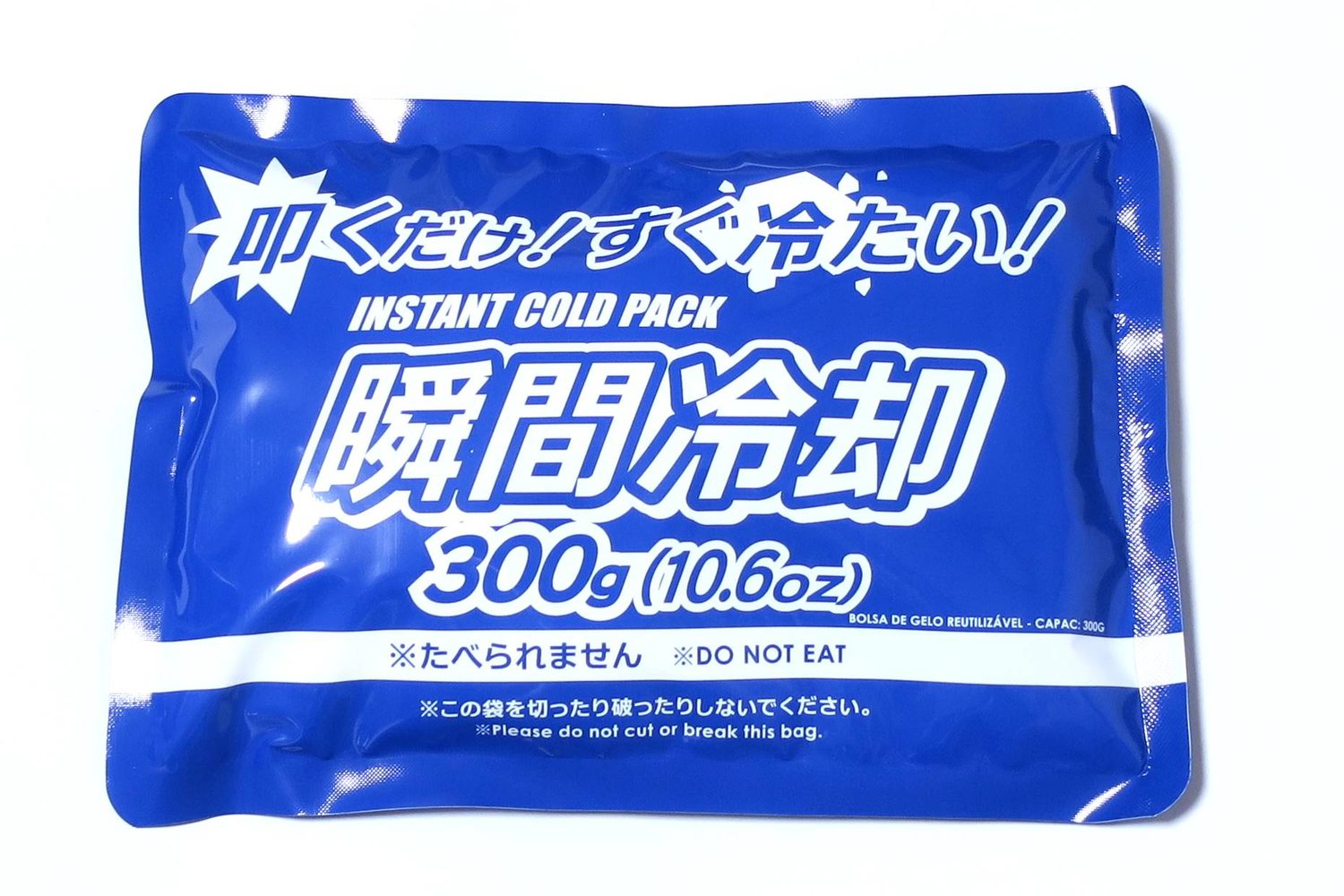
اضغط على هذه الكيس وفي ثوانٍ يصبح بارداً كالجليد. لا شيء يحترق؛ لا شيء يبرده من الخارج. مادة صلبة تذوب ببساطة في الماء داخل…

English narration · English + 中文 subtitles burned in · ⁨سرد باللغة الإنجليزية · ترجمة مدمجة بالإنجليزية + الصينية⁩

6.1

Endothermic and Exothermic Processes · ⁨العمليات الماصة والطاردة للحرارة⁩

Syllabus · ⁨المنهج⁩
English

Learning Objective 6.1.A: Explain the relationship between experimental observations and energy changes associated with a chemical or physical transformation.

  • 6.1.A.1 Temperature changes in a system indicate energy changes.
  • 6.1.A.2 Energy changes in a system can be described as endothermic and exothermic processes such as the heating or cooling of a substance, phase changes, or chemical transformations.
  • 6.1.A.3 When a chemical reaction occurs, the energy of the system either decreases (exothermic reaction), increases (endothermic reaction), or remains the same. For exothermic reactions, the energy lost by the reacting species (system) is gained by the surroundings, as heat transfer from or work done by the system. Likewise, for endothermic reactions, the system gains energy from the surroundings by heat transfer to or work done on the system.
  • 6.1.A.4 The formation of a solution may be an exothermic or endothermic process, depending on the relative strengths of intermolecular/interparticle interactions before and after the dissolution process.
العربية

هدف التعلم 6.1.A: شرح العلاقة بين الملاحظات التجريبية والتغيرات في الطاقة المرتبطة بالتحول الكيميائي أو الفيزيائي.

  • 6.1.A.1 تشير التغيرات في درجة الحرارة إلى وجود تغيرات في الطاقة داخل النظام.
  • 6.1.A.2 يمكن وصف التغيرات في طاقة النظام بأنها عمليات ماصة للحرارة ومحررة لها، مثل تسخين أو تبريد مادة، أو تحولات الطور، أو التحولات الكيميائية.
  • 6.1.A.3 عند حدوث تفاعل كيميائي، تتغير طاقة النظام إما بتناقص (تفاعل محرر للحرارة)، أو بزيادة (تفاعل ماص للحرارة)، أو تبقى ثابتة. بالنسبة للتفاعلات المحررة للحرارة، فإن الطاقة المفقودة بواسطة الأنواع المتفاعلة (النظام) تُكتسب من قبل المحيط، سواء عن طريق انتقال الحرارة أو انجام الشغل بواسطة النظام. وبالمثل، بالنسبة للتفاعلات الماصة للحرارة، يكتسب النظام طاقة من المحيط عن طريق انتقال الحرارة إليه أو انجام شغل عليه.
  • 6.1.A.4 قد تكون عملية تكوين المحلول عملية محررة أو ماصة للحرارة، وذلك اعتماداً على القوى النسبية للتفاعلات بين الجزيئات/الجسيمات قبل وبعد عملية الذوبان.
Source: College Board AP Course and Exam Description · ⁨المصدر: وصف دورة وامتحان College Board AP⁩

English

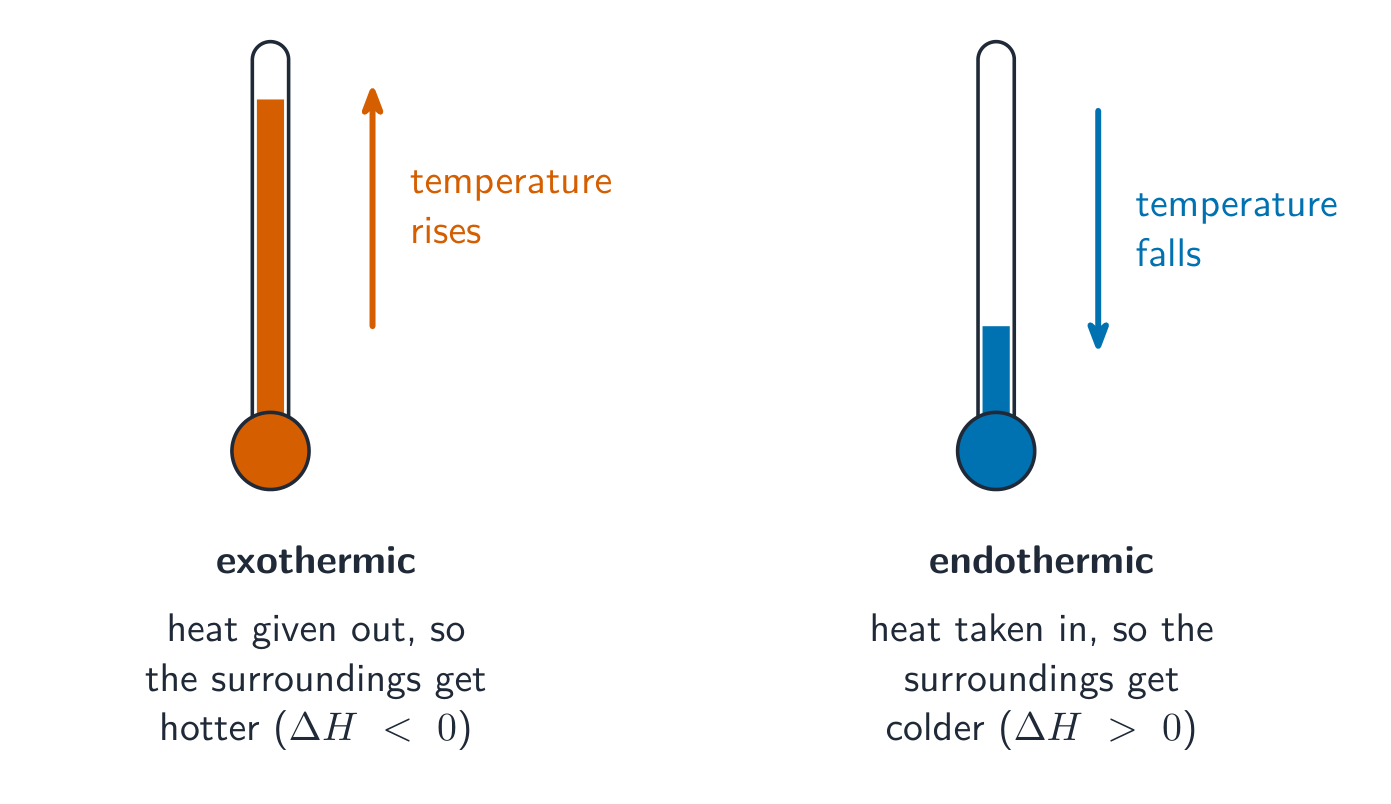
Thermochemistry 热化学 tracks energy in reactions. A process is exothermic 放热 if it releases energy to the surroundings (feels hot, $\Delta H<0$) and endothermic 吸热 if it absorbs energy (feels cold, $\Delta H>0$). Breaking bonds costs energy; forming bonds releases it – the net decides the sign.

العربية
حزمة باردة فورية: العمليات الماصة للحرارة تمتص الحرارة من المحيط

الكيمياء الحرارية تتبع الطاقة في التفاعلات. العملية طاردة للحرارة إذا أخرجت طاقة للمحيط (تشعر بالحرارة، $\Delta H<0$) وماصة للحرارة إذا امتصت طاقة (تشعر بالبرودة، $\Delta H>0$). كسر الروابط يتطلب طاقة؛ تكوين الروابط يحررها – الصافي يحدد الإشارة.

تفاعل طارد للحرارة يسخّن المحيط؛ ماص للحرارة يبرّده
Explore · ⁨استكشف⁩

Compare endothermic and exothermic profiles · ⁨قارن بين المنحنيات الماصة والطاردة للحرارة⁩

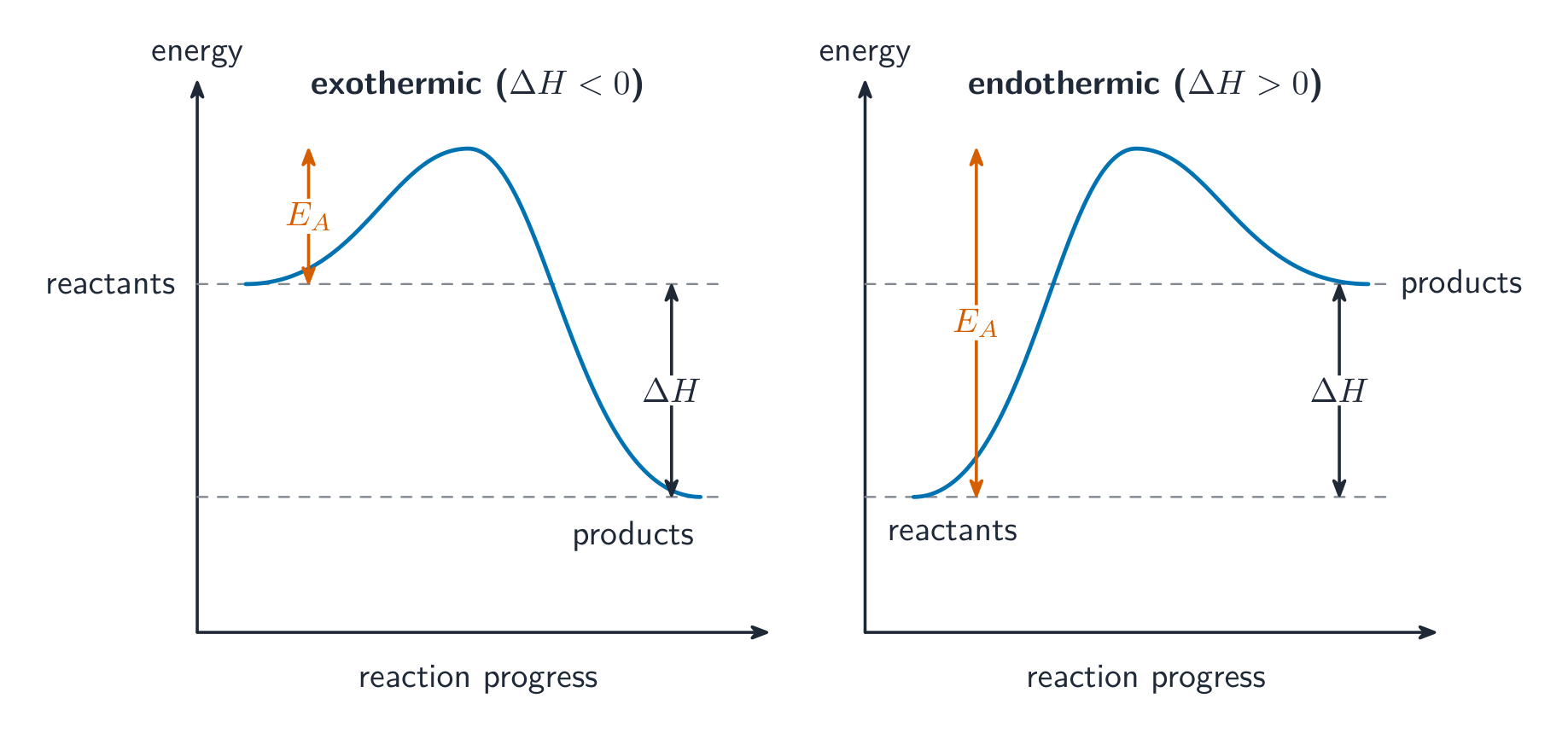
An exothermic reaction releases energy (products lower than reactants, $\Delta H<0$); an endothermic one absorbs it. The hump is the activation energy. · ⁨التفاعل الطارق للحرارة يُطلق الطاقة (النواتج أقل من المتفاعلات، $\Delta H<0$)؛ أما الماص للحرارة فيمتصها. يمثل البروز طاقة التنشيط.⁩

6.2

Energy Diagrams · ⁨مخططات الطاقة⁩

Syllabus · ⁨المنهج⁩
English

Learning Objective 6.2.A: Represent a chemical or physical transformation with an energy diagram.

  • 6.2.A.1 A physical or chemical process can be described with an energy diagram that shows the endothermic or exothermic nature of that process.
العربية

هدف التعلم 6.2.A: تمثيل تحول كيميائي أو فيزيائي بمخطط طاقة.

  • 6.2.A.1 يمكن وصف عملية فيزيائية أو كيميائية بمخطط طاقة يُظهر الطبيعة الماصة أو المحررة للحرارة لهذه العملية.

Source: College Board AP Course and Exam Description · ⁨المصدر: وصف دورة وامتحان College Board AP⁩

English

An energy diagram plots energy from reactants to products. Reactants above products means exothermic; below means endothermic. The vertical gap between them is the enthalpy change $\Delta H$.

العربية

يُخطط مخطط الطاقة الطاقة من المتفاعلات إلى النواتج. إذا كانت المتفاعلات أعلى من النواتج فالعملية طاردة للحرارة؛ وإذا كانت أسفل فالعملية ماصة للحرارة. الفارق الرأسي بينهما هو التغير في الإنثالبي $\Delta H$.

مخططات الطاقة: نواتج طاردة للحرارة تقع أسفل المتفاعلات، ماصة للحرارة فوقها
6.3

Heat Transfer and Thermal Equilibrium · ⁨انتقال الحرارة والتوازن الحراري⁩

Syllabus · ⁨المنهج⁩
English

Learning Objective 6.3.A: Explain the relationship between the transfer of thermal energy and molecular collisions.

  • 6.3.A.1 The particles in a warmer body have a greater average kinetic energy than those in a cooler body.
  • 6.3.A.2 Collisions between particles in thermal contact can result in the transfer of energy. This process is called "heat transfer," "heat exchange," or "transfer of energy as heat."
  • 6.3.A.3 Eventually, thermal equilibrium is reached as the particles continue to collide. At thermal equilibrium, the average kinetic energy of both bodies is the same, and hence, their temperatures are the same.
العربية

هدف التعلم 6.3.A: شرح العلاقة بين انتقال الطاقة الحرارية وتصادم الجزيئات.

  • 6.3.A.1 تمتلك الجسيمات في الجسم الأكثر دفئاً متوسط طاقة حركية أكبر من تلك الموجودة في الجسم الأكثر برودة.
  • 6.3.A.2 يمكن أن تؤدي التصادمات بين الجسيمات المتلامسة حرارياً إلى انتقال الطاقة. تُسمى هذه العملية "انتقال الحرارة" أو "التبادل الحراري" أو "انتقال الطاقة كحرارة".
  • 6.3.A.3 في النهاية، يتحقق التوازن الحراري مع استمرار تصادم الجسيمات. عند التوازن الحراري، يكون متوسط الطاقة الحركية لكلا الجسمين متساوياً، وبالتالي تكون درجتي حرارتهما متساويتين.

Source: College Board AP Course and Exam Description · ⁨المصدر: وصف دورة وامتحان College Board AP⁩

English

Heat 热量 flows from hot to cold until objects reach thermal equilibrium 热平衡 (equal temperature). Energy is conserved: the heat lost by the hot object equals the heat gained by the cold one.

العربية

الحرارة تنتقل من الساخن إلى البارد حتى تصل الأجسام إلى التوازن الحراري (متساوية في درجة الحرارة). الطاقة محفوظة: الحرارة المفقودة للجسم الساخن تساوي الحرارة المكتسبة للجسم البارد.

6.4

Heat Capacity and Calorimetry · ⁨السعة الحرارية وقياس الحرارة⁩

Syllabus · ⁨المنهج⁩
English

Learning Objective 6.4.A: Calculate the heat $q$ absorbed or released by a system undergoing heating/cooling based on the amount of the substance, the heat capacity, and the change in temperature.

  • 6.4.A.1 The heating of a cool body by a warmer body is an important form of energy transfer between two systems. The amount of heat transferred between two bodies may be quantified by the heat transfer equation:

    • Equation: $q = mc\Delta T$.

    Calorimetry experiments are used to measure the transfer of heat.

  • 6.4.A.2 The first law of thermodynamics states that energy is conserved in chemical and physical processes.

  • 6.4.A.3 The transfer of a given amount of thermal energy will not produce the same temperature change in equal masses of matter with differing specific heat capacities.

  • 6.4.A.4 Heating a system increases the energy of the system, while cooling a system decreases the energy of the system.

  • 6.4.A.5 The specific heat capacity of a substance and the molar heat capacity are both used in energy calculations.

  • 6.4.A.6 Chemical systems change their energy through three main processes: heating/cooling, phase transitions, and chemical reactions.

  • 6.4.A.7 In calorimetry experiments involving dissolution, temperature changes of the mixture within the calorimeter can be used to determine the direction of energy flow. If the temperature of the mixture increases, thermal energy is released by the dissolution process (exothermic). If the temperature of the mixture decreases, thermal energy is absorbed by the dissolution process (endothermic).

العربية

هدف التعلم 6.4.A: حساب كمية الحرارة $q$ الممتصة أو المنطلقة من نظام يخضع للتسخين/التبريد استناداً إلى كمية المادة والسعة الحرارية والتغير في درجة الحرارة.

  • 6.4.A.1 يعد تسخين جسم بارد بجسم أكثر دفئاً شكلاً مهماً من أشكال انتقال الطاقة بين نظامين. يمكن قياس كمية الحرارة المنتقلة بين جسمين باستخدام معادلة انتقال الحرارة:

    • المعادلة: $q = mc\Delta T$.

    تُستخدم تجارب القياس الحراري (الكالوريمتر) لقياس انتقال الحرارة.

  • 6.4.A.2 تنص القانون الأول للديناميكا الحرارية على أن الطاقة محفوظة في العمليات الكيميائية والفيزيائية.

  • 6.4.A.3 لن ينتج انتقال كمية معينة من الطاقة الحرارية نفس التغير في درجة الحرارة في كتل متساوية من المواد ذات السعات الحرارية النوعية المختلفة.

  • 6.4.A.4 يؤدي تسخين النظام إلى زيادة طاقته، بينما يؤدي تبريد النظام إلى انخفاض طاقته.

  • 6.4.A.5 تُستخدم السعة الحرارية النوعية للمادة والسعة الحرارية المولية كلاهما في الحسابات الطاقة.

  • 6.4.A.6 تتغير الأنظمة الكيميائية طاقتها عبر ثلاث عمليات رئيسية: التسخين/التبريد، تحولات الطور، والتفاعلات الكيميائية.

  • 6.4.A.7 في تجارب القياس الحراري involving الذوبان، يمكن استخدام التغيرات في درجة حرارة الخليط داخل الكالوريمتر لتحديد اتجاه تدفق الطاقة. إذا ارتفعت درجة حرارة الخليط، فإن الطاقة الحرارية تُطلقها عملية الذوبان (تفاعل محرر للحرارة). وإذا انخفضت درجة حرارة الخليط، فإن الطاقة الحرارية تمتصها عملية الذوبان (تفاعل ماص للحرارة).

Source: College Board AP Course and Exam Description · ⁨المصدر: وصف دورة وامتحان College Board AP⁩

English

The heat to change a substance's temperature is

$$q=mc\,\Delta T,$$
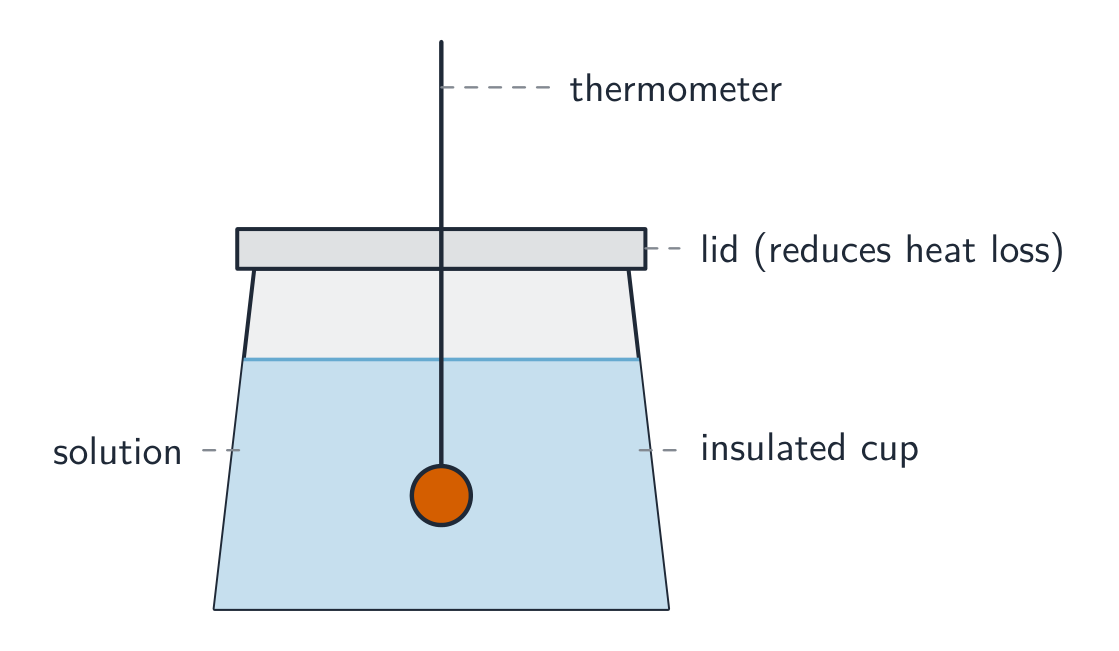
where $c$ is the specific heat 比热容 (energy per gram per degree). Calorimetry 量热法 measures a reaction's heat by tracking the temperature change of surrounding water: the heat the water gains equals the heat the reaction releases.

Worked example. A reaction in a coffee-cup calorimeter warms $100\ \text{g}$ of water by $8.0\,{}^{\circ}\text{C}$ ($c=4.18\ \text{J/(g}\,{}^{\circ}\text{C)}$). The heat absorbed by the water is

$$q=mc\,\Delta T=100\times4.18\times8.0=3.3\times10^{3}\ \text{J}.$$
By energy conservation the reaction released this $3.3\ \text{kJ}$, so it is exothermic ($q_{\text{rxn}}=-3.3\ \text{kJ}$).

العربية

الحرارة اللازمة لتغيير درجة حرارة مادة ما هي

$$q=mc\,\Delta T,$$
حيث $c$ هي السعة الحرارية النوعية (طاقة لكل جرام لكل درجة). قياس الحرارة يقيس حرارة التفاعل بتتبع تغير درجة حرارة الماء المحيط: الحرارة التي يكتسبها الماء تساوي الحرارة التي يحررها التفاعل.

قياس الحرارة: قياس التغير في درجة حرارة كتلة معروفة من المحلول

مثال محلول. تفاعل في مسعر كوب قهوة سخّن $100\ \text{g}$ من الماء بمقدار $8.0\,{}^{\circ}\text{C}$ ($c=4.18\ \text{J/(g}\,{}^{\circ}\text{C)}$). الحرارة الممتصة بواسطة الماء هي

$$q=mc\,\Delta T=100\times4.18\times8.0=3.3\times10^{3}\ \text{J}.$$
بناءً على حفظ الطاقة، فإن التفاعل أخرج هذا $3.3\ \text{kJ}$، لذا فهو طارد للحرارة ($q_{\text{rxn}}=-3.3\ \text{kJ}$).

Explore · ⁨استكشف⁩

Heat different materials · ⁨تسخن مواد مختلفة⁩

$Q=mc\Delta T$: a high specific heat (like water's) means a lot of energy for a small temperature rise. Compare materials for the same heat input. · ⁨$Q=mc\Delta T$: تعني السعة الحرارية النوعية العالية (مثل الماء) الحاجة لطاقة كبيرة لارتفاع طفيف في درجة الحرارة. قارن المواد عند نفس المدخل الحراري.⁩

Vocabulary · ⁨مفردات⁩ Train · ⁨تدريب⁩
English العربية
Thermochemistry/ˈθɜːməkemɪstri/ الكيمياء الحرارية
exothermic/eɡzəˈðɜːmɪk/ طارد للحرارة
endothermic/ˌendəʊˈθɜːmɪk/ ماص للحرارة
Heat/hiːt/ الحرارة
thermal equilibrium/ˈθɜːml ˌiːkwɪˈlɪbrɪəm/ التوازن الحراري
specific heat/spəˈsɪfɪk hiːt/ الحرارة النوعية
Calorimetry/ˌkælɔːˈrɪmətri/ قياس الحرارة
phase change/feɪz tʃeɪndʒ/ التغير الطوري
enthalpy of reaction/enˈθælpi ɒv rɪˈækʃn/ إنثالبي التفاعل
state function/steɪt ˈfʌŋkʃn/ دالة الحالة
standard enthalpy of formation/ˈstændəd enˈθælpi ɒv fɔːˈmeɪʃn/ إنثالبي التكوين القياسي
Hess's law/ˈhesɪz lɔː/ قانون هس
6.5

Energy of Phase Changes · ⁨طاقة تغيرات الطور⁩

Syllabus · ⁨المنهج⁩
English

Learning Objective 6.5.A: Explain changes in the heat $q$ absorbed or released by a system undergoing a phase transition based on the amount of the substance in moles and the molar enthalpy of the phase transition.

  • 6.5.A.1 Energy must be transferred to a system to cause a substance to melt (or boil). The energy of the system therefore increases as the system undergoes a solid-to-liquid (or liquid-to-gas) phase transition. Likewise, a system releases energy when it freezes (or condenses). The energy of the system decreases as the system undergoes a liquid-to-solid (or gas-to-liquid) phase transition. The temperature of a pure substance remains constant during a phase change.
  • 6.5.A.2 The energy absorbed during a phase change is equal to the energy released during a complementary phase change in the opposite direction. For example, the molar enthalpy of condensation of a substance is equal to the negative of its molar enthalpy of vaporization. Similarly, the molar enthalpy of fusion can be used to calculate the energy absorbed when melting a substance and the energy released when freezing a substance.
العربية

هدف التعلم 6.5.A: شرح التغيرات في كمية الحرارة $q$ الممتصة أو المنطلقة من نظام يخضع لتحول طور استناداً إلى كمية المادة بالمولات والإنثالبي المولي لتحول الطور.

  • 6.5.A.1 يجب نقل الطاقة إلى النظام لإذابة المادة (أو غليها). لذلك تزداد طاقة النظام عندما يخضع لتحول طور من صلب إلى سائل (أو سائل إلى غاز). وبالمثل، يحرر النظام الطاقة عندما يتجمد (أو يتكثف). تقل طاقة النظام عندما يخضع لتحول طور من سائل إلى صلب (أو غاز إلى سائل). تظل درجة حرارة المادة النقية ثابتة أثناء تحول الطور.
  • 6.5.A.2 الطاقة الممتصة خلال تحول الطور تساوي الطاقة المنطلقة خلال تحول الطور المكمل في الاتجاه المعاكس. على سبيل المثال، الإنثالبي المولي للتكاثف لمادة يساوي سالب الإنثالبي المولي للتبخير لنفس المادة. وبالمثل، يمكن استخدام الإنثالبي المولي للانصهار لحساب الطاقة الممتصة عند إذابة المادة والطاقة المنطلقة عند تجمدها.

Source: College Board AP Course and Exam Description · ⁨المصدر: وصف دورة وامتحان College Board AP⁩

English

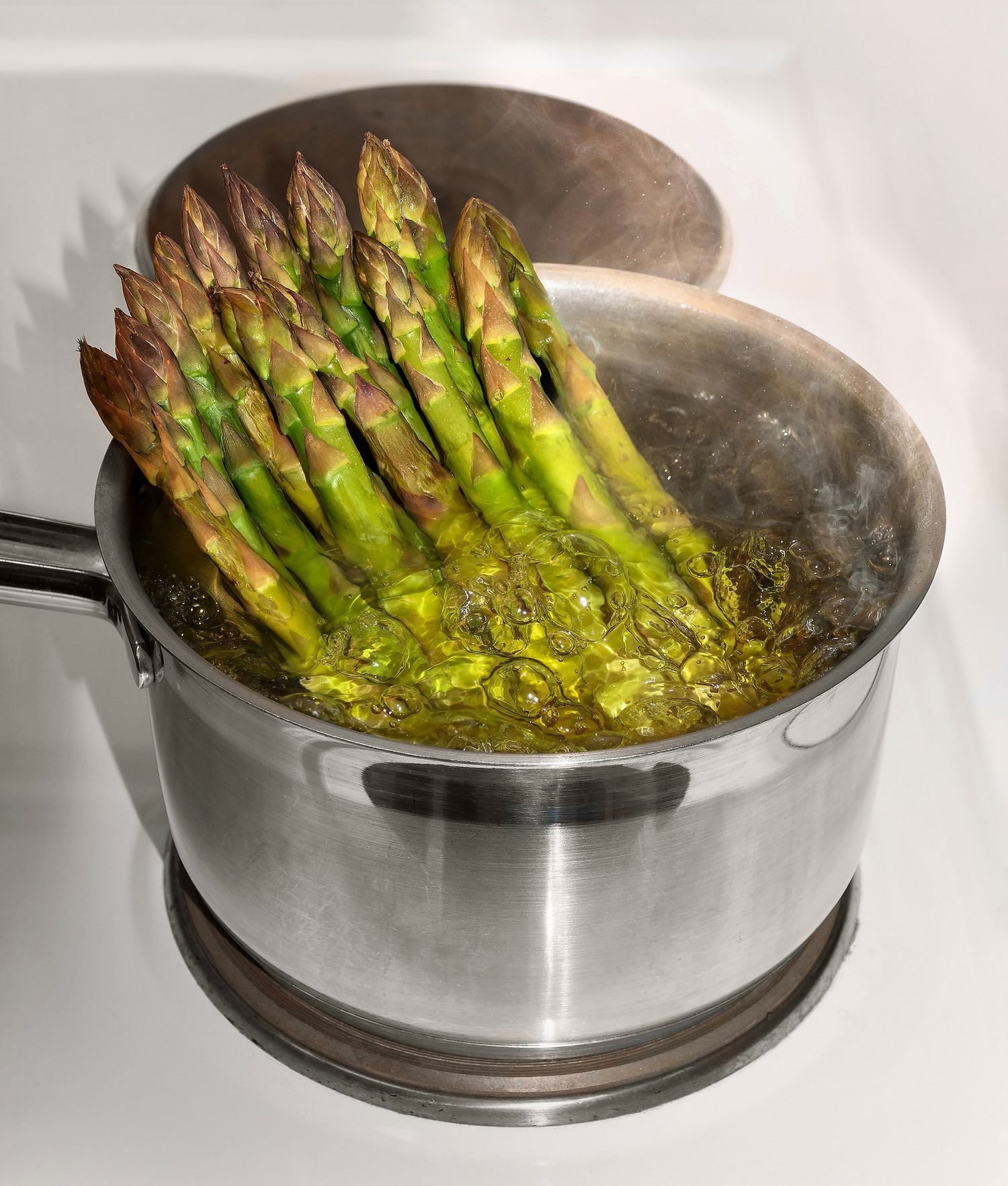
During a phase change 相变 (melting, boiling) the temperature stays constant while heat goes into breaking intermolecular forces, not raising kinetic energy. The energy needed is $q=n\,\Delta H_{\text{fus}}$ (melting) or $q=n\,\Delta H_{\text{vap}}$ (boiling) – the flat steps on a heating curve.

العربية

خلال تغير الطور (ذوبان، غليان) تبقى درجة الحرارة ثابتة بينما تذهب الحرارة لكسر القوى بين الجزيئات، لا لرفع الطاقة الحركية. الطاقة المطلوبة هي $q=n\,\Delta H_{\text{fus}}$ (للذوبان) أو $q=n\,\Delta H_{\text{vap}}$ (للغليان) – وهي الخطوط الأفقية في منحنى التسخين.

بخار من ماء مغلي: تغيرات الطور تمتص أو تطلق طاقة عند درجة حرارة ثابتة
Explore · ⁨استكشف⁩

Heat through a phase change · ⁨الحرارة خلال تغير الحالة⁩

During a phase change the temperature holds flat while energy breaks bonds — the latent heat. Watch the plateaus at melting and boiling. · ⁨أثناء تغير الحالة، تظل درجة الحرارة ثابتة بينما تُستهلك الطاقة لكسر الروابط — وهو الحرارة الكامنة. راقب المستويات الأفقية عند الانصهار والغليان.⁩

6.6

Introduction to Enthalpy of Reaction · ⁨مقدمة لإنثالبي التفاعل⁩

Syllabus · ⁨المنهج⁩
English

Learning Objective 6.6.A: Calculate the heat $q$ absorbed or released by a system undergoing a chemical reaction in relationship to the amount of the reacting substance in moles and the molar enthalpy of reaction.

  • 6.6.A.1 The enthalpy change of a reaction gives the amount of heat energy released (for negative values) or absorbed (for positive values) by a chemical reaction at constant pressure.
  • 6.6.A.2 When the products of a reaction are at a different temperature than their surroundings, they exchange energy with the surroundings to reach thermal equilibrium. Thermal energy is transferred to the surroundings as the reactants convert to products in an exothermic reaction. Thermal energy is transferred from the surroundings as the reactants convert to products in an endothermic reaction.
  • 6.6.A.3 The chemical potential energy of the products of a reaction is different from that of the reactants because of the breaking and forming of bonds. The energy difference results in a change in the kinetic energy of the particles, which manifests as a temperature change.
    • Exclusion Statement: The technical distinctions between enthalpy and internal energy will not be assessed on the AP Exam. Most reactions studied at the AP level are carried out at constant pressure, where the enthalpy change of the process is equal to the heat (and by extension, the energy) of reaction.
العربية

الهدف التعليمي 6.6.A: حساب الحرارة $q$ الممتصة أو المنطلقة من نظام يخضع لتفاعل كيميائي بالنسبة لكمية المادة المتفاعلة بالمولات والإنثالبي المولاري للتفاعل.

  • 6.6.A.1 يعطي تغير الإنثالبي للتفاعل كمية الطاقة الحرارية المنطلقة (للقوى السالبة) أو الممتصة (للقوى الموجبة) من قبل تفاعل كيميائي عند ضغط ثابت.
  • 6.6.A.2 عندما تكون نواتج التفاعل عند درجة حرارة مختلفة عن محيطها، فإنها تتبادل الطاقة مع المحيط للوصول إلى التوازن الحراري. تنتقل الطاقة الحرارية إلى المحيط أثناء تحول المتفاعلات إلى نواتج في تفاعل طارد للحرارة. وتنتقل الطاقة الحرارية من المحيط أثناء تحول المتفاعلات إلى نواتج في تفاعل ماص للحرارة.
  • 6.6.A.3 طاقة الروابط الكيميائية لنواتج التفاعل تختلف عن تلك للمتفاعلات بسبب كسر وتكوين الروابط. يؤدي فرق الطاقة إلى تغير في الطاقة الحركية للجسيمات، مما يظهر كتغير في درجة الحرارة.
    • عبارة الاستبعاد: لن يتم تقييم الفروق التقنية بين الإنثالبي والطاقة الداخلية في امتحان AP. معظم التفاعلات المدروسة على مستوى AP تُجرى عند ضغط ثابت، حيث يكون تغير الإنثالبي للعملية مساويًا للحرارة (وعلى هذا الأساس، الطاقة) للتفاعل.

Source: College Board AP Course and Exam Description · ⁨المصدر: وصف دورة وامتحان College Board AP⁩

English

The enthalpy of reaction 反应焓 $\Delta H_{\text{rxn}}$ is the heat released or absorbed at constant pressure. Because enthalpy is a state function 状态函数, $\Delta H$ depends only on the initial and final states, not the path taken – the key that makes the next three methods work.

العربية

إنثالبي التفاعل $\Delta H_{\text{rxn}}$ هو الحرارة المنطلقة أو الممتصة عند ضغط ثابت. بما أن الإنثالبي دالة حالة، فإن $\Delta H$ يعتمد فقط على الحالة الأولية والنهائية، وليس المسار المتخذ – وهو المفتاح الذي يجعل الطرق الثلاث التالية تعمل.

6.7

Bond Enthalpies · ⁨إنثالبي الروابط⁩

Syllabus · ⁨المنهج⁩
English

Learning Objective 6.7.A: Calculate the enthalpy change of a reaction based on the average bond energies of bonds broken and formed in the reaction.

  • 6.7.A.1 During a chemical reaction, bonds are broken and/or formed, and these events change the potential energy of the system.
  • 6.7.A.2 The average energy required to break all of the bonds in the reactant molecules can be estimated by adding up the average bond energies of all the bonds in the reactant molecules. Likewise, the average energy released in forming the bonds in the product molecules can be estimated. If the energy released is greater than the energy required, the reaction is exothermic. If the energy required is greater than the energy released, the reaction is endothermic.
العربية

الهدف التعليمي 6.7.A: حساب تغير الإنثالبي للتفاعل بناءً على متوسط طاقات الروابط المكسورة والمكونة في التفاعل.

  • 6.7.A.1 خلال التفاعل الكيميائي، تتم كسر و/أو تكوين الروابط، وتغير هذه الأحداث الطاقة الكامنة للنظام.
  • 6.7.A.2 يمكن تقدير متوسط الطاقة اللازمة لكسر جميع الروابط في جزيئات المتفاعلات عن طريق جمع متوسط طاقات الروابط لجميع الروابط في جزيئات المتفاعلات. وبالمثل، يمكن تقدير متوسط الطاقة المنطلقة في تكوين الروابط في جزيئات النواتج. إذا كانت الطاقة المنطلقة أكبر من الطاقة المطلوبة، فإن التفاعل طارد للحرارة. وإذا كانت الطاقة المطلوبة أكبر من الطاقة المنطلقة، فإن التفاعل ماص للحرارة.

Source: College Board AP Course and Exam Description · ⁨المصدر: وصف دورة وامتحان College Board AP⁩

English

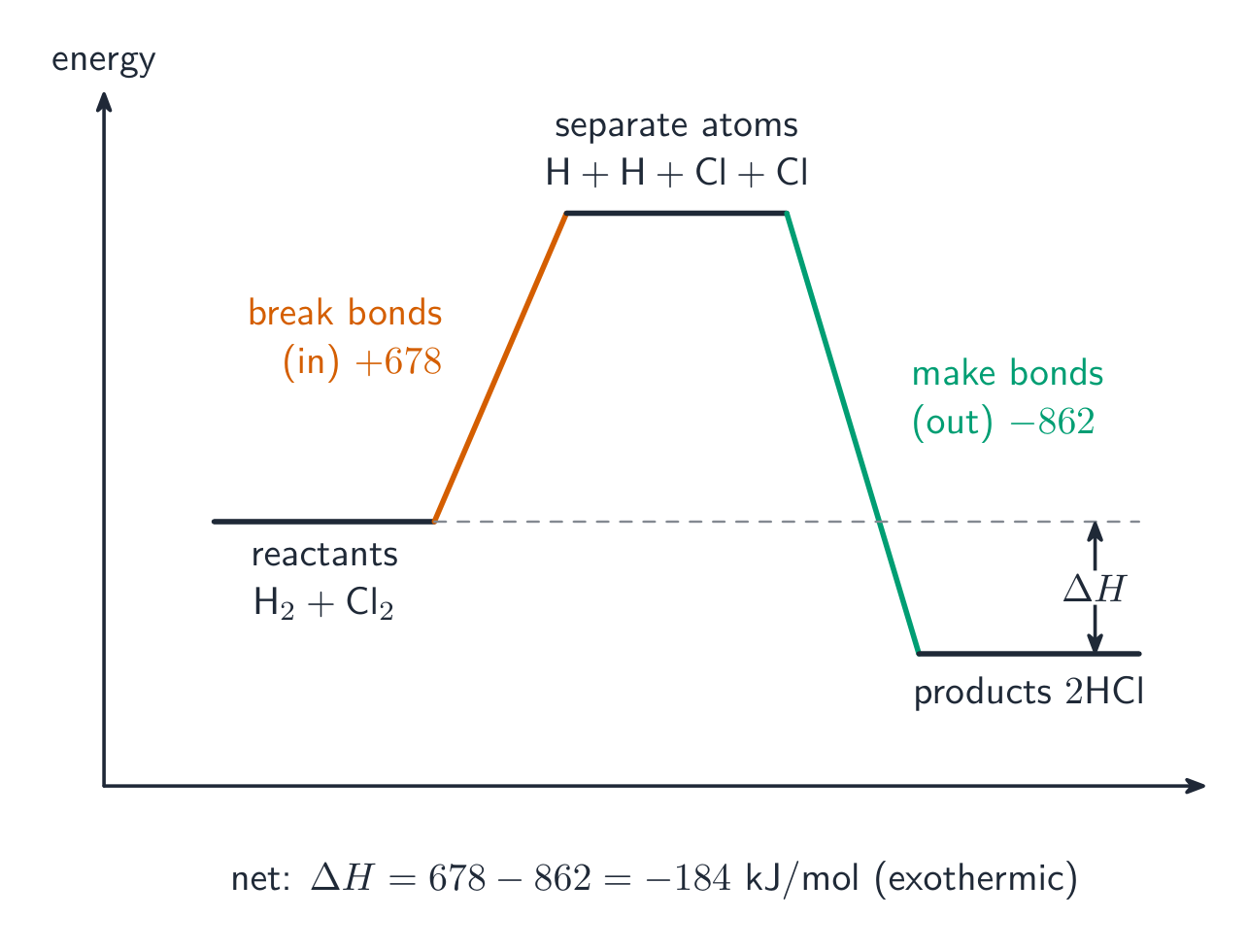
One way to estimate $\Delta H$: sum the energy to break all reactant bonds, then subtract the energy released forming product bonds:

$$\Delta H \approx \sum (\text{bonds broken}) - \sum (\text{bonds formed}).$$
This is an approximation, since bond enthalpies are averages.

Worked example. Estimate $\Delta H$ for $\text{H}_2+\text{Cl}_2\rightarrow2\text{HCl}$ using bond enthalpies H–H $=436$, Cl–Cl $=242$, H–Cl $=431\ \text{kJ/mol}$. Break both reactant bonds ($436+242=678$) and form two H–Cl bonds ($2\times431=862$):

$$\Delta H\approx 678-862=-184\ \text{kJ},$$
exothermic, because the strong H–Cl bonds formed release more than the reactant bonds cost.

العربية

إحدى طرق تقدير $\Delta H$: اجمع الطاقة اللازمة لـ كسر جميع روابط المتفاعلات، ثم اطرح الطاقة الـمنطلقة عند تكوين روابط النواتج:

$$\Delta H \approx \sum (\text{bonds broken}) - \sum (\text{bonds formed}).$$
هذا تقريب، لأن إنثالبي الروابط قيم متوسطة.

كسر الروابط يستهلك طاقة؛ تكوين الروابط يطلقها

مثال محلول. قدّر $\Delta H$ لـ $\text{H}_2+\text{Cl}_2\rightarrow2\text{HCl}$ باستخدام طاقة الرابطة H–H $=436$، Cl–Cl $=242$، H–Cl $=431\ \text{kJ/mol}$. قم بكسر كلتا رابطتي المتفاعلات ($436+242=678$) وتكوين رابطتين H–Cl ($2\times431=862$):

$$\Delta H\approx 678-862=-184\ \text{kJ},$$
طارد للحرارة، لأن الروابط القوية H–Cl المُكوّنة تطلق طاقة أكثر مما تكلفه روابط المتفاعلات.

6.8

Enthalpy of Formation · ⁨إنثالبي التكوين⁩

Syllabus · ⁨المنهج⁩
English

Learning Objective 6.8.A: Calculate the enthalpy change for a chemical or physical process based on the standard enthalpies of formation.

  • 6.8.A.1 Tables of standard enthalpies of formation can be used to calculate the standard enthalpies of reactions.
    • Equation: $\Delta H^{\circ}_{reaction} = \Sigma \Delta H^{\circ}_{f\ products} - \Sigma \Delta H^{\circ}_{f\ reactants}$
العربية

الهدف التعليمي 6.8.A: حساب تغير الإنثالبي لعملية كيميائية أو فيزيائية بناءً على إنثالبيات التكوين القياسية.

  • 6.8.A.1 يمكن استخدام جداول إنثالبيات التكوين القياسية لحساب إنثالبيات التفاعل القياسية.
    • المعادلة: $\Delta H^{\circ}_{reaction} = \Sigma \Delta H^{\circ}_{f\ products} - \Sigma \Delta H^{\circ}_{f\ reactants}$

Source: College Board AP Course and Exam Description · ⁨المصدر: وصف دورة وامتحان College Board AP⁩

English

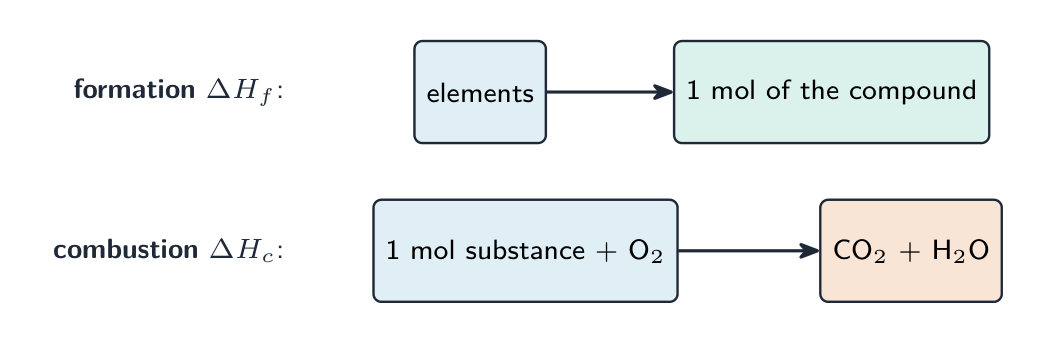
The standard enthalpy of formation 生成焓 $\Delta H_f^\circ$ is the enthalpy to make one mole of a compound from its elements (zero for an element in its standard state). Then

$$\Delta H_{\text{rxn}}^\circ = \sum \Delta H_f^\circ(\text{products}) - \sum \Delta H_f^\circ(\text{reactants}).$$

Worked example. Find $\Delta H_{\text{rxn}}^\circ$ for burning methane, $\text{CH}_4+2\text{O}_2\rightarrow\text{CO}_2+2\text{H}_2\text{O}$, given $\Delta H_f^\circ$: CH$_4=-75$, CO$_2=-394$, H$_2$O$=-286\ \text{kJ/mol}$ (O$_2=0$). Products minus reactants:

$$\Delta H_{\text{rxn}}^\circ=[-394+2(-286)]-[-75+0]=-966+75=-891\ \text{kJ},$$
a large release, as expected for a combustion.

العربية

إنثالبي التكوين القياسي $\Delta H_f^\circ$ هو الإنثالبي اللازم لتكوين مول واحد من مركب من عناصره (صفر للعنصر في حالته القياسية). ثم

$$\Delta H_{\text{rxn}}^\circ = \sum \Delta H_f^\circ(\text{products}) - \sum \Delta H_f^\circ(\text{reactants}).$$

التكوين يُكوّن مركباً من عناصره؛ الاحتراق يحرقه في الأكسجين
التكوين يُنتج مركباً من عناصره؛ الاحتراق يحرقه في الأكسجين

مثال محلول. أوجد $\Delta H_{\text{rxn}}^\circ$ لحرق الميثان $\text{CH}_4+2\text{O}_2\rightarrow\text{CO}_2+2\text{H}_2\text{O}$، بمعلومية $\Delta H_f^\circ$: CH$_4=-75$، CO$_2=-394$، H$_2$O$=-286\ \text{kJ/mol}$ (O$_2=0$). النواتج ناقص المتفاعلات:

$$\Delta H_{\text{rxn}}^\circ=[-394+2(-286)]-[-75+0]=-966+75=-891\ \text{kJ},$$
إطلاق كبير، كما هو متوقع للاحتراق.

6.9

Hess's Law · ⁨قانون هس⁩

Syllabus · ⁨المنهج⁩
English

Learning Objective 6.9.A: Represent a chemical or physical process as a sequence of steps.

  • 6.9.A.1 Many processes can be broken down into a series of steps. Each step in the series has its own energy change.

Learning Objective 6.9.B: Explain the relationship between the enthalpy of a chemical or physical process and the sum of the enthalpies of the individual steps.

  • 6.9.B.1 Because total energy is conserved (first law of thermodynamics), and each individual reaction in a sequence transfers thermal energy to or from the surroundings, the net thermal energy transferred in the sequence will be equal to the sum of the thermal energy transfers in each of the steps. These thermal energy transfers are the result of potential energy changes among the species in the reaction sequence; thus, at constant pressure, the enthalpy change of the overall process is equal to the sum of the enthalpy changes of the individual steps.
  • 6.9.B.2 The following are essential principles of Hess's law:
    • i. When a reaction is reversed, the enthalpy change stays constant in magnitude but becomes reversed in mathematical sign.
    • ii. When a reaction is multiplied by a factor $c$, the enthalpy change is multiplied by the same factor $c$.
    • iii. When two (or more) reactions are added to obtain an overall reaction, the individual enthalpy changes of each reaction are added to obtain the net enthalpy change of the overall reaction.
    • Exclusion Statement: The concept of state functions will not be assessed on the AP Exam.
العربية

الهدف التعليمي 6.9.A: تمثيل عملية كيميائية أو فيزيائية كمسلسل من الخطوات.

  • 6.9.A.1 يمكن تفكيك العديد من العمليات إلى سلسلة من الخطوات. لكل خطوة في السلسلة تغيير طاقتها الخاص.

الهدف التعليمي 6.9.B: شرح العلاقة بين إنثالبي عملية كيميائية أو فيزيائية ومجموع إنثالبيات الخطوات الفردية.

  • 6.9.B.1 نظرًا لأن الطاقة الكلية محفوظة (القانون الأول للديناميكا الحرارية)، وكل تفاعل فردي في المسلسل ينقل الطاقة الحرارية إلى أو من المحيط، فإن صافي الطاقة الحرارية المنقولة في المسلسل سيكون مساويًا لمجموع انتقالات الطاقة الحرارية في كل من الخطوات. هذه الانتقالات للطاقة الحرارية هي نتيجة لتغيرات الطاقة الكامنة بين الأنواع في مسلسل التفاعل؛ وبالتالي، عند ضغط ثابت، يكون تغير الإنثالبي للعملية الإجمالي مساويًا لمجموع تغيرات الإنثالبي للخطوات الفردية.
  • 6.9.B.2 المبادئ التالية أساسية لقانون هس:
    • i. عند عكس تفاعل، يبقى تغير الإنثالبي ثابتًا من حيث المقدار ولكنه يصبح معكوسًا في الإشارة الرياضية.
    • ii. عند ضرب تفاعل في عامل $c$، يُضرب تغير الإنثالبي في نفس العامل $c$.
    • iii. عند جمع تفاعلين (أو أكثر) للحصول على تفاعل كلي، يتم جمع تغيرات الإنثالبي الفردية لكل تفاعل للحصول على صافي تغير الإنثالبي للتفاعل الكلي.
    • عبارة الاستبعاد: لن يتم تقييم مفهوم دوال الحالة في امتحان AP.

Source: College Board AP Course and Exam Description · ⁨المصدر: وصف دورة وامتحان College Board AP⁩

English
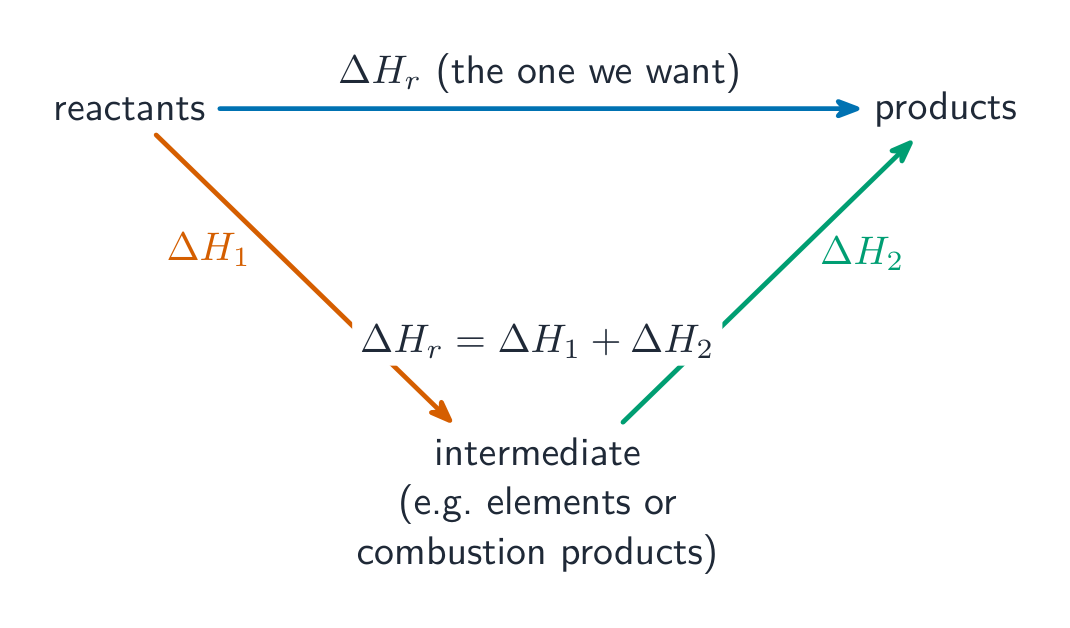
Hess's law: the route does not matter

Hess's law 盖斯定律: if a reaction is the sum of several steps, its $\Delta H$ is the sum of the steps' $\Delta H$ values. Reverse a step and flip the sign; scale a step and scale its $\Delta H$. This lets you find a hard-to-measure $\Delta H$ by combining known reactions – a frequent exam calculation.

العربية
قانون هس: المسار لا يهم

قانون هس: إذا كان التفاعل مجموع عدة خطوات، فإن $\Delta H$ الخاص به هو مجموع $\Delta H$ هذه الخطوات. عكِّس خطوة وأعد إشارة قيمتها؛ ضاعف خطوة وضاعف $\Delta H$ الخاص بها. هذا يسمح لك بإيجاد $\Delta H$ يصعب قياسه بدمج تفاعلات معروفة – وهو حساب شائع في الامتحانات.

قانون هس: المسارات المباشرة وغير المباشرة تعطي نفس التغير الكلي في الإنثالبي
6.9

Exam tips · ⁨نصائح للامتحان⁩

English
  • An exothermic reaction has $\Delta H<0$ (feels hot); endothermic has $\Delta H>0$ — always give $\Delta H$ a sign and units.
  • In calorimetry use $q=mc\,\Delta T$ with the mass of the water/solution; the reaction releases what the water gains.
  • Bond enthalpies: $\Delta H\approx\sum(\text{bonds broken})-\sum(\text{bonds made})$ — breaking is endothermic, making is exothermic (the classic sign trap).
  • Hess's law: the total $\Delta H$ is the sum of the steps' — reverse a step and flip the sign, scale a step and scale $\Delta H$.
  • During a phase change the temperature stays constant while energy goes into the forces between particles.
العربية
  • التفاعل الطارد للحرارة له $\Delta H<0$ (يشعر بالحرارة)؛ والماص للحرارة له $\Delta H>0$ — اذكر دائمًا $\Delta H$ الإشارة والوحدات.
  • في القياس الحراري استخدم $q=mc\,\Delta T$ مع كتلة الماء/المحلول؛ التفاعل يحرر ما يكسبه الماء.
  • إنثالبيات الروابط: $\Delta H\approx\sum(\text{bonds broken})-\sum(\text{bonds made})$ — الكسر ماص للحرارة، والتكوين طارد للحرارة (فخ الإشارات الكلاسيكي).
  • قانون هس: $\Delta H$ الكلي هو مجموع الخطوات — عكِّ خطوة وأعد إشارتها، ضاعف خطوة وضاعف $\Delta H$.
  • أثناء التحول الطوري تظل درجة الحرارة ثابتة بينما تنتقل الطاقة إلى القوى بين الجسيمات.

Interactive lessons on this topic · ⁨دروس تفاعلية حول هذا الموضوع⁩

Work through it step by step, with instant-check exercises. · ⁨ا-working عليه خطوة بخطوة، مع تمارين تحقق فوري.⁩

Past Papers · ⁨أوراق الامتحانات السابقة⁩

More topics in AP Chemistry · ⁨AP الكيمياء⁩ · ⁨المزيد من المواضيع في AP Chemistry · ⁨AP الكيمياء⁩⁩

Log in or create account · ⁨تسجيل الدخول أو إنشاء حساب⁩

IGCSE, A-Level & AP