انظر إلى الملصق على هاتفك، حذاءك، مصباح مكتبك. تقريباً لم يتم تصنيع أي جزء منها في البلد الذي تجلس فيه. وصلت في صناديق فولاذية، على…
English narration · English + 中文 subtitles burned in · سرد باللغة الإنجليزية · ترجمة مدمجة بالإنجليزية + الصينية
6.1
Why countries trade · لماذا تتبادل الدول
Syllabus · المنهج
English
explain absolute and comparative advantage and the gains from specialisation and trade
explain the terms of trade and the benefits and limitations of trade theory
العربية
اشرح الميزة المطلقة والميزة النسبية والمكاسب من التخصص والتجارة
اشرح شروط التجارة وفوائد وقيود نظرية التجارة
Source: Cambridge International syllabus · المصدر: منهج كامبريدج الدولي
English
international trade 国际贸易 lets countries buy and sell with each other. Trade lets each country specialise 专业化 in what it makes best, so the world makes more in total.
Absolute and comparative advantage
a country has an absolute advantage 绝对优势 in a good if it can make more of it with the same resources than another country.
a country has a comparative advantage 比较优势 in a good if it can make it at a lower opportunity cost 机会成本 than another country.
Comparative advantage is the key idea: a country should make the goods it gives up least to produce, and trade for the rest. Look at this example, where each country uses the same resources:
Country
Wine (units)
Cloth (units)
Country A
20
10
Country B
5
5
Country A is better at both (absolute advantage in both). But think about opportunity cost:
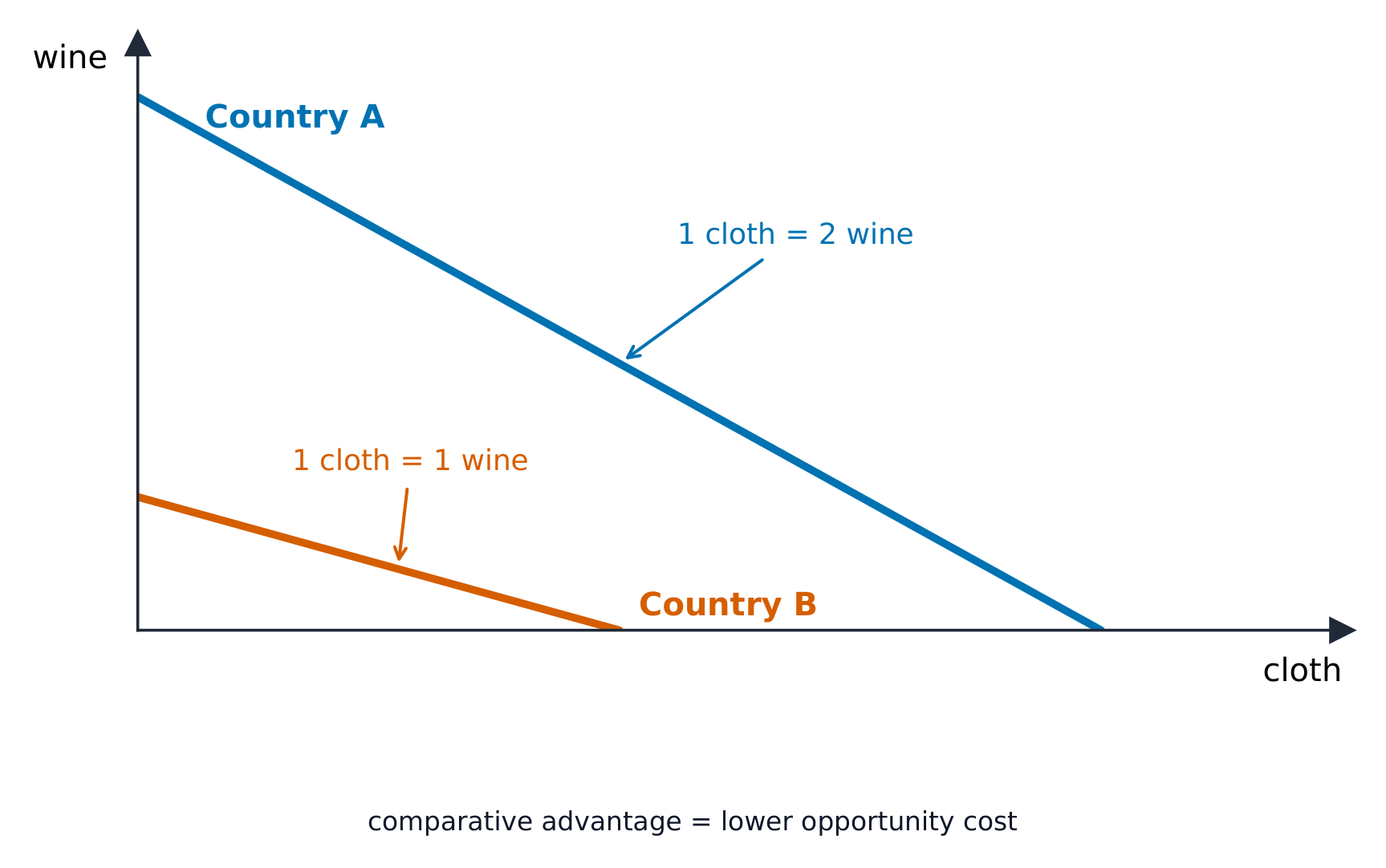
in A, making 1 cloth means giving up 2 wine.
in B, making 1 cloth means giving up 1 wine.
So B gives up less to make cloth — B has the comparative advantage in cloth. A has it in wine. If A makes only wine and B makes only cloth, and they trade, both can end up with more than before.
Terms of trade
The terms of trade 贸易条件 measure the price of a country's exports compared with the price of its imports. It is worked out as an index:
$$\text{terms of trade} = \frac{\text{index of export prices}}{\text{index of import prices}} \times 100.$$
If export prices rise faster than import prices, the terms of trade "improve" — the country can buy more imports for the same exports.
Worked example. Over a year, a country's export price index rises from $100$ to $110$, while its import price index rises from $100$ to $105$. Find the new terms of trade.
$$\text{terms of trade} = \frac{110}{105} \times 100 = 104.8.$$
The figure is above $100$, so the terms of trade have improved: each unit of exports now buys about $4.8\%$ more imports than before.
Limits of the theory
The gains are real, but the simple theory assumes no transport costs, no trade barriers, and that costs do not change with output. In the real world these do not fully hold, and specialising in one good is risky if its price falls.
العربية
التجارة الدولية تسمح للدول بالشراء والبيع مع بعضها البعض. التجارة تسمح لكل دولة بـ التخصص في ما تصنعه بشكل أفضل، بحيث ينتج العالم أكثر إجمالاً.
ميناء حاويات: التجارة الدولية تنقل البضائع بين الدول بحجم هائل
الميزة المطلقة والميزة النسبية
تمتلك الدولة ميزة مطلقة في سلعة معينة إذا كانت قادرة على إنتاج كمية أكبر منها بنفس الموارد مقارنة بدولة أخرى.
تمتلك الدولة ميزة نسبية في سلعة معينة إذا كانت_details ability to produce it at a lower opportunity cost than another country.
الميزة النسبية هي الفكرة الرئيسية: يجب على الدولة إنتاج السلع التي تتخلى عنها أقل لإنتاجها، والتداول مقابل البقية. انظر إلى هذا المثال، حيث تستخدم كل دولة نفس الموارد:
الدولة
النبيذ (وحدات)
القماش (وحدات)
الدولة أ
20
10
الدولة ب
5
5
الدولة أ أفضل في كلا السلعتين (ميزة مطلقة في كليهما). لكن فكر في تكلفة الفرصة البديلة:
في أ، إنتاج 1 قماش يعني التخلي عن 2 نبيذ.
في ب، إنتاج 1 قماش يعني التخلي عن 1 نبيذ.
لذا فإن ب تتخلى عن أقل لإنتاج القماش — ب لديها الميزة النسبية في القماش. أ لديهاها في النبيذ. إذا أنتجت أ النبيذ فقط وأنتجت ب القماش فقط، وتبادلت، كلاهما يمكن أن ينتهي بمزيد مما كان عليه سابقاً.
الدولة أ تستطيع إنتاج المزيد من كلا السلعتين، ولكن منحناها PPC أكثر انحداراً: فهي تتخلى عن 2 نبيذ لكل قماش، بينما تتخلى ب عن 1 فقط، لذا فإن ب لديها الميزة النسبية في القماش.
شروط التجارة
تقيس شروط التجارة سعر صادرات الدولة مقارنة بسعر وارداتها. يتم حسابها كمؤشر:
$$\text{terms of trade} = \frac{\text{index of export prices}}{\text{index of import prices}} \times 100.$$
إذا ارتفعت أسعار الصادرات أسرع من أسعار الواردات، فإن شروط التجارة "تحسن" — يمكن للدولة شراء واردات أكثر مقابل نفس حجم الصادرات.
مثال محلول. خلال عام واحد، ارتفع مؤشر أسعار الصادرات لدولة ما من $100$ إلى $110$، بينما ارتفع مؤشر أسعار الواردات من $100$ إلى $105$. أوجد شروط التبادل الجديدة.
$$\text{terms of trade} = \frac{110}{105} \times 100 = 104.8.$$
الرقم أعلى من $100$، لذا فإن شروط التجارة قد تحسنت: كل وحدة من الصادرات تشتري الآن حوالي $4.8\%$ وحدة واردات إضافية مقارنة بالسابق.
حدود النظرية
الفوائد حقيقية، لكن النظرية البسيطة تفترض عدم وجود تكاليف نقل، ولا حواجز تجارية، وأن التكاليف لا تتغير مع الإنتاج. في الواقع هذه الافتراضات لا تنطبق بالكامل، والتخصص في سلعة واحدة خطير إذا انخفض سعرها.
Explore · استكشف
Why countries trade · لماذا تتبادل الدول التجارة
Each country specialises where its opportunity cost is lowest, then trades — both can consume beyond their own frontier. · تتخصص كل دولة حيث تكلفة الفرصة الأقل لديها، ثم تتداول — يمكن لكلا البلدين استهلاك ما يفوق حدودهما الخاصة.
اشرح الحجج المؤيدة والمعارضة لـالحماية التجارية وتأثيرها على أصحاب المصالح
Source: Cambridge International syllabus · المصدر: منهج كامبريدج الدولي
English
protectionism 贸易保护主义 means a government protecting home producers from foreign competition. The main tools:
a tariff 关税 — a tax on imports, which raises their price.
a quota 配额 — a legal limit on the quantity of a good that may be imported.
a subsidy 补贴 to home producers, so they can sell more cheaply than foreign rivals.
an embargo 禁运 — a complete ban on trade with a country or in a good.
administrative barriers 行政壁垒 — extra paperwork and tough standards that make importing hard.
For and against
Arguments for protection include protecting an infant industry 幼稚产业 (a young industry that needs time to grow), saving jobs, and stopping dumping 倾销 (foreign firms selling below cost to destroy local rivals).
Arguments against are strong: protection raises prices for consumers, protects weak firms so they stay inefficient, and can lead to retaliation 报复 — other countries hitting back with their own barriers.
Effects on stakeholders
A tariff affects each stakeholder 利益相关者 differently: home producers gain, the government gains tariff revenue, but consumers lose (higher prices, less choice) and foreign producers lose sales.
العربية
الحماية التجارية تعني حماية الحكومة للمنتجين المحليين من المنافسة الأجنبية. الأدوات الرئيسية:
ثلاثة أدوات للحماية: الجمركية، الحصص والإعانات
جمرك — ضريبة على الواردات، مما يرفع سعرها.
حصص — حد قانوني على كمية سلعة معينة يمكن استيرادها.
إعانة للمنتجين المحليين، حتى يتمكنوا من البيع بأسعار أرخص من المنافسين الأجانب.
حظر تجاري — منع كامل للتجارة مع دولة ما أو في سلعة معينة.
يرفع الجمرك السعر من السعر العالمي إلى "السعر العالمي + الجمرك": يرتفع العرض المحلي، ويقل الطلب، وتتقلص الواردات؛ الصندوق المظلل يمثل إيرادات جمرك الحكومة.
الحجج المؤيدة والمعارضة
تشمل الحجج الداعية إلى الحماية حماية الصناعة الرشيقة (صناعة ناشئة تحتاج وقتًا للنمو)، وحفظ الوظائف، ومنع التسريب (بيع الشركات الأجنبية بأسعار أقل من التكلفة لإزالة المنافسين المحليين).
الحجج المعارضة قوية: فإن الحماية ترفع أسعار المستهلكين، وتحمي الشركات الضعيفة لتبقى غير فعالة، وقد تؤدي إلى الردود الفعلية — حيث تضرب دول أخرى بردود فعلها الخاصة بوضع حواجزها الخاصة.
الآثار على أصحاب المصلحة
يتأثر كل صاحب مصلحة بالتعريف الجمركي بشكل مختلف: فالفائدة تتحقق للمنتجين المحليين، وتحصل الحكومة على إيرادات التعريفات، لكن المستهلكين يخسرون (أسعار أعلى، وخيارات أقل) ويخسر المنتجون الأجانب مبيعاتهم.
Explore · استكشف
Protectionism in the market · الحماية في السوق
A tariff or quota shifts effective supply and raises the domestic price, protecting home producers but costing consumers. Shift the lines to see it. · يُزيح التعريف الجمركي أو الكمية الحدّية العرضية ويرفع السعر المحلي، مما يحمي المنتجين المحليين لكنه يكلف المستهلكين. حوّر الخطوط لترى ذلك.
describe the structure of the balance of payments and the components of the current account (trade in goods and services, primary and secondary income)
explain the causes and consequences of current account deficits and surpluses
العربية
صف هيكل ميزان المدفوعات ومكونات الحساب الجاري (التجارة في السلع والخدمات، الدخل الأولي والثانوي)،
اشرح أسباب وعواقب العجز والفائض في الحساب الجاري
Source: Cambridge International syllabus · المصدر: منهج كامبريدج الدولي
English
The balance of payments 国际收支 is a record of all money flows between one country and the rest of the world. Its most-studied part is the current account 经常账户, which has four parts:
trade in goods 货物贸易 — exports and imports of physical goods.
trade in services 服务贸易 — exports and imports of services (tourism, banking).
primary income 初次收入 — income from work and investment abroad (wages, profit, interest).
secondary income 二次收入 — transfers with nothing given back, like foreign aid.
A current account deficit 经常账户赤字 means a country buys more from abroad than it sells. A current account surplus 经常账户盈余 is the opposite. A long deficit can mean rising debt to other countries; a large surplus can mean the country saves a lot but consumes little.
العربية
الميزانية الجارية هي سجل لجميع تدفقات الأموال بين بلد واحد وبقية العالم. الجزء الأكثر دراسة هو الحساب الجاري، والذي يتكون من أربعة أجزاء:
تجارة الخدمات — الصادرات والواردات للخدمات (السياحة، البنوك).
الدخل الأولي — الدخل من العمل والاستثمار في الخارج (الأجور، الأرباح، الفوائد).
الدخل الثانوي — التحويلات دون مقابل، مثل المساعدات الخارجية.
يجمع الحساب الجاري أربعة تدفقات: تجارة البضائع والخدمات، بالإضافة إلى الدخل الأولي (من العمل والاستثمار) والدخل الثانوي (التحويلات)
يعني عجز الحساب الجاري أن البلد يشتري أكثر من الخارج مما يبيعه. أما فائض الحساب الجاري فهو العكس. قد يعني العجز الطويل ارتفاع الديون للدول الأخرى؛ بينما قد يعني الفائض الكبير أن该国 يوفر كثيرًا لكنه يستهلك قليلًا.
Explore · استكشف
Current account flow · تدفق الحساب الجاري
Track exports, imports and income flows into the current account. · تتبع تصدير، واردات وتدفقات الدخل في الحساب الجاري.
explain the determination of floating exchange rates by demand and supply of currency, and fixed and managed systems
explain the causes and effects of appreciation and depreciation on the economy
العربية
اشرح تحديد أسعار الصرف العائمة عبر العرض والطلب على العملة، وأنظمة الثابتة والمدارة
اشرح أسباب وآثار التعزيز والتخفيض على الاقتصاد
Source: Cambridge International syllabus · المصدر: منهج كامبريدج الدولي
English
Exchange rates: appreciation
An exchange rate 汇率 is the price of one currency in terms of another. There are three main systems.
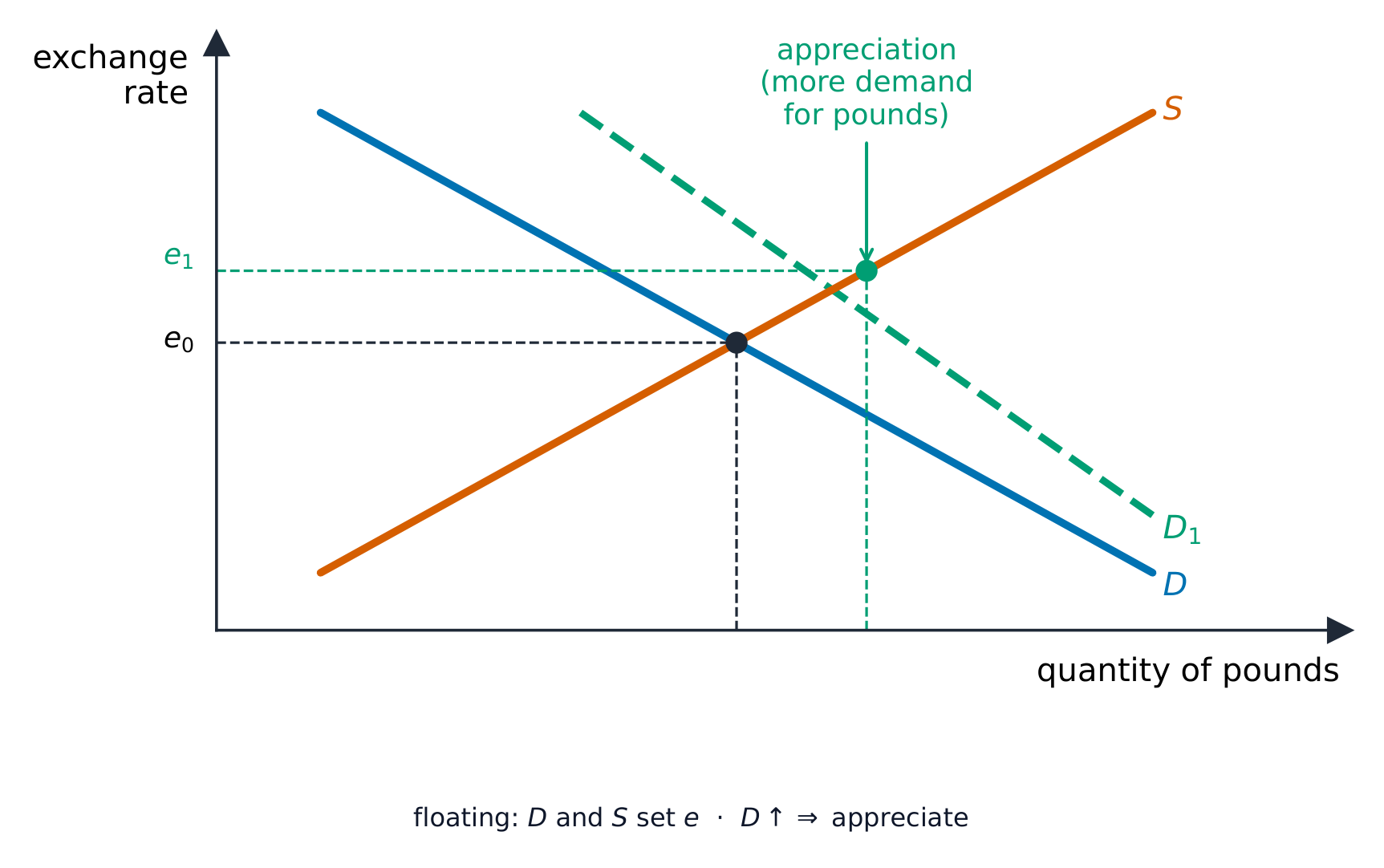
a floating exchange rate 浮动汇率 is set freely by the demand for and supply of the currency. If more people want a currency (to buy its exports), its value rises.
a fixed exchange rate 固定汇率 is held at a set value by the central bank, which buys and sells the currency to keep it there.
a managed exchange rate 管理浮动汇率 mostly floats, but the central bank steps in now and then to steady it.
Appreciation and depreciation
Under floating rates:
appreciation 升值 is a rise in the currency's value. Exports become dearer for foreigners, and imports become cheaper.
depreciation 贬值 is a fall in the currency's value. Exports become cheaper, and imports become dearer.
A depreciation can therefore raise export sales and cut imports, helping the current account — but it can also raise inflation, because imports cost more.
Worked example. Suppose the exchange rate is $\text{\pounds} 1 = \$1.40$.
A UK exporter's $\text{\pounds} 200$ machine costs an American buyer $\text{\pounds} 200 \times 1.40 = \$280$. If the pound then appreciates to $\text{\pounds} 1 = \$1.60$, the same machine costs $\text{\pounds} 200 \times 1.60 = \$320$ — dearer for the American, so fewer are sold. Going the other way, a $\$700$ invoice from a US supplier costs a UK firm $\$700 \div 1.40 = \text{\pounds} 500$.
العربية
أسعار الصرف: الارتفاع
سعر الصرف هو سعر عملة واحدة بدلالة أخرى. توجد ثلاثة أنظمة رئيسية.
شباك صرف عملات: سعر الصرف هو سعر عملة واحدة بدلالة أخرى.
سعر الصرف العائم يُحدد بحرية بناءً على الطلب والعرض على العملة. إذا أراد المزيد من الناس عملة معينة (لشراء صادراتها)، يرتفع قيمتها.
سعر الصرف الثابت يُحافظ على قيمة محددة من قبل البنك المركزي، الذي يقوم بشراء وبيع العملة للحفاظ عليها عند هذا المستوى.
سعر الصرف المُدار يطبع عليه طابع العوم的大部分، لكن يتدخل البنك المركزي أحيانًا لاستقراره.
يُحدد سعر الصرف العائم عند نقطة تقاطع الطلب على العملة مع العرض. زيادة الطلب على الجنيهات ($D \to D_1$) ترفع السعر — وهو ارتفاع.
الارتفاع والانخفاض
تحت أسعار الصرف العائمة:
الارتفاع هو زيادة في قيمة العملة. تصبح الصادرات أغلى للأجانب، وتصبح الواردات أرخص.
الانخفاض هو انخفاض في قيمة العملة. تصبح الصادرات أرخص، وتصبح الواردات أغلى.
وبالتالي يمكن لـ الانخفاض أن يزيد مبيعات الصادرات ويقلل الواردات، مما يساعد الحساب الجاري — ولكنه قد يؤدي أيضًا إلى ارتفاع التضخم، لأن الواردات تكلف أكثر.
مثال محلول. لنفترض أن سعر الصرف هو $\text{\pounds} 1 = \$1.40$.
آلة costing $\text{\pounds} 200$ لصادر بريطاني تكلف المشتري الأمريكي $\text{\pounds} 200 \times 1.40 = \$280$. If the pound then appreciates to $\text{\pounds} 1 = \$1.60$، نفس الآلة تكلف $\text{\pounds} 200 \times 1.60 = \$320$ — dearer for the American, so fewer are sold. Going the other way, a $\$700$ فاتورة من مورد أمريكي تكلف الشركة البريطانية $\$700 ÷ 1.40 = \text{\pounds} 500$.
Explore · استكشف
The foreign-exchange market · سوق العملات الأجنبية
A currency has its own market. More demand for £ (or less supply) pushes the exchange rate up — it appreciates. · للعملة سوق خاص بها. زيادة الطلب على الجنيه (أو نقص العرض) تدفع سعر الصرف للأعلى — فت appreciation (ترتقي).
Correcting a current account deficit · تصحيح عجز الحساب الجاري
Syllabus · المنهج
English
explain expenditure-switching and expenditure-reducing policies and supply-side measures to correct a deficit
evaluate the effectiveness of these policies
العربية
اشرح سياسات تحويل الإنفاق وتقليل الإنفاق والتدابير الجانبية لتصحيح العجز
قيّم فعالية هذه السياسات
Source: Cambridge International syllabus · المصدر: منهج كامبريدج الدولي
English
A government can use three kinds of policy to cut a deficit:
expenditure-reducing 支出减少 policies lower total demand (higher taxes or interest rates), so people buy fewer imports. But they also slow growth and raise unemployment.
expenditure-switching 支出转换 policies move spending away from imports towards home goods (a tariff, or a lower exchange rate). But they can cause retaliation or inflation.
supply-side policies raise the competitiveness 竞争力 of home firms (better skills and technology), so exports rise. These work best in the long run but are slow.
العربية
يمكن للحكومة استخدام ثلاثة أنواع من السياسات لتقليص العجز:
سياسات تقليل الإنفاق تخفض الطلب الكلي (زيادة الضرائب أو أسعار الفائدة)، sehingga people buys fewer imports. But they also slow growth and raise unemployment.
سياسات تحويل الإنفاق تحرك الإنفاق بعيدًا عن الواردات نحو السلع المحلية (تعريف جمركي، أو انخفاض سعر الصرف). But they can cause retaliation or inflation.
السياسات الجانبية للعرض ترفع القدرة التنافسية للشركات المحلية (مهارات وتكنولوجيا أفضل)، مما يؤدي إلى زيادة الصادرات. تعمل هذه السياسات بشكل أفضل على المدى الطويل لكنها بطيئة.
تدفقات التجارة في ميناء حاويات: عجز الحساب الجاري يعني أن واردات البضائع والخدمات تفوق الصادرات
Explore · استكشف
Current account flow · تدفق الحساب الجاري
Track exports, imports and income flows into the current account. · تتبع تصدير، واردات وتدفقات الدخل في الحساب الجاري.
Pick one and the site follows you — notes, papers, videos and practice all open on it. · اختر واحدًا وسيتبعك الموقع — الملاحظات، الأوراق، الفيديوهات والتدريب جميعها تفتح عليه.
Type to search notes, lessons, code, vocabulary and past-paper questions across every subject. · اكتب للبحث عن ملاحظات، دروس، أكواد، مفردات وأسئلة امتحانات سابقة عبر جميع المواد.