في أي لحظة، يحتوي جسمك فقط على حوالي خمسين جراماً من ATP. ومع ذلك، خلال يوم واحد، ستنتج وتنفق ما يعادل وزن جسمك تقريباً منه. نفس…
English narration · English + 中文 subtitles burned in · سرد باللغة الإنجليزية · ترجمة مدمجة بالإنجليزية + الصينية
12.1
Why living things need energy · لماذا تحتاج الكائنات الحية إلى الطاقة
Syllabus · المنهج
English
outline the need for energy in living organisms, as illustrated by active transport, movement and anabolic reactions, such as those occurring in DNA replication and protein synthesis
describe the features of ATP that make it suitable as the universal energy currency
state that ATP is synthesised by: • transfer of phosphate in substrate-linked reactions • chemiosmosis in membranes of mitochondria and chloroplasts
explain the relative energy values of carbohydrates, lipids and proteins as respiratory substrates
state that the respiratory quotient (RQ) is the ratio of the number of molecules of carbon dioxide produced to the number of molecules of oxygen taken in, as a result of respiration
calculate RQ values of different respiratory substrates from equations for respiration
describe and carry out investigations, using simple respirometers, to determine the RQ of germinating seeds or small invertebrates (e.g. blowfly larvae)
العربية
صِف الحاجة للطاقة في الكائنات الحية، كما هو موضح في النقل النشط والحركة والتفاعلات البنائية، مثل تلك التي تحدث في تضاعف DNA وتركيب البروتين
صف ميزات ATP التي تجعله مناسبًا كعملة طاقة عالمية
بيّن أن ATP يتم تصنيعه عن طريق: • نقل الفوسفات في التفاعلات المرتبطة بالمادة الأساسية • الأكسدة الكيميائية في أغشية الميتوكوندريا والبلاستيدات الخضراء
بيّن أن معامل التنفس (RQ) هو نسبة عدد جزيئات ثاني أكسيد الكربون المنتجة إلى عدد جزيئات الأكسجين المستهلكة نتيجة للتنفس
احسب قيم RQ لمواد أساسية تنفسية مختلفة من معادلات التنفس
صف وأجرِ تحقيقات باستخدام أجهزة تنفس بسيطة لتحديد RQ للبذور الملمعة أو اللافقاريات الصغيرة (مثل يرقات ذبابة اللحم)
Source: Cambridge International syllabus · المصدر: منهج كامبريدج الدولي
English
Cells need a steady supply of energy 能量, which they get from respiration 呼吸作用. Energy is needed for:
active transport 主动运输 (moving substances against a gradient),
movement (for example muscle contraction),
anabolic 合成代谢 reactions — the building of large molecules, such as in DNA replication and protein synthesis.
العربية
تحتاج الخلايا إلى إمداد مستمر من الطاقة، which تحصل عليها من التنفس الخلوي. الطاقة مطلوبة لـ:
النقل النشط (تحريك المواد عكس تدرج التركيز)،
الحركة (على سبيل المثال انقباض العضلات)،
التفاعلات البنائية — بناء جزيئات كبيرة، مثل تضخيم الحمض النووي وتخليق البروتين.
أثناء ممارسة الرياضة، تحتاج العضلات إلى إمداد مستمر بالطاقة التي يحررها التنفس الخلوي
12.1
ATP — the energy currency · ATP — عملة الطاقة
English
ATP is the molecule that carries energy to where it is needed. It is made from ADP and a phosphate group; when it loses that phosphate again, it releases a small, usable burst of energy. ATP suits this job well, so we call it the universal energy currency:
it releases energy quickly, in small amounts that match a cell's needs.
it is easily made and re-made, again and again.
it is small and soluble, so it moves easily around the cell.
ATP is made in two ways: by direct transfer of a phosphate group in phosphorylation 磷酸化 reactions, and by chemiosmosis 化学渗透 across the membranes of mitochondria 线粒体 and chloroplasts.
العربية
ATP هو الجزيء الذي يحمل الطاقة إلى حيث تحتاجه. يُصنع من ADP ومجموعة فوسفات؛ عند فقدانه لتلك المجموعة الفوسفاتية مرة أخرى، يطلق نبضة صغيرة من الطاقة قابلة للاستخدام. يناسب ATP هذا الدور جيداً، لذا نسميه عملة الطاقة العالمية:
يطلق الطاقة بسرعة، بكميات صغيرة تتناسب مع احتياجات الخلية.
يُصنع ويُعاد تصنيعه بسهولة، مراراً وتكراراً.
صغير وقابل للذوبان، لذلك يتحرك بسهولة داخل الخلية.
يضيف التنفس الخلوي فوسفاتاً لتكوين ATP؛ تكسر الخلية الرابطة مرة أخرى لإطلاق الطاقة
يُصنع ATP بطريقتين: بنقل مباشر لمجموعة فوسفات في تفاعلات الفسفرة، وبـ الكيميوسموزة عبر أغشية الميتوكوندريا والكلوروبلاستات.
Explore · استكشف
The ATP cycle · دورة ATP
Step around the loop. ATP is split to release a small burst of energy, then rebuilt by respiration — over and over. · مرحلة حول الحلقة. يتحلل ATP لإطلاق نبضة صغيرة من الطاقة، ثم يُعاد بناؤه بالتنفس — مراراً وتكراراً.
12.1
Respiratory substrates and RQ · ركائز التنفس ونسبة التنفس RQ
English
A respiratory substrate 呼吸底物 is a molecule that is broken down to release energy. Per gram, lipids release the most energy (they have the most hydrogen), proteins are next, and carbohydrates the least.
The respiratory quotient 呼吸商 (RQ) compares the gases exchanged:
$$\text{RQ} = \frac{\text{molecules of carbon dioxide produced}}{\text{molecules of oxygen taken in}}$$
You can work out the RQ from a respiration equation. Carbohydrates give an RQ of about 1.0, lipids about 0.7 and proteins about 0.9.
Worked example. Find the RQ for the aerobic respiration of glucose: $\text{C}_6\text{H}_{12}\text{O}_6 + 6\text{O}_2 \rightarrow 6\text{CO}_2 + 6\text{H}_2\text{O}$.
This is why an RQ near $1.0$ suggests the organism is respiring carbohydrate; a lower RQ (about $0.7$) suggests it is using lipid, which needs more oxygen per molecule of $\text{CO}_2$.
A respirometer 呼吸计 measures the oxygen 氧气 taken in by living things, such as germinating 萌发 seeds or small invertebrates 无脊椎动物, and is used to find their RQ.
العربية
المادة المرسلة للتنفس هي جزيء يتم تكسيرها لإطلاق الطاقة. لكل غرام، تطلق الدهون أكثر الطاقة (لأنها تحتوي على المزيد من الهيدروجين)، تليها البروتينات، ثم الكربوهيدرات التي تطلق الأقل.
تحرر الدهون أكثر الطاقة لكل جرام، ثم البروتينات، ثم الكربوهيدرات
مقياس التنفس (RQ) يقارن الغازات المتبادلة:
$$\text{RQ} = \frac{\text{molecules of carbon dioxide produced}}{\text{molecules of oxygen taken in}}$$
يمكنك حساب الـ RQ من معادلة التنفس. تعطي الكربوهيدرات RQ تقارب 1.0، والدهون تقارب 0.7 والبروتينات تقارب 0.9.
ولهذا فإن RQ قريب من $1.0$ يشير إلى أن الكائن الحي يتنفس الكربوهيدرات؛ بينما RQ أقل (تقارب $0.7$) يشير إلى أنه يستخدم الدهون، والتي تتطلب أكسجين أكثر لكل جزيء من $\text{CO}_2$.
جهاز قياس التنفس يقيس الأكسجين الذي تستهلكه الكائنات الحية، مثل البذور النبتة أو الحيوانات لا فقارية صغيرة، ويُستخدم لإيجاد RQ الخاص بها.
يمتص هيدروكسيد الصوديوم ثاني أكسيد الكربون المنبعث، لذا ينخفض حجم الغاز فقط بمقدار الأكسجين المستخدم — وتتحرك الخرزة لمقدار ذلك
Explore · استكشف
Respiratory quotient lab · مختبر معامل التنفس
RQ = CO2 produced / O2 used · RQ = CO2 الناتج / O2 المستهلك
Change oxygen use and see how RQ compares fuels. · غيّر استخدام الأكسجين ولاحظ كيفية مقارنة RQ بين الوقود.
electron transport chain/ɪˈlektrɒn ˈtrænspɔːt tʃeɪn/
سلسلة نقل الإلكترون
proton/ˈprəʊtɒn/
بروتون
ATP synthase/ˌeɪ tiː ˈpiː ˈsɪnθeɪs/
إنزيم合成 ATP
cristae/ˈkrɪstiː/
الأعراف
fermentation/fɜːmənˈteɪʃn/
التخمر
lactate/ˈlækteɪt/
لاكتات
yeast/jiːst/
الخميرة
ethanol/ˈeθənɒl/
إيثانول
12.2
Aerobic respiration: the four stages · التنفس الهوائي: المراحل الأربع
Syllabus · المنهج
English
State where each of the four stages in aerobic respiration occurs in eukaryotic cells: • glycolysis in the cytoplasm • link reaction in the mitochondrial matrix • Krebs cycle in the mitochondrial matrix • oxidative phosphorylation on the inner membrane of mitochondria
outline glycolysis as phosphorylation of glucose and the subsequent splitting of fructose 1,6-bisphosphate (6C) into two triose phosphate molecules (3C), which are then further oxidised to pyruvate (3C), with the production of ATP and reduced NAD
explain that, when oxygen is available, pyruvate enters mitochondria to take part in the link reaction
describe the link reaction, including the role of coenzyme A in the transfer of acetyl (2C) groups
outline the Krebs cycle, explaining that oxaloacetate (4C) acts as an acceptor of the 2C fragment from acetyl coenzyme A to form citrate (6C), which is converted back to oxaloacetate in a series of small steps
explain that reactions in the Krebs cycle involve decarboxylation and dehydrogenation and the reduction of the coenzymes NAD and FAD
describe the role of NAD and FAD in transferring hydrogen to carriers in the inner mitochondrial membrane
explain that during oxidative phosphorylation: • hydrogen atoms split into protons and energetic electrons • energetic electrons release energy as they pass through the electron transport chain (details of carriers are not expected) • the released energy is used to transfer protons across the inner mitochondrial membrane • protons return to the mitochondrial matrix by facilitated diffusion through ATP synthase, providing energy for ATP synthesis (details of ATP synthase are not expected) • oxygen acts as the final electron acceptor to form water
describe the relationship between the structure and function of mitochondria using diagrams and electron micrographs
outline respiration in anaerobic conditions in mammals (lactate fermentation) and in yeast cells (ethanol fermentation)
explain why the energy yield from respiration in aerobic conditions is much greater than the energy yield from respiration in anaerobic conditions (a detailed account of the total yield of ATP from the aerobic respiration of glucose is not expected)
explain how rice is adapted to grow with its roots submerged in water, limited to the development of aerenchyma in roots, ethanol fermentation in roots and faster growth of stems
describe and carry out investigations using redox indicators, including DCPIP and methylene blue, to determine the effects of temperature and substrate concentration on the rate of respiration of yeast
describe and carry out investigations using simple respirometers to determine the effect of temperature on the rate of respiration
العربية
حدد أين يحدث كل طور من المراحل الأربع في التنفس الهوائي في الخلايا حقيقية النواة: • تحلل السكر في السيتوبلازم • تفاعل الربط في مصفوفة الميتوكوندريا • دورة كريبس في مصفوفة الميتوكوندريا • الفسفرة التأكسدية على الغشاء الداخلي للميتوكوندريا
صِف تحلل السكر كتفسفرة الجلوكوز وانقسام فركتوز 1,6-ثنائي فوسفات (6C) لاحقًا إلى جزيئين من ثلاثي فوسفات التريوز (3C)، والتي يتم بعد ذلك أكسدتها أكثر إلى بيروفيت (3C)، مع إنتاج ATP وNAD المختزل
اشرح أنه عند توفر الأكسجين، يدخل البيروفيت الميتوكوندريا للمشاركة في تفاعل الربط
صف تفاعل الربط، بما في ذلك دور إنزيم A في نقل مجموعات أسيتيل (2C)
صِف دورة كريبس، مشيرًا إلى أن أوكسالوإيثان (4C) يعمل كمستقبل للقطعة ذات الـ 2C من أسيتيل إنزيم A لتشكيل سيترات (6C)، والذي يتحول مرة أخرى إلى أوكسالوإيثان عبر سلسلة من الخطوات الصغيرة
اشرح أن تفاعلات دورة كريبس تتضمن إزالة الكربوكسيل و إزالة الهيدروجين واختزال الإنزيمات NAD وFAD
صف دور NAD وFAD في نقل الهيدروجين إلى ناقلات في الغشاء الداخلي للميتوكوندريا
اشرح أنه خلال الفسفرة التأكسدية: • تنقسم ذرات الهيدروجين إلى بروتونات وإلكترونات ذات طاقة عالية • تطلق الإلكترونات ذات الطاقة العالية طاقة أثناء مرورها عبر سلسلة نقل الإلكترون (لم يُطلب تفاصيل الحاملات) • تُستخدم الطاقة المنطلقة لنقل البروتونات عبر الغشاء الداخلي للميتوكوندريا • تعود البروتونات إلى حيز الميتوكوندريا عن طريق الانتشار المساعِد عبر إنزيم تركيب الـ ATP، مما يوفر الطاقة لتركيب الـ ATP (لم يُطلب تفاصيل إنزيم تركيب الـ ATP) • يعمل الأكسجين كمستقبل نهائي للإلكترونات لتكوين الماء
صف العلاقة بين بنية الميتوكوندريا ووظيفتها باستخدام المخططات والمجهر الإلكتروني
استعرض التنفس في ظروف اللاهوائية عند الثدييات (التخمر اللبني) وعند خلايا الخميرة (التخمر الكحولي)
اشرح لماذا يكون العائد من الطاقة من التنفس في الظروف الهوائية أعلى بكثير من العائد من الطاقة في التنفس في الظروف اللاهوائية (لم يُطلب حساب تفصيلي لإجمالي عائد الـ ATP من التنفس الهوائي للجلوكوز)
اشرح كيف تتكيف الأرز للنمو بجذورها مغمورة في الماء، مع التركيز على تطور النسيج الهوائي في الجذور، والتخمر الكحولي في الجذور، ونمو الساق بسرعة أكبر
صف وأجرِ تحقيقات باستخدام مؤشرات الأكسدة والاختزال، بما في ذلك DCPIP والميثيلين الأزرق، لتحديد تأثيرات درجة الحرارة وتركيز المادة المؤثرة على معدل تنفس الخميرة
صف وأجرِ تحقيقات باستخدام أجهزة قياس التنفس البسيطة لتحديد تأثير درجة الحرارة على معدل التنفس
Source: Cambridge International syllabus · المصدر: منهج كامبريدج الدولي
English
Aerobic 有氧 respiration (with oxygen) has four stages, each in a set place in the cell:
Stage
Where it happens
glycolysis 糖酵解
the cytoplasm 细胞质
link reaction 连接反应
the matrix 基质 of the mitochondria
Krebs cycle 克雷布斯循环
the matrix of the mitochondria
oxidative phosphorylation 氧化磷酸化
the inner membrane of the mitochondria
Glycolysis
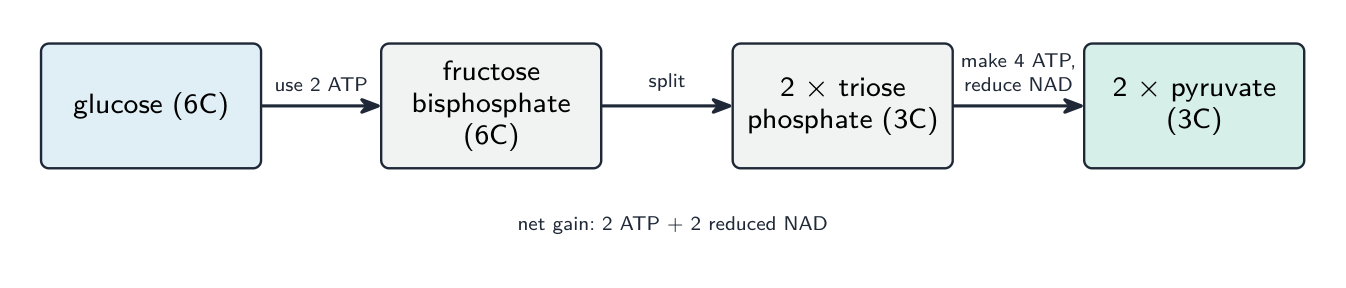
Glucose 葡萄糖 (6 carbons) is first phosphorylated, using 2 ATP, to form fructose bisphosphate (6C). This 6C molecule is split into two triose phosphate molecules (3C each). These are then oxidised 氧化 to pyruvate 丙酮酸 (3C). Glycolysis makes a net gain of 2 ATP and some reduced 还原 NAD (NAD is a coenzyme 辅酶, a helper molecule).
The link reaction
When oxygen is available, pyruvate enters the mitochondria. There each pyruvate loses a carbon dioxide 二氧化碳 and is turned into a 2-carbon acetyl 乙酰基 group. This group is carried by coenzyme A 辅酶A to form acetyl coenzyme A. Some carbon dioxide is released and NAD is reduced.
The Krebs cycle
The 2C acetyl group joins a 4-carbon molecule, oxaloacetate 草酰乙酸, to make a 6-carbon molecule, citrate 柠檬酸. Citrate is then changed back to oxaloacetate in a series of small steps, ready to accept the next acetyl group. During these steps:
decarboxylation 脱羧 removes carbon as carbon dioxide.
dehydrogenation 脱氢 removes hydrogen, which reduces the coenzymes NAD and FAD.
The reduced NAD and FAD then carry the hydrogen to the carriers in the inner mitochondrial membrane.
Oxidative phosphorylation
This stage makes most of the ATP:
the hydrogen atoms split into protons 质子 and energetic electrons 电子.
the electrons pass along the electron transport chain 电子传递链, releasing energy as they go.
this energy is used to pump protons across the inner membrane.
the protons flow back into the matrix through a channel called ATP synthase ATP合酶. This flow provides the energy to make ATP (this is chemiosmosis).
oxygen is the final electron acceptor: it joins with electrons and protons to form water.
The structure of mitochondria
The inner membrane is folded into cristae 嵴, giving a large surface for the electron transport chain and ATP synthase. The matrix inside holds the substances and helpers for the link reaction and the Krebs cycle.
العربية
التنفس الهوائي (مع وجود الأكسجين) له أربع مراحل، كل منها في مكان محدد داخل الخلية:
المرحلة
أين تحدث
تحلل السكر
السيتوبلازم
تفاعل الربط
المصفوفة الخاصة بالميتوكوندريا
دورة كريبس
مصفوفة الميتوكوندريا
الفسفرة التأكسدية
الغشاء الداخلي للميتوكوندريا
المراحل الأربع وأماكن حدوثها؛ يحمل NAD وFAD المختزلان الهيدروجين إلى الغشاء الداخلي حيث يُصنع معظم الـ ATP
تحلل السكر
الجلوكوز (6 ذرات كربون) يخضع للفسفرة أولاً، باستخدام 2 ATP، لتكوين فركتوز ثنائي الفسفات (6C). ينقسم هذا الجزيء الـ 6C إلى جزيئين من فوسفات التريوز (3C لكل منهما). ثم يتم أكسدتهما إلى بيروفيت (3C). ينتج تحلل السكر ربحاً صافياً قدره 2 ATP وبعض NAD المختزل (NAD هو إنزيم مساعد، جزيء مساند).
يستهلك تحلل السكر 2 ATP لبدء العملية لكنه ينتج 4، لذا الربح الصافي هو 2 ATP (بالإضافة إلى NAD المختزل) — ولا يحتاج إلى أكسجين
تفاعل الربط
عند توفر الأكسجين، يدخل البيروفيت إلى الميتوكوندريا. هناك يفقد كل بيروفيت ثاني أكسيد الكربون ويتحول إلى مجموعة أسيتيل ذات 2 ذرة كربون. تنقل هذه المجموعة بواسطة إنزيم أ A لتكوين أسيتيل إنزيم أ. يتم إطلاق بعض ثاني أكسيد الكربون وتختزل NAD.
دورة كريبس
تتصل مجموعة الأسيتيل 2C بجزيء 4-ذرة كربون، وهو أوكسالوأسيتات، لتكوين جزيء 6-ذرة كربون، وهو سيترات. ثم يتحول السيترات مرة أخرى إلى أوكسالوأسيتات عبر سلسلة من الخطوات الصغيرة، استعداداً لاستقبال مجموعة الأسيتيل التالية. خلال هذه الخطوات:
إزالة الكربوكسيل تُزيل الكربون على شكل ثاني أكسيد الكربون.
إزالة الهيدروجين تُزيل الهيدروجين، مما يؤدي إلى اختزال الإنزيمات المساعدة NAD وFAD.
يحمل NAD وFAD المختزلان بعد ذلك الهيدروجين إلى ناقلات الغشاء الداخلي للميتوكوندريا.
كل دورة تطلق ثاني أكسيد الكربون (إزالة الكربوكسيل) وNAD وFAD المختزلين (إزالة الهيدروجين)
الفسفرة التأكسدية
تنتج هذه المرحلة معظم الـ ATP:
تنقسم ذرات الهيدروجين إلى بروتونات وإلكترونات عالية الطاقة.
تمر الإلكترونات عبر سلسلة نقل الإلكترون، محررةً الطاقة أثناء مرورها.
تُستخدم هذه الطاقة لضخ البروتونات عبر الغشاء الداخلي.
تعود البروتونات إلى المصفوفة عبر قناة تسمى ATP سينثيز. يوفر هذا التدفق الطاقة لتصنيع ATP (وهذا ما يسمى بالانتشار الكيميائي).
الأكسجين هو المستقبل النهائي للإلكترونات: يرتبط بالإلكترونات والبروتونات لتكوين الماء.
تضخ الإلكترونات البروتونات (H⁺) إلى الفراغ بين الغشائين؛ تعود عبر ATP سينثيز لتصنيع ATP (الانتشار الكيميائي)
بنية الميتوكوندريا
يتم طي الغشاء الداخلي إلى أعراف، مما يوفر سطحاً كبيراً لسلسلة نقل الإلكترون وATP سينثيز. تحتوي المصفوفة الداخلية على المواد والمساند الخاصة بتفاعل الربط ودورة كريبس.
ميتوكوندرتان حقيقيتان، تم تصويرهما بالمجهر الإلكتروني. الخطوط الداكنة المقطعة للداخل هي الأعراف — كل هذا الطي هو ما يجعل السطح الخاص بسلسلة نقل الإلكترون كبيراً جداً
Explore · استكشف
Glycolysis · تحلل السكر
Step through it. Glucose is split in the cytoplasm into two pyruvate, for a small net gain of ATP and reduced NAD. · مرر عبر المراحل. ينقسم الجلوكوز في السيتوبلازم إلى بيروفاتين، لتحقيق ربح صافي صغير من ATP وNAD مختزل.
Explore · استكشف
The four stages of respiration · المراحل الأربع للتنفس
Step through where ATP comes from. Glucose is broken down in stages; most ATP is made at the last stage. · مرر عبر来源 ATP. يُكسر الجلوكوز على مراحل؛ يتم制成 معظم ATP في المرحلة الأخيرة.
When there is no oxygen, only glycolysis can run. To keep glycolysis going, the cell must use up the reduced NAD. This happens by fermentation 发酵:
in mammals, pyruvate is turned into lactate 乳酸 (lactate fermentation). The lactate is later broken down when oxygen returns.
in yeast 酵母, pyruvate is turned into ethanol 乙醇 and carbon dioxide (ethanol fermentation).
Anaerobic 无氧 respiration gives far less energy than aerobic respiration. Aerobic respiration also runs the Krebs cycle and oxidative phosphorylation, which release a lot more ATP, while anaerobic respiration gains only the small amount from glycolysis.
العربية
عندما لا يوجد أكسجين، لا يمكن أن يعمل سوى تحلل السكر. وللمضي قدماً في تحلل السكر، يجب على الخلية استهلاك NAD المختزل. يحدث ذلك عن طريق التخمر:
في الثدييات، يتحول البيروفيت إلى لاكتات (تخمر اللاكتات). يتم تكسير اللاكتات لاحقاً عند عودة الأكسجين.
في الخميرة، يتحول البيروفيت إلى إيثانول وثاني أكسيد الكربون (تخمر الإيثانول).
بدون الأكسجين، يتحول البيروفات إلى لاكتات (في الثدييات) أو كحول (في الخميرة)؛ مما يعيد توليد NAD لتحلل السكر
التنفس اللاهوائي ينتج طاقة أقل بكثير من التنفس الهوائي. التنفس الهوائي يشمل أيضًا دورة كريبس والفسفرة التأكسدية، اللتين تطلقان كمية أكبر بكثير من ATP، بينما يقتصر التنفس اللاهوائي على الكمية الصغيرة الناتجة من تحلل السكر.
Explore · استكشف
Why fermentation matters · لماذا التخمر مهم
Step through it. Without oxygen, fermentation regenerates NAD so glycolysis can keep making a little ATP. · مرر عبر المراحل. بدون أكسجين، يعيد التخمر توليد NAD حتى تستمر عملية تحلل السكر في صنع القليل من الـATP.
Rice and waterlogged roots · الأرز وجذور الغرق بالماء
English
Rice can grow with its roots under water, where there is little oxygen. It is adapted in three ways: it develops aerenchyma 通气组织 (air-filled spaces) in the roots to carry air down; the roots use ethanol fermentation to keep making some ATP; and the stems grow faster to reach the air above the water.
العربية
يمكن للأرز النمو وجذوره تحت الماء، حيث يكون الأكسجين قليلًا. وهو متكيف بثلاث طرق: يطور أريينشيم (مساحات مملوءة بالهواء) في الجذور لنقل الهواء للأسفل؛ تستخدم الجذور تخمر الكحول لمواصلة إنتاج بعض الـATP؛ وتنمو السيقان بسرعة للوصول إلى الهواء فوق الماء.
جذر لنبات ينمو في الماء، يُرى في مقطع عرضي. الفجوات البيضاء الكبيرة هي الأريينشيم — قنوات هوائية متصلة تسمح للأكسجين بالانتشار حتى الجذور المغمورة في طين فقير بالأكسجين
Investigating the rate of respiration · استكشاف معدل التنفس
English
A redox indicator 指示剂 such as DCPIP or methylene blue loses its colour when it gains hydrogen from respiring cells. The faster the colour is lost, the faster the yeast is respiring, so you can test the effect of temperature or substrate concentration. A respirometer can also be used to measure how temperature changes the rate of oxygen uptake.
العربية
يخسر المؤشر الأحمر مثل DCPIP أو أزرق الميثيلين لونه عندما يكتسب الهيدروجين من الخلايا المتنفسلة. كلما كان فقدان اللون أسرع، كان تنفس الخميرة أسرع، لذا يمكنك اختبار تأثير درجة الحرارة أو تركيز المادة الغذائية. يمكن أيضًا استخدام جهاز قياس التنفس لقياس كيف تغير درجة الحرارة معدل امتصاص الأكسجين.
12.2
Exam tips · نصائح للامتحان
English
State where each stage happens and its ATP yield: glycolysis (cytoplasm), link reaction + Krebs (matrix), oxidative phosphorylation (inner membrane, most ATP).
Explain the roles of NAD/FAD (carry hydrogen to the electron transport chain) and of oxygen (the final electron acceptor).
RQ$=$ CO2 produced $\div$ O2 used ($\approx 1.0$ carbohydrate, $0.7$ lipid); know how a respirometer measures it.
Anaerobic respiration gives lactate (animals) or ethanol + CO2 (yeast/plants) and far less ATP (glycolysis only).
العربية
حدد أين يحدث كل مرحلة وإنتاجها من ATP: تحلل السكر (السيتوبلازم)، تفاعل الربط + دورة كريبس (المصفوفة)، الفسفرة التأكسدية (الغشاء الداخلي، أكثر ATP).
اشرح أدوار NAD/FAD (تحمّل الهيدروجين إلى سلسلة نقل الإلكترون) وأدوار الأكسجين (المستقبل النهائي للإلكترونات).
معدل التنفس (RQ)$=$ CO2 المُنتَج $\div$ O2 المُستهلك ($\approx 1.0$ الكربوهيدرات، $0.7$ الدهون)؛ تعرف كيف يقيس جهاز التنفس ذلك.
التنفس اللاهوائي يُنتج حمض اللاكتيك (في الحيوانات) أو الإيثانول + CO2 (في الخميرة/النباتات) وكمية أقل بكثير من ATP (تحلل السكر فقط).
Interactive lessons on this topic · دروس تفاعلية حول هذا الموضوع
Work through it step by step, with instant-check exercises. · ا-working عليه خطوة بخطوة، مع تمارين تحقق فوري.
Pick one and the site follows you — notes, papers, videos and practice all open on it. · اختر واحدًا وسيتبعك الموقع — الملاحظات، الأوراق، الفيديوهات والتدريب جميعها تفتح عليه.
Type to search notes, lessons, code, vocabulary and past-paper questions across every subject. · اكتب للبحث عن ملاحظات، دروس، أكواد، مفردات وأسئلة امتحانات سابقة عبر جميع المواد.