本讲义涵盖主题 8,概率(Probability)。标记 (Extended) 的部分只在拓展卷上考查;其他一切对两个层次都适用。
概率
IGCSE 数学 · 第 8 主题
 7:31
7:31
Probability
Will it rain tomorrow? Will the bus be late? Will this die show a six? Almost nothing in life is certain, and almost nothing is impossible. Most things sit…
英文讲解 · 内嵌中英文字幕
8.1
概率导论

大纲
| Subject content | Notes and examples |
|---|---|
| 1 Understand and use the probability scale from 0 to 1. | Probability notation is not required. Probabilities should be given as a fraction, decimal or percentage. Problems may require using information from tables, graphs or Venn diagrams (limited to two sets). |
| 2 Calculate the probability of a single event. | |
| 3 Understand that the probability of an event not occurring = 1 – the probability of the event occurring. | e.g. The probability that a counter is blue is 0.8. What is the probability that it is not blue? |
| Subject content | Notes and examples |
|---|---|
| 1 Understand and use the probability scale from 0 to 1. | $\text{P}(A)$ is the probability of $A$ |
| 2 Understand and use probability notation. | $\text{P}(A')$ is the probability of not $A$ |
| 3 Calculate the probability of a single event. | Probabilities should be given as a fraction, decimal or percentage. Problems may require using information from tables, graphs or Venn diagrams. |
| 4 Understand that the probability of an event not occurring = 1 – the probability of the event occurring. | e.g. $\text{P}(B) = 0.8$, find $\text{P}(B')$ |
来源:剑桥国际大纲
概率(probability)衡量一个事件(event)有多可能。它在一个从 $0$(不可能)到 $1$(确定)的标度上,而且能被写成一个分数、小数或百分比。我们把事件 $A$ 的概率写成 $\text{P}(A)$。

对于等可能的结果(outcomes),
$$\text{P}(\text{event}) = \frac{\text{number of favourable outcomes}}{\text{total number of outcomes}}.$$
一个事件不发生的概率是
$$\text{P}(A') = 1 - \text{P}(A).$$
Worked example. 一个袋子有 $3$ 个红和 $5$ 个蓝的筹码。求不抽到红的概率。
$$\text{P}(\text{red}) = \frac{3}{8}, \qquad \text{P}(\text{not red}) = 1 - \frac{3}{8} = \frac{5}{8}.$$
探索
The probability scale
Slide the marker from 0 (impossible) to 1 (certain) to place an event on the probability scale.
词汇表
训练
| 英文 | 中文 | 拼音 |
|---|---|---|
| probability/ˌprɒbəˈbɪlɪti/ | 概率 | gài lǜ |
| event/ɪˈvent/ | 事件 | shì jiàn |
| outcome/ˈaʊtkʌm/ | 结果 | jié guǒ |
8.2
相对频率与期望频率
大纲
| Subject content | Notes and examples |
|---|---|
| 1 Understand relative frequency as an estimate of probability. | e.g. use results of experiments with a spinner to estimate the probability of a given outcome. |
| 2 Calculate expected frequencies. | e.g. use probability to estimate an expected value from a population. Includes understanding what is meant by fair, bias and random. |
| Subject content | Notes and examples |
|---|---|
| 1 Understand relative frequency as an estimate of probability. | e.g. use results of experiments with a spinner to estimate the probability of a given outcome. |
| 2 Calculate expected frequencies. | e.g. use probability to estimate an expected value from a population. |
| Includes understanding what is meant by fair, bias and random. |
来源:剑桥国际大纲
当结果不是等可能时,做一个实验。相对频率(relative frequency)估计概率:
$$\text{relative frequency} = \frac{\text{number of times it happened}}{\text{total number of trials}}.$$
你做的试验越多,估计越好。一个公平(fair)的物体给出相等的机会;一个有偏倚(bias)的不给;随机(random)意味着每个结果偶然发生。
期望频数(expected frequency)是你在 $n$ 次试验里期望一个事件多少次:
$$\text{expected frequency} = \text{P}(\text{event}) \times n.$$
Worked example. 掷出一个六的概率是 $\tfrac{1}{6}$。在 $300$ 次掷中期望多少个六?
$$\frac{1}{6} \times 300 = 50.$$
探索
Two-dice probability
Roll the two dice many times: the bars start jumpy but settle into the theoretical triangle peaking at 7 — experimental probability closing in on theory.
词汇表
训练
| 英文 | 中文 | 拼音 |
|---|---|---|
| relative frequency/ˈrelətɪv ˈfriːkwənsi/ | 相对频率 | xiāng duì pín lǜ |
| fair/feə/ | 公平 | gōng píng |
| bias/ˈbaɪəs/ | 偏倚 | piān yǐ |
| random/ˈrændəm/ | 随机 | suí jī |
| expected frequency/ekˈspektɪd ˈfriːkwənsi/ | 期望频数 | qī wàng pín shuò |
8.3
组合事件的概率

大纲
| Subject content | Notes and examples |
|---|---|
| Calculate the probability of combined events using, where appropriate: • sample space diagrams • Venn diagrams • tree diagrams. | Combined events will only be with replacement. |
| Venn diagrams will be limited to two sets. | |
| In tree diagrams, outcomes will be written at the end of the branches and probabilities by the side of the branches. |
| Subject content | Notes and examples |
|---|---|
| Calculate the probability of combined events using, where appropriate: • sample space diagrams • Venn diagrams | Combined events could be with or without replacement. |
| The notation $\text{P}(A \cap B)$ and $\text{P}(A \cup B)$ may be used in the context of Venn diagrams. | |
| • tree diagrams. | On tree diagrams outcomes will be written at the end of branches and probabilities by the side of the branches. |
来源:剑桥国际大纲
对于两个或更多事件一起(组合事件(combined events)),两条规则有帮助:
- AND(两者都发生):乘概率——当事件独立(independent)时(一个不影响另一个)。
- OR(任一发生):加概率——当事件互斥(mutually exclusive)时(它们不能都发生)。
三幅图帮助你组织工作。
Sample space diagrams
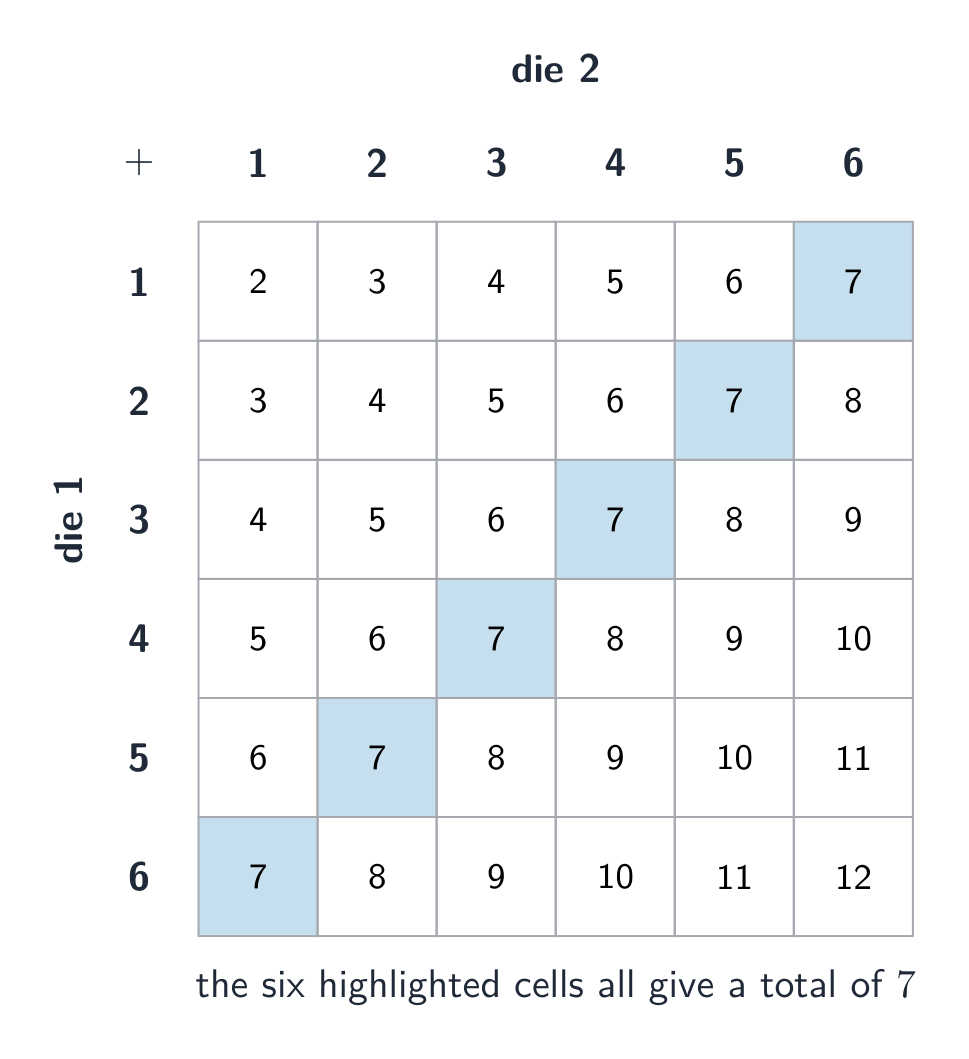
一个样本空间图(sample space diagram)是列出每个可能结果的一张表或网格——对两个骰子或两个转盘有用。数出你想要的结果占总数。
Venn diagrams
一个维恩图(Venn diagram)把结果分类到重叠的集合里。从它你能读出 $\text{P}(A \cap B)$(在两者里)和 $\text{P}(A \cup B)$(在任一里)。

Tree diagrams
一个树状图(tree diagram)把每个阶段显示为一组分支。在每个分支上写概率而在结尾写结果。沿分支乘,然后加你想要的路径。
Worked example (with replacement). 从袋子($3$ 红,$5$ 蓝)抽一个筹码、放回,然后抽第二个。这是有放回(with replacement),所以机会不变。求两个红的概率。
$$\text{P}(\text{red, red}) = \frac{3}{8} \times \frac{3}{8} = \frac{9}{64}.$$

Worked example (without replacement, Extended). 现在第一个筹码不放回——无放回(without replacement)地抽取。一个红被拿走后,$7$ 个里剩 $2$ 个红:
$$\text{P}(\text{red, red}) = \frac{3}{8} \times \frac{2}{7} = \frac{6}{56} = \frac{3}{28}.$$
探索
Probability tree
Multiply the probabilities along each branch; the four outcomes always add up to 1.
探索
Combined events
P(A ∩ B) = P(A)·P(B|A)
Combine two events: the area model shows AND (overlap) versus OR (union).
词汇表
训练
| 英文 | 中文 | 拼音 |
|---|---|---|
| combined events/kəmˈbaɪnd ɪˈvents/ | 组合事件 | zǔ hé shì jiàn |
| independent events/ˌɪndɪˈpendənt ɪˈvents/ | 独立事件 | dú lì shì jiàn |
| mutually exclusive/ˈmjuːtʃuːəli eksˈkluːsɪv/ | 互斥 | hù chì |
| sample space diagram/ˈsæmpl speɪs ˈdaɪəɡræm/ | 样本空间图 | yàng běn kōng jiān tú |
| Venn diagram/ven ˈdaɪəɡræm/ | 维恩图 | wéi ēn tú |
| tree diagram/triː ˈdaɪəɡræm/ | 树状图 | shù zhuàng tú |
| with replacement/wɪð rɪˈpleɪsmənt/ | 有放回 | yǒu fàng huí |
| without replacement/wɪˈðaʊt rɪˈpleɪsmənt/ | 无放回 | wú fàng huí |
8.4
条件概率
大纲
| Subject content | Notes and examples |
|---|---|
| Calculate conditional probability using Venn diagrams, tree diagrams and tables. | Knowledge of notation, $\text{P}(A|B)$, and formulas relating to conditional probability is not required. |
来源:剑桥国际大纲
条件概率(conditional probability)是一个事件在另一个已经发生的条件下的概率。通过只看匹配条件的部分,从一个维恩图、双向表或树状图读它。
Worked example. 在一个 $30$ 人的班里,$18$ 人学法语,而在那些人里,$7$ 人也学德语。一个法语学生被选中。求他们也学德语的概率。
只看这 $18$ 个法语学生:
$$\text{P}(\text{German} \mid \text{French}) = \frac{7}{18}.$$
探索
Probability trees
Change the branch probabilities and read combined and conditional probabilities off the tree.
词汇表
训练
| 英文 | 中文 | 拼音 |
|---|---|---|
| conditional probability/kənˈdɪʃənl ˌprɒbəˈbɪlɪti/ | 条件概率 | tiáo jiàn gài lǜ |
8.4
考试技巧
- 每个概率位于 $0$ 和 $1$ 之间,而所有结果的概率加起来等于 $1$。
- 对于"and"(两个事件)乘概率;对于"or"(任一事件)加它们。在一个树状图上,沿分支乘。
- 注意无放回:第二个概率变化,因为一个物品已经被移除。
- 期望频数 = 概率 × 试验次数。
本主题的互动课程
逐步学习,并即时检测练习。