English
This handout covers Topic 6, Trigonometry. Parts marked (Extended) are only tested on the Extended papers; everything else is for both levels. Give angle answers to one decimal place.
IGCSE 数学 · 知识点 6
 8:37
三角学
那座塔有多高?你无法用卷尺爬上去测量。但你可以在地面上站定,后退五十米,测量一个角度——那个你……的角度
英语旁白 · 英中内嵌字幕
This handout covers Topic 6, Trigonometry. Parts marked (Extended) are only tested on the Extended papers; everything else is for both levels. Give angle answers to one decimal place.

| 学科内容 | 注释与示例 |
|---|---|
| 了解并运用勾股定理。 |
来源:Cambridge International 教学大纲
Pythagoras' theorem 勾股定理 links the three sides of a right-angled triangle 直角三角形 (a triangle 三角形 with one $90^{\circ}$ angle). If the longest side (the hypotenuse 斜边, opposite the right angle) is $c$, then
Use it to find a missing side.
Worked example. A right-angled triangle has a hypotenuse of $13\text{ cm}$ and one short side of $5\text{ cm}$. Find the other short side.
Worked example: a ladder. A ladder $6\text{ m}$ long leans against a vertical wall. Its foot is $1.5\text{ m}$ from the wall. How high up the wall does it reach?
The ladder is the hypotenuse, so subtract:
Common mistake. Adding the squares when the hypotenuse is one of the sides you know. Find the hypotenuse first: if you know it, subtract; if you want it, add.
改变两条短边,观察 $a^2 + b^2 = c^2$ ——边上的平方确实相加。
| English | 中文 | 拼音 |
|---|---|---|
| Pythagoras' theorem/paɪˈθæɡərəs ˈθɪərəm/ | 勾股定理 | gōu gǔ dìng lǐ |
| right-angled triangle/raɪt ˈæŋɡld ˈtraɪæŋɡl/ | 直角三角形 | zhí jiǎo sān jiǎo xíng |
| triangle/ˈtraɪæŋɡl/ | 三角形 | sān jiǎo xíng |
| hypotenuse/haɪˈpɒtənjuːs/ | 斜边 | xié biān |

| 学科内容 | 备注与示例 |
|---|---|
| 1 掌握并运用锐角的正弦、余弦和正切比,进行涉及直角三角形边长和角度的计算。 | 角度将以度为单位给出,答案应以度为单位书写,小数保留至一位小数。 |
| 2 利用勾股定理和三角学解决二维问题。 | 可能需要掌握方位角知识。 |
| 学科内容 | 注释与示例 |
|---|---|
| 1 掌握并运用锐角的正弦、余弦和正切比值,进行涉及直角三角形边长和角度的计算。 | 角度将以度为单位给出,答案应以度为单位,小数保留一位有效数字。 |
| 2 利用勾股定理和三角学解决二维平面问题。 | 可能需要用到方位角的知识。 |
| 3 知道点到直线的垂直距离是该点到该直线的最短距离。 | |
| 4 进行涉及仰角和俯角的计算。 |
来源:Cambridge International 教学大纲
Label the sides from the acute angle you are using: the opposite 对边 (across from the angle), the adjacent 邻边 (next to the angle, excluding the hypotenuse), and the hypotenuse. The three ratios are the sine 正弦, cosine 余弦 and tangent ratio 正切 (sin, cos, tan):
Remember them as SOH-CAH-TOA. To find an angle, use the inverse ($\sin^{-1}$, $\cos^{-1}$, $\tan^{-1}$).
Worked example (find a side). In a right-angled triangle the hypotenuse is $10\text{ cm}$ and the angle is $30^{\circ}$. Find the opposite side.
Worked example (find an angle). The opposite side is $4\text{ cm}$ and the adjacent side is $3\text{ cm}$.
Worked example: bearings. Amir walks $5\text{ km}$ due north and then $8\text{ km}$ due east. Find how far he is from his starting point, and his bearing from it.
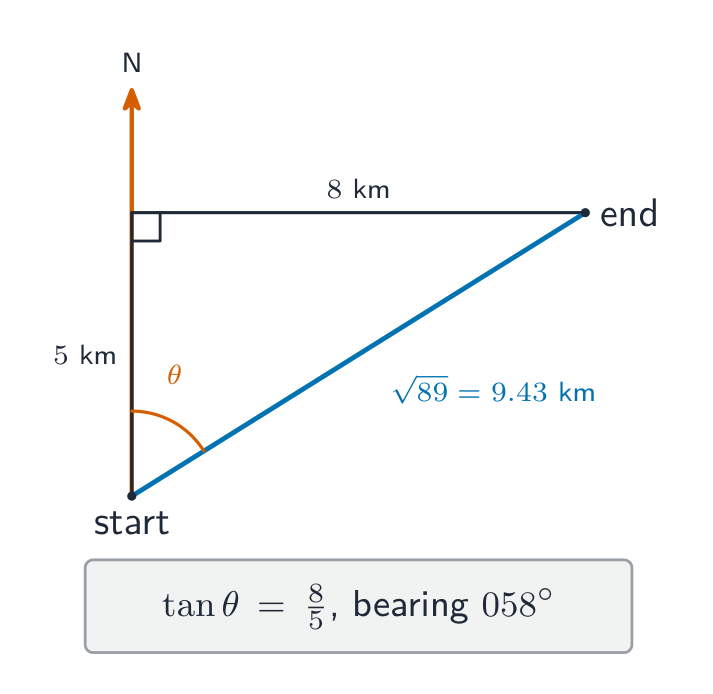
The two walks make a right-angled triangle, so
A bearing is measured clockwise from north, so use the angle at the start, between north and his path:
Common mistakes. Calling the side next to the right angle the hypotenuse (the hypotenuse is always opposite the right angle), and leaving the calculator in radians: $\sin 30$ should give $0.5$.
在单位圆上拖动角度,观察 sin、cos 和 tan 的来源。
| English | 中文 | 拼音 |
|---|---|---|
| opposite/ˈɒpəzɪt/ | 对边 | duì biān |
| adjacent/əˈdʒeɪsənt/ | 邻边 | lín biān |
| sine/saɪn/ | 正弦 | zhèng xián |
| cosine/ˈkəʊsaɪn/ | 余弦 | yú xián |
| tangent ratio/ˈtændʒənt ˈreɪʃɪəʊ/ | 正切 | zhèng qiē |

| 学科内容 | 注释与示例 |
|---|---|
| 1 掌握并运用锐角的正弦、余弦和正切比值,进行涉及直角三角形边长和角度的计算。 | 角度将以度为单位给出,答案应以度为单位,小数保留一位有效数字。 |
| 2 利用勾股定理和三角学解决二维平面问题。 | 可能需要用到方位角的知识。 |
| 3 知道点到直线的垂直距离是该点到该直线的最短距离。 | |
| 4 进行涉及仰角和俯角的计算。 |
来源:Cambridge International 教学大纲
The angle of elevation 仰角 is the angle up from the horizontal to an object above you. The angle of depression 俯角 is the angle down from the horizontal to an object below you. The shortest distance from a point to a line is the perpendicular 垂直 distance.

Worked example. From a point $50\text{ m}$ from the foot of a tower, the angle of elevation to the top is $40^{\circ}$. Find the height of the tower.
Worked example: angle of depression. From the top of a cliff $80\text{ m}$ high, the angle of depression of a boat is $25^{\circ}$. How far is the boat from the foot of the cliff?
The angle of depression from the cliff top equals the angle of elevation from the boat (alternate angles), so at the boat the cliff is the opposite side:
Common mistake. Putting the angle of depression between the cliff and the line of sight. It is always measured from the horizontal.
| English | 中文 | 拼音 |
|---|---|---|
| angle of elevation/ˈæŋɡl ɒv ˌelɪˈveɪʃn/ | 仰角 | yǎng jiǎo |
| angle of depression/ˈæŋɡl ɒv dɪˈpreʃn/ | 俯角 | fǔ jiǎo |
| perpendicular/ˌpɜːpənˈdɪkjʊlə/ | 垂直 | chuí zhí |

| 学科内容 | 注释与示例 |
|---|---|
| 掌握以下精确值:1 $\sin x$ 和 $\cos x$,其中 $x = 0^\circ, 30^\circ, 45^\circ, 60^\circ$ 和 $90^\circ$。2 $\tan x$,其中 $x = 0^\circ, 30^\circ, 45^\circ$ 和 $60^\circ$。 |
来源:Cambridge International 教学大纲
You must know these exact values without a calculator.
| $x$ | $0^{\circ}$ | $30^{\circ}$ | $45^{\circ}$ | $60^{\circ}$ | $90^{\circ}$ |
|---|---|---|---|---|---|
| $\sin x$ | $0$ | $\tfrac{1}{2}$ | $\tfrac{\sqrt{2}}{2}$ | $\tfrac{\sqrt{3}}{2}$ | $1$ |
| $\cos x$ | $1$ | $\tfrac{\sqrt{3}}{2}$ | $\tfrac{\sqrt{2}}{2}$ | $\tfrac{1}{2}$ | $0$ |
| $\tan x$ | $0$ | $\tfrac{1}{\sqrt{3}}$ | $1$ | $\sqrt{3}$ | — |

| 学科内容 | 注释与示例 |
|---|---|
| 1 识别、绘制并解释以下图像在 $0^\circ \leqslant x \leqslant 360^\circ$ 范围内的图形: • $y = \sin x$ • $y = \cos x$ • $y = \tan x$。 | |
| 2 求解涉及 $\sin x$、$\cos x$ 或 $\tan x$ 的三角方程,其中 $0^\circ \leqslant x \leqslant 360^\circ$。 | 例如:求解: • $\sin x = \frac{\sqrt{3}}{2}$ (当 $0^\circ \leqslant x \leqslant 360^\circ$ 时) • $2 \cos x + 1 = 0$ (当 $0^\circ \leqslant x \leqslant 360^\circ$ 时)。 |
来源:Cambridge International 教学大纲
For $0^{\circ} \leqslant x \leqslant 360^{\circ}$:

A trigonometric equation 三角方程 often has more than one answer in this range. Use the graph (or the symmetry of the wave) to find them all.
Worked example. Solve $\sin x = \tfrac{\sqrt{3}}{2}$ for $0^{\circ} \leqslant x \leqslant 360^{\circ}$.
One answer is $x = 60^{\circ}$. The sine wave is also $\tfrac{\sqrt{3}}{2}$ at $180^{\circ} - 60^{\circ} = 120^{\circ}$. So $x = 60^{\circ}$ or $120^{\circ}$.
Worked example. Solve $2\cos x + 1 = 0$ for $0^{\circ} \leqslant x \leqslant 360^{\circ}$.
Worked example. Solve $\tan x = 1.5$ for $0^{\circ} \leqslant x \leqslant 360^{\circ}$.
The calculator gives $x = 56.3^{\circ}$. The tangent repeats every $180^{\circ}$, so the other answer is $56.3^{\circ} + 180^{\circ} = 236.3^{\circ}$.
Worked example. Solve $\sin x = -0.4$ for $0^{\circ} \leqslant x \leqslant 360^{\circ}$.
The calculator gives $-23.6^{\circ}$, which is outside the range. Work with $23.6^{\circ}$: sine is negative between $180^{\circ}$ and $360^{\circ}$, so
Common mistake. Stopping at the calculator's answer. Sketch the graph and look for every point at the right height in the range.
(cos θ, sin θ)
随着 θ 转动,sin 和 cos 描出它们的波——并每 360° 重复。
| English | 中文 | 拼音 |
|---|---|---|
| trigonometric equation/ˌtrɪɡənəʊˈmetrɪk ɪˈkweɪʒn/ | 三角方程 | sān jiǎo fāng chéng |

| 教学内容 | 说明与示例 |
|---|---|
| 1 在涉及任意三角形的边长和角度的计算中,使用正弦定理和余弦定理。 | 包括涉及钝角和模糊情况的题目。 |
| 2 使用公式 $\text{area of triangle} = \frac{1}{2} ab \sin C$。 | 正弦定理、余弦定理以及三角形面积公式均列于“公式列表”中。 |
来源:Cambridge International 教学大纲
For any triangle (not just right-angled), with sides $a, b, c$ opposite angles $A, B, C$:
Use the sine rule 正弦定理 when you have a side and its opposite angle. Use the cosine rule 余弦定理 when you have two sides and the angle between them, or all three sides. With the sine rule, watch for the ambiguous case 两解情况, where an angle could be acute or obtuse.
The area of any triangle is
Worked example. A triangle has $b = 7\text{ cm}$, $c = 8\text{ cm}$ and the angle between them $A = 40^{\circ}$. Find side $a$.
Worked example: cosine rule for an angle. A triangle has sides $5\text{ cm}$, $7\text{ cm}$ and $8\text{ cm}$. Find the angle opposite the $7\text{ cm}$ side.
Rearrange the cosine rule so the angle is the subject:
Worked example: sine rule for a side. In triangle $ABC$, angle $B = 48^{\circ}$, angle $C = 71^{\circ}$ and $AB = 12\text{ cm}$. Find $AC$.
$AB$ is side $c$ (opposite $C$) and $AC$ is side $b$ (opposite $B$):
Worked example: the ambiguous case. In triangle $ABC$, $a = 7\text{ cm}$, $b = 9\text{ cm}$ and angle $A = 40^{\circ}$. Find the two possible values of angle $B$.
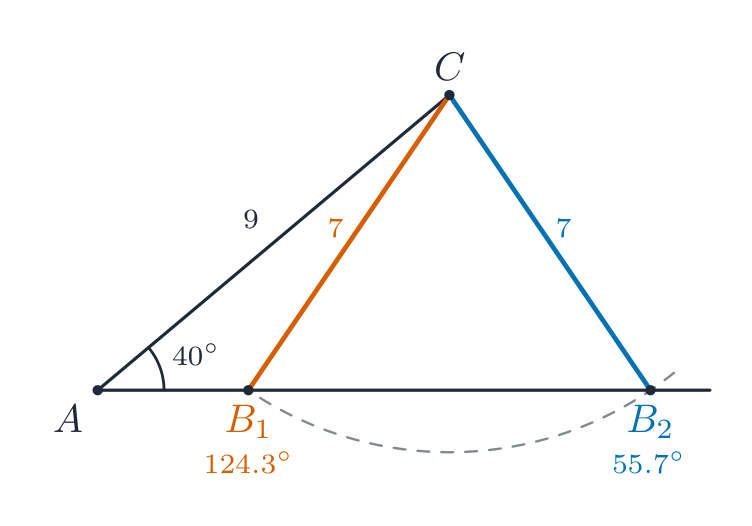
Because $\sin(180^{\circ} - B) = \sin B$, $B = 180^{\circ} - 55.7^{\circ} = 124.3^{\circ}$ also works. Both fit in a triangle with $A = 40^{\circ}$, since $40^{\circ} + 124.3^{\circ} < 180^{\circ}$, so there are two different triangles.
Worked example: area. Two sides of a triangle are $8\text{ cm}$ and $11\text{ cm}$, and the angle between them is $35^{\circ}$. Find the area.
Common mistakes. Working out $113 - 112$ first in the cosine rule (multiply $112 \times \cos 40^{\circ}$ first), using the sine rule with a side and an angle that are not opposite each other, and rounding in the middle of a calculation (keep the full calculator value until the end).
两条边和它们之间的夹角确定三角形:余弦定理求第三边,正弦定理求其余的角。
在单位圆上转动角度:水平的边是 cos θ,垂直的边是 sin θ——正弦和余弦定理用的正是这些比值。
| English | 中文 | 拼音 |
|---|---|---|
| sine rule/saɪn ruːl/ | 正弦定理 | zhèng xián dìng lǐ |
| cosine rule/ˈkəʊsaɪn ruːl/ | 余弦定理 | yú xián dìng lǐ |
| ambiguous case/æmˈbɪɡjuːəs keɪs/ | 两解情况 | liǎng jiě qíng kuàng |
| 学科内容 | 注释与示例 |
|---|---|
| 运用勾股定理和三角学进行三维计算并解决问题,包括计算直线与平面之间的夹角。 |
来源:Cambridge International 教学大纲
In three dimensions, find a right-angled triangle inside the solid, then use Pythagoras or trigonometry on it. A common task is the angle between a line and a flat surface (a plane 平面).
Worked example. A box has a base $6\text{ cm}$ by $8\text{ cm}$ and height $5\text{ cm}$. Find the angle between a space diagonal and the base.
First the base diagonal: $\sqrt{6^{2} + 8^{2}} = \sqrt{100} = 10\text{ cm}$. This diagonal and the height form a right-angled triangle, so the angle $\theta$ with the base is
在直角三角形中,a² + b² = c²。将这一思想应用两次,可以得到3维立体图形内部的长度。
| English | 中文 | 拼音 |
|---|---|---|
| plane/pleɪn/ | 平面 | píng miàn |
逐步完成,配合即时检查练习。
正在加载学科…