The sine and cosine rules
Introduced| English | Meaning |
|---|---|
| sine rule/saɪn ruːl/ | The rule that each side of a triangle divided by the sine of its opposite angle has the same value. |
| cosine rule/ˈkəʊsaɪn ruːl/ | The rule relating a triangle's sides and an angle: one side squared equals the sum of the other two sides squared minus twice their product times the cosine of the included angle. |
| included angle/ɪnˈkluːdɪd ˈæŋɡl/ | The angle formed between two specified sides or vectors meeting at a common point. |
When the triangle isn't right-angled
- Pythagoras and SOH-CAH-TOA only work for right-angled triangles.
- For any other triangle, you need the sine rule 正弦定理 or the cosine rule 余弦定理.
The sine rule
- For any triangle with sides $a, b, c$ opposite angles $A, B, C$:
- Use it when you know: a side and its opposite angle, plus one other piece.
$a = 10$, $A = 30^{\circ}$, $B = 50^{\circ}$: $\;\dfrac{10}{\sin 30^{\circ}} = \dfrac{b}{\sin 50^{\circ}} \Rightarrow b = \dfrac{10 \sin 50^{\circ}}{0.5} = 15.3$.

$y=\sin x$ and $y=\cos x$ are smooth waves between $-1$ and $1$; cosine is sine shifted left by $90^\circ$
Sine & cosine rule
Two sides and the angle between them fix the triangle: the cosine rule finds the third side, the sine rule the other angles.
What sin and cos mean
Spin the angle on the unit circle: the horizontal leg is cos θ and the vertical leg is sin θ — the same ratios the sine and cosine rules use.
You know all three sides and want an angle. Which rule do you use?
Difficulty 1/5 · 100 coins + a small bonus on first completion today
With three sides (or two sides and the included angle), use the cosine rule.
The sine rule requires a side and its opposite angle to be known.
Difficulty 1/5 · 100 coins + a small bonus on first completion today
You need at least one side paired with its opposite angle to apply the sine rule.
In a triangle, a = 10, A = 30°, B = 50°. Using the sine rule, b = 10 sin 50° / sin 30°. Find b (1 dp).
Difficulty 2/5 · 140 coins + a small bonus on first completion today
b = 10 × sin 50° / 0.5 = 10 × 0.766 / 0.5 = 15.3.
The cosine rule
- Use it when you know: two sides and the included angle 夹角 (to find the third side), or all three sides (to find an angle).
Included angle only. The angle $A$ in the cosine rule must be the angle between sides $b$ and $c$. If it's not the included angle, the formula doesn't apply directly.

In any triangle, sides $a,b,c$ lie opposite angles $A,B,C$; the sine and cosine rules use these
A triangle has b = 7, c = 8 and the angle between them A = 40°. Using a² = 49 + 64 − 2(7)(8)cos40° ≈ 27.2, find a (1 dp).
Difficulty 2/5 · 140 coins + a small bonus on first completion today
a = √27.2 ≈ 5.2 cm.
In the cosine rule a² = b² + c² − 2bc cos A, the angle A must be the ______ angle between sides b and c.
Difficulty 1/5 · 100 coins + a small bonus on first completion today
A must be the included angle (the angle between sides b and c).
Area of any triangle
- This works for any triangle (not just right-angled ones), using two sides and the included angle.
The area of any triangle (two sides a, b with angle C between them) is:
Difficulty 1/5 · 100 coins + a small bonus on first completion today
Area = ½ab sin C uses two sides and the included angle.
Worked example
- $b = 7$, $c = 8$, included angle $A = 40^{\circ}$.
- $a^2 = 7^2 + 8^2 - 2(7)(8)\cos 40^{\circ} = 49 + 64 - 85.8 = 27.2$, so $a = 5.2$ cm.
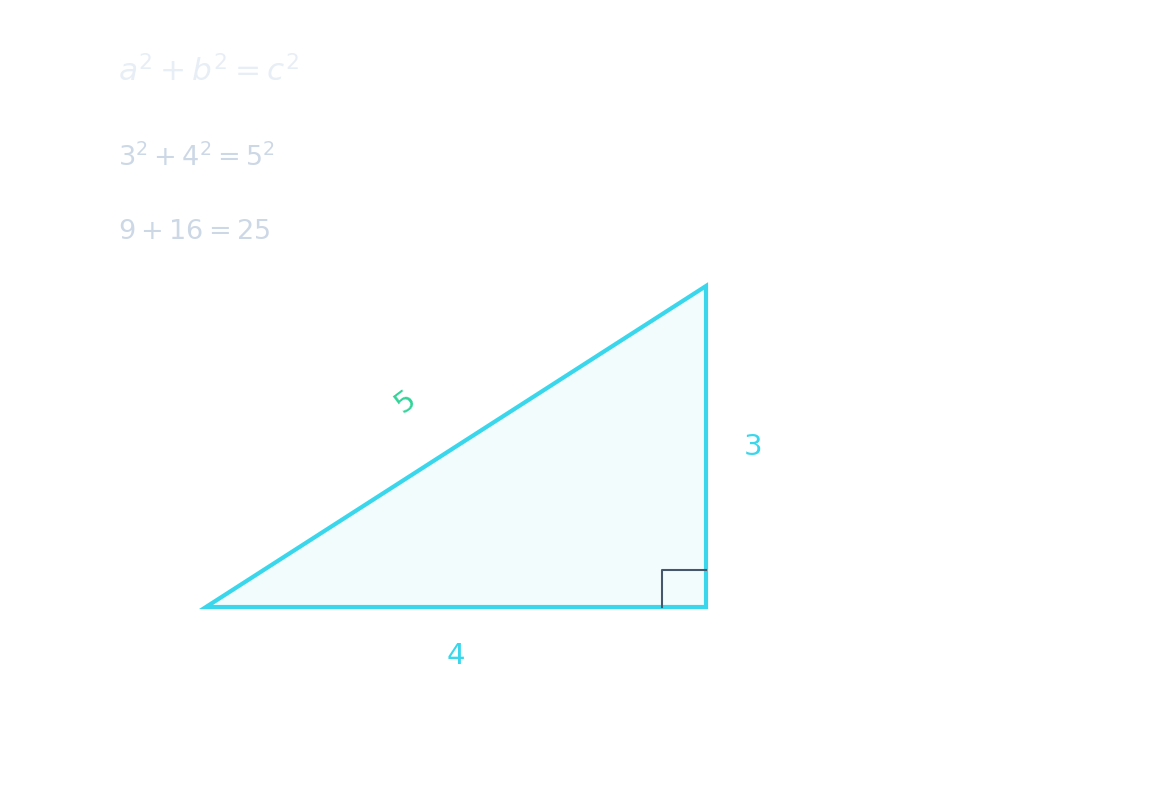
The cosine rule generalises Pythagoras: when $A = 90^{\circ}$, $\cos A = 0$ and you get $a^2 = b^2 + c^2$.
Sides a = 5, b = 7, c = 8. Find angle A opposite a, to 1 dp.
Difficulty 2/5 · 140 coins + a small bonus on first completion today
cos A = (49+64−25)/112 = 11/14, so A ≈ 38.2°.
Finding an angle and checking the other possibility
- With sides $a=5,b=7,c=8$, use $\cos A=(b^2+c^2-a^2)/(2bc)=(49+64-25)/112=11/14$. Thus $A=\cos^{-1}(11/14)\approx38.2^{\circ}$.
- In a sine-rule question, $a=10,A=30^{\circ},b=12$ gives $\sin B=b\sin A/a=0.6$. Both $B\approx36.9^{\circ}$ and $143.1^{\circ}$ leave a positive third angle, so two triangles are possible. Use any extra condition, such as B being obtuse, to choose.
Two sides 7 cm and 8 cm include 40°. Find the area to 1 dp in cm².
Difficulty 2/5 · 140 coins + a small bonus on first completion today
Area = ½ × 7 × 8 × sin 40° ≈ 18.0 cm².
Area with an included angle
- Two sides 7 cm and 8 cm include $40^{\circ}$. Use $K=\frac12bc\sin A=\frac12(7)(8)\sin40^{\circ}\approx18.0\text{ cm}^2$.
- The angle must lie between the two sides used. Keep degree mode and full trigonometric values until the final rounding.
You've got it
- sine rule: $\dfrac{a}{\sin A} = \dfrac{b}{\sin B}$ — side + its opposite angle
- cosine rule: $a^2 = b^2 + c^2 - 2bc\cos A$ — two sides + included angle (or three sides)
- area of any triangle $= \dfrac{1}{2}ab\sin C$
Write from an area of 24
- Two sides of 6 cm and 8 cm enclose a right angle.
- Find the area of the triangle.
A triangle has two sides 6 cm and 8 cm with a right angle between them. What is its area, in square centimetres?
Half of 48 is 24.
What is the area?
Difficulty 1/5 · 100 coins + a small bonus on first completion today
Half of base times height is 24. Other options — 10 (the third side); 48 (the product before halving).