Trigonometry in right-angled triangles
Introduced| English | Meaning |
|---|---|
| trigonometry/ˌtrɪɡəˈnɒmətri/ | trigonometry |
| opposite/ˈɒpəzɪt/ | The side across from the chosen angle in a right-angled triangle. |
| adjacent/əˈdʒeɪsənt/ | The side next to the chosen angle that is not the hypotenuse. |
| angle of elevation/ˈæŋɡl ɒv ˌelɪˈveɪʃn/ | The angle measured upwards from a horizontal line to the line of sight to an object. |
| angle of depression/ˈæŋɡl ɒv dɪˈpreʃn/ | The angle measured downwards from a horizontal line to the line of sight to an object. |
How tall is that tree?
- You can't climb it with a tape measure. But standing $10$ m away and looking up at $50^{\circ}$, trigonometry 三角学 gives you the height: $10 \times \tan 50^{\circ} \approx 11.9$ m.
- Trigonometry measures the unmeasurable — using angles and one known length.
Naming the sides
- In a right-angled triangle, name the sides relative to the angle $\theta$:
- Opposite 对边 (O): the side across from $\theta$.
- Adjacent 邻边 (A): the side next to $\theta$ (not the hypotenuse).
- Hypotenuse (H): the longest side, opposite the right angle.
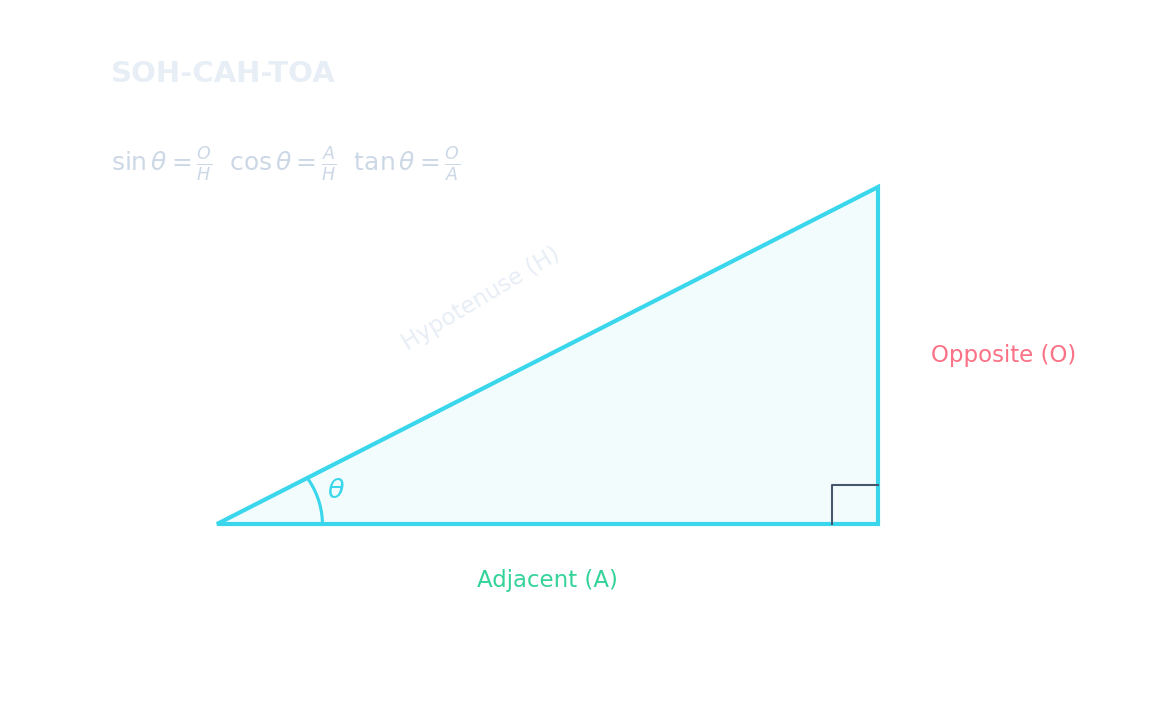
SOH-CAH-TOA: the three ratios that connect angles to side lengths in right-angled triangles.
Right-angled trig
(cos θ, sin θ)
SOHCAHTOA comes from this circle — sin, cos and tan of the angle.
The three ratios — SOH CAH TOA
- To find a side: use the ratio and multiply/divide.
- To find an angle: use the inverse ($\sin^{-1}$, $\cos^{-1}$, $\tan^{-1}$).
Opposite $4$, adjacent $3$: $\;\tan\theta = \dfrac{4}{3}$, so $\theta = \tan^{-1}\!\left(\dfrac{4}{3}\right) = 53.1^{\circ}$.

Looking up at a tower involves an angle of elevation 仰角
In a right-angled triangle the hypotenuse is 10 cm and the angle is 30°. The opposite side = 10 × sin 30°. Find it (cm).
Difficulty 2/5 · 140 coins + a small bonus on first completion today
10 × sin 30° = 10 × 0.5 = 5 cm.
The opposite side is 4 cm and the adjacent side is 3 cm. Find the angle (degrees, 1 dp).
Difficulty 2/5 · 140 coins + a small bonus on first completion today
tan θ = 4/3, so θ = tan⁻¹(4/3) = 53.1°.
The adjacent side is 8 cm and the angle is 60°. The hypotenuse = 8 / cos 60°. Find it (cm).
Difficulty 2/5 · 140 coins + a small bonus on first completion today
cos 60° = 0.5, so hyp = 8 / 0.5 = 16 cm.
In SOH CAH TOA, sin θ = opposite / ______.
Difficulty 1/5 · 100 coins + a small bonus on first completion today
SOH: sin θ = Opposite / Hypotenuse.
Angles of elevation and depression (Extended)
- Angle of elevation: looking up from the horizontal.
- Angle of depression 俯角: looking down from the horizontal.
- Both are measured from the horizontal, not from the vertical.
From the horizontal, always. The angle of elevation/depression is measured from the horizontal line, not from the vertical. This is the most common error in these problems.

Name the sides from the angle $\theta$: the opposite is across from it, the adjacent next to it, the hypotenuse opposite the right angle (SOH-CAH-TOA)
From 50 m away, the angle of elevation to a tower top is 40°. Height = 50 × tan 40°. Find it (m, 1 dp).
Difficulty 2/5 · 140 coins + a small bonus on first completion today
50 × tan 40° = 50 × 0.839 = 42.0 m.
The angle of elevation is measured from the vertical.
Difficulty 1/5 · 100 coins + a small bonus on first completion today
Angles of elevation and depression are both measured from the horizontal, not the vertical.
Worked example
- $50$ m from a tower, elevation $40^{\circ}$:
- $h=d\tan\theta=50\tan40^{\circ}\approx42.0$ m. Keep the full calculator value of the tangent before rounding.

The angle of elevation looks up from the horizontal; the angle of depression looks down
You've got it
- SOH: $\sin\theta = \dfrac{\text{opp}}{\text{hyp}}$; CAH: $\cos\theta = \dfrac{\text{adj}}{\text{hyp}}$; TOA: $\tan\theta = \dfrac{\text{opp}}{\text{adj}}$
- use the inverse ($\tan^{-1}$ etc.) to find an angle
- elevation looks up, depression looks down — both from the horizontal
Write from a height of 20
- The angle of elevation is 45 degrees.
- The observer is 20 m from the base.
From 20 m away, the angle of elevation to the top of a pole is 45 degrees. How tall is the pole, in metres?
Tangent of 45 degrees is 1.
How tall is the pole?
Difficulty 1/5 · 100 coins + a small bonus on first completion today
A 45 degree rise matches the horizontal distance. Other options — 50 m (the lesson distance); 45 m (the angle used as a length).