- explain why businesses need finance (start-up capital, expansion, working capital, cash-flow problems)
- distinguish short-term and long-term finance and internal and external sources of finance
- describe sources of finance (retained profit, sale of assets, owners' savings, bank loan/overdraft, share issue, debentures, leasing, hire purchase, trade credit, microfinance, crowdfunding, government grants)
- explain the factors that influence the choice of source of finance
财务信息与决策
IGCSE 商业研究 · 第 5 主题
 12:52
12:52
Financial information and decisions
This business was doing well. Every month it made a profit — the products sold, the customers were happy. But watch the money in the bank. Suppliers wanted…
英文讲解 · 内嵌中英文字幕
5.1
企业融资:需求与来源

大纲
来源:剑桥国际大纲

资金(finance)意味着一个企业需要的钱。一个企业需要资金来:
- 启动——启动资金(start-up capital)在它赚任何钱之前买设备和存货,
- 增长——用于扩张(expansion)的钱,例如新商店或机器,
- 日常运营——营运资金(working capital)在等待顾客付钱时付工资和供应商,
- 度过一个现金流(cash-flow)问题,当流出的钱多于流入的时。
Sources of finance
资金能是短期(short-term)(一年内偿还)或长期(long-term)(几年内)。它能来自企业内部(内部)或来自外部(外部)。
| 来源 | 内部 / 外部 | 备注 |
|---|---|---|
| 留存利润(retained profit) | 内部 | 保留在企业里、没有付出的利润 |
| 出售资产(assets) | 内部 | 卖企业不再需要的东西 |
| 所有者储蓄 | 内部 | 所有者自己的钱 |
| 银行贷款(loan) | 外部 | 借来的钱,随时间连同利息(interest)偿还 |
| 银行透支(overdraft) | 外部 | 银行让账户降到零以下,用于短期需要 |
| 发行新股份(shares) | 外部 | 只对有限公司;筹钱但分散控制 |
| 债券(debentures) | 外部 | 给一家公司的付利息的长期贷款 |
| 租赁(leasing) | 外部 | 租设备而不是买它 |
| 分期付款(hire purchase) | 外部 | 现在买而按月分期付 |
| 贸易信贷(trade credit) | 外部 | 稍后付供应商,例如 30 天后 |
| 小额信贷(microfinance) | 外部 | 给较穷地区的微小企业的小贷款 |
| 众筹(crowdfunding) | 外部 | 许多人各给一小笔,常在网上 |
| 政府补助金(grants) | 外部 | 来自政府的、不必偿还的钱 |

Choosing a source
最好的来源取决于需要多少钱以及多长时间、成本(利息和费用)、企业的大小和法律类型(只有公司能卖股份),以及所有者将接受多少风险和控制。
探索
Sources of finance lab
Choose the best type of finance by time, risk and ownership.
词汇表
训练
| 英文 | 中文 | 拼音 |
|---|---|---|
| finance/ˈfaɪnæns/ | 资金 | zī jīn |
| start-up capital/stɑːt ʌp ˈkæpɪtl/ | 启动资金 | qǐ dòng zī jīn |
| expansion/ekˈspænʃn/ | 扩张 | kuò zhāng |
| cash-flow/kæʃ fləʊ/ | 现金流 | xiàn jīn liú |
| short-term/ʃɔːt tɜːm/ | 短期 | duǎn qī |
| long-term/lɒŋ tɜːm/ | 长期 | cháng qī |
| retained profit/rɪˈteɪnd ˈprɒfɪt/ | 留存利润 | liú cún lì rùn |
| assets/ˈæsets/ | 资产 | zī chǎn |
| loan/ləʊn/ | 贷款 | dài kuǎn |
| interest/ˈɪntrest/ | 利息 | lì xī |
| overdraft/ˈəʊvədræft/ | 透支 | tòu zhī |
| shares/ʃeəz/ | 股份 | gǔ fèn |
| debentures/deˈbentʃəz/ | 债券 | zhài quàn |
| leasing/ˈliːsɪŋ/ | 租赁 | zū lìn |
| hire purchase/ˈhaɪə ˈpɜːtʃɪs/ | 分期付款 | fēn qī fù kuǎn |
| trade credit/treɪd ˈkredɪt/ | 贸易信贷 | mào yì xìn dài |
| microfinance/ˌmaɪkrəʊfaɪˈnæns/ | 小额信贷 | xiǎo é xìn dài |
| crowdfunding/ˈkraʊdfʌndɪŋ/ | 众筹 | zhòng chóu |
| grants/ɡrænts/ | 补助金 | bǔ zhù jīn |
| cash/kæʃ/ | 现金 | xiàn jīn |
| profit/ˈprɒfɪt/ | 利润 | lì rùn |
5.2
现金流预测与营运资金

大纲
- explain the importance of cash and the difference between cash and profit
- construct, complete and interpret a cash-flow forecast (inflows, outflows, net cash flow, opening/closing balance)
- explain working capital and how a business can overcome cash-flow problems
来源:剑桥国际大纲
Cash is not the same as profit
现金(cash)是一个企业现在就能用的钱。利润(profit)是一段时间里收入(revenue)减成本。一个企业能在赚取利润的同时仍然耗尽现金——例如,若顾客还没付钱。耗尽现金能迫使即使一个盈利的企业也关门。
The cash-flow forecast
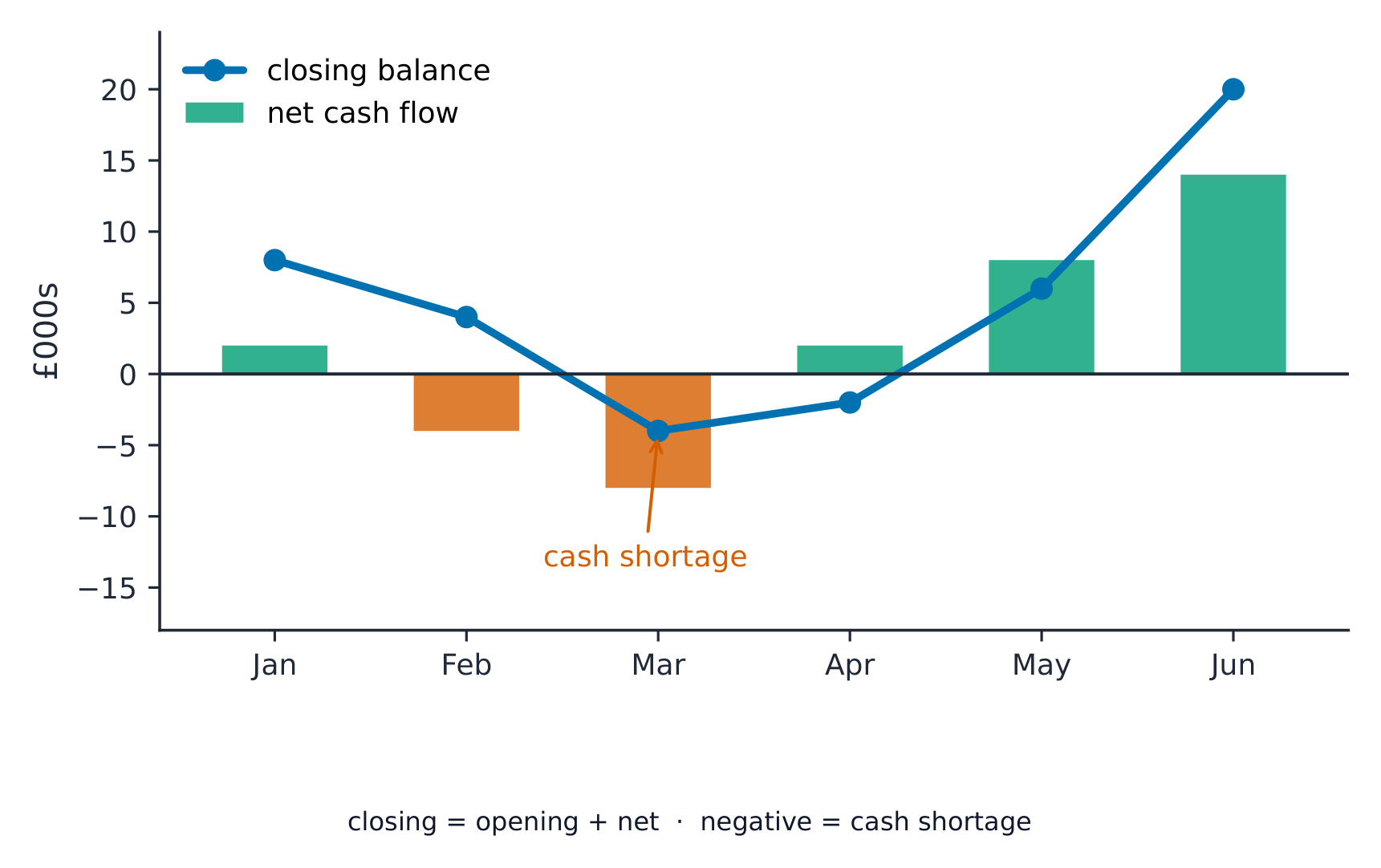
一份现金流预测(cash-flow forecast)预测每个月流入和流出的钱。它使用:
- 流入(inflows)——进来的钱(销售、贷款),
- 流出(outflows)——出去的钱(工资、租金、材料),
- 净现金流(net cash flow)——流入减流出,
- 期初余额(opening balance)——月初持有的现金,
- 期末余额(closing balance)——月末持有的现金。
$$\text{net cash flow} = \text{inflows} - \text{outflows}$$
$$\text{closing balance} = \text{opening balance} + \text{net cash flow}$$
Worked example. 一家商店预期下个月流入 £12,000 和流出 £9,000,并以银行里 £2,000 开始这个月。求净现金流和期末余额。
$$\text{net cash flow} = \text{\pounds} 12\,000 - \text{\pounds} 9\,000 = \text{\pounds} 3\,000$$
$$\text{closing balance} = \text{\pounds} 2\,000 + \text{\pounds} 3\,000 = \text{\pounds} 5\,000$$
Working capital
营运资金是可用于日常运营的钱。它是流动资产(current assets)(现金和很快变成现金的东西)减流动负债(current liabilities)(一年内到期的债务)。
$$\text{working capital} = \text{current assets} - \text{current liabilities}$$
要克服现金流问题,一个企业能安排一个透支、延迟付供应商、要求顾客更早付钱、卖多余的资产,或削减花费。

探索
Cash-flow forecasting
A forecast of cash in and out each month warns a business of a cash shortage before it strikes.
探索
Cash-flow forecast lab
Drag the monthly cash in, cash out and the one-off oven purchase — does the bakery stay out of the red all six months?
词汇表
训练
| 英文 | 中文 | 拼音 |
|---|---|---|
| working capital/ˈwɜːkɪŋ ˈkæpɪtl/ | 营运资金 | yíng yùn zī jīn |
| revenue/ˈrevənjuː/ | 收入 | shōu rù |
| cash-flow forecast/kæʃ fləʊ ˈfɔːkæst/ | 现金流预测 | xiàn jīn liú yù cè |
| inflows/ˈɪnfləʊz/ | 流入 | liú rù |
| outflows/aʊtˈfləʊz/ | 流出 | liú chū |
| net cash flow/net kæʃ fləʊ/ | 净现金流 | jìng xiàn jīn liú |
| opening balance/ˈəʊpənɪŋ ˈbæləns/ | 期初余额 | qī chū yú é |
| closing balance/ˈkləʊzɪŋ ˈbæləns/ | 期末余额 | qī mò yú é |
| current assets/ˈkʌrənt ˈæsets/ | 流动资产 | liú dòng zī chǎn |
| current liabilities/ˈkʌrənt ˌlaɪəˈbɪlɪtiz/ | 流动负债 | liú dòng fù zhài |
| liabilities/ˌlaɪəˈbɪlɪtiz/ | 负债 | fù zhài |
5.3
利润表
大纲
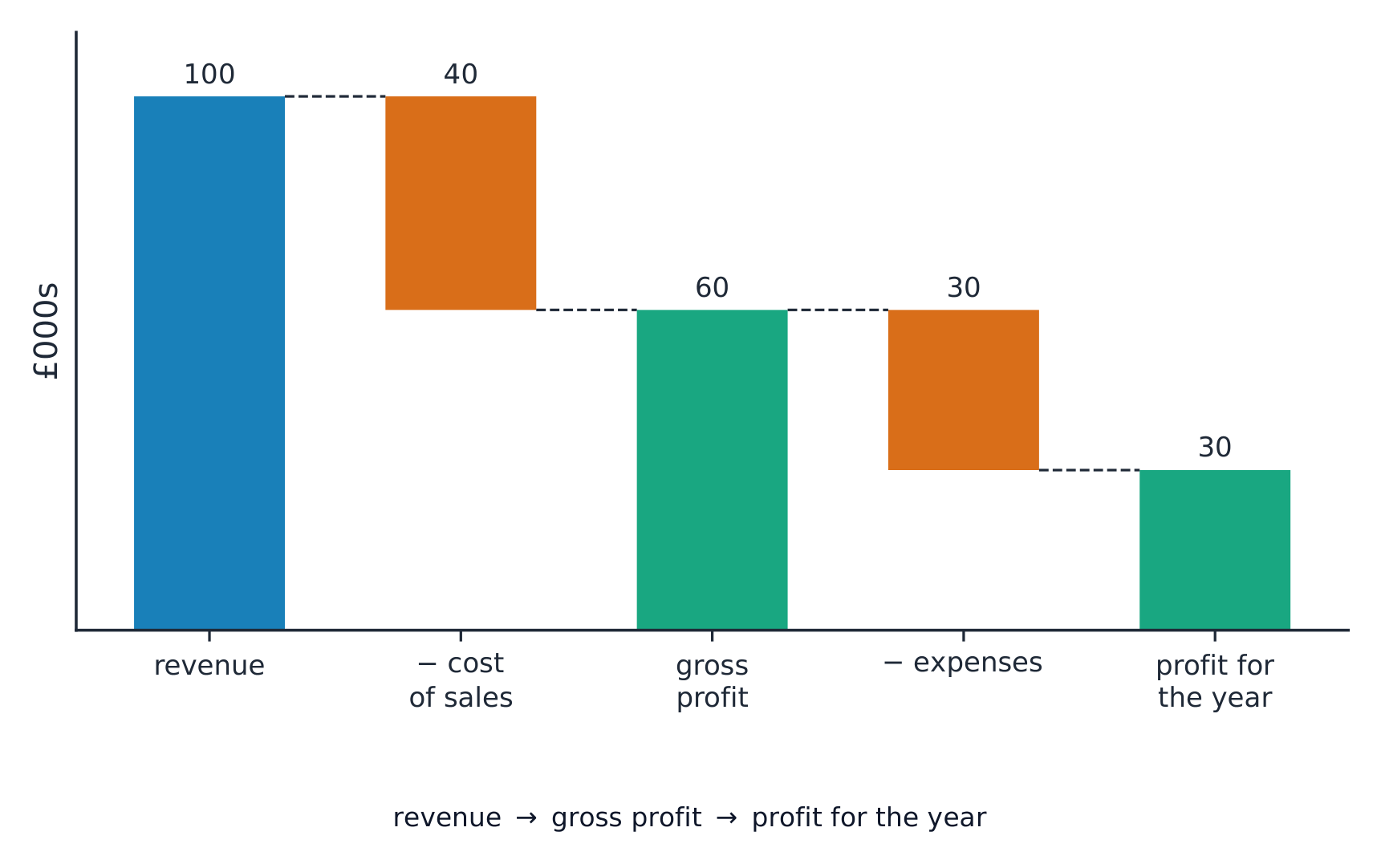
- identify the main features of an income statement: revenue, cost of sales, gross profit, expenses and profit for the year
- explain how income statements are used by stakeholders
来源:剑桥国际大纲
一份损益表(income statement)显示一个企业在一段时间——通常一年——里赚了多少利润。
| 行 | 含义 |
|---|---|
| 收入 | 来自销售的钱 |
| 销售成本(cost of sales) | 制造或购买被卖出的商品的成本 |
| 毛利润(gross profit) | 收入减销售成本 |
| 费用(expenses) | 其他运营成本:租金、工资、广告 |
| 年度利润(profit for the year) | 毛利润减费用 |
$$\text{gross profit} = \text{revenue} - \text{cost of sales}$$
$$\text{profit for the year} = \text{gross profit} - \text{expenses}$$
Worked example. 一个企业有收入 £200,000、销售成本 £120,000 和费用 £50,000。求它的毛利润和它的年度利润。
$$\text{gross profit} = \text{\pounds} 200\,000 - \text{\pounds} 120\,000 = \text{\pounds} 80\,000$$
$$\text{profit for the year} = \text{\pounds} 80\,000 - \text{\pounds} 50\,000 = \text{\pounds} 30\,000$$
损益表被利益相关者(stakeholders)使用:所有者检查利润、放贷者检查他们的贷款是否安全,而经理寻找问题。
探索
Financial statements flow
See how business events become the statements users read.
词汇表
训练
| 英文 | 中文 | 拼音 |
|---|---|---|
| income statement/ˈɪŋkʌm ˈsteɪtmənt/ | 损益表 | sǔn yì biǎo |
| cost of sales/kɒst ɒv seɪlz/ | 销售成本 | xiāo shòu chéng běn |
| gross profit/ɡrəʊs ˈprɒfɪt/ | 毛利润 | máo lì rùn |
| expenses/ekˈspensɪz/ | 费用 | fèi yòng |
| profit for the year/ˈprɒfɪt fəðə jɪə/ | 年度利润 | nián dù lì rùn |
| stakeholders/ˈsteɪkhəʊldəz/ | 利益相关者 | lì yì xiāng guān zhě |
5.4
财务状况表

大纲
- identify the main classifications in a statement of financial position: non-current and current assets, current and non-current liabilities, and owners' equity/capital
- explain how the statement of financial position is used
来源:剑桥国际大纲
一份财务状况表(statement of financial position)(也叫资产负债表)显示一个企业在一天拥有什么和欠什么(它的负债(liabilities))。
- 非流动资产(non-current assets)——长期保留的东西:建筑、机器。
- 流动资产(current assets)——短期物品:库存(inventory)、顾客欠的钱,和现金。
- 流动负债(current liabilities)——一年内到期的债务:一笔透支、欠供应商的钱。
- 非流动负债(non-current liabilities)——一年以上后到期的债务:一笔长期贷款。
- 所有者权益(owners' equity)——所有者投入的钱,加保留在企业里的利润。
它被用来检查企业值多少、它欠多少,以及它能否付它的债务。

探索
Financial statements flow
See how business events become the statements users read.
词汇表
训练
| 英文 | 中文 | 拼音 |
|---|---|---|
| statement of financial position/ˈsteɪtmənt ɒv faɪˈnænʃl pəˈzɪʃn/ | 财务状况表 | cái wù zhuàng kuàng biǎo |
| non-current assets/nɒn ˈkʌrənt ˈæsets/ | 非流动资产 | fēi liú dòng zī chǎn |
| inventory/ˈɪnvəntri/ | 库存 | kù cún |
| non-current liabilities/nɒn ˈkʌrənt ˌlaɪəˈbɪlɪtiz/ | 非流动负债 | fēi liú dòng fù zhài |
| owners' equity/ˈəʊnəz ˈekwɪti/ | 所有者权益 | suǒ yǒu zhě quán yì |
5.5
账目分析

大纲
- calculate and interpret profitability ratios: gross profit margin, profit margin and return on capital employed (ROCE)
- calculate and interpret liquidity ratios: current ratio and acid test (quick) ratio
- explain how internal and external users use account analysis to make decisions
来源:剑桥国际大纲
你能通过从它的账目算出比率(ratios)来评判一个企业。一个比率比较两个数字。
Profitability ratios
盈利能力(profitability)比率显示一个企业在赚取利润上有多好。
$$\text{gross profit margin} = \frac{\text{gross profit}}{\text{revenue}} \times 100\%$$
$$\text{profit margin} = \frac{\text{profit for the year}}{\text{revenue}} \times 100\%$$
$$\text{ROCE} = \frac{\text{profit}}{\text{capital employed}} \times 100\%$$
- 毛利率(gross profit margin)——毛利润作为收入的一个百分比。
- 利润率(profit margin)——年度利润作为收入的一个百分比。
- 资本回报率(return on capital employed,ROCE)——利润作为所用资本(capital employed)(投入的钱)的一个百分比。它显示投资被用得多好。
对全部三个,一个更高的百分比更好。
Worked example. 同一个企业(收入 £200,000、毛利润 £80,000、年度利润 £30,000)有所用资本 £150,000。求它的三个盈利能力比率。
$$\text{gross profit margin} = \frac{80\,000}{200\,000} \times 100\% = 40\%$$
$$\text{profit margin} = \frac{30\,000}{200\,000} \times 100\% = 15\%$$
$$\text{ROCE} = \frac{30\,000}{150\,000} \times 100\% = 20\%$$
Liquidity ratios
流动性(liquidity)比率显示一个企业能否付它的短期债务。
$$\text{current ratio} = \frac{\text{current assets}}{\text{current liabilities}}$$
$$\text{acid test ratio} = \frac{\text{current assets} - \text{inventory}}{\text{current liabilities}}$$
- 流动比率(current ratio)比较流动资产和流动负债。大约 1.5 到 2 是健康的。
- 速动比率(acid test ratio)更严格:它去掉库存,因为库存还没被卖出。
Worked example. 一个企业有流动资产 £40,000(包括 £10,000 的库存)和流动负债 £20,000。求它的流动比率和速动比率。
$$\text{current ratio} = \frac{40\,000}{20\,000} = 2.0$$
$$\text{acid test ratio} = \frac{40\,000 - 10\,000}{20\,000} = 1.5$$
Who uses account analysis
- 内部用户(所有者和经理)用它来控制企业和计划。
- 外部用户(银行、供应商、政府和投资者)用它来决定是否借出、供应或投资。
探索
Accounts ratio diagnosis
Classify ratios by the question they answer about a business.
词汇表
训练
| 英文 | 中文 | 拼音 |
|---|---|---|
| ratios/ˈreɪʃɪəʊz/ | 比率 | bǐ lǜ |
| profitability/ˌprɒfɪtəˈbɪlɪti/ | 盈利能力 | yíng lì néng lì |
| gross profit margin/ɡrəʊs ˈprɒfɪt ˈmɑːdʒɪn/ | 毛利率 | máo lì lǜ |
| profit margin/ˈprɒfɪt ˈmɑːdʒɪn/ | 利润率 | lì rùn lǜ |
| return on capital employed/rɪˈtɜːn ɒn ˈkæpɪtl emˈplɔɪd/ | 资本回报率 | zī běn huí bào lǜ |
| capital employed/ˈkæpɪtl emˈplɔɪd/ | 所用资本 | suǒ yòng zī běn |
| liquidity/lɪˈkwɪdɪti/ | 流动性 | liú dòng xìng |
| current ratio/ˈkʌrənt ˈreɪʃɪəʊ/ | 流动比率 | liú dòng bǐ lǜ |
| acid test ratio/ˈæsɪd test ˈreɪʃɪəʊ/ | 速动比率 | sù dòng bǐ lǜ |
5.5
考试技巧
- 现金不是利润:若顾客晚付,一个盈利的企业仍能耗尽现金。注意一份现金流预测上的期末余额。
- 把内部来源(留存利润、出售资产、所有者储蓄)与外部的(银行贷款、透支、股份、租赁、贸易信贷)分开。
- 关键公式:净现金流 = 流入 − 流出;期末余额 = 期初余额 + 净现金流;营运资金 = 流动资产 − 流动负债。
- 盈利能力比率(毛利率、利润率、ROCE)——更高更好。流动性:流动比率(健康 ≈ 1.5–2)和更严格的速动比率(它去掉库存)。
- 只有有限公司能通过发行股份筹钱;一个独资商人或合伙企业不能。
本主题的互动课程
逐步学习,并即时检测练习。