- describe the methods of production: job, batch and flow production, and their advantages/disadvantages
- explain productivity and how it can be increased
- explain lean production and just-in-time (JIT) inventory control and the management of inventory
- explain how technology has changed production
运营管理
IGCSE 商业研究 · 第 4 主题
 9:48
9:48
Operations management
Look inside a car factory. The same car, again and again, hundreds every day, each one exactly like the last. Somebody decided all of it: how to make it, what…
英文讲解 · 内嵌中英文字幕
4.1
商品与服务的生产

大纲
来源:剑桥国际大纲
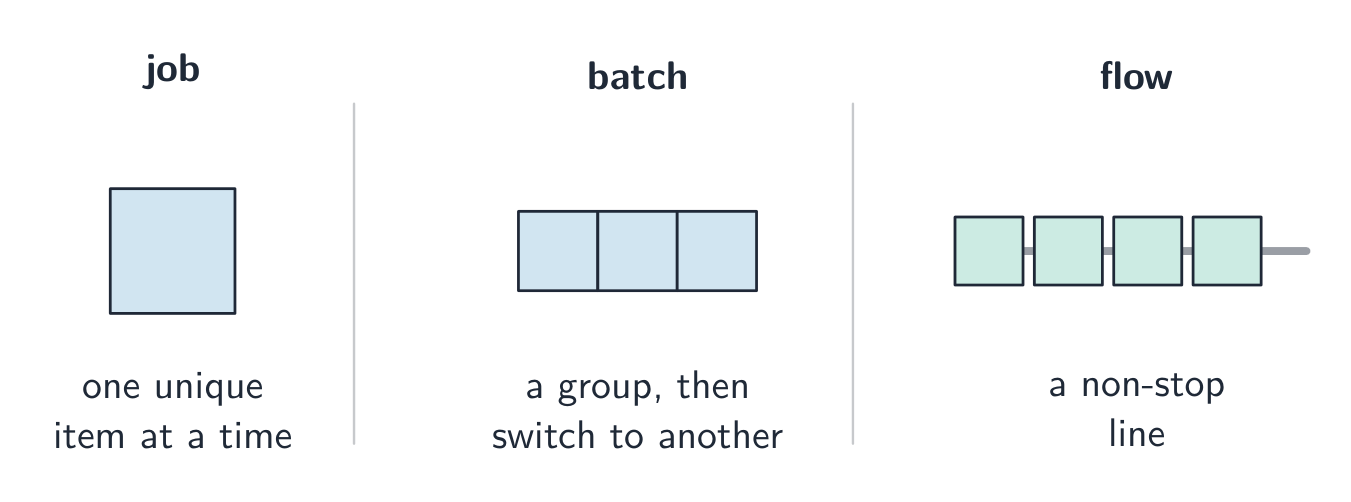
生产(production)意味着把材料和劳动力(labour)变成成品商品和服务(services)。有三种主要方法。
| 方法 | 它是什么 | 适合于 | 缺点 |
|---|---|---|---|
| 单件生产(job production) | 一次制造一件物品,按订单 | 特殊的、一次性的物品:一个婚礼蛋糕、一艘船 | 每件慢而昂贵 |
| 批量生产(batch production) | 制造一组相同的物品,然后切换到另一组 | 面包店、不同尺寸的衣服 | 切换时机器闲置 |
| 流水线生产(flow production) | 在一条移动的线上不停地制造商品 | 大量制造的商品:汽车、饮料 | 建立昂贵;工作会无聊 |
Productivity
生产率(productivity)衡量每个工人或机器在一段固定时间里生产多少。更高的生产率降低每件的成本。一个企业能通过以下方式提高生产率:
- 培训工人,
- 使用更好的机器和技术(technology),
- 改善激励(motivation),
- 更好地组织工作。

Lean production and just-in-time
精益生产(lean production)意味着削减所有浪费——浪费的时间、材料、空间和精力——同时保持质量。
一个关键方法是准时制(just-in-time,JIT)。用 JIT,材料恰好在它们被需要时到达,而成品被快速卖出,所以企业持有非常少的库存(inventory)(它的材料和商品存货)。这节省储存成本,但一次延迟的交付能停止生产。好的库存管理保持足够的存货来满足需求,但不至于多到钱被占用或商品过期。

Technology in production
技术已经改变了生产。自动化(automation)(机器和机器人做任务)、计算机设计和网上订购都使生产更快、更便宜、更精确。但机器买起来花很多钱而且能取代工人的工作。

探索
Methods of production
A business picks job, batch or flow production to suit its product and order size.
词汇表
训练
| 英文 | 中文 | 拼音 |
|---|---|---|
| production/prəˈdʌkʃn/ | 生产 | shēng chǎn |
| labour/ˈleɪbə/ | 劳动力 | láo dòng lì |
| services/ˈsɜːvɪsɪz/ | 服务 | fú wù |
| job production/dʒɒb prəˈdʌkʃn/ | 单件生产 | dān jiàn shēng chǎn |
| batch production/bætʃ prəˈdʌkʃn/ | 批量生产 | pī liàng shēng chǎn |
| flow production/fləʊ prəˈdʌkʃn/ | 流水线生产 | liú shuǐ xiàn shēng chǎn |
| productivity/ˌprɒdəkˈtɪvɪti/ | 生产率 | shēng chǎn lǜ |
| technology/tekˈnɒlədʒi/ | 技术 | jì shù |
| motivation/ˌməʊtɪˈveɪʃn/ | 激励 | jī lì |
| lean production/liːn prəˈdʌkʃn/ | 精益生产 | jīng yì shēng chǎn |
| just-in-time/dʒʌst ɪn taɪm/ | 准时制 | zhǔn shí zhì |
| inventory/ˈɪnvəntri/ | 库存 | kù cún |
| automation/ˌɔːtəˈmeɪʃn/ | 自动化 | zì dòng huà |
4.2
成本、生产规模与盈亏平衡分析

大纲
- classify costs into fixed, variable, total and average costs
- construct and interpret break-even charts; identify the break-even level of output and the margin of safety
- calculate and use break-even output, total revenue, total cost and profit; explain limitations of break-even analysis
来源:剑桥国际大纲
Types of cost
一个企业有不同种类的成本(cost)。
- 固定成本(fixed costs)不随产出变化——租金、薪金、保险。即使你什么都不制造你也付它们。
- 可变成本(variable costs)随产量(output)变化——材料,以及为制造的每件付酬。更多产出意味着更多可变成本。
- 总成本(total cost)是固定成本加可变成本。
- 平均成本(average cost)是总成本除以制造的物品数量。
$$\text{total cost} = \text{fixed costs} + \text{variable costs}$$
$$\text{average cost} = \frac{\text{total cost}}{\text{output}}$$
Worked example. 一座工厂有 £8,000 的固定成本和每单位 £2 的可变成本,并制造 1,000 单位。求总成本和每单位的平均成本。
$$\text{total cost} = \text{\pounds} 8\,000 + (1\,000 \times \text{\pounds} 2) = \text{\pounds} 10\,000$$
$$\text{average cost} = \frac{\text{\pounds} 10\,000}{1\,000} = \text{\pounds} 10 \text{ per unit}$$
Revenue and profit
收入(revenue)是一个企业从出售它的产品得到的钱。
$$\text{total revenue} = \text{price} \times \text{quantity sold}$$
利润(profit)是所有成本付清之后剩下的。
$$\text{profit} = \text{total revenue} - \text{total cost}$$
Worked example. 同一座工厂以每个 £15 卖出所有 1,000 单位。求它的总收入和它的利润。
$$\text{total revenue} = \text{\pounds} 15 \times 1\,000 = \text{\pounds} 15\,000$$
$$\text{profit} = \text{\pounds} 15\,000 - \text{\pounds} 10\,000 = \text{\pounds} 5\,000$$
Break-even
盈亏平衡(break-even)点是总收入恰好等于总成本的产出水平:企业不赚利润也不亏损。它之下企业亏损;它之上,一份利润。
卖出的每件物品给出一个数额用于覆盖固定成本。这个数额是出售价格减去一件物品的可变成本(有时叫每单位的贡献(contribution))。
$$\text{break-even output} = \frac{\text{fixed costs}}{\text{selling price per unit} - \text{variable cost per unit}}$$
一张盈亏平衡图(break-even chart)把总成本和总收入相对于产出描出。这两条线在盈亏平衡点(break-even point)交叉。
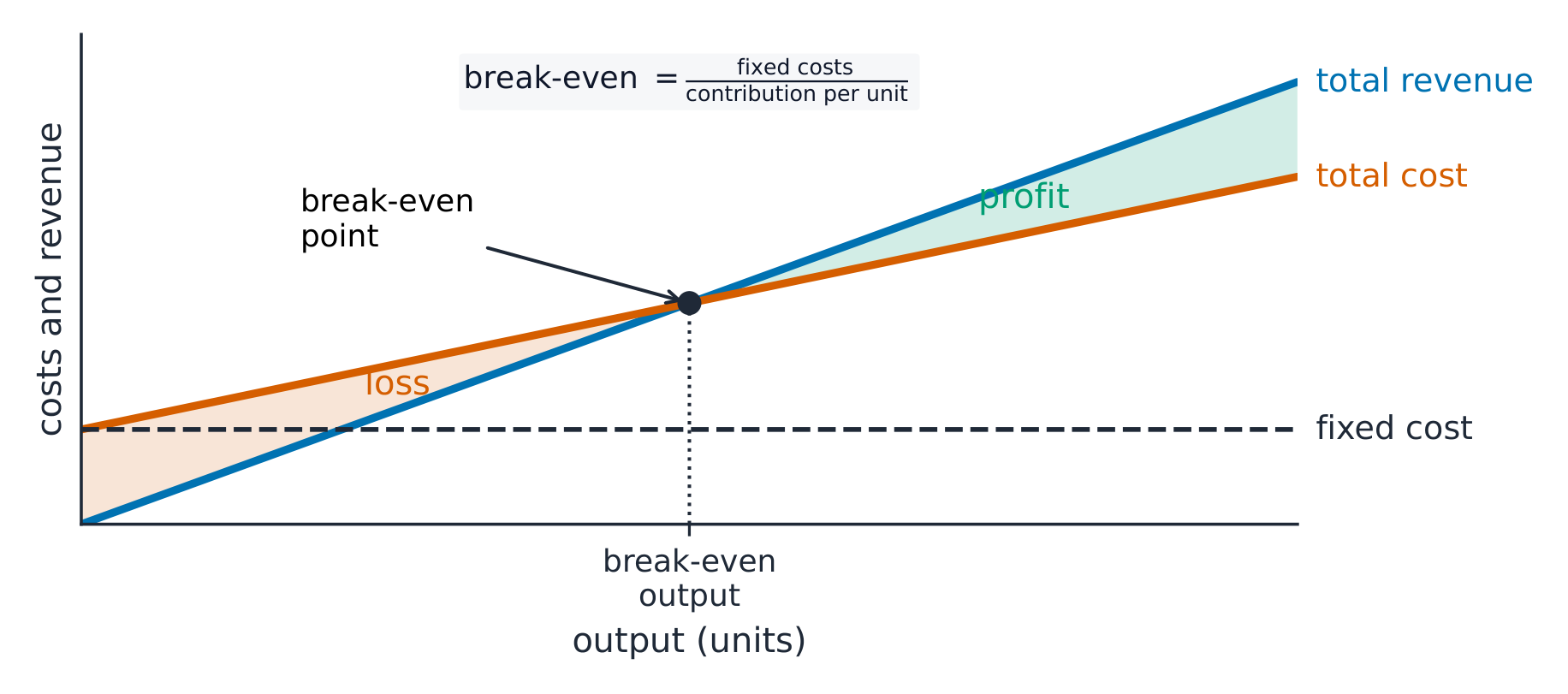
安全边际(margin of safety)是实际产出在盈亏平衡产出之上多远。
$$\text{margin of safety} = \text{actual output} - \text{break-even output}$$
Worked example. 一个产品以 £15 出售,每单位可变成本 £5,而公司的固定成本是 £8,000。求盈亏平衡产出,以及若公司实际制造 1,200 单位的安全边际。
每单位的贡献是 $\text{\pounds} 15 - \text{\pounds} 5 = \text{\pounds} 10$,所以
$$\text{break-even output} = \frac{\text{\pounds} 8\,000}{\text{\pounds} 10} = 800 \text{ units}$$
$$\text{margin of safety} = 1\,200 - 800 = 400 \text{ units}$$
一个大的安全边际更安全,因为销售能下降很长一段路后企业才亏损。
盈亏平衡分析的局限。 它假设所有产出被卖出,而且出售价格和成本在每个产出水平保持不变。在现实生活里这些常常变化,所以盈亏平衡只是一个向导。
探索
Break-even
Break-even is where total revenue crosses total cost.
词汇表
训练
| 英文 | 中文 | 拼音 |
|---|---|---|
| cost/kɒst/ | 成本 | chéng běn |
| fixed costs/fɪkst kɒsts/ | 固定成本 | gù dìng chéng běn |
| variable costs/ˈveərɪəbl kɒsts/ | 可变成本 | kě biàn chéng běn |
| output/ˈaʊtpʊt/ | 产量 | chǎn liàng |
| total cost/ˈtəʊtl kɒst/ | 总成本 | zǒng chéng běn |
| average cost/ˈævrɪdʒ kɒst/ | 平均成本 | píng jūn chéng běn |
| revenue/ˈrevənjuː/ | 收入 | shōu rù |
| profit/ˈprɒfɪt/ | 利润 | lì rùn |
| break-even/breɪk ˈiːvən/ | 盈亏平衡 | yíng kuī píng héng |
| contribution/ˌkɒntrɪˈbjuːʃn/ | 贡献 | gòng xiàn |
| break-even chart/breɪk ˈiːvən tʃɑːt/ | 盈亏平衡图 | yíng kuī píng héng tú |
| break-even point/breɪk ˈiːvən pɔɪnt/ | 盈亏平衡点 | yíng kuī píng héng diǎn |
| margin of safety/ˈmɑːdʒɪn ɒv ˈseɪfti/ | 安全边际 | ān quán biān jì |
4.3
实现优质生产
大纲
- explain why quality is important to a business
- distinguish quality control and quality assurance and the methods used to achieve quality
来源:剑桥国际大纲
Why quality matters
质量(quality)意味着一个产品对顾客(customers)需要的足够好。好的质量:
- 建立一个强的品牌(brand)和顾客忠诚度(customer loyalty),
- 意味着更少的退货、投诉和浪费的材料,
- 让一个企业收取一个更高的价格。
差的质量失去顾客并损害品牌。
Quality control and quality assurance
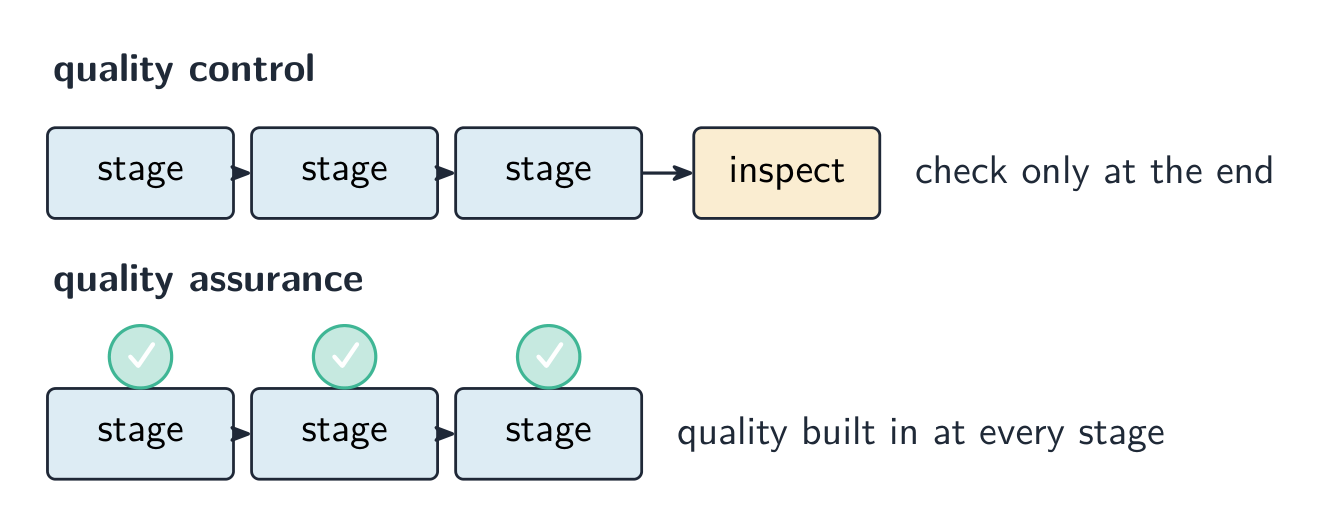
有两种主要方式管理质量:质量控制(quality control)和质量保证(quality assurance)。
| 质量控制 | 质量保证 | |
|---|---|---|
| 何时 | 在末尾检查 | 在每个阶段建入质量 |
| 谁 | 检查员检查成品 | 每个工人都负责 |
| 思想 | 找到并移除有缺陷的商品 | 完全阻止缺陷发生 |
探索
Quality methods lab
Compare quality approaches by when they prevent or find faults.
词汇表
训练
| 英文 | 中文 | 拼音 |
|---|---|---|
| quality/ˈkwɒlɪti/ | 质量 | zhì liàng |
| customers/ˈkʌstəməz/ | 顾客 | gù kè |
| brand/brænd/ | 品牌 | pǐn pái |
| customer loyalty/ˈkʌstəmə ˈlɔɪəlti/ | 顾客忠诚度 | gù kè zhōng chéng dù |
| quality control/ˈkwɒlɪti kənˈtrəʊl/ | 质量控制 | zhì liàng kòng zhì |
| quality assurance/ˈkwɒlɪti əˈʃʊərəns/ | 质量保证 | zhì liàng bǎo zhèng |
4.4
选址决策

大纲
- explain the factors affecting the location decision of a manufacturing business and a service business
- explain the factors a business considers when locating in another country and the role of legal controls
来源:剑桥国际大纲
Locating a business
一个企业坐落在哪里影响它的成本和它的销售。一个制造业(manufacturing)企业(一个制造商品的)看:
- 与原材料(raw materials)的接近程度,因为重的或笨重的材料移动起来花很多钱,
- 与顾客和市场(market)的接近程度,
- 土地的成本和大小,
- 合适劳动力的供应,
- 好的运输连接,
- 一些地区提供的政府补助金。
一个服务(service)企业(一个卖服务的,例如一家商店或一家美发沙龙)更看接近顾客、经过的人流、附近的商店,和租金。
Locating in another country
一个企业可能在国外生产或销售,以便到达新顾客和更大的市场、付更低的工资或租金、更接近原材料,或通过在这个国家里面制造商品来避免关税(tariffs)(对进口的税)。但它于是必须应对不同的法律、语言和习俗,并遵守两个国家的法律管制(legal controls)。
探索
Location factor lab
Classify why a business chooses one site over another.
词汇表
训练
| 英文 | 中文 | 拼音 |
|---|---|---|
| manufacturing/ˌmænjuːˈfæktʃərɪŋ/ | 制造业 | zhì zào yè |
| raw materials/rɔː məˈtɪərɪəlz/ | 原材料 | yuán cái liào |
| market/ˈmɑːkɪt/ | 市场 | shì chǎng |
| tariffs/ˈtærɪfs/ | 关税 | guān shuì |
| legal controls/ˈliːɡl kənˈtrəʊlz/ | 法律管制 | fǎ lǜ guǎn zhì |
4.4
考试技巧
- 匹配生产方法:单件(按订单的一次性物品)、批量(一组,然后切换到另一组)、流水线(在一条线上不停的大量生产)。
- 学公式:总成本 = 固定 + 可变;平均成本 = 总成本 ÷ 产量;总收入 = 价格 × 数量;利润 = 总收入 − 总成本。
- 盈亏平衡产出 = 固定成本 ÷ (出售价格 − 每单位可变成本)。实际产出在盈亏平衡之上多远是安全边际。
- 盈亏平衡分析假设制造的一切以一个固定的价格和成本被卖出,所以它只是一个向导。
- 质量控制在末尾检查成品;质量保证在每个阶段建入质量。
本主题的互动课程
逐步学习,并即时检测练习。