跳到主要内容

生物世界:生态系统

AP 环境科学 · 第 1 主题

训练
讲义 词汇表
1.1

生态系统导论

大纲
Enduring UnderstandingLearning ObjectiveEssential Knowledge

ERT-1
Ecosystems are the result of biotic and abiotic interactions.

ERT-1.A
Explain how the availability of resources influences species interactions.

  • ERT-1.A.1 In a predator-prey relationship, the predator is an organism that eats another organism (the prey).
  • ERT-1.A.2 Symbiosis is a close and long-term interaction between two species in an ecosystem. Types of symbiosis include mutualism, commensalism, and parasitism.
  • ERT-1.A.3 Competition can occur within or between species in an ecosystem where there are limited resources. Resource partitioning—using the resources in different ways, places, or at different times—can reduce the negative impact of competition on survival.

来源:美国大学理事会 AP 课程与考试说明

一个生态系统(ecosystem)是一个区域里所有的生物(生物的)和非生物(非生物的),一起相互作用。生物依赖彼此和它们的物理环境,而像捕食(predation)、竞争(competition)和共生(symbiosis)(互利共生、偏利共生、寄生)这样的相互作用塑造群落。

探索

Explore how a population grows

Change the growth rate $r$ and the carrying capacity $K$. Growth is fast when a population is small, then levels off as resources run short and the ecosystem fills up.

词汇表 训练
英文 中文 拼音
ecosystem 生态系统 shēng tài xì tǒng
predation 捕食 bǔ shí
competition 竞争 jìng zhēng
symbiosis 共生 gòng shēng
1.2

陆地生物群系

大纲
Enduring UnderstandingLearning ObjectiveEssential Knowledge

ERT-1
Ecosystems are the result of biotic and abiotic interactions.

ERT-1.B
Describe the global distribution and principal environmental aspects of terrestrial biomes.

  • ERT-1.B.1 A biome contains characteristic communities of plants and animals that result from, and are adapted to, its climate.
  • ERT-1.B.2 Major terrestrial biomes include taiga, temperate rainforests, temperate seasonal forests, tropical rainforests, shrubland, temperate grassland, savanna, desert, and tundra.
  • ERT-1.B.3 The global distribution of nonmineral terrestrial natural resources, such as water and trees for lumber, varies because of some combination of climate, geography, latitude and altitude, nutrient availability, and soil.
  • ERT-1.B.4 The worldwide distribution of biomes is dynamic; the distribution has changed in the past and may again shift as a result of global climate changes.

来源:美国大学理事会 AP 课程与考试说明

一个生物群系(biome)是一个由它的气候和特有的生命定义的大区域。陆地生物群系(terrestrial biomes)(沙漠、草原、热带雨林、温带森林、针叶林、苔原)主要由温度和降水(precipitation)决定。每个都有适应那些条件的植物和动物。

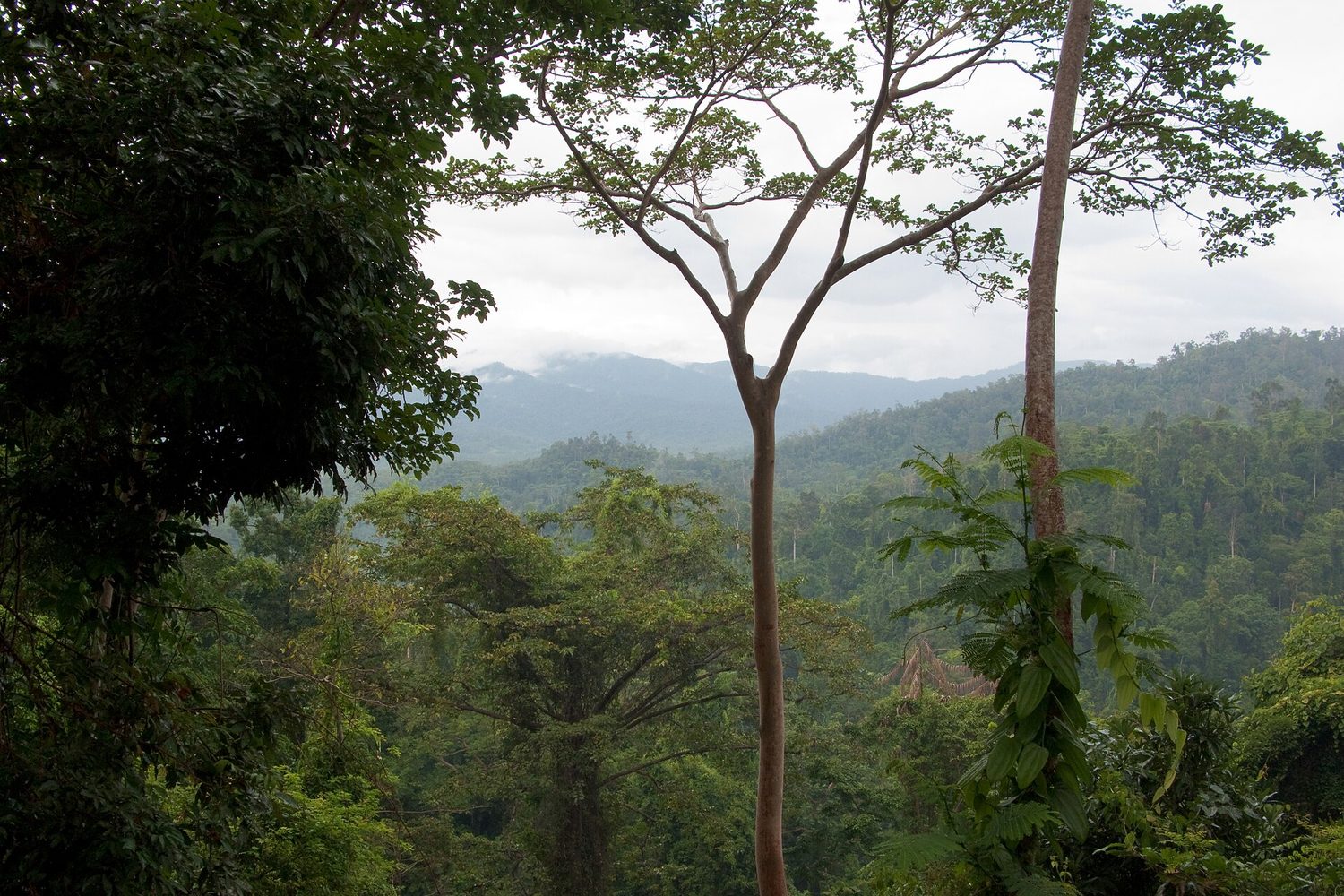
下面两张图处在降水量的两个极端,这就是它们的生命看起来如此不同的原因:
一片雾气缭绕的热带雨林,陡坡上覆盖着茂密、分层的绿色树冠
热带雨林:全年又热又湿,因此有茂密分层的植物和任何陆地生物群系中最丰富的生物多样性
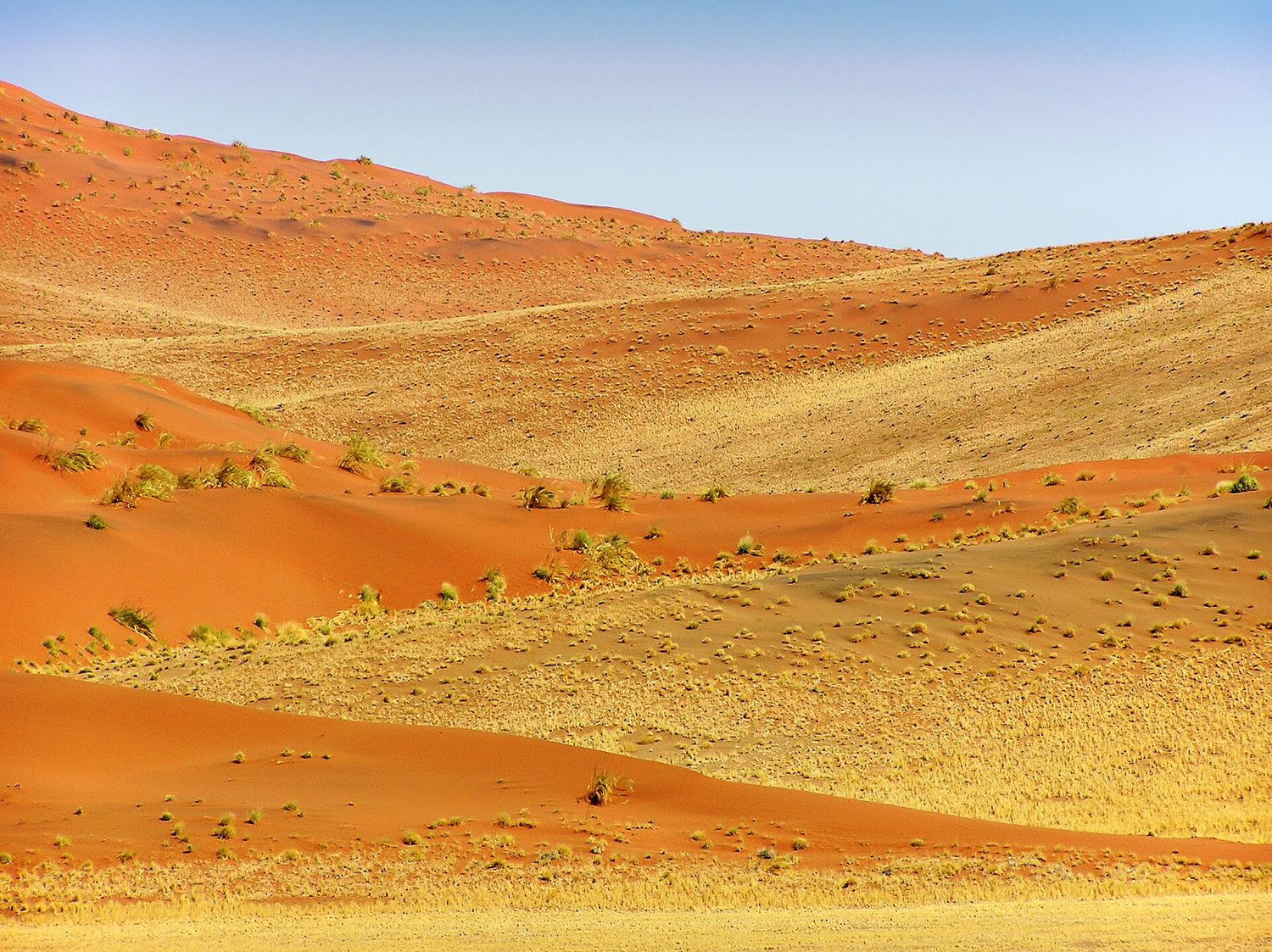
一片干旱的沙漠,只有光秃秃的沙丘,几乎没有植物
沙漠:降水极少,所以只有稀疏的耐旱生命能存活
词汇表 训练
英文 中文 拼音
biome 生物群系 shēng wù qún xì
temperature and precipitation 降水 jiàng shuǐ
tropical rainforest 热带雨林 rè dài yǔ lín
desert 沙漠 shā mò
1.3

水生生物群系

大纲
Enduring UnderstandingLearning ObjectiveEssential Knowledge

ERT-1
Ecosystems are the result of biotic and abiotic interactions.

ERT-1.C
Describe the global distribution and principal environmental aspects of aquatic biomes.

  • ERT-1.C.1 Freshwater biomes include streams, rivers, ponds, and lakes. These freshwater biomes are a vital resource for drinking water.
  • ERT-1.C.2 Marine biomes include oceans, coral reefs, marshland, and estuaries. Algae in marine biomes supply a large portion of the Earth's oxygen, and also take in carbon dioxide from the atmosphere.
  • ERT-1.C.3 The global distribution of nonmineral marine natural resources, such as different types of fish, varies because of some combination of salinity, depth, turbidity, nutrient availability, and temperature.

来源:美国大学理事会 AP 课程与考试说明

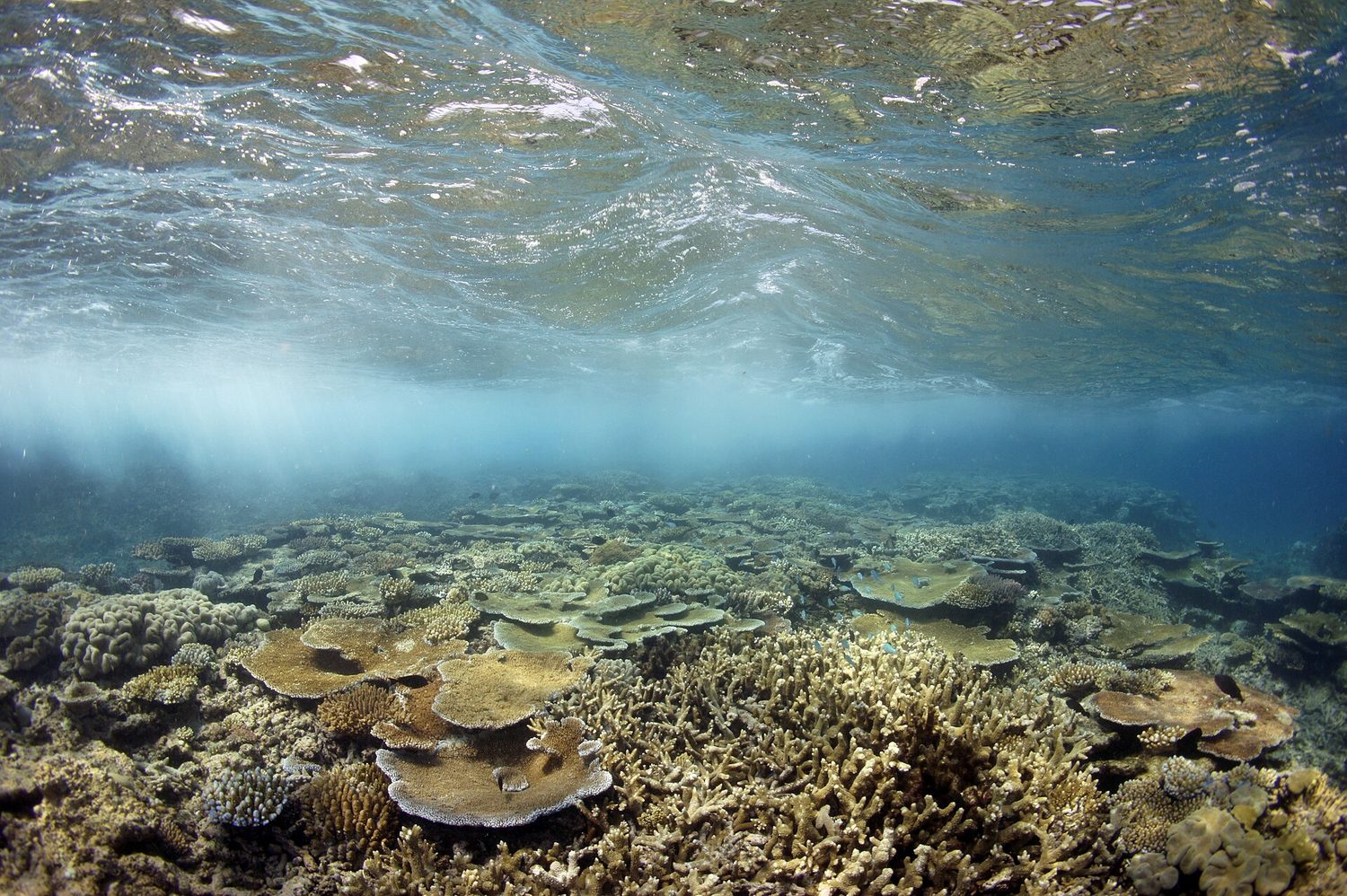
水生生物群系(aquatic biomes)覆盖地球比陆地更多。淡水(溪流、湖泊、湿地)和海洋(开阔海洋、珊瑚礁、河口)系统在盐度(salinity)、阳光和营养上不同。河口(estuaries)(河流遇到海洋的地方)和珊瑚礁尤其多产和生物多样。

珊瑚礁的水下视角,就在海面下方,布满珊瑚
珊瑚礁:温暖、阳光充足的浅水使它成为所有生物群系中最多产、生物最多样的之一
词汇表 训练
英文 中文 拼音
salinity 盐度 yán dù
Estuaries 河口 hé kǒu
coral reef 珊瑚礁 shān hú jiāo
1.4

碳循环

大纲
Enduring UnderstandingLearning ObjectiveEssential Knowledge

ERT-1
Ecosystems are the result of biotic and abiotic interactions.

ERT-1.D
Explain the steps and reservoir interactions in the carbon cycle.

  • ERT-1.D.1 The carbon cycle is the movement of atoms and molecules containing the element carbon between sources and sinks.
  • ERT-1.D.2 Some of the reservoirs in which carbon compounds occur in the carbon cycle hold those compounds for long periods of time, while some hold them for relatively short periods of time.
  • ERT-1.D.3 Carbon cycles between photosynthesis and cellular respiration in living things.
  • ERT-1.D.4 Plant and animal decomposition have led to the storage of carbon over millions of years. The burning of fossil fuels quickly moves that stored carbon into atmospheric carbon, in the form of carbon dioxide.

来源:美国大学理事会 AP 课程与考试说明

碳循环

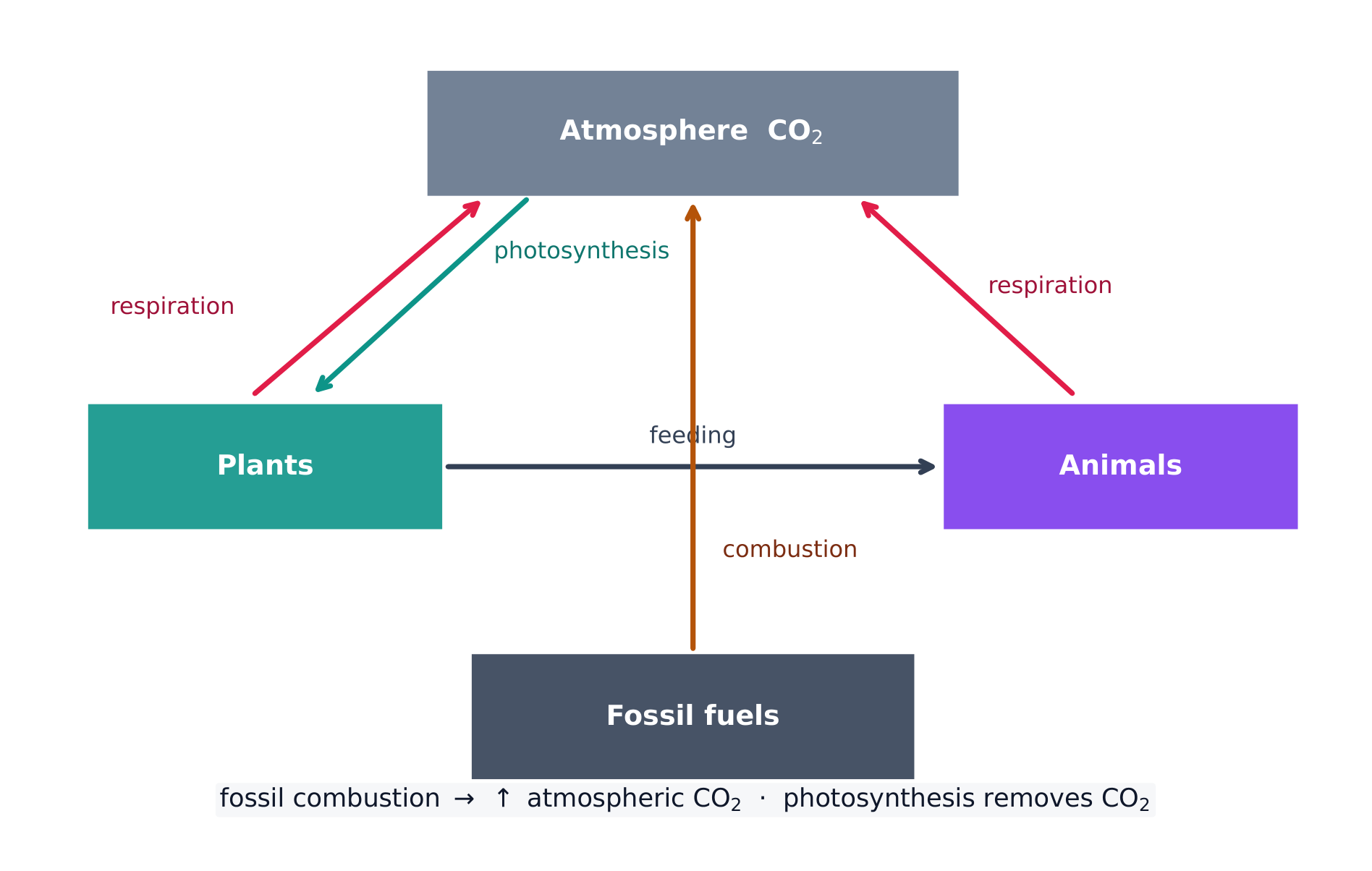
碳循环(carbon cycle)在大气、生物、海洋和岩石之间移动碳。光合作用(photosynthesis)移除 $\text{CO}_2$;呼吸(respiration)、分解(decomposition)和燃烧化石燃料(fossil fuels)返回它。燃烧化石燃料添加碳的速度远快于自然过程移除它。

碳循环在大气、生物和化石燃料之间移动碳
碳循环在大气、生物和化石燃料之间移动碳
词汇表 训练
英文 中文 拼音
carbon cycle 碳循环 tàn xún huán
fossil fuels 化石燃料 huà shí rán liào
1.5

氮循环

大纲
Enduring UnderstandingLearning ObjectiveEssential Knowledge

ERT-1
Ecosystems are the result of biotic and abiotic interactions.

ERT-1.E
Explain the steps and reservoir interactions in the nitrogen cycle.

  • ERT-1.E.1 The nitrogen cycle is the movement of atoms and molecules containing the element nitrogen between sources and sinks.
  • ERT-1.E.2 Most of the reservoirs in which nitrogen compounds occur in the nitrogen cycle hold those compounds for relatively short periods of time.
  • ERT-1.E.3 Nitrogen fixation is the process in which atmospheric nitrogen is converted into a form of nitrogen (primarily ammonia) that is available for uptake by plants and that can be synthesized into plant tissue.
  • ERT-1.E.4 The atmosphere is the major reservoir of nitrogen.

来源:美国大学理事会 AP 课程与考试说明

氮循环

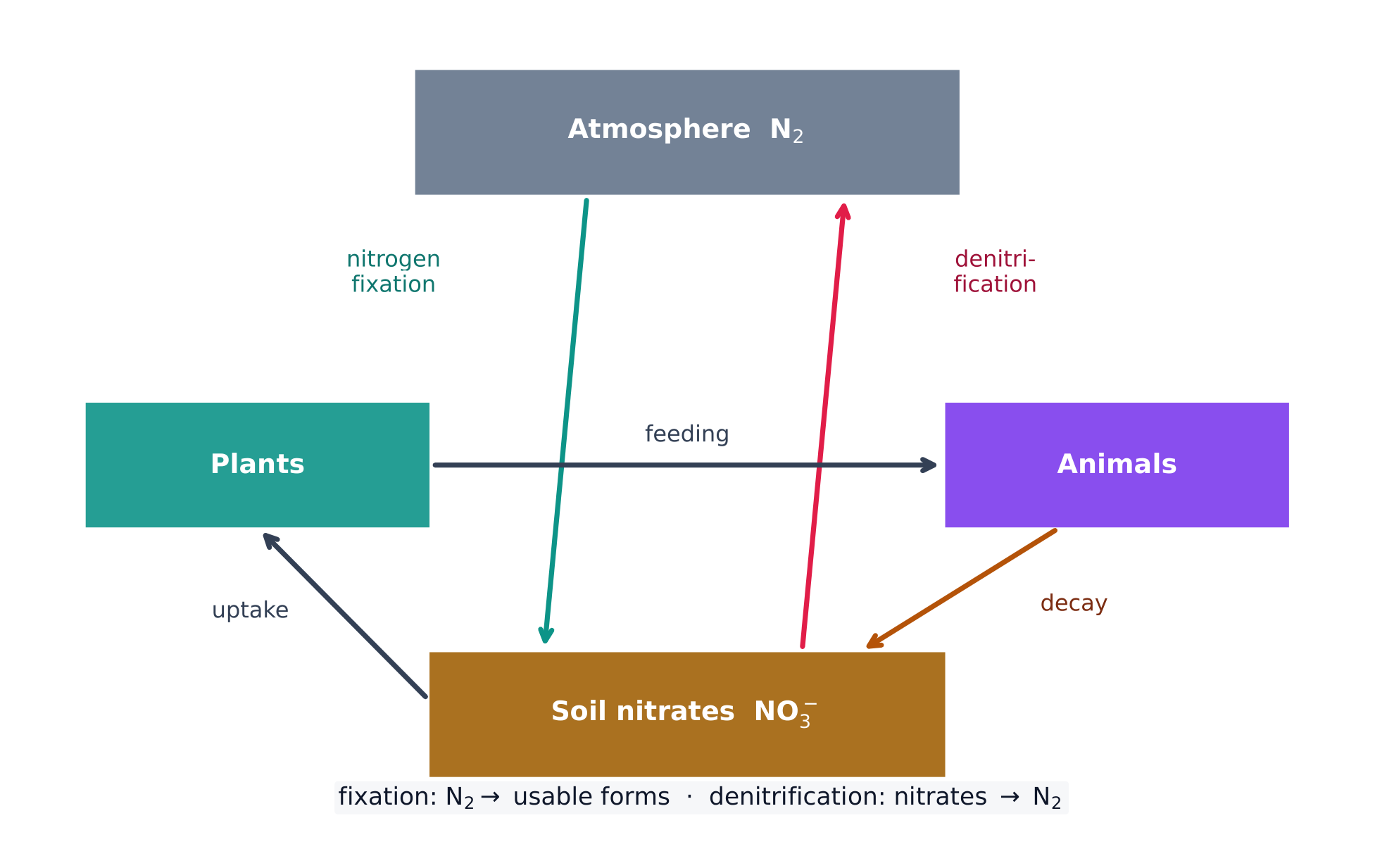
氮循环(nitrogen cycle)使氮对生命可用。固氮(nitrogen fixation)(由细菌)把大气 $\text{N}_2$ 转换成氨;硝化和同化使它通过生物;反硝化(denitrification)把 $\text{N}_2$ 返回空气。肥料添加活性氮,它能污染水。

氮循环:N 被固定成土壤硝酸盐、通过食物传递,并由反硝化返回空气
氮循环:N$_2$ 被固定成土壤硝酸盐、通过食物传递,并由反硝化返回空气
词汇表 训练
英文 中文 拼音
nitrogen cycle 氮循环 dàn xún huán
Nitrogen fixation 固氮 gù dàn
1.6

磷循环

大纲
Enduring UnderstandingLearning ObjectiveEssential Knowledge

ERT-1
Ecosystems are the result of biotic and abiotic interactions.

ERT-1.F
Explain the steps and reservoir interactions in the phosphorus cycle.

  • ERT-1.F.1 The phosphorus cycle is the movement of atoms and molecules containing the element phosphorus between sources and sinks.
  • ERT-1.F.2 The major reservoirs of phosphorus in the phosphorus cycle are rock and sediments that contain phosphorus-bearing minerals.
  • ERT-1.F.3 There is no atmospheric component in the phosphorus cycle, and the limitations this imposes on the return of phosphorus from the ocean to land make phosphorus naturally scarce in aquatic and many terrestrial ecosystems. In undisturbed ecosystems, phosphorus is the limiting factor in biological systems.

来源:美国大学理事会 AP 课程与考试说明

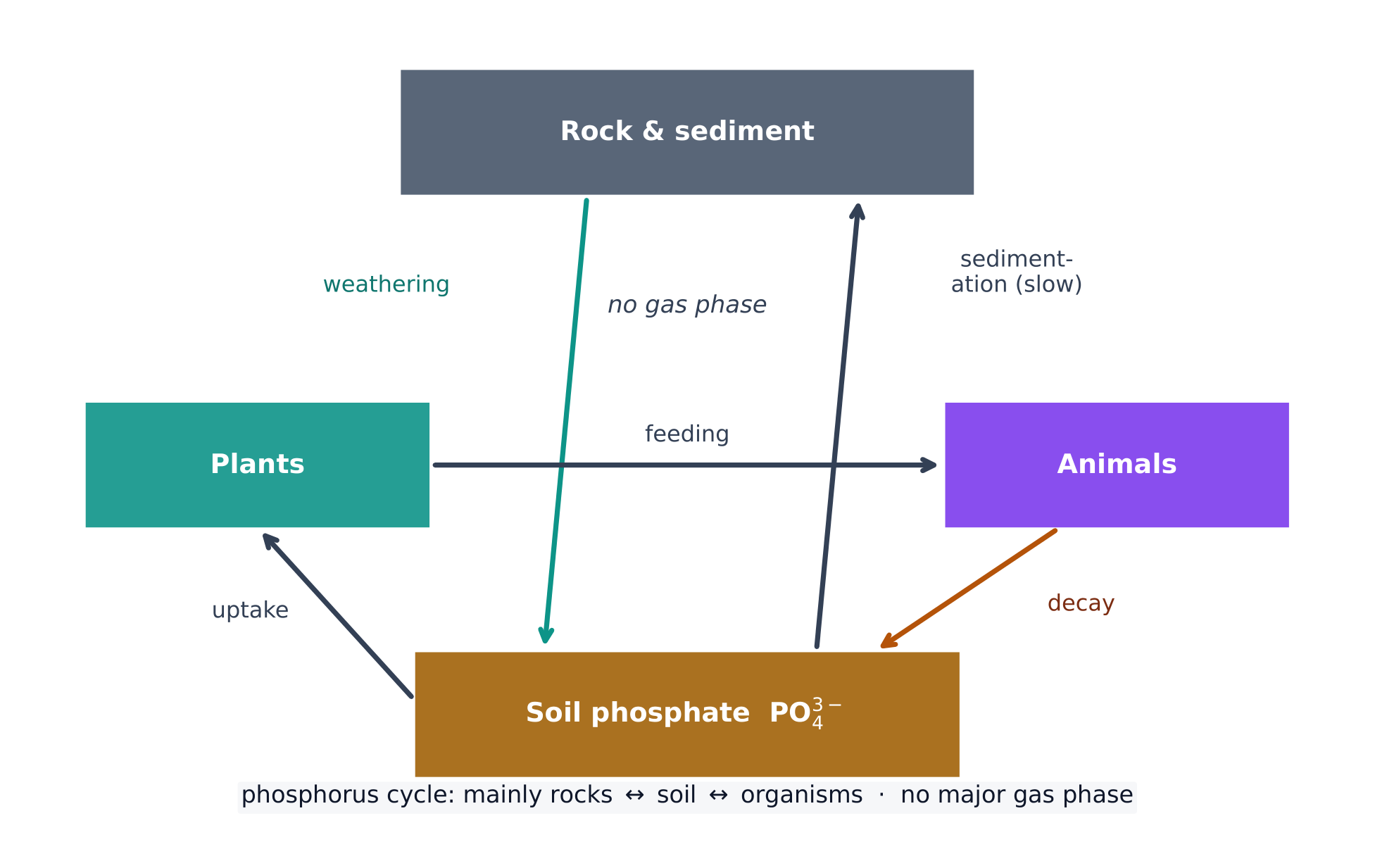
磷循环(phosphorus cycle)没有大气(气体)阶段——磷通过岩石、土壤、水和生物移动。它慢而常常是增长的限制性营养(limiting nutrient),所以添加的磷(肥料、洗涤剂)能触发藻类爆发。

磷循环:岩石风化成土壤磷酸盐并缓慢沉积回去,没有气体相
词汇表 训练
英文 中文 拼音
phosphorus cycle 磷循环 lín xún huán
limiting nutrient 限制性营养 xiàn zhì xìng yíng yǎng
1.7

水循环

大纲
Enduring UnderstandingLearning ObjectiveEssential Knowledge

ERT-1
Ecosystems are the result of biotic and abiotic interactions.

ERT-1.G
Explain the steps and reservoir interactions in the hydrologic cycle.

  • ERT-1.G.1 The hydrologic cycle, which is powered by the sun, is the movement of water in its various solid, liquid, and gaseous phases between sources and sinks.
  • ERT-1.G.2 The oceans are the primary reservoir of water at the Earth's surface, with ice caps and groundwater acting as much smaller reservoirs.

来源:美国大学理事会 AP 课程与考试说明

水循环

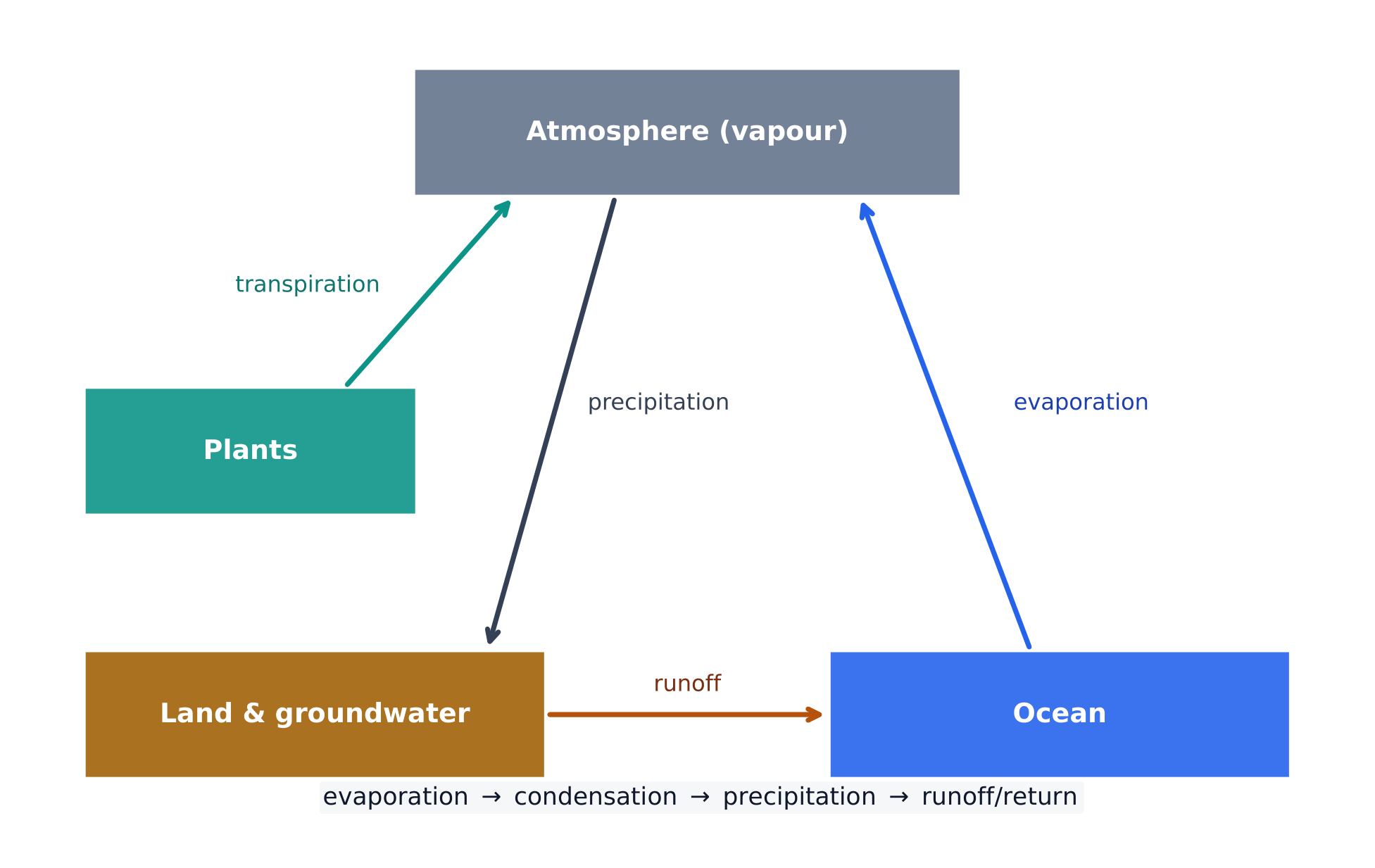
水循环(water cycle)通过蒸发(evaporation)、蒸腾(transpiration)(从植物)、凝结(condensation)、降水(precipitation)和径流移动水。它分配淡水并塑造气候;人类使用和土地变化能改变它的流动。

水循环:蒸发和蒸腾把水提到空气;降水和径流返回它
词汇表 训练
英文 中文 拼音
water cycle 水循环 shuǐ xún huán
evaporation 蒸发 zhēng fā
transpiration 蒸腾 zhēng téng
1.8

初级生产力

大纲
Enduring UnderstandingLearning ObjectiveEssential Knowledge

ENG-1
Energy can be converted from one form to another.

ENG-1.A
Explain how solar energy is acquired and transferred by living organisms.

  • ENG-1.A.1 Primary productivity is the rate at which solar energy (sunlight) is converted into organic compounds via photosynthesis over a unit of time.
  • ENG-1.A.2 Gross primary productivity is the total rate of photosynthesis in a given area.
  • ENG-1.A.3 Net primary productivity is the rate of energy storage by photosynthesizers in a given area, after subtracting the energy lost to respiration.
  • ENG-1.A.4 Productivity is measured in units of energy per unit area per unit time (e.g., $\text{kcal/m}^2\text{/yr}$).
  • ENG-1.A.5 Most red light is absorbed in the upper 1m of water, and blue light only penetrates deeper than 100m in the clearest water. This affects photosynthesis in aquatic ecosystems, whose photosynthesizers have adapted mechanisms to address the lack of visible light.

来源:美国大学理事会 AP 课程与考试说明

初级生产力(primary productivity)是生产者捕获能量的速率(通常通过光合作用)。总初级生产力(GPP)(gross primary productivity)是捕获的总量;净初级生产力(NPP)(net primary productivity)是生产者自己的呼吸之后剩下的——对生态系统其余部分可用的能量。温暖、湿润、阳光充足的系统(雨林、珊瑚礁)最多产。

Worked example. 若一个草原里的生产者捕获 $20{,}000\ \text{kcal/m}^2/\text{yr}$ 的能量(GPP)并在它们自己的呼吸里燃烧 $8{,}000\ \text{kcal/m}^2/\text{yr}$,那么 $\text{NPP}=\text{GPP}-R=20{,}000-8{,}000=12{,}000\ \text{kcal/m}^2/\text{yr}$。只有那个 NPP ——不是完整的 GPP ——对上面的消费者可用。

探索

Explore GPP, respiration and NPP

The energy producers capture (GPP) splits into what they burn for their own respiration $R$ and what is left over as new biomass — $\text{NPP} = \text{GPP} - R$, and useful + wasted always equals the input.

词汇表 训练
英文 中文 拼音
Primary productivity 初级生产力 chū jí shēng chǎn lì
1.9

营养级

大纲
Enduring UnderstandingLearning ObjectiveEssential Knowledge

ENG-1
Energy can be converted from one form to another.

ENG-1.B
Explain how energy flows and matter cycles through trophic levels.

  • ENG-1.B.1 All ecosystems depend on a continuous inflow of high-quality energy in order to maintain their structure and function of transferring matter between the environment and organisms via biogeochemical cycles.
  • ENG-1.B.2 Biogeochemical cycles are essential for life and each cycle demonstrates the conservation of matter.
  • ENG-1.B.3 In terrestrial and near-surface marine communities, energy flows from the sun to producers in the lowest trophic levels and then upward to higher trophic levels.

来源:美国大学理事会 AP 课程与考试说明

能量流动与十分之一定律

生物占据营养级(trophic levels):生产者(producers)(制造它们自己的食物),然后初级、次级和三级消费者(consumers),而分解者(decomposers)在每一级回收营养。每一级依赖它下面捕获的能量。

词汇表 训练
英文 中文 拼音
trophic levels 营养级 yíng yǎng jí
producers 生产者 shēng chǎn zhě
primary, secondary, and tertiary consumers 消费者 xiāo fèi zhě
decomposers 分解者 fēn jiě zhě
1.10

能量流动与10%定律

大纲
Enduring UnderstandingLearning ObjectiveEssential Knowledge

ENG-1
Energy can be converted from one form to another.

ENG-1.C
Determine how the energy decreases as it flows through ecosystems.

  • ENG-1.C.1 The 10% rule approximates that in the transfer of energy from one trophic level to the next, only about 10% of the energy is passed on.
  • ENG-1.C.2 The loss of energy that occurs when energy moves from lower to higher trophic levels can be explained through the laws of thermodynamics.

来源:美国大学理事会 AP 课程与考试说明

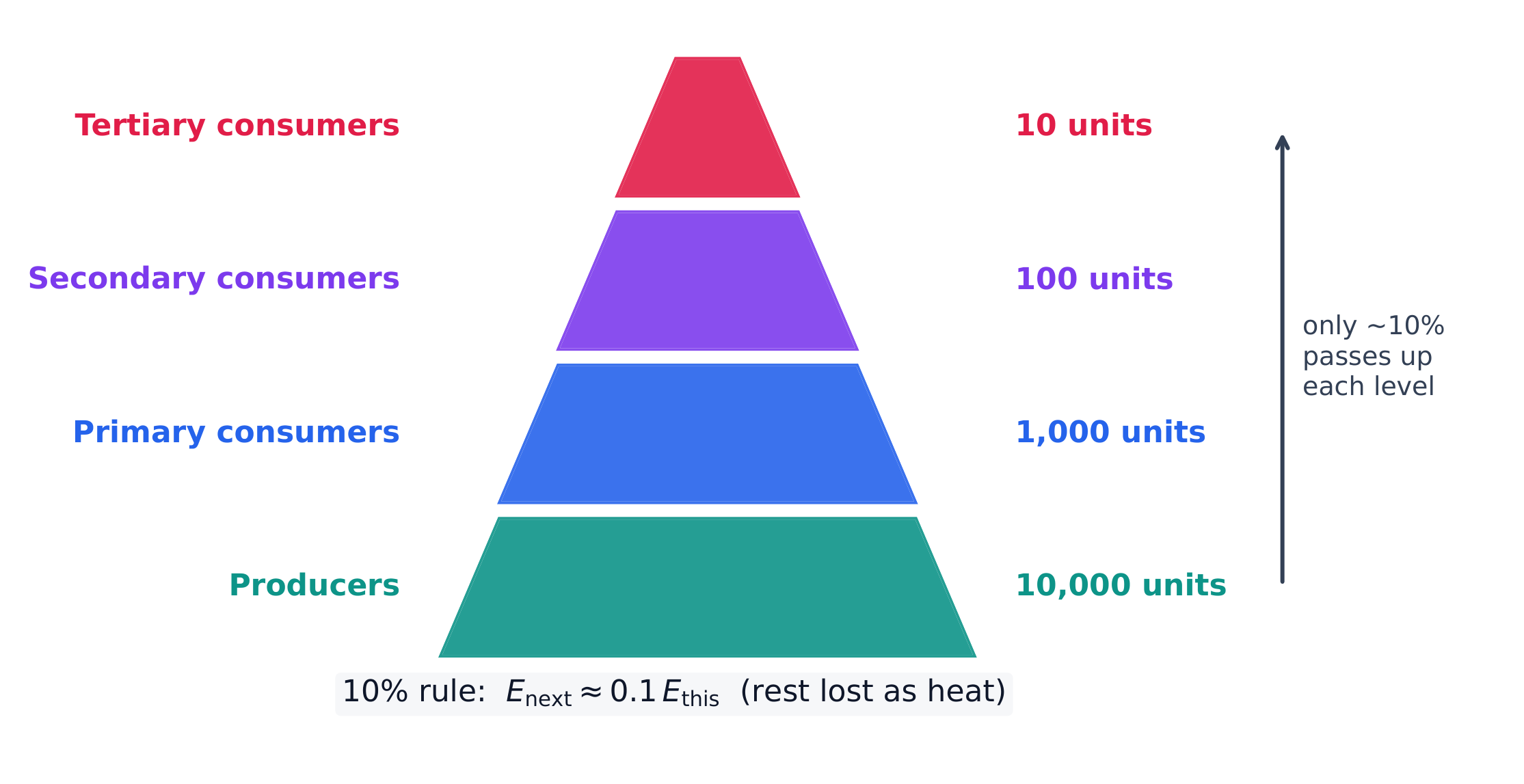
能量单向流过一个生态系统,并在每次转移时作为热损失。10% 规则:一个营养级只有约 10% 的能量传给下一个;另外的 90% 驱动生命过程并作为热逃逸。这就是为什么食物链是短的而顶级捕食者很少。

Worked example. 从生产者层面的 $12{,}000\ \text{kcal/m}^2/\text{yr}$ 的 NPP 继续,初级消费者接收约 $10\%=1{,}200\ \text{kcal}$、次级消费者 $\approx120\ \text{kcal}$,而三级消费者只有 $\approx12\ \text{kcal}$。三次转移之后能量已经缩小了一千倍——为什么第四或第五营养级很少有足够能量支持它的算术原因。

一个能量金字塔:只有约 10% 的能量传给下一个营养级
探索

Explore the 10% rule

Set the energy producers capture and the ecological efficiency, then watch only about a tenth pass to each level up — this is why the apex predator is left with so little and food chains stay short.

1.11

食物链与食物网
大纲
Enduring UnderstandingLearning ObjectiveEssential Knowledge

ENG-1
Energy can be converted from one form to another.

ENG-1.D
Describe food chains and food webs, and their constituent members by trophic level.

  • ENG-1.D.1 A food web is a model of an interlocking pattern of food chains that depicts the flow of energy and nutrients in two or more food chains.
  • ENG-1.D.2 Positive and negative feedback loops can each play a role in food webs. When one species is removed from or added to a specific food web, the rest of the food web can be affected.

来源:美国大学理事会 AP 课程与考试说明

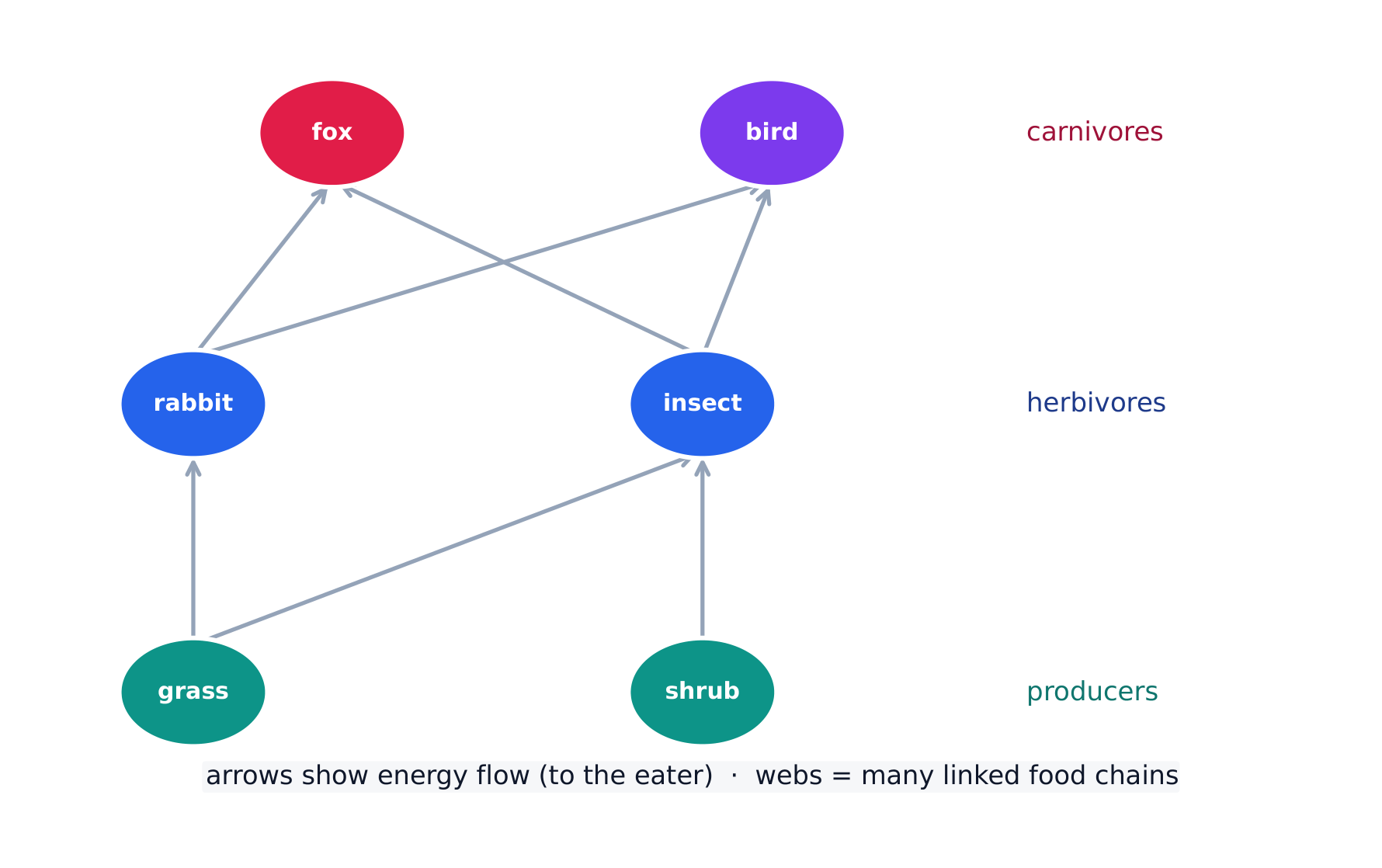
一个食物链(food chain)是谁吃谁的一条单一的线;一个食物网(food web)把许多链连接成一幅现实的取食关系图。因为物种相互连接,移除一个(尤其是一个关键种(keystone species))能破坏整个网。

一个食物网连接许多食物链;箭头指向能量流动的方向
词汇表 训练
英文 中文 拼音
food chain 食物链 shí wù liàn
food web 食物网 shí wù wǎng
keystone species 关键种 guān jiàn zhǒng
1.11

考试技巧

  • 记住能量流动并被损失(10% 规则)而物质循环(碳、氮、磷、水)。
  • 沿一条食物链应用 10% 规则并知道 NPP = GPP − 呼吸(只有 NPP 对消费者可用)。
  • 学每个生物地球化学循环的储库以及人类如何扰动它(燃烧化石燃料添加 CO₂;肥料添加氮/磷)。
  • 生产者最丰富,因为如此少的能量到达顶部。
  • 在自由回答的数学问题上使用正确的单位并展示你的算术(无计算器——保持数字整齐)。

本主题的互动课程

逐步学习,并即时检测练习。

AP 环境科学历年真题

AP 环境科学的更多主题

登录或创建账号

IGCSE, A-Level & AP