持久理解 (CHA-3): 导数使我们能够解决涉及变化率的现实世界问题。
学习目标 CHA-3.A: 在具体情境中解释导数的含义。
- CHA-3.A.1 函数的导数可以被解释为相对于其自变量的瞬时变化率。
- CHA-3.A.2 导数可用于表达应用情境中关于变化率的信息。
- CHA-3.A.3 $f'(x)$ 的单位是 $f$ 的单位除以 $x$ 的单位。
AP 微积分 AB · 知识点 4
 6:54
在情境中解释导数
既然我们已经能够计算导数,就可以用它们来描述现实世界。导数是一种变化率。人口增长有多快?……有多快?
英语旁白 · 英中内嵌字幕
持久理解 (CHA-3): 导数使我们能够解决涉及变化率的现实世界问题。
学习目标 CHA-3.A: 在具体情境中解释导数的含义。
来源:College Board AP 课程与考试说明
Once you can compute derivatives, you use them to describe the real world. The derivative $f'(x)$ is the instantaneous rate of change 瞬时变化率 of $f$ with respect to 关于 its input. Reading and reporting this rate correctly is a graded skill.
Units matter. The unit of $f'(x)$ is the unit of $f$ divided by the unit of $x$. If $C(t)$ is a number of acres and $t$ is in weeks, then $C'(t)$ is in acres per week. On the exam, “Using correct units, interpret the meaning of $g'(140)$” wants a full sentence: the value, the quantity, the rate word “per”, and the moment. For example: “$g'(140)=2.3$ means that at $x=140$, the quantity is increasing at about $2.3$ units per unit of $x$.”
Common mistakes. Reading $g'(140)$ as an amount (“the quantity is $2.3$”) instead of a rate; leaving out the units or the moment ($x=140$); and calling a negative derivative “increasing”.
| English | 中文 | 拼音 |
|---|---|---|
| instantaneous rate of change/ˌɪnstənˈteɪnɪəs reɪt ɒv tʃeɪndʒ/ | 瞬时变化率 | shùn shí biàn huà lǜ |
| with respect to | 关于 | guān yú |
持久理解 (CHA-3): 导数使我们能够解决涉及变化率的现实世界问题。
学习目标 CHA-3.B: 计算实际应用情境中的变化率。
来源:College Board AP 课程与考试说明
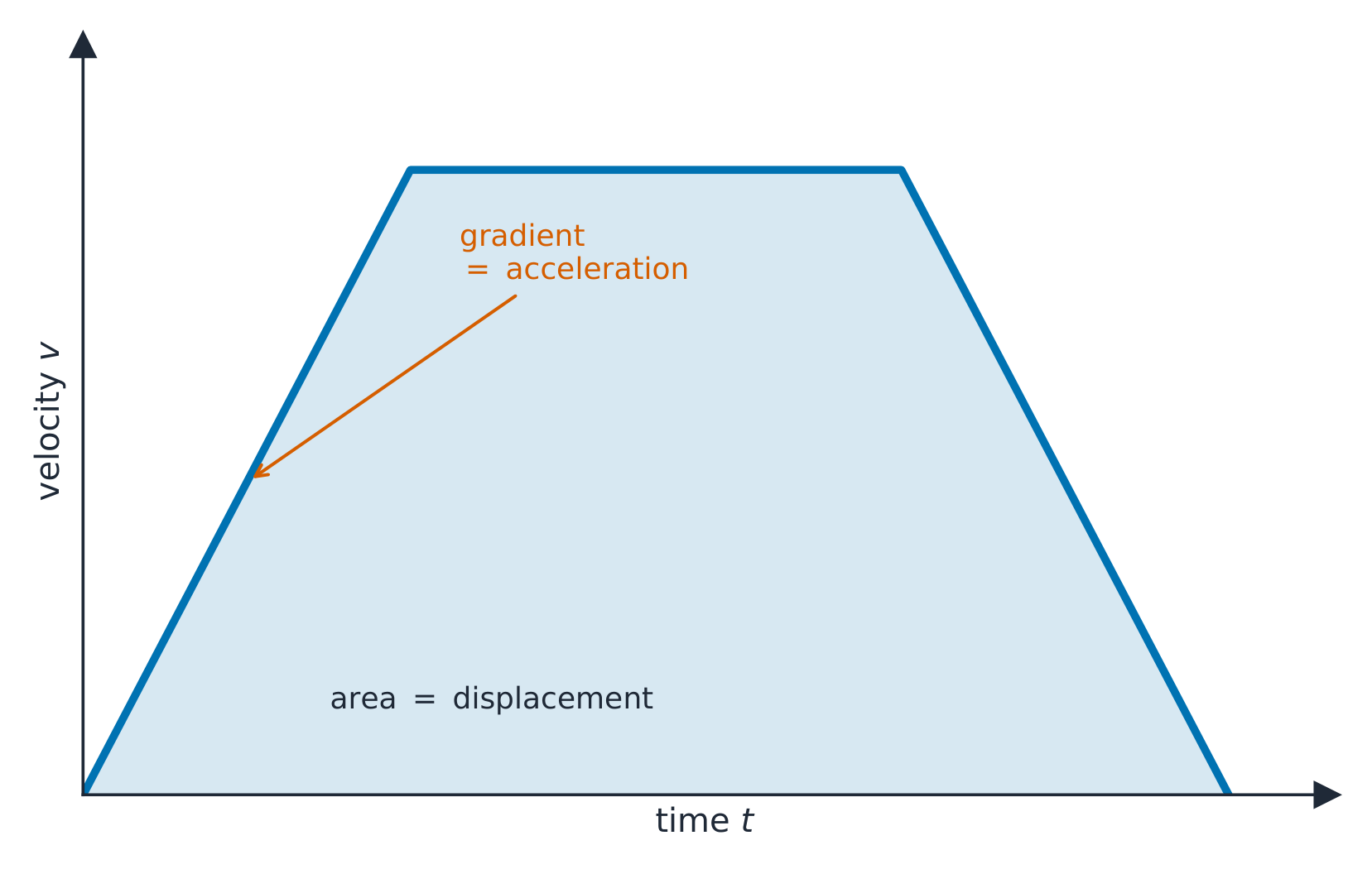
For a particle 质点 moving on a line, three functions of time are linked by differentiation 求导:
Key readings (frequent exam parts):
Worked example. A particle moves with $s(t)=t^3-6t^2+9t$. Then $v(t)=3t^2-12t+9=3(t-1)(t-3)$, so it is at rest at $t=1$ and $t=3$, and changes direction at each. At $t=2$, $v(2)=3(1)(-1)=-3<0$ (moving left) and $a(2)=6(2)-12=0$; just after, $a>0$ while $v<0$, so it is slowing down there. Distinguish carefully between velocity (has direction) and speed (does not) – the exam tests this exact difference.
Common mistakes. Saying the particle speeds up because $a>0$: compare the signs of both $v$ and $a$. Saying it changes direction wherever $v=0$: $v$ must change sign. With $v(t)=(t-2)^2$ the particle stops for an instant at $t=2$, then keeps moving the same way.

y = ax³ + bx² + cx + d
对于直线运动,速度是位置(斜率)的导数,加速度是速度的导数。滑动该点以读取瞬时速度。
| English | 中文 | 拼音 |
|---|---|---|
| particle/ˈpɑːtɪkl/ | 质点 | zhì diǎn |
| differentiation/ˌdɪfəˌrenʃɪˈeɪʃn/ | 求导 | qiú dǎo |
| position/pəˈzɪʃn/ | 位置 | wèi zhì |
| velocity/vəˈlɒsɪti/ | 速度 | sù dù |
| acceleration/əkˌseləˈreɪʃn/ | 加速度 | jiā sù dù |
| at rest/æt rest/ | 静止 | jìng zhǐ |
| changes direction | 改变方向 | gǎi biàn fāng xiàng |
| Speed/spiːd/ | 速率 | sù lǜ |
| speeding up | 加速 | jiā sù |
持久理解 (CHA-3): 导数使我们能够解决涉及变化率的现实世界问题。
学习目标 CHA-3.C: 解释应用情境中的变化率。
来源:College Board AP 课程与考试说明
The same derivative idea models any changing quantity: a draining tank, a spreading population, a cooling cup. Whenever a problem says "the rate at which...", it is describing a derivative. Read the units to know which quantity's rate you have, then interpret in context.

持久理解 (CHA-3): 导数使我们能够解决涉及变化率的现实世界问题。
学习目标 CHA-3.D: 计算应用背景下的相关变化率。
来源:College Board AP 课程与考试说明
In a related rates 相关变化率 problem, several quantities change together over time, and you know some rates but want another. The engine is the chain rule 链式法则: differentiate a relationship with respect to time $t$. Every variable becomes a function of $t$, so each derivative picks up a “$\,/\,dt$” factor. The product rule 乘积法则 and quotient rule 商法则 may also be needed.
y = a·x³ (V vs r)
$V=\tfrac43\pi r^3$ 急剧上升——当 $r$ 很大时,微小的半径变化率会导致巨大的体积变化率。
| English | 中文 | 拼音 |
|---|---|---|
| related rates/rɪˈleɪtɪd reɪts/ | 相关变化率 | xiāng guān biàn huà lǜ |
| chain rule/tʃeɪn ruːl/ | 链式法则 | liàn shì fǎ zé |
| product rule/ˈprɒdʌkt ruːl/ | 乘积法则 | chéng jī fǎ zé |
| quotient rule/ˈkwəʊʃənt ruːl/ | 商法则 | shāng fǎ zé |
持久理解 (CHA-3): 导数使我们能够解决涉及变化率的现实世界问题。
学习目标 CHA-3.E: 在实际情境中解释相关变化率。
来源:College Board AP 课程与考试说明
A reliable procedure – and a full-credit template on the exam:
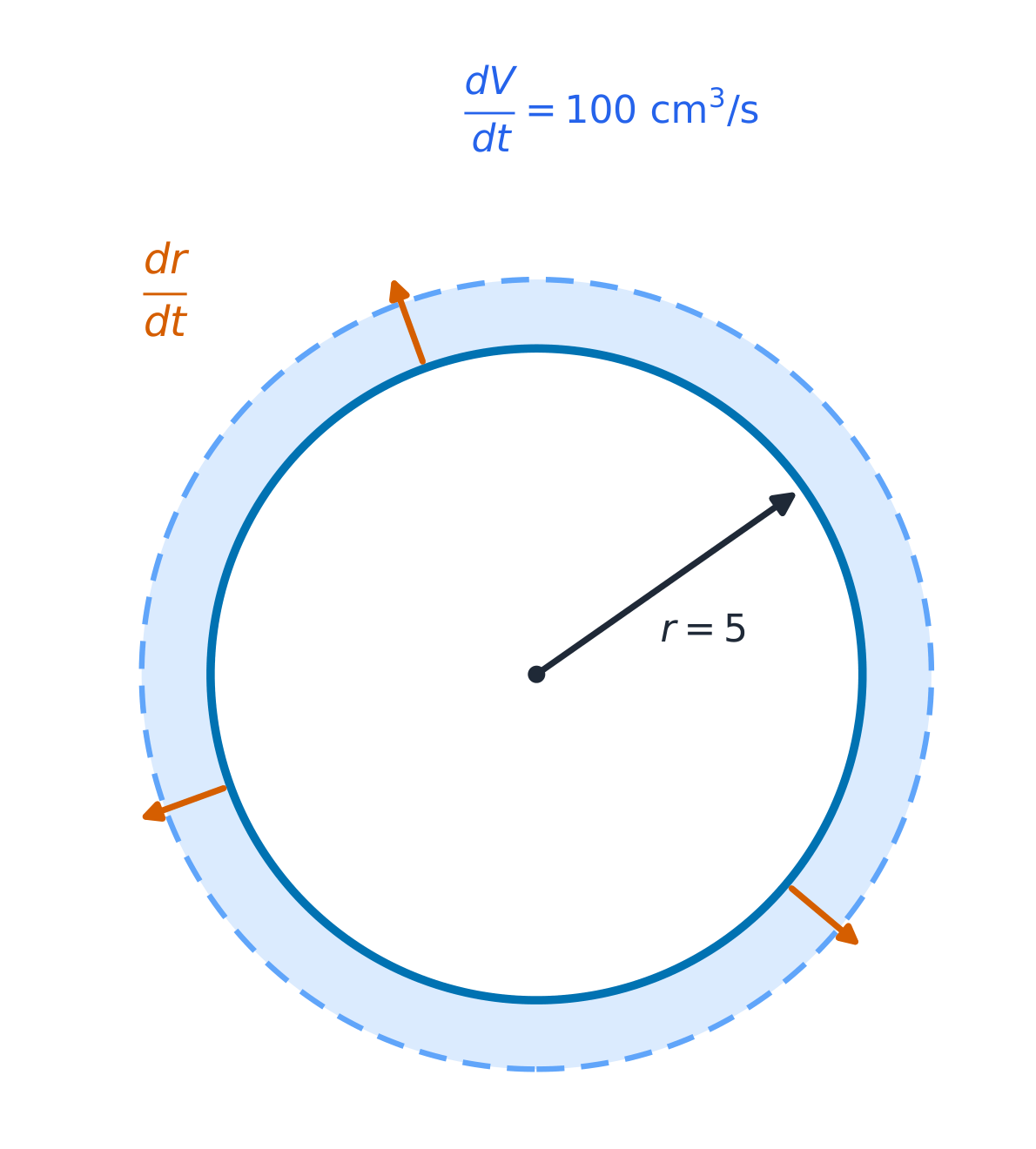
Worked example. Air is pumped into a spherical balloon so its volume grows at $\dfrac{dV}{dt}=100\ \text{cm}^3/\text{s}$. How fast is the radius growing when $r=5\ \text{cm}$? Start from $V=\tfrac43\pi r^3$ and differentiate with respect to $t$ first:
Worked example: sliding ladder. A $10$ m ladder leans against a wall. Its foot slides away from the wall at $0.5$ m/s. How fast is the top sliding down the wall when the foot is $6$ m from the wall?
Note that $y=8$ came from the equation at that instant; it is not given in the question.
Common mistakes. Treating a constant as a variable or a variable as a constant: the ladder's length $10$ never changes (its derivative is $0$), but $x$ and $y$ both do. Dropping the sign: report $\dfrac{dy}{dt}=-0.375$ m/s, or say the top slides down at $0.375$ m/s, never “down at $-0.375$ m/s”.
y = a·x³ (V vs r)
因为 $\tfrac{dV}{dt}=4\pi r^2\tfrac{dr}{dt}$,固定的半径变化率会使体积变化率随 $r$ 增大而飙升。
| English | 中文 | 拼音 |
|---|---|---|
| geometric/ˌdʒiːəʊˈmetrɪk/ | 几何 | jǐ hé |
| volume/ˈvɒljuːm/ | 体积 | tǐ jī |
| instant | 时刻 | shí kè |
| Pythagoras' theorem/paɪˈθæɡərəs ˈθɪərəm/ | 勾股定理 | gōu gǔ dìng lǐ |
持久理解 (CHA-3): 导数使我们能够解决涉及变化率的现实世界问题。
学习目标 CHA-3.F: 使用切线方程近似曲线上的一个值。
来源:College Board AP 课程与考试说明
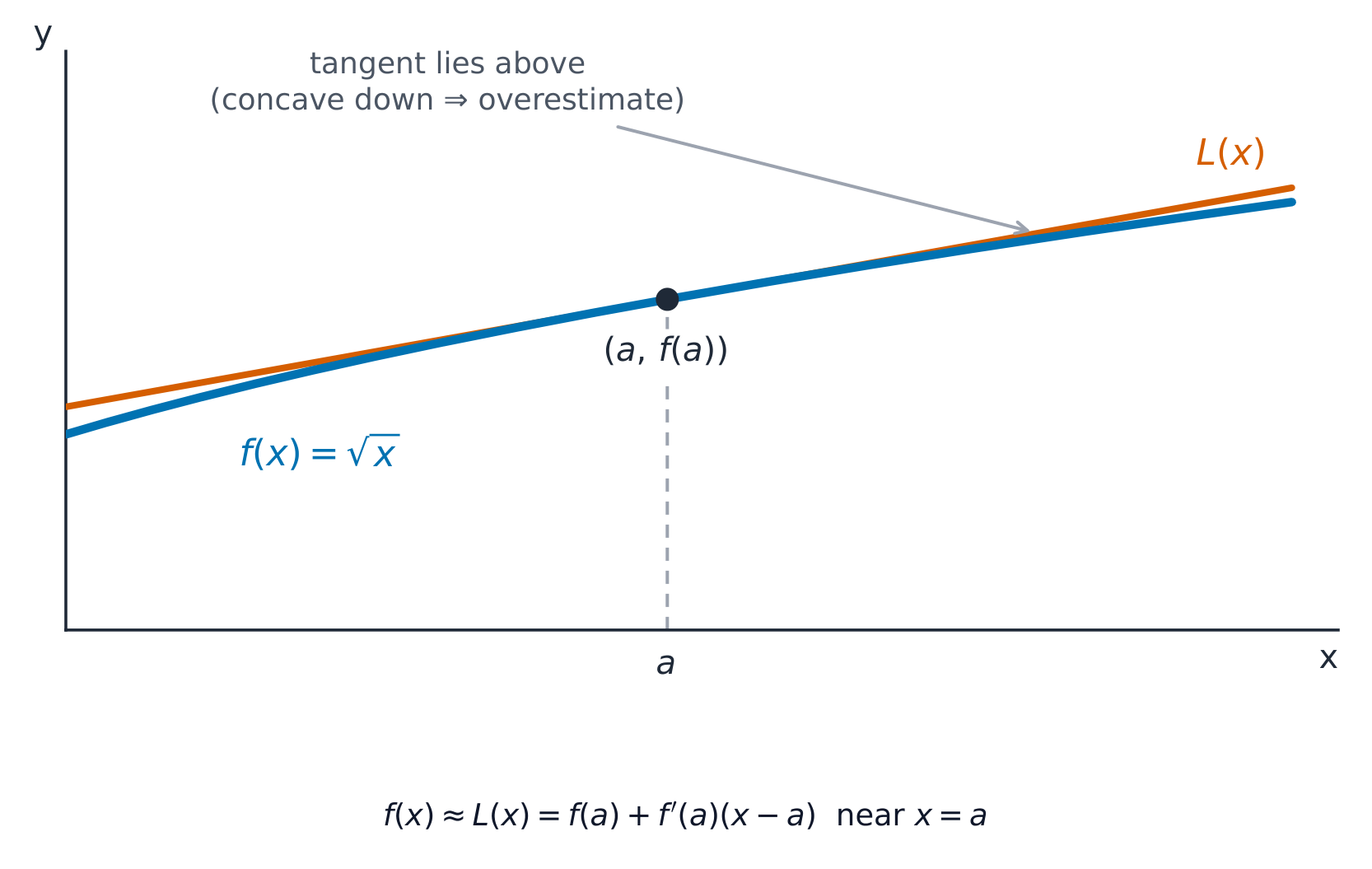
Near a point of tangency 切点, a smooth curve 光滑曲线 looks like its tangent line 切线 – this is local linearity 局部线性. So the tangent line gives a linear approximation 线性近似 (linearization 线性化) of the function near that point:
Worked example. Estimate $\sqrt{4.1}$. Take $f(x)=\sqrt{x}$ and $a=4$: $f(4)=2$ and $f'(x)=\dfrac{1}{2\sqrt{x}}$ so $f'(4)=\dfrac14$. Then $L(4.1)=2+\tfrac14(4.1-4)=2.025$ (the true value is $2.0248\ldots$). Because $\sqrt{x}$ is concave down 下凹, the tangent lies above the curve, so this is a slight overestimate 高估 – justify over/under with the sign of $f''$.
Common mistake. Using the slope at the new point, $f'(4.1)$, instead of the known point, $f'(4)$. The whole idea is that $f(a)$ and $f'(a)$ are easy to find exactly.
y = ax³ + bx² + cx + d
局部线性性:在一点附近,光滑曲线看起来像其切线,因此切线为附近的值提供了良好的线性近似。
| English | 中文 | 拼音 |
|---|---|---|
| point of tangency | 切点 | qiē diǎn |
| smooth curve | 光滑曲线 | guāng huá qū xiàn |
| tangent line/ˈtændʒənt laɪn/ | 切线 | qiè xiàn |
| local linearity/ˈləʊkl lɪˈnɪərɪti/ | 局部线性 | jú bù xiàn xìng |
| linear approximation/ˈlɪnɪə əˌprɒksɪˈmeɪʃn/ | 线性近似 | xiàn xìng jìn sì |
| linearization/ˌlɪnɪəraɪˈzeɪʃn/ | 线性化 | xiàn xìng huà |
| concave down/kɒnˈkeɪv daʊn/ | 下凹 | xià āo |
| overestimate/ˌəʊvəˈrestɪmət/ | 高估 | gāo gū |

持久理解 (LIM-4): 洛必达法则使我们能够求出某些不定式的极限。
学习目标 LIM-4.A: 求导致不定式的函数极限。
来源:College Board AP 课程与考试说明
When direct substitution 直接代入 in a quotient of limits gives the indeterminate form 未定式 $\dfrac{0}{0}$ or $\dfrac{\infty}{\infty}$, you may use L'Hospital's Rule 洛必达法则:
Worked example. Evaluate $\displaystyle\lim_{x\to 0}\frac{\sin x}{x}$. Substituting gives $\tfrac00$, so differentiate top and bottom: $\displaystyle\lim_{x\to 0}\frac{\cos x}{1}=\cos 0=1$ – confirming the famous limit from Unit 1.
Worked example. Evaluate $\displaystyle\lim_{x\to \infty}\frac{x^2}{e^{x}}$. Both top and bottom grow without bound: the form is $\tfrac{\infty}{\infty}$. Apply the rule, check the new form, and apply it again:
This proves the Unit 1 claim that an exponential 指数函数 beats any polynomial 多项式. Check the form before every use: once it stops being $\tfrac00$ or $\tfrac{\infty}{\infty}$, stop and substitute.
| English | 中文 | 拼音 |
|---|---|---|
| direct substitution/daɪˈrekt ˌsʌbstɪˈtjuːʃn/ | 直接代入 | zhí jiē dài rù |
| indeterminate form/ˌɪndɪˈtɜːmɪnət fɔːm/ | 未定式 | wèi dìng shì |
| L'Hospital's Rule/ˈelhɒspɪtlz ruːl/ | 洛必达法则 | luò bì dá fǎ zé |
| numerator/ˈnjuːməreɪtə/ | 分子 | fèn zǐ |
| denominator/dɪˈnɒmɪneɪtə/ | 分母 | fēn mǔ |
| differentiable/ˈdɪfərenʃɪəbl/ | 可导 | kě dǎo |
| one-sided | 单侧 | dān cè |
| exponential/ˌekspəˈnenʃl/ | 指数函数 | zhǐ shù hán shù |
| polynomial/ˌpɒlɪˈnəʊmɪəl/ | 多项式 | duō xiàng shì |
逐步完成,配合即时检查练习。
正在加载学科…