持久理解 (FUN-1): 存在性定理使我们能够在不精确定位的情况下,推断函数在某个区间上的行为特征。
学习目标 FUN-1.B: 通过在整个区间上应用中值定理,论证关于函数的结论。
- FUN-1.B.1 如果函数 $f$ 在闭区间 $[a, b]$ 上连续,且在开区间 $(a, b)$ 上可导,则中值定理保证在该开区间内至少存在一点,使得该点的瞬时变化率等于整个区间的平均变化率。
AP 微积分 AB · 知识点 5
 10:24
分析函数:中值定理
想象一次公路旅行。在两小时内,你行驶了一百二十公里——平均速度为六十。这里有一个惊人的保证:在某个瞬间……
英语旁白 · 英中内嵌字幕
持久理解 (FUN-1): 存在性定理使我们能够在不精确定位的情况下,推断函数在某个区间上的行为特征。
学习目标 FUN-1.B: 通过在整个区间上应用中值定理,论证关于函数的结论。
来源:College Board AP 课程与考试说明
The Mean Value Theorem 中值定理 (MVT) links the average rate of change 平均变化率 to an instantaneous one:
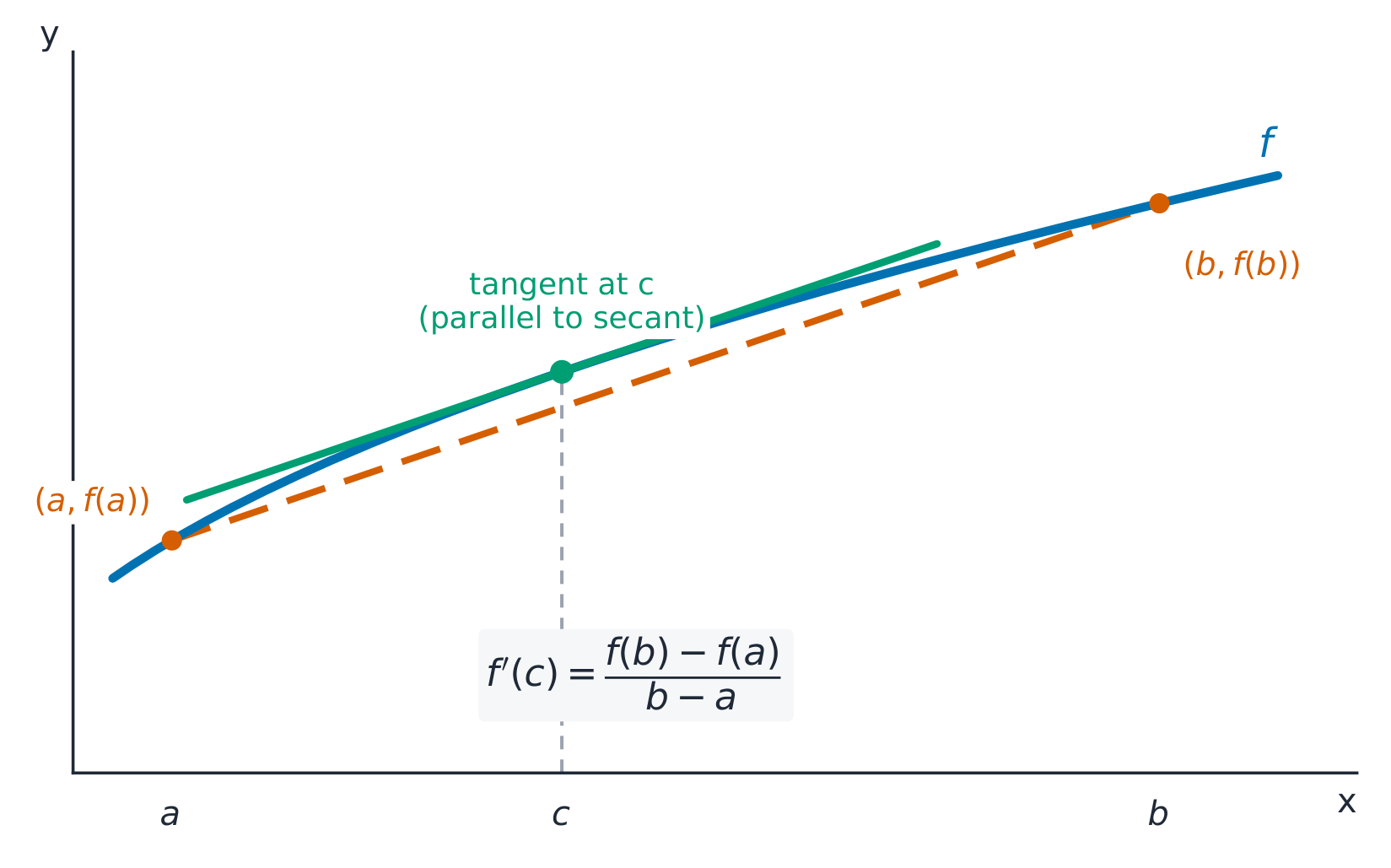
If $f$ is continuous 连续 on $[a,b]$ and differentiable 可导 on $(a,b)$, then there is at least one point $c$ in $(a,b)$ where
$$f'(c) = \frac{f(b)-f(a)}{b-a}.$$
In words: somewhere inside the interval 区间, the instantaneous rate equals the average rate. Geometrically, some tangent line 切线 is parallel 平行 to the line joining the endpoints 端点.
Exam skill. Like the IVT, the MVT is an existence theorem, and questions ask you to justify. Full credit needs: (1) state $f$ is continuous on $[a,b]$ and differentiable on $(a,b)$; (2) compute the average rate $\frac{f(b)-f(a)}{b-a}$; (3) conclude “by the MVT there is a $c$ in $(a,b)$ with $f'(c)$ equal to that value.” Both hypotheses must be named.
Worked example. Verify the MVT for $f(x)=x^2$ on $[1,3]$. It is a polynomial, so continuous and differentiable everywhere. The average rate is $\dfrac{f(3)-f(1)}{3-1}=\dfrac{9-1}{2}=4$. Setting $f'(c)=2c=4$ gives $c=2$, which does lie in $(1,3)$ – the guaranteed point.
Why both hypotheses matter. Take $f(x)=|x|$ on $[-1,1]$. It is continuous, and the average rate is $\dfrac{f(1)-f(-1)}{1-(-1)}=\dfrac{1-1}{2}=0$. But $f'(x)$ is $-1$ or $1$ everywhere it exists, never $0$. The MVT does not apply, because $f$ is not differentiable at $x=0$, which is inside $(-1,1)$.
y = ax³ + bx² + cx + d
中值定理 (MVT) 保证存在一点,使得切线平行于割线——即区间内某处的瞬时速率等于平均速率。
| English | 中文 | 拼音 |
|---|---|---|
| Mean Value Theorem/miːn ˈvæljuː ˈθɪərəm/ | 中值定理 | zhōng zhí dìng lǐ |
| average rate of change/ˈævrɪdʒ reɪt ɒv tʃeɪndʒ/ | 平均变化率 | píng jūn biàn huà lǜ |
| continuous/kənˈtɪnjuːəs/ | 连续 | lián xù |
| differentiable/ˈdɪfərenʃɪəbl/ | 可导 | kě dǎo |
| interval/ˈɪntəvl/ | 区间 | qū jiān |
| tangent line/ˈtændʒənt laɪn/ | 切线 | qiè xiàn |
| parallel/ˈpærəlel/ | 平行 | píng xíng |
| endpoints | 端点 | duān diǎn |
持久理解 (FUN-1): 存在性定理使我们能够在不精确定位函数行为的情况下,对函数在某个区间上的行为得出结论。
学习目标 FUN-1.C: 应用极值定理来论证关于函数的结论。
来源:College Board AP 课程与考试说明
The Extreme Value Theorem 极值定理 (EVT) guarantees extremes exist: a function continuous on a closed interval 闭区间 $[a,b]$ attains both an absolute maximum 最大值 and an absolute minimum 最小值 on it.
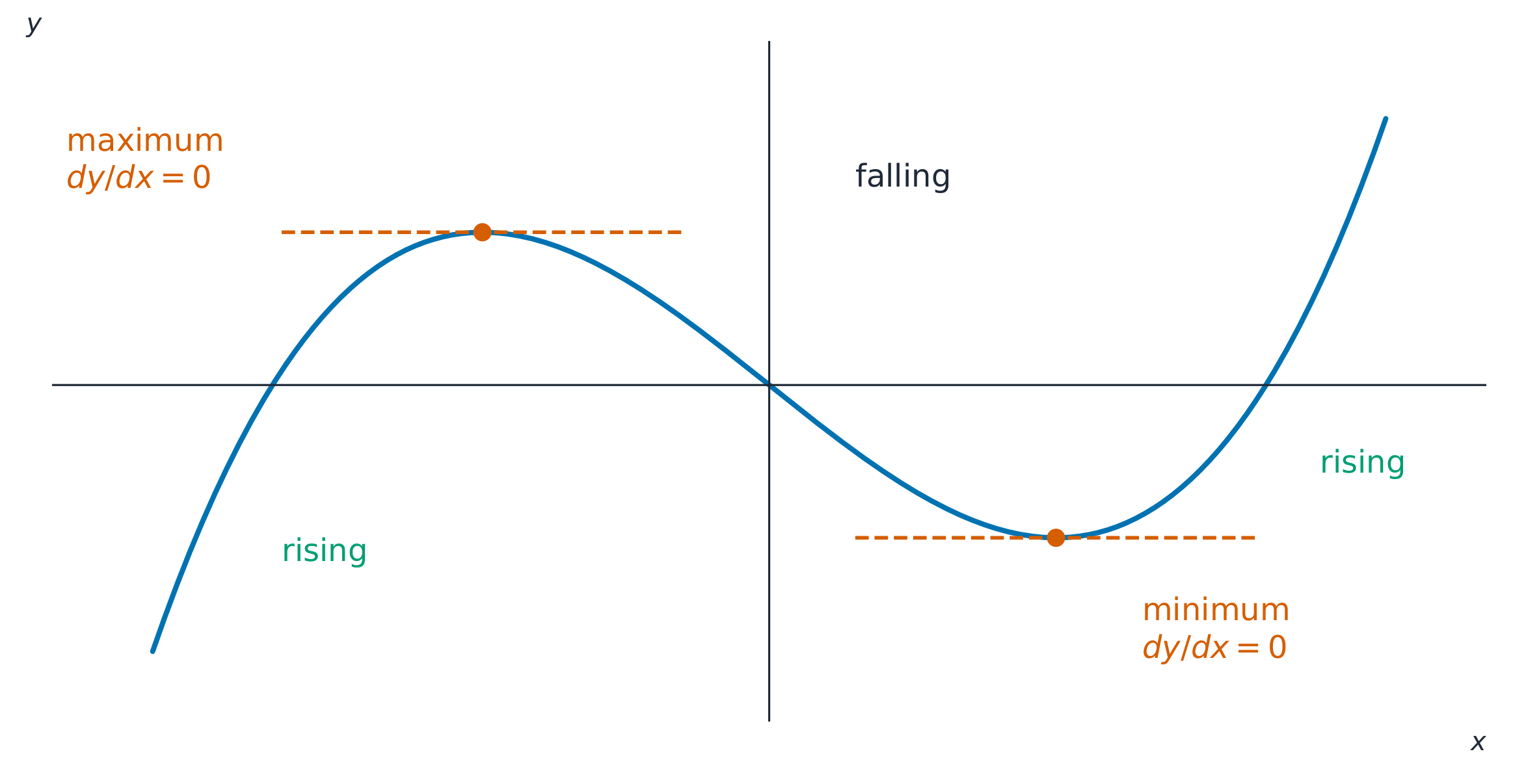
A critical point 临界点 is an interior point 内点 of the function's domain 定义域 where $f'(x)=0$ or $f'(x)$ does not exist. All local (relative) extrema 局部极值 occur at critical points – but not every critical point is an extremum 极值. So critical points are the candidates 候选点; you must test each.
| English | 中文 | 拼音 |
|---|---|---|
| Extreme Value Theorem/ekˈstriːm ˈvæljuː ˈθɪərəm/ | 极值定理 | jí zhí dìng lǐ |
| closed interval | 闭区间 | bì qū jiān |
| absolute maximum | 最大值 | zuì dà zhí |
| absolute minimum | 最小值 | zuì xiǎo zhí |
| critical point/ˈkrɪtɪkl pɔɪnt/ | 临界点 | lín jiè diǎn |
| interior point | 内点 | nèi diǎn |
| domain/dəˈmeɪn/ | 定义域 | dìng yì yù |
| local (relative) extrema/ˈləʊkl ekˈstremə/ | 局部极值 | jú bù jí zhí |
| extremum | 极值 | jí zhí |
| candidates | 候选点 | hòu xuǎn diǎn |
持久理解(FUN-4): 函数的导数可用于理解函数的某些性质。
学习目标 FUN-4.A: 根据导数的行为论证关于函数性质的结论。
来源:College Board AP 课程与考试说明
The first derivative 一阶导数 tells you where $f$ rises or falls:
On the exam, “find the intervals where $f$ is increasing” means: find the critical points, then test the sign of $f'$ between them, and justify with the sign of $f'$ (a stated reason, not just an interval).
| English | 中文 | 拼音 |
|---|---|---|
| first derivative | 一阶导数 | yī jiē dǎo shù |
| increasing/ɪnˈkriːsɪŋ/ | 递增 | dì zēng |
| decreasing/ˈdiːkriːsɪŋ/ | 递减 | dì jiǎn |
持久理解 (FUN-4): 函数的导数可用于理解函数的一些性质。
学习目标 FUN-4.A: 基于导数的行为论证关于函数行为的结论。
来源:College Board AP 课程与考试说明
To classify a critical point $x=c$ as a local max, local min, or neither, check how $f'$ changes sign there:
Always state the sign change 符号变化 as your justification 理由.
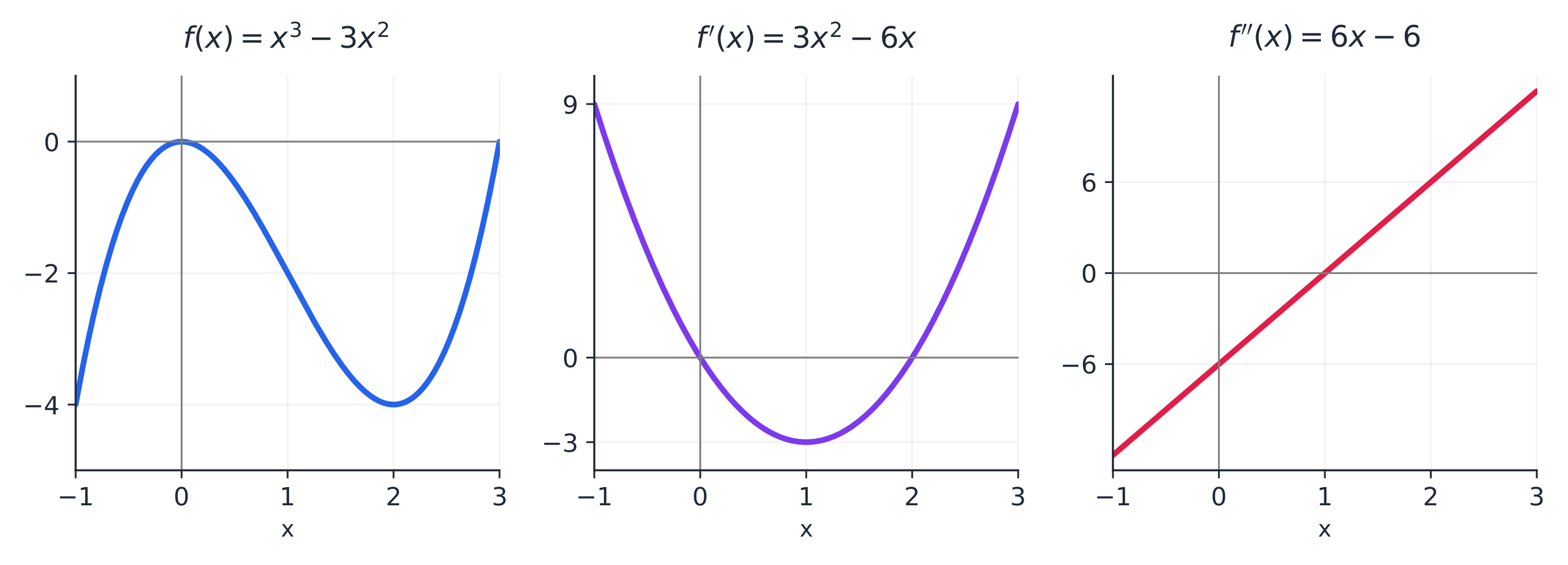
Worked example. Classify the critical points of $f(x)=x^3-3x^2$. Here $f'(x)=3x^2-6x=3x(x-2)$, zero at $x=0$ and $x=2$. Testing signs: $f'>0$ for $x<0$, $f'<0$ on $(0,2)$, and $f'>0$ for $x>2$. So $f'$ turns $+\to-$ at $x=0$ (a local maximum, $f(0)=0$) and $-\to+$ at $x=2$ (a local minimum, $f(2)=-4$).
Common mistakes. Justifying with “$f'(0)=0$” alone: a zero of $f'$ only makes $x=0$ a candidate; the reason is the sign change of $f'$. Testing the sign of $f$ instead of $f'$. Giving the $x$-value when the question asks for the maximum value ($f(0)=0$), or the reverse.
| English | 中文 | 拼音 |
|---|---|---|
| local maximum/ˈləʊkl ˈmæksɪməm/ | 极大值 | jí dà zhí |
| local minimum/ˈləʊkl ˈmɪnɪməm/ | 极小值 | jí xiǎo zhí |
| sign change/saɪn tʃeɪndʒ/ | 符号变化 | fú hào biàn huà |
| justification | 理由 | lǐ yóu |

持久理解 (FUN-4): 函数的导数可用于理解函数的某些性质。
学习目标 FUN-4.A: 根据导数的行为对函数的性质做出合理推断。
来源:College Board AP 课程与考试说明
On a closed interval, absolute (global) extrema occur only at critical points or endpoints. The candidates test 候选点判别法:
Show the table of values – the comparison is the argument.
Worked example. Find the absolute maximum and minimum of $f(x)=x^3-3x^2$ on $[1,4]$.
$f'(x)=3x(x-2)$ is zero at $x=0$ and $x=2$. Only $x=2$ lies in $[1,4]$, so the candidates are $x=1$, $x=2$ and $x=4$:
| $x$ | $1$ (endpoint) | $2$ (critical point) | $4$ (endpoint) |
|---|---|---|---|
| $f(x)$ | $1-3=-2$ | $8-12=-4$ | $64-48=16$ |
The absolute maximum is $16$, at $x=4$; the absolute minimum is $-4$, at $x=2$. The maximum is at an endpoint where $f'(4)=24\neq 0$: this is why the endpoints must be on the list.
| English | 中文 | 拼音 |
|---|---|---|
| candidates test/ˈkændɪdeɪts test/ | 候选点判别法 | hòu xuǎn diǎn pàn bié fǎ |
持久理解 (FUN-4): 函数的导数可用于理解函数的某些性质。
学习目标 FUN-4.A: 基于导数的行为论证关于函数行为的结论。
来源:College Board AP 课程与考试说明
The second derivative 二阶导数 describes bending:
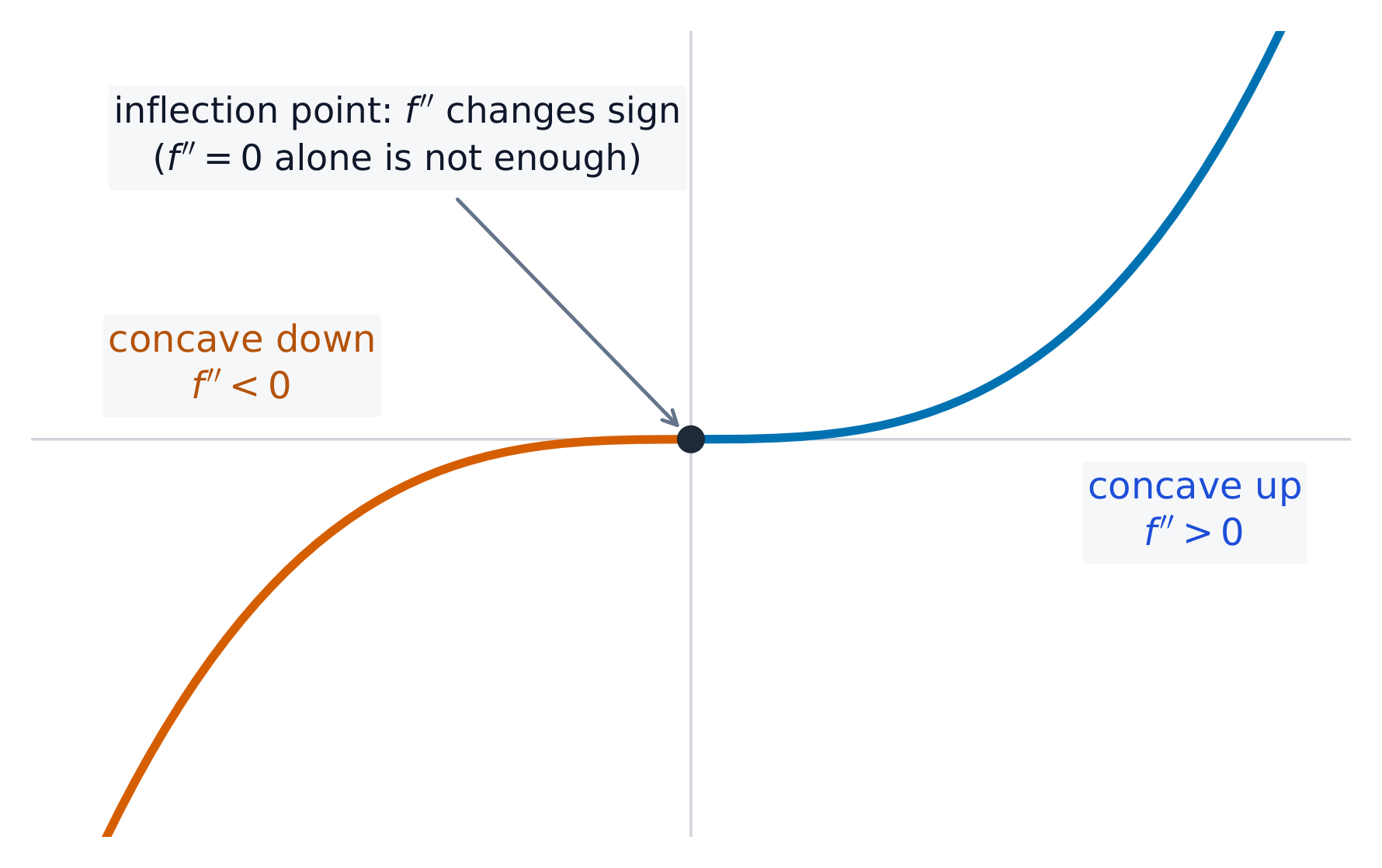
A point of inflection 拐点 is a continuous point where concavity changes. Where the second derivative exists on neighbouring intervals, use its sign change; a zero alone is insufficient. Report its $x$-coordinate and justify with the sign change of $f''$.
For $h(x)=x^4$, $h''(x)=12x^2$ is positive on both sides of 0, so there is no inflection. Yet $h(x)\ge h(0)=0$, so 0 is a minimum even though $h''(0)=0$. For $k(x)=x^3$, $k''(x)=6x$ changes from negative to positive, giving an inflection at 0. Check neighbouring concavity; the second derivative need not exist at the point itself. The function must be continuous at an inflection point.
y = ax³ + bx² + cx + d
凹凸性由 $f''$ 的符号决定:凹向上盛水,凹向下漏水。拐点是其发生切换的位置。
| English | 中文 | 拼音 |
|---|---|---|
| second derivative/ˈsekənd dɪˈrɪvətɪv/ | 二阶导数 | èr jiē dǎo shù |
| concave up/kɒnˈkeɪv ʌp/ | 上凹 | shàng āo |
| concave down/kɒnˈkeɪv daʊn/ | 下凹 | xià āo |
| point of inflection/pɔɪnt ɒv ɪnˈflekʃn/ | 拐点 | guǎi diǎn |

持久理解 (FUN-4): 函数的导数可用于理解函数的某些性质。
学习目标 FUN-4.A: 基于导数的行为论证关于函数行为的结论。
来源:College Board AP 课程与考试说明
An alternative way to classify a critical point $c$ where $f'(c)=0$:
Special case: if a continuous function has only one critical point on an interval and it is a local extremum, that point is also the absolute extremum there.
| English | 中文 | 拼音 |
|---|---|---|
| inconclusive/ɪŋkənˈkluːsɪv/ | 无法判定 | wú fǎ pàn dìng |
| first derivative test/fɜːst dɪˈrɪvətɪv test/ | 一阶导数判别法 | yī jiē dǎo shù pàn bié fǎ |
持久理解 (FUN-4): 函数的导数可用于理解函数的某些性质。
学习目标 FUN-4.A: 基于导数的性质,论证关于函数性质的结论。
来源:College Board AP 课程与考试说明
For $f(x)=x^3-3x^2$, the derivative is $f'(x)=3x(x-2)$ and the second derivative is $f''(x)=6x-6$.
On $(-1,0)$, $(0,2)$ and $(2,3)$, the signs of $f'$ are positive, negative and positive. Hence $f$ increases, decreases and increases. The sign changes give a local maximum at $(0,0)$ and minimum at $(2,-4)$. On $(-1,0)$ the function is increasing but concave down: $f'>0$ while $f'$ decreases. Concavity changes at 1 because $f''$ changes from negative to positive; the inflection is $(1,-2)$, where $f'(1)=-3$.
Adding 5 to $f$ leaves both derivatives unchanged. The shape and turning-point x coordinates stay the same; the vertical position needs a given function value.
持久理解 (FUN-4): 函数的导数可用于理解函数的某些性质。
学习目标 FUN-4.A: 根据导数的行为论证关于函数行为的结论。
来源:College Board AP 课程与考试说明
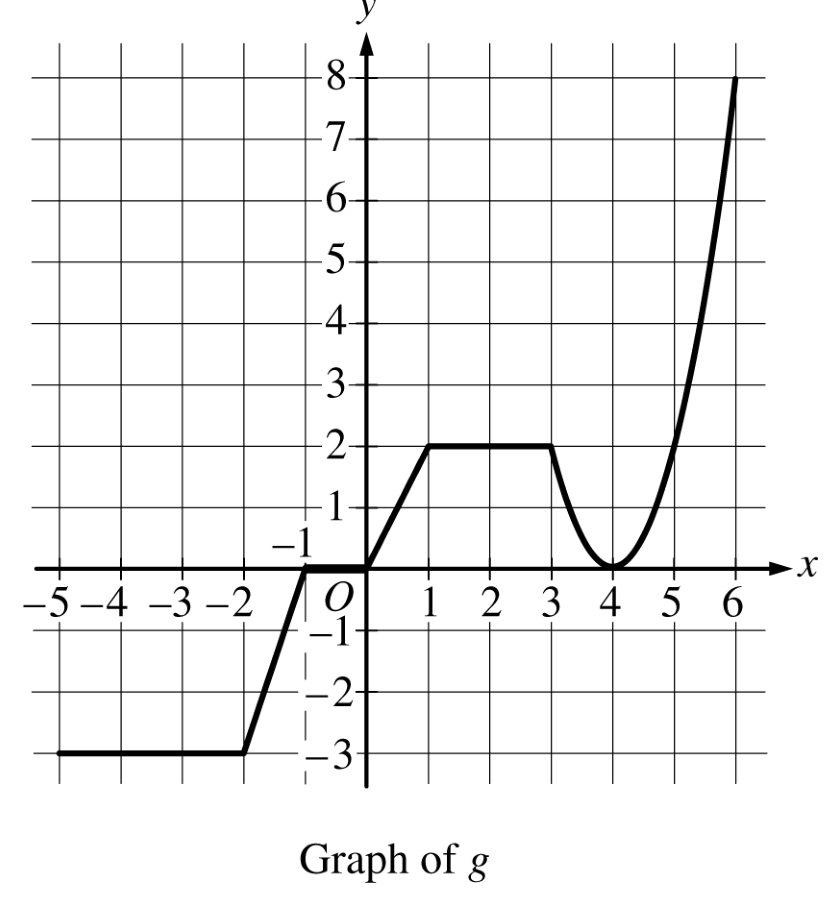
The given $g$ is $f'$. For $f$ to be increasing and concave up, $g$ must be positive and increasing: $(0,1)$ and $(4,6)$. At 4, $g$ changes from decreasing to increasing, so $f$ has an inflection. Since $g$ is positive on both sides of 4, $f$ has no extremum there. The official scheme awards both the interval answer and its reason.
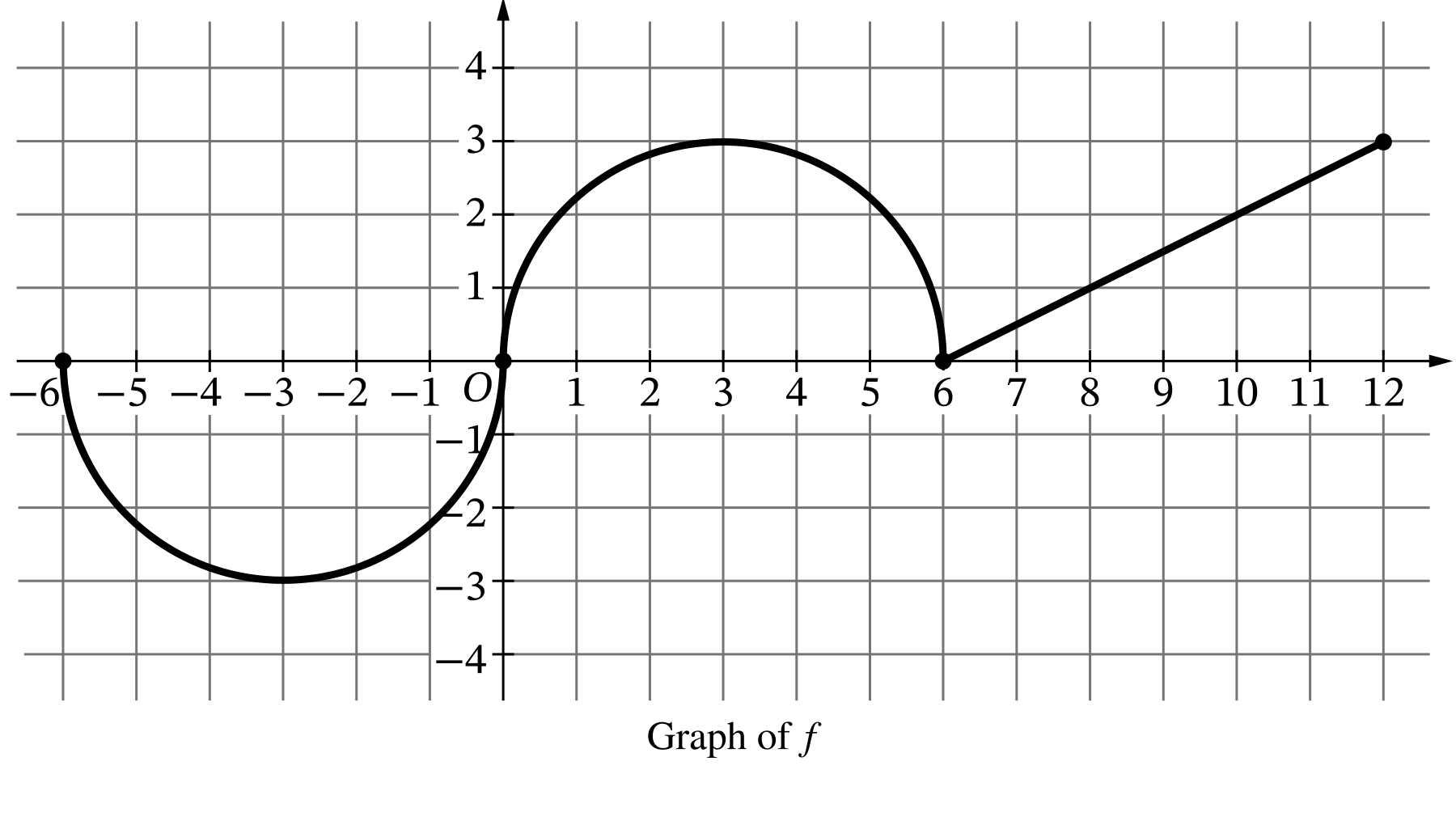
Here $g(x)=\int_6^x f(t)\,dt$, so $g'=f$. The inflections of $g$ occur at $x=-3,3,6$: the displayed $f$ changes decreasing/increasing behaviour there. At 0, $f$ increases on both sides, so $g$ remains concave up. At 6 the change of concavity is valid even though $f'$ is undefined at its corner. The official scheme requires evidence tied to the given graph, not simply naming a change in concavity.
Common mistakes when the graph shown is $f'$. Reading it as if it were $f$. On a graph of $f'$: $f$ increases where the graph lies above the axis (not where it rises); $f$ has a local extremum where the graph crosses the axis; and $f$ has an inflection point where the graph of $f'$ turns (changes from increasing to decreasing, or the reverse).
y = ax³ + bx² + cx + d
当 $f'>0$ 时函数上升;当 $f''>0$ 时它向上弯曲。滑动切线以将 $f$ 的形状与其导数的符号联系起来。
持久理解 (FUN-4): 函数的导数可用于理解函数的一些性质。
学习目标 FUN-4.B: 在实际情境或函数分析中计算最小值和最大值。
来源:College Board AP 课程与考试说明
Optimization 最优化 uses the derivative to find the largest or smallest value of a quantity on an interval. It is the candidates/derivative-test machinery applied to a real goal.
y = ax² + bx
利用约束条件后,面积变为$A=10x-x^2$——一条开口向下的抛物线,只有一个峰值需要寻找。
| English | 中文 | 拼音 |
|---|---|---|
| Optimization/ˌɒptɪmaɪˈzeɪʃn/ | 最优化 | zuì yōu huà |
持久理解 (FUN-4): 函数的导数可用于理解函数的某些性质。
学习目标 FUN-4.C: 解释在实际应用情境中计算出的最小值和最大值。
来源:College Board AP 课程与考试说明
A dependable procedure:
Worked example. A farmer has $100\ \text{m}$ of fence for a rectangular pen against a wall, so only three sides need fencing. Maximize the area. Let the two ends be $x$ and the side parallel to the wall be $y$; the constraint is $2x+y=100$, so $y=100-2x$. The area is
Common mistakes. Trying to optimize a function of two variables without using the constraint to remove one; skipping the justification that $x=25$ gives a maximum (here $A''<0$); and stopping at $x=25$ when the question asks for the largest area.
y = ax² + bx
面积抛物线开口向下,有一个单一峰值——顶点处导数为零,是最大值。
| English | 中文 | 拼音 |
|---|---|---|
| constraint/kənˈstreɪnt/ | 约束条件 | yuē shù tiáo jiàn |

持久理解(FUN-4): 函数的导数可用于理解函数的一些性质。
学习目标 FUN-4.D: 确定隐式关系的临界点。
学习目标 FUN-4.E: 基于其导数的证据,对隐式定义函数的性质进行论证。
来源:College Board AP 课程与考试说明
All of this extends to implicitly defined 隐式定义 relations. A critical point of an implicit relation is where $\dfrac{dy}{dx}=0$ (horizontal tangent 水平切线) or is undefined 无定义 (vertical tangent 竖直切线). Because $\dfrac{dy}{dx}$ is usually a relation in $x$ and $y$, and the second derivative involves $x$, $y$, and $\dfrac{dy}{dx}$, substitute your first-derivative expression back in when finding $\dfrac{d^2y}{dx^2}$, then reason about concavity from its sign.
| English | 中文 | 拼音 |
|---|---|---|
| implicitly defined/ɪmˈplɪsɪtli dɪˈfaɪnd/ | 隐式定义 | yǐn shì dìng yì |
| horizontal tangent | 水平切线 | shuǐ píng qiè xiàn |
| undefined | 无定义 | wú dìng yì |
| vertical tangent/ˈvɜːtɪkl ˈtændʒənt/ | 竖直切线 | shù zhí qiè xiàn |
| English | 中文 | 拼音 |
|---|---|---|
| second-derivative test | 二阶导数判别法 | èr jiē dǎo shù pàn bié fǎ |
逐步完成,配合即时检查练习。
正在加载学科…