持久理解 (FUN-7): 求解微分方程使我们能够确定函数并建立模型。
学习目标 FUN-7.A: 将问题的文字描述解释为包含导数表达式的微分方程。
- FUN-7.A.1 微分方程将一个自变量的函数与该函数的导数联系起来。
AP 微积分 AB · 知识点 7
 5:24
微分方程
许多现实情况不是由公式描述的,而是由速率描述的。种群越大,增长越快。热饮越热,冷却越快。一个……
英语旁白 · 英中内嵌字幕
持久理解 (FUN-7): 求解微分方程使我们能够确定函数并建立模型。
学习目标 FUN-7.A: 将问题的文字描述解释为包含导数表达式的微分方程。
来源:College Board AP 课程与考试说明
A differential equation 微分方程 is an equation that relates a function to its own derivatives 导数. It describes a situation by its rate of change 变化率. For example, "the rate of change of a quantity is proportional 成正比 to its size" becomes
方程$\tfrac{dy}{dt}=ky$表示速率与$y$成正比——其方向场展示了所建模的增长模式。
| English | 中文 | 拼音 |
|---|---|---|
| differential equation/ˌdɪfəˈrenʃl ɪˈkweɪʒn/ | 微分方程 | wēi fēn fāng chéng |
| derivative/dɪˈrɪvətɪv/ | 导数 | dǎo shù |
| rate of change/reɪt ɒv tʃeɪndʒ/ | 变化率 | biàn huà lǜ |
| proportional/prəˈpɔːʃənl/ | 成正比 | chéng zhèng bǐ |
持久理解(FUN-7): 求解微分方程使我们能够确定函数并建立模型。
学习目标 FUN-7.B: 验证微分方程的解。
来源:College Board AP 课程与考试说明
A solution 解 of a differential equation is a function that makes it true. You can verify 验证 a proposed solution by differentiating it and substituting into the equation: if both sides match, it is a solution. Note a differential equation usually has infinitely many solutions – a whole family of solutions 解族 – indexed by an arbitrary constant 任意常数, which need not be an additive constant.
每条指数曲线$y=Ce^{kx}$穿过方向场——验证其中一个即确认其导数匹配$ky$。
| English | 中文 | 拼音 |
|---|---|---|
| solution/səˈluːʃn/ | 解 | jiě |
| verify/ˈverɪfaɪ/ | 验证 | yàn zhèng |
| family of solutions | 解族 | jiě zú |
| arbitrary constant | 任意常数 | rèn yì cháng shù |

持久理解 (FUN-7): 求解微分方程使我们能够确定函数并建立模型。
学习目标 FUN-7.C: 估计微分方程的解。
来源:College Board AP 课程与考试说明
A slope field 斜率场 draws the differential equation as a grid of short segments: at each point $(x,y)$ the segment has slope $\dfrac{dy}{dx}$ evaluated there. To sketch one, plug several points into the right-hand side and draw a small segment with that slope at each. The picture shows the shape of the solution curves 解曲线 without solving.
Exam skill. A common part gives a portion of a slope field and asks you to sketch the particular solution through a given point – start at the point and follow the segments, staying tangent 相切 to them.
Worked example. Sketch the slope field of $\dfrac{dy}{dx}=x-y$ at a few points. Substitute each point into $x-y$:
| point $(x,y)$ | $(0,0)$ | $(1,0)$ | $(0,1)$ | $(1,1)$ | $(2,1)$ | $(-1,1)$ |
|---|---|---|---|---|---|---|
| slope $x-y$ | $0$ | $1$ | $-1$ | $0$ | $1$ | $-2$ |
Draw a flat segment at $(0,0)$ and $(1,1)$, a segment rising at $45^{\circ}$ at $(1,0)$ and $(2,1)$, and so on. Every point on the line $y=x$ has slope $0$, and every point on $y=x-1$ has slope $1$.
斜率场在每个点绘制斜率 $dy/dx$。解曲线穿过其中,始终与这些小线段相切——你可以通过跟随流向来绘制它。
| English | 中文 | 拼音 |
|---|---|---|
| slope field/sləʊp fiːld/ | 斜率场 | xié lǜ chǎng |
| solution curve/səˈluːʃn kɜːv/ | 解曲线 | jiě qū xiàn |
| tangent/ˈtændʒənt/ | 相切 | xiāng qiè |
持久理解 (FUN-7): 求解微分方程使我们能够确定函数并建立模型。
学习目标 FUN-7.C: 估算微分方程的解。
来源:College Board AP 课程与考试说明
Solutions to a differential equation are functions or families of functions. Read a slope field to reason about behavior: where the segments are flat ($\tfrac{dy}{dx}=0$) the solution is momentarily level; where they steepen the solution rises or falls faster; equal slopes across every horizontal row suggest dependence only on $y$; equal slopes down every vertical column suggest dependence only on $x$.
解曲线经过的每一段短线都与其相切——拖动起点观察其如何跟随场。
持久理解 (FUN-7): 求解微分方程使我们能够确定函数并建立模型。
学习目标 FUN-7.D: 确定微分方程的通解。
来源:College Board AP 课程与考试说明
Many exam differential equations are solved by separation of variables 分离变量法. If $\dfrac{dy}{dx}$ factors into a function of $x$ times a function of $y$, move all $y$'s to one side and all $x$'s to the other, then integrate both sides where the divided factor is nonzero:
Worked example. Solve $\dfrac{dy}{dx}=xy$ with the initial condition $y(0)=2$. Separate and integrate:
Common mistakes. Adding the constant at the end: $y=e^{x^2/2}+C$ is wrong, because the constant enters when you integrate and becomes the multiplier $A=e^{C}$. Trying to separate an equation such as $\dfrac{dy}{dx}=x+y$: a sum cannot be written as $g(x)\,h(y)$.
求解$\tfrac{dy}{dx}=ay$得到$y=Ce^{ax}$——每个常数对应一条曲线,均符合同一方向场。
| English | 中文 | 拼音 |
|---|---|---|
| separation of variables/ˌsepəˈreɪʃn ɒv ˈveərɪəblz/ | 分离变量法 | fēn lí biàn liàng fǎ |
| constant of integration/ˈkɒnstənt ɒv ˌɪntɪˈɡreɪʃn/ | 积分常数 | jī fēn cháng shù |
| general solution/ˈdʒenərəl səˈluːʃn/ | 通解 | tōng jiě |
| constant solution | 常数解 | cháng shù jiě |
持久理解 (FUN-7): 求解微分方程使我们能够确定函数并建立模型。
学习目标 FUN-7.E: 确定微分方程的特解。
来源:College Board AP 课程与考试说明
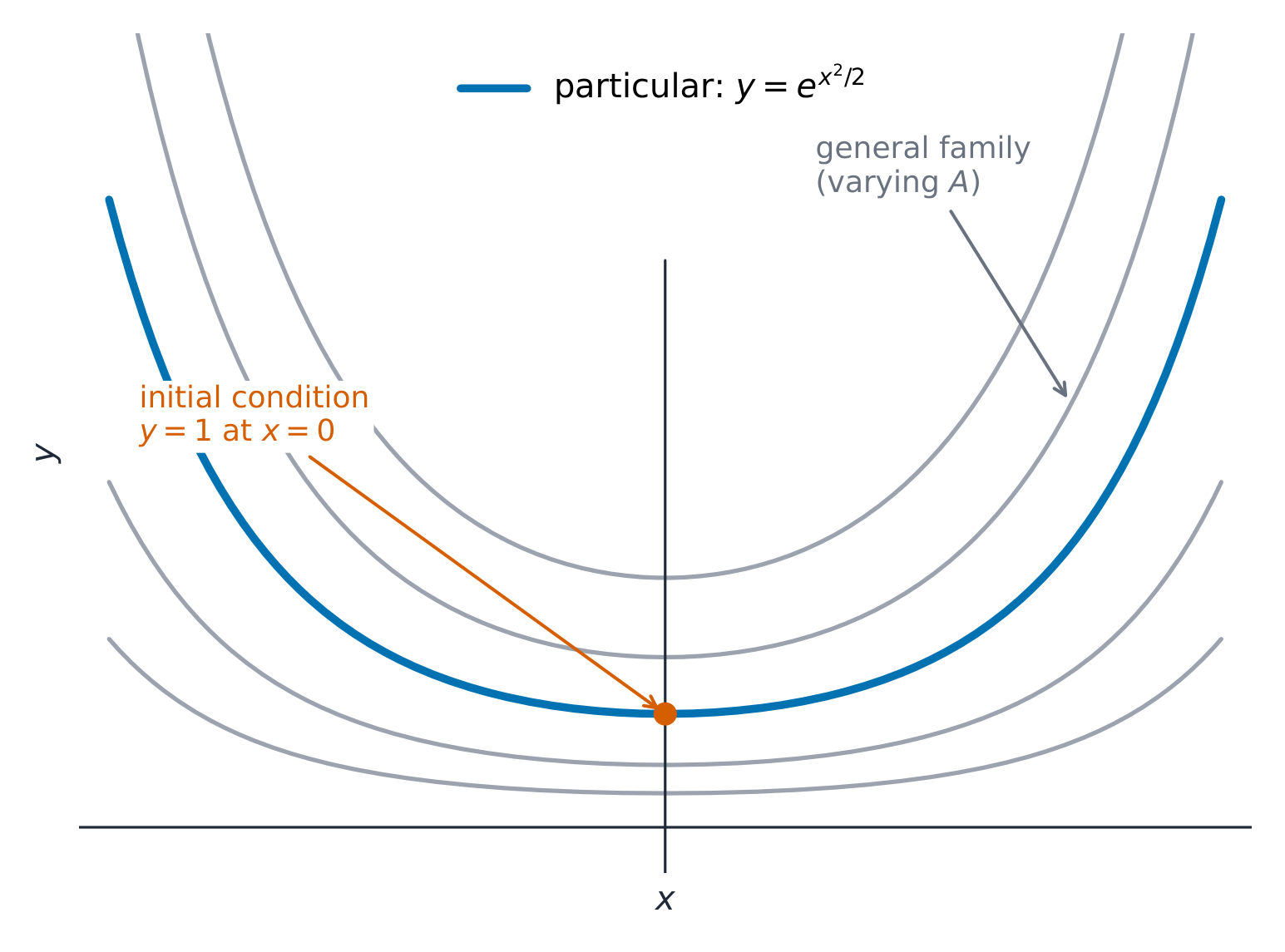
An initial condition 初始条件 – a known point $(x_0,y_0)$ – pins down one curve from the family. Substitute it to solve for the constant $C$; the result is the particular solution 特解. Uniqueness 唯一性 requires conditions: for $y'=F(x,y)$, continuity 连续性 of $F$ and its partial derivative 偏导数 with respect to $y$ near the initial point is a sufficient local condition. Watch for domain restrictions 定义域限制: keep the branch that contains the initial point (for example, the correct sign of a square root).
Worked example. Solve $\dfrac{dy}{dx}=\dfrac{x}{y}$ with $y(0)=-3$.
Substitute $x=0$, $y=-3$ now, before solving for $y$: $\tfrac92=0+C$, so $C=\tfrac92$ and $y^2=x^2+9$. Taking the square root gives $y=\pm\sqrt{x^2+9}$; the initial value $y(0)=-3$ is negative, so the particular solution is
Writing $y=+\sqrt{x^2+9}$ is the classic error: it fails the initial condition.
通解是一个完整的解族;初始条件 $y(x_0)=y_0$ 从中选出经过该点的唯一一条曲线。
| English | 中文 | 拼音 |
|---|---|---|
| initial condition/ɪˈnɪʃl kənˈdɪʃn/ | 初始条件 | chū shǐ tiáo jiàn |
| particular solution/pəˈtɪkjʊlə səˈluːʃn/ | 特解 | tè jiě |
| uniqueness | 唯一性 | wéi yī xìng |
| continuity/kɒntɪˈnjuːɪti/ | 连续性 | lián xù xìng |
| partial derivative | 偏导数 | piān dǎo shù |
| domain restriction/dəˈmeɪn rɪˈstrɪkʃn/ | 定义域限制 | dìng yì yù xiàn zhì |
持久理解(FUN-7): 求解微分方程有助于我们确定函数并建立数学模型。
学习目标 FUN-7.F: 在特定情境下解释微分方程及其变量的含义。
学习目标 FUN-7.G: 在特定情境下确定涉及微分方程问题的通解和特解。
来源:College Board AP 课程与考试说明
The most important model is exponential growth and decay 指数增长与衰减. The equation $\dfrac{dy}{dt}=ky$ (rate proportional to size) has the solution:
Worked example. A sample decays by $\dfrac{dy}{dt}=-0.10\,y$ (in years) from $y_0=50\ \text{g}$. The solution is $y=50e^{-0.10t}$, so after $10$ years $y=50e^{-1}=18.4\ \text{g}$. Its half-life 半衰期 solves $25=50e^{-0.10t}$, i.e. $e^{-0.10t}=\tfrac12$, giving $t=\dfrac{\ln 2}{0.10}=6.9\ \text{years}$ – independent of the starting amount.
Worked example: Newton's law of cooling. Coffee at $90^{\circ}$C is left in a room at $20^{\circ}$C. Its temperature $T$ obeys $\dfrac{dT}{dt}=-k\,(T-20)$, with $t$ in minutes. After $5$ minutes it is $70^{\circ}$C. When does it reach $40^{\circ}$C?
The temperature difference $D=T-20$ decays exponentially: $D=70e^{-kt}$ (the start value is $90-20=70$), so
Use $T(5)=70$: $50=70e^{-5k}$, so $k=\dfrac{\ln(7/5)}{5}\approx 0.0673$ per minute. For $T=40$:
Common error: writing $T=90e^{-kt}$, which would cool the coffee towards $0^{\circ}$C instead of towards room temperature.

y = a·e^(bx) + c
方程 $dy/dt=ky$ 具有指数解:数量以与其自身成比例的速率变化,导致无界增长($k>0$)或衰减至零($k<0$)。
| English | 中文 | 拼音 |
|---|---|---|
| exponential growth and decay/ˌekspəˈnenʃl ɡrəʊθ ænd dɪˈkeɪ/ | 指数增长与衰减 | zhǐ shù zēng zhǎng yǔ shuāi jiǎn |
| radioactive decay/ˌreɪdɪəʊˈæktɪv dɪˈkeɪ/ | 放射性衰变 | fàng shè xìng shuāi biàn |
| Newton's law of cooling | 牛顿冷却定律 | niú dùn lěng què dìng lǜ |
| half-life/hɑːf laɪf/ | 半衰期 | bàn shuāi qī |
逐步完成,配合即时检查练习。
正在加载学科…