| English | 释义 | 拼音 |
|---|---|---|
| related rates/rɪˈleɪtɪd reɪts/ | 相关变化率 | xiāng guān biàn huà lǜ |
| time/taɪm/ | 时间 | shí jiān |
When one rate drives another
- Blow up a balloon: the radius grows, and because of that the volume grows. Quantities that change together in time 时间 are related rates 相关变化率.
- The chain rule links their rates.
A related-rates problem links the rates of quantities that change with respect to...
难度 1/5 · 今日首次完成可获 100 金币及少量额外奖励
The variables are functions of time, linked via the chain rule.
Step 1: an equation that relates the variables
- Use geometry or a formula that is true at every instant: a balloon $V=\tfrac43\pi r^3$, a ladder $x^2+y^2=L^2$, a circle $A=\pi r^2$.
- Use letters for anything that changes. Put in numbers only after differentiating.
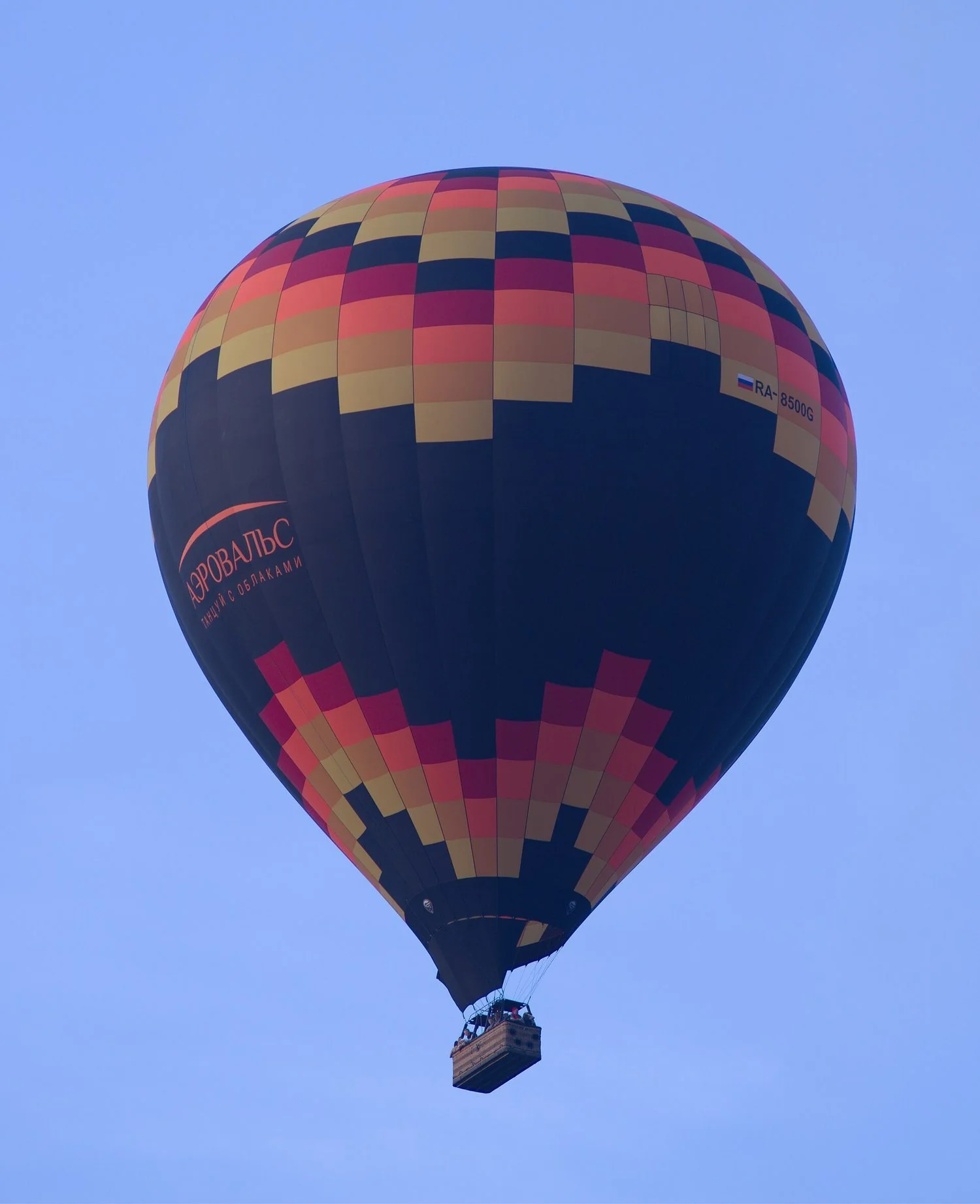
A rising balloon: related rates link how fast radius, volume and height change together
体积随半径增大
y = a·x³ (V vs r)
$V=\tfrac43\pi r^3$ climbs steeply — a small radius rate makes a large volume rate when $r$ is big.
The first step is to write an ____ that relates the changing variables.
难度 1/5 · 今日首次完成可获 100 金币及少量额外奖励
Usually a geometric or physical relationship.
A ladder of length $L$ leans on a wall. Which equation relates the base distance $x$ and height $y$?
难度 1/5 · 今日首次完成可获 100 金币及少量额外奖励
Pythagoras: the wall and floor form a right angle, so $x^2+y^2=L^2$.
Step 2: differentiate with respect to time
- Every changing variable depends on $t$, so each one brings its own rate: $\dfrac{d}{dt}\big[r^3\big]=3r^2\dfrac{dr}{dt}$.
- $V=\tfrac43\pi r^3$ gives $\dfrac{dV}{dt}=4\pi r^2\dfrac{dr}{dt}$: an equation linking the two rates.
Differentiating $V=\tfrac43\pi r^3$ with respect to $t$ gives $\dfrac{dV}{dt}=$
难度 1/5 · 今日首次完成可获 100 金币及少量额外奖励
Chain rule in time: $4\pi r^2$ times $\tfrac{dr}{dt}$.
A full solve. Oil spreads in a circle. The radius grows at 3 cm/s. How fast is the area growing when $r=10$ cm?
- Relate: $A=\pi r^2$. Differentiate in $t$: $\dfrac{dA}{dt}=2\pi r\dfrac{dr}{dt}$.
- Substitute now: $\dfrac{dA}{dt}=2\pi(10)(3)=60\pi\approx188.5$ cm²/s.
A spherical balloon's radius grows at 0.5 cm/s. How fast is its volume growing when $r=5$ cm? Give cm³/s to 1 decimal place.
难度 2/5 · 今日首次完成可获 140 金币及少量额外奖励
$\dfrac{dV}{dt}=4\pi r^2\dfrac{dr}{dt}=4\pi(25)(0.5)=50\pi\approx157.1$ cm³/s.
Step 3: sort the givens from the unknown
- Label each rate: "the radius grows at 2 cm/s" gives $\tfrac{dr}{dt}=2$ (given). "How fast is the volume growing?" asks for $\tfrac{dV}{dt}$ (wanted).
- Note the values at the instant asked about, like "when $r=5$". Shrinking quantities have negative rates.
"The radius grows at $2$ cm/s; how fast is the volume growing?" Select 所有 correct labels.
难度 2/5 · 今日首次完成可获 140 金币及少量额外奖励
The radius rate is given, the volume rate is wanted, and $V=\tfrac43\pi r^3$ relates them.
Two changing sides. A rectangle's length grows at 2 cm/s while its width shrinks at 1 cm/s. How fast is the area changing when $l=8$, $w=5$?
- $A=lw$. Both change, so use the product rule: $\dfrac{dA}{dt}=\dfrac{dl}{dt}w+l\dfrac{dw}{dt}$.
- $=(2)(5)+(8)(-1)=2$ cm²/s: the area is increasing.
A rectangle's length grows at 3 cm/s and its width shrinks at 2 cm/s. Find $\dfrac{dA}{dt}$ (cm²/s) when $l=6$ and $w=4$.
难度 2/5 · 今日首次完成可获 140 金币及少量额外奖励
Product rule: $\dfrac{dA}{dt}=\dfrac{dl}{dt}w+l\dfrac{dw}{dt}=(3)(4)+(6)(-2)=0$. At that instant the area is not changing.
A circle's radius is 3 units and is growing at 2 units per second. How fast is its area changing?
Substitute the radius and its rate after differentiating.
A circle has radius 3 units, growing at 2 units per second. How fast is its area growing (square units per second)?
难度 1/5 · 今日首次完成可获 100 金币及少量额外奖励
2 pi times 3 times 2 = 12 pi.
- $\dfrac{d}{dt}\big[r^3\big]$ is $3r^2\dfrac{dr}{dt}$, never just $3r^2$.
- Don't substitute $r=10$ before differentiating: $r$ is changing, so it would become a constant with derivative 0.
- A shrinking quantity has a negative rate.
Differentiating $r^3$ with respect to time gives just $3r^2$.
难度 1/5 · 今日首次完成可获 100 金币及少量额外奖励
It gives $3r^2\tfrac{dr}{dt}$ — the rate factor is required.
Related rates: (1) write an equation linking the variables; (2) differentiate with respect to time, giving every changing variable its $\tfrac{d(\ )}{dt}$; (3) then substitute the values at the instant and solve for the wanted rate, with units.