| English | 释义 | 拼音 |
|---|---|---|
| economics/ˌiːkəˈnɒmɪks/ | 经济学 | jīng jì xué |
Rates are everywhere, not just motion
- A derivative measures how fast anything changes: money, populations, temperature, water in a tank. Only the units and the story change.
- The units are always output per input.
Economics, biology, physics: same tool
- Economics 经济学: $C'(x)$ is the marginal cost, about the extra cost of one more item (dollars per item). Biology: $P'(t)$ is a growth rate (organisms per year).
- Physics: if $Q(t)$ is electric charge, $Q'(t)$ is the current (coulombs per second = amperes).
$C(x)$ is cost in dollars for $x$ items. The units of the marginal cost $C'(x)$ are...
难度 1/5 · 今日首次完成可获 100 金币及少量额外奖励
Output per input: dollars per item.
In economics, the derivative of a cost function is called the ____ cost.
难度 1/5 · 今日首次完成可获 100 金币及少量额外奖励
Marginal cost = cost of one more unit.
Match each quantity to the meaning of its derivative.
难度 2/5 · 今日首次完成可获 140 金币及少量额外奖励
The derivative's units are always output-per-input for the field.
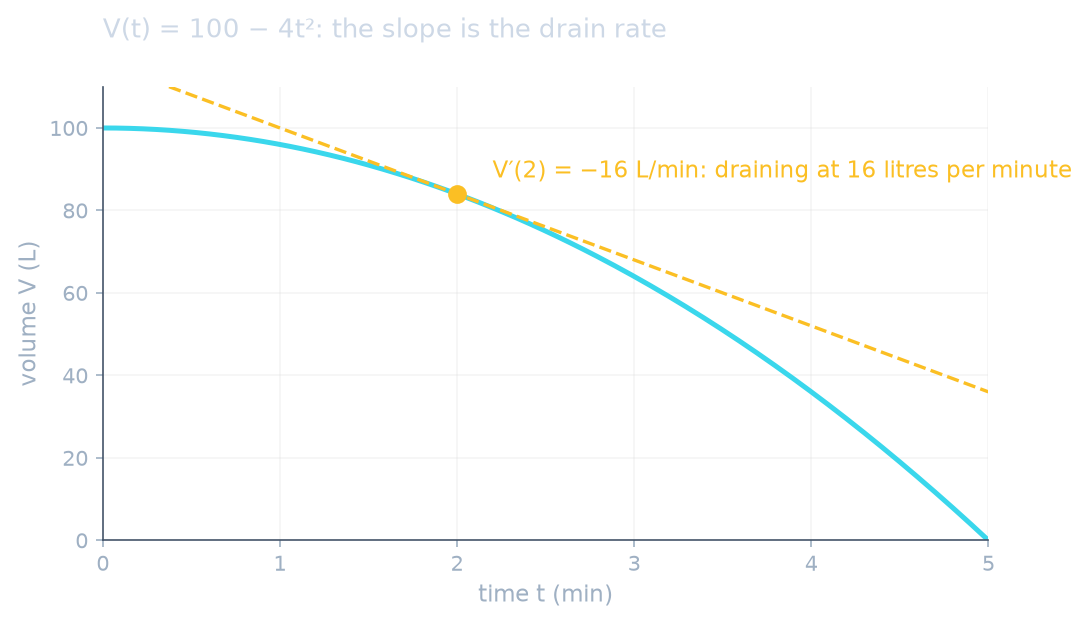
A tank drains so that $V(t)=100-4t^2$ litres ($t$ in minutes).
- $V'(t)=-8t$, so $V'(3)=-24$ L/min.
- "At 3 minutes, the volume of water is decreasing at 24 litres per minute."
排水罐的体积
y = ax² + c
This falling curve is volume $V(t)$; its (negative) slope is the drain rate $V'(t)$ — steeper means draining faster.
支持 $V(t)=100-4t^2$, the rate is $V'(t)=-8t$. Find $V'(3)$ (litres per minute).
难度 2/5 · 今日首次完成可获 140 金币及少量额外奖励
$V'(3)=-8(3)=-24$; draining at $24$ L/min.
Two balances change at rates $-5$ and $-50$ dollars/day. Which is changing faster?
难度 1/5 · 今日首次完成可获 100 金币及少量额外奖励
Magnitude sets speed: $|-50|>|-5|$, so $-50$ changes faster.
When the rate function is given
- AP questions often give the rate itself, like $R(t)$ litres per hour flowing in. Then $R(t)$ is already a rate, and $R'(t)$ is the rate of the rate.
- $R'(t)$ has units L/h per hour. It says whether the flow is speeding up or slowing down.
AP style. Water flows into a pond at $R(t)=20+6t-t^2$ litres per hour, $0\le t\le8$. Find $R'(5)$ and explain its meaning.
- $R'(t)=6-2t$, so $R'(5)=-4$ L/h per hour.
- "At $t=5$ hours, the rate at which water flows into the pond is decreasing at 4 litres per hour per hour." Water is still flowing in ($R(5)=25>0$), just more slowly.
Cars enter a car park at $R(t)=30+4t-t^2$ cars per hour, $t$ in hours. Find $R'(1)$.
难度 2/5 · 今日首次完成可获 140 金币及少量额外奖励
$R'(t)=4-2t$, so $R'(1)=2$ cars per hour per hour: the rate at which cars arrive is increasing.
$C(q)$ is the cost in dollars of making $q$ items, and $C'(10)=2.5$. What does $C'(10)$ mean?
Marginal cost is the derivative of cost.
$C(q)$ is the cost in dollars for $q$ items, and $C'(10)=2.5$. What does this mean near $q=10$?
难度 1/5 · 今日首次完成可获 100 金币及少量额外奖励
The derivative is a rate, not the total.
- Marginal cost $C'(x)$ is in dollars per item, not dollars: it is not a total cost.
- If $R(t)$ is a rate, $R'(t)<0$ means the flow slows down, not that the amount goes down. Check the sign of $R$ itself for that.
A negative rate of change means the modeled quantity is decreasing.
难度 1/5 · 今日首次完成可获 100 金币及少量额外奖励
Negative derivative → the quantity falls.
Water flows into a tank at $R(t)$ L/min. At $t=6$, $R(6)=10$ and $R'(6)=-2$. What is happening at $t=6$?
难度 1/5 · 今日首次完成可获 100 金币及少量额外奖励
$R(6)=10>0$, so water is still coming in. $R'(6)<0$ means the flow is slowing down by 2 L/min each minute.
A derivative is a rate of change in any field (marginal cost, growth rate, current), with units output per input. When the given function is already a rate, its derivative tells whether that rate is speeding up or slowing down.