- understand and use the terms displacement, amplitude, period, frequency, angular frequency and phase difference in the context of oscillations, and express the period in terms of both frequency and angular frequency
- understand that simple harmonic motion occurs when acceleration is proportional to displacement from a fixed point and in the opposite direction
- use $a = -\omega^2 x$ and recall and use, as a solution to this equation, $x = x_0 \sin \omega t$
- use the equations $v = v_0 \cos \omega t$ and $v = \pm \omega \sqrt{x_0^2 - x^2}$
- analyse and interpret graphical representations of the variations of displacement, velocity and acceleration for simple harmonic motion
振动
A-Level 物理 · 第 17 主题
 15:13
15:13
Oscillations & Simple Harmonic Motion
In 1940, a brand-new bridge opened across the Tacoma Narrows — long, elegant, and, as it turned out, dangerous. Within months, an ordinary wind set it heaving…
英文讲解 · 内嵌中英文字幕
17.1
简谐振动

大纲
来源:剑桥国际大纲
当一个粒子的加速度(acceleration)满足下列条件时,它做简谐运动(simple harmonic motion,SHM):
- 与它离一个固定平衡点的位移成正比,并且
- 方向指回那个点——与位移符号相反。
定义方程是
$$a = -\omega^{2} x,$$
其中 $x$ 是离平衡(equilibrium)点的位移(displacement),$\omega$ 是一个正的常数,即角频率(angular frequency)。负号意味着"方向指回平衡点"。
两分的定义。 简谐运动是加速度与离某固定点的位移成正比、并始终指向该点(与位移方向相反)的运动。 两半都要有。"负号的意义":加速度与位移方向相反——始终指向平衡位置。"说明振动频率的含义":单位时间内完整振动的次数。
许多系统在一个稳定平衡点附近这样运动:弹簧(spring)上的质量、单摆(pendulum,小摆幅)、被压下的漂浮物块、LC 电路中电容器(capacitor)上的电荷、固体中的原子。

关键术语
- 位移 $x$——某一时刻离平衡点的距离(沿运动线的矢量)。
- 振幅(amplitude)$x_{0}$——离平衡点的最大位移。总为正。
- 周期(period)$T$——一次完整振动的时间。
- 频率(frequency)$f$——每秒振动的次数;$f = 1/T$。单位:Hz。
- 角频率 $\omega$——$\omega = 2\pi/T = 2\pi f$。单位:$\text{rad s}^{-1}$。
- 相位差(phase difference)——一个振动比另一个超前或滞后的那一部分周期(以弧度计)。相隔四分之一周期是 $\pi/2$ 的相位差。
所以 $T = 2\pi/\omega$,$f = \omega/(2\pi)$——给定 $\omega$、$f$、$T$ 中任何一个,你就能求出其他的。
例题。 弹簧上的一个质量以振幅 $0.050\ \text{m}$、频率 $2.5\ \text{Hz}$ 做简谐运动。求它的最大加速度。
角频率是 $\omega = 2\pi f = 2\pi \times 2.5 = 15.7\ \text{rad s}^{-1}$。加速度在两端最大,那里 $|a| = \omega^{2}x_{0}$:
$$a_{\text{max}} = \omega^{2}x_{0} = 15.7^{2} \times 0.050 \approx 12\ \text{m s}^{-2}.$$
证明一个运动是简谐运动
考试最爱的四分推导,套路总是一样:(1)把物体从平衡位置移开 $x$;(2)求出合回复力,它的形式是 $F = -(\text{常数}) \times x$;(3)用牛顿第二定律,$a = F/m = -(\text{常数}/m)\,x$;(4)这具有 $a = -\omega^{2}x$ 的形式,所以运动是简谐的,$\omega^{2} = \text{常数}/m$,而 $T = 2\pi/\omega$。要用文字说出为什么力指回平衡位置、为什么它与 $x$ 成正比——分数在这里,不在代数上。
例题。 质量 $m$ 挂在劲度系数 $k$ 的弹簧上。证明它被拉开释放后做简谐运动,并求周期。
平衡时弹簧张力与重力平衡。把质量向下移开距离 $x$:张力增加 $kx$(胡克定律),所以有一个向上、指向平衡位置的合力 $kx$。牛顿第二定律:$a = -\dfrac{k}{m}x$。这就是 $a = -\omega^{2}x$,$\omega^{2} = k/m$,所以运动是简谐的,$T = 2\pi/\omega = 2\pi\sqrt{m/k}$。(夹在两个相同弹簧之间的小车受到两个弹簧的回拉,$F = -2kx$,所以 $\omega^{2} = 2k/m$。)
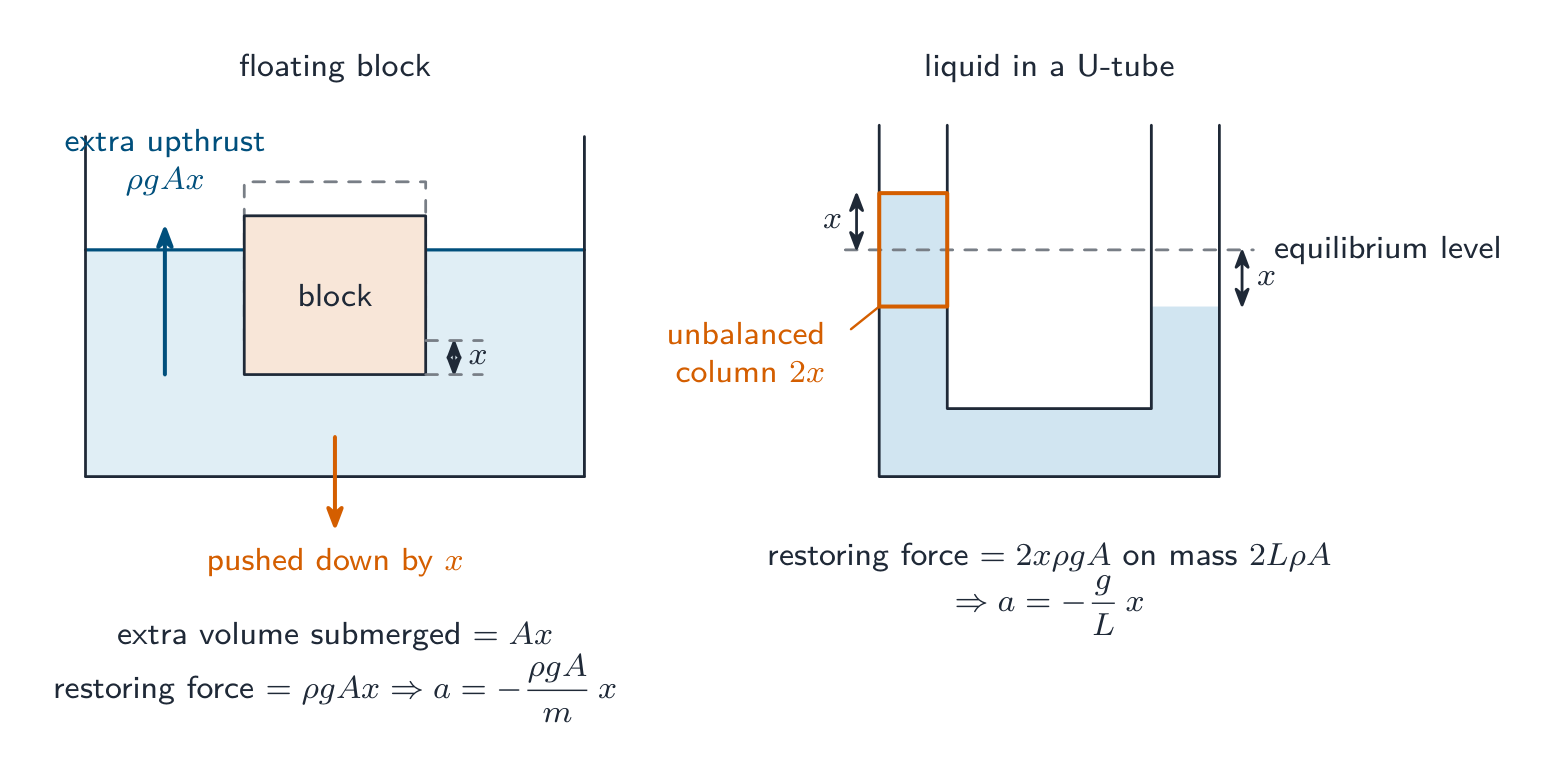
例题。 横截面积 $A$、质量 $m$ 的长方体木块浮在密度 $\rho$ 的液体中,底面在液面下深度 $h$ 处。把它压下一小段距离 $x$ 后释放。证明它做简谐运动,并用 $h$ 和 $g$ 表示周期。
木块被压下 $x$ 时多浸没体积 $Ax$,所以浮力(upthrust)增加了这部分液体的重量 $\rho g A x$;这个附加力向上,指向平衡位置。因此 $a = -\dfrac{\rho g A}{m}x$:与 $x$ 成正比且方向相反,所以运动是简谐的,$\omega^{2} = \rho g A/m$。平衡时浸没体积 $Ah$ 所受浮力等于重力,$\rho g A h = mg$,所以 $m = \rho A h$,$\omega^{2} = g/h$:$T = 2\pi\sqrt{h/g}$——与长度为 $h$ 的单摆同形。
例题。 横截面积 $A$ 的 U 形管装有密度 $\rho$ 的液体;每一臂中的液柱长 $L$。液体被移动,使一侧液面高出平衡液面 $x$,另一侧低 $x$。证明液体做简谐运动。
两液面现在相差 $2x$,所以高 $2x$ 的一段液柱失去平衡:液体受到的回复力是这段液柱的重量 $2x\rho g A$,方向使液面趋于齐平。被推动的质量是全部液体 $2L\rho A$。所以 $a = -\dfrac{2x\rho g A}{2L\rho A} = -\dfrac{g}{L}x$:简谐运动,$\omega^{2} = g/L$,$T = 2\pi\sqrt{L/g}$。注意 $\rho$ 和 $A$ 约掉了——周期既不取决于液体也不取决于管子。
探索
Swing a pendulum
Set it swinging, then change the start angle — the time for one swing stays the same (that is what makes it a good clock). Now make the string longer, or move to the Moon, and watch the period change.
词汇表
训练
| 英文 | 中文 | 拼音 |
|---|---|---|
| simple harmonic motion/ˈsɪmpl hɑːˈmɒnɪk ˈməʊʃn/ | 简谐运动 | jiǎn xié yùn dòng |
| spring/sprɪŋ/ | 弹簧 | tán huáng |
| pendulum/ˈpendjʊləm/ | 单摆 | dān bǎi |
| acceleration/əkˌseləˈreɪʃn/ | 加速度 | jiā sù dù |
| displacement/dɪˈspleɪsmənt/ | 位移 | wèi yí |
| equilibrium/ˌiːkwɪˈlɪbrɪəm/ | 平衡 | píng héng |
| angular frequency/ˈæŋɡjʊlə ˈfriːkwənsi/ | 角频率 | jiǎo pín lǜ |
| frequency/ˈfriːkwənsi/ | 频率 | pín lǜ |
| capacitor/kəˈpæsɪtə/ | 电容器 | diàn róng qì |
| amplitude/ˈæmplɪtjuːd/ | 振幅 | zhèn fú |
| period/ˈpɪərɪəd/ | 周期 | zhōu qī |
| phase difference/feɪz ˈdɪfrəns/ | 相位差 | xiàng wèi chā |
| upthrust/ˈʌpθrʌst/ | 浮力 | fú lì |
17.1
简谐运动中的位移、速度与加速度
如果粒子在 $t = 0$ 时从 $x = 0$ 沿正方向运动,那么
$$x = x_{0} \sin (\omega t).$$
求一次导给出速度(velocity):
$$v = x_{0} \omega \cos(\omega t) = v_{0} \cos(\omega t),$$
其中 $v_{0} = x_{0} \omega$ 是最大速率(粒子经过平衡点时)。
再求一次导给出加速度:
$$a = -x_{0} \omega^{2} \sin(\omega t) = -\omega^{2} x,$$
这又是 SHM 的定义方程。(如果粒子改为在 $t = 0$ 时从极端位置 $x = x_{0}$ 开始,用 $x = x_{0} \cos(\omega t)$。选择符合初始条件的那个。)
用位移表示的速度
一个不用时间的有用关系:
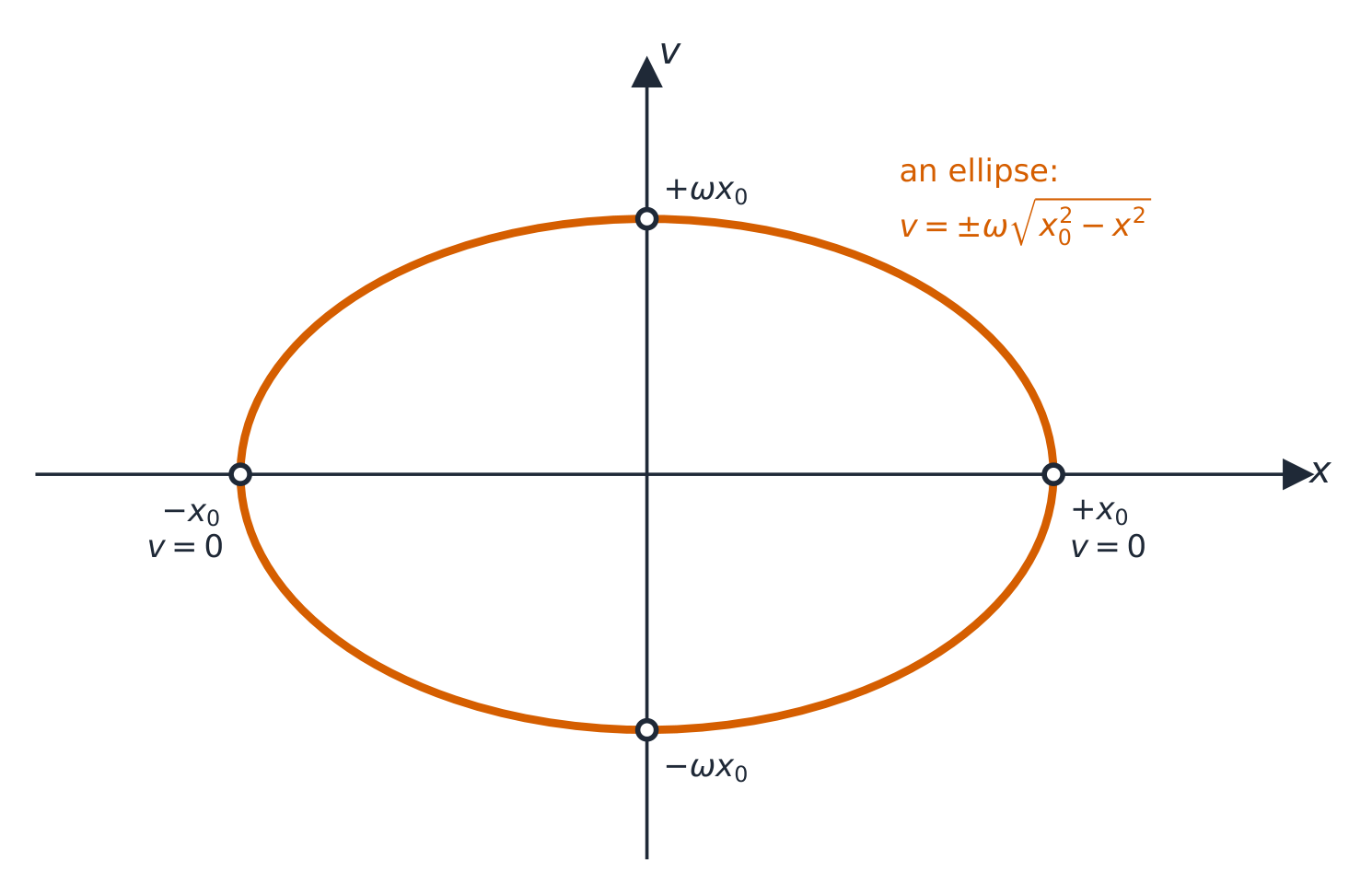
$$v = \pm \omega \sqrt{x_{0}^{2} - x^{2}}.$$
- 在平衡点($x = 0$):$v = \pm \omega x_{0}$(最大速率)。两个符号,因为粒子每周期两次经过平衡点。
- 在两端($x = \pm x_{0}$):$v = 0$(瞬间静止)。
例题。 同一振动的振幅 $x_{0} = 0.050\ \text{m}$、角频率 $\omega = 15.7\ \text{rad s}^{-1}$。求位移为 $x = 0.030\ \text{m}$ 时的速率。
$$v = \omega\sqrt{x_{0}^{2} - x^{2}} = 15.7\sqrt{0.050^{2} - 0.030^{2}} = 15.7 \times 0.040 \approx 0.63\ \text{m s}^{-1}.$$
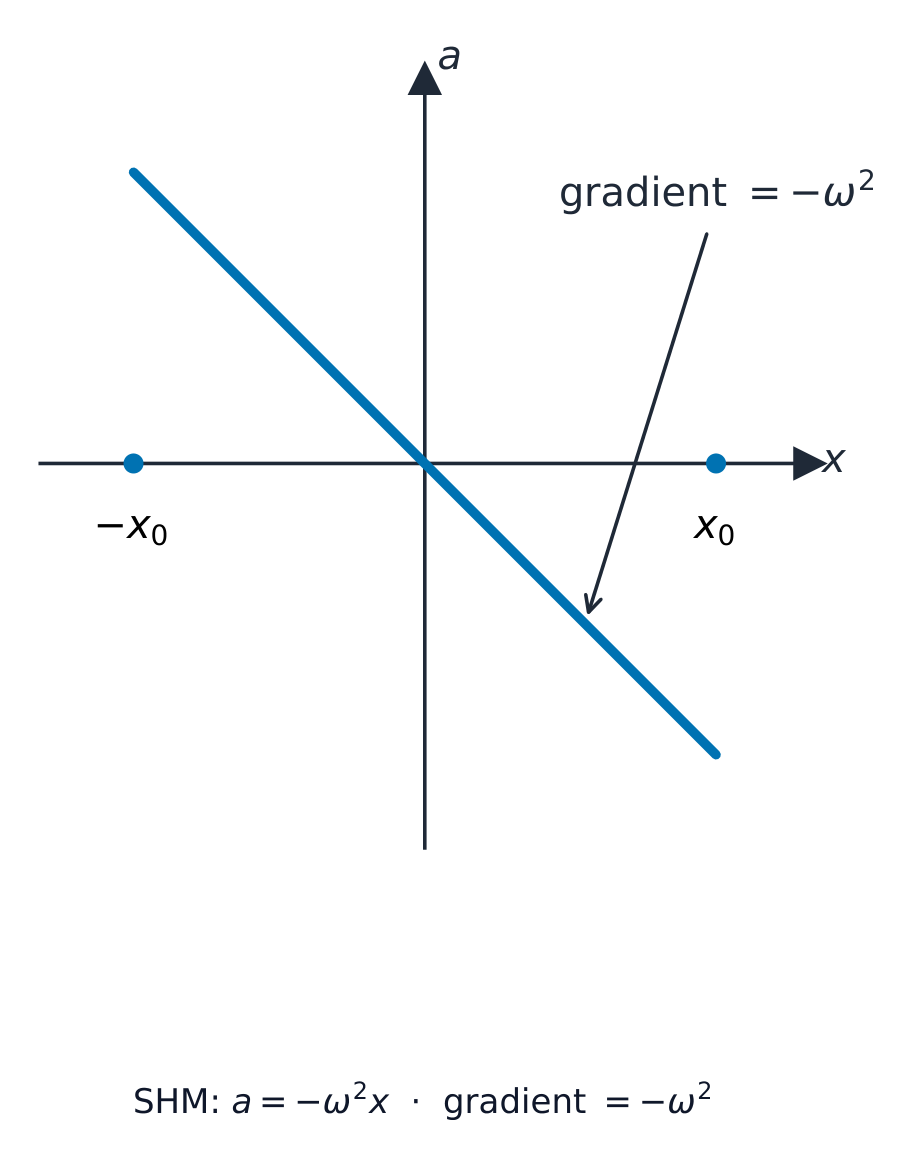
读 $v$–$x$ 图。 它的宽度给出振幅($v = 0$ 处 $x = \pm x_{0}$),高度给出最大速率($x = 0$ 处 $v = \pm\omega x_{0}$),所以 $\omega = v_{0}/x_{0}$,周期随之得出。被要求在同一坐标上画 $a$ 对 $x$ 时,画一条过原点、斜率为负 $-\omega^{2}$ 的直线,在 $x = \pm x_{0}$ 处达到 $\mp\omega^{2}x_{0}$。
例题。 一个振动物块的速度随时间按 $v = 0.56\sin(5.1t)$ 变化,$v$ 以 $\text{m s}^{-1}$ 计,$t$ 以秒计。求振幅、周期和最大加速度。
与 $v = v_{0}\sin\omega t$ 比较:$v_{0} = 0.56\ \text{m s}^{-1}$,$\omega = 5.1\ \text{rad s}^{-1}$。由于 $v_{0} = \omega x_{0}$,振幅 $x_{0} = 0.56/5.1 = 0.11\ \text{m}$;$T = 2\pi/\omega = 1.2\ \text{s}$;$a_{\text{max}} = \omega^{2}x_{0} = \omega v_{0} = 5.1 \times 0.56 = 2.9\ \text{m s}^{-2}$。(因为这个 $v$ 是正弦,物块在 $t = 0$ 时位于一端:它的位移是余弦。)
简谐运动是圆周运动的影子。 一个以角速度 $\omega$ 绕半径 $R$ 的圆运动的小球,从侧面照亮时,它的影子来回做振幅为 $R$、$\omega$ 相同的简谐运动:影子的位移是 $x = R\cos\omega t$(若从一端开始),最大速率 $R\omega$,最大加速度 $R\omega^{2}$。对直径 $0.46\ \text{m}$、$\omega = 1.9\ \text{rad s}^{-1}$ 的圆,影子的振幅为 $0.23\ \text{m}$,$v_{0} = 0.44\ \text{m s}^{-1}$,$a_{\text{max}} = 0.83\ \text{m s}^{-2}$——在路径两端大小最大,并始终指回中心。
对时间的图像
对于 $x = x_{0}\sin\omega t$:
- $x$ 对 $t$——一条正弦曲线,振幅 $x_{0}$,周期 $T = 2\pi/\omega$。
- $v$ 对 $t$——一条余弦曲线,比 $x$ 超前 $\pi/2$,振幅 $\omega x_{0}$。
- $a$ 对 $t$——一条负正弦曲线,与 $x$ 相差 $\pi$(180°),振幅 $\omega^{2} x_{0}$。


$a$ 对 $x$ 的图
一条过原点、斜率为负 $-\omega^{2}$ 的直线。所以你可以从图读出 $\omega$:斜率 $= -\omega^{2}$,所以 $\omega = \sqrt{|\text{gradient}|}$,然后 $T = 2\pi / \omega$。这是一个常见的考试模式。
例题。 质量 $36\ \text{kg}$ 的物体做竖直简谐运动,其高度 $h$ 的图像显示 $h$ 在 $2\ \text{m}$ 和 $10\ \text{m}$ 之间变化,每 $4.0\ \text{s}$ 完成一次完整振动。求振幅、角频率、最大速率、最大加速度和最大动能。
振幅 $x_{0} = (10 - 2)/2 = 4.0\ \text{m}$(峰峰范围的一半;平衡高度是 $6\ \text{m}$)。$\omega = 2\pi/T = 2\pi/4.0 = 1.57\ \text{rad s}^{-1}$。$v_{\text{max}} = \omega x_{0} = 6.3\ \text{m s}^{-1}$;$a_{\text{max}} = \omega^{2}x_{0} = 9.9\ \text{m s}^{-2}$;$E_{\text{K,max}} = \tfrac{1}{2}mv_{\text{max}}^{2} = \tfrac{1}{2} \times 36 \times 6.28^{2} = 7.1 \times 10^{2}\ \text{J}$。这里最常见的失误是把振幅读成整个高度范围而不是它的一半。
例题。 一个小物体放在一个以振幅 $6.0\ \text{mm}$ 做竖直简谐运动的水平平台上。求物体能全程与平台保持接触的最高频率,并说明在运动的哪个位置首先失去接触。
当平台向下的加速度超过 $g$ 时物体离开平台——在振动的顶点,那里加速度最大且向下:平台下落得比物体快。极限是 $\omega^{2}x_{0} = g$:$\omega = \sqrt{9.81/0.0060} = 40\ \text{rad s}^{-1}$,所以 $f = \omega/2\pi = 6.4\ \text{Hz}$。低于此值时顶点处的支持力很小但为正;高于此值时为零。
词汇表
训练
| 英文 | 中文 | 拼音 |
|---|---|---|
| velocity/vəˈlɒsɪti/ | 速度 | sù dù |
17.2
简谐运动中的能量
大纲
- describe the interchange between kinetic and potential energy during simple harmonic motion
- recall and use $E = \frac{1}{2}m\omega^2x_0^2$ for the total energy of a system undergoing simple harmonic motion
来源:剑桥国际大纲
一个简谐振子在两种形式之间不断交换能量:
- 动能(kinetic energy)$E_{\text{K}} = \tfrac{1}{2} m v^{2}$。
- 势能(potential energy)$E_{\text{P}}$(弹簧是弹性势能,单摆是重力势能)。
在没有阻尼(damping)时,总能量恒定(这是能量守恒(conservation of energy))。
最大和最小
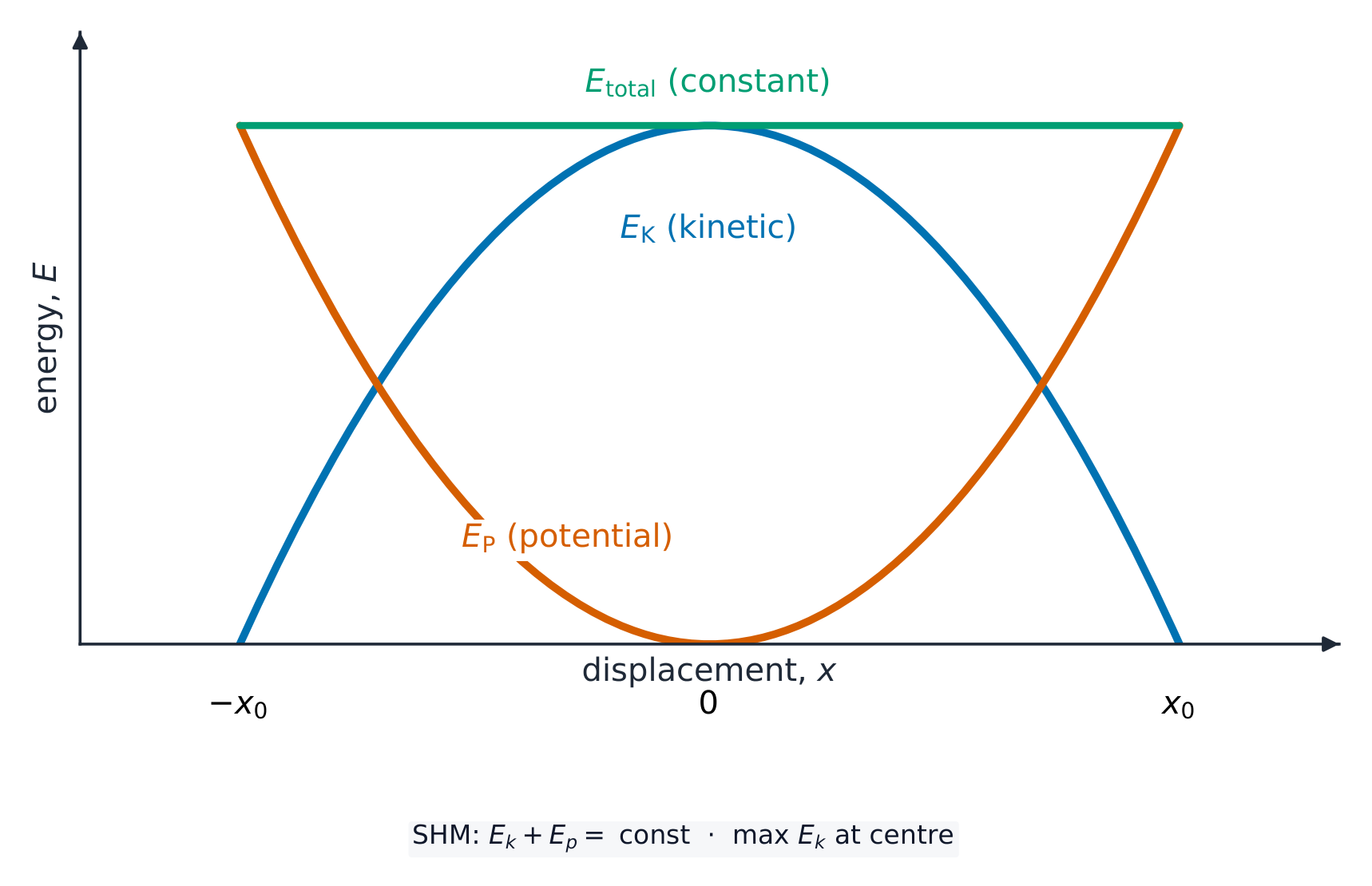
- 在平衡点($x = 0$):$v$ 最大,所以 $E_{\text{K}}$ 最大、$E_{\text{P}}$ 最小(选取为零)。
- 在两端($x = \pm x_{0}$):$v = 0$,所以 $E_{\text{K}} = 0$、$E_{\text{P}}$ 最大。
总能量
用 $v_{\text{max}} = \omega x_{0}$:
$$E_{\text{total}} = \tfrac{1}{2} m v_{\text{max}}^{2} = \tfrac{1}{2} m \omega^{2} x_{0}^{2}.$$
两个关键事实:总能量与振幅的平方成正比($x_{0}$ 翻倍给出四倍的能量),并与 $\omega^{2}$ 成正比。
能量对位移
用 $v^{2} = \omega^{2}(x_{0}^{2} - x^{2})$:
$$E_{\text{K}} = \tfrac{1}{2} m \omega^{2} (x_{0}^{2} - x^{2}), \qquad E_{\text{P}} = \tfrac{1}{2} m \omega^{2} x^{2}.$$
所以 $E_{\text{K}}$ 是一条向下的抛物线(峰在 $x = 0$,在 $x = \pm x_{0}$ 处为零),$E_{\text{P}}$ 是一条向上的抛物线(在 $x = 0$ 处为零,在 $x = \pm x_{0}$ 处最大)。它们的和恒定。
例题。 一个 $0.20\ \text{kg}$ 的质量以振幅 $x_{0} = 0.050\ \text{m}$、角频率 $\omega = 15.7\ \text{rad s}^{-1}$ 振动。求振动的总能量。
当质量以 $v_{\text{max}} = \omega x_{0}$ 经过 $x = 0$ 时,总能量等于最大动能:
$$E = \tfrac{1}{2} m \omega^{2} x_{0}^{2} = \tfrac{1}{2}(0.20)(15.7)^{2}(0.050)^{2} \approx 0.062\ \text{J}.$$
它保持恒定,每周期两次在动能和势能形式之间交换。
不计算地描述能量交换。 在运动的一端,振子瞬时静止:动能为零,势能最大。它向平衡位置运动时,回复力对它做功,势能转化为动能;在平衡位置动能最大、势能最小。越过平衡位置后,动能又转化为势能,直到另一端。总量保持恒定,交换每次振动发生两次,所以能量对时间的图像频率是位移图像的两倍。
例题。 质量 $0.81\ \text{kg}$ 的摆球以振幅 $32\ \text{mm}$、周期 $1.9\ \text{s}$ 做小幅摆动。求振动的总能量,并说明若振幅降到 $16\ \text{mm}$ 它会怎样。
$\omega = 2\pi/1.9 = 3.31\ \text{rad s}^{-1}$;$E = \tfrac{1}{2}m\omega^{2}x_{0}^{2} = \tfrac{1}{2} \times 0.81 \times 3.31^{2} \times 0.032^{2} = 4.5 \times 10^{-3}\ \text{J}$。振幅减半使能量变为四分之一($E \propto x_{0}^{2}$),即 $1.1 \times 10^{-3}\ \text{J}$;差额已被空气阻力耗散为热能。
探索
Energy in SHM
Watch energy swap between kinetic and potential as the oscillator moves — fastest (max KE) at the centre, still (max PE) at the ends.
词汇表
训练
| 英文 | 中文 | 拼音 |
|---|---|---|
| kinetic energy/kɪˈnetɪk ˈenədʒi/ | 动能 | dòng néng |
| damping/ˈdæmpɪŋ/ | 阻尼 | zǔ ní |
| conservation of energy/ˌkɒnsəˈveɪʃn ɒv ˈenədʒi/ | 能量守恒 | néng liàng shǒu héng |
17.3
阻尼振动、受迫振动与共振

大纲
- understand that a resistive force acting on an oscillating system causes damping
- understand and use the terms light, critical and heavy damping and sketch displacement–time graphs illustrating these types of damping
- understand that resonance involves a maximum amplitude of oscillations and that this occurs when an oscillating system is forced to oscillate at its natural frequency
来源:剑桥国际大纲
一个阻碍力(摩擦力(friction)、阻力(drag)、空气阻力(air resistance))引起阻尼——随着能量以热的形式损失,振幅随时间缩小。三种有名称的情形:
轻阻尼
振幅在许多周期内缓慢缩小(轻阻尼(light damping)的情形)。系统仍以接近它固有频率振动,但每个周期都比上一个小。汽车的悬挂是轻到中等阻尼,所以颠簸消失但乘坐保持平稳。
临界阻尼
使系统不过冲也不振动地回到平衡点的最小阻尼——临界阻尼(critical damping)的情形。它在最短的时间内返回。检流计(galvanometer)或模拟电压表(voltmeter)是临界阻尼的,所以指针很快稳定。
过阻尼
阻碍力如此之大,使系统缓慢返回、不振动,但比临界情形更慢——过阻尼(heavy damping)的情形。一扇带强力闭门器的门是过阻尼的。
在位移-时间图上:轻阻尼是一个大小平滑消失的波;临界阻尼很快返回、不过冲;过阻尼缓慢返回。
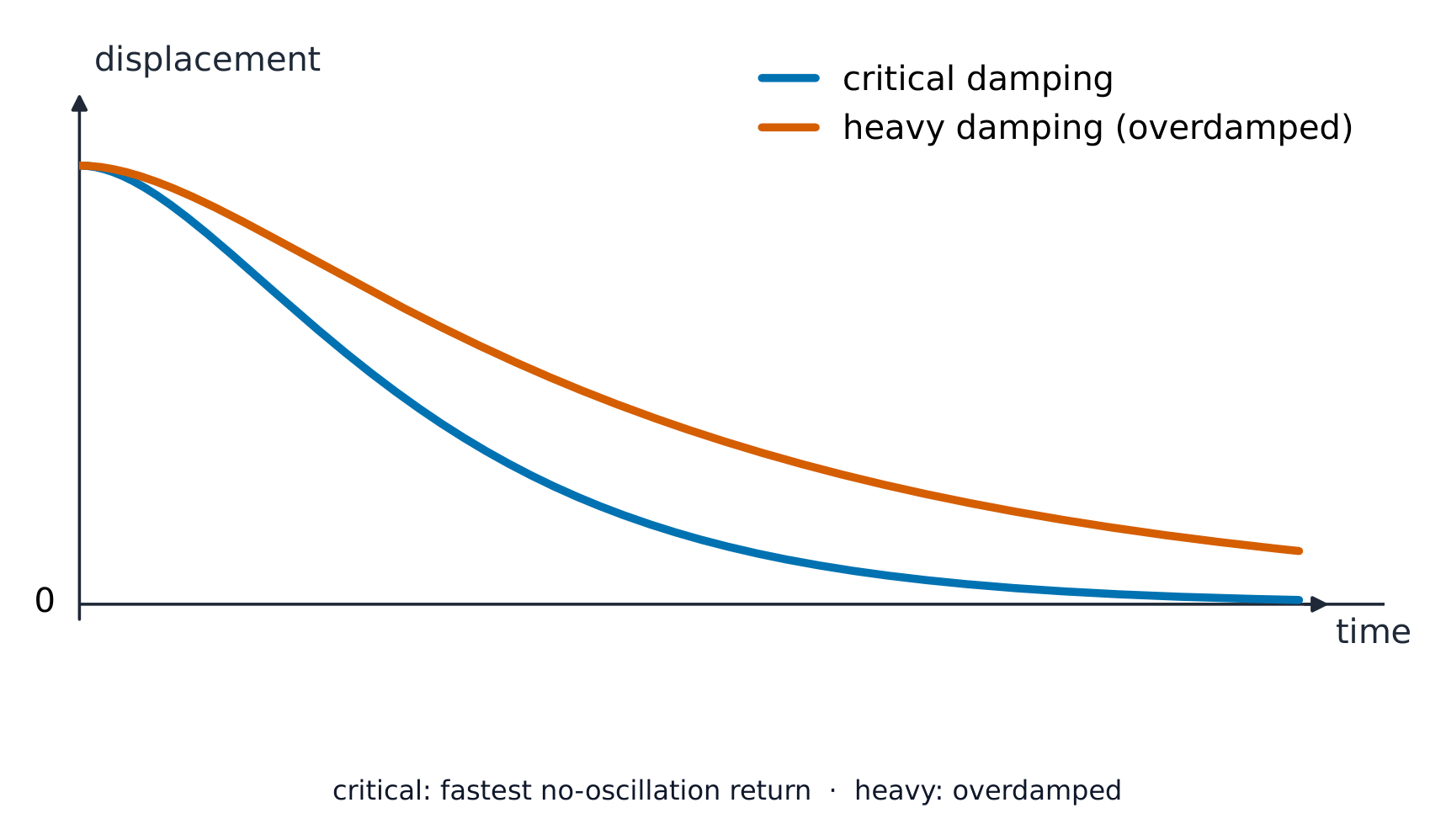
按考试的问法。 阻尼是由耗散振子能量的阻碍力引起的振幅减小。轻阻尼中系统振动,振幅随时间逐渐(指数地)减小;周期几乎不变。临界阻尼中系统在最短时间内不振动地回到平衡位置。过阻尼中它缓慢地、不振动地回到平衡位置。画图:轻阻尼曲线是包络不断缩小的正弦波;临界和过阻尼曲线都不穿越坐标轴地降到零,过阻尼更慢。
例题。 一根条形磁铁挂在弹簧上,一个磁极位于线圈内,线圈通过开关接到一个电阻。磁铁被置于振动。解释为什么闭合开关时振动衰减得更快。
运动的磁铁改变穿过线圈的磁通量,所以感应出电动势(法拉第定律);开关闭合时电流流过电阻,把能量耗散为热。由楞次定律,感应电流反抗磁铁的运动——一个额外的阻碍力。这些能量来自振动,所以振幅减小得更快:电路增加了阻尼。开关断开时有电动势但没有电流,所以没有额外的能量损失。
词汇表
训练
| 英文 | 中文 | 拼音 |
|---|---|---|
| air resistance/eə rɪˈzɪstəns/ | 空气阻力 | kōng qì zǔ lì |
| friction/ˈfrɪkʃn/ | 摩擦力 | mó cā lì |
| drag/dræɡ/ | 阻力 | zǔ lì |
| light damping/laɪt ˈdæmpɪŋ/ | 轻阻尼 | qīng zǔ ní |
| critical damping/ˈkrɪtɪkl ˈdæmpɪŋ/ | 临界阻尼 | lín jiè zǔ ní |
| galvanometer/ˌɡælvəˈnɒmɪtə/ | 检流计 | jiǎn liú jì |
| voltmeter/ˈvəʊltmiːtə/ | 电压表 | diàn yā biǎo |
| heavy damping/ˈhevi ˈdæmpɪŋ/ | 过阻尼 | guò zǔ ní |
17.3
受迫振动与共振
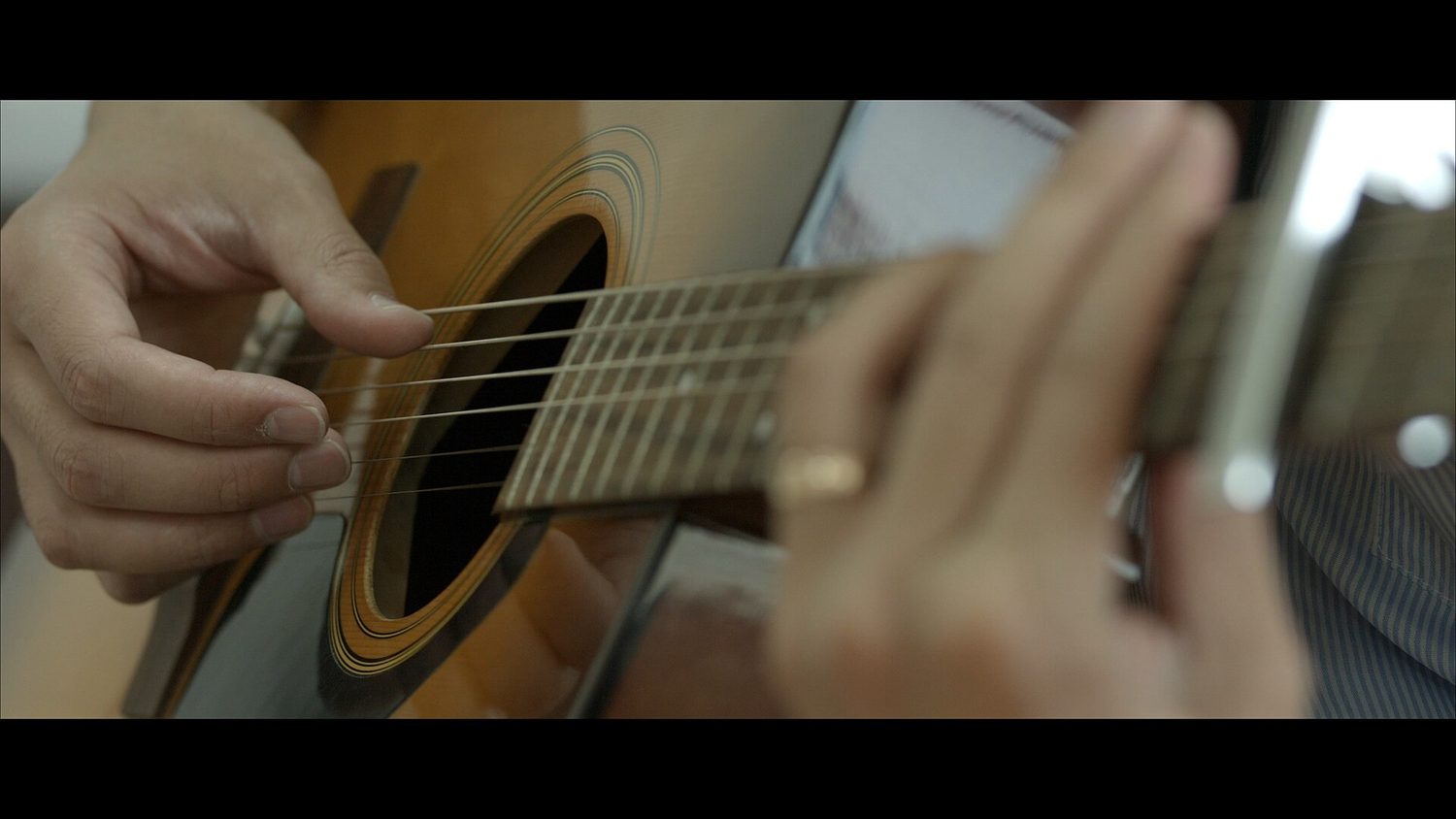
受迫振动(forced oscillation)由一个外部周期力以实验者选定的频率 $f_{\text{d}}$ 驱动。系统于是以这个驱动频率(driving frequency)$f_{\text{d}}$ 振动,而不是以它自己的固有频率。振幅对 $f_{\text{d}}$ 的图是一条带峰的共振曲线(resonance curve)。
共振
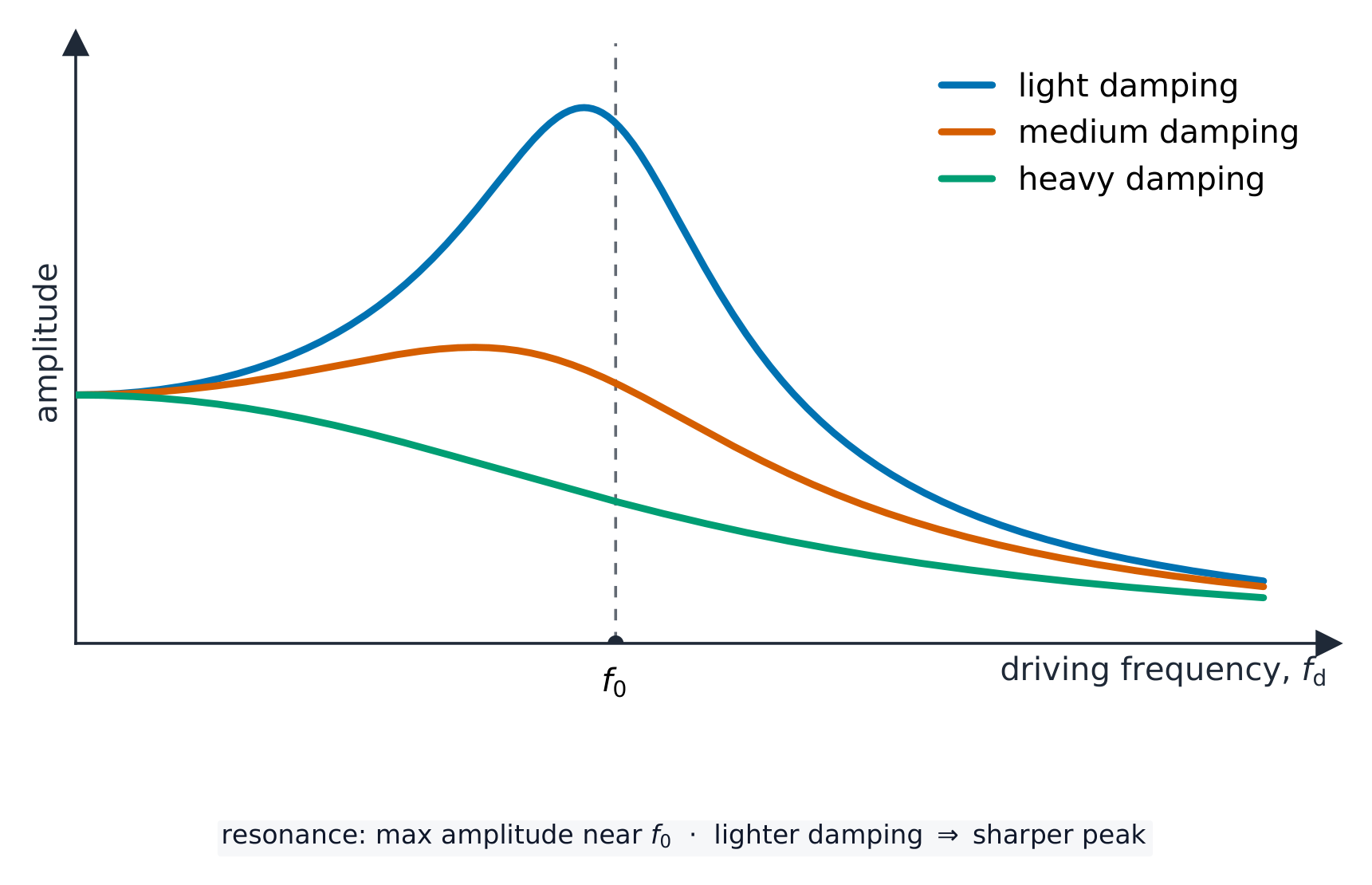
当驱动频率等于系统的固有频率(natural frequency)$f_{0}$ 时,发生共振(resonance)。在共振时振幅最大,来自驱动者的能量传递最有效。

例子:
- 以正确的节奏推的秋千建立起很大的振幅。
- 一个酒杯被它固有振鸣频率的声音震碎。
- 一座建筑被频率与某个固有频率相匹配的地震摇晃——工程师设计建筑,使它们的固有频率避开地震的主要范围。
峰的形状取决于阻尼:较轻的阻尼 → 更尖、更高的峰;较重的阻尼 → 更宽、更低的峰,略微移向较低的频率。
两分的定义。 共振是系统被迫以其固有频率振动、振幅达到最大的状态(驱动者传递的能量最多)。两部分——驱动频率等于固有频率,以及振幅最大——都要有。
例题。 拉紧的弦上的一个球固有频率为 $4.0\ \text{Hz}$。弦由振动发生器驱动,其频率从 $0$ 缓慢增加到 $10\ \text{Hz}$。画出球的振幅随驱动频率的变化,并说明增加阻尼的效果。
曲线在低频时从一个小的、非零的振幅开始,在 $4.0\ \text{Hz}$ 处升到一个尖峰,然后在高频时向零衰减;峰在固有频率处,只有在那里振幅才最大。更多的阻尼使峰更低更宽,并把它略微移向更低的频率;远离共振处的振幅几乎不变。
探索
Resonance
Drive the swing at different frequencies. Far from its natural frequency it barely moves; tune them to match and the amplitude explodes — resonance, the same effect that can shake a bridge apart.
词汇表
训练
| 英文 | 中文 | 拼音 |
|---|---|---|
| natural frequency/ˈnætʃərəl ˈfriːkwənsi/ | 固有频率 | gù yǒu pín lǜ |
| forced oscillation/fɔːst ˌɒsɪˈleɪʃn/ | 受迫振动 | shòu pò zhèn dòng |
| resonance/ˈrezənəns/ | 共振 | gòng zhèn |
| driving frequency/ˈdraɪvɪŋ ˈfriːkwənsi/ | 驱动频率 | qū dòng pín lǜ |
| resonance curve/ˈrezənəns kɜːv/ | 共振曲线 | gòng zhèn qū xiàn |
17.3
考官认可的定义
定义题按固定措辞给分。把这些记准,并且只给一个答案。
| 术语 | 定义 |
|---|---|
| 简谐运动 | 加速度与离某固定点的位移成正比并始终指向该点的运动 |
| 振幅 | 离平衡位置的最大位移 |
| 周期 | 一次完整振动所用的时间 |
| 频率 | 单位时间内完整振动的次数 |
| 角频率 | $\omega = 2\pi f = 2\pi/T$;振动相位变化的速率 |
| 相位差 | 一个振动超前或滞后于另一个振动的周期分数,以角度表示 |
| 阻尼 | 由耗散振动能量的阻碍力引起的振幅减小 |
| 临界阻尼 | 使被移开的系统在最短时间内不振动地回到平衡位置的阻尼 |
| 固有频率 | 系统被移开并任其自由振动时的振动频率 |
| 共振 | 系统以其固有频率做受迫振动、振幅达到最大的情形 |
17.3
考试技巧
- SHM 的条件是 $a = -\omega^2 x$(加速度与位移成正比,方向指回平衡位置);要证明一个运动是 SHM,求出回复力,证明它与 $x$ 成正比且指回平衡位置,再读出 $\omega^{2}$。
- 记住 $x = x_0\sin\omega t$(或 cos)、$v_{max} = \omega x_0$、$a_{max} = \omega^2 x_0$ 和 $v = \pm\omega\sqrt{x_0^2 - x^2}$;动能和势能交换而总能量恒定,$E = \tfrac{1}{2}m\omega^{2}x_{0}^{2} \propto x_{0}^{2}$。
- 速度在两端为零、在中心最大;加速度在两端最大、在中心为零。
- 振幅是位移图峰峰范围的一半;$\omega$ 来自周期、$a$–$x$ 的斜率,或 $v_{0}/x_{0}$。
- 当驱动频率等于固有频率时发生共振;阻尼降低并加宽峰。
常见错误
- 把 SHM 定义为"绕平衡位置的振动"。标准答案要的是加速度与位移成正比并且指向固定点。
- 说负号表示加速度为负。它表示加速度与位移方向相反。
- 把 $v$ 对 $x$ 画成直线。它是椭圆;$a$ 对 $x$ 才是直线。
- 把位移的整个范围当作振幅。振幅是范围的一半。
- 把共振定义为"振幅很大"。它是以固有频率的受迫振动,振幅最大。
- 把临界阻尼叫作"无阻尼",或把过阻尼当作"最快返回"。临界阻尼是不振动的最快返回;过阻尼更慢。
本主题的互动课程
逐步学习,并即时检测练习。