- understand that amount of substance is an SI base quantity with the base unit mol
- use molar quantities where one mole of any substance is the amount containing a number of particles of that substance equal to the Avogadro constant $N_{\text{A}}$
理想气体
A-Level 物理 · 第 15 主题
 13:48
13:48
Ideal Gases
Hold up a single glass of water. It looks simple enough. But inside it are more molecules than you could ever count. One mole of water — just eighteen grams, a…
英文讲解 · 内嵌中英文字幕
15.1
摩尔

大纲
来源:剑桥国际大纲
物质的量(amount of substance)是一个 SI 基本量。它的单位是摩尔(mole,mol)——七个 SI 基本单位之一,还有主题 1 中的千克、米、秒、安培和开尔文(kelvin)。
任何物质的一摩尔都有等于阿伏伽德罗常量(Avogadro constant)的粒子数:
$$N_{\text{A}} = 6.02 \times 10^{23}\ \text{mol}^{-1}.$$
"粒子"是指你正在数的东西——对像氦这样的单原子(monatomic)元素是原子(atoms),对 $\text{O}_{2}$ 或 $\text{H}_{2}\text{O}$ 是分子(molecules)。总要说明你在数什么。
对于 $n$ 摩尔,粒子数是 $N = n N_{\text{A}}$。
摩尔质量(molar mass)$M_{\text{m}}$ 是一摩尔的质量($\text{kg mol}^{-1}$ 或 $\text{g mol}^{-1}$)。$n$ 摩尔的质量是 $M = n M_{\text{m}}$。一个粒子的质量是 $m_{0} = M_{\text{m}} / N_{\text{A}}$。
考官的措辞。 阿伏伽德罗常量是一摩尔物质中原子(或分子)的数目——一分;加上"在 $0.012\ \text{kg}$ 碳-12 中"也接受但不必要。被问"$N_{\text{A}}$、$R$ 和 $k$ 的关系"时,写 $k = R/N_{\text{A}}$(或 $R = N_{\text{A}}k$)。
例题。 氧的摩尔质量为 $32\ \text{g mol}^{-1}$。求一个氧分子的质量,以及 $8.0\ \text{g}$ 氧气中的分子数。
$m_{0} = \dfrac{M_{\text{m}}}{N_{\text{A}}} = \dfrac{0.032}{6.02 \times 10^{23}} = 5.3 \times 10^{-26}\ \text{kg}$。$8.0\ \text{g}$ 是 $n = 8.0/32 = 0.25\ \text{mol}$,所以 $N = nN_{\text{A}} = 1.5 \times 10^{23}$ 个分子。答案以千克为单位时,摩尔质量要用 $\text{kg mol}^{-1}$——那个 $1000$ 的因子是常见的失误。
探索
Mole particle count lab
particles = n x Avogadro constant
Change amount of substance and see particle number scale directly.
词汇表
训练
| 英文 | 中文 | 拼音 |
|---|---|---|
| mole/məʊl/ | 摩尔 | mó ěr |
| amount of substance/əˈmaʊnt ɒv ˈsʌbstəns/ | 物质的量 | wù zhì dì liàng |
| kelvin/ˈkelvɪn/ | 开尔文 | kāi ěr wén |
| Avogadro constant/ˌævəˈɡædrəʊ ˈkɒnstənt/ | 阿伏伽德罗常量 | ā fú gā dé luó cháng liàng |
| atom/ˈætəm/ | 原子 | yuán zi |
| monatomic/ˌmɒnəˈtɒmɪk/ | 单原子 | dān yuán zi |
| molecules/ˈmɒlɪkjuːlz/ | 分子 | fèn zǐ |
| molecule/ˈmɒlɪkjuːl/ | 分子 | fèn zǐ |
| molar mass/ˈməʊlə mæs/ | 摩尔质量 | mó ěr zhì liàng |
15.2
状态方程

大纲
- understand that a gas obeying $pV \propto T$, where $T$ is the thermodynamic temperature, is known as an ideal gas
- recall and use the equation of state for an ideal gas expressed as $pV = nRT$, where $n =$ amount of substance (number of moles) and as $pV = NkT$, where $N =$ number of molecules
- recall that the Boltzmann constant $k$ is given by $k = R/N_{\text{A}}$
来源:剑桥国际大纲
一种理想气体(ideal gas)精确地遵守 $pV \propto T$,其中 $T$ 是热力学温度(thermodynamic temperature)。
状态方程(equation of state)可以写成两种等价形式:
$$p V = n R T \qquad\text{or}\qquad p V = N k T.$$
这里:
- $p$——压强(pressure,Pa)。
- $V$——体积(volume,m³)。
- $T$——以开尔文为单位的热力学温度(决不用 °C)。
- $n$——摩尔数;$N$——分子数。
- $R$——摩尔气体常量(molar gas constant),$R = 8.31\ \text{J mol}^{-1}\ \text{K}^{-1}$。
- $k$——玻尔兹曼常量(Boltzmann constant),$k = 1.38 \times 10^{-23}\ \text{J K}^{-1}$。
由于 $N = n N_{\text{A}}$,我们得到 $k = R/N_{\text{A}}$:$k$ 是每分子的气体常量,正如 $R$ 是每摩尔的。
两分的定义。 理想气体是在压强、体积和温度的所有取值下都遵守 $pV = nRT$(或 $pV \propto T$,$T$ 为热力学温度)的气体。 两分都需要方程(或写明 $T$ 为热力学温度的正比关系)以及"在所有取值下"或"对所有 $p$、$V$ 和 $T$"。被要求"说明 $pV = NkT$ 中每个符号的含义"时:$p$ 是压强,$V$ 是体积,$N$ 是分子数,$k$ 是玻尔兹曼常量,$T$ 是热力学温度——真实气体在低压和高温下接近理想,那时分子相距很远。
使用状态方程
列出你已有的变量,找出未知量,并选择与你的"量"相匹配的形式(摩尔 → $nRT$;分子 → $NkT$)。始终用 SI 单位:Pa、m³、K。
例题。 一个体积 $0.020\ \text{m}^{3}$ 的气瓶装着 $27\ ^{\circ}\text{C}$、压强 $2.0 \times 10^{5}\ \text{Pa}$ 的气体。里面有多少摩尔气体?($R = 8.31\ \text{J mol}^{-1}\ \text{K}^{-1}$。)
换成开尔文:$T = 27 + 273 = 300\ \text{K}$。然后由 $pV = nRT$,
$$n = \frac{pV}{RT} = \frac{(2.0 \times 10^{5})(0.020)}{8.31 \times 300} \approx 1.6\ \text{mol}.$$
如果固定量的气体从状态 1 变到状态 2:
$$\frac{p_{1} V_{1}}{T_{1}} = \frac{p_{2} V_{2}}{T_{2}}.$$
例题。 $300\ \text{K}$ 的一固定质量气体占据 $0.50\ \text{m}^{3}$。它在恒压下被加热到 $450\ \text{K}$。求新的体积。
在恒压下 $V/T$ 恒定,所以
$$V_{2} = V_{1}\,\frac{T_{2}}{T_{1}} = 0.50 \times \frac{450}{300} = 0.75\ \text{m}^{3}.$$
例题。 一个体积 $0.0500\ \text{m}^{3}$ 的密封容器装有 $0.0424\ \text{kg}$ 的理想气体,温度 $227\ ^{\circ}\text{C}$,压强 $1.37 \times 10^{5}\ \text{Pa}$。求气体的物质的量、一个分子的质量,以及分子的均方速率。
$T = 227 + 273 = 500\ \text{K}$。$n = \dfrac{pV}{RT} = \dfrac{1.37 \times 10^{5} \times 0.0500}{8.31 \times 500} = 1.65\ \text{mol}$。摩尔质量为 $0.0424/1.65 = 0.0257\ \text{kg mol}^{-1}$,所以一个分子的质量为 $0.0257/(6.02 \times 10^{23}) = 4.3 \times 10^{-26}\ \text{kg}$。由 $\tfrac{1}{2}m\langle c^{2}\rangle = \tfrac{3}{2}kT$,$\langle c^{2}\rangle = \dfrac{3kT}{m} = \dfrac{3 \times 1.38 \times 10^{-23} \times 500}{4.27 \times 10^{-26}} = 4.8 \times 10^{5}\ \text{m}^{2}\ \text{s}^{-2}$(均方根速率约 $700\ \text{m s}^{-1}$)。
例题。 气缸 X(体积 $0.0260\ \text{m}^{3}$,$0.740\ \text{mol}$)和气缸 Y(体积 $0.0180\ \text{m}^{3}$,$0.320\ \text{mol}$)装有理想气体,彼此在 $290\ \text{K}$ 处于热平衡。求各自的压强,并解释若打开连接两者的阀门,每个气缸中的分子数会怎样。
$p_{\text{X}} = \dfrac{nRT}{V} = \dfrac{0.740 \times 8.31 \times 290}{0.0260} = 6.86 \times 10^{4}\ \text{Pa}$,$p_{\text{Y}} = \dfrac{0.320 \times 8.31 \times 290}{0.0180} = 4.28 \times 10^{4}\ \text{Pa}$。气体从高压(X)流向低压(Y),直到压强相等;温度不变,所以末压强 $p = \dfrac{(n_{\text{X}} + n_{\text{Y}})RT}{V_{\text{X}} + V_{\text{Y}}} = 5.8 \times 10^{4}\ \text{Pa}$,X 最后有 $n_{\text{X}} = pV_{\text{X}}/RT = 0.63\ \text{mol}$——它向 Y 失去约 $0.11\ \text{mol}$。
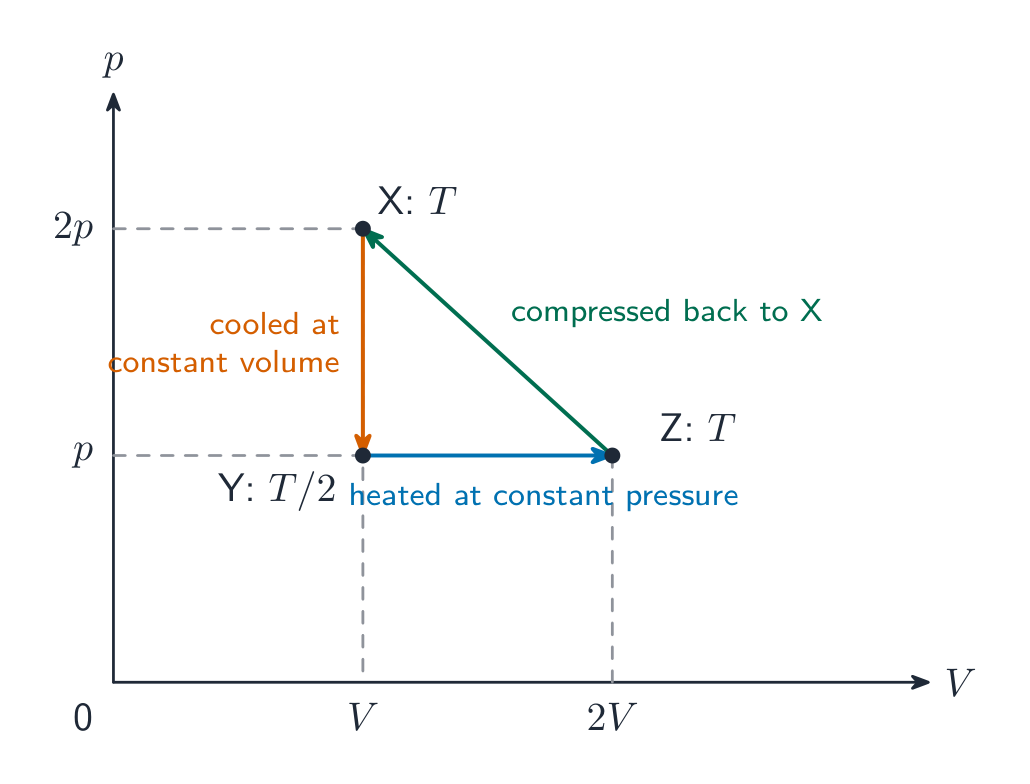
例题。 温度为 $T$ 的一固定量理想气体处于状态 X,压强 $2p$、体积 $V$。它在恒容下冷却到状态 Y,压强为 $p$;再在恒压下加热到状态 Z,体积为 $2V$;然后回到 X。求 Y 和 Z 的温度,并描述内能在循环中如何变化。
X 到 Y 恒容,所以 $p/T$ 恒定:压强减半,温度减半,$T_{\text{Y}} = T/2$。Y 到 Z 恒压,所以 $V/T$ 恒定:体积加倍,温度加倍,$T_{\text{Z}} = T$。理想气体的内能只取决于温度,所以从 X 到 Y 减少(减少 $\tfrac{3}{2}nR \cdot T/2$),从 Y 到 Z 增加同样的量,从 Z 回到 X 不变。写方程之前先从图上读每一段:竖直表示恒 $V$,水平表示恒 $p$。
特殊情形:
- 恒温(玻意耳定律(Boyle's law)):$p_{1} V_{1} = p_{2} V_{2}$。
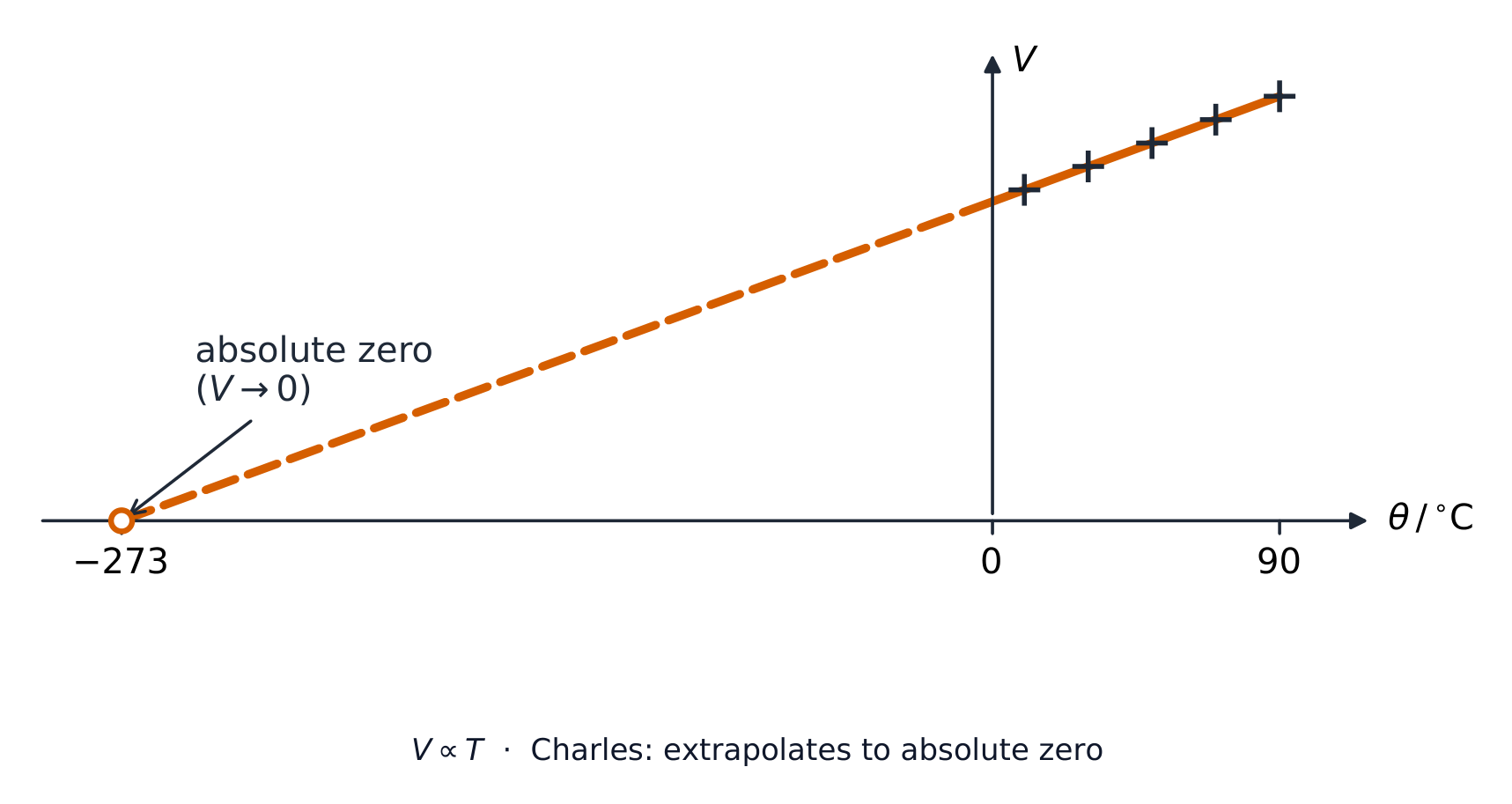
- 恒压(查理定律(Charles's law)):$V / T = \text{constant}$。
- 恒容(气体压强定律(pressure law)):$p / T = \text{constant}$。
一个常见错误是用 °C 代替 K——$pV \propto T$ 只在 $T$ 以开尔文为单位时成立。

探索
The ideal gas (Boyle)
p = k / V
At constant temperature p ∝ 1/V — squeeze the volume and pressure rises.
词汇表
训练
| 英文 | 中文 | 拼音 |
|---|---|---|
| equation of state/ɪˈkweɪʒn ɒv steɪt/ | 状态方程 | zhuàng tài fāng chéng |
| ideal gas/aɪˈdɪəl ɡæs/ | 理想气体 | lǐ xiǎng qì tǐ |
| pressure/ˈpreʃə/ | 压强 | yā qiáng |
| thermodynamic temperature/ˌθɜːməʊdaɪˈnæmɪk ˈtemprɪtʃə/ | 热力学温度 | rè lì xué wēn dù |
| volume/ˈvɒljuːm/ | 体积 | tǐ jī |
| molar gas constant/ˈməʊlə ɡæs ˈkɒnstənt/ | 摩尔气体常量 | mó ěr qì tǐ cháng liàng |
| Boltzmann constant/ˈbɒltsmən ˈkɒnstənt/ | 玻尔兹曼常量 | bō ěr zī màn cháng liàng |
| Boyle's law/bɔɪlz lɔː/ | 玻意耳定律 | bō yì ěr dìng lǜ |
| Charles's law/ˈtʃɑːlzɪz lɔː/ | 查理定律 | chá lǐ dìng lǜ |
| pressure law/ˈpreʃə lɔː/ | 气体压强定律 | qì tǐ yā qiáng dìng lǜ |
15.3
气体动理论

大纲
- state the basic assumptions of the kinetic theory of gases
- explain how molecular movement causes the pressure exerted by a gas and derive and use the relationship $pV = \frac{1}{3}Nm\langle c^2 \rangle$, where $\langle c^2 \rangle$ is the mean-square speed (a simple model considering one-dimensional collisions and then extending to three dimensions using $\frac{1}{3}\langle c^2 \rangle = \langle c_x^2 \rangle$ is sufficient)
- understand that the root-mean-square speed $c_{\text{r.m.s.}}$ is given by $\sqrt{\langle c^2 \rangle}$
- compare $pV = \frac{1}{3}Nm\langle c^2 \rangle$ with $pV = NkT$ to deduce that the average translational kinetic energy of a molecule is $\frac{3}{2}kT$, and recall and use this expression
来源:剑桥国际大纲
分子动理论(kinetic theory)从气体分子的无规则运动(random motion)来解释它的大尺度行为。
假设
对于理想气体:
- 大量相同的分子在做连续的无规则运动。
- 与容器相比,分子自身的体积小到可忽略。
- 与两次碰撞之间的时间相比,每次碰撞的时间短到可忽略。
- 除碰撞时外,分子间(intermolecular)力被忽略(分子在两次碰撞之间沿直线运动)。
- 碰撞(与器壁以及彼此之间)是弹性的——弹性碰撞(elastic collision)不损失动能,所以气体不会自己冷却下来。
- 牛顿定律适用。

在极高压(分子体积变得重要)或极低温(分子间力变得重要)时,这些假设会变得不准确。
按考试的问法。 "说出分子动理论的两条(或三条)基本假设":从以下选择——分子在做连续的无规则运动;分子的体积与气体的体积相比可忽略;除碰撞时外分子之间没有力;碰撞是完全弹性的;碰撞的时间与两次碰撞之间的时间相比可忽略。"说明弹性碰撞的含义":总动能守恒的碰撞(动量也守恒)。"用这些假设说明为什么极高压下恒星表面的气体不是理想气体":分子挨得如此之近,以致它们自身的体积相对气体体积不可忽略,并且分子之间有力作用——气体被压缩时失效的正是这两条假设。
例题。 一个气球装有 $0.40\ \text{mol}$ 氢气(每个分子 $m = 3.34 \times 10^{-27}\ \text{kg}$),体积 $9.8 \times 10^{-3}\ \text{m}^{3}$。估算分子的平均间距、相邻分子间的引力,并评论这检验了分子动理论的哪条假设。
$N = 0.40 \times 6.02 \times 10^{23} = 2.4 \times 10^{23}$ 个分子,所以每个分子占 $V/N = 4.1 \times 10^{-26}\ \text{m}^{3}$,平均间距 $d = (V/N)^{1/3} = 3.4 \times 10^{-9}\ \text{m}$。两个分子间的引力 $F = \dfrac{Gm^{2}}{d^{2}} = \dfrac{6.67 \times 10^{-11} \times (3.34 \times 10^{-27})^{2}}{(3.4 \times 10^{-9})^{2}} = 6 \times 10^{-47}\ \text{N}$——比一个分子自身的重力($mg = 3.3 \times 10^{-26}\ \text{N}$)小约 $10^{20}$ 倍。除碰撞时外分子间的力确实可以忽略,正如理论所假设的。
气体的压强——推导概要
取一个边长为 $L$ 的立方盒子,里面有 $N$ 个分子,每个质量为 $m$。看一个沿 $x$ 轴以速度 $u_{1}$ 运动的分子。

- 与右壁的一次碰撞:速度反转为 $-u_{1}$,动量(momentum)变化 $\Delta p_{x} = -2 m u_{1}$。由牛顿第三定律器壁得到一个 $+2 m u_{1}$ 的冲量(impulse)。
- 两次撞该壁之间的时间:往返走 $2L$,所以 $\Delta t = 2L/u_{1}$。
- 这个分子的平均力:$F_{1} = \Delta p / \Delta t = m u_{1}^{2} / L$。
- 对所有分子求和:$F = (Nm/L)\langle u_{x}^{2} \rangle$,其中 $\langle u_{x}^{2} \rangle$ 是 $x$ 方向速度的均方(mean square)。
- 压强:$p = F/L^{2} = N m \langle u_{x}^{2} \rangle / V$。
在三维中,由对称性 $\langle u_{x}^{2} \rangle = \tfrac{1}{3} \langle c^{2} \rangle$,其中 $\langle c^{2} \rangle$ 是均方速率(mean-square speed)。所以
$$p V = \tfrac{1}{3} N m \langle c^{2} \rangle.$$
"解释分子运动如何产生气体的压强"(3 分)。 分子做无规则运动并与容器壁碰撞;每次碰撞时分子的动量改变(它反弹),所以由牛顿第二定律器壁对它施力,由第三定律它对器壁施加相等的力;每秒极多次碰撞在器壁上产生稳定的总力,压强就是单位面积上的这个力。大纲的说法"考虑一维碰撞的简单模型"指的就是上面的推导:只需跟踪一个分子在两个相对面之间来回反弹,然后求平均即可。
密度形式。 由于 $Nm$ 是气体的总质量,$Nm/V$ 是它的密度 $\rho$,同一结果可写成 $p = \tfrac{1}{3}\rho\langle c^{2}\rangle$——题目给密度而不给 $N$ 和 $m$ 时用这个版本。
例题。 压强 $1.6 \times 10^{5}\ \text{Pa}$ 的理想气体密度为 $1.9\ \text{kg m}^{-3}$。证明其分子的均方根速率约为 $500\ \text{m s}^{-1}$。
$\langle c^{2}\rangle = \dfrac{3p}{\rho} = \dfrac{3 \times 1.6 \times 10^{5}}{1.9} = 2.53 \times 10^{5}\ \text{m}^{2}\ \text{s}^{-2}$,所以 $c_{\text{r.m.s.}} = \sqrt{2.53 \times 10^{5}} = 503\ \text{m s}^{-1} \approx 500\ \text{m s}^{-1}$。"证明"题中,与题给值比较之前多保留一位($503$)。
均方根速率
$\langle c^{2} \rangle$ 的平方根是均方根(root-mean-square,r.m.s.)速率:
$$c_{\text{r.m.s.}} = \sqrt{\langle c^{2} \rangle}.$$
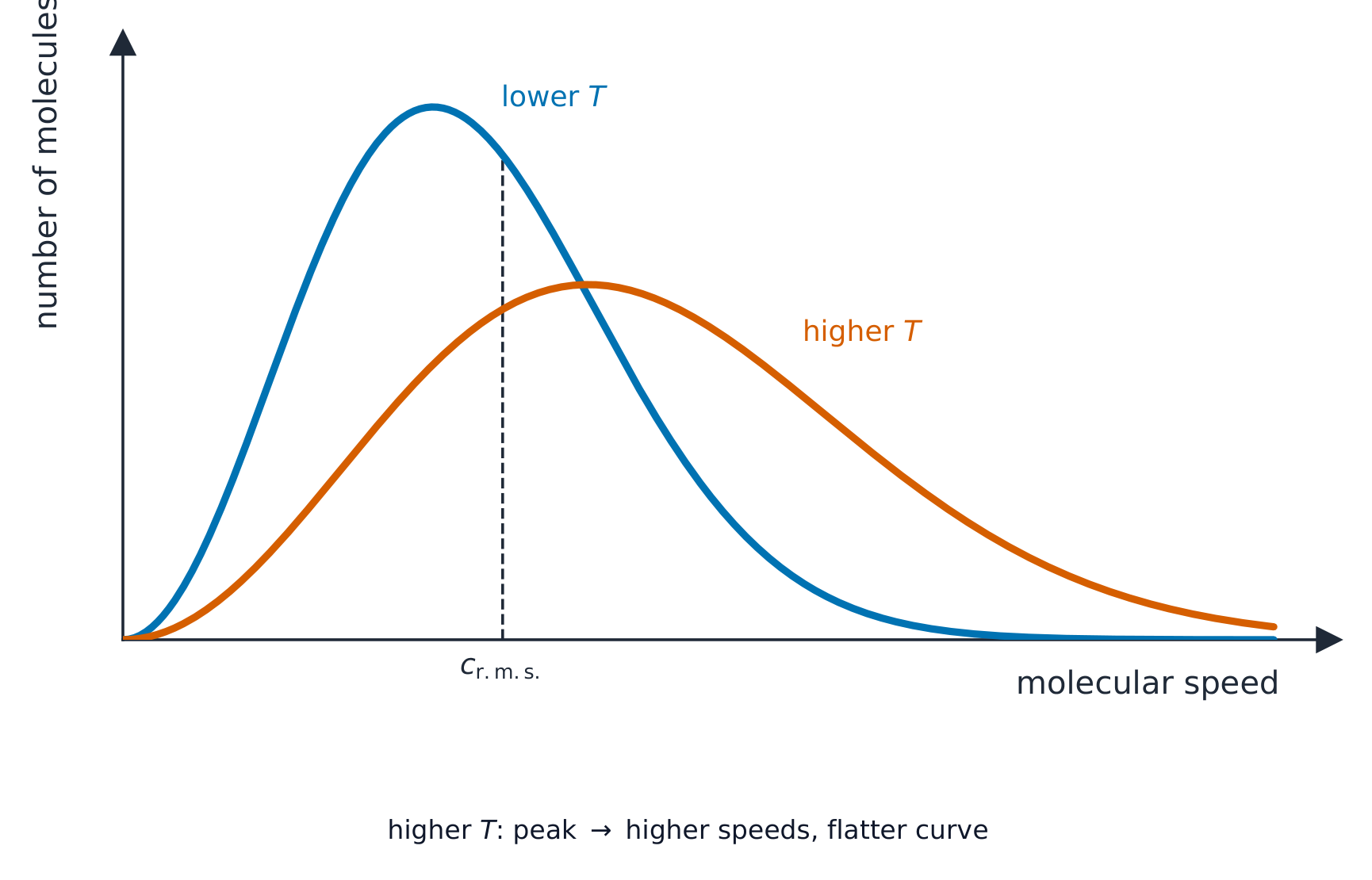
它是分子运动快慢的一个有用的单一量度,略大于平均速率(平方给快分子更大的权重)。

探索
Boyle's law
p ∝ 1/V
At constant temperature, pressure is inversely proportional to volume — squash the gas and the pressure rises.
词汇表
训练
| 英文 | 中文 | 拼音 |
|---|---|---|
| mean-square speed/miːn skweə spiːd/ | 均方速率 | jūn fāng sù lǜ |
| kinetic theory/kɪˈnetɪk ˈθɪəri/ | 分子动理论 | fèn zǐ dòng lǐ lùn |
| random motion/ˈrændəm ˈməʊʃn/ | 无规则运动 | wú guī zé yùn dòng |
| intermolecular/ˌɪntəməˈlekjʊlə/ | 分子间 | fèn zǐ jiān |
| elastic collision/ɪˈlæstɪk kəˈlɪʒn/ | 弹性碰撞 | tán xìng pèng zhuàng |
| momentum/məʊˈmentəm/ | 动量 | dòng liàng |
| impulse/ˈɪmpʌls/ | 冲量 | chōng liàng |
| mean square/miːn skweə/ | 均方 | jūn fāng |
| root-mean-square/ruːt miːn skweə/ | 均方根 | jūn fāng gēn |
15.3
平均平动动能

比较 $pV$ 的两个表达式:
$$p V = N k T \quad\text{and}\quad p V = \tfrac{1}{3} N m \langle c^{2} \rangle.$$
令它们相等,约去 $N$,再乘以 $\tfrac{3}{2}$:
$$\tfrac{3}{2} k T = \tfrac{1}{2} m \langle c^{2} \rangle.$$
右边是一个分子的平动动能(average translational kinetic energy)$\langle E_{\text{k}} \rangle$。所以
$$\langle E_{\text{k}} \rangle = \tfrac{1}{2} m \langle c^{2} \rangle = \tfrac{3}{2} k T.$$
这是一个关键结论:理想气体分子的平均平动动能只取决于热力学温度,而不取决于气体的种类或它的压强。
例题。 求 $300\ \text{K}$ 时氧分子的均方根速率。(一个 $\text{O}_{2}$ 分子的质量 $= 5.3 \times 10^{-26}\ \text{kg}$,$k = 1.38 \times 10^{-23}\ \text{J K}^{-1}$。)
由 $\tfrac{1}{2}m\langle c^{2}\rangle = \tfrac{3}{2}kT$,均方速率是 $\langle c^{2}\rangle = 3kT/m$:
$$c_{\text{r.m.s.}} = \sqrt{\frac{3kT}{m}} = \sqrt{\frac{3 (1.38 \times 10^{-23})(300)}{5.3 \times 10^{-26}}} \approx 480\ \text{m s}^{-1}.$$
例题。 月球表面在阳光下可达约 $400\ \text{K}$。计算该温度下氢分子($m = 3.34 \times 10^{-27}\ \text{kg}$)的均方根速率,并用月球 $2.4\ \text{km s}^{-1}$ 的逃逸速率说明为什么月球没有氢大气。
$c_{\text{r.m.s.}} = \sqrt{\dfrac{3kT}{m}} = \sqrt{\dfrac{3 \times 1.38 \times 10^{-23} \times 400}{3.34 \times 10^{-27}}} = 2.2 \times 10^{3}\ \text{m s}^{-1}$。这个均方根速率接近逃逸速率,而速率在它附近分布很宽,所以任一时刻都有很大一部分分子快于 $2.4\ \text{km s}^{-1}$ 并逃逸;久而久之氢就丢失了。
例题。 某恒星表面的气体主要是氢原子($m = 1.67 \times 10^{-27}\ \text{kg}$),均方根速率 $9300\ \text{m s}^{-1}$。求表面温度。
$T = \dfrac{m\langle c^{2}\rangle}{3k} = \dfrac{1.67 \times 10^{-27} \times 9300^{2}}{3 \times 1.38 \times 10^{-23}} = 3.5 \times 10^{3}\ \text{K}$。
例题。 对一固定样品的气体,$pV$ 对 $kT$ 的图是过原点、斜率 $7.2 \times 10^{22}$ 的直线。当 $pV = 270\ \text{J}$ 时分子的均方根速率为 $1900\ \text{m s}^{-1}$。求分子数以及一个分子以 u 为单位的质量。
由 $pV = NkT$,斜率为 $N = 7.2 \times 10^{22}$。由 $pV = \tfrac{1}{3}Nm\langle c^{2}\rangle$:$m = \dfrac{3pV}{N\langle c^{2}\rangle} = \dfrac{3 \times 270}{7.2 \times 10^{22} \times 1900^{2}} = 3.1 \times 10^{-27}\ \text{kg} = \dfrac{3.1 \times 10^{-27}}{1.66 \times 10^{-27}} = 1.9\ \text{u}$——在舍入范围内是氢分子。
比较气体和样品。 相同温度下每种气体每个分子的平均动能相同,所以 $\langle c^{2}\rangle \propto 1/m$:氢($M_{\text{m}} = 2$)和氧($M_{\text{m}} = 32$)有 $\dfrac{c_{\text{H}}}{c_{\text{O}}} = \sqrt{\dfrac{32}{2}} = 4$。相同 $T$ 下的两个样品——X 在体积 $V$ 中有 $N$ 个质量 $m$ 的分子,Y 在体积 $2V$ 中有 $2N$ 个质量 $2m$ 的分子——压强相同($p = NkT/V$,$N$ 和 $V$ 都加倍),每个分子的平均动能相同,但 Y 的分子均方速率减半($3kT/2m$),且 Y 的内能是两倍(分子数两倍)。
推论
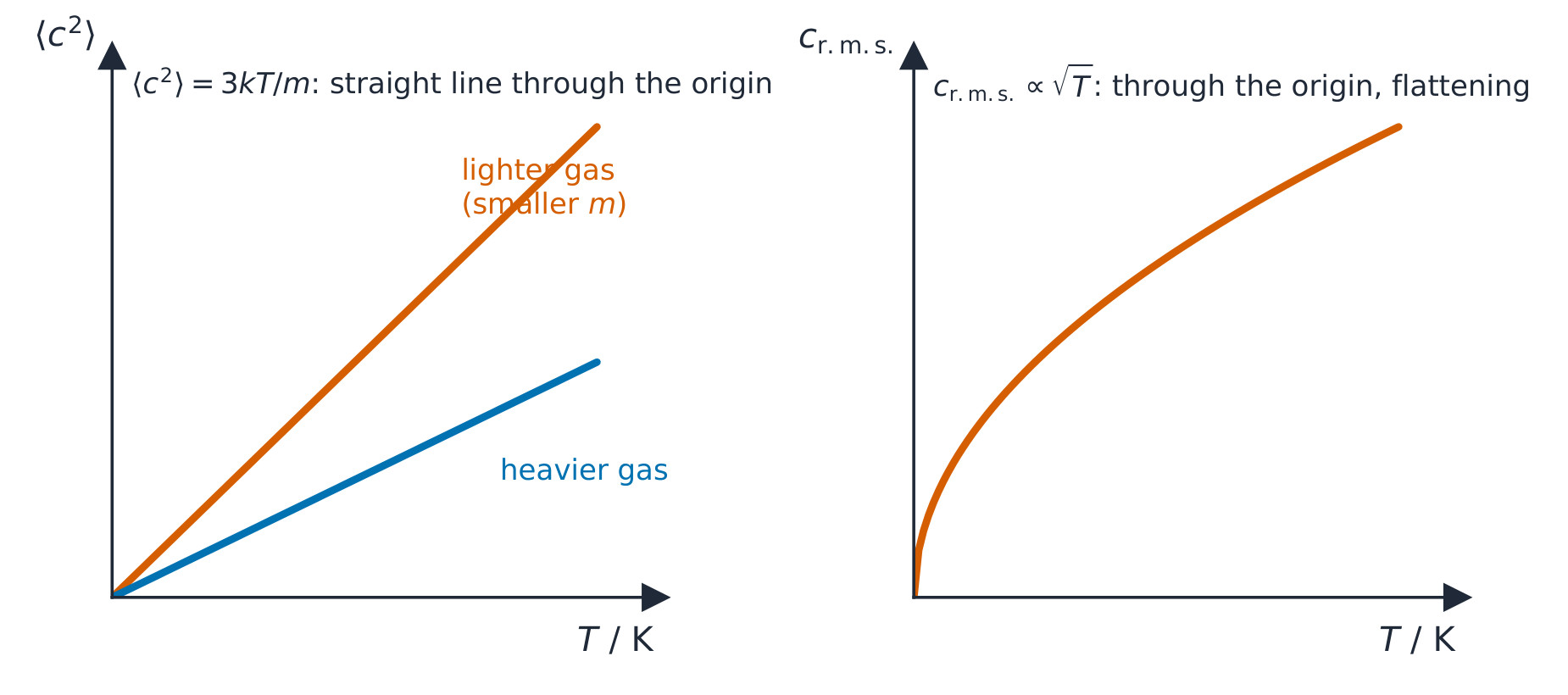
- 绝对温度翻倍使每个分子的平均动能翻倍,所以 $\langle c^{2} \rangle$ 翻倍,$c_{\text{r.m.s.}}$ 增大 $\sqrt{2}$ 倍。
- 对于相同温度下的两种气体,较轻的气体有较大的 $\langle c^{2} \rangle$。在同一房间里氢分子平均比氧分子运动得更快。
- $N$ 个分子的总平动动能:$\tfrac{3}{2} N k T = \tfrac{3}{2} n R T$。
理想气体的内能
对于理想气体,分子是没有分子间势能、(在这个简单模型中)没有转动或振动的点粒子。所以内能(internal energy)就是总动能(kinetic energy):
$$U = \tfrac{3}{2} N k T = \tfrac{3}{2} n R T.$$
所以理想气体的内能与热力学温度成正比——$T$ 翻倍使 $U$ 翻倍。
按考试的问法。 "用一条基本假设说明关于分子势能能推出什么":分子之间没有力(碰撞时除外),所以没有与它们间距相关的势能——无规则运动的能量全是动能。"解释为什么理想气体的内能与热力学温度成正比"(2 分):内能是分子动能与势能之和;势能为零(没有分子间力),而一个分子的平均动能是 $\tfrac{3}{2}kT$,与 $T$ 成正比;所以总量 $U = \tfrac{3}{2}NkT$ 与 $T$ 成正比。"推导 $\tfrac{3}{2}kT$"(2 分):令 $pV = NkT$ 与 $pV = \tfrac{1}{3}Nm\langle c^{2}\rangle$ 相等,约去 $N$,整理成 $\tfrac{1}{2}m\langle c^{2}\rangle = \tfrac{3}{2}kT$——要写出约去的过程和 $\tfrac{3}{2}$ 这个因子。
例题。 $0.26\ \text{m}^{3}$ 的理想气体样品处于 $2.0 \times 10^{5}\ \text{Pa}$ 和 $290\ \text{K}$。求分子数、一个分子的平均平动动能,以及气体的内能。
$N = \dfrac{pV}{kT} = \dfrac{2.0 \times 10^{5} \times 0.26}{1.38 \times 10^{-23} \times 290} = 1.3 \times 10^{25}$。$\langle E_{\text{k}}\rangle = \tfrac{3}{2}kT = 1.5 \times 1.38 \times 10^{-23} \times 290 = 6.0 \times 10^{-21}\ \text{J}$。$U = N\langle E_{\text{k}}\rangle = 1.3 \times 10^{25} \times 6.0 \times 10^{-21} = 7.8 \times 10^{4}\ \text{J}$——或直接 $U = \tfrac{3}{2}pV = 7.8 \times 10^{4}\ \text{J}$,一个利落的检验。
在固定温度下改变压强
在固定 $T$ 下把 $p$ 翻倍(通过把气体压到一半体积)不改变 $\langle E_{\text{k}} \rangle$——那只取决于 $T$。每秒有更多的器壁碰撞,但每个分子有相同的平均动能。
词汇表
训练
| 英文 | 中文 | 拼音 |
|---|---|---|
| internal energy/ɪnˈtɜːnl ˈenədʒi/ | 内能 | nèi néng |
| kinetic energy/kɪˈnetɪk ˈenədʒi/ | 动能 | dòng néng |
| average translational kinetic energy/ˈævrɪdʒ trænˈsleɪʃənl kɪˈnetɪk ˈenədʒi/ | 平动动能 | píng dòng dòng néng |
| translational kinetic energy/trænˈsleɪʃənl kɪˈnetɪk ˈenədʒi/ | 平动动能 | píng dòng dòng néng |
15.3
考官认可的定义
定义题按固定措辞给分。把这些记准,并且只给一个答案。
| 术语 | 定义 |
|---|---|
| 摩尔 | 含有数目等于阿伏伽德罗常量的粒子的物质的量 |
| 阿伏伽德罗常量 | 一摩尔物质中原子或分子的数目,$6.02 \times 10^{23}\ \text{mol}^{-1}$ |
| 理想气体 | 在 $p$、$V$ 和 $T$ 的所有取值下都遵守 $pV = nRT$(等价地 $pV \propto T$,$T$ 为热力学温度)的气体 |
| 玻尔兹曼常量 | 每个分子的气体常量,$k = R/N_{\text{A}}$ |
| 弹性碰撞 | 总动能守恒的碰撞 |
| 均方速率 | 分子速率平方的平均值,$\langle c^{2}\rangle$ |
| 均方根速率 | 均方速率的平方根,$c_{\text{r.m.s.}} = \sqrt{\langle c^{2}\rangle}$ |
| 分子的平均平动动能 | $\tfrac{1}{2}m\langle c^{2}\rangle = \tfrac{3}{2}kT$,只取决于热力学温度 |
| 理想气体的内能 | 其分子的总动能 $\tfrac{3}{2}NkT$,因为没有势能 |
15.3
考试技巧
- 用 $pV = nRT$($n$ 以 mol 计)或 $pV = NkT$($N$ 个分子),温度用开尔文,体积用 $\text{m}^{3}$($1\ \text{cm}^{3} = 10^{-6}\ \text{m}^{3}$)。
- 逐字记住分子动理论的假设(无规则运动、分子体积可忽略、除碰撞外无分子间力、弹性碰撞、碰撞时间可忽略),并知道高压下失效的是哪两条。
- 平均平动动能 $= \frac{3}{2}kT$——它只取决于温度;相同 $T$ 下较轻的分子更快,$\langle c^{2}\rangle \propto 1/m$。
- 关于压强的"证明"题,给出这条链:与器壁碰撞、动量改变、力(牛顿第二和第三定律)、单位面积上的力。
- 给密度时用 $p = \tfrac{1}{3}\rho\langle c^{2}\rangle$;问内能时用 $U = \tfrac{3}{2}NkT = \tfrac{3}{2}pV$。
常见错误
- 在 $pV = nRT$ 或 $\langle E_{\text{k}}\rangle = \tfrac{3}{2}kT$ 中用 °C。先换算;温度比值只在开尔文下成立。
- 只用"遵守 $pV = nRT$"定义理想气体。要加上"在 $p$、$V$ 和 $T$ 的所有取值下"。
- 混淆 $n$(摩尔数)与 $N$(分子数),或 $R$ 与 $k$。$N = nN_{\text{A}}$,$k = R/N_{\text{A}}$。
- 把"分子无规则运动"当作压强的原因。得分点在器壁处的动量改变和由此产生的单位面积上的力。
- 把 $c_{\text{r.m.s.}}$ 对 $T$ 画成直线。$\langle c^{2}\rangle$ 与 $T$ 成线性;$c_{\text{r.m.s.}}$ 按 $\sqrt{T}$ 上升。
- 说恒温下压强加倍时分子的动能改变。改变的只是每秒的碰撞次数。
本主题的互动课程
逐步学习,并即时检测练习。