The ideal gas equation
Introduced| English | Meaning |
|---|---|
| volume/ˈvɒljuːm/ | The amount of three-dimensional space occupied. |
| pressure/ˈpreʃə/ | Force acting normally per unit area. |
| equation of state/ɪˈkweɪʒn ɒv steɪt/ | An equation relating the state variables of a system, such as its pressure, volume and temperature. |
| ideal gas/aɪˈdɪəl ɡæs/ | A model of a gas with point particles that exert no intermolecular forces except during perfectly elastic collisions. |
| thermodynamic temperature/ˌθɜːməʊdaɪˈnæmɪk ˈtemprɪtʃə/ | Temperature measured on an absolute scale, in kelvin, with zero corresponding to absolute zero. |
| molar gas constant/ˈməʊlə ɡæs ˈkɒnstənt/ | The constant R in the ideal-gas equation pV = nRT. |
| Boltzmann constant/ˈbɒltsmən ˈkɒnstənt/ | The constant k that relates temperature to energy on the scale of individual particles. |
| Boyle's law/bɔɪlz lɔː/ | For a fixed amount of gas at constant temperature, pressure is inversely proportional to volume in the ideal-gas approximation. |
| Charles's law/ˈtʃɑːlzɪz lɔː/ | For a fixed amount of ideal gas at constant pressure, volume is directly proportional to absolute temperature. |
| pressure law/ˈpreʃə lɔː/ | For a fixed amount of ideal gas at constant volume, pressure is directly proportional to absolute temperature. |
The tank that must not be filled at noon
- A scuba tank is filled to 200 bar on a cool morning and left in a car in the sun. Nothing is added and nothing escapes, yet by afternoon the gauge reads far higher.
- The gas has not changed. Its temperature has, and for a fixed amount in a fixed volume, pressure and temperature move together in strict proportion.
- Divers are taught this as a safety rule. The exam asks for it as an equation, and one equation covers every case of it.
- This lesson is the equation of state 状态方程 $pV = nRT$, its per-molecule twin, and the three special cases that fall out of it.
What makes a gas ideal
- An ideal gas 理想气体 is one that obeys $pV \propto T$, where $T$ is the thermodynamic temperature 热力学温度, at all values of pressure, volume and temperature.
- The examiner's two-mark definition needs both halves: the relationship, and "at all values of $p$, $V$ and $T$". Stating the equation alone earns one.
- Real gases approach this behaviour at low pressure and high temperature, and depart from it when the molecules are crowded or slow.
A two-mark definition of an ideal gas needs which elements? Select all that apply.
Difficulty 2/5 · 140 coins + a small bonus on first completion today
The relationship alone earns one mark; "at all values" earns the second. Being monatomic is not part of the definition.
The equation of state, both forms
- $p$ is the pressure 压强 in Pa, $V$ the volume 体积 in m³, $T$ the thermodynamic temperature in kelvin, never °C.
- $n$ is the number of moles and $R = 8.31\ \text{J/(mol K)}$ the molar gas constant 摩尔气体常量. $N$ is the number of molecules and $k = 1.38 \times 10^{-23}\ \text{J/K}$ the Boltzmann constant 玻尔兹曼常量.
- The two forms are the same equation: since $N = nN_{\text{A}}$, it follows that $k = R/N_{\text{A}}$. Choose the form that matches the "amount" the question gives you: moles go with $R$, molecules with $k$.

A fixed amount in a fixed volume: only temperature is left to change the pressure
The equation of state of an ideal gas is:
Difficulty 1/5 · 100 coins + a small bonus on first completion today
$pV = nRT$ (moles) or $pV = NkT$ (molecules) — with $T$ in kelvin.
You may use temperature in °C in the ideal gas equation.
Difficulty 1/5 · 100 coins + a small bonus on first completion today
No — $pV \propto T$ only with $T$ in kelvin. Convert °C to K first.
The Boltzmann constant equals $R / N_{\text{A}}$ — the gas constant per molecule.
Difficulty 1/5 · 100 coins + a small bonus on first completion today
Since $N = n N_{\text{A}}$, comparing $pV = nRT$ with $pV = NkT$ gives $k = \dfrac{R}{N_{\text{A}}}$.
Worked example: how much gas is in the cylinder
- A cylinder of volume $0.020\ \text{m}^3$ holds gas at $27\ ^\circ\text{C}$ and a pressure of $2.0 \times 10^5\ \text{Pa}$. How many moles are there?
- Convert first: $T = 27 + 273 = 300\ \text{K}$. The volume and pressure are already in SI units.
- Rearrange and substitute:
- Convert to kelvin before anything else. Using 27 in place of 300 gives an answer eleven times too large, and it is the single commonest error in this topic.
A cylinder of volume 0.020 m^3 holds gas at 27 degrees C and 2.0 x 10^5 Pa. How many moles are there? (R = 8.31)
Difficulty 2/5 · 140 coins + a small bonus on first completion today
T must be 300 K, not 27. n = pV/RT = (2.0e5 x 0.020)/(8.31 x 300) = 1.6 mol. Using 27 gives an answer eleven times too large.
A fixed amount changing state
- If the amount of gas does not change, $nR$ is a constant, so $pV/T$ is the same before and after:
- Write down the six quantities, mark the one you want, and substitute. Any quantity that is unchanged cancels from both sides.
- Because it cancels, you do not need the volume in a constant-volume problem, nor the pressure in a constant-pressure one.
A gas at $200\ \text{kPa}$ and $300\ \text{K}$ is heated to $600\ \text{K}$ at constant volume. What is the new pressure?
Difficulty 2/5 · 140 coins + a small bonus on first completion today
At constant volume $\dfrac{p}{T}$ is constant: $p_2 = 200 \times \dfrac{600}{300} = 400\ \text{kPa}$.
The three special cases
- Boyle's law 玻意耳定律, constant temperature: $pV$ is constant, so $p_1V_1 = p_2V_2$. Halve the volume and the pressure doubles.
- Charles's law 查理定律, constant pressure: $V/T$ is constant. Volume rises linearly with absolute temperature and extrapolates to zero at absolute zero.
- The pressure law 气体压强定律, constant volume: $p/T$ is constant. This is the scuba tank in the sun.
- All three are the same equation with one quantity held fixed. Learn the parent equation and derive the case you need.
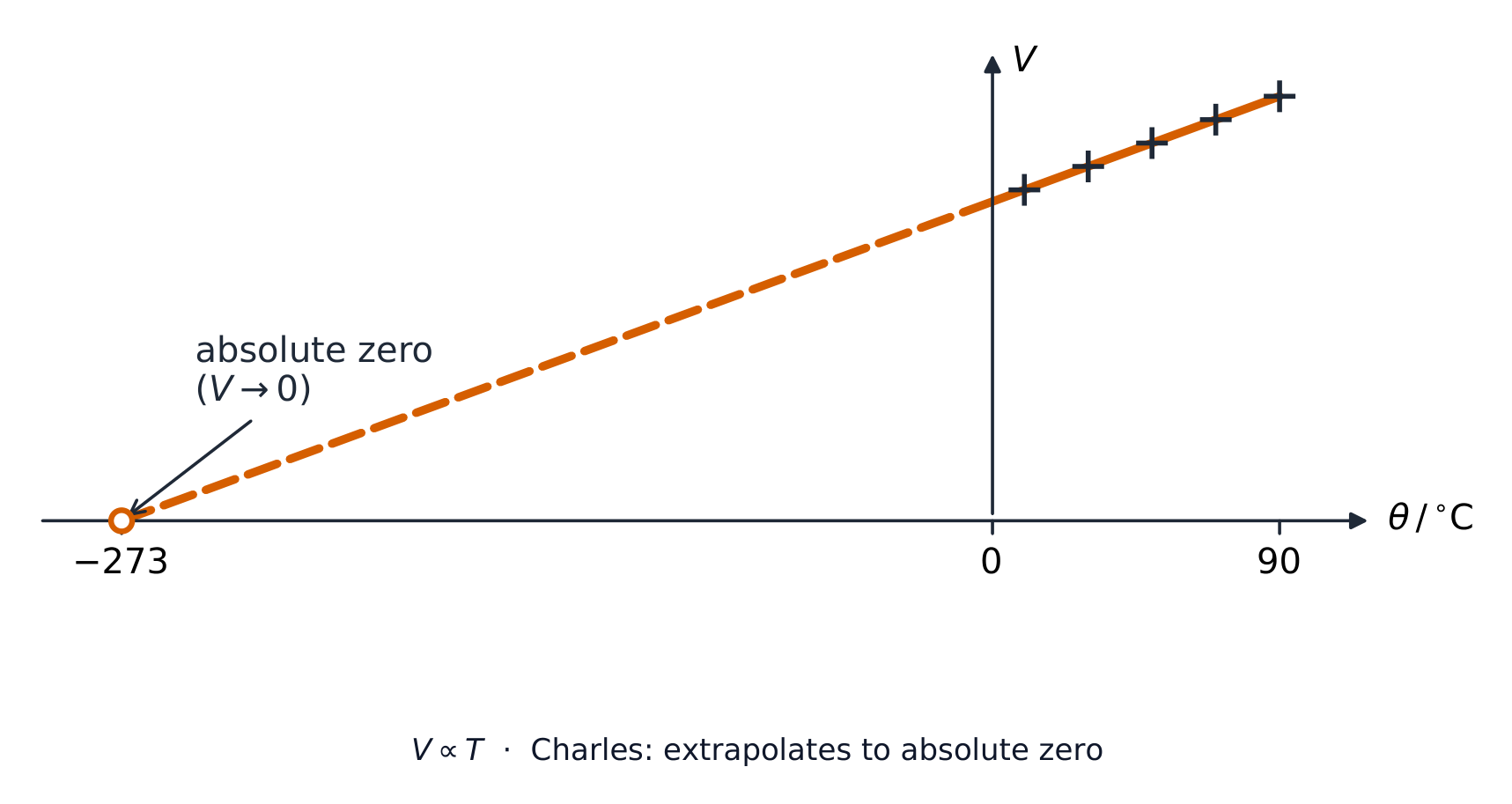
The line points at absolute zero, which is what makes the kelvin scale the natural one
The ideal gas (Boyle)
p = k / V
At constant temperature p ∝ 1/V — squeeze the volume and pressure rises.
At constant temperature, a gas at $100\ \text{kPa}$ is squeezed to half its volume. What is the new pressure?
Difficulty 2/5 · 140 coins + a small bonus on first completion today
Boyle: $pV$ is constant, so halving $V$ doubles $p$ → $200\ \text{kPa}$.
At constant pressure, $V$ divided by $T$ stays ____.
Difficulty 1/5 · 100 coins + a small bonus on first completion today
That is Charles's law: $\dfrac{V}{T} =$ constant at fixed pressure.
Match each gas law to what is held constant and what stays constant.
Difficulty 2/5 · 140 coins + a small bonus on first completion today
All three are the parent equation with one quantity fixed, so the fixed one cancels from p1V1/T1 = p2V2/T2.
Worked example: heating at constant pressure
- A fixed mass of gas at $300\ \text{K}$ occupies $0.50\ \text{m}^3$. It is heated to $450\ \text{K}$ at constant pressure. Find the new volume.
- Pressure is constant, so it cancels from $p_1V_1/T_1 = p_2V_2/T_2$, leaving $V/T$ constant.
- Both temperatures are already in kelvin here. Had they been in °C, the ratio would have been meaningless: $\tfrac{177}{27}$ is not $\tfrac{450}{300}$.
A fixed mass of gas at 300 K occupies 0.50 m^3. It is heated to 450 K at constant pressure. What is the new volume in m^3?
Difficulty 2/5 · 140 coins + a small bonus on first completion today
Pressure cancels, leaving V/T constant: V2 = 0.50 x 450/300 = 0.75 m^3. The ratio only works because both temperatures are in kelvin.
Worked example: reading a p-V cycle
- A fixed amount of gas at temperature $T$ is in state X, with pressure $2p$ and volume $V$. It is cooled at constant volume to state Y at pressure $p$, then heated at constant pressure to state Z at volume $2V$.
- X to Y is at constant volume, so $p/T$ is constant. Halving the pressure halves the temperature: $T_{\text{Y}} = T/2$.
- Y to Z is at constant pressure, so $V/T$ is constant. Doubling the volume doubles the temperature: $T_{\text{Z}} = T$.
- On a $p$-$V$ diagram a vertical line is constant volume and a horizontal line is constant pressure, and $pV/T$ has the same value at every state on the cycle. That last fact is what lets you check your answers.
A fixed amount of gas at temperature T, pressure 2p and volume V is cooled at constant volume to pressure p. What is its new temperature?
Difficulty 1/5 · 100 coins + a small bonus on first completion today
At constant volume p/T is constant, so halving the pressure halves the absolute temperature. On a p-V diagram this is a vertical line.
Marks that slip away
- Kelvin, always. $T(\text{K}) = \theta(^\circ\text{C}) + 273$. This is the most-penalised error in the topic.
- Match the form to the amount: moles with $R$, molecules with $k$. Mixing them is out by $N_{\text{A}}$.
- The two-mark definition of an ideal gas needs "at all values of $p$, $V$ and $T$" as well as the relationship.
- Volumes in m³ and pressures in Pa. A volume in litres or a pressure in kPa must be converted first.
You've got it
- an ideal gas obeys $pV \propto T$ with $T$ thermodynamic, at all values of $p$, $V$ and $T$
- $pV = nRT$ with moles and $R$, or $pV = NkT$ with molecules and $k$, and $k = R/N_{\text{A}}$; temperature in kelvin and SI units throughout
- for a fixed amount, $\dfrac{p_1V_1}{T_1} = \dfrac{p_2V_2}{T_2}$, and anything held constant cancels
- the three cases: Boyle ($pV$ constant), Charles ($V/T$ constant), pressure law ($p/T$ constant)