Kinetic theory of gases
Introduced| English | Meaning |
|---|---|
| kinetic theory/kɪˈnetɪk ˈθɪəri/ | A model that explains properties of matter through the motion and interactions of its particles. |
| random motion/ˈrændəm ˈməʊʃn/ | Motion whose direction and speed change without an orderly predictable pattern. |
| elastic/ɪˈlæstɪk/ | Describing a material or object that returns to its original shape or size after a deforming force is removed, within its elastic limit. |
| momentum/məʊˈmentəm/ | The product of mass and velocity. |
| mean-square speed/miːn skweə spiːd/ | The average of the squares of particles' speeds. |
| root-mean-square/ruːt miːn skweə/ | The square root of the mean of the squares of a set of values or a varying quantity. |
| average translational kinetic energy/ˈævrɪdʒ trænˈsleɪʃənl kɪˈnetɪk ˈenədʒi/ | The mean energy associated with particles moving from place to place, excluding rotation and vibration. |
Pressure is a drum roll, not a push
- A balloon feels like it is being pushed steadily outwards. Nothing is pushing steadily. Molecules are striking the rubber at random, each blow lasting a fraction of a nanosecond.
- There are so many blows, so close together, that the average is perfectly smooth. Pressure is a drum roll heard from far enough away that the individual beats disappear.
- Taking that picture seriously, and applying nothing but Newton's laws to it, produces the gas laws from scratch and reveals what temperature actually is.
- This lesson is the assumptions of kinetic theory 分子动理论, the pressure derivation, r.m.s. speed and the meaning of temperature.
The assumptions
- A large number of identical molecules in continuous random motion 无规则运动.
- The molecules' own volume is negligible compared with the volume of the gas.
- There are no forces between molecules except during collisions, so they travel in straight lines between them.
- Collisions are perfectly elastic 弹性, losing no kinetic energy, and the time of a collision is negligible compared with the time between collisions. Newton's laws apply throughout.
- These fail at very high pressure, where molecular volume matters, and at very low temperature, where intermolecular forces matter.
Select all the assumptions of the kinetic theory of an ideal gas.
Difficulty 2/5 · 140 coins + a small bonus on first completion today
Forces between molecules are ignored except during (elastic) collisions — they do not attract strongly at all times.
Deriving the pressure
- Take a cube of side $L$ holding $N$ molecules of mass $m$, and follow one moving along $x$ with velocity $u_1$.
- One collision with the right wall reverses its velocity, so its momentum 动量 changes by $-2mu_1$ and, by Newton's third law, the wall receives $+2mu_1$.
- Between hits on that wall it travels $2L$, so $\Delta t = 2L/u_1$, giving an average force $F_1 = \Delta p/\Delta t = mu_1^2/L$.
- Summing over all molecules and dividing by the wall area $L^2$ gives $p = Nm\langle u_x^2\rangle / V$. In three dimensions, symmetry means $\langle u_x^2\rangle = \tfrac13\langle c^2\rangle$, so:

One molecule, one wall, then multiply up
Boyle's law
p ∝ 1/V
At constant temperature, pressure is inversely proportional to volume — squash the gas and the pressure rises.
A gas exerts pressure on its container because the molecules:
Difficulty 1/5 · 100 coins + a small bonus on first completion today
Each collision pushes on the wall; the combined effect of countless collisions is the pressure.
Worked example: explain the pressure in words
- Explain how molecular movement causes the pressure exerted by a gas. [3]
- The molecules move randomly and collide with the walls of the container.
- At each collision a molecule rebounds, so its momentum changes; by Newton's second law the wall exerts a force on it, and by the third law it exerts an equal and opposite force on the wall.
- There are very many collisions each second, so the individual impulses average to a steady total force, and pressure is that force divided by the area.
- Three sentences, three marks. The middle one must name both of Newton's laws to earn its mark.
Put the three-mark explanation of gas pressure in order.
Difficulty 3/5 · 200 coins + a small bonus on first completion today
Random motion, momentum change with both of Newton's laws, the averaging over many collisions, then force per area.
The density form
- $Nm$ is the total mass of the gas, so $Nm/V$ is its density $\rho$. The same result reads:
- Use this version whenever a question gives a density instead of $N$ and $m$, which it often does.
Root-mean-square speed
- $\langle c^2 \rangle$ is the mean-square speed 均方速率: square each molecule's speed, then average. Its square root is the root-mean-square 均方根 speed:
- It is a single useful measure of molecular speed, slightly larger than the mean speed because squaring weights the fast molecules more heavily.
- The molecules do not all move at this speed. They have a wide spread, and raising the temperature shifts the whole spread to higher speeds.
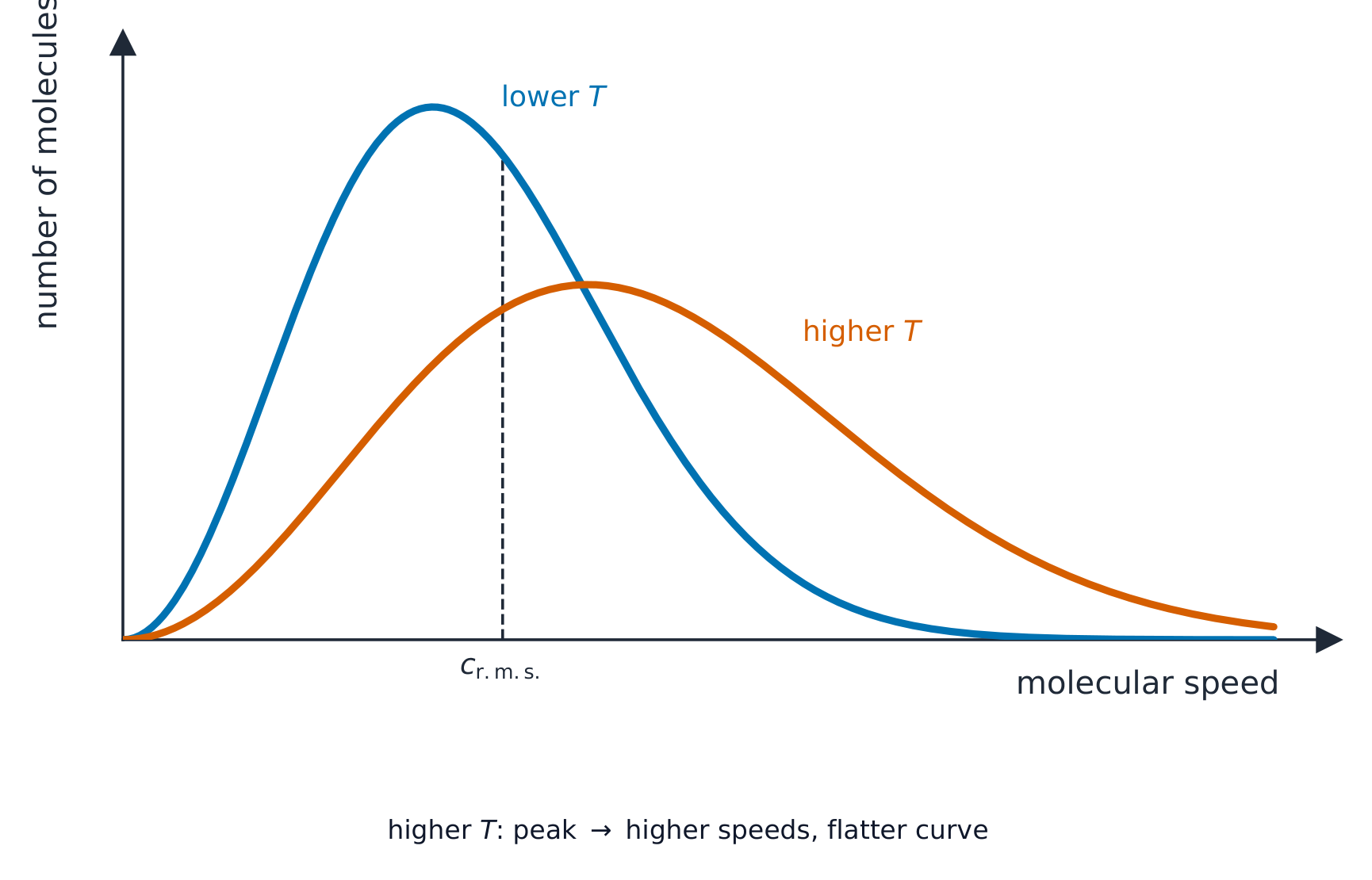
A distribution, of which the r.m.s. speed is one summary
The r.m.s. speed is the square root of the ____ speed.
Difficulty 1/5 · 100 coins + a small bonus on first completion today
Take the mean of the squared speeds, then square-root it: $c_{\text{r.m.s.}} = \sqrt{\langle c^{2}\rangle}$.
How is the root-mean-square speed calculated from a set of molecular speeds?
Difficulty 1/5 · 100 coins + a small bonus on first completion today
Square, average, root, in that order. Squaring first weights the fast molecules more, which is why c_rms is slightly larger than the mean speed.
Worked example: r.m.s. speed from a density
- An ideal gas at a pressure of $1.6 \times 10^5\ \text{Pa}$ has a density of $1.9\ \text{kg/m}^3$. Show that the r.m.s. speed of its molecules is about $500\ \text{m/s}$.
- From $p = \tfrac13\rho\langle c^2\rangle$: $\langle c^2 \rangle = \dfrac{3p}{\rho} = \dfrac{3 \times 1.6 \times 10^5}{1.9} = 2.53 \times 10^5\ \text{m}^2\text{/s}^2$.
- Then $c_{\text{r.m.s.}} = \sqrt{2.53 \times 10^5} = 503\ \text{m/s} \approx 500\ \text{m/s}$.
- In a "show that", carry an extra significant figure and quote it (503) before comparing with the value given. Rounding to 500 first proves nothing.
An ideal gas at 1.6 x 10^5 Pa has density 1.9 kg/m^3. What is the r.m.s. speed of its molecules, in m/s?
Difficulty 2/5 · 140 coins + a small bonus on first completion today
Use p = rho <c^2>/3, so <c^2> = 3p/rho = 2.53e5 and c_rms = 503 m/s. In a 'show that' question, quote the extra figure before rounding.
What temperature actually is
- Two expressions for the same $pV$: $pV = NkT$ from the equation of state, and $pV = \tfrac13 Nm\langle c^2\rangle$ from kinetic theory. Set them equal, cancel $N$ and multiply by $\tfrac32$:
- The left side is the average translational kinetic energy 平动动能 of one molecule. So temperature is a measure of average molecular kinetic energy, and nothing else.
- Two consequences the exam asks for. Double the absolute temperature and the average kinetic energy doubles, so $c_{\text{r.m.s.}}$ grows by $\sqrt{2}$. And at the same temperature, lighter molecules move faster, since $\tfrac12 m\langle c^2\rangle$ is the same for both.
The average translational kinetic energy of a gas molecule depends only on:
Difficulty 1/5 · 100 coins + a small bonus on first completion today
$\langle E_k\rangle = \tfrac{3}{2}kT$ — only the thermodynamic temperature matters.
If the absolute temperature doubles, the r.m.s. speed grows by a factor of:
Difficulty 2/5 · 140 coins + a small bonus on first completion today
$\langle c^{2}\rangle \propto T$, so $c_{\text{r.m.s.}} \propto \sqrt{T}$ — doubling $T$ multiplies it by $\sqrt{2} \approx 1.41$.
At the same temperature, lighter molecules move faster on average than heavier ones.
Difficulty 1/5 · 100 coins + a small bonus on first completion today
Same average KE $\tfrac{3}{2}kT$, but smaller mass means a larger $\langle c^{2}\rangle$ — so lighter molecules are faster.
Comparing pV = NkT with pV = Nm<c^2>/3 shows that the average translational kinetic energy of a molecule equals ____ kT.
Difficulty 1/5 · 100 coins + a small bonus on first completion today
So temperature is a direct measure of average molecular kinetic energy, and the internal energy of an ideal gas is (3/2)nRT.
Internal energy of an ideal gas
- An ideal gas has no forces between molecules, so there is no molecular potential energy: its internal energy is entirely kinetic.
- Multiplying the average kinetic energy by the number of molecules:
- So the internal energy of an ideal gas depends only on its temperature, not on its pressure or volume. That single fact does most of the work in the next lesson.
The internal energy of an ideal gas equals:
Difficulty 1/5 · 100 coins + a small bonus on first completion today
Ideal-gas molecules have only kinetic energy, so $U = \tfrac{3}{2}NkT = \tfrac{3}{2}nRT$ — proportional to $T$.
Marks that slip away
- The r.m.s. speed is the square root of the mean of the squares, not the mean speed. Order matters: square, average, then root.
- Average kinetic energy depends on temperature alone. Two different gases at the same temperature have the same average molecular kinetic energy.
- $T$ doubling makes $c_{\text{r.m.s.}}$ grow by $\sqrt{2}$, not by 2. The energy is proportional to $T$, so the speed goes as $\sqrt{T}$.
- An "explain the pressure" answer needs the momentum change, both of Newton's laws, and the very many collisions per second.
You've got it
- assumptions: many identical molecules in random motion, negligible molecular volume, no forces except in collisions, elastic collisions of negligible duration, Newton's laws apply
- $pV = \tfrac13 Nm\langle c^2\rangle$, or $p = \tfrac13\rho\langle c^2\rangle$ when a density is given; pressure is momentum change at the walls, averaged over very many collisions
- $c_{\text{r.m.s.}} = \sqrt{\langle c^2\rangle}$, one summary of a wide spread of speeds
- comparing with $pV = NkT$ gives $\tfrac12 m\langle c^2\rangle = \tfrac32 kT$: temperature is average molecular kinetic energy, so $U = \tfrac32 nRT$ depends on temperature alone