The mole
Introduced| English | Meaning |
|---|---|
| molecules/ˈmɒlɪkjuːlz/ | Groups of atoms joined by covalent bonds that can exist as discrete particles. |
| mole/məʊl/ | The SI unit of amount of substance, containing exactly 6.02214076 times ten to the power 23 specified entities. |
| amount of substance/əˈmaʊnt ɒv ˈsʌbstəns/ | A quantity proportional to the number of specified elementary entities in a sample, measured in moles. |
| kelvin/ˈkelvɪn/ | The SI unit of thermodynamic temperature, with zero at absolute zero. |
| Avogadro constant/ˌævəˈɡædrəʊ ˈkɒnstənt/ | The number of specified elementary entities in one mole, exactly 6.02214076 times ten to the power 23 per mole. |
| atoms/ˈætəmz/ | Units of chemical elements consisting of nuclei and electrons. |
| monatomic/ˌmɒnəˈtɒmɪk/ | Consisting of individual atoms rather than molecules containing several atoms. |
| molar mass/ˈməʊlə mæs/ | The mass of one mole of a substance. |
A number nobody can picture
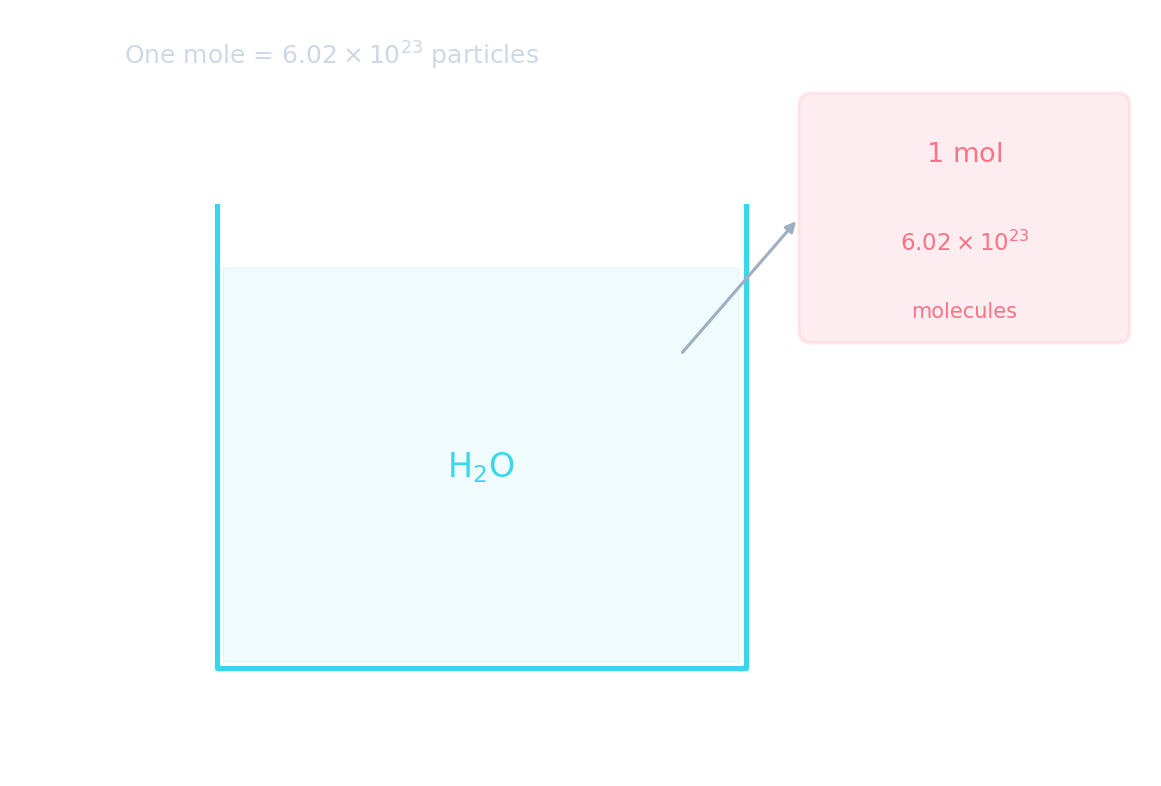
- Spread $6.02 \times 10^{23}$ grains of sand over the United Kingdom and the country would be buried ten metres deep. That is the number of water molecules in a tablespoon.
- Chemistry and physics both need to count particles, and no experiment can count them one at a time. So we count them in packets, and the packet holds that number.
- The packet is called the mole 摩尔, and it is an SI base unit alongside the metre, the kilogram and the second.
- This lesson is what the mole is, how to convert between moles, particles and mass, and the wording the examiner accepts.
Amount of substance and the mole
- Amount of substance 物质的量 is an SI base quantity, and its base unit is the mole (mol), one of the seven alongside the kilogram, metre, second, ampere and kelvin 开尔文.
- One mole of any substance contains a number of particles equal to the Avogadro constant 阿伏伽德罗常量:
- The examiner's one-mark definition: the Avogadro constant is the number of atoms or molecules in one mole of a substance. Adding "in 0.012 kg of carbon-12" is accepted but not required.

A fixed count, whatever the substance
One mole of a substance contains:
Difficulty 1/5 · 100 coins + a small bonus on first completion today
A mole always contains the Avogadro number, $N_{\text{A}} = 6.02 \times 10^{23}$, of particles.
The mole is one of the SI base units.
Difficulty 1/5 · 100 coins + a small bonus on first completion today
Yes — amount of substance (mole) is a base quantity, alongside the kilogram, metre, second, ampere and kelvin.
Say what you are counting
- A "particle" means whatever the substance is made of: atoms 原子 for a monatomic 单原子 element such as helium, molecules 分子 for $\text{O}_2$ or $\text{H}_2\text{O}$.
- One mole of oxygen gas contains $6.02 \times 10^{23}$ molecules, and therefore twice as many atoms. A question that says "molecules" and an answer that gives atoms is out by a factor of two.
- For $n$ moles the number of particles is:
A laboratory quantity on one side, an atomic count on the other
Mole particle count lab
particles = n x Avogadro constant
Change amount of substance and see particle number scale directly.
A sample contains $3.01 \times 10^{23}$ molecules. How many moles is this?
Difficulty 2/5 · 140 coins + a small bonus on first completion today
$n = \dfrac{N}{N_{\text{A}}} = \dfrac{3.01 \times 10^{23}}{6.02 \times 10^{23}} = 0.50\ \text{mol}$.
How many atoms are there in one mole of oxygen gas, O2?
Difficulty 1/5 · 100 coins + a small bonus on first completion today
One mole is 6.02 x 10^23 molecules, and each O2 molecule holds two atoms. Saying which particle you are counting is worth a mark on its own.
Molar mass
- The molar mass 摩尔质量 $M_{\text{m}}$ is the mass of one mole of the substance, in $\text{kg/mol}$ or $\text{g/mol}$.
- The mass of $n$ moles is $M = n M_{\text{m}}$, so the number of moles in a sample of mass $M$ is $n = M / M_{\text{m}}$.
- The mass of a single particle follows by dividing the mass of a mole by the number in a mole:
The molar mass is the mass of:
Difficulty 1/5 · 100 coins + a small bonus on first completion today
Molar mass is the mass per mole; dividing it by $N_{\text{A}}$ gives the mass of one particle.
The mass of a single particle equals the molar mass divided by the ____ constant.
Difficulty 1/5 · 100 coins + a small bonus on first completion today
$m_0 = \dfrac{M_{\text{m}}}{N_{\text{A}}}$ — molar mass shared over the $N_{\text{A}}$ particles in a mole.
Worked example: oxygen, both ways
- Oxygen has a molar mass of $32\ \text{g/mol}$. Find the mass of one oxygen molecule, and the number of molecules in $8.0\ \text{g}$ of oxygen.
- Mass of one molecule: work in kilograms. $m_0 = \dfrac{M_{\text{m}}}{N_{\text{A}}} = \dfrac{0.032}{6.02 \times 10^{23}} = 5.3 \times 10^{-26}\ \text{kg}$.
- Number of moles: $n = \dfrac{8.0}{32} = 0.25\ \text{mol}$. Then $N = n N_{\text{A}} = 0.25 \times 6.02 \times 10^{23} = 1.5 \times 10^{23}$ molecules.
- Keep molar masses in $\text{kg/mol}$ whenever the answer is wanted in kilograms. The stray factor of 1000 is the commonest slip in the whole topic.
The three conversions
- Moles to particles: multiply by $N_{\text{A}}$. Particles to moles: divide by $N_{\text{A}}$.
- Moles to mass: multiply by $M_{\text{m}}$. Mass to moles: divide by $M_{\text{m}}$.
- Mass to particles: go through moles. There is no single step, and inventing one is where errors come from.
- Every question in this subtopic is one or two of these six conversions in a row. Write down which one you need before reaching for the calculator.
Oxygen has a molar mass of 32 g/mol. What is the mass of one oxygen molecule, in units of 10^-26 kg?
Difficulty 2/5 · 140 coins + a small bonus on first completion today
Convert to kilograms first: 0.032 / (6.02 x 10^23) = 5.3 x 10^-26 kg. Dividing 32 by the Avogadro constant instead gives an answer 1000 times too large.
How many moles are there in 8.0 g of oxygen, molar mass 32 g/mol?
Difficulty 2/5 · 140 coins + a small bonus on first completion today
n = M / Mm = 8.0 / 32 = 0.25 mol, which is 1.5 x 10^23 molecules. Both masses are in grams here, so no conversion is needed.
How the mole links to the gas constants
- The mole is what connects the per mole and per molecule versions of the gas equations you meet next.
- The Boltzmann constant is the gas constant per molecule: $k = R / N_{\text{A}}$, equivalently $R = N_{\text{A}} k$.
- When a question asks for "the relationship between $N_{\text{A}}$, $R$ and $k$", that one line is the whole answer.
Match each conversion to what you do.
Difficulty 2/5 · 140 coins + a small bonus on first completion today
Every question in this subtopic is one or two of these in a row. Decide which before reaching for the calculator.
Marks that slip away
- State what you are counting. One mole of $\text{O}_2$ is $6.02 \times 10^{23}$ molecules and twice that many atoms.
- Convert grams to kilograms before dividing by $N_{\text{A}}$, or the particle mass is out by 1000.
- The mole is a base unit, and amount of substance a base quantity. It is not derived from anything.
- Mass to particles has no shortcut: go mass, then moles, then particles.
Write the relationship between the Boltzmann constant k, the molar gas constant R and the Avogadro constant NA, in the form k = ...
Difficulty 1/5 · 100 coins + a small bonus on first completion today
k is the gas constant per molecule, as R is per mole. That single line is the whole answer when the relationship is asked for.
You've got it
- amount of substance is an SI base quantity with base unit the mole; one mole holds $N_{\text{A}} = 6.02 \times 10^{23}$ particles
- $N = n N_{\text{A}}$, and a "particle" is an atom or a molecule depending on the substance, so say which
- molar mass is the mass of one mole: $M = n M_{\text{m}}$ and one particle has mass $M_{\text{m}} / N_{\text{A}}$
- $k = R / N_{\text{A}}$: the Boltzmann constant is the gas constant per molecule