这份讲义涵盖主题 4:力学(Mechanics)。它研究力如何使物体运动。在这个主题中,取自由落体的加速度为 $g = 10\ \text{m s}^{-2}$。
力学
A-Level 数学 · 第 4 主题
 12:38
12:38
Mechanics
Push a shopping trolley, and it speeds up. Push harder, and it speeds up faster. Push a heavier one with the same effort, and it barely moves. All of mechanics…
英文讲解 · 内嵌中英文字幕
4.1
力与平衡
大纲
| Candidates should be able to: | Notes and examples |
|---|---|
| identify the forces acting in a given situation | e.g. by drawing a force diagram. |
| understand the vector nature of force, and find and use components and resultants | Calculations are always required, not approximate solutions by scale drawing. |
| use the principle that, when a particle is in equilibrium, the vector sum of the forces acting is zero, or equivalently, that the sum of the components in any direction is zero | Solutions by resolving are usually expected, but equivalent methods (e.g. triangle of forces, Lami's Theorem, where suitable) are also acceptable; these other methods are not required knowledge, and will not be referred to in questions. |
| understand that a contact force between two surfaces can be represented by two components, the normal component and the frictional component | |
| use the model of a 'smooth' contact, and understand the limitations of this model | |
| understand the concepts of limiting friction and limiting equilibrium, recall the definition of coefficient of friction, and use the relationship $F = \mu R$ or $F \leqslant \mu R$, as appropriate | Terminology such as 'about to slip' may be used to mean 'in limiting equilibrium' in questions. |
| use Newton's third law. | e.g. the force exerted by a particle on the ground is equal and opposite to the force exerted by the ground on the particle. |
来源:剑桥国际大纲
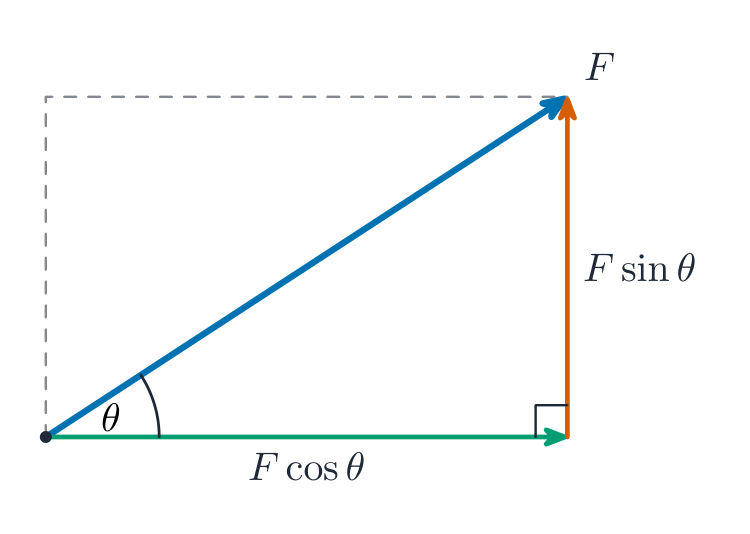
一个力(force)是一个推或一个拉。它是一个向量,所以它有大小和方向。因为它是一个向量,你可以把一个力拆成分量(components,通常是水平和竖直),而且你可以把几个力加成一个合力(resultant)。
当力平衡时,一个质点处于平衡(equilibrium):力的向量和为零。在实践中这意味着任何方向上的分量加起来为零。

Friction
当两个表面接触时,它们之间的接触力(contact force)有两部分:法向反作用力(normal reaction)$R$,与表面成直角,和摩擦力(friction)$F$,沿表面,它反对滑动。一个"光滑"表面是一个没有摩擦的模型。
摩擦只能增长到一个最大值。在那个最大值,物体处于极限平衡(limiting equilibrium),即将滑动,而摩擦是最大静摩擦力(limiting friction)。最大值由摩擦系数(coefficient of friction)$\mu$ 设定:
$$F \leqslant \mu R, \qquad \text{with } F = \mu R \text{ at the point of slipping}.$$

由牛顿第三定律(Newton's third law),两个表面以相等且相反的力互相推。
例题。 一个重 $20\text{ N}$ 的方块放在一张摩擦系数 $\mu = 0.4$ 的粗糙水平桌子上。求方块滑动之前能施加的最大水平力。
桌子的法向反作用力平衡重力,所以 $R = 20\text{ N}$。当摩擦达到它的最大值 $F = \mu R = 0.4 \times 20 = 8\text{ N}$ 时,方块处于即将滑动的点。在平衡中施加的力等于摩擦,所以它能抵抗的最大力是 $8\text{ N}$。
探索
Adding forces
resultant = a + b
Forces add tip-to-tail. They are in equilibrium when the resultant is zero.
词汇表
训练
| 英文 | 中文 | 拼音 |
|---|---|---|
| Mechanics/mɪˈkænɪks/ | 力学 | lì xué |
| force/fɔːs/ | 力 | lì |
| components/kəmˈpəʊnənts/ | 分量 | fèn liàng |
| resultant/rɪˈzʌltənt/ | 合力 | hé lì |
| equilibrium/ˌiːkwɪˈlɪbrɪəm/ | 平衡 | píng héng |
| contact force/ˈkɒntækt fɔːs/ | 接触力 | jiē chù lì |
| normal reaction/ˈnɔːml rɪˈækʃn/ | 法向反作用力 | fǎ xiàng fǎn zuò yòng lì |
| friction/ˈfrɪkʃn/ | 摩擦力 | mó cā lì |
| limiting friction/ˈlɪmɪtɪŋ ˈfrɪkʃn/ | 最大静摩擦力 | zuì dà jìng mó cā lì |
| coefficient of friction/ˌkəʊɪˈfɪʃənt ɒv ˈfrɪkʃn/ | 摩擦系数 | mó cā xì shù |
| Newton's third law/ˈnjuːtnz θɜːd lɔː/ | 牛顿第三定律 | niú dùn dì sān dìng lǜ |
| limiting equilibrium/ˈlɪmɪtɪŋ ˌiːkwɪˈlɪbrɪəm/ | 极限平衡 | jí xiàn píng héng |
4.2
直线运动的运动学

大纲
| Candidates should be able to: | Notes and examples |
|---|---|
| understand the concepts of distance and speed as scalar quantities, and of displacement, velocity and acceleration as vector quantities | Restricted to motion in one dimension only. The term 'deceleration' may sometimes be used in the context of decreasing speed. |
| sketch and interpret displacement–time graphs and velocity–time graphs, and in particular appreciate that – the area under a velocity–time graph represents displacement, – the gradient of a displacement–time graph represents velocity, – the gradient of a velocity–time graph represents acceleration | |
| use differentiation and integration with respect to time to solve simple problems concerning displacement, velocity and acceleration | Calculus required is restricted to techniques from the content for Paper 1: Pure Mathematics 1. |
| use appropriate formulae for motion with constant acceleration in a straight line. | Questions may involve setting up more than one equation, using information about the motion of different particles. |
来源:剑桥国际大纲
距离(distance)和速率(speed)是标量(只有大小)。位移(displacement)、速度(velocity)和加速度(acceleration)是向量(大小和方向)。
在一个速度时间图(velocity-time graph)上,图形下的面积是位移,而斜率是加速度(一个负加速度是一个减速度(deceleration))。在一个位移时间图上,斜率是速度。更一般地,关于时间微分从位移到速度到加速度,而积分回去。
对于匀加速(constant acceleration)的运动,用这些公式("suvat"方程):
$$v = u + at, \qquad s = ut + \tfrac12 at^2, \qquad v^2 = u^2 + 2as, \qquad s = \tfrac12(u + v)t.$$
例题。 一辆车从静止开始并以 $2.5\ \text{m s}^{-2}$ 加速 $4\ \text{s}$。求它的速率和行进的距离。
$$v = 0 + 2.5\times 4 = 10\ \text{m s}^{-1}, \qquad s = 0 + \tfrac12(2.5)(4^2) = 20\ \text{m}.$$
探索
Velocity–time graph
Change the start velocity and acceleration. The gradient is the acceleration; the area under the line is the displacement.
词汇表
训练
| 英文 | 中文 | 拼音 |
|---|---|---|
| distance/ˈdɪstəns/ | 距离 | jù lí |
| speed/spiːd/ | 速率 | sù lǜ |
| displacement/dɪˈspleɪsmənt/ | 位移 | wèi yí |
| velocity/vəˈlɒsɪti/ | 速度 | sù dù |
| acceleration/əkˌseləˈreɪʃn/ | 加速度 | jiā sù dù |
| velocity-time graph/vəˈlɒsɪti taɪm ɡræf/ | 速度时间图 | sù dù shí jiān tú |
| constant acceleration/ˈkɒnstənt əkˌseləˈreɪʃn/ | 匀加速 | yún jiā sù |
| deceleration/dɪˌseləˈreɪʃn/ | 减速度 | jiǎn sù dù |
4.3
动量

大纲
| Candidates should be able to: | Notes and examples |
|---|---|
| use the definition of linear momentum and show understanding of its vector nature | For motion in one dimension only. |
| use conservation of linear momentum to solve problems that may be modelled as the direct impact of two bodies. | Including direct impact of two bodies where the bodies coalesce on impact. Knowledge of impulse and the coefficient of restitution is not required. |
来源:剑桥国际大纲
一个物体的动量(linear momentum)是 $\text{mass} \times \text{velocity}$。它是一个向量。在两个物体的直接碰撞中,总动量不变。这是动量守恒(conservation of linear momentum):
$$m_1 u_1 + m_2 u_2 = m_1 v_1 + m_2 v_2.$$

例题。 一个质量 $2\ \text{kg}$、以 $3\ \text{m s}^{-1}$ 运动的物体撞上一个静止的质量 $1\ \text{kg}$ 的物体,它们粘在一起。求它们之后共同的速率。
$$2(3) + 1(0) = (2 + 1)v \;\Rightarrow\; v = \frac{6}{3} = 2\ \text{m s}^{-1}.$$
探索
A collision
Set each mass and speed and collide them. Total momentum stays the same before and after.
词汇表
训练
| 英文 | 中文 | 拼音 |
|---|---|---|
| momentum/məʊˈmentəm/ | 动量 | dòng liàng |
| conservation of momentum/ˌkɒnsəˈveɪʃn ɒv məʊˈmentəm/ | 动量守恒 | dòng liàng shǒu héng |
| mass/mæs/ | 质量 | zhì liàng |
4.4
牛顿运动定律

大纲
| Candidates should be able to: | Notes and examples |
|---|---|
| • apply Newton’s laws of motion to the linear motion of a particle of constant mass moving under the action of constant forces, which may include friction, tension in an inextensible string and thrust in a connecting rod | If any other forces resisting motion are to be considered (e.g. air resistance) this will be indicated in the question. |
| • use the relationship between mass and weight | $W = mg$. In this component, questions are mainly numerical, and use of the approximate numerical value $10\text{ (ms}^{-2}\text{)}$ for $g$ is expected. |
| • solve simple problems which may be modelled as the motion of a particle moving vertically or on an inclined plane with constant acceleration | Including, for example, motion of a particle on a rough plane where the acceleration while moving up the plane is different from the acceleration while moving down the plane. |
| • solve simple problems which may be modelled as the motion of connected particles. | e.g. particles connected by a light inextensible string passing over a smooth pulley, or a car towing a trailer by means of either a light rope or a light rigid tow-bar. |
来源:剑桥国际大纲
牛顿运动定律(Newton's laws of motion)连接力和加速度。关键的一个是:合力 $=$ 质量(mass)$\times$ 加速度,
$$F = ma.$$
一个物体的重力(weight)是它上面重力的力:$W = mg$。一个问题中的力可能包括重力、摩擦、一根绳中的张力(tension)、一根杆中的推力(thrust),以及空气阻力(air resistance)。
对于在一个斜面(inclined plane)上的运动,把每个力拆成沿斜坡的一部分和与它成直角的一部分,然后沿斜坡应用 $F = ma$。对于连接质点(connected particles,由一根绳连接),对每个物体、或对整个系统应用 $F = ma$。
例题。 一个质量 $12\ \text{kg}$ 的方块被一根平行于斜坡的绳沿一个粗糙的平面往上拉。平面与水平成 $20^\circ$,摩擦系数是 $0.4$,而加速度是 $2\ \text{m s}^{-2}$。求绳中的张力。
法向反作用力是 $R = mg\cos 20^\circ = 120\cos 20^\circ = 112.8\ \text{N}$,所以摩擦是 $F = \mu R = 0.4 \times 112.8 = 45.1\ \text{N}$。沿斜坡,$T - mg\sin 20^\circ - F = ma$:
$$T = ma + mg\sin 20^\circ + F = 12(2) + 120\sin 20^\circ + 45.1 = 24 + 41.0 + 45.1 = 110\ \text{N (3 s.f.)}.$$
探索
Resultant force
F = ma
The resultant force sets the acceleration. Balanced forces ⇒ no acceleration.
词汇表
训练
| 英文 | 中文 | 拼音 |
|---|---|---|
| Newton's laws of motion/ˈnjuːtnz lɔːz ɒv ˈməʊʃn/ | 牛顿运动定律 | niú dùn yùn dòng dìng lǜ |
| weight/weɪt/ | 重力 | zhòng lì |
| tension/ˈtenʃn/ | 张力 | zhāng lì |
| inclined plane/ɪnˈklaɪnd pleɪn/ | 斜面 | xié miàn |
| connected particles/kəˈnektɪd ˈpɑːtɪklz/ | 连接质点 | lián jiē zhì diǎn |
| thrust/θrʌst/ | 推力 | tuī lì |
| air resistance/eə rɪˈzɪstəns/ | 空气阻力 | kōng qì zǔ lì |
4.5
能量、功与功率

大纲
| Candidates should be able to: | Notes and examples |
|---|---|
| • understand the concept of the work done by a force, and calculate the work done by a constant force when its point of application undergoes a displacement not necessarily parallel to the force | $W = Fd \cos \theta$; Use of the scalar product is not required. |
| • understand the concepts of gravitational potential energy and kinetic energy, and use appropriate formulae | |
| • understand and use the relationship between the change in energy of a system and the work done by the external forces, and use in appropriate cases the principle of conservation of energy | Including cases where the motion may not be linear (e.g. a child on a smooth curved ‘slide’), where only overall energy changes need to be considered. |
| • use the definition of power as the rate at which a force does work, and use the relationship between power, force and velocity for a force acting in the direction of motion | Including calculation of (average) power as $$\frac{\text{Work done}}{\text{Time taken}}$$ $P = Fv$. |
| • solve problems involving, for example, the instantaneous acceleration of a car moving on a hill against a resistance. |
来源:剑桥国际大纲
一个恒定力做的功(work done)是力和位移的数量积——力乘以沿力方向移动的距离:$W = Fd\cos\theta$,其中 $\theta$ 是力和运动之间的角。功以焦耳(J)测量。
能量以你能计算的形式出现:
- 动能(kinetic energy,运动的能量):$\text{KE} = \tfrac12 mv^2$。
- 重力势能(gravitational potential energy,高度的能量):$\text{PE} = mgh$。
外力做的功等于总能量的变化。当没有摩擦作用时,总能量保持不变——能量守恒(conservation of energy)。
功率(power)是做功的速率。对于一个沿运动方向拉的力,$P = Fv$(功率 $=$ 力 $\times$ 速度)。功率以瓦特(W)测量。
例题。 一个汽车引擎在车以 $20\ \text{m s}^{-1}$ 在一条水平的路上运动时以 $12\ \text{kW}$ 工作。求驱动力。
$$P = Fv \;\Rightarrow\; F = \frac{P}{v} = \frac{12000}{20} = 600\ \text{N}.$$
探索
Conservation of energy
Drop the object and watch energy change form. With no friction, GPE + KE stays constant the whole way down.
词汇表
训练
| 英文 | 中文 | 拼音 |
|---|---|---|
| work done/wɜːk dʌn/ | 功 | gōng |
| kinetic energy/kɪˈnetɪk ˈenədʒi/ | 动能 | dòng néng |
| gravitational potential energy/ˌɡrævɪˈteɪʃənl pəˈtenʃl ˈenədʒi/ | 重力势能 | zhòng lì shì néng |
| conservation of energy/ˌkɒnsəˈveɪʃn ɒv ˈenədʒi/ | 能量守恒 | néng liàng shǒu héng |
| power/ˈpaʊə/ | 功率 | gōng lǜ |
4.5
考试技巧
- 画一个清晰的力图并分解成垂直的分量;对于平衡,每个方向加起来为零。
- 只对匀加速用 SUVAT 并保持一个一致的正方向。
- 沿运动方向应用 $F = ma$,在一个粗糙表面上包括摩擦($F = \mu R$)。
- 陈述你的假设(轻的不可伸长的绳、光滑的滑轮、质点)——它们常常值一分。
本主题的互动课程
逐步学习,并即时检测练习。