- explain and use the term rate of reaction, frequency of collisions, effective collisions and non-effective collisions
- explain qualitatively, in terms of frequency of effective collisions, the effect of concentration and pressure changes on the rate of a reaction
- use experimental data to calculate the rate of a reaction
反应动力学
A-Level 化学 · 第 8 主题
 7:13
7:13
Reaction kinetics
Iron left outside takes years to rust away. Strike a match, and almost the same chemistry — oxygen attacking a fuel — is over in less than a second. Same…
英文讲解 · 内嵌中英文字幕
8.1
反应速率

大纲
来源:剑桥国际大纲
反应速率(rate of reaction)是反应物变成产物的快慢。我们把它测量为每单位时间内浓度(或量)的变化。
要反应,粒子必须碰撞(collide)。碰撞频率(collision frequency)是粒子相互撞击的频繁程度。但并非每次碰撞都导致反应:
- 有效碰撞(effective collision)有足够的能量并且有正确的方向,所以发生反应。
- 无效碰撞(non-effective collision)没有足够的能量,或粒子以错误的角度撞击,所以什么也不发生。
所以速率取决于有效碰撞的频率——每秒发生多少次有用的碰撞。
浓度和压强
如果你增大一个溶液的浓度(或一个气体的压强),粒子被挤得更靠近。它们碰撞得更频繁,所以每秒有更多的有效碰撞,速率上升。

你可以从实验数据算出一个速率——例如,制得的气体体积除以所用的时间。
例题。 一个反应放出二氧化碳。在头 $30\ \text{s}$ 内,收集到 $48\ \text{cm}^3$ 气体。求这段时间内的平均反应速率。
$$\text{average rate} = \frac{\text{volume of gas}}{\text{time}} = \frac{48}{30} = 1.6\ \text{cm}^3\,\text{s}^{-1}.$$
速率在开始时最快(图在那里最陡),因为反应物最浓,然后随着它们被用完而变慢。
探索
Rate of reaction
[A] = [A]₀·bᵗ
Reactant concentration falls over time as it's used up.
词汇表
训练
| 英文 | 中文 | 拼音 |
|---|---|---|
| rate of reaction/reɪt ɒv rɪˈækʃn/ | 反应速率 | fǎn yìng sù lǜ |
| collide/kəˈlaɪd/ | 碰撞 | pèng zhuàng |
| collision frequency/kəˈlɪʒn ˈfriːkwənsi/ | 碰撞频率 | pèng zhuàng pín lǜ |
| effective collision/ɪˈfektɪv kəˈlɪʒn/ | 有效碰撞 | yǒu xiào pèng zhuàng |
| non-effective collision/nɒn ɪˈfektɪv kəˈlɪʒn/ | 无效碰撞 | wú xiào pèng zhuàng |
8.2
温度对反应速率的影响与活化能概念
大纲
- define activation energy, $E_A$, as the minimum energy required for a collision to be effective
- sketch and use the Boltzmann distribution to explain the significance of activation energy
- explain qualitatively, in terms both of the Boltzmann distribution and of frequency of effective collisions, the effect of temperature change on the rate of a reaction
来源:剑桥国际大纲
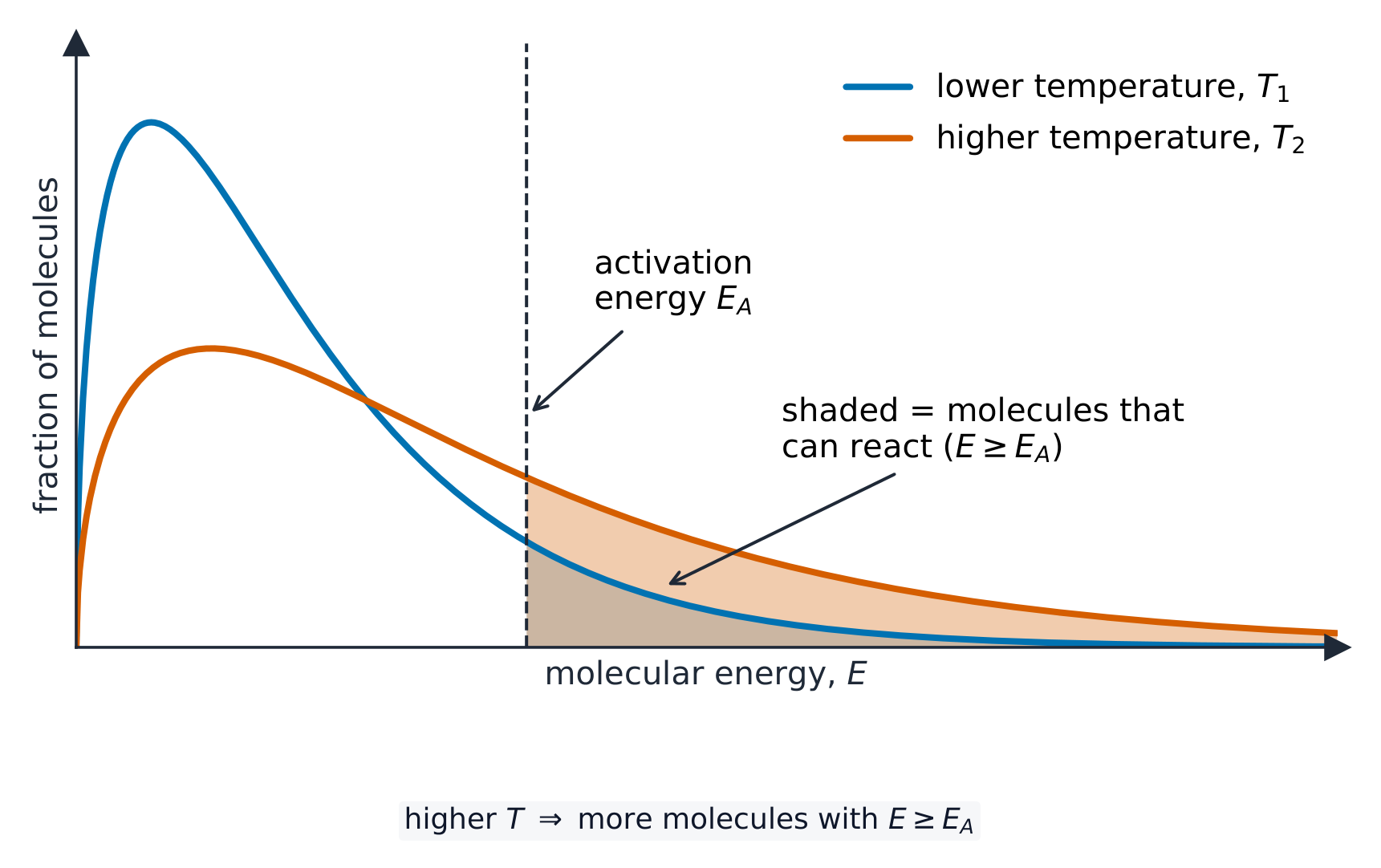
活化能(activation energy,$E_A$)是一次碰撞为了有效所需的最小能量。
玻尔兹曼分布(Boltzmann distribution)是一张显示在一个温度下分子的能量如何分布的图。曲线从原点开始,升到一个峰,然后在一条长尾中降落。曲线下方的总面积是分子的总数。只有 $E_A$ 右边的分子才有足够的能量反应。
当你升高温度时:
- 曲线变平并向右展开,所以现在能量大于 $E_A$ 的分子的比例大得多。
- 分子也运动得更快、碰撞得更频繁。
第一个效应是更大的那个。这就是为什么温度的一个小上升给出速率的一个大上升。
探索
Why heat speeds up reactions
Raise the temperature: the curve spreads right, so more molecules have at least the activation energy and can react.
词汇表
训练
| 英文 | 中文 | 拼音 |
|---|---|---|
| activation energy/ˌæktɪˈveɪʃn ˈenədʒi/ | 活化能 | huó huà néng |
| Boltzmann distribution/ˈbɒltsmən ˌdɪstrɪˈbjuːʃn/ | 玻尔兹曼分布 | bō ěr zī màn fēn bù |
8.3
均相与多相催化剂

大纲
- explain and use the terms catalyst and catalysis: (a) explain that, in the presence of a catalyst, a reaction has a different mechanism, i.e. one of lower activation energy (b) explain this catalytic effect in terms of the Boltzmann distribution (c) construct and interpret a reaction pathway diagram, for a reaction in the presence and absence of an effective catalyst
来源:剑桥国际大纲
一个催化剂(catalyst)加速一个反应但自己不被消耗。催化作用(catalysis)是这个作用的名称。
催化剂通过给反应一个不同的反应机理(reaction mechanism)——一条活化能更低的新路线——来起作用。在玻尔兹曼分布上,降低 $E_A$ 把线向左移,所以现在更多的分子有足够的能量。这意味着每秒更多的有效碰撞,以及更快的速率。
在一张反应路径图(reaction pathway diagram)上,被催化的路线有一个较低的能量"山丘"。反应的焓变 $\Delta H$ 不被催化剂改变。
有两种类型:
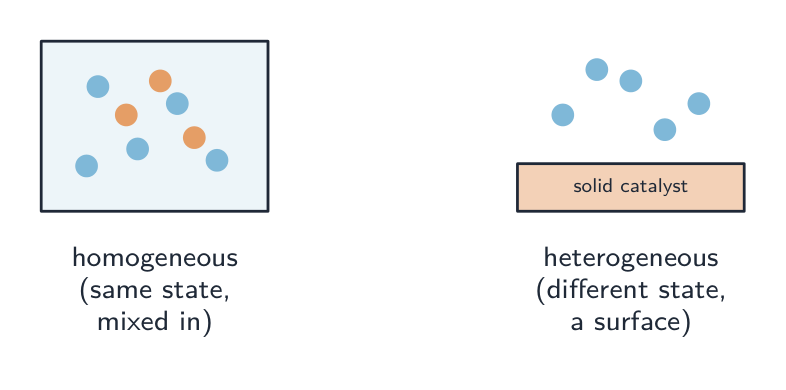
- 一个均相催化剂(homogeneous catalyst)与反应物处于相同的物理状态——例如,溶在一个液体溶液中的酸催化剂。
- 一个多相催化剂(heterogeneous catalyst)与反应物处于不同的状态——例如,在哈伯法中加速气体反应的固体铁。

探索
Catalysts
a catalyst lowers Ea
A catalyst lowers Ea, so a bigger fraction of molecules can react — without heating.
探索
How a catalyst works
Add a catalyst and watch the activation-energy barrier drop — it gives an easier route, without changing ΔH.
词汇表
训练
| 英文 | 中文 | 拼音 |
|---|---|---|
| catalyst/ˈkætəlɪst/ | 催化剂 | cuī huà jì |
| catalysis/kæˈtæləsɪs/ | 催化作用 | cuī huà zuò yòng |
| reaction mechanism/rɪˈækʃn ˈmekənɪzəm/ | 反应机理 | fǎn yìng jī lǐ |
| reaction pathway diagram/rɪˈækʃn ˈpæθweɪ ˈdaɪəɡræm/ | 反应路径图 | fǎn yìng lù jìng tú |
| homogeneous catalyst/həˈməʊdʒnɪəs ˈkætəlɪst/ | 均相催化剂 | jūn xiāng cuī huà jì |
| heterogeneous catalyst/ˌhetrəˈdʒiːnɪəs ˈkætəlɪst/ | 多相催化剂 | duō xiāng cuī huà jì |
8.3
考试技巧
- 用碰撞理论解释速率变化——更频繁和/或更有能量的有效碰撞。
- 在一张玻尔兹曼分布上标出 $E_A$,给它右边涂上阴影,并显示曲线在较高温度下变平并右移;它从原点开始且永不触及坐标轴。
- 一个催化剂给出一条 $E_A$ 更低的替代路线,并不改变 $\Delta H$。
- 说明为什么温度的一个小上升给出速率的一个大上升:现在超过 $E_A$ 的分子的比例大得多(主要效应)。
本主题的互动课程
逐步学习,并即时检测练习。