- explain the meanings of the terms haploid (n) and diploid (2n)
- explain what is meant by homologous pairs of chromosomes
- explain the need for a reduction division during meiosis in the production of gametes
- describe the behaviour of chromosomes in plant and animal cells during meiosis and the associated behaviour of the nuclear envelope, the cell surface membrane and the spindle (names of the main stages of meiosis, but not the sub-divisions of prophase I, are expected: prophase I, metaphase I, anaphase I, telophase I, prophase II, metaphase II, anaphase II and telophase II)
- interpret photomicrographs and diagrams of cells in different stages of meiosis and identify the main stages of meiosis
- explain that crossing over and random orientation (independent assortment) of pairs of homologous chromosomes and sister chromatids during meiosis produces genetically different gametes
- explain that the random fusion of gametes at fertilisation produces genetically different individuals
遗传
A-Level 生物 · 第 16 主题
 9:35
9:35
Genetics
You have twenty three pairs of chromosomes. When a gamete is made, each pair lines up independently — either way round — so the number of different gametes you…
英文讲解 · 内嵌中英文字幕
16.1
亲代向子代传递遗传信息

大纲
来源:剑桥国际大纲
一个二倍体(diploid)细胞(2n)有两整套染色体(chromosomes)——每个亲代一套。一个单倍体(haploid)细胞(n)只有一套。
染色体成同源染色体(homologous chromosomes)对出现:一对中的两个染色体长度相同并携带相同的基因(genes)(虽然它们可能携带这些基因的不同版本)。


配子(gametes,性细胞)必须是单倍体。若它们是二倍体,染色体数目就会每一代翻倍。所以配子由一种特殊的分裂,减数分裂(meiosis)制造,它把染色体数目减半。
减数分裂有两次分裂,一个接一个,所以有八个命名的阶段:前期 I、中期 I、后期 I 和末期 I,然后前期 II、中期 II、后期 II 和末期 II。如同有丝分裂,核膜(nuclear envelope)分解、一个纺锤体(spindle)构成,而染色体被纺锤体移动。
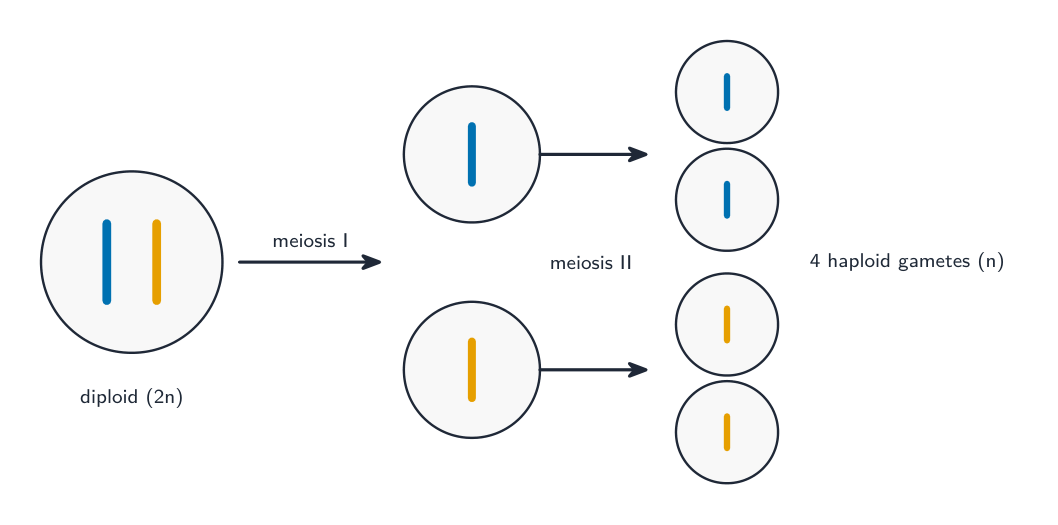
减数分裂以两种方式使配子彼此遗传上不同:
- 交叉互换(crossing over)——同源染色体交换匹配的片段,混合等位基因。

- 自由组合(independent assortment)——各对以一个随机的顺序排列,所以每个配子得到亲代染色体的一个随机混合。

然后在受精(fertilisation)时,任何配子能与任何其他配子融合。这种随机融合使每个新个体遗传上不同。
探索
Meiosis
Step through it. Two divisions halve the chromosome number and shuffle the alleles, giving four unique gametes.
词汇表
训练
| 英文 | 中文 | 拼音 |
|---|---|---|
| diploid/ˈdɪplɔɪd/ | 二倍体 | èr bèi tǐ |
| chromosome/ˈkrəʊməsəʊm/ | 染色体 | rǎn sè tǐ |
| haploid/ˈhæplɔɪd/ | 单倍体 | dān bèi tǐ |
| homologous chromosomes/həˈmɒləɡəs ˈkrəʊməsəʊmz/ | 同源染色体 | tóng yuán rǎn sè tǐ |
| gene/dʒiːn/ | 基因 | jī yīn |
| gamete/ˈɡæmiːt/ | 配子 | pèi zi |
| meiosis/meɪˈəʊsɪs/ | 减数分裂 | jiǎn shù fēn liè |
| nuclear envelope/ˈnjuːklɪə ˈenvələʊp/ | 核膜 | hé mó |
| spindle/ˈspɪndl/ | 纺锤体 | fǎng chuí tǐ |
| crossing over/ˈkrɒsɪŋ ˈəʊvə/ | 交叉互换 | jiāo chā hù huàn |
| independent assortment/ˌɪndɪˈpendənt əˈsɔːtmənt/ | 自由组合 | zì yóu zǔ hé |
| fertilisation/ˌfɜːtɪlaɪˈzeɪʃn/ | 受精 | shòu jīng |
16.1
遗传学的术语
你必须精确地知道这些术语:
- 一个基因是一段编码一个蛋白质(protein)的 DNA。它在一个染色体上的位置是它的基因座(locus)。
- 一个等位基因(allele)是一个基因的一个版本。
- 一个显性(dominant)等位基因即使只有一个副本存在时也显示它的效果;一个隐性(recessive)等位基因只在两个副本存在时才显示。
- 共显性(codominant)等位基因两者一起显示它们的效果。
- 基因型(genotype)是一个生物体拥有的等位基因;表现型(phenotype)是你能看到的特征。
- 纯合(homozygous)意味着两个等位基因相同;杂合(heterozygous)意味着它们不同。
- 一个测交(test cross)把一个生物体与隐性纯合子杂交以找出它未知的基因型。
探索
Genetics vocabulary lab
Link each genetics word to the real feature it names.
词汇表
训练
| 英文 | 中文 | 拼音 |
|---|---|---|
| protein/ˈprəʊtiːn/ | 蛋白质 | dàn bái zhì |
| locus/ˈləʊkəs/ | 基因座 | jī yīn zuò |
| allele/əˈliːl/ | 等位基因 | děng wèi jī yīn |
| dominant/ˈdɒmɪnənt/ | 显性 | xiǎn xìng |
| recessive/rɪˈsesɪv/ | 隐性 | yǐn xìng |
| codominant/ˈkəʊdəmɪnənt/ | 共显性 | gòng xiǎn xìng |
| genotype/ˈdʒenətaɪp/ | 基因型 | jī yīn xíng |
| phenotype/ˈfenətaɪp/ | 表现型 | biǎo xiàn xíng |
| homozygous/ˌhɒməˈzɪɡəs/ | 纯合 | chún hé |
| heterozygous/ˌhetrəˈzɪɡəs/ | 杂合 | zá hé |
| test cross/test krɒs/ | 测交 | cè jiāo |
16.1
遗传图解与杂交

你用一个遗传图显示一个杂交,常用一个庞纳特方格(Punnett square)——一个显示配子能组合的所有方式的网格。
- 一个单基因杂交(monohybrid cross)跟踪一个基因;一个双基因杂交(dihybrid cross)一次跟踪两个基因。
- 一些基因有复等位基因(multiple alleles,种群中多于两个版本),如人类血型的等位基因。
- 在伴性遗传(sex linkage)中,基因在 X 染色体上,所以结果对男性和女性不同。
- 在连锁(linkage)中,同一个常染色体(autosome,一个非性染色体)上的基因倾向于一起遗传。
- 在上位性(epistasis)中,一个基因影响另一个基因如何被显示。

探索
A monohybrid cross
Set each parent's genotype and read off the offspring. Crossing two heterozygotes (Aa × Aa) gives the classic 3 : 1 ratio.
词汇表
训练
| 英文 | 中文 | 拼音 |
|---|---|---|
| Punnett square/ˈpʌnɪt skweə/ | 庞纳特方格 | páng nà tè fāng gé |
| monohybrid cross/ˈmɒnəʊhaɪbrɪd krɒs/ | 单基因杂交 | dān jī yīn zá jiāo |
| dihybrid cross/daɪˈhaɪbrɪd krɒs/ | 双基因杂交 | shuāng jī yīn zá jiāo |
| multiple alleles/ˈmʌltɪpl əˈliːlz/ | 复等位基因 | fù děng wèi jī yīn |
| sex linkage/seks ˈlɪŋkɪdʒ/ | 伴性遗传 | bàn xìng yí chuán |
| linkage/ˈlɪŋkɪdʒ/ | 连锁 | lián suǒ |
| autosome/ˈɔːtəʊsəʊm/ | 常染色体 | cháng rǎn sè tǐ |
| epistasis/ɪpɪˈstɑːsiz/ | 上位性 | shàng wèi xìng |
16.1
卡方检验
卡方检验(chi-squared test)比较你实际数的结果(观察数,$O$)和你从遗传图预期的结果(预期数,$E$)。它告诉你差异是否小到足以归因于机遇,还是大到足以意味着有别的事情在发生。
你对每个组加起来观察和预期之间的平方差,除以预期:
$$\chi^2 = \sum \frac{(O - E)^2}{E}$$
然后你把这个 $\chi^2$ 值与一个表里的临界值比较。你用的行由自由度(组的数目减 1)设定。若 $\chi^2$ 小于临界值,差异不显著——结果符合预期的比,而任何差异只是机遇。若 $\chi^2$ 大于临界值,差异显著,所以某个其他因素牵涉其中。
例题。 一个 $\text{Tt} \times \text{Tt}$ 杂交给出 $160$ 个后代:$114$ 个高的和 $46$ 个矮的。检验这是否符合预期的 $3:1$ 比。
预期数是 $\tfrac{3}{4} \times 160 = 120$ 个高的和 $\tfrac{1}{4} \times 160 = 40$ 个矮的。然后:
$$\chi^2 = \frac{(114 - 120)^2}{120} + \frac{(46 - 40)^2}{40} = \frac{36}{120} + \frac{36}{40} = 0.30 + 0.90 = 1.20.$$
有 $2$ 个组,所以自由度 $= 2 - 1 = 1$。在 $p = 0.05$ 的临界值是 $3.84$。因为 $1.20 < 3.84$,差异不显著:结果符合一个 $3:1$ 比,而这个小差异归因于机遇。
探索
Test a genetic ratio with chi-squared
This is the worked example on the page. The cross gives $\chi^2 = 1.20$ with $1$ degree of freedom, and the widget shows the critical value $3.84$ — set the statistic to $1.20$ and it falls well short of the shaded region, so the results fit the $3:1$ ratio. Drag it past $3.84$ to see what a significant departure would look like.
词汇表
训练
| 英文 | 中文 | 拼音 |
|---|---|---|
| chi-squared test/kaɪ skweəd test/ | 卡方检验 | kǎ fāng jiǎn yàn |
16.2
基因在决定表现型中的作用
大纲
- explain the terms gene, locus, allele, dominant, recessive, codominant, linkage, test cross, F1, F2, phenotype, genotype, homozygous and heterozygous
- interpret and construct genetic diagrams, including Punnett squares, to explain and predict the results of monohybrid crosses and dihybrid crosses that involve dominance, codominance, multiple alleles and sex linkage
- interpret and construct genetic diagrams, including Punnett squares, to explain and predict the results of dihybrid crosses that involve autosomal linkage and epistasis (knowledge of the expected ratios for different types of epistasis is not expected)
- interpret and construct genetic diagrams, including Punnett squares, to explain and predict the results of test crosses
- use the chi-squared test to test the significance of differences between observed and expected results (the formula for the chi-squared test will be provided, as shown in the Mathematical requirements)
- explain the relationship between genes, proteins and phenotype with respect to the: • TYR gene, tyrosinase and albinism • HBB gene, haemoglobin and sickle cell anaemia • F8 gene, factor VIII and haemophilia • HTT gene, huntingtin and Huntington’s disease
- explain the role of gibberellin in stem elongation including the role of the dominant allele, Le, that codes for a functional enzyme in the gibberellin synthesis pathway, and the recessive allele, le, that codes for a non-functional enzyme
来源:剑桥国际大纲
一个基因编码一个蛋白质,而那个蛋白质影响表现型。若基因有缺陷,蛋白质有缺陷,而表现型改变:
| 基因 | 蛋白质 | 一个有缺陷等位基因的效果 |
|---|---|---|
| TYR | 酶(enzyme)酪氨酸酶 | 白化病(albinism,不制造色素) |
| HBB | 血红蛋白(haemoglobin) | 镰状细胞贫血(sickle cell anaemia) |
| F8 | 因子 VIII(帮助血液凝固) | 血友病(haemophilia) |
| HTT | 亨廷顿蛋白 | 亨廷顿病(Huntington's disease) |
Gibberellin and stem height
在豌豆植株中,显性等位基因 Le 编码一个制造赤霉素(gibberellin)的工作的酶,所以植株通过茎伸长(elongation)长得高。隐性等位基因 le 编码一个坏掉的酶,所以制造很少的赤霉素,而植株矮。
探索
From gene to phenotype
Step through it. A gene makes a protein that does a job — so a faulty allele makes a faulty protein and a changed feature.
词汇表
训练
| 英文 | 中文 | 拼音 |
|---|---|---|
| enzyme/ˈenzaɪm/ | 酶 | méi |
| albinism/ˈælbɪnɪzəm/ | 白化病 | bái huà bìng |
| haemoglobin/ˌhiːməˈɡləʊbɪn/ | 血红蛋白 | xuè hóng dàn bái |
| sickle cell anaemia/ˈsɪkl sel əˈniːmɪə/ | 镰状细胞贫血 | lián zhuàng xì bāo pín xuè |
| haemophilia/ˌhiːməˈfɪlɪə/ | 血友病 | xuè yǒu bìng |
| Huntington's disease/ˈhʌntɪŋtnz dɪˈziːz/ | 亨廷顿病 | hēng tíng dùn bìng |
| gibberellin/ˌdʒɪbəˈrelɪn/ | 赤霉素 | chì méi sù |
| elongation/iːˌlɒnˈɡeɪʃn/ | 伸长 | shēn cháng |
16.3
基因调控

大纲
- describe the differences between structural genes and regulatory genes and the differences between repressible enzymes and inducible enzymes
- explain genetic control of protein production in a prokaryote using the lac operon (knowledge of the role of cAMP is not expected)
- state that transcription factors are proteins that bind to DNA and are involved in the control of gene expression in eukaryotes by decreasing or increasing the rate of transcription
- explain how gibberellin activates genes by causing the breakdown of DELLA protein repressors, which normally inhibit factors that promote transcription
来源:剑桥国际大纲
不是所有的基因都一直开着。细胞控制它们制造哪些蛋白质。
- 结构基因(structural genes)编码有用的蛋白质如酶;调节基因(regulatory genes)控制其他基因是否开着。
- 一个可诱导酶(inducible enzyme)只在需要时才制造;一个可抑制酶(repressible enzyme)通常制造但能被关掉。
The lac operon
在一个像细菌的原核生物(prokaryote)中,一组叫乳糖操纵子(lac operon)的基因控制乳糖的消化:
- 当没有乳糖时,一个阻遏物(repressor)蛋白结合到操纵基因(operator,操纵子内一段短的控制序列)并阻挡转录(transcription),所以消化乳糖的酶不被制造。
- 当乳糖确实存在时,它结合到阻遏物并把它拉下来。转录现在能发生,而酶被制造。所以这些酶是可诱导的。
Control in eukaryotes
在真核生物中,转录因子(transcription factors)是结合到 DNA 并通过增加或减少转录速率来控制基因表达(gene expression)的蛋白质。
赤霉素以这种方式开启基因:它引起 DELLA 蛋白阻遏物的分解。这些 DELLA 蛋白通常阻挡开启转录的因子,所以移除它们让那些基因被表达。
探索
The lac operon
Step through the switch. With no lactose the genes are blocked; lactose pulls the repressor off and switches them on.
词汇表
训练
| 英文 | 中文 | 拼音 |
|---|---|---|
| structural gene/ˈstrʌktʃərəl dʒiːn/ | 结构基因 | jié gòu jī yīn |
| regulatory gene/ˌreɡjʊˈleɪtəri dʒiːn/ | 调节基因 | tiáo jié jī yīn |
| inducible enzyme/ɪnˈdjuːsɪbl ˈenzaɪm/ | 可诱导酶 | kě yòu dǎo méi |
| repressible enzyme/rɪˈpresɪbl ˈenzaɪm/ | 可抑制酶 | kě yì zhì méi |
| prokaryote/ˈprɒkərɪəʊt/ | 原核生物 | yuán hé shēng wù |
| lac operon/læk ˈɒpərən/ | 乳糖操纵子 | rǔ táng cāo zòng zi |
| repressor/rɪˈpresə/ | 阻遏物 | zǔ è wù |
| transcription/trænˈskrɪpʃn/ | 转录 | zhuǎn lù |
| transcription factor/trænˈskrɪpʃn ˈfæktə/ | 转录因子 | zhuǎn lù yīn zi |
| gene expression/dʒiːn ekˈspreʃn/ | 基因表达 | jī yīn biǎo dá |
16.3
考试技巧
- 完整地布置一个杂交:亲代基因型 → 配子(在圆圈里)→ 庞纳特方格 → 后代比和表现型。
- 用卡方检验比较观察与预期;自由度 $=$ 类别 $- 1$,在 $p = 0.05$ 与 $3.84$ 比较。
- 识别共显性、复等位基因、伴性遗传、上位性和连锁——每个都改变预期的比。
- 减数分裂通过交叉互换和自由组合创造变异——两者都陈述。
本主题的互动课程
逐步学习,并即时检测练习。