- outline the need for energy in living organisms, as illustrated by active transport, movement and anabolic reactions, such as those occurring in DNA replication and protein synthesis
- describe the features of ATP that make it suitable as the universal energy currency
- state that ATP is synthesised by: • transfer of phosphate in substrate-linked reactions • chemiosmosis in membranes of mitochondria and chloroplasts
- explain the relative energy values of carbohydrates, lipids and proteins as respiratory substrates
- state that the respiratory quotient (RQ) is the ratio of the number of molecules of carbon dioxide produced to the number of molecules of oxygen taken in, as a result of respiration
- calculate RQ values of different respiratory substrates from equations for respiration
- describe and carry out investigations, using simple respirometers, to determine the RQ of germinating seeds or small invertebrates (e.g. blowfly larvae)
能量与呼吸作用
A-Level 生物 · 第 12 主题
 9:49
9:49
Respiration
At any moment your body holds only about fifty grams of ATP. Yet over a single day you will make and spend roughly your own body weight of it. The same…
英文讲解 · 内嵌中英文字幕
12.1
能量

大纲
来源:剑桥国际大纲
细胞需要稳定的能量(energy)供应,它们从呼吸作用(respiration)获得。能量被用于:
- 主动运输(active transport,逆一个梯度移动物质),
- 运动(例如肌肉收缩),
- 合成代谢(anabolic)反应——大分子的建造,如在 DNA 复制和蛋白质合成中。
词汇表
训练
| 英文 | 中文 | 拼音 |
|---|---|---|
| energy/ˈenədʒi/ | 能量 | néng liàng |
| respiration/ˌrespɪˈreɪʃn/ | 呼吸作用 | hū xī zuò yòng |
| active transport/ˈæktɪv ˈtrænspɔːt/ | 主动运输 | zhǔ dòng yùn shū |
| anabolic/ˌænəˈbɒlɪk/ | 合成代谢 | hé chéng dài xiè |
12.1
ATP —— 能量货币

ATP 是把能量携带到需要它的地方的分子。它由 ADP 和一个磷酸基团制成;当它再次失去那个磷酸时,它释放一小份、可用的能量爆发。ATP 很好地适合这个工作,所以我们把它叫通用能量货币:
- 它快速释放能量,以匹配一个细胞需要的小量。
- 它容易被制造和重新制造,一遍又一遍。
- 它小而可溶,所以它容易在细胞周围移动。
ATP 以两种方式制造:通过在磷酸化(phosphorylation)反应中直接转移一个磷酸基团,以及通过跨线粒体(mitochondria)和叶绿体膜的化学渗透(chemiosmosis)。
探索
The ATP cycle
Step around the loop. ATP is split to release a small burst of energy, then rebuilt by respiration — over and over.
词汇表
训练
| 英文 | 中文 | 拼音 |
|---|---|---|
| phosphorylation/ˌfɒsfɔːrɪˈleɪʃn/ | 磷酸化 | lín suān huà |
| chemiosmosis/ˌkemɪəzˈməʊsɪs/ | 化学渗透 | huà xué shèn tòu |
12.1
呼吸底物与呼吸商

一个呼吸底物(respiratory substrate)是一个被分解以释放能量的分子。每克,脂质释放最多的能量(它们有最多的氢),蛋白质其次,而碳水化合物最少。
呼吸商(respiratory quotient,RQ)比较交换的气体:
$$\text{RQ} = \frac{\text{molecules of carbon dioxide produced}}{\text{molecules of oxygen taken in}}$$
你可以从一个呼吸方程算出 RQ。碳水化合物给出约 1.0 的 RQ,脂质约 0.7,蛋白质约 0.9。
例题。 求葡萄糖有氧呼吸的 RQ:$\text{C}_6\text{H}_{12}\text{O}_6 + 6\text{O}_2 \rightarrow 6\text{CO}_2 + 6\text{H}_2\text{O}$。
$$\text{RQ} = \frac{\text{CO}_2 \text{ produced}}{\text{O}_2 \text{ taken in}} = \frac{6}{6} = 1.0.$$
这就是为什么一个接近 $1.0$ 的 RQ 暗示生物体在呼吸碳水化合物;一个较低的 RQ(约 $0.7$)暗示它在用脂质,它每分子 $\text{CO}_2$ 需要更多的氧气。
一个呼吸计(respirometer)测量生物吸入的氧气(oxygen),如萌发(germinating)的种子或小的无脊椎动物(invertebrates),并被用来求它们的 RQ。

探索
Respiratory quotient lab
RQ = CO2 produced / O2 used
Change oxygen use and see how RQ compares fuels.
词汇表
训练
| 英文 | 中文 | 拼音 |
|---|---|---|
| respiratory substrate/rɪˈspɪrətəri ˈsʌbstreɪt/ | 呼吸底物 | hū xī dǐ wù |
| respiratory quotient/rɪˈspɪrətəri ˈkwəʊʃənt/ | 呼吸商 | hū xī shāng |
| respirometer/rɪspɪˈrɒmɪtə/ | 呼吸计 | hū xī jì |
| oxygen/ˈɒksɪdʒn/ | 氧气 | yǎng qì |
| germinate/ˈdʒɜːmɪneɪt/ | 萌发 | méng fā |
| invertebrate/ɪnˈvɜːtɪbreɪt/ | 无脊椎动物 | wú jǐ zhuī dòng wù |
| carbon dioxide/ˈkɑːbən daɪˈɒksaɪd/ | 二氧化碳 | èr yǎng huà tàn |
12.2
呼吸作用

大纲
- State where each of the four stages in aerobic respiration occurs in eukaryotic cells: • glycolysis in the cytoplasm • link reaction in the mitochondrial matrix • Krebs cycle in the mitochondrial matrix • oxidative phosphorylation on the inner membrane of mitochondria
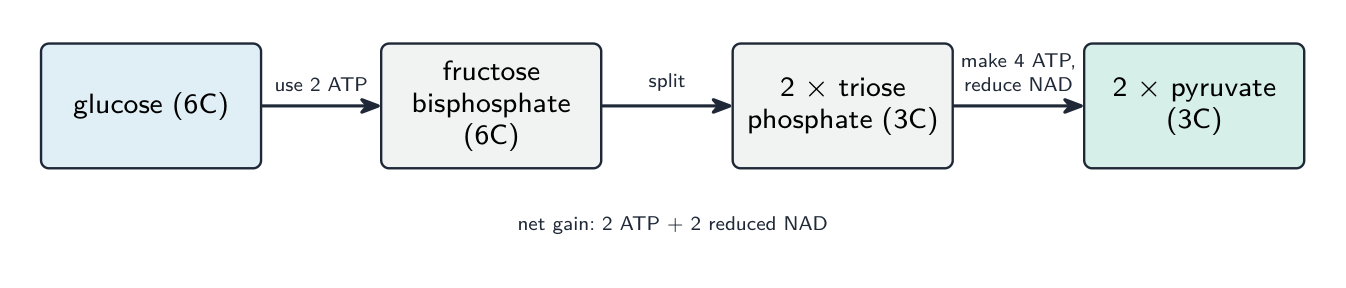
- outline glycolysis as phosphorylation of glucose and the subsequent splitting of fructose 1,6-bisphosphate (6C) into two triose phosphate molecules (3C), which are then further oxidised to pyruvate (3C), with the production of ATP and reduced NAD
- explain that, when oxygen is available, pyruvate enters mitochondria to take part in the link reaction
- describe the link reaction, including the role of coenzyme A in the transfer of acetyl (2C) groups
- outline the Krebs cycle, explaining that oxaloacetate (4C) acts as an acceptor of the 2C fragment from acetyl coenzyme A to form citrate (6C), which is converted back to oxaloacetate in a series of small steps
- explain that reactions in the Krebs cycle involve decarboxylation and dehydrogenation and the reduction of the coenzymes NAD and FAD
- describe the role of NAD and FAD in transferring hydrogen to carriers in the inner mitochondrial membrane
- explain that during oxidative phosphorylation: • hydrogen atoms split into protons and energetic electrons • energetic electrons release energy as they pass through the electron transport chain (details of carriers are not expected) • the released energy is used to transfer protons across the inner mitochondrial membrane • protons return to the mitochondrial matrix by facilitated diffusion through ATP synthase, providing energy for ATP synthesis (details of ATP synthase are not expected) • oxygen acts as the final electron acceptor to form water
- describe the relationship between the structure and function of mitochondria using diagrams and electron micrographs
- outline respiration in anaerobic conditions in mammals (lactate fermentation) and in yeast cells (ethanol fermentation)
- explain why the energy yield from respiration in aerobic conditions is much greater than the energy yield from respiration in anaerobic conditions (a detailed account of the total yield of ATP from the aerobic respiration of glucose is not expected)
- explain how rice is adapted to grow with its roots submerged in water, limited to the development of aerenchyma in roots, ethanol fermentation in roots and faster growth of stems
- describe and carry out investigations using redox indicators, including DCPIP and methylene blue, to determine the effects of temperature and substrate concentration on the rate of respiration of yeast
- describe and carry out investigations using simple respirometers to determine the effect of temperature on the rate of respiration
来源:剑桥国际大纲
有氧(aerobic)呼吸(带氧气)有四个阶段,每个在细胞里一个固定的位置:
| 阶段 | 它在哪里发生 |
|---|---|
| 糖酵解(glycolysis) | 细胞质(cytoplasm) |
| 连接反应(link reaction) | 线粒体的基质(matrix) |
| 克雷布斯循环(Krebs cycle) | 线粒体的基质 |
| 氧化磷酸化(oxidative phosphorylation) | 线粒体的内膜 |
Glycolysis
葡萄糖(glucose,6 碳)首先用 2 ATP 被磷酸化,以构成果糖二磷酸(6C)。这个 6C 分子被分裂成两个丙糖磷酸分子(各 3C)。这些随即被氧化(oxidised)成丙酮酸(pyruvate,3C)。糖酵解净得 2 ATP 和一些还原的(reduced)NAD(NAD 是一个辅酶(coenzyme),一个帮助分子)。
The link reaction
当氧气可用时,丙酮酸进入线粒体。在那里每个丙酮酸失去一个二氧化碳(carbon dioxide)并被变成一个 2 碳的乙酰基(acetyl)基团。这个基团由辅酶A(coenzyme A)携带以构成乙酰辅酶A。一些二氧化碳被释放,而 NAD 被还原。
The Krebs cycle
2C 的乙酰基基团加入一个 4 碳分子,草酰乙酸(oxaloacetate),以制造一个 6 碳分子,柠檬酸(citrate)。柠檬酸随即在一系列小步骤中被变回草酰乙酸,准备好接受下一个乙酰基基团。在这些步骤期间:
- 脱羧(decarboxylation)以二氧化碳的形式移除碳。
- 脱氢(dehydrogenation)移除氢,它还原辅酶 NAD 和 FAD。
还原的 NAD 和 FAD 随即把氢带到线粒体内膜中的载体。

Oxidative phosphorylation
这个阶段制造大部分的 ATP:
- 氢原子分裂成质子(protons)和有能量的电子(electrons)。
- 电子沿电子传递链(electron transport chain)传递,一路释放能量。
- 这个能量被用来把质子泵过内膜。
- 质子通过一个叫 ATP合酶(ATP synthase)的通道流回基质。这种流动提供制造 ATP 的能量(这是化学渗透)。
- 氧气是最终的电子受体:它与电子和质子结合以构成水。

The structure of mitochondria
内膜折叠成嵴(cristae),给电子传递链和 ATP 合酶一个大表面。里面的基质容纳连接反应和克雷布斯循环的物质和帮助者。

探索
Glycolysis
Step through it. Glucose is split in the cytoplasm into two pyruvate, for a small net gain of ATP and reduced NAD.
探索
The four stages of respiration
Step through where ATP comes from. Glucose is broken down in stages; most ATP is made at the last stage.
词汇表
训练
| 英文 | 中文 | 拼音 |
|---|---|---|
| mitochondria/ˌmaɪtəˈkɒndrɪə/ | 线粒体 | xiàn lì tǐ |
| aerobic/eəˈrəʊbɪk/ | 有氧 | yǒu yǎng |
| glycolysis/ɡlaɪˈkɒləsɪs/ | 糖酵解 | táng jiào jiě |
| cytoplasm/ˈsaɪtəplæzəm/ | 细胞质 | xì bāo zhì |
| link reaction/lɪŋk rɪˈækʃn/ | 连接反应 | lián jiē fǎn yìng |
| matrix/ˈmeɪtrɪks/ | 基质 | jī zhì |
| Krebs cycle/krebz ˈsaɪkl/ | 克雷布斯循环 | kè léi bù sī xún huán |
| oxidative phosphorylation/ˈɒksɪdətɪv ˌfɒsfɔːrɪˈleɪʃn/ | 氧化磷酸化 | yǎng huà lín suān huà |
| glucose/ˈɡluːkəʊs/ | 葡萄糖 | pú táo táng |
| oxidise/ˈɒksɪdaɪz/ | 氧化 | yǎng huà |
| pyruvate/ˈpaɪruːveɪt/ | 丙酮酸 | bǐng tóng suān |
| reduce/rɪˈdjuːs/ | 还原 | huán yuán |
| coenzyme/ˌkəʊˈenzaɪm/ | 辅酶 | fǔ méi |
| acetyl/ˈæsɪtaɪl/ | 乙酰基 | yǐ xiān jī |
| coenzyme A/ˌkəʊˈenzaɪm eɪ/ | 辅酶A | fǔ méi A |
| oxaloacetate/ˈɒksələʊsɪteɪt/ | 草酰乙酸 | cǎo xiān yǐ suān |
| citrate/ˈsɪtreɪt/ | 柠檬酸 | níng méng suān |
| decarboxylation/dɪˌkɑːbəksɪˈleɪʃn/ | 脱羧 | tuō suō |
| dehydrogenation/ˌdiːhaɪˈdrɒdʒəneɪʃn/ | 脱氢 | tuō qīng |
| electron/ɪˈlektrɒn/ | 电子 | diàn zi |
| electron transport chain/ɪˈlektrɒn ˈtrænspɔːt tʃeɪn/ | 电子传递链 | diàn zi chuán dì liàn |
| proton/ˈprəʊtɒn/ | 质子 | zhì zi |
| ATP synthase/ˌeɪ tiː ˈpiː ˈsɪnθeɪs/ | ATP合酶 | hé méi |
| cristae/ˈkrɪstiː/ | 嵴 | jǐ |
12.2
无氧呼吸

当没有氧气时,只有糖酵解能运行。为了让糖酵解继续,细胞必须用掉还原的 NAD。这通过发酵(fermentation)发生:
- 在哺乳动物中,丙酮酸被变成乳酸(lactate,乳酸发酵)。乳酸后来在氧气返回时被分解。
- 在酵母(yeast)中,丙酮酸被变成乙醇(ethanol)和二氧化碳(乙醇发酵)。
无氧(anaerobic)呼吸给出的能量远少于有氧呼吸。有氧呼吸也运行克雷布斯循环和氧化磷酸化,它们释放多得多的 ATP,而无氧呼吸只获得糖酵解的那一小份。
探索
Why fermentation matters
Step through it. Without oxygen, fermentation regenerates NAD so glycolysis can keep making a little ATP.
词汇表
训练
| 英文 | 中文 | 拼音 |
|---|---|---|
| fermentation/fɜːmənˈteɪʃn/ | 发酵 | fā jiào |
| lactate/ˈlækteɪt/ | 乳酸 | rǔ suān |
| yeast/jiːst/ | 酵母 | jiào mǔ |
| ethanol/ˈeθənɒl/ | 乙醇 | yǐ chún |
| anaerobic/ˌæneəˈrəʊbɪk/ | 无氧 | wú yǎng |
12.2
水稻与被水淹的根

水稻能在它的根在水下、那里氧气很少的情况下生长。它以三种方式适应:它在根中发育出通气组织(aerenchyma,充气的空间)以把空气带下去;根用乙醇发酵以保持制造一些 ATP;而茎生长得更快以到达水上的空气。
词汇表
训练
| 英文 | 中文 | 拼音 |
|---|---|---|
| aerenchyma/ˈeərəntʃɪmə/ | 通气组织 | tōng qì zǔ zhī |
12.2
研究呼吸速率
一个氧化还原指示剂(indicator)如 DCPIP 或亚甲基蓝,当它从进行呼吸作用的细胞获得氢时失去它的颜色。颜色失去得越快,酵母呼吸得越快,所以你可以测试温度或底物浓度的影响。一个呼吸计也可以被用来测量温度如何改变氧气吸收的速率。
词汇表
训练
| 英文 | 中文 | 拼音 |
|---|---|---|
| indicator/ˈɪndɪkeɪtə/ | 指示剂 | zhǐ shì jì |
12.2
考试技巧
- 陈述每个阶段在哪里发生及它的 ATP 产量:糖酵解(细胞质)、连接反应 + 克雷布斯(基质)、氧化磷酸化(内膜,大部分 ATP)。
- 解释 NAD/FAD 的作用(把氢带到电子传递链)和氧气的作用(最终的电子受体)。
- RQ $=$ 产生的 CO2 $\div$ 用掉的 O2($\approx 1.0$ 碳水化合物,$0.7$ 脂质);知道一个呼吸计如何测量它。
- 无氧呼吸给出乳酸(动物)或乙醇 + CO2(酵母/植物)以及远少的 ATP(只有糖酵解)。
本主题的互动课程
逐步学习,并即时检测练习。