Glycolysis and the link reaction · 糖酵解与连接反应
| English | 中文 | Pinyin · 拼音 |
|---|---|---|
| glycolysis/ɡlaɪˈkɒləsɪs/ | 糖酵解 | táng jiào jiě |
| link reaction/lɪŋk rɪˈækʃn/ | 连接反应 | lián jiē fǎn yìng |
| Krebs cycle/krebz ˈsaɪkl/ | 克雷布斯循环 | kè léi bù sī xún huán |
| oxidative phosphorylation/ˈɒksɪdətɪv ˌfɒsfɔːrɪˈleɪʃn/ | 氧化磷酸化 | yǎng huà lín suān huà |
| pyruvate/ˈpaɪruːveɪt/ | 丙酮酸 | bǐng tóng suān |
| coenzyme/ˌkəʊˈenzaɪm/ | 辅酶 | fǔ méi |
| acetyl coenzyme A/ˈæsɪtaɪl ˌkəʊˈenzaɪm eɪ/ | 乙酰辅酶A | yǐ xiān fǔ méi A |
Aerobic respiration: the first stages
- Aerobic respiration (with oxygen) runs in four stages.
- Each happens in a set place in the cell.
- We start with glycolysis 糖酵解 and the link reaction 连接反应.
有氧呼吸:最初的阶段
- 有氧(aerobic) 呼吸(有氧气)分 四个阶段 进行。
- 每个发生在细胞中一个固定的地方。
- 我们从 糖酵解(glycolysis) 和 连接反应(link reaction) 开始。
Glycolysis takes place in the cytoplasm, and needs no oxygen. · 糖酵解在细胞质中进行,不需要氧气。
Glycolysis is in the cytoplasm and is anaerobic; the later stages (Krebs, oxidative phosphorylation) are in the mitochondria. · 糖酵解在细胞质中且是无氧的;后面的阶段(克雷布斯、氧化磷酸化)在线粒体中。
Where each stage happens
| Stage | Location |
|---|---|
| glycolysis | the cytoplasm |
| link reaction | the matrix of the mitochondria |
| Krebs cycle 克雷布斯循环 | the matrix of the mitochondria |
| oxidative phosphorylation 氧化磷酸化 | the inner membrane of the mitochondria |
The four stages of aerobic respiration and where each one happens
每个阶段在哪里发生
| 阶段 | 位置 |
|---|---|
| 糖酵解 | 细胞质 |
| 连接反应 | 线粒体的 基质 |
| 克雷布斯循环 | 线粒体的 基质 |
| 氧化磷酸化 | 线粒体的 内膜 |

有氧呼吸的四个阶段以及每个在哪里发生
Match each stage of aerobic respiration to where it happens. · 把有氧呼吸的每个阶段与它发生的地方配对。
Glycolysis = cytoplasm; link reaction & Krebs = matrix; oxidative phosphorylation = inner membrane. · 糖酵解 = 细胞质;连接反应和克雷布斯 = 基质;氧化磷酸化 = 内膜。
Glycolysis
- In the cytoplasm, glucose (6C) is phosphorylated using 2 ATP, then split into two triose phosphate (3C) molecules.
- These are oxidised to two pyruvate 丙酮酸 (3C).
- Net result: a gain of 2 ATP and some reduced NAD (NAD is a coenzyme 辅酶, a helper molecule).
Glycolysis splits one glucose into two pyruvate, for a net gain of 2 ATP and reduced NAD
糖酵解
- 在细胞质中,葡萄糖(6C) 用 2 个 ATP 被磷酸化,然后分裂成 两个磷酸丙糖(3C) 分子。
- 这些被氧化成 两个丙酮酸(pyruvate,3C)。
- 净结果:得到 2 个 ATP 和一些 还原型 NAD(NAD 是一种辅酶,一种帮助分子)。
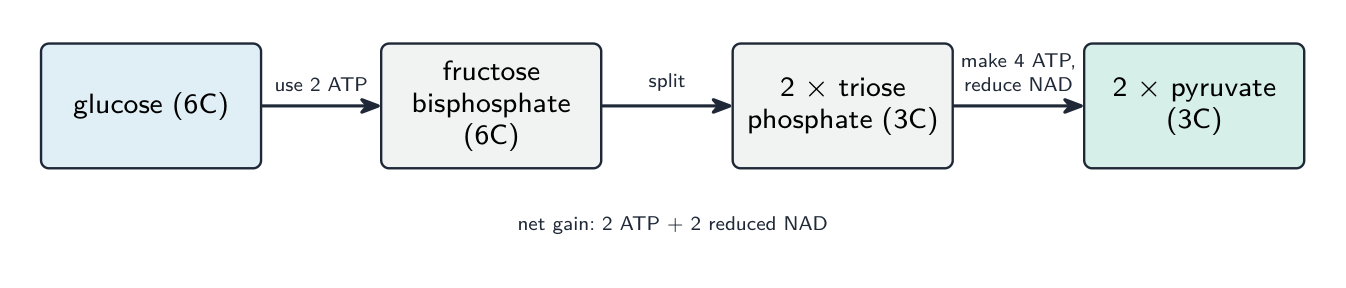
糖酵解把一个葡萄糖分裂成两个丙酮酸,净得 2 个 ATP 和还原型 NAD
Glycolysis · 糖酵解
Step through it. Glucose is split in the cytoplasm into two pyruvate, for a small net gain of ATP and reduced NAD. · 一步步走过它。葡萄糖在细胞质中被分裂成两个丙酮酸,得到少量净 ATP 和还原型 NAD。
The net yield of glycolysis is: · 糖酵解的净产量是:
Glycolysis uses 2 ATP and makes 4, a net gain of 2 ATP, plus reduced NAD. · 糖酵解使用 2 个 ATP 并制造 4 个,净得 2 个 ATP,加上还原型 NAD。
Glycolysis ends by splitting glucose into: · 糖酵解以把葡萄糖分裂成以下结束:
Glucose (6C) → 2 triose phosphate (3C) → 2 pyruvate (3C). · 葡萄糖(6C)→ 2 个磷酸丙糖(3C)→ 2 个丙酮酸(3C)。
Glycolysis gives a net gain of ______ ATP per glucose molecule. · 糖酵解每个葡萄糖分子净得 ______ 个 ATP。
2 ATP are used and 4 are made — a net gain of 2 ATP (plus 2 reduced NAD). · 使用 2 个 ATP 并制造 4 个——净得 2 个 ATP(加上 2 个还原型 NAD)。
Put the steps of glycolysis in order. · 把糖酵解的步骤按顺序排列。
Phosphorylate → split → oxidise to pyruvate, for a net 2 ATP and 2 reduced NAD. · 磷酸化 → 分裂 → 氧化成丙酮酸,净得 2 个 ATP 和 2 个还原型 NAD。
The link reaction
- When oxygen is available, pyruvate enters the mitochondrial matrix.
- Each pyruvate loses a CO₂ and becomes a 2-carbon acetyl group.
- Carried by coenzyme A, it forms acetyl coenzyme A 乙酰辅酶A; NAD is reduced.
连接反应
- 当氧气可用时,丙酮酸进入线粒体 基质。
- 每个丙酮酸 失去一个 CO₂ 并变成一个 2 碳的 乙酰(acetyl) 基团。
- 由 辅酶 A(coenzyme A) 携带,它形成 乙酰辅酶 A(acetyl coenzyme A);NAD 被还原。
In the link reaction, each pyruvate: · 在连接反应中,每个丙酮酸:
Pyruvate is decarboxylated (loses CO₂) to a 2C acetyl group, carried by coenzyme A as acetyl CoA. · 丙酮酸被脱羧(失去 CO₂)成一个 2C 乙酰基团,由辅酶 A 作为乙酰辅酶 A 携带。
You've got it
- aerobic respiration = 4 stages: glycolysis (cytoplasm), link + Krebs (matrix), oxidative phosphorylation (inner membrane)
- glycolysis: glucose → 2 pyruvate; net 2 ATP + reduced NAD
- link reaction: pyruvate → acetyl CoA (loses CO₂, reduces NAD)
你掌握了
- 有氧呼吸 = 4 个阶段:糖酵解(细胞质)、连接 + 克雷布斯(基质)、氧化磷酸化(内膜)
- 糖酵解:葡萄糖 → 2 个丙酮酸;净 2 个 ATP + 还原型 NAD
- 连接反应:丙酮酸 → 乙酰辅酶 A(失去 CO₂,还原 NAD)