- make temporary preparations of cellular material suitable for viewing with a light microscope
- draw cells from microscope slides and photomicrographs
- calculate magnifications of images and actual sizes of specimens from drawings, photomicrographs and electron micrographs (scanning and transmission)
- use an eyepiece graticule and stage micrometer scale to make measurements and use the appropriate units, millimetre (mm), micrometre (µm) and nanometre (nm)
- define resolution and magnification and explain the differences between these terms, with reference to light microscopy and electron microscopy
A-Level 生物
学习建议
A-Level 生物(9700)从细胞出发向外展开:细胞膜与运输、有丝分裂周期、核酸与蛋白质合成,然后是植物与哺乳动物的运输、气体交换、传染病与免疫。A2 增加呼吸作用、光合作用、稳态、遗传、选择与进化。
生物被称作“背诵型”学科,而这恰恰是失分的原因。指令词决定了大部分分数:“explain”要机理,“describe”不要。题目问 explain 时,再完美的描述也得不到分。
答案按具体的评分点批改。一句笼统地覆盖三个要点的话,通常只得一分,而不是三分。
-
1
细胞结构
1.1
显微镜在细胞研究中的应用

大纲
来源:剑桥国际大纲
细胞(cells)非常小,所以你不能只用眼睛看到它们。你用一台显微镜(microscope)把它们做成一幅更大的图像。你遇到的第一种是光学显微镜(light microscope)。它让光穿过一个薄的标本(specimen,你观察的材料)并用玻璃透镜放大视野。
一台光学显微镜:光向上穿过标本,然后两个透镜(物镜和目镜)放大它 Making a slide and drawing what you see
要观察活的材料,你制作一个临时装片(temporary preparation)。你把一小片薄的材料放在一块玻璃载玻片(slide)上、加一滴染色剂(stain,一种使各部分更容易看到的有色液体),然后在上面放下一块薄的盖玻片(cover slip)以把它压平并挡住空气。

制作一个临时湿装片——倾斜地放下盖玻片,这样没有气泡被困住 当你从一块载玻片或一张照片画细胞时,遵循简单的规则:
- 用一支尖的铅笔和清晰、单一的线条(不涂阴影)。
- 只画你真正能看到的,各部分用正确的大小。
- 用不交叉的直线标注各部分。
Magnification and actual size
放大倍数(magnification)告诉你图像比真实物体大多少倍。它没有单位。你用一个方程求它:

放大倍数 = 图像大小 ÷ 实际大小 $$\text{magnification} = \frac{\text{size of image}}{\text{actual size of object}}$$你可以重排它,从另外两个值求任何一个值:
$$\text{actual size} = \frac{\text{size of image}}{\text{magnification}}$$分数的上面和下面必须用同样的单位。细胞很小,所以你用小单位工作:
- $1\ \text{mm} = 1000\ \text{micrometre}$ 微米(µm)
- $1\ \text{µm} = 1000\ \text{nanometre}$ 纳米(nm)
- 所以 $1\ \text{mm} = 1\,000\,000\ \text{nm}$。
例题。 在一张放大倍数 $5000$ 的显微照片中,一个叶绿体(chloroplast)横向量得 $25\ \text{mm}$。它的实际大小是
$$\frac{25\ \text{mm}}{5000} = 0.005\ \text{mm} = 5\ \text{µm}.$$同样的方程适用于图画、显微照片(photomicrographs,通过光学显微镜拍的照片)和电子显微照片(electron micrographs,最详细的照片,下面解释)。总是先转换成同样的单位,然后相除。
Eyepiece graticule and stage micrometer
要测量显微镜下一个真实的细胞,你用一个目镜测微尺(eyepiece graticule)——目镜里面的一个微小刻度。它的分度没有固定的大小,所以你必须先校准(calibrate)它们(算出一个分度值多少)。
你用一个载物台测微尺(stage micrometer)校准——一块带精确刻度的特殊载玻片(常常是 $1\ \text{mm}$ 分成 $100$ 份,所以每份是 $10\ \text{µm}$)。你把两个刻度对齐,数有多少个测微尺分度对上一个已知长度,并相除。一旦校准好,你可以换上你的标本并用测微尺测量它。

通过把测微尺与载物台测微尺的已知刻度对齐来校准它 Resolution and magnification
这两个词容易混淆。考官为这个区别给分。
- 放大倍数是图像比物体大多少倍。
- 分辨率(resolution)是两个点之间仍能让你把它们看成两个分开的点的最小距离。
把一个图像做大并不总是显示更多细节。过了某一点你只会得到一个更大、更模糊的图像。分辨率设定细节的真实极限。
一台光学显微镜有较低的分辨率,因为光有相当长的波长(wavelength)。一台电子显微镜(electron microscope)用电子(electrons)束而不是光。电子有短得多的波长,所以分辨率高得多,你能看到细胞内部非常小的结构。有两种:扫描(scanning,以 3D 显示表面)和透射(transmission,让电子穿过一个薄切片以显示内部细节)。

分辨率:一台光学显微镜把两个非常近的点模糊成一个;一台电子显微镜,凭它更短的波长,把它们分辨为两个 探索Microscope decision lab
Choose the right microscopy idea from what the student wants to see.
词汇表 训练英文 中文 拼音 cell/sel/ 细胞 xì bāo microscope/ˈmaɪkrəskəʊp/ 显微镜 xiǎn wēi jìng light microscope/laɪt ˈmaɪkrəskəʊp/ 光学显微镜 guāng xué xiǎn wēi jìng specimen/ˈspesɪmən/ 标本 biāo běn temporary preparation/ˈtemprəri ˌprepəˈreɪʃn/ 临时装片 lín shí zhuāng piàn slide/slaɪd/ 载玻片 zài bō piàn stain/steɪn/ 染色剂 rǎn sè jì cover slip/ˈkʌvə slɪp/ 盖玻片 gài bō piàn magnification/ˌmæɡnɪfɪˈkeɪʃn/ 放大倍数 fàng dà bèi shù micrometre/ˈmaɪkrəʊmiːtə/ 微米 wēi mǐ nanometre/ˌnænəʊˈmiːtə/ 纳米 nà mǐ chloroplast/ˈklɔːrəʊplæst/ 叶绿体 yè lǜ tǐ photomicrograph/ˌfəʊtəʊˈmaɪkrəɡræf/ 显微照片 xiǎn wēi zhào piān electron micrograph/ɪˈlektrɒn ˈmaɪkrəɡræf/ 电子显微照片 diàn zi xiǎn wēi zhào piān eyepiece graticule/ˈaɪpiːs ˈɡrætɪkjuːl/ 目镜测微尺 mù jìng cè wēi chǐ calibrate/ˈkælɪbreɪt/ 校准 jiào zhǔn stage micrometer/steɪdʒ maɪˈkrɒmɪtə/ 载物台测微尺 zài wù tái cè wēi chǐ resolution/ˌrezəˈluːʃn/ 分辨率 fēn biàn lǜ wavelength/ˈweɪvleŋθ/ 波长 bō cháng electron microscope/ɪˈlektrɒn ˈmaɪkrəskəʊp/ 电子显微镜 diàn zi xiǎn wēi jìng electron/ɪˈlektrɒn/ 电子 diàn zi scanning/ˈskænɪŋ/ 扫描 sǎo miáo transmission/trænˈsmɪʃn/ 透射 tòu shè 1.2
细胞作为生物体的基本单位

大纲
- recognise organelles and other cell structures found in eukaryotic cells and outline their structures and functions, limited to: • cell surface membrane • nucleus, nuclear envelope and nucleolus • rough endoplasmic reticulum • smooth endoplasmic reticulum • Golgi body (Golgi apparatus or Golgi complex) • mitochondria (including the presence of small circular DNA) • ribosomes (80S in the cytoplasm and 70S in chloroplasts and mitochondria) • lysosomes • centrioles and microtubules • cilia • microvilli • chloroplasts (including the presence of small circular DNA) • cell wall • plasmodesmata • large permanent vacuole and tonoplast of plant cells
- describe and interpret photomicrographs, electron micrographs and drawings of typical plant and animal cells
- compare the structure of typical plant and animal cells
- state that cells use ATP from respiration for energy-requiring processes
- outline key structural features of a prokaryotic cell as found in a typical bacterium, including: • unicellular • generally 1–5 μm diameter • peptidoglycan cell walls • circular DNA • 70S ribosomes • absence of organelles surrounded by double membranes
- compare the structure of a prokaryotic cell as found in a typical bacterium with the structures of typical eukaryotic cells in plants and animals
- state that all viruses are non-cellular structures with a nucleic acid core (either DNA or RNA) and a capsid made of protein, and that some viruses have an outer envelope made of phospholipids
来源:剑桥国际大纲
植物和动物细胞是真核细胞(eukaryotic cells):它们的 DNA 被保存在一个细胞核(nucleus)里面。细胞内部有许多叫细胞器(organelles)的小部件,每个有它自己的工作。它们周围果冻状的液体是细胞质(cytoplasm)。
一个概括的动物细胞及它的细胞器 
一个植物细胞也有一个细胞壁、叶绿体和一个大液泡 在一张显微照片或电子显微照片中,你按细胞器的形状、大小和位置识别它们;在一张图画中,你显示它们的轮廓并标注它们。
细胞器 结构 功能 细胞膜(cell surface membrane) 细胞周围一层薄层 控制进出细胞的东西 细胞核 大,被一个核膜(nuclear envelope,一个带孔的双层膜)围绕;含一个核仁(nucleolus) 容纳 DNA;控制细胞;核仁制造核糖体 粗面内质网(rough endoplasmic reticulum,rough ER) 带核糖体在表面的膜片 制造并运输蛋白质(proteins,例如抗体(antibodies)) 滑面内质网(smooth endoplasmic reticulum,smooth ER) 膜片,无核糖体 制造脂质(lipids) 高尔基体(Golgi body) 一叠扁平的膜囊 改变蛋白质和脂质并把它们包进囊泡(vesicles)以供分泌(secretion) 线粒体(mitochondria) 椭圆形,带一个折叠的内膜;有小的环状 DNA 呼吸作用(respiration)的场所——以 ATP 释放能量(energy) 核糖体(ribosomes) 非常小;细胞质中 $80\text{S}$,叶绿体和线粒体中 $70\text{S}$ 连接氨基酸(amino acids)以合成(synthesise)蛋白质 溶酶体(lysosomes) 小的酶(enzymes)囊 分解旧的细胞器和废物 中心粒(centrioles)和微管(microtubules) 由蛋白质构成的小管 帮助移动染色体并构成细胞的"骨架" 纤毛(cilia) 细胞表面上摆动的微小毛 移动液体或移动细胞 微绒毛(microvilli) 细胞膜的微小褶皱 增加吸收(absorption)的表面积 叶绿体(chloroplasts,植物) 绿色,带堆叠的膜;有小的环状 DNA 光合作用(photosynthesis)的场所 细胞壁(cell wall,植物) 由纤维素(cellulose)构成的坚固外层 支持并保护细胞;阻止它胀破 胞间连丝(plasmodesmata,植物) 穿过细胞壁的微小通道 连接相邻细胞的细胞质 大的永久液泡(vacuole,植物) 大的水状液体囊,带一个叫液泡膜(tonoplast)的膜 储存水并保持细胞坚挺 细胞把呼吸作用中制造的 ATP 用作它们每项需要能量的工作的能量供应,例如制造蛋白质、移动东西和分裂。
Comparing plant and animal cells
特征 植物细胞 动物细胞 细胞壁 有(纤维素) 无 叶绿体 有 无 大的永久液泡 有 无(只有小的、临时的) 中心粒 大多数中无 有 形状 固定而规则 更圆、更灵活 两者都有一个细胞膜、细胞质、一个细胞核、线粒体、核糖体、ER 和一个高尔基体。
探索Explore an animal cell
Tap each numbered part to check you know its job — the same organelles as the table above.
词汇表 训练英文 中文 拼音 eukaryotic cell/ˌjuːkərɪˈɒtɪk sel/ 真核细胞 zhēn hé xì bāo nucleus/ˈnjuːklɪəs/ 细胞核 xì bāo hé organelle/ˌɔːɡəˈnel/ 细胞器 xì bāo qì cytoplasm/ˈsaɪtəplæzəm/ 细胞质 xì bāo zhì cell surface membrane/sel ˈsɜːfɪs ˈmembreɪn/ 细胞膜 xì bāo mó nuclear envelope/ˈnjuːklɪə ˈenvələʊp/ 核膜 hé mó nucleolus/ˌnjuːklɪˈəʊləs/ 核仁 hé rén rough endoplasmic reticulum/rʌf ˌendəʊˈplæzmɪk reˈtɪkjʊləm/ 粗面内质网 cū miàn nèi zhì wǎng protein/ˈprəʊtiːn/ 蛋白质 dàn bái zhì antibody/ˈæntɪbɒdi/ 抗体 kàng tǐ smooth endoplasmic reticulum/smuːð ˌendəʊˈplæzmɪk reˈtɪkjʊləm/ 滑面内质网 huá miàn nèi zhì wǎng lipid/ˈlɪpɪd/ 脂质 zhī zhì Golgi body/ˈɡɒlɡɪ ˈbɒdi/ 高尔基体 gāo ěr jī tǐ vesicle/ˈvesɪkl/ 囊泡 náng pào secretion/sɪˈkriːʃn/ 分泌 fēn mì mitochondria/ˌmaɪtəˈkɒndrɪə/ 线粒体 xiàn lì tǐ respiration/ˌrespɪˈreɪʃn/ 呼吸作用 hū xī zuò yòng energy/ˈenədʒi/ 能量 néng liàng ribosome/ˈriːbəʊsəʊm/ 核糖体 hé táng tǐ amino acid/əˈmiːnəʊ ˈæsɪd/ 氨基酸 ān jī suān synthesise/ˈsɪnθəsaɪz/ 合成 hé chéng lysosome/ˈlaɪsəʊsəʊm/ 溶酶体 róng méi tǐ enzyme/ˈenzaɪm/ 酶 méi centriole/ˈsentrɪəʊl/ 中心粒 zhōng xīn lì microtubule/ˌmaɪkrəʊˈtjuːbjuːl/ 微管 wēi guǎn cilia/ˈsɪlɪə/ 纤毛 xiān máo microvilli/ˈmaɪkrəʊvɪlaɪ/ 微绒毛 wēi róng máo absorption/əbˈsɔːpʃn/ 吸收 xī shōu photosynthesis/ˌfəʊtəʊˈsɪnθəsɪs/ 光合作用 guāng hé zuò yòng cell wall/sel wɔːl/ 细胞壁 xì bāo bì cellulose/ˈseljuːləʊs/ 纤维素 xiān wéi sù plasmodesmata/ˌplæzməʊdˈsmɑːtə/ 胞间连丝 bāo jiān lián sī vacuole/ˈvækjuːəʊl/ 液泡 yè pào tonoplast/ˈtɒnəplæst/ 液泡膜 yè pào mó envelope/ˈenvələʊp/ 包膜 bāo mó 1.2
原核细胞(细菌)

一个原核细胞(prokaryotic cell),如一个细菌(bacterium),比一个真核细胞小得多、简单得多。它的关键特征是:
- 单细胞(unicellular)——它是一个单一的细胞。
- 一般横向 $1$–$5\ \text{µm}$。
- 一个由肽聚糖(peptidoglycan,不是纤维素)构成的细胞壁。
- 自由地躺在细胞质中的环状 DNA——没有细胞核。
- $70\text{S}$ 核糖体(比真核生物细胞质中的 $80\text{S}$ 的小)。
- 没有被双层膜围绕的细胞器——所以没有细胞核、没有线粒体、没有叶绿体。
一个原核细胞:环状 DNA(拟核)自由地躺着,没有细胞核、没有双层膜细胞器 Comparing prokaryotic and eukaryotic cells
特征 原核细胞 真核细胞 大小 约 $1$–$5\ \text{µm}$ 约 $10$–$100\ \text{µm}$ DNA 环状,自由在细胞质中 线状,在一个细胞核里面 细胞核 无 有 双层膜细胞器 无 线粒体(以及植物中的叶绿体) 核糖体 $70\text{S}$ $80\text{S}$(线粒体和叶绿体里面有 $70\text{S}$) 细胞壁 肽聚糖 纤维素(植物)或无(动物) 探索Explore a bacterial cell
A prokaryote is smaller and simpler. Tap each part — notice there is no nucleus and no double-membrane organelles.
词汇表 训练英文 中文 拼音 prokaryotic cell/ˌprɒkərɪˈɒtɪk sel/ 原核细胞 yuán hé xì bāo bacterium/bækˈtɪərɪəm/ 细菌 xì jūn unicellular/ˌjuːnɪˈseljʊlə/ 单细胞 dān xì bāo peptidoglycan/ˈpeptɪdɒɡlɪkən/ 肽聚糖 tài jù táng 1.2
病毒

所有病毒(viruses)都是非细胞(non-cellular)的——它们根本不是由细胞构成的。每个病毒只由两三个部分构成:
- 一个核酸(nucleic acid)核心,它是 DNA 或 RNA(从不两者都有)。
- 核心周围一个叫衣壳(capsid)的蛋白质外壳。
- 在一些病毒中,一个由磷脂(phospholipids)构成的外包膜(envelope)。
一个被极大放大的真实病毒。圆形的头是包裹着核酸核心的蛋白质衣壳;尾部把那些核酸注入细菌。注意比例尺——整个病毒只有大约 100 纳米,远比任何细胞都小 
一个概括的病毒:核酸在一个蛋白质衣壳里面,一些病毒中带一层脂质包膜 一个病毒没有细胞质、没有细胞器、没有核糖体。它不能呼吸或制造它自己的蛋白质。它只能在一个活的宿主(host)细胞里面复制自己,所以它坐在我们称为"有生命"的边缘。
探索Explore a virus
A virus is non-cellular — just a few parts. Tap each one: there is no cytoplasm, no organelles and no ribosomes.
词汇表 训练英文 中文 拼音 virus/ˈvaɪrəs/ 病毒 bìng dú non-cellular/nɒn ˈseljʊlə/ 非细胞 fēi xì bāo nucleic acid/njuːˈklɪɪk ˈæsɪd/ 核酸 hé suān capsid/ˈkæpsɪd/ 衣壳 yī ké phospholipid/ˈfɒsfəlɪpɪd/ 磷脂 lín zhī host/həʊst/ 宿主 sù zhǔ 1.2
考试技巧
- 放大倍数 $=$ 图像大小 $\div$ 实际大小——先转换单位($\text{mm} \leftrightarrow \mu\text{m} \leftrightarrow \text{nm}$),然后重排以求未知的那个。
- 区分放大倍数(大多少倍)和分辨率(仍被看成两个点的最小距离);电子显微镜分辨更多,因为电子有更短的波长。
- 给每个细胞器一个结构 + 功能对(例如线粒体:折叠的内膜 → 有氧呼吸)。
- 精确地陈述原核对真核的区别:无细胞核、更小的(70S)核糖体、无膜结合细胞器、环状 DNA。
- 病毒是无生命的——只用衣壳、遗传物质和(有时)一个包膜来描述它们。
-
2
生物分子
2.1
生物分子的检测

大纲
- describe and carry out the Benedict’s test for reducing sugars, the iodine test for starch, the emulsion test for lipids and the biuret test for proteins
- describe and carry out a semi-quantitative Benedict’s test on a reducing sugar solution by standardising the test and using the results (time to first colour change or comparison to colour standards) to estimate the concentration
- describe and carry out a test to identify the presence of non-reducing sugars, using acid hydrolysis and Benedict’s solution
来源:剑桥国际大纲
生物由四种主要的大分子(molecule)构成:碳水化合物(carbohydrates)、脂质(lipids)、蛋白质(proteins)和核酸(nucleic acids)。你可以用简单的化学测试来查出一个样品中存在哪些种类。
本尼迪特测试:随着更多还原糖存在,蓝色变绿,然后橙,然后砖红 测试 它检出什么 方法 阳性结果 本尼迪特测试 还原糖(reducing sugar) 加本尼迪特溶液并在水浴中加热 蓝色变绿、黄、橙,然后砖红沉淀(precipitate) 碘测试 淀粉(starch) 加橙棕色的碘(iodine)溶液 颜色变蓝黑 乳浊液测试 脂质(lipid) 把样品与乙醇混合,然后倒入水中 形成一个白色、浑浊的乳浊液(emulsion) 双缩脲(biuret)测试 蛋白质(protein) 在室温加双缩脲溶液 蓝色变紫 Semi-quantitative Benedict's test
普通的本尼迪特测试只告诉你"是或否"。一个半定量(semi-quantitative)测试给出一个粗略的量。首先你标准化(standardise)这个测试:你在已知浓度(concentration)的溶液上运行它并记录每个的结果。然后你可以用以下之一估计一个未知量:
- 到第一次颜色变化的时间(更多的糖更快变色),或
- 把最终颜色与你的一组颜色标准比较。
Testing for non-reducing sugars
一些糖,如蔗糖,是非还原糖(non-reducing sugar):它们给出一个阴性的本尼迪特测试。要检出它们:
- 先做一个普通的本尼迪特测试。它保持蓝色(没有还原糖)。
- 取一个新鲜样品并加稀盐酸(hydrochloric acid),然后加热。这个酸水解把糖分解成更小的还原糖。
- 冷却,然后用碳酸氢钠中和(neutralise)酸。
- 现在再做一次本尼迪特测试。一个砖红色显示曾存在一个非还原糖。

测试一个非还原糖:先用酸水解它,然后第二次本尼迪特测试变红 例题。 某溶液的本尼迪特试验呈阴性。随后把它与稀盐酸共煮,用碳酸氢钠中和,再用本尼迪特试剂复检 - 这次变成砖红色。原来含有什么?为什么每一步都必需?第一次的阴性结果排除了还原糖。与酸共煮会水解糖苷键,把像蔗糖这样的非还原糖拆成它的还原性单糖。中和这一步必不可少,因为本尼迪特试剂只在碱性条件下起作用 - 省掉它,即使有糖,试验也会失败。因此复检呈阳性说明原来一直存在非还原糖。要把第一次的阴性试验作为答案的一部分写出来:没有它,最后的红色无法把非还原糖与还原糖区分开。
探索Testing for a non-reducing sugar
Step through the trick: a non-reducing sugar stays blue, so you hydrolyse it with acid, neutralise, then re-test.
词汇表 训练英文 中文 拼音 molecule/ˈmɒlɪkjuːl/ 分子 fèn zǐ carbohydrate/ˌkɑːbəʊˈhaɪdreɪt/ 碳水化合物 tàn shuǐ huà hé wù lipid/ˈlɪpɪd/ 脂质 zhī zhì protein/ˈprəʊtiːn/ 蛋白质 dàn bái zhì nucleic acid/njuːˈklɪɪk ˈæsɪd/ 核酸 hé suān reducing sugar/rɪˈdjuːsɪŋ ˈʃʊɡə/ 还原糖 huán yuán táng precipitate/prɪˈsɪpɪteɪt/ 沉淀 chén diàn starch/stɑːtʃ/ 淀粉 diàn fěn iodine/ˈaɪədiːn/ 碘 diǎn emulsion/ɪˈmʌlʃn/ 乳浊液 rǔ zhuó yè biuret/ˈbɪjuːrət/ 双缩脲 shuāng suō niào semi-quantitative/ˈsemi ˈkwɒntɪteɪtɪv/ 半定量 bàn dìng liàng standardise/ˈstændədaɪz/ 标准化 biāo zhǔn huà concentration/ˌkɒnsənˈtreɪʃn/ 浓度 nóng dù non-reducing sugar/nɒn rɪˈdjuːsɪŋ ˈʃʊɡə/ 非还原糖 fēi huán yuán táng hydrochloric acid/ˌhaɪdrəˈklɔːrɪk ˈæsɪd/ 盐酸 yán suān neutralise/ˈnjuːtrəlaɪz/ 中和 zhōng hé 2.2
糖类与脂质

大纲
- describe and draw the ring forms of α-glucose and β-glucose
- define the terms monomer, polymer, macromolecule, monosaccharide, disaccharide and polysaccharide
- state the role of covalent bonds in joining smaller molecules together to form polymers
- state that glucose, fructose and maltose are reducing sugars and that sucrose is a non-reducing sugar
- describe the formation of a glycosidic bond by condensation, with reference to disaccharides, including sucrose, and polysaccharides
- describe the breakage of a glycosidic bond in polysaccharides and disaccharides by hydrolysis, with reference to the non-reducing sugar test
- describe the molecular structure of the polysaccharides starch (amylose and amylopectin) and glycogen and relate their structures to their functions in living organisms
- describe the molecular structure of the polysaccharide cellulose and outline how the arrangement of cellulose molecules contributes to the function of plant cell walls
- state that triglycerides are non-polar hydrophobic molecules and describe the molecular structure of triglycerides with reference to fatty acids (saturated and unsaturated), glycerol and the formation of ester bonds
- relate the molecular structure of triglycerides to their functions in living organisms
- describe the molecular structure of phospholipids with reference to their hydrophilic (polar) phosphate heads and hydrophobic (non-polar) fatty acid tails
来源:剑桥国际大纲
Monomers, polymers and macromolecules
- 一个单体(monomer)是一个作为单一单元的小分子。
- 一个聚合物(polymer)是一个由许多单体连接在一起构成的长分子。
- 一个大分子(macromolecule)是任何非常大的分子。
糖有三种大小:
- 一个单糖(monosaccharide)是一个单一的糖单元,如葡萄糖(glucose)和果糖。
- 一个二糖(disaccharide)是两个单元连接,如麦芽糖和蔗糖。
- 一个多糖(polysaccharide)是许多单元连接成一个聚合物。
葡萄糖、果糖(fructose)和麦芽糖(maltose)是还原糖。蔗糖(sucrose)是一个非还原糖。
Two ring forms of glucose
葡萄糖有六个碳原子并构成一个环。有两种环形式。它们只在碳 1 上不同:
- 在 α-葡萄糖中,碳 1 上的 –OH 基团指下,在环下面。
- 在 β-葡萄糖中,碳 1 上的 –OH 基团指上,在环上面。
这个小差别决定葡萄糖能构建哪种多糖。
两种环形式只在碳 1 上不同:–OH 在 α 中指下,在 β 中指上 Joining and breaking sugars
单体由强的共价键(covalent bonds)连接。当两个糖连接时,它们之间形成一个糖苷键(glycosidic bond)。这通过缩合(condensation)发生:每次一个键形成时移除一个水分子。
反过来是水解(hydrolysis):加一个水分子来打断一个糖苷键。这就是为什么非还原糖测试需要酸和热——它们把蔗糖水解成葡萄糖和果糖。

缩合移除水以连接单体;水解加水以分裂它们 Storage polysaccharides: starch and glycogen
淀粉是植物中的能量(energy)储存。它由 α-葡萄糖的两种聚合物构成:
- 直链淀粉(amylose)——一条长的、无分支的链,盘绕成一个螺旋。
- 支链淀粉(amylopectin)——一条带许多侧分支的链。
糖原(glycogen)是动物中的能量储存。它像支链淀粉,但有更多的分支,所以在需要能量时它能被快速分解。
这些储存很好地适合它们的工作:它们紧凑、它们不溶(insoluble,所以它们不离开细胞),而且它们不改变细胞的水势(water potential,所以它们不通过渗透(osmosis)把水拉进来)。许多分支给出许多端,所以葡萄糖可以被快速添加或移除。

马铃薯内部真实的淀粉粒,被碘染色。每一粒都是直链淀粉和支链淀粉的一个致密、不溶的包裹——注意比例:最大的也只有大约 0.1 毫米宽 Cellulose
纤维素(cellulose)由 β-葡萄糖构成。因为 β 形式,每隔一个葡萄糖就翻转过来,所以链是长而直的。许多直链并排躺着,由氢键(hydrogen bonds)保持在一起成为叫微纤丝(microfibrils)的坚固束。这些给植物细胞壁(cell wall)它的强度并阻止细胞胀破。

形状适合工作:直链淀粉盘绕、支链淀粉/糖原分支(为了紧凑的储存),而直的纤维素链紧密堆积成坚固的纤维 探索Condensation and hydrolysis
Step through how two sugars join. Condensation removes one water to make the bond; hydrolysis is the reverse — adding water splits it again.
词汇表 训练英文 中文 拼音 monomer/ˈmɒnəʊmə/ 单体 dān tǐ polymer/ˈpɒlɪmə/ 聚合物 jù hé wù macromolecule/ˈmækrəmɒlɪkjuːl/ 大分子 dà fēn zi monosaccharide/ˈmɒnəʊsækɑːraɪd/ 单糖 dān táng glucose/ˈɡluːkəʊs/ 葡萄糖 pú táo táng disaccharide/ˌdɪsəkˈhɑːraɪd/ 二糖 èr táng polysaccharide/ˌpɒlɪˈsækɑːraɪd/ 多糖 duō táng fructose/ˈfrʌktəʊs/ 果糖 guǒ táng maltose/ˈmɒltəʊs/ 麦芽糖 mài yá táng sucrose/ˈsuːkrəʊs/ 蔗糖 zhè táng covalent bond/ˈkəʊvələnt bɒnd/ 共价键 gòng jià jiàn glycosidic bond/ˌɡlaɪkəˈsɪdɪk bɒnd/ 糖苷键 táng gān jiàn condensation/kɒndenˈseɪʃn/ 缩合 suō hé hydrolysis/haɪˈdrɒləsɪs/ 水解 shuǐ jiě energy/ˈenədʒi/ 能量 néng liàng amylose/ˈæmɪləʊs/ 直链淀粉 zhí liàn diàn fěn amylopectin/ˈæmɪləʊpktɪn/ 支链淀粉 zhī liàn diàn fěn glycogen/ˈɡlaɪkədʒn/ 糖原 táng yuán insoluble/ɪnˈsɒljuːbl/ 不溶 bù róng water potential/ˈwɔːtə pəˈtenʃl/ 水势 shuǐ shì osmosis/ɒzˈməʊsɪs/ 渗透 shèn tòu cellulose/ˈseljuːləʊs/ 纤维素 xiān wéi sù hydrogen bond/ˈhaɪdrədʒn bɒnd/ 氢键 qīng jiàn microfibril/ˈmaɪkrəʊfɪbrəl/ 微纤丝 wēi xiān sī cell wall/sel wɔːl/ 细胞壁 xì bāo bì soluble/ˈsɒljuːbl/ 可溶 kě róng 2.2
脂质

Triglycerides
一个甘油三酯(triglyceride)是主要的脂肪或油。它是非极性(non-polar)和疏水(hydrophobic,它不与水混合)的。它由一个甘油(glycerol)分子通过酯键(ester bonds)连接三个脂肪酸(fatty acids)构成。每个酯键通过缩合形成,所以移除三个水分子。
一个甘油加三条脂肪酸尾;一条直尾是饱和的,一条有弯的是不饱和的 脂肪酸有两种:
- 饱和(saturated)——没有碳–碳双键(double bonds);这些脂肪通常是固体。
- 不饱和(unsaturated)——一个或多个双键;这些油通常是液体。
甘油三酯是一个好的长期能量储存:它们每克释放约两倍于碳水化合物的能量、它们不溶,而且它们储存很少的额外质量,因为它们不含水。在皮肤下它们也提供隔热(insulation)并保护器官。
Phospholipids
一个磷脂(phospholipid)像一个甘油三酯,但一个脂肪酸被一个磷酸(phosphate)基团替换。这给这个分子两个行为不同的端:
- 一个亲水(hydrophilic,"爱水")的极性(polar)磷酸头。
- 两条疏水("怕水")的脂肪酸尾。
这种分裂的个性就是为什么磷脂构成细胞周围的膜。

亲水的头面向水;疏水的尾藏在里面,构成一个双层 探索Building a triglyceride
Watch one glycerol join three fatty acids. Each ester bond forms by condensation, removing one water — three bonds, three waters.
词汇表 训练英文 中文 拼音 triglyceride/ˈtrɪɡlɪsəraɪd/ 甘油三酯 gān yóu sān zhǐ non-polar/nɒn ˈpəʊlə/ 非极性 fēi jí xìng hydrophobic/ˌhaɪdrəˈfəʊbɪk/ 疏水 shū shuǐ glycerol/ˈɡlɪsərɒl/ 甘油 gān yóu fatty acid/ˈfæti ˈæsɪd/ 脂肪酸 zhī fáng suān ester bond/ˈestə bɒnd/ 酯键 zhǐ jiàn saturated/ˈsætʃəreɪtɪd/ 饱和 bǎo hé double bond/ˈdʌbl bɒnd/ 双键 shuāng jiàn unsaturated/ʌnˈsætʃəreɪtɪd/ 不饱和 bù bǎo hé insulation/ˌɪnsjuːˈleɪʃn/ 隔热 gé rè phospholipid/ˈfɒsfəlɪpɪd/ 磷脂 lín zhī phosphate/ˈfɒsfeɪt/ 磷酸 lín suān hydrophilic/ˌhaɪdrəˈfɪlɪk/ 亲水 qīn shuǐ polar/ˈpəʊlə/ 极性 jí xìng 2.3
蛋白质

大纲
- describe and draw the general structure of an amino acid and the formation and breakage of a peptide bond
- explain the meaning of the terms primary structure, secondary structure, tertiary structure and quaternary structure of proteins
- describe the types of interaction that hold protein molecules in shape: • hydrophobic interactions • hydrogen bonding • ionic bonding • covalent bonding, including disulfide bonds
- state that globular proteins are generally soluble and have physiological roles and fibrous proteins are generally insoluble and have structural roles
- describe the structure of a molecule of haemoglobin as an example of a globular protein, including the formation of its quaternary structure from two alpha (α) chains (α–globin), two beta (β) chains (β–globin) and a haem group
- relate the structure of haemoglobin to its function, including the importance of iron in the haem group
- describe the structure of a molecule of collagen as an example of a fibrous protein, and the arrangement of collagen molecules to form collagen fibres
- relate the structures of collagen molecules and collagen fibres to their function
来源:剑桥国际大纲
Amino acids and the peptide bond
蛋白质是氨基酸(amino acids)的聚合物。每个氨基酸在一个中心碳原子周围有同样的一般结构:一个氨基(amino group,–NH₂)、一个羧基(carboxyl group,–COOH)、一个氢原子,和一个可变的侧链(side chain,R 基团)。R 基团在每个氨基酸中不同。
两个氨基酸通过缩合连接。在一个的氨基和下一个的羧基之间形成的键是一个肽键(peptide bond),并移除一个水分子。这样连接的许多氨基酸构成一个多肽(polypeptide)。加水(水解)打断一个肽键。
每个氨基酸有一个氨基、一个羧基和一个 R 基团;两个通过一个肽键连接 Four levels of protein structure
层次 它意味着什么 一级结构(primary structure) 链中氨基酸的顺序 二级结构(secondary structure) 局部形状——α-螺旋(α-helix)和 β-折叠片(β-pleated sheet)——由氢键保持 三级结构(tertiary structure) 整条链折叠成一个精确的三维形状 四级结构(quaternary structure) 两条或更多多肽链连接成一个蛋白质 
四个层次:一级 → 二级 → 三级 → 四级结构 折叠的形状由 R 基团之间四种相互作用保持在一起:
- 疏水作用(hydrophobic interactions,非极性 R 基团聚集在远离水处)。
- 氢键。
- 离子键(ionic bonds,在带电的 R 基团之间)。
- 共价键,包括强的二硫键(disulfide bonds)。
Globular and fibrous proteins
- 球状蛋白质(globular proteins)折叠成一个圆形,通常可溶(soluble),并在体内做工作(例如酶和血红蛋白)。
- 纤维状蛋白质(fibrous proteins)构成长链,通常不溶,并提供结构和支持(例如胶原蛋白)。
Haemoglobin — a globular protein
血红蛋白(haemoglobin)在红细胞中携带氧气(oxygen)。它有一个由四条多肽链构成的四级结构:两条 alpha(α-珠蛋白)链和两条 beta(β-珠蛋白)链。每条链容纳一个血红素(haem group)。每个血红素的中心是一个铁(iron)原子,而这就是一个氧分子结合的地方。四条链意味着一个血红蛋白分子能携带四个氧分子。

一个真实的血红蛋白分子,由 X 射线数据推算出来。数一数:两条 alpha 链(红)、两条 beta 链(蓝),每条中容纳一个绿色的血红素——所以总共四个氧分子 Collagen — a fibrous protein
胶原蛋白(collagen)给皮肤、肌腱(tendons)、骨和血管壁力量。一个胶原蛋白分子是三条多肽链紧紧地相互缠绕成一个三股链,由氢键保持。许多这些分子并排躺着、稍微错开,并交联成粗纤维(fibres)。这种错开、交联的排列使胶原蛋白在被拉时非常坚固。
探索The four levels of protein structure
Build a protein up one level at a time: sequence → local shapes → a folded 3-D shape → several chains joined.
词汇表 训练英文 中文 拼音 amino acid/əˈmiːnəʊ ˈæsɪd/ 氨基酸 ān jī suān amino group/əˈmiːnəʊ ɡruːp/ 氨基 ān jī carboxyl group/ˈkɑːbəksɪl ɡruːp/ 羧基 suō jī side chain/saɪd tʃeɪn/ 侧链 cè liàn peptide bond/ˈpeptaɪd bɒnd/ 肽键 tài jiàn polypeptide/ˌpɒlɪˈpeptaɪd/ 多肽 duō tài primary structure/ˈpraɪməri ˈstrʌktʃə/ 一级结构 yī jí jié gòu secondary structure/ˈsekəndəri ˈstrʌktʃə/ 二级结构 èr jí jié gòu helix/ˈhiːlɪks/ 螺旋 luó xuán pleated sheet/ˈpliːtɪd ʃiːt/ 折叠片 zhé dié piàn tertiary structure/ˈtɜːʃjəri ˈstrʌktʃə/ 三级结构 sān jí jié gòu quaternary structure/kwəˈtɜːnəri ˈstrʌktʃə/ 四级结构 sì jí jié gòu hydrophobic interactions/ˌhaɪdrəˈfəʊbɪk ˌɪntəˈrækʃnz/ 疏水作用 shū shuǐ zuò yòng ionic bond/aɪˈɒnɪk bɒnd/ 离子键 lí zi jiàn disulfide bond/ˈdaɪsəlfaɪd bɒnd/ 二硫键 èr liú jiàn globular protein/ˈɡlɒbjʊlə ˈprəʊtiːn/ 球状蛋白质 qiú zhuàng dàn bái zhì fibrous protein/ˈfɪbrəs ˈprəʊtiːn/ 纤维状蛋白质 xiān wéi zhuàng dàn bái zhì haemoglobin/ˌhiːməˈɡləʊbɪn/ 血红蛋白 xuè hóng dàn bái oxygen/ˈɒksɪdʒn/ 氧气 yǎng qì haem group/hiːm ɡruːp/ 血红素 xuè hóng sù iron/ˈaɪən/ 铁 tiě collagen/ˈkɒlədʒn/ 胶原蛋白 jiāo yuán dàn bái tendon/ˈtendn/ 肌腱 jī jiàn fibre/ˈfaɪbə/ 纤维 xiān wéi 2.4
水

大纲
- explain how hydrogen bonding occurs between water molecules and relate the properties of water to its roles in living organisms, limited to solvent action, high specific heat capacity and latent heat of vaporisation
来源:剑桥国际大纲
水是一个小分子,但它的两个 O–H 键是极性的:氧端稍微带负电,而氢端稍微带正电。所以一个水分子吸引它的邻居,在它们之间构成弱氢键。这些氢键解释水的有用性质:
- 溶剂作用——水是一个好的溶剂(solvent),所以许多物质溶解在它里面。这让反应发生并让物质被运送到全身。
- 高比热容(high specific heat capacity)——水需要很多能量来升温,所以它的温度保持稳定。这保护生物免于快速的温度变化。
- 汽化潜热(latent heat of vaporisation)——水需要很多能量来蒸发(evaporate)。所以当水蒸发时(例如汗水变干时),它带走很多热并使身体降温。
水是极性的(δ− 氧、δ+ 氢),所以它的分子通过氢键相互吸引——上面所有性质的原因 探索Why water is polar
Tap each part. Oxygen pulls the shared electrons closer, so it is slightly negative and the hydrogens slightly positive — and these opposite charges form hydrogen bonds.
词汇表 训练英文 中文 拼音 solvent/ˈsɒlvənt/ 溶剂 róng jì specific heat capacity/spəˈsɪfɪk hiːt kəˈpæsɪti/ 比热容 bǐ rè róng latent heat of vaporisation/ˈleɪtənt hiːt ɒv ˌveɪpəraɪˈzeɪʃn/ 汽化潜热 qì huà qián rè evaporate/ɪˈvæpəreɪt/ 蒸发 zhēng fā 2.4
考试技巧
- 把每个食物测试记为试剂 + 阳性结果 + 颜色变化(本尼迪特 → 砖红;碘 → 蓝黑;双缩脲 → 紫;乳浊液 → 白)。
- 本尼迪特检出还原糖;对一个非还原糖你必须先用酸水解,然后重测。
- 精确地命名键:糖苷键(碳水化合物)、酯键(脂质)、肽键(蛋白质)——都由缩合(移除水)构成。
- 把结构与功能联系起来:纤维素(直链、氢键 → 坚固)、糖原/淀粉(分支/盘绕 → 紧凑储存)。
- 对于蛋白质,命名每个层次的键:一级(肽键)、二级(氢键)、三级(R 基团相互作用)、四级。
-
3
酶
3.1
酶的作用机制

大纲
- state that enzymes are globular proteins that catalyse reactions inside cells (intracellular enzymes) or are secreted to catalyse reactions outside cells (extracellular enzymes)
- explain the mode of action of enzymes in terms of an active site, enzyme–substrate complex, lowering of activation energy and enzyme specificity, including the lock-and-key hypothesis and the induced-fit hypothesis
- investigate the progress of enzyme-catalysed reactions by measuring rates of formation of products using catalase and rates of disappearance of substrate using amylase
- outline the use of a colorimeter for measuring the progress of enzyme-catalysed reactions that involve colour changes
来源:剑桥国际大纲
酶的作用:锁与钥匙 酶(enzymes)是球状蛋白质(globular proteins)——一种带圆形、可溶形状的蛋白质(protein)。它们是生物催化剂:它们催化(catalyse,加速)生物中的化学反应,而且它们不被消耗,所以每个酶一遍又一遍地工作。
酶在两个地方工作:
- 细胞内(intracellular)的酶在制造它们的细胞(cell)内部工作。一个例子是过氧化氢酶(catalase),它分解有害的过氧化氢。
- 细胞外(extracellular)的酶被分泌(secreted,送出)以在细胞外工作。一个例子是淀粉酶(amylase),它被释放到肠道以消化(digest)淀粉(starch)。
酵母的酶发酵糖,放出二氧化碳的气泡 词汇表 训练英文 中文 拼音 enzyme/ˈenzaɪm/ 酶 méi globular protein/ˈɡlɒbjʊlə ˈprəʊtiːn/ 球状蛋白质 qiú zhuàng dàn bái zhì protein/ˈprəʊtiːn/ 蛋白质 dàn bái zhì catalyse/ˈkætəlaɪz/ 催化 cuī huà intracellular/ˌɪntrəˈseljʊlə/ 细胞内 xì bāo nèi cell/sel/ 细胞 xì bāo catalase/ˈkætəleɪz/ 过氧化氢酶 guò yǎng huà qīng méi extracellular/ˌekstrəˈseljʊlə/ 细胞外 xì bāo wài secrete/sɪˈkriːt/ 分泌 fēn mì amylase/ˈæmɪleɪz/ 淀粉酶 diàn fěn méi digest/ˈdaɪdʒest/ 消化 xiāo huà starch/stɑːtʃ/ 淀粉 diàn fěn 3.1
酶如何起作用

每个酶有一个叫活性位点(active site)的特殊口袋。它作用的分子是它的底物(substrate)。底物嵌入活性位点以构成一个酶底物复合物(enzyme–substrate complex)。然后反应发生,而产物(products)离开,腾出活性位点给下一个底物。
Specificity
一个酶是专一的:它通常只作用于一个底物。这是因为活性位点的形状与那个底物而非其他的形状是互补(complementary,契合)的。我们把这叫专一性(specificity)。
两个思想解释底物如何契合:
- 锁钥学说(lock-and-key hypothesis)——活性位点是一个固定的形状,只有一个带匹配形状的底物才契合,像一把钥匙在一把锁里。
- 诱导契合学说(induced-fit hypothesis)——活性位点起初不完全是正确的形状。当底物结合时,活性位点稍微改变形状以紧紧地包住它。这个思想更好地符合证据。
锁钥:一个固定的活性位点。诱导契合:活性位点改变形状以抓住底物 Lowering activation energy
每个反应需要一小"推"能量来开始,叫活化能(activation energy)。一个酶降低活化能。这让反应在细胞的正常温度(temperature)下快速进行,而不需要高热。

酶的路线有一个较低的活化能($E_A$),所以更多的分子能反应 探索The catalytic cycle
Step through the cycle. The enzyme binds its substrate, the reaction happens, the products leave — and the same enzyme is free to go again.
词汇表 训练英文 中文 拼音 active site/ˈæktɪv saɪt/ 活性位点 huó xìng wèi diǎn substrate/ˈsʌbstreɪt/ 底物 dǐ wù enzyme–substrate complex/ˈenzaɪm ˈsʌbstreɪt ˈkɒmpleks/ 酶底物复合物 méi dǐ wù fù hé wù product/ˈprɒdʌkt/ 产物 chǎn wù complementary/ˌkɒmplɪˈmentəri/ 互补 hù bǔ specificity/ˌspesɪˈfɪsɪti/ 专一性 zhuān yī xìng lock-and-key hypothesis/lɒk ænd kiː haɪˈpɒθəsɪs/ 锁钥学说 suǒ yuè xué shuō induced-fit hypothesis/ɪnˈdjuːst fɪt haɪˈpɒθəsɪs/ 诱导契合学说 yòu dǎo qì hé xué shuō activation energy/ˌæktɪˈveɪʃn ˈenədʒi/ 活化能 huó huà néng 3.1
测量反应速率

你可以用两种方式跟踪一个酶反应:
- 测量产物制造得多快。用过氧化氢酶,氧气是一个产物,所以你收集气体并随时间测量它的体积。
- 测量底物消失得多快。用淀粉酶,你取出样品并用碘测试;随着淀粉被用尽,蓝黑色褪去。
一个比色计(colorimeter)使这个精确。它让光穿过管子并测量吸收了多少光,所以一个颜色变化变成一个你可以画图的数字。
反应速率(rate of reaction)在开始时最陡(存在最多的底物),所以初速率(在时间零的斜率)是最公平的比较值。
产物在开始时积累得最快;初速率是时间零处切线的斜率——最公平的比较值 例题。 在一个过氧化氢酶反应的头 $20$ 秒里,收集了 $16\ \text{cm}^3$ 的氧气。估计反应速率。
$$\text{rate} = \frac{\text{volume of product}}{\text{time}} = \frac{16}{20} = 0.8\ \text{cm}^3\,\text{s}^{-1}.$$因为反应在开始时最快,在这个短的早期区间上测量给出一个接近初速率的值;在一个更长的时间上取平均会包括较慢的后期阶段并低估它。
词汇表 训练英文 中文 拼音 colorimeter/ˌkʌləˈrɪmɪtə/ 比色计 bǐ sè jì rate of reaction/reɪt ɒv rɪˈækʃn/ 反应速率 fǎn yìng sù lǜ 3.2
影响酶活性的因素

大纲
- investigate and explain the effects of the following factors on the rate of enzyme-catalysed reactions: • temperature • pH (using buffer solutions) • enzyme concentration • substrate concentration • inhibitor concentration
- explain that the maximum rate of reaction ($V_{\text{max}}$) is used to derive the Michaelis–Menten constant ($K_{\text{m}}$), which is used to compare the affinity of different enzymes for their substrates
- explain the effects of reversible inhibitors, both competitive and non-competitive, on enzyme activity
- investigate the difference in activity between an enzyme immobilised in alginate and the same enzyme free in solution, and state the advantages of using immobilised enzymes
来源:剑桥国际大纲
Temperature
随着温度上升,分子获得更多的动能(kinetic energy)并更频繁地碰撞(collide),所以速率上升。但在最适温度(optimum temperature)之上,酶开始变性(denature):热打断保持它形状的键,所以活性位点改变并不再契合底物。然后速率快速下降。
速率上升到最适温度,然后随着酶变性快速下降 pH
每个酶有一个最适 pH。若 pH 离它移动太远,酶变性而速率下降。要公平地研究 pH,你用一个缓冲液(buffer solution)保持它稳定。

速率在最适 pH 处达到峰值并在任一侧下降 Enzyme concentration
在有大量底物时,更多的酶意味着更多的活性位点,所以速率与酶浓度成正比地上升。
Substrate concentration
起初,加更多的底物加速反应。但一旦每个活性位点都忙碌,加更多就没有区别了——速率在一个最大值趋平。
Inhibitor concentration
一个抑制剂(inhibitor)是一个减慢一个酶的分子。存在的抑制剂越多,速率越低。
探索How temperature changes enzyme activity
Drag the temperature slider. Activity rises to an optimum, then crashes as the enzyme denatures and its active site loses shape.
词汇表 训练英文 中文 拼音 temperature/ˈtemprɪtʃə/ 温度 wēn dù kinetic energy/kɪˈnetɪk ˈenədʒi/ 动能 dòng néng collide/kəˈlaɪd/ 碰撞 pèng zhuàng optimum temperature/ˈɒptɪməm ˈtemprɪtʃə/ 最适温度 zuì shì wēn dù denature/ˈdenətʃə/ 变性 biàn xìng buffer solution/ˈbʌfə səˈluːʃn/ 缓冲液 huǎn chōng yè inhibitor/ɪnˈhɪbɪtə/ 抑制剂 yì zhì jì 3.2
最大反应速率与米氏常数
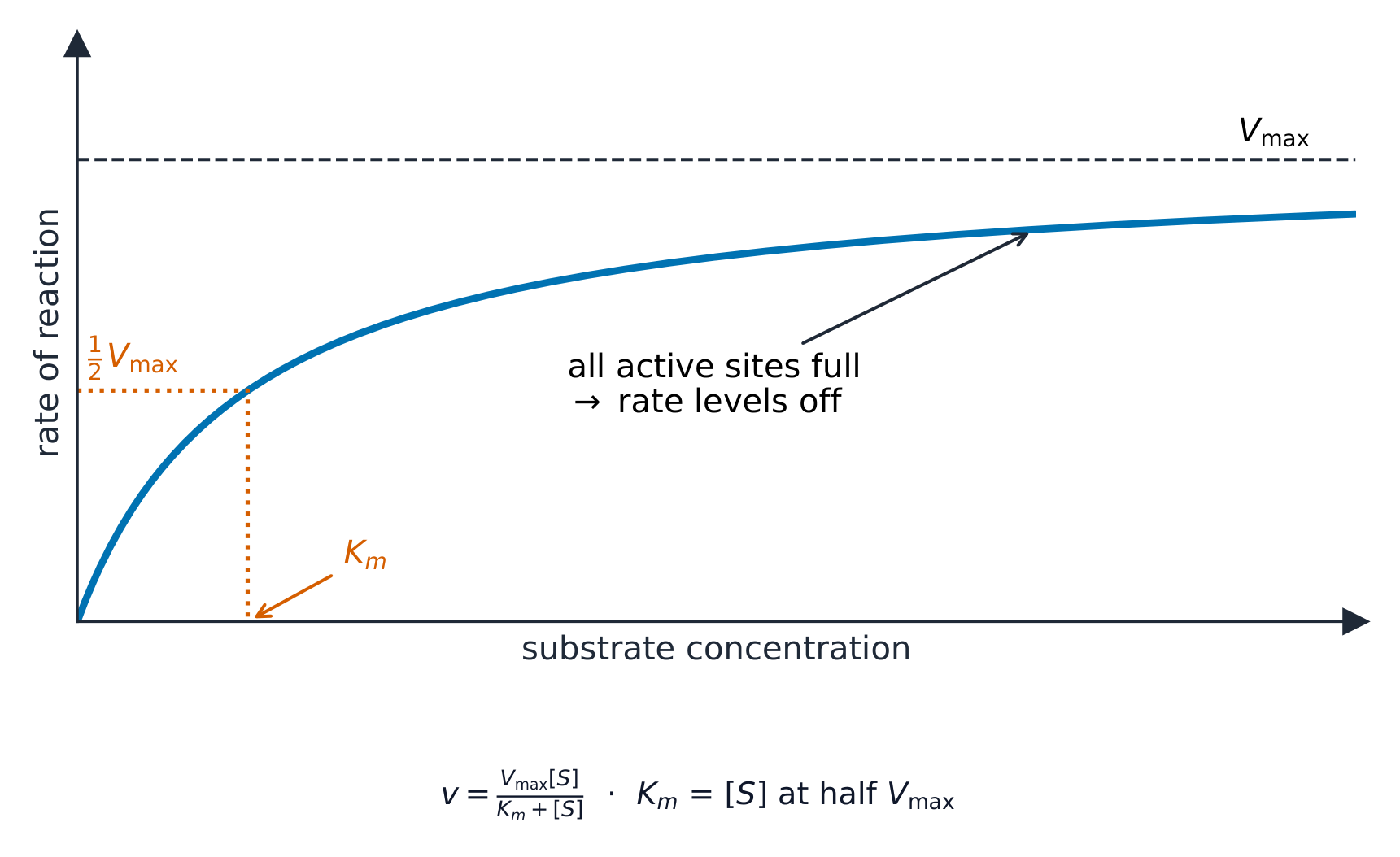
趋平的速率,当所有活性位点都满时,是最大速率,写成 $V_{\text{max}}$。
米氏常数(Michaelis–Menten constant,$K_{\text{m}}$)是给出 $V_{\text{max}}$ 一半的底物浓度。它告诉你关于酶对它底物的亲和力(affinity,拉力):
- 一个低的 $K_{\text{m}}$ 意味着酶在一个低底物浓度就达到半速,所以它有一个高亲和力。
- 一个高的 $K_{\text{m}}$ 意味着一个低亲和力。
所以 $K_{\text{m}}$ 让你比较不同的酶多强地抓住它们的底物。
当所有活性位点都满时速率爬升到 $V_{\text{max}}$;$K_{\text{m}}$ 是给出 $V_{\text{max}}$ 一半的底物浓度 探索Substrate concentration and Vmax
Add more substrate: the rate climbs, then plateaus at $V_{max}$ once every active site is busy. $K_m$ is the substrate concentration that gives half of $V_{max}$.
词汇表 训练英文 中文 拼音 Michaelis–Menten constant/ˈmaɪkəliz ˈmentn ˈkɒnstənt/ 米氏常数 mǐ shì cháng shù affinity/əˈfɪnɪti/ 亲和力 qīn hé lì 3.2
可逆抑制剂
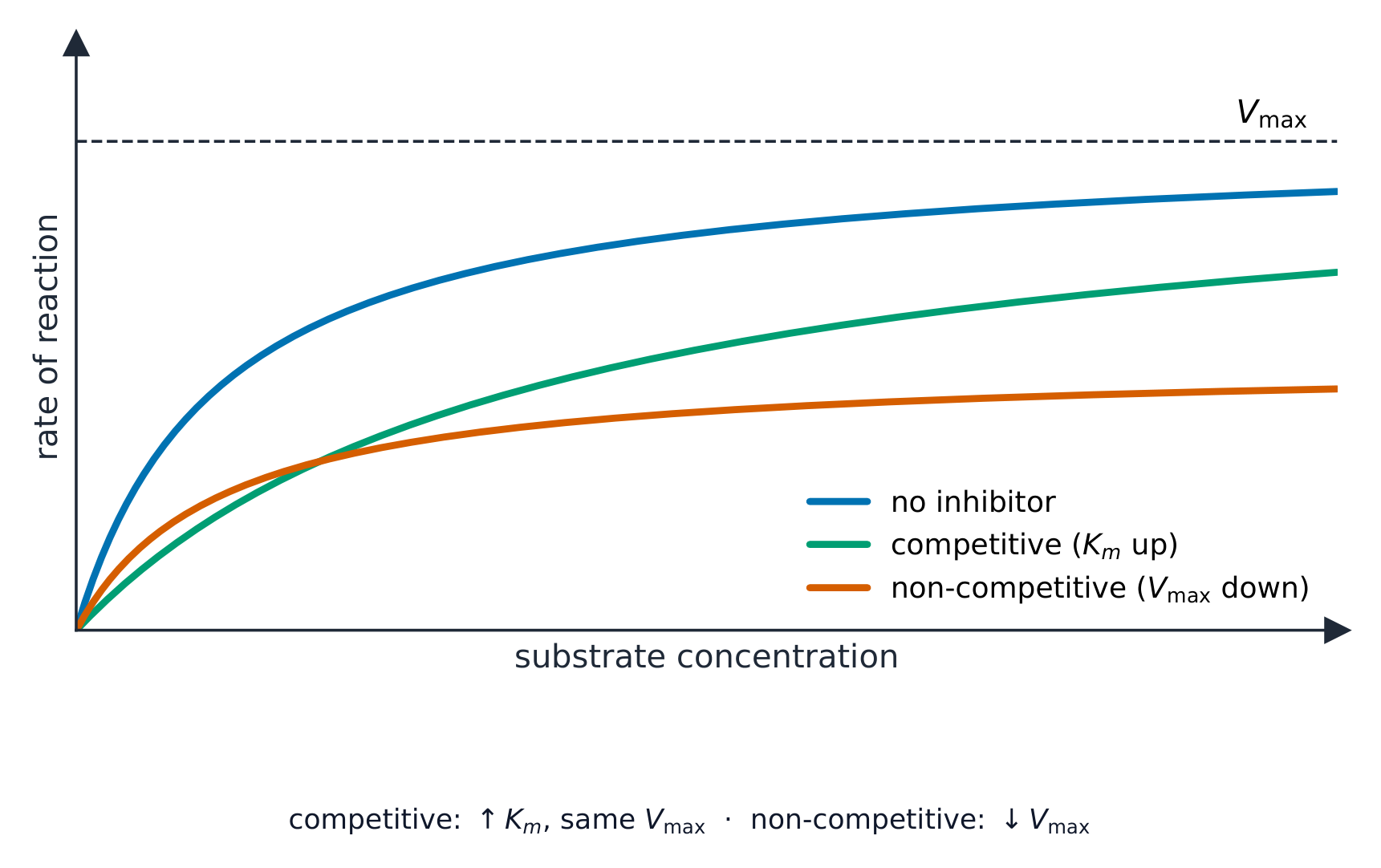
一些抑制剂是可逆(reversible)的:它们能再次离开酶。有两种类型。
类型 它在哪里结合 加更多底物的效果 对 $V_{\text{max}}$ 和 $K_{\text{m}}$ 的效果 竞争性抑制剂(competitive inhibitor) 在活性位点(它有一个与底物相似的形状) 更多底物胜过它,所以它的效果被减少 $V_{\text{max}}$ 不变;$K_{\text{m}}$ 上升 非竞争性抑制剂(non-competitive inhibitor) 在另一个位点,改变活性位点的形状 加更多底物没有帮助 $V_{\text{max}}$ 下降;$K_{\text{m}}$ 不变 一个竞争性抑制剂提高 $K_{\text{m}}$(更多底物克服它);一个非竞争性的降低 $V_{\text{max}}$ 词汇表 训练英文 中文 拼音 reversible/rɪˈvɜːsɪbl/ 可逆 kě nì competitive inhibitor/kəmˈpetɪtɪv ɪnˈhɪbɪtə/ 竞争性抑制剂 jìng zhēng xìng yì zhì jì non-competitive inhibitor/nɒn kəmˈpetɪtɪv ɪnˈhɪbɪtə/ 非竞争性抑制剂 fēi jìng zhēng xìng yì zhì jì 3.2
固定化酶

一个固定化酶(immobilised enzyme)被固定在原位——例如,被困在海藻酸盐(alginate)的小珠里面——而不是在溶液中自由漂浮。底物溶液流过这些珠。
酶保持被困在珠里,而底物流入、产物流出——所以酶从不被冲走 一个自由的酶通常工作得快一点,因为底物能容易地到达它。但固定化酶有大的实际优势:
- 酶不被冲走,所以它能一遍又一遍地使用。
- 产物是纯的——它不与酶混合。
- 酶更稳定,所以它更好地经受温度和 pH 的变化。
- 过程可以连续运行,底物流入、产物流出。

生物洗衣粉含有在低温下消化食物和血渍的酶 词汇表 训练英文 中文 拼音 immobilised enzyme/ɪˈməʊbəlaɪzd ˈenzaɪm/ 固定化酶 gù dìng huà méi alginate/ˈældʒɪneɪt/ 海藻酸盐 hǎi zǎo suān yán 3.2
考试技巧
- 用诱导契合模型解释酶的作用(活性位点围绕底物塑形)——现在比锁钥更受青睐。
- 在最适温度之上酶变性(氢键和三级结构断裂)——写"变性",绝不写"死了"或"被杀死"。
- 区分抑制剂:竞争性结合活性位点(被更多底物克服,同样的 $V_{max}$);非竞争性在别处结合(更低的 $V_{max}$)。
- 用初速率(时间零处的切线)比较速率——最公平的量度,在底物变成限制之前。
-
4
细胞膜与物质运输
4.1
流动镶嵌模型膜

大纲
- describe the fluid mosaic model of membrane structure with reference to the hydrophobic and hydrophilic interactions that account for the formation of the phospholipid bilayer and the arrangement of proteins
- describe the arrangement of cholesterol, glycolipids and glycoproteins in cell surface membranes
- describe the roles of phospholipids, cholesterol, glycolipids, proteins and glycoproteins in cell surface membranes, with reference to stability, fluidity, permeability, transport (carrier proteins and channel proteins), cell signalling (cell surface receptors) and cell recognition (cell surface antigens – see 11.1.2)
- outline the main stages in the process of cell signalling leading to specific responses: • secretion of specific chemicals (ligands) from cells • transport of ligands to target cells • binding of ligands to cell surface receptors on target cells
来源:剑桥国际大纲
每个细胞被包在一层细胞膜(cell surface membrane)里。我们用流动镶嵌模型(fluid mosaic model)描述它的结构。
扫描电子显微镜下的红细胞——每个被包在一层细胞膜里 The phospholipid bilayer
膜主要由磷脂(phospholipids)构成。每个磷脂有一个亲水(hydrophilic,"爱水")的头和两条疏水(hydrophobic,"怕水")的尾。膜的两侧都有水,所以磷脂排成两层——一个双层(bilayer)——头面向外面和里面的水,而尾藏在中间、远离水。这种排列因那些亲水和疏水的相互作用而自行形成。
这个模型被叫作"流动"是因为磷脂不是固定的:它们互相滑过,所以膜能移动和弯曲。它被叫作"镶嵌"是因为许多蛋白质(proteins)散布其中,像一幅画里的瓷砖。
What floats in the membrane
部件 它坐在哪里 主要角色 磷脂 两层 构成基本屏障 蛋白质 穿过膜或在它的表面 运输、支持和信号传递 载体蛋白(carrier proteins) 跨越膜 把特定的分子运过去 通道蛋白(channel proteins) 跨越膜 构成充水的孔以让离子通过 胆固醇(cholesterol) 在磷脂尾之间 控制流动性(fluidity)并增加强度 糖脂(glycolipids)和糖蛋白(glycoproteins) 外表面上的碳水化合物链 细胞识别;一些充当抗原(antigens) 
流动镶嵌模型:蛋白质、胆固醇和碳水化合物链坐在一个流动的磷脂双层中 所以膜的分子一起给膜它的稳定性(stability)、它的流动性、它的通透性(permeability,对什么能通过的控制)、它的运输工作、它的信号传递工作,以及它的细胞识别。
膜是半透膜(partially permeable):它让一些物质容易通过,但阻挡其他的。
探索Explore the cell membrane
Tap each part of the fluid mosaic model — the bilayer plus the proteins and other molecules dotted through it.
词汇表 训练英文 中文 拼音 cell surface membrane/sel ˈsɜːfɪs ˈmembreɪn/ 细胞膜 xì bāo mó fluid mosaic model/ˈfluːɪd məˈseɪɪk ˈmɒdl/ 流动镶嵌模型 liú dòng xiāng qiàn mó xíng phospholipid/ˈfɒsfəlɪpɪd/ 磷脂 lín zhī hydrophilic/ˌhaɪdrəˈfɪlɪk/ 亲水 qīn shuǐ hydrophobic/ˌhaɪdrəˈfəʊbɪk/ 疏水 shū shuǐ bilayer/ˈbɪleɪə/ 双层 shuāng céng protein/ˈprəʊtiːn/ 蛋白质 dàn bái zhì carrier protein/ˈkærɪə ˈprəʊtiːn/ 载体蛋白 zài tǐ dàn bái channel protein/ˈtʃænl ˈprəʊtiːn/ 通道蛋白 tōng dào dàn bái cholesterol/kəˈlestərɒl/ 胆固醇 dǎn gù chún fluidity/fluːˈɪdɪti/ 流动性 liú dòng xìng glycolipid/ˈɡlaɪkəlɪpɪd/ 糖脂 táng zhī glycoprotein/ˈɡlaɪkəprəʊtiːn/ 糖蛋白 táng dàn bái antigen/ˈæntɪdʒen/ 抗原 kàng yuán stability/stəˈbɪlɪti/ 稳定性 wěn dìng xìng permeability/ˌpɜːməˈbɪlɪti/ 通透性 tōng tòu xìng partially permeable membrane/ˈpɑːʃəli ˈpɜːməbl ˈmembreɪn/ 半透膜 bàn tòu mó 4.1
细胞信号传导

细胞通过细胞信号传递(cell signalling)相互交谈。主要阶段是:
- 一个细胞分泌一个叫配体(ligand)的信号化学物(例如一个激素(hormone))。
- 配体被运送(常常在血液中)到一个靶细胞(target cell)。
- 配体结合到靶细胞表面膜上一个特定的受体(receptor)。受体的形状只匹配那个配体。结合随即在靶细胞内部触发一个特定的响应。
配体只契合一个受体形状,所以只有带那个受体的细胞才响应这个信号 词汇表 训练英文 中文 拼音 cell signalling/sel ˈsɪɡnəlɪŋ/ 细胞信号传递 xì bāo xìn hào chuán dì ligand/ˈlɪɡænd/ 配体 pèi tǐ hormone/ˈhɔːməʊn/ 激素 jī sù target cell/ˈtɑːɡɪt sel/ 靶细胞 bǎ xì bāo receptor/rɪˈseptə/ 受体 shòu tǐ 4.2
物质进出细胞的运输

大纲
- describe and explain the processes of simple diffusion, facilitated diffusion, osmosis, active transport, endocytosis and exocytosis
- investigate simple diffusion and osmosis using plant tissue and non-living materials, including dialysis (Visking) tubing and agar
- illustrate the principle that surface area to volume ratios decrease with increasing size by calculating surface areas and volumes of simple 3-D shapes (as shown in the Mathematical requirements)
- investigate the effect of changing surface area to volume ratio on diffusion using agar blocks of different sizes
- investigate the effects of immersing plant tissues in solutions of different water potentials, using the results to estimate the water potential of the tissues
- explain the movement of water between cells and solutions in terms of water potential and explain the different effects of the movement of water on plant cells and animal cells (knowledge of solute potential and pressure potential is not expected)
来源:剑桥国际大纲
主动运输对扩散 渗透:水穿过膜 扩散:随机运动,单向流动 有六个过程。一些是被动(passive,它们不需要能量(energy))的,一些是主动(它们用来自 ATP 的能量)的。
Simple diffusion
扩散(diffusion)是粒子从它们处于高浓度(concentration)处到它们处于低浓度处的净移动,直到它们均匀铺开。简单扩散(simple diffusion)是当粒子直接穿过双层、沿浓度梯度(concentration gradient)向下时。只有小的或非极性的分子能这样做——如氧气(oxygen)和二氧化碳(carbon dioxide)。它是被动的。
Facilitated diffusion
带电的离子(ions)和大的极性分子(如葡萄糖(glucose))不能自己越过油性的双层。在易化扩散(facilitated diffusion)中,它们穿过通道蛋白或载体蛋白,仍沿浓度梯度向下移动。它也是被动的。
Osmosis
渗透(osmosis)是水穿过一个半透膜的扩散,从一个较高的水势(water potential)到一个较低的水势。它是被动的。
一个土豆渗透计:随着水通过渗透进入土豆,糖溶液沿管子上升 
水穿过到较低的水势;溶质太大而不能穿过半透膜 Active transport
主动运输(active transport)把一个物质逆它的浓度梯度移动——从低浓度到高浓度。这需要载体蛋白和来自 ATP 的能量。

扩散和易化扩散是被动的(沿梯度向下);主动运输逆它而行并需要 ATP Endocytosis and exocytosis
这些用 ATP 大量地移动大量的材料。
- 在胞吞作用(endocytosis)中,膜向内折叠围绕材料并掐下一个囊泡(vesicle)以把它带进细胞。
- 在胞吐作用(exocytosis)中,一个囊泡与膜融合并把它的内容物释放到细胞外。

胞吞作用通过构成一个囊泡把材料带进来;胞吐作用融合一个囊泡以释放它的内容物 探索Diffusion across a membrane
Set the concentration on each side. Particles spread from high to low concentration until both sides are equal.
词汇表 训练英文 中文 拼音 passive/ˈpæsɪv/ 被动 bèi dòng energy/ˈenədʒi/ 能量 néng liàng diffusion/dɪˈfjuːʒn/ 扩散 kuò sàn concentration/ˌkɒnsənˈtreɪʃn/ 浓度 nóng dù simple diffusion/ˈsɪmpl dɪˈfjuːʒn/ 简单扩散 jiǎn dān kuò sàn concentration gradient/ˌkɒnsənˈtreɪʃn ˈɡreɪdɪənt/ 浓度梯度 nóng dù tī dù oxygen/ˈɒksɪdʒn/ 氧气 yǎng qì carbon dioxide/ˈkɑːbən daɪˈɒksaɪd/ 二氧化碳 èr yǎng huà tàn ion/ˈaɪɒn/ 离子 lí zi glucose/ˈɡluːkəʊs/ 葡萄糖 pú táo táng facilitated diffusion/fəˈsɪlɪteɪtɪd dɪˈfjuːʒn/ 易化扩散 yì huà kuò sàn osmosis/ɒzˈməʊsɪs/ 渗透 shèn tòu water potential/ˈwɔːtə pəˈtenʃl/ 水势 shuǐ shì active transport/ˈæktɪv ˈtrænspɔːt/ 主动运输 zhǔ dòng yùn shū endocytosis/ˌendəʊsɪˈtəʊsɪs/ 胞吞作用 bāo tūn zuò yòng vesicle/ˈvesɪkl/ 囊泡 náng pào exocytosis/eɡˌzɒsɪˈtəʊsɪs/ 胞吐作用 bāo tǔ zuò yòng 4.2
表面积与体积之比

一个细胞跨它的表面吸收和排出物质。当一个物体变大时,它的体积(volume)比它的表面积(surface area)增长得更快。所以随着大小增加,表面积对体积比变得更小。
对于一个边长 $L$ 的立方体:
$$\text{surface area} = 6L^2, \qquad \text{volume} = L^3, \qquad \text{ratio} = \frac{6}{L}.$$一个大的 $L$ 给出一个小的比。这就是为什么小细胞(和薄、平的形状)快速交换材料,而大细胞不能只依靠扩散。
随着一个立方体(或细胞)增长,它的表面积:体积比变得更小 例题。 比较一个边长 $4$ 的立方体形细胞和一个边长 $10$ 的表面积:体积比。
对于边长 $4$:表面积 $= 6 \times 4^2 = 96$ 而体积 $= 4^3 = 64$,所以比是 $96 : 64 = 1.5 : 1$。对于边长 $10$:表面积 $= 6 \times 10^2 = 600$ 而体积 $= 10^3 = 1000$,所以比是 $600 : 1000 = 0.6 : 1$。较大的细胞有较小的比,所以它按它的大小更慢地跨它的表面交换材料——这就是为什么大的生物体需要专门的交换表面,如肺和鳃。
你可以用浸在染料或酸中的不同大小的琼脂(agar)块显示这个:最小的块,带最大的表面积对体积比,最快地一路变色通透。跨非生命材料的扩散也可以用透析袋(dialysis tubing,Visking 管)研究。
探索Surface area : volume
Make the cube bigger: its volume grows faster than its surface, so the SA:V ratio falls — which is why exchange surfaces and cells stay small.
探索Diffusion across the surface
Particles spread on their own from crowded to sparse. A small cell has a large surface-area-to-volume ratio, so substances diffuse in and out fast enough.
词汇表 训练英文 中文 拼音 volume/ˈvɒljuːm/ 体积 tǐ jī surface area/ˈsɜːfɪs ˈeərɪə/ 表面积 biǎo miàn jī agar/ˈeɪɡɑː/ 琼脂 qióng zhī dialysis tubing/daɪˈæləsɪs ˈtjuːbɪŋ/ 透析袋 tòu xī dài 4.2
水势与活细胞

水势(water potential)测量水离开一个溶液的可能性有多大。纯水有最高的水势。加一个溶质(solute,一个溶解的物质)降低它。水总是通过渗透从一个较高的水势移动到一个较低的水势。
要估计植物组织的水势,你把小块放入不同水势的蔗糖溶液中。造成质量或长度无变化的溶液有与组织大致相同的水势。
Effect on plant cells
- 在一个更高水势的溶液中(例如蒸馏水(distilled water)),水进入细胞。细胞膨胀并变得膨胀(turgid),但坚固的细胞壁阻止它胀破。
- 在一个更低水势的溶液中,水离开。细胞内容物收缩,膜从细胞壁拉开——这是质壁分离(plasmolysis)。
Effect on animal cells
动物细胞没有细胞壁来保护它们。
- 在一个更高水势的溶液中,水进入,细胞可能胀破。在一个红细胞中这种胀破叫溶血(haemolysis)。
- 在一个更低水势的溶液中,水离开,细胞收缩。
一个植物细胞变得膨胀或质壁分离;一个动物细胞可能胀破(溶血)或收缩 探索Water potential
water follows the gradient
Drag the concentrations. A water-potential gradient drives net movement — it stops only when the two sides match.
词汇表 训练英文 中文 拼音 solute/ˈsɒljuːt/ 溶质 róng zhì distilled water/dɪˈstɪld ˈwɔːtə/ 蒸馏水 zhēng liú shuǐ turgid/ˈtɜːdʒɪd/ 膨胀 péng zhàng plasmolysis/plæzˈmɒləsɪs/ 质壁分离 zhì bì fēn lí haemolysis/hiːˈmɒləsɪs/ 溶血 róng xuè 4.2
考试技巧
- 把膜描述为一个流动镶嵌:一个带蛋白质、胆固醇和糖蛋白的磷脂双层。
- 给每个过程分类:扩散、易化扩散和渗透是被动的(沿一个梯度向下);主动运输和胞吞/胞吐需要 ATP 并能逆它而行。
- 对于渗透总是用水势($\Psi$):水从高(不太负)到低(更负) $\Psi$ 移动;纯水是 $0$,最高的。
- 按细胞类型陈述结果:植物细胞膨胀/质壁分离;动物细胞溶解/皱缩——把它与水势梯度联系起来。
-
5
有丝分裂细胞周期
5.1
细胞核与细胞的复制和分裂

大纲
- describe the structure of a chromosome, limited to: • DNA • histone proteins • sister chromatids • centromere • telomeres
- explain the importance of mitosis in the production of genetically identical daughter cells during: • growth of multicellular organisms • replacement of damaged or dead cells • repair of tissues by cell replacement • asexual reproduction
- outline the mitotic cell cycle, including: • interphase (growth in G_1 and G_2 phases and DNA replication in S phase) • mitosis • cytokinesis
- outline the role of telomeres in preventing the loss of genes from the ends of chromosomes during DNA replication
- outline the role of stem cells in cell replacement and tissue repair by mitosis
- explain how uncontrolled cell division can result in the formation of a tumour
来源:剑桥国际大纲
有丝分裂:一个细胞变成两个 一个染色体(chromosome)是一个非常长的 DNA 分子,紧紧地缠绕在叫组蛋白(histones)的特殊蛋白质(proteins)周围。这样缠绕 DNA 让一个巨大的长度能装进细胞核并保持它整齐。
在一个细胞分裂之前,它的 DNA 被复制(这种复制叫复制(replication))。复制之后,每个染色体由连接在一起的两个相同的副本构成。这两个副本是姐妹染色单体(sister chromatids),它们在一个叫着丝粒(centromere)的点上被保持在一起。每个染色体的尖端被端粒(telomeres)封顶,它们保护端部。
复制之后,一个染色体是两个在着丝粒处连接的姐妹染色单体,尖端有端粒 词汇表 训练英文 中文 拼音 chromosome/ˈkrəʊməsəʊm/ 染色体 rǎn sè tǐ protein/ˈprəʊtiːn/ 蛋白质 dàn bái zhì histone/ˈhɪstəʊn/ 组蛋白 zǔ dàn bái replication/ˌreplɪˈkeɪʃn/ 复制 fù zhì sister chromatids/ˈsɪstə ˈkrəʊmətɪdz/ 姐妹染色单体 jiě mèi rǎn sè dān tǐ centromere/ˈsentrəʊmə/ 着丝粒 zhe sī lì telomere/ˈteləʊmə/ 端粒 duān lì mitosis/maɪˈtəʊsɪs/ 有丝分裂 yǒu sī fēn liè 5.1
有丝分裂的重要性

有丝分裂(mitosis)是一种细胞核分裂,产生两个遗传上相同的子细胞(daughter cells)——它们携带与亲代细胞以及与彼此完全相同的基因(genes)。
这对以下重要:
- 多细胞(multicellular)生物体(organisms)的生长(制造更多细胞)。
- 受损或死亡细胞的替换。
- 通过制造新细胞对组织(tissues)的修复。
- 无性生殖(asexual reproduction,一个亲代制造相同的后代)。
Onion root tip at metaphase: mitosis produces identical body cells for growth and repair 探索Why mitosis matters
Classify real cases by the role mitosis is playing.
词汇表 训练英文 中文 拼音 daughter cell/ˈdɔːtə sel/ 子细胞 zi xì bāo gene/dʒiːn/ 基因 jī yīn multicellular/ˌmʌltɪˈseljʊlə/ 多细胞 duō xì bāo organism/ˈɔːɡənɪzəm/ 生物体 shēng wù tǐ tissue/ˈtɪʃuː/ 组织 zǔ zhī asexual reproduction/eɪˈsekʃuːəl rɪprəˈdʌkʃn/ 无性生殖 wú xìng shēng zhí metaphase/ˌmetəˈfeɪz/ 中期 zhōng qī 5.1
有丝分裂细胞周期

细胞周期(cell cycle)是一个细胞从一次分裂到下一次的完整生命。它有三部分:
- 间期(interphase)——最长的部分。细胞在 G₁ 期生长、在 S 期复制它的 DNA(复制),并在 G₂ 期再次生长并准备分裂。
- 有丝分裂——细胞核分裂成两个相同的核。
- 胞质分裂(cytokinesis)——细胞的其余部分分裂,给出两个分开的子细胞。
周期的大部分是间期(G₁、S、G₂);有丝分裂(M)和胞质分裂是一个短的部分 The mitotic index
有丝分裂指数是一个样品中处于有丝分裂的细胞的比例。你通过在显微镜下数细胞求它:
$$\text{mitotic index} = \frac{\text{number of cells in mitosis}}{\text{total number of cells}}.$$例题。 在一个根尖样品中,看到的 $50$ 个细胞中有 $8$ 个处于有丝分裂。求有丝分裂指数。
$$\text{mitotic index} = \frac{8}{50} = 0.16.$$一个高的有丝分裂指数意味着许多细胞在快速分裂——在一个生长的根尖中正常,但在成年动物组织中它可能是失控生长的一个警告信号。
探索The cell cycle
Step around the cycle. Most of it is interphase (grow, copy DNA, grow); mitosis and cytokinesis are short, then it repeats.
探索The cell cycle
Step through the cycle. Most of a cell's life is interphase (G1, S, G2); mitosis and cytokinesis are the short dividing phase.
词汇表 训练英文 中文 拼音 cell cycle/sel ˈsaɪkl/ 细胞周期 xì bāo zhōu qī interphase/ˌɪntəˈfeɪz/ 间期 jiān qī cytokinesis/ˌsaɪtəkəˈniːsɪs/ 胞质分裂 bāo zhì fēn liè 5.1
端粒与染色体末端

当 DNA 被复制时,复制不能到达分子的最末端,所以每次都丢失一点。端粒是端部短的、重复的 DNA 长度,携带没有基因。因为被缩短的是端粒,复制期间没有重要的基因丢失。
端粒(携带没有基因)在每次分裂时缩短一点,所以中间的基因从不丢失 5.1
干细胞

一个干细胞(stem cell)是一个未特化的细胞,它能通过有丝分裂不断分裂,并能分化(differentiate,改变)成不同的特化细胞类型。干细胞是用于替换丢失的细胞和修复组织的新细胞的来源。
一个未特化的干细胞能分化成许多特化的细胞类型 词汇表 训练英文 中文 拼音 stem cell/stem sel/ 干细胞 gàn xì bāo differentiate/ˌdɪfəˈrenʃɪeɪt/ 分化 fēn huà 5.1
失控分裂与肿瘤

细胞周期通常被紧密地控制,所以细胞只在需要时分裂。若这种控制丢失,一个细胞可能一遍又一遍地分裂而不停止。这种失控的分裂产生一团叫肿瘤(tumour)的细胞。
通常细胞在它们应当时停止分裂;若那种控制丢失,它们不断分裂成一个肿瘤 词汇表 训练英文 中文 拼音 tumour/ˈtjuːmə/ 肿瘤 zhǒng liú 5.2
有丝分裂中染色体的行为

大纲
- describe the behaviour of chromosomes in plant and animal cells during the mitotic cell cycle and the associated behaviour of the nuclear envelope, the cell surface membrane and the spindle (names of the main stages of mitosis are expected: prophase, metaphase, anaphase and telophase)
- interpret photomicrographs, diagrams and microscope slides of cells in different stages of the mitotic cell cycle and identify the main stages of mitosis
来源:剑桥国际大纲
有丝分裂经过四个阶段。你应当能够在显微照片和载玻片中识别它们。
阶段 发生什么 前期(prophase) 染色体盘绕起来并作为两个姐妹染色单体变得可见;核膜(nuclear envelope)分解;一个纤维的纺锤体(spindle)在细胞上构成 中期(metaphase) 染色体沿中间(赤道(equator))排列;纺锤丝附着到每个着丝粒 后期(anaphase) 着丝粒分裂;姐妹染色单体被拉到细胞的相反端(极) 末期(telophase) 一组染色体到达每个极;一个新核膜在每组周围构成,造出两个核 四个阶段:前期、中期、后期、末期 
一个真实的洋葱根尖:在一个生长的尖端,许多细胞被抓在分裂中 然后胞质分裂随之而来。在一个动物细胞中,细胞膜向内掐以分裂细胞;在一个植物细胞中,一堵新墙在中间构成。结果是两个遗传上相同的子细胞。
探索The stages of mitosis
Drag through prophase, metaphase, anaphase and telophase to watch the chromosomes line up and then separate into two identical cells.
探索The stages of mitosis
Step through PMAT. Watch the chromosomes condense, line up, split to the poles, then reform two nuclei.
词汇表 训练英文 中文 拼音 prophase/ˈprɒfeɪz/ 前期 qián qī nuclear envelope/ˈnjuːklɪə ˈenvələʊp/ 核膜 hé mó spindle/ˈspɪndl/ 纺锤体 fǎng chuí tǐ equator/ɪˈkweɪtə/ 赤道 chì dào anaphase/ˈænəfeɪz/ 后期 hòu qī telophase/ˈteləfeɪz/ 末期 mò qī 5.2
考试技巧
- 按顺序学习各阶段(前期、中期、后期、末期),每个带一个关键事件;间期(G1、S、G2)不是有丝分裂的一部分。
- 有丝分裂给出两个遗传上相同的二倍体细胞——用于生长、修复和无性生殖。
- 有丝分裂指数 $=$ 处于有丝分裂的细胞 $\div$ 总细胞;一个高值意味着快速分裂。
- 把失控的有丝分裂与肿瘤、以及端粒缩短与分裂次数的极限联系起来。
-
6
核酸与蛋白质合成
6.1
核酸的结构与DNA的复制

大纲
- describe the structure of nucleotides, including the phosphorylated nucleotide ATP (structural formulae are not expected)
- state that the bases adenine and guanine are purines with a double ring structure, and that the bases cytosine, thymine and uracil are pyrimidines with a single ring structure (structural formulae for bases are not expected)
- describe the structure of a DNA molecule as a double helix, including: • the importance of complementary base pairing between the 5′ to 3′ strand and the 3′ to 5′ strand (antiparallel strands) • differences in hydrogen bonding between C–G and A–T base pairs • linking of nucleotides by phosphodiester bonds
- describe the semi-conservative replication of DNA during the S phase of the cell cycle, including: • the roles of DNA polymerase and DNA ligase (knowledge of other enzymes in DNA replication in cells and different types of DNA polymerase is not expected) • the differences between leading strand and lagging strand replication as a consequence of DNA polymerase adding nucleotides only in a 5′ to 3′ direction
- describe the structure of an RNA molecule, using the example of messenger RNA (mRNA)
来源:剑桥国际大纲
DNA 复制:解开并复制 核酸(nucleic acids,DNA 和 RNA)是叫核苷酸(nucleotides)的小单元的聚合物。每个核苷酸由三个连接在一起的部分构成:
- 一个磷酸(phosphate)基团,
- 一个糖(一个 5 碳糖),
- 一个含氮的碱基(base)。
ATP 是一个特殊的核苷酸。它有碱基腺嘌呤(adenine)、糖核糖(ribose)和三个磷酸基团。断开最后一个磷酸为细胞释放能量(energy)。
一个核苷酸是一个磷酸、一个糖和一个碱基;ATP 是一个带三个磷酸的核苷酸 
从细胞中提取的 DNA 显现为这些核苷酸聚合物的苍白、丝状的链 有五种碱基,分两组:
- 嘌呤(purines)有一个双环(两个环):腺嘌呤和鸟嘌呤(guanine)。
- 嘧啶(pyrimidines)有一个单环(一个环):胞嘧啶(cytosine)、胸腺嘧啶(thymine)和尿嘧啶(uracil)。

两组在形状上不同:一个嘌呤是一个双环,一个嘧啶是一个单环——这就是为什么一个嘌呤总是与一个嘧啶配对 词汇表 训练英文 中文 拼音 nucleic acid/njuːˈklɪɪk ˈæsɪd/ 核酸 hé suān nucleotide/ˈnjuːklɪɒtaɪd/ 核苷酸 hé gān suān phosphate/ˈfɒsfeɪt/ 磷酸 lín suān base/beɪs/ 碱基 jiǎn jī adenine/ˈædəniːn/ 腺嘌呤 xiàn piào líng ribose/ˈrɪbəʊs/ 核糖 hé táng energy/ˈenədʒi/ 能量 néng liàng purine/ˈpjʊəriːn/ 嘌呤 piào líng guanine/ˈɡwɑːnaɪn/ 鸟嘌呤 niǎo piào líng pyrimidine/ˈpɪrɪmɪdiːn/ 嘧啶 mì dìng cytosine/ˈsaɪtəsaɪn/ 胞嘧啶 bāo mì dìng thymine/ˈθaɪmaɪn/ 胸腺嘧啶 xiōng xiàn mì dìng uracil/ˈjʊərəsɪl/ 尿嘧啶 niào mì dìng replication/ˌreplɪˈkeɪʃn/ 复制 fù zhì semi-conservative replication/ˈsemi kənˈsɜːvətɪv ˌreplɪˈkeɪʃn/ 半保留复制 bàn bǎo liú fù zhì 6.1
DNA 的结构

一个 DNA 分子是两条链扭在一起成一个双螺旋(double helix)。
每条链(strand)有一个交替的糖(这里糖是脱氧核糖(deoxyribose))和磷酸的骨架。一个核苷酸的糖由一个磷酸二酯键(phosphodiester bond)连接到下一个的磷酸。
两条链由它们的碱基保持在一起,碱基在中间相遇。配对是精确的——这是碱基互补配对(complementary base pairing):
- A 总是与 T 配对,由两个****氢键(hydrogen bonds)保持。
- C 总是与 G 配对,由三个氢键保持(所以一个 C–G 碱基对(base pair)更难分开)。
两条链沿相反的方向走:一条从 5′ 到 3′,而另一条从 3′ 到 5′。我们说它们是反平行(antiparallel)的。
碱基互补配对:A 与 T 配对(2 个氢键),C 与 G(3 个);链是反平行的 上面平的梯子被扭成一个螺旋。这个空间填充模型,每个原子是一个球,显示双螺旋的真实形状:

一个 DNA 的空间填充模型:两条链相互扭绕成双螺旋——图中的梯子,盘绕起来 探索Explore the DNA ladder
Tap each part of the double helix — two antiparallel backbones with complementary base pairs as the rungs.
词汇表 训练英文 中文 拼音 double helix/ˈdʌbl ˈhiːlɪks/ 双螺旋 shuāng luó xuán strand/strænd/ 链 liàn deoxyribose/diːˈɒksɪrɪbəʊs/ 脱氧核糖 tuō yǎng hé táng phosphodiester bond/ˈfɒsfəʊdɪstə bɒnd/ 磷酸二酯键 lín suān èr zhǐ jiàn complementary base pairing/ˌkɒmplɪˈmentəri beɪs ˈpeərɪŋ/ 碱基互补配对 jiǎn jī hù bǔ pèi duì hydrogen bond/ˈhaɪdrədʒn bɒnd/ 氢键 qīng jiàn base pair/beɪs peə/ 碱基对 jiǎn jī duì antiparallel/ˌæntɪˈpærəlel/ 反平行 fǎn píng xíng 6.1
DNA 复制

DNA 复制(replication,复制)发生在细胞周期的 S 期。它是半保留复制(semi-conservative):每个新分子保留一条旧链和一条新链。步骤是:
- 双螺旋解开,氢键断裂,所以两条链分离。
- 每条旧链充当一个模板。自由的核苷酸通过碱基互补配对与暴露的碱基配对。
- 酶(enzyme)DNA 聚合酶(DNA polymerase)把新核苷酸连接成一条链。它只能沿 5′ 到 3′ 方向添加核苷酸。
因为那个 5′ 到 3′ 的规则,两条新链的制造方式不同:
- 前导链(leading strand)连续地构建,跟随解开。
- 后随链(lagging strand)以短片段构建,背离解开点工作。然后酶 DNA 连接酶(DNA ligase)把这些片段连接在一起。
复制是半保留的:每个新分子保留一条旧链(蓝色)和一条新链(橙色) 探索Semi-conservative replication
Step through copying DNA. The helix unwinds, each old strand templates a new one, and you end with two identical molecules.
词汇表 训练英文 中文 拼音 enzyme/ˈenzaɪm/ 酶 méi polymerase/ˌpɒlɪməˈreɪz/ 聚合酶 jù hé méi leading strand/ˈliːdɪŋ strænd/ 前导链 qián dǎo liàn lagging strand/ˈlæɡɪŋ strænd/ 后随链 hòu suí liàn ligase/ˈlɪɡeɪs/ 连接酶 lián jiē méi 6.1
RNA

RNA 也由核苷酸构成,但它是一条单链,它的糖是核糖,而且它用尿嘧啶代替胸腺嘧啶。这里最重要的类型是信使 RNA(mRNA),它把一个基因指令的一个副本带出细胞核以被使用。
DNA double helix: RNA is a related nucleic acid that carries genetic information into protein synthesis 词汇表 训练英文 中文 拼音 gene/dʒiːn/ 基因 jī yīn 6.2
蛋白质合成
大纲
- state that a polypeptide is coded for by a gene and that a gene is a sequence of nucleotides that forms part of a DNA molecule
- describe the principle of the universal genetic code in which different triplets of DNA bases either code for specific amino acids or correspond to start and stop codons
- describe how the information in DNA is used during transcription and translation to construct polypeptides, including the roles of: • RNA polymerase • messenger RNA (mRNA) • codons • transfer RNA (tRNA) • anticodons • ribosomes
- state that the strand of a DNA molecule that is used in transcription is called the transcribed or template strand and that the other strand is called the non-transcribed strand
- explain that, in eukaryotes, the RNA molecule formed following transcription (primary transcript) is modified by the removal of non-coding sequences (introns) and the joining together of coding sequences (exons) to form mRNA
- state that a gene mutation is a change in the sequence of base pairs in a DNA molecule that may result in an altered polypeptide
- explain that a gene mutation is a result of substitution or deletion or insertion of nucleotides in DNA and outline how each of these types of mutation may affect the polypeptide produced
来源:剑桥国际大纲
蛋白质合成:DNA 到蛋白质 一个基因(gene)是编码一个多肽(polypeptide)的一段 DNA 核苷酸序列。
密码以三联体(triplets)读取——三个碱基一组。每个三联体要么编码一个特定的氨基酸(amino acid),要么充当一个开始或停止信号。密码是通用的:几乎所有生物对同样的氨基酸都用同样的三联体。
有 64 个可能的三联体但只有 20 种常见的氨基酸,所以大多数氨基酸由不止一个三联体编码。
词汇表 训练英文 中文 拼音 polypeptide/ˌpɒlɪˈpeptaɪd/ 多肽 duō tài triplet/ˈtrɪplɪt/ 三联体 sān lián tǐ amino acid/əˈmiːnəʊ ˈæsɪd/ 氨基酸 ān jī suān 6.2
蛋白质合成:转录与翻译

Transcription (in the nucleus)
DNA 基因被复制成 mRNA。这是转录(transcription)。
- 被复制的那条 DNA 链是模板链(template strand);伙伴链是非转录链(non-transcribed strand)。
- 酶 RNA 聚合酶(RNA polymerase)连接与模板碱基配对的 RNA 核苷酸(尿嘧啶与腺嘌呤配对)。
- 在真核生物中,最先制造的 RNA(初级转录本(primary transcript))含有叫外显子(exons)的编码部分和叫内含子(introns)的非编码部分。内含子被剪出,外显子连接在一起以构成完成的 mRNA。
剪接:非编码的内含子被剪出,编码的外显子被连接以制造完成的 mRNA Translation (at the ribosome)
mRNA 离开细胞核并附着到一个核糖体(ribosome)。从 mRNA 密码构建多肽是翻译(translation)。
- mRNA 以密码子(codons)读取(每个密码子是一个三联体的 mRNA 碱基)。
- 转运 RNA(tRNA)分子把氨基酸带到核糖体。每个 tRNA 有一个与匹配的密码子配对的反密码子(anticodon)。
- 随着密码子被按顺序读取,核糖体用肽键(peptide bonds)连接氨基酸,构建多肽。

转录在细胞核中把 DNA 复制成 mRNA;核糖体处的翻译构建多肽 例题。 某 DNA 模板链读作
TAC GGA CTT。写出 mRNA 的密码子,并说明多肽有多长。按碱基互补配对转录,记住 RNA 用尿嘧啶代替胸腺嘧啶:TAC给出AUG,GGA给出CCU,CTT给出GAA。所以 mRNA 读作AUG CCU GAA。AUG是起始密码子(甲硫氨酸),所以这条多肽有三个氨基酸 - 去掉起始的甲硫氨酸后是两个。有两个错误会在这里丢掉大部分分数:写 mRNA 时把 A 与 T 配对而不是与 U 配对;以及转录了编码链而不是模板链。mRNA 与模板链互补,而与编码链相同,只是用 U 代替了 T。探索From gene to protein
Step through the central dogma: the DNA template is transcribed into mRNA by base pairing (A→U, T→A, G→C, C→G), then read in codons and translated into a chain of amino acids.
探索From gene to protein
Step through how a gene becomes a protein. Transcription copies DNA into mRNA; translation reads the mRNA to build the polypeptide.
词汇表 训练英文 中文 拼音 codon/ˈkəʊdɒn/ 密码子 mì mǎ zi transcription/trænˈskrɪpʃn/ 转录 zhuǎn lù template strand/ˈtempleɪt strænd/ 模板链 mú bǎn liàn non-transcribed strand/nɒn trænˈskraɪbd strænd/ 非转录链 fēi zhuǎn lù liàn primary transcript/ˈpraɪməri ˈtrænskrɪpt/ 初级转录本 chū jí zhuǎn lù běn exon/eɡˈzɒn/ 外显子 wài xiǎn zi intron/ɪnˈtrɒn/ 内含子 nèi hán zi ribosome/ˈriːbəʊsəʊm/ 核糖体 hé táng tǐ translation/trænˈsleɪʃn/ 翻译 fān yì anticodon/ˌæntɪˈkəʊdɒn/ 反密码子 fǎn mì mǎ zi peptide bond/ˈpeptaɪd bɒnd/ 肽键 tài jiàn 6.2
基因突变

一个基因突变(mutation)是一个 DNA 分子碱基序列的一个改变。它可能改变制造的多肽。有三种类型:
- 替换(substitution)——一个碱基被换成一个不同的碱基。这最多改变一个氨基酸,有时一个都不改(因为大多数氨基酸有不止一个三联体)。
- 缺失(deletion)——一个碱基被移除。
- 插入(insertion)——加了一个额外的碱基。
一个缺失或插入改变后面每个三联体被读取的方式,所以它通常改变那个点之后的许多氨基酸,并对多肽有大的影响。
一个替换改变一个三联体;一个缺失或插入改变后面每个三联体(一个移码) 探索Mutation type lab
Compare substitution, insertion and deletion using their effect on the code.
词汇表 训练英文 中文 拼音 mutation/mjuːˈteɪʃn/ 突变 tū biàn substitution/ˌsʌbstɪˈtjuːʃn/ 替换 tì huàn deletion/dɪˈliːʃn/ 缺失 quē shī insertion/ɪnˈsɜːʃn/ 插入 chā rù 6.2
考试技巧
- DNA 是反平行的,由氢键保持(A=T 两个,C≡G 三个);复制是半保留的(每个产物保留一条旧链)。
- 陈述在哪里和是什么:转录(细胞核 → mRNA)、翻译(核糖体,mRNA + tRNA → 多肽)。
- 用全部四个术语描述密码:三联体、非重叠、简并、通用。
- 对于一个基因突变(替换、插入、缺失)解释对蛋白质的影响——以及为什么一个替换可以是沉默的(简并性)。
-
7
植物体内的运输
7.1
运输组织的结构

大纲
- draw plan diagrams of transverse sections of stems, roots and leaves of herbaceous dicotyledonous plants from microscope slides and photomicrographs
- describe the distribution of xylem and phloem in transverse sections of stems, roots and leaves of herbaceous dicotyledonous plants
- draw and label xylem vessel elements, phloem sieve tube elements and companion cells from microscope slides, photomicrographs and electron micrographs
- relate the structure of xylem vessel elements, phloem sieve tube elements and companion cells to their functions
来源:剑桥国际大纲
植物通过两种运输组织(tissues)移动物质:
- 木质部(xylem)把水和溶解的矿物离子(mineral ions)从根部往上运。
- 韧皮部(phloem)把溶解的食物(叫同化物(assimilates),主要是糖)运到任何需要它们的地方。
在一个双子叶植物(dicotyledonous plant)的横切面(transverse section,直接横切)中:
- 在茎中,木质部和韧皮部在靠近外侧的束中坐在一起,木质部在每个束的内侧。
- 在根中,木质部在中央,常呈星形,韧皮部在星臂之间。
- 在叶中,两者都在叶脉里找到。
当你画一个平面图时,你只画组织的轮廓,而不是单个细胞。
组织坐在哪里:茎的束在靠近边缘构成一个环(木质部在内);在根中木质部构成一个中央星形 
一根树干的木材是木质部;每个年轮是一年的生长 Xylem vessels
木质部的运水管叫导管(vessels)。它们由端端相连的死的、空的细胞构成,端壁消失,所以它们构成一根长的开放管道。它们的壁用木质素(lignin)加厚并防水。所以结构适合工作:空心、开放、没有内容物的管让水快速流动,而木质素给予强度和支持。
Phloem sieve tubes and companion cells
韧皮部的运食物管叫筛管(sieve tubes)。它们是端端相连的活细胞,但它们的端壁没有消失——它们变成带许多汁液流过的孔的筛板(sieve plates)。为了给流动腾出空间,一个筛管细胞失去它大部分的内容物并没有细胞核。
每个筛管旁边是一个伴胞(companion cell)。它保留它的细胞核(nucleus)并有许多线粒体(mitochondria)。它为筛管做活的工作并把糖装入它。

木质部是一根死的、开放的管道;韧皮部是活的筛管,带筛板和伴胞 这是一个真实的维管束(vascular bundle)在显微镜下的样子,在一个幼向日葵茎的染色切面中:

切面中一个真实的维管束:大的红色细胞是木质部导管(厚的木质化壁);上方更小的细胞是韧皮部 探索Xylem and phloem side by side
Tap each part. Xylem is a dead, hollow pipe for water; phloem is a living tube for sugars, helped by its companion cell.
词汇表 训练英文 中文 拼音 tissue/ˈtɪʃuː/ 组织 zǔ zhī xylem/ˈzaɪləm/ 木质部 mù zhì bù mineral ion/ˈmɪnərəl ˈaɪɒn/ 矿物离子 kuàng wù lí zi phloem/ˈfləʊɪm/ 韧皮部 rèn pí bù assimilate/əˈsɪmɪleɪt/ 同化物 tóng huà wù transverse section/trænsˈvɜːs ˈsekʃn/ 横切面 héng qiē miàn dicotyledonous plant/ˌdɪkətɪˈliːdənəs plænt/ 双子叶植物 shuāng zǐ yè zhí wù vessel/ˈvesl/ 导管 dǎo guǎn lignin/ˈlɪɡnɪn/ 木质素 mù zhì sù sieve tube/sɪv tjuːb/ 筛管 shāi guǎn sieve plate/sɪv pleɪt/ 筛板 shāi bǎn companion cell/kəmˈpænɪən sel/ 伴胞 bàn bāo nucleus/ˈnjuːklɪəs/ 细胞核 xì bāo hé mitochondria/ˌmaɪtəˈkɒndrɪə/ 线粒体 xiàn lì tǐ vascular bundle/ˈvæskjʊlə ˈbʌndl/ 维管束 wéi guǎn shù 7.2
运输机制

大纲
- state that some mineral ions and organic compounds can be transported within plants dissolved in water
- describe the transport of water from the soil to the xylem through the: • apoplast pathway, including reference to lignin and cellulose • symplast pathway, including reference to the endodermis, Casparian strip and suberin
- explain that transpiration involves the evaporation of water from the internal surfaces of leaves followed by diffusion of water vapour to the atmosphere
- explain how hydrogen bonding of water molecules is involved with movement of water in the xylem by cohesion-tension in transpiration pull and by adhesion to cellulose in cell walls
- make annotated drawings of transverse sections of leaves from xerophytic plants to explain how they are adapted to reduce water loss by transpiration
- state that assimilates dissolved in water, such as sucrose and amino acids, move from sources to sinks in phloem sieve tubes
- explain how companion cells transfer assimilates to phloem sieve tubes, with reference to proton pumps and cotransporter proteins
- explain mass flow in phloem sieve tubes down a hydrostatic pressure gradient from source to sink
来源:剑桥国际大纲
水通过渗透(osmosis)进入一个根毛细胞(root hair cell),因为根毛的水势比土壤水低。然后水通过两条途径穿过根到木质部:
- 质外体途径(apoplast pathway)——水穿过细胞壁(cell walls,由纤维素(cellulose)构成)和细胞之间的空隙移动,不进入细胞质。这很快。
- 共质体途径(symplast pathway)——水穿过细胞的细胞质移动,通过胞间连丝(plasmodesmata)从一个细胞传到另一个细胞。
在一圈叫内皮层(endodermis)的细胞处,质外体途径被凯氏带(Casparian strip)——一条木栓质(suberin)的防水带——阻挡。这迫使所有的水穿过细胞膜,这让植物控制什么进入木质部。
质外体穿过壁,共质体穿过细胞质;凯氏带在内皮层阻挡质外体 探索Water from soil to xylem
Follow water in from the soil. It crosses the root two ways, is forced through a membrane at the endodermis, then enters the xylem.
词汇表 训练英文 中文 拼音 root hair cell/ruːt heə sel/ 根毛细胞 gēn máo xì bāo osmosis/ɒzˈməʊsɪs/ 渗透 shèn tòu apoplast pathway/ˈæpəplæst ˈpæθweɪ/ 质外体途径 zhì wài tǐ tú jìng cell wall/sel wɔːl/ 细胞壁 xì bāo bì cellulose/ˈseljuːləʊs/ 纤维素 xiān wéi sù symplast pathway/ˈsɪmplæst ˈpæθweɪ/ 共质体途径 gòng zhì tǐ tú jìng plasmodesmata/ˌplæzməʊdˈsmɑːtə/ 胞间连丝 bāo jiān lián sī endodermis/ˈendəʊdəmɪs/ 内皮层 nèi pí céng Casparian strip/kæˈspeərɪən strɪp/ 凯氏带 kǎi shì dài suberin/ˈsʌbərɪn/ 木栓质 mù shuān zhì 7.2
蒸腾作用与水在木质部中的上升

蒸腾作用(transpiration)是水蒸气从一株植物的流失。水从叶内部湿的细胞表面蒸发(变成蒸气)——这是蒸发(evaporation)。然后水蒸气(water vapour)通过气孔(stomata)扩散(diffuses)出去到大气(atmosphere)中。
顶部的这种流失把水沿木质部以一个连续的柱往上拉。它有效是因为水分子之间的氢键:
- 水分子通过氢键(hydrogen bonds)相互吸引,所以它们粘在一起。这种粘连是内聚力(cohesion),它让整个柱在张力(tension)下被往上拉(内聚–张力思想)。
- 水分子也粘到细胞壁的纤维素上。这是附着力(adhesion),它帮助把柱保持在原位。
叶处的蒸腾作用把整个水柱沿木质部往上拉;内聚力(氢键)使它保持在一起 例题。 把一个水势为 $-800\ \text{kPa}$ 的植物细胞放入水势为 $-400\ \text{kPa}$ 的溶液中。水向哪个方向移动?细胞会怎样?水总是顺着水势梯度移动 - 从负得较少(较高)的一方流向负得较多(较低)的一方。$-400$ 的溶液比 $-800$ 的细胞更高,所以水进入细胞。细胞膨大,原生质体压向细胞壁,压力势升高,细胞变得膨胀(紧张)。有两个陷阱:$-400$ 大于 $-800$,这个符号错误会让一半的答案方向反过来;以及纯水的最大值是 0,所以任何溶液都是负的,水势永远不可能高于零。
探索The transpiration stream
Step through how water is pulled up a tree — evaporation at the top creates a tension that drags the whole cohesive column upward.
词汇表 训练英文 中文 拼音 transpiration/trænspəˈreɪʃn/ 蒸腾作用 zhēng téng zuò yòng evaporation/ɪˌvæpəˈreɪʃn/ 蒸发 zhēng fā water vapour/ˈwɔːtə ˈveɪpə/ 水蒸气 shuǐ zhēng qì diffuse/dɪˈfjuːz/ 扩散 kuò sàn stomata/ˈstəʊmətə/ 气孔 qì kǒng atmosphere/ˈætməsfɪə/ 大气 dà qì hydrogen bond/ˈhaɪdrədʒn bɒnd/ 氢键 qīng jiàn cohesion/kəʊˈhiːʒn/ 内聚力 nèi jù lì tension/ˈtenʃn/ 张力 zhāng lì adhesion/ədˈhiːʒn/ 附着力 fù zhuó lì 7.2
旱生植物

一株旱生植物(xerophyte)是一株适应(adapted)于生活在水稀缺处的植物。它的叶以几种方式减少蒸腾作用的水分流失:一层厚的蜡质角质层(cuticle)、沉在坑里的气孔(stomata)、困住湿润空气的毛,以及能卷起的叶。你应当能够画一个显示这些特征的标注叶切面。
旱生植物叶削减水分流失:一层厚角质层、下陷的气孔、困住的湿润空气和卷起 词汇表 训练英文 中文 拼音 xerophyte/ˈzɪərəfaɪt/ 旱生植物 hàn shēng zhí wù adapted/əˈdæptɪd/ 适应 shì yìng cuticle/ˈkjuːtɪkl/ 角质层 jiǎo zhì céng 7.2
转运:同化产物在韧皮部中的运输

蔗糖(sucrose)和氨基酸(amino acids)等同化物在韧皮部中从一个源(source)被运到一个库(sink)。
- 一个源是同化物被制造或释放的地方(例如一片进行光合作用的叶)。
- 一个库是它被使用或储存的地方(例如一个生长的根)。
Loading at the source
伴胞把蔗糖逆它的浓度梯度装入筛管。它们用质子泵(proton pumps)把氢离子泵出去,然后协同运输蛋白(cotransporter proteins)把蔗糖连同那些离子一起带回来。这是一种形式的主动运输(active transport)。
装入蔗糖降低筛管内部的水势(water potential),所以水通过渗透跟随。这提高那里的静水压(hydrostatic pressure)。
Mass flow
在库处,蔗糖被移除,所以水势上升、水离开,而压力下降。结果是源(高)和库(低)之间的一个压力差。汁液沿这个梯度从高压流向低压。这种压力驱动的流动叫集流(mass flow)。
在源处装入蔗糖提高压力;然后汁液通过集流流向库 探索Translocation by mass flow
Step through how sugar moves. Loading at the source pulls water in and raises the pressure, pushing sap to the sink.
词汇表 训练英文 中文 拼音 sucrose/ˈsuːkrəʊs/ 蔗糖 zhè táng amino acid/əˈmiːnəʊ ˈæsɪd/ 氨基酸 ān jī suān source/sɔːs/ 源 yuán sink/sɪŋk/ 库 kù proton pump/ˈprəʊtɒn pʌmp/ 质子泵 zhì zi bèng cotransporter protein/ˈkɒtrənspɔːtə ˈprəʊtiːn/ 协同运输蛋白 xié tóng yùn shū dàn bái active transport/ˈæktɪv ˈtrænspɔːt/ 主动运输 zhǔ dòng yùn shū water potential/ˈwɔːtə pəˈtenʃl/ 水势 shuǐ shì hydrostatic pressure/ˌhaɪdrəˈstætɪk ˈpreʃə/ 静水压 jìng shuǐ yā mass flow/mæs fləʊ/ 集流 jí liú 7.2
考试技巧
- 陈述每个方向的组织:木质部把水往上运(死的、木质化的),韧皮部双向运同化物(活的筛管 + 伴胞)。
- 用内聚–张力解释水的移动:蒸腾作用拉动一个由内聚力(氢键)和附着力保持的连续水柱。
- 列出影响蒸腾速率的因素(光、温度、湿度、空气流动)以及一个蒸腾计如何测量吸收。
- 对于旱生植物,把每个适应(厚角质层、下陷气孔、卷起的叶、毛)与减少的水分流失联系起来。
-
8
哺乳动物体内的运输
8.1
循环系统

大纲
- state that the mammalian circulatory system is a closed double circulation consisting of a heart, blood and blood vessels including arteries, arterioles, capillaries, venules and veins
- describe the functions of the main blood vessels of the pulmonary and systemic circulations, limited to pulmonary artery, pulmonary vein, aorta and vena cava
- recognise arteries, veins and capillaries from microscope slides, photomicrographs and electron micrographs and make plan diagrams showing the structure of arteries and veins in transverse section (TS) and longitudinal section (LS)
- explain how the structure of muscular arteries, elastic arteries, veins and capillaries are each related to their functions
- recognise and draw red blood cells, monocytes, neutrophils and lymphocytes from microscope slides, photomicrographs and electron micrographs
- state that water is the main component of blood and tissue fluid and relate the properties of water to its role in transport in mammals, limited to solvent action and high specific heat capacity
- state the functions of tissue fluid and describe the formation of tissue fluid in a capillary network
来源:剑桥国际大纲
哺乳动物有一个闭合的双循环。"闭合"意味着血液一直待在血管(blood vessels)里面。"双"意味着每绕身体完整一圈,血液就通过心脏(heart)两次。这给出两个相连的环,所以我们把它叫双循环(double circulation),把整个东西叫一个循环系统(circulatory system):
- 肺循环(pulmonary circulation)把血液从心脏运到肺再运回。
- 体循环(systemic circulation)把血液从心脏运到身体的其余部分再运回。
血液按这个顺序行进:动脉(arteries)→ 小动脉(arterioles)→ 毛细血管(capillaries)→ 小静脉(venules)→ 静脉(veins)。
双循环:肺环去肺,体环去身体;血液通过心脏两次 主要的血管是:
- 肺动脉(pulmonary artery)——把氧气(oxygen)少的血液从心脏运到肺。
- 肺静脉(pulmonary vein)——把富氧血液从肺运回心脏。
- 主动脉(aorta)——把富氧血液从心脏运到身体的大动脉。
- 腔静脉(vena cava)——把缺氧血液从身体送回心脏的大静脉。
How the vessels suit their jobs
血管 结构 功能 动脉 厚的肌肉(muscle)和弹性(elastic)纤维壁;窄的管腔(lumen,里面的空间) 以高压把血液从心脏运走;弹性壁伸展和回弹以平滑流动;肌肉控制流动 毛细血管 壁只有一个细胞厚;非常窄 血液和细胞之间物质交换的短距离 静脉 薄壁;宽管腔;有瓣膜(valves) 以低压把血液送回心脏;瓣膜阻止血液倒流 
一个动脉有厚壁和窄管腔;一个静脉有薄壁、宽管腔和瓣膜;一个毛细血管一个细胞厚 Blood cells
你应当识别:红细胞(red blood cells,它携带氧气),和三种白细胞——单核细胞(monocytes)、中性粒细胞(neutrophils)和淋巴细胞(lymphocytes)。

一个染色的血涂片:许多小的红细胞,加上一个淋巴细胞(中心)和中性粒细胞(分叶的核)——白细胞更大并有一个核 Water, plasma and tissue fluid
水是血液的主要部分。它是一个好的溶剂(solvent),所以它携带溶解的物质,而且它有一个高的比热容(specific heat capacity),所以血液的温度保持稳定。
在一个毛细血管的起点,高血压把液体(但不是细胞或大蛋白质)从血浆(plasma)中、穿过毛细血管壁推出去。细胞周围的这种液体是组织液(tissue fluid)。它给细胞供应氧气和葡萄糖并带走废物。它的大部分在远端返回毛细血管,那里压力较低。

动脉端的高压把液体推出以构成组织液;大部分在静脉端返回 探索Double circulation
Follow one red blood cell around the loop. It passes through the heart twice each circuit — once to the lungs, once to the body.
词汇表 训练英文 中文 拼音 blood vessel/blʌd ˈvesl/ 血管 xuè guǎn heart/hɑːt/ 心脏 xīn zàng double circulation/ˈdʌbl ˌsɜːkjʊˈleɪʃn/ 双循环 shuāng xún huán circulatory system/ˌsɜːkjʊˈleɪtəri ˈsɪstəm/ 循环系统 xún huán xì tǒng pulmonary circulation/ˈpʌlmənəri ˌsɜːkjʊˈleɪʃn/ 肺循环 fèi xún huán systemic circulation/sɪˈstemɪk ˌsɜːkjʊˈleɪʃn/ 体循环 tǐ xún huán artery/ˈɑːtəri/ 动脉 dòng mài arteriole/ɑːˈtɪəriəʊl/ 小动脉 xiǎo dòng mài capillary/kəˈpɪləri/ 毛细血管 máo xì xuè guǎn venule/ˈvenjuːl/ 小静脉 xiǎo jìng mài vein/veɪn/ 静脉 jìng mài pulmonary artery/ˈpʌlmənəri ˈɑːtəri/ 肺动脉 fèi dòng mài pulmonary vein/ˈpʌlmənəri veɪn/ 肺静脉 fèi jìng mài aorta/eɪˈɔːtə/ 主动脉 zhǔ dòng mài vena cava/ˈviːnə ˈkɑːvə/ 腔静脉 qiāng jìng mài muscle/ˈmʌsl/ 肌肉 jī ròu elastic/ɪˈlæstɪk/ 弹性 tán xìng lumen/ˈluːmen/ 管腔 guǎn qiāng valve/vælv/ 瓣膜 bàn mó red blood cell/red blʌd sel/ 红细胞 hóng xì bāo monocyte/ˈmɒnəʊsaɪt/ 单核细胞 dān hé xì bāo neutrophil/ˈnjuːtrəfɪl/ 中性粒细胞 zhōng xìng lì xì bāo lymphocyte/ˈlɪmfəsaɪt/ 淋巴细胞 lín bā xì bāo solvent/ˈsɒlvənt/ 溶剂 róng jì specific heat capacity/spəˈsɪfɪk hiːt kəˈpæsɪti/ 比热容 bǐ rè róng plasma/ˈplæzmə/ 血浆 xuè jiāng tissue fluid/ˈtɪʃuː ˈfluːɪd/ 组织液 zǔ zhī yè 8.2
氧气与二氧化碳的运输
大纲
- describe the role of red blood cells in transporting oxygen and carbon dioxide with reference to the roles of: • haemoglobin • carbonic anhydrase • the formation of haemoglobinic acid • the formation of carbaminohaemoglobin
- describe the chloride shift and explain the importance of the chloride shift
- describe the role of plasma in the transport of carbon dioxide
- describe and explain the oxygen dissociation curve of adult haemoglobin
- explain the importance of the oxygen dissociation curve at partial pressures of oxygen in the lungs and in respiring tissues
- describe the Bohr shift and explain the importance of the Bohr shift
来源:剑桥国际大纲
Carrying oxygen
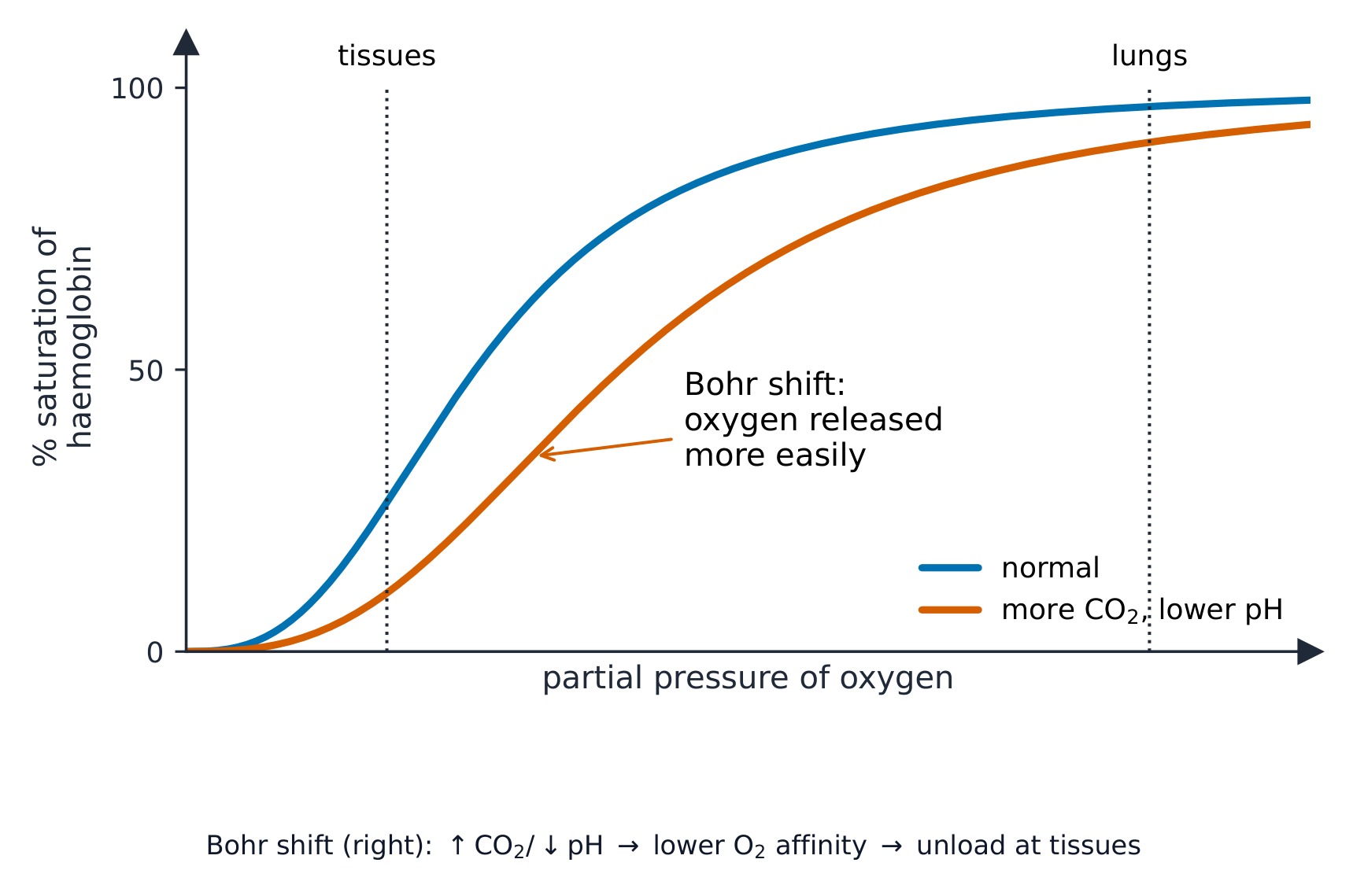
氧气由红细胞中的血红蛋白(haemoglobin)携带。我们用氧解离曲线(oxygen dissociation curve)显示血红蛋白多好地抓住氧气。这个 S 形的图把饱和度(saturation,血红蛋白装满氧气的程度)对氧气的分压(partial pressure)作图:
- 在氧气分压高的地方(在肺中),血红蛋白装载起来并变得几乎完全饱和。
- 在它低的地方(在进行呼吸作用的组织中),血红蛋白卸下它的氧气供细胞使用。
The Bohr shift
当组织非常活跃时,它们释放更多的二氧化碳(carbon dioxide),这降低 pH。这使血红蛋白更容易释放氧气,所以曲线向右移动。这个有益的变化是波尔位移(Bohr shift):氧气恰好在它最被需要的地方被交出。
血红蛋白在肺中装载氧气并在组织中卸下它;波尔位移把曲线右移,所以释放更多 Carrying carbon dioxide
一点点二氧化碳直接溶入血浆,但大部分在红细胞内部一个反应之后被携带:
- 酶(enzyme)碳酸酐酶(carbonic anhydrase)加速二氧化碳与水的反应以制造碳酸。
- 碳酸分裂成氢离子和碳酸氢根离子(hydrogencarbonate ions)。
- 碳酸氢根离子移出到血浆。这是二氧化碳被携带的主要方式。
- 为了保持电荷平衡,氯离子(chloride ions)移入红细胞。这种移动是氯转移(chloride shift)。
- 氢离子加入血红蛋白以构成血红蛋白酸(haemoglobinic acid);这吸收氢离子并保持 pH 稳定。
一些二氧化碳也直接加入血红蛋白以构成氨甲酰血红蛋白(carbaminohaemoglobin)。

大部分 CO₂ 作为碳酸氢根离子行进;氯转移保持电荷平衡,而血红蛋白吸收 H⁺ 例题。 在肺部,氧分压约为 $12\ \text{kPa}$,血红蛋白的饱和度约为 98%;在运动中的肌肉里,氧分压约为 $3\ \text{kPa}$,饱和度降到约 40%。有多少氧被卸下?为什么曲线呈 S 形?把饱和度相减:$98 - 40 =$ 58% 的血红蛋白结合氧在肌肉中被释放。S 形源于协同结合 - 第一个氧结合后改变了血红蛋白的形状,使后面的氧更容易结合,这正是曲线中段如此陡峭的原因。这种陡峭正是要点所在:在进行呼吸作用的组织里,分压小幅下降就会引起氧的大量释放。运动中肌肉产生的额外二氧化碳降低了 pH,使曲线右移,于是在相同分压下卸下的氧更多 - 这就是波尔位移在起作用。
探索How blood carries oxygen
Haemoglobin picks up oxygen where there is lots of it (the lungs) and releases it where there is little (the tissues).
词汇表 训练英文 中文 拼音 oxygen/ˈɒksɪdʒn/ 氧气 yǎng qì haemoglobin/ˌhiːməˈɡləʊbɪn/ 血红蛋白 xuè hóng dàn bái oxygen dissociation curve/ˈɒksɪdʒn dɪˌsəʊsɪˈeɪʃn kɜːv/ 氧解离曲线 yǎng jiě lí qū xiàn saturation/ˌsætʃəˈreɪʃn/ 饱和度 bǎo hé dù partial pressure/ˈpɑːʃl ˈpreʃə/ 分压 fēn yā Bohr shift/ˈbəʊə ʃɪft/ 波尔位移 bō ěr wèi yí carbon dioxide/ˈkɑːbən daɪˈɒksaɪd/ 二氧化碳 èr yǎng huà tàn enzyme/ˈenzaɪm/ 酶 méi carbonic anhydrase/kɑːˈbɒnɪk ˈænhaɪdreɪz/ 碳酸酐酶 tàn suān gān méi hydrogencarbonate ion/ˈhaɪdrəʊdʒeŋkɑːbɒneɪt ˈaɪɒn/ 碳酸氢根离子 tàn suān qīng gēn lí zi chloride ion/ˈklɔːraɪd ˈaɪɒn/ 氯离子 lǜ lí zi chloride shift/ˈklɔːraɪd ʃɪft/ 氯转移 lǜ zhuǎn yí haemoglobinic acid/ˌhiːməˌɡləʊˈbɪnɪk ˈæsɪd/ 血红蛋白酸 xuè hóng dàn bái suān carbaminohaemoglobin/ˌkɑːbəˌmɪnəʊˌhiːməˈɡləʊbɪn/ 氨甲酰血红蛋白 ān jiǎ xiān xuè hóng dàn bái 8.3
心脏

大纲
- describe the external and internal structure of the mammalian heart
- explain the differences in the thickness of the walls of the: • atria and ventricles • left ventricle and right ventricle
- describe the cardiac cycle, with reference to the relationship between blood pressure changes during systole and diastole and the opening and closing of valves
- explain the roles of the sinoatrial node, the atrioventricular node and the Purkyne tissue in the cardiac cycle (knowledge of nervous and hormonal control is not expected)
来源:剑桥国际大纲
Structure
心脏有四个腔。两个上腔是心房(atria,单数:atrium);它们有薄壁,因为它们只把血液往下推入下面的腔。两个下腔是心室(ventricles);它们有厚的肌肉壁,因为它们把血液泵出心脏。
左心室壁比右心室壁厚,因为左侧必须把血液泵绕全身,而右侧只泵到附近的肺。
四个腔、瓣膜和主要血管;左心室壁最厚 The cardiac cycle
一次心跳是心动周期(cardiac cycle)。它有两部分:收缩期(systole,当心肌收缩时)和舒张期(diastole,当它放松并充盈时)。当一个腔收缩时,里面的压力上升;这种压力变化打开和关闭瓣膜,使血液只往一个方向流。
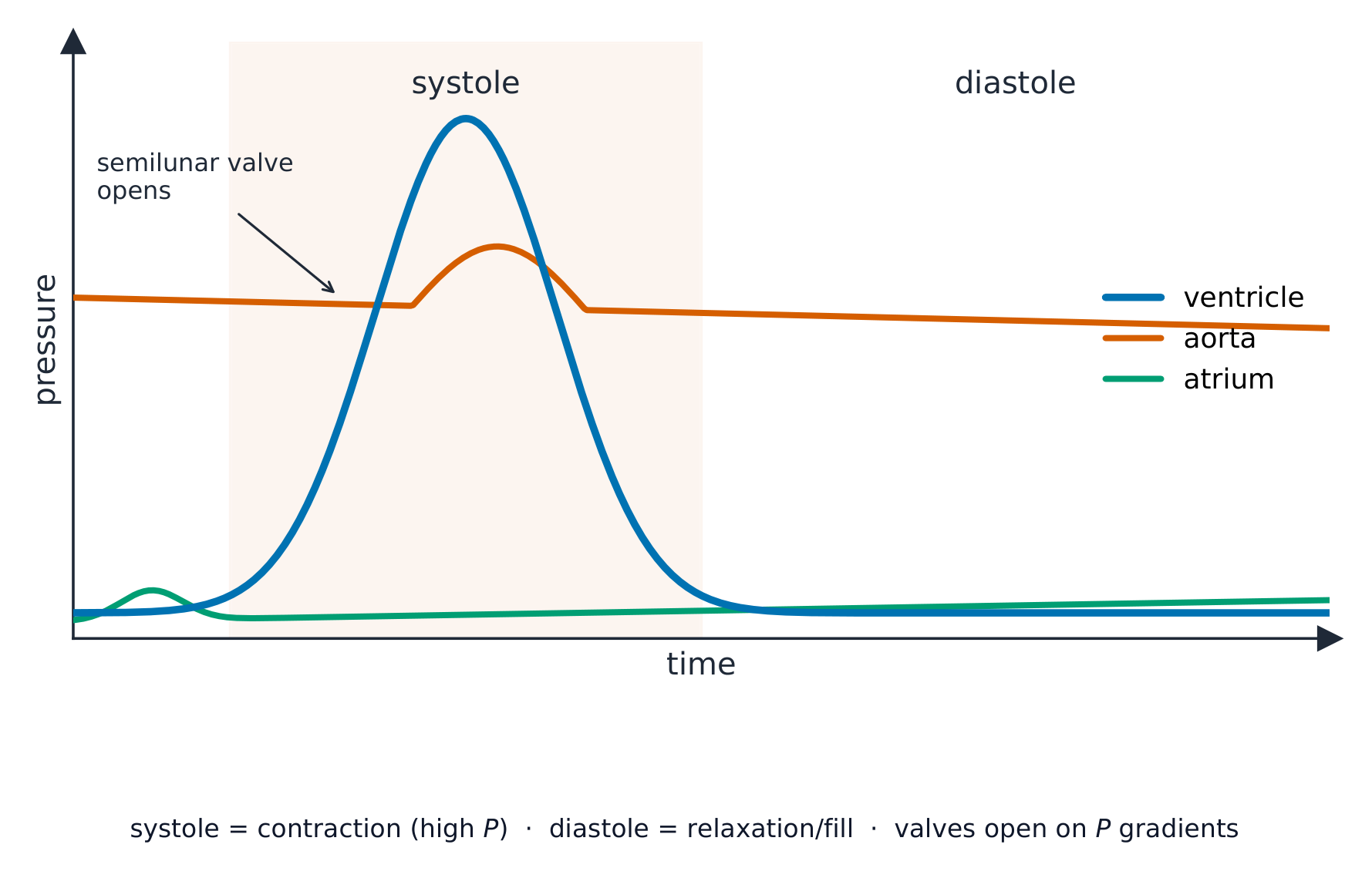
心室压力在收缩期骤升并把血液推入主动脉;每当两条压力曲线交叉时一个瓣膜打开或关闭 Controlling the heartbeat
心脏设定它自己的节律:
- 右心房中的窦房结(sinoatrial node)是起搏器。它发出一个电兴奋波,它铺开到心房并使它们收缩。
- 房室结(atrioventricular node)接收这个波、把它扣住片刻(所以心房先排空),然后传递它。
- 浦肯野组织(Purkyne tissue)把波往下带并穿过心室壁,所以心室从底部向上收缩并把血液推出。

窦房结设定节律;波传到房室结,然后浦肯野组织使心室自下而上收缩 探索Explore the heart
Tap each part. The right side pumps blood to the lungs; the thicker-walled left side pumps it round the whole body.
探索The cardiac cycle
Step through one heartbeat — atria contract, then ventricles contract, then everything relaxes and refills.
探索The cardiac cycle
Step through one heartbeat. Pressure changes open and close the valves so blood always flows one way.
词汇表 训练英文 中文 拼音 atrium/ˈeɪtrɪəm/ 心房 xīn fáng ventricle/ˈventrɪkl/ 心室 xīn shì cardiac cycle/ˈkɑːdiæk ˈsaɪkl/ 心动周期 xīn dòng zhōu qī systole/ˈsɪstəʊl/ 收缩期 shōu suō qī diastole/ˈdaɪəstəʊl/ 舒张期 shū zhāng qī sinoatrial node/sɪˈnəʊtrɪəl nəʊd/ 窦房结 dòu fáng jié atrioventricular node/ˌeɪtrɪˌəʊvənˈtrɪkjʊlə nəʊd/ 房室结 fáng shì jié Purkyne tissue/ˈpɜːkaɪn ˈtɪʃuː/ 浦肯野组织 pǔ kěn yě zǔ zhī 8.3
考试技巧
- 追踪双循环并命名腔、瓣膜和血管;左心室壁更厚(以更高的压力泵得更远)。
- 读心动周期压力图:当跨一个瓣膜的压力交叉时它打开/关闭。
- 解释氧解离曲线(S 形)和波尔位移(更多 CO2 把它右移,向活跃的组织卸下更多 O2)。
- 大部分 CO2 作为碳酸氢根携带(通过氯转移)。
-
9
气体交换
9.1
气体交换系统

大纲
- describe the structure of the human gas exchange system, limited to: • lungs • trachea • bronchi • bronchioles • alveoli • capillary network
- describe the distribution in the gas exchange system of cartilage, ciliated epithelium, goblet cells, squamous epithelium of alveoli, smooth muscle and capillaries
- recognise cartilage, ciliated epithelium, goblet cells, squamous epithelium of alveoli, smooth muscle and capillaries in microscope slides, photomicrographs and electron micrographs
- recognise trachea, bronchi, bronchioles and alveoli in microscope slides, photomicrographs and electron micrographs and make plan diagrams of transverse sections of the walls of the trachea and bronchus
- describe the functions of ciliated epithelial cells, goblet cells and mucous glands in maintaining the health of the gas exchange system
- describe the functions in the gas exchange system of cartilage, smooth muscle, elastic fibres and squamous epithelium
- describe gas exchange between air in the alveoli and blood in the capillaries
来源:剑桥国际大纲
你的身体需要吸入氧气并除去二氧化碳。这种交换发生在气体交换(gas exchange)系统中。空气沿这条路径进入身体:
- 往下经气管(trachea,气道),
- 进入两个支气管(bronchi,每个肺一个),
- 进入许多更小的细支气管(bronchioles),
- 最后进入叫肺泡(alveoli)的微小气囊,深在肺(lungs)里。
每个肺泡被一个毛细血管(capillaries)网络包裹,所以空气和血液被带得非常靠近。
人类肺,气体交换在那里跨数百万个肺泡进行 
空气往下经气管、进入支气管和细支气管,到肺泡 探索Explore the airways
Tap each part. Air branches from the trachea down to the tiny alveoli, where gas exchange happens.
词汇表 训练英文 中文 拼音 gas exchange/ɡæs eksˈtʃeɪndʒ/ 气体交换 qì tǐ jiāo huàn trachea/trəˈkɪə/ 气管 qì guǎn bronchus/ˈbrɒŋkəs/ 支气管 zhī qì guǎn bronchiole/ˈbrɒŋkɪəʊl/ 细支气管 xì zhī qì guǎn alveoli/ˈælvɪɒli/ 肺泡 fèi pào lungs/lʌŋz/ 肺 fèi capillary/kəˈpɪləri/ 毛细血管 máo xì xuè guǎn 9.1
呼吸道的组织及其功能

组织 它在哪里 功能 软骨(cartilage) 气管和支气管中的 C 形环 保持气道张开,使它在你吸气时不能塌陷 纤毛上皮(ciliated epithelium) 衬在气管和支气管 叫纤毛(cilia)的微小毛摆动以把黏液(mucus)扫向喉咙、远离肺 杯状细胞(goblet cells)和黏液腺(mucous glands) 在气道的衬里中 制造黏液,它困住你吸入的尘埃和微生物(microbes) 平滑肌(smooth muscle) 在支气管和细支气管的壁中 收缩以使气道变窄 弹性纤维(elastic fibres) 在气道和肺泡壁中 你吸气时伸展,然后弹回以帮助把空气推出 扁平上皮(squamous epithelium) 肺泡的非常薄、平的衬里 给气体一个非常短的穿越距离 纤毛、杯状细胞和黏液腺一起工作以保持肺干净和健康:黏液困住脏物和微生物,而纤毛把它带走以被吞下。
穿过气道壁的一个切面:纤毛和杯状细胞衬着管腔,后面有平滑肌和支撑的软骨 
杯状细胞制造困住尘埃和微生物的黏液;纤毛把它扫到喉咙 词汇表 训练英文 中文 拼音 cartilage/ˈkɑːtɪlɪdʒ/ 软骨 ruǎn gǔ ciliated epithelium/ˈsɪlɪeɪtɪd ˌepɪˈθiːlɪəm/ 纤毛上皮 xiān máo shàng pí cilia/ˈsɪlɪə/ 纤毛 xiān máo mucus/ˈmjuːkəs/ 黏液 nián yè goblet cell/ˈɡɒblət sel/ 杯状细胞 bēi zhuàng xì bāo mucous gland/ˈmjuːkəs ɡlænd/ 黏液腺 nián yè xiàn microbe/ˈmaɪkrəʊb/ 微生物 wēi shēng wù smooth muscle/smuːð ˈmʌsl/ 平滑肌 píng huá jī elastic fibre/ɪˈlæstɪk ˈfaɪbə/ 弹性纤维 tán xìng xiān wéi squamous epithelium/ˈskwɒməs ˌepɪˈθiːlɪəm/ 扁平上皮 biǎn píng shàng pí diffuse/dɪˈfjuːz/ 扩散 kuò sàn 9.1
肺泡中的气体交换

肺泡是交换气体的极好表面,因为它们有:
- 一个非常大的总表面积(数百万个微小的囊),
- 非常薄的壁——肺泡的扁平上皮和毛细血管壁各只有一个细胞厚,所以要穿越的距离很微小,
- 来自毛细血管网络的丰富血液供应,
- 一个湿润的衬里,所以气体在穿越之前溶解。
气体通过扩散(diffusion)沿它们的浓度梯度(concentration gradients)移动:
- 氧气(oxygen)在肺泡空气中处于高浓度、在血液中处于低浓度,所以它从空气扩散进血液。
- 二氧化碳(carbon dioxide)在血液中处于高浓度、在肺泡空气中处于低浓度,所以它从血液扩散进空气以被呼出。
跨薄的、湿润的壁,氧气扩散进血液,二氧化碳扩散出去 在显微镜下,真实的肺组织看起来像一片精细的粉色蕾丝。许多开放的空间是肺泡,它们之间薄的粉色线是气体交换发生的壁:

为显微镜染色的真实肺组织:开放的空间是肺泡,薄的粉色壁是气体穿越的地方;一个小气道坐在中心 呼吸使新鲜空气保持在肺泡里,而流动的血液不断把气体带走。这两者都保持浓度梯度陡峭,所以气体交换保持快速。
例题。 用菲克定律解释为什么肺泡能进行如此快速的气体交换。菲克定律指出扩散速率正比于
$$\frac{\text{surface area} \times \text{concentration difference}}{\text{diffusion distance}}$$所以要快,三项都得帮忙。表面积:数以百万计的肺泡提供了巨大的总面积,大约 $70\ \text{m}^2$。扩散距离:肺泡上皮和毛细血管内皮各自只有一个扁平细胞那么厚,所以氧在不到 $1\ \mu\text{m}$ 的距离内就能穿过。浓度差:通气不断更新空气,循环不断把含氧的血液带走,所以陡峭的梯度得以维持。要把每一项适应特征与它所服务的方程中的那一项联系起来 - 只罗列"表面积大、壁薄、血液供应好"而不与菲克定律挂钩,是较弱的答案。
探索At the alveolus
Tap each part. Oxygen and carbon dioxide swap across a wall just one cell thick, between the air and the blood.
词汇表 训练英文 中文 拼音 concentration gradient/ˌkɒnsənˈtreɪʃn ˈɡreɪdɪənt/ 浓度梯度 nóng dù tī dù oxygen/ˈɒksɪdʒn/ 氧气 yǎng qì carbon dioxide/ˈkɑːbən daɪˈɒksaɪd/ 二氧化碳 èr yǎng huà tàn 9.1
考试技巧
- 把每个肺泡特征与快速扩散联系起来:大表面积、薄(一个细胞)壁、湿润表面、好的血液供应——一个"表面积、短距离、陡梯度"的答案。
- 把气道组织匹配到功能:软骨(保持气道张开)、纤毛 + 杯状细胞(困住并扫走黏液)、平滑肌和弹性纤维。
- 用菲克定律(Fick's law)思想构造答案:速率 $\propto$ 表面积 $\times$ 浓度差 $\div$ 距离。
-
10
传染病
10.1
传染病

大纲
- state that infectious diseases are caused by pathogens and are transmissible
- state the name and type of pathogen that causes each of the following diseases: • cholera – caused by the bacterium Vibrio cholerae • malaria – caused by the protoctists Plasmodium falciparum, Plasmodium malariae, Plasmodium ovale and Plasmodium vivax • tuberculosis (TB) – caused by the bacteria Mycobacterium tuberculosis and Mycobacterium bovis • HIV/AIDS – caused by the human immunodeficiency virus (HIV)
- explain how cholera, malaria, TB and HIV are transmitted
- discuss the biological, social and economic factors that need to be considered in the prevention and control of cholera, malaria, TB and HIV (details of the life cycle of the malarial parasite are not expected)
来源:剑桥国际大纲
一种传染病(infectious disease)由一个病原体(pathogen)引起——一个生活在一个宿主里面或上面并造成伤害的生物。传染病是可传播的:病原体能从一个人传播(transmitted,传递)到另一个人。
你需要知道四种疾病、引起每种的病原体,以及每种如何传播。
疾病 病原体和类型 它如何传播 霍乱(cholera) 细菌(bacterium)Vibrio cholerae 饮用被粪便(faeces,人类排泄物)污染(contaminated)的水或食物 疟疾(malaria) 原生生物(protoctist)Plasmodium 一只受感染的蚊子(mosquito)的叮咬,它充当一个媒介(vector,病原体的一个携带者);也通过受感染的血液 结核病(TB)(tuberculosis) 细菌 Mycobacterium 来自咳嗽和喷嚏的微小空气传播飞沫(droplets);在人们拥挤的地方传播快 HIV/AIDS 病毒(virus)HIV(它导致 AIDS(艾滋病)) 无保护的性行为、受感染的血液(例如共用针头),以及从母亲到婴儿 HIV 感染并摧毁某些白细胞,所以它慢慢削弱身体的免疫系统(immune system)。
引起结核病的细菌 Mycobacterium(红色杆),在一个痰样品中染色 
引起疟疾的原生生物 Plasmodium(小的深色环),生活在红细胞里面 
疟疾需要一个蚊子媒介:寄生虫随每次叮咬从人传到蚊子再传到人——这就是为什么控制针对蚊子 探索Infectious disease route lab
Classify disease cases by pathogen and route of transmission.
探索Disease control chain
Follow how prevention breaks the chain of infection.
词汇表 训练英文 中文 拼音 infectious disease/ɪnˈfekʃəs dɪˈziːz/ 传染病 chuán rǎn bìng pathogen/ˈpæθədʒn/ 病原体 bìng yuán tǐ transmit/trænˈsmɪt/ 传播 chuán bō cholera/ˈkɒlərə/ 霍乱 huò luàn bacterium/bækˈtɪərɪəm/ 细菌 xì jūn contaminated/kənˈtæmɪneɪtɪd/ 污染 wū rǎn faeces/ˈfiːsiːz/ 粪便 fèn biàn malaria/mæˈleərɪə/ 疟疾 nüè jí protoctist/ˈprəʊtəʊktɪst/ 原生生物 yuán shēng shēng wù mosquito/məˈskiːtəʊ/ 蚊子 wén zi vector/ˈvektə/ 媒介 méi jiè tuberculosis/ˌtjuːbəkjʊˈləʊsɪs/ 结核病 jié hé bìng droplet/ˈdrɒplɪt/ 飞沫 fēi mò virus/ˈvaɪrəs/ 病毒 bìng dú AIDS/eɪdz/ 艾滋病 ài zī bìng immune system/ɪˈmjuːn ˈsɪstəm/ 免疫系统 miǎn yì xì tǒng 10.1
预防和控制这些疾病
控制有生物、社会和经济方面——病原体的科学、人们的行为和教育,以及可用的钱和资源。例子:
- 霍乱:提供干净的水和适当的污水处理;好的卫生;一些地区的疫苗(vaccines)。
- 疟疾:睡在蚊帐下;去除蚊子繁殖的死水池;喷杀虫剂(insecticides);服用抗疟药物。
- TB:找到并用一个长疗程的抗生素治疗受感染的人;打卡介苗;减少过度拥挤;追踪患者的接触者。
- HIV:使用避孕套;使用干净的针头;检测捐献的血液;教育人们。目前还没有治愈方法、没有疫苗,但药物能减慢病毒。
在每种情况下,成本(经济)、人们改变行为的意愿(社会)以及药物或疫苗的供应(生物)都影响一种疾病能被多好地控制。
词汇表 训练英文 中文 拼音 vaccine/vækˈsiːn/ 疫苗 yì miáo insecticide/ˌɪnˈsektɪsaɪd/ 杀虫剂 shā chóng jì 10.2
抗生素

大纲
- outline how penicillin acts on bacteria and why antibiotics do not affect viruses
- discuss the consequences of antibiotic resistance and the steps that can be taken to reduce its impact
来源:剑桥国际大纲
一种抗生素(antibiotic)是一种杀死细菌或阻止它们生长的药物。例如,青霉素(penicillin)阻止细菌建造它们的细胞壁(cell walls)。随着细菌生长,它的弱壁不能撑住它,所以细胞吸入水并胀破。
青霉素阻止新细胞壁构成,所以细菌吸入水并胀破 
我们如何测试哪种抗生素有效。每张纸片含一种不同的抗生素。清晰的圆环意味着那种抗生素杀死了它周围的细菌——圆环越大,药效越强。没有圆环的纸片是细菌能抵抗的那些 抗生素对病毒****不起作用。一个病毒没有细胞壁、没有它自己的化学反应可攻击——它只是使用宿主细胞的机器。所以一个病毒里没有抗生素靶点。
词汇表 训练英文 中文 拼音 antibiotic/ˌæntɪbaɪˈɒtɪk/ 抗生素 kàng shēng sù penicillin/ˌpenɪˈsɪlɪn/ 青霉素 qīng méi sù cell wall/sel wɔːl/ 细胞壁 xì bāo bì 10.2
抗生素耐药性

有时一个突变(mutation)使一个细菌对一种抗生素耐药,这意味着抗生素不再杀死它。这种耐药性(resistance)是一个严重的问题:
- 当一种抗生素被使用时,不耐药的细菌死亡,但任何耐药的存活并繁殖。随时间,越来越多的细菌携带耐药性。
- 一些感染随即变得非常难、或不可能治疗。
抗生素耐药性通过自然选择传播:抗生素杀死其余的,所以耐药的幸存者接管 减慢耐药性的步骤:
- 只在真正需要时使用抗生素(不用于像感冒这样的病毒性疾病)。
- 总是完成整个疗程,所以没有细菌被留活。
- 对感染使用正确的抗生素。
- 减少农业中抗生素的大量使用。
例题。 一位流感患者被开了抗生素。解释为什么它没有用,以及为什么它还有实际的害处。抗生素起作用靠的是攻击细菌有而人体细胞没有的结构或过程 - 例如青霉素阻断细胞壁的合成,使正在生长的细菌因渗透压而破裂。病毒没有细胞壁,没有自己的核糖体,也没有代谢:它在宿主细胞内部利用宿主的机器进行复制,所以根本没有可供该药攻击的细菌靶点。照吃不误还会让患者体内无害的常驻细菌接触到这种抗生素,杀死敏感的那些,并选择出耐药的那些 - 耐药性就是这样在群体中扩散的。要点出缺失的那个靶点:"病毒不是活的"不是理由,得不到分。
探索How resistance evolves
Step through natural selection in fast-forward. The antibiotic kills the rest, so only the resistant bacteria are left to breed.
词汇表 训练英文 中文 拼音 mutation/mjuːˈteɪʃn/ 突变 tū biàn resistance/rɪˈzɪstəns/ 耐药性 nài yào xìng 10.2
考试技巧
- 对每种命名的疾病给出病原体和途径(霍乱–细菌、水;疟疾–疟原虫、蚊子媒介;还有 TB、HIV/AIDS)。
- 解释为什么抗生素只对细菌起作用(它们针对细胞壁/酶,而不是病毒)。
- 把抗生素耐药性解释为自然选择:一个耐药的突变体存活并繁殖;通过完成疗程和避免过度使用来减少它。
-
11
免疫
11.1
免疫系统

大纲
- describe the mode of action of phagocytes (macrophages and neutrophils)
- explain what is meant by an antigen (see 4.1.3) and state the difference between self antigens and non-self antigens
- describe the sequence of events that occurs during a primary immune response with reference to the roles of: • macrophages • B-lymphocytes, including plasma cells • T-lymphocytes, limited to T-helper cells and T-killer cells
- explain the role of memory cells in the secondary immune response and in long-term immunity
来源:剑桥国际大纲
你的免疫系统(immune system)是保卫身体抵抗病原体(pathogens)的一组细胞。最先行动的细胞是吞噬细胞(phagocytes),一组白细胞,包括巨噬细胞(macrophages)和中性粒细胞(neutrophils)。
一个血涂片:大的染色细胞是白细胞,散布在许多红细胞之间 一个吞噬细胞通过吞噬作用(phagocytosis)摧毁一个病原体:它围住病原体、把它包进一个囊泡带进里面,并用酶消化它。这之后,一个巨噬细胞在它自己的表面展示病原体的部分,准备好警示其他免疫细胞。

吞噬作用:吞噬细胞吞入病原体、消化它,然后展示它的抗原 这张假彩色电子显微照片捕捉了现实生活中的那一刻:一个吞噬细胞伸出去抓住并吞入杆状细菌。

一个真实的中性粒细胞(黄色),一种吞噬细胞,伸出去通过吞噬作用吞入杆状细菌(橙色) 探索Phagocytosis
Step through how a phagocyte deals with a pathogen — engulf it, digest it, then display its antigen to call in the rest of the immune system.
词汇表 训练英文 中文 拼音 immune system/ɪˈmjuːn ˈsɪstəm/ 免疫系统 miǎn yì xì tǒng pathogen/ˈpæθədʒn/ 病原体 bìng yuán tǐ phagocyte/ˈfæɡəsaɪt/ 吞噬细胞 tūn shì xì bāo macrophage/ˈmækrəfɪdʒ/ 巨噬细胞 jù shì xì bāo neutrophil/ˈnjuːtrəfɪl/ 中性粒细胞 zhōng xìng lì xì bāo phagocytosis/ˌfæɡəsɪˈtəʊsɪs/ 吞噬作用 tūn shì zuò yòng 11.1
抗原:自我与非我

一个抗原(antigen)是一个细胞表面上免疫系统能识别的分子(通常是一个蛋白质)。
- 自身抗原(self antigens)是身体自己的标记。免疫系统学会忽略它们。
- 非自身抗原(non-self antigens)是外来的,例如一个病原体上的抗原。这些触发一个免疫反应。
Clear zones on a culture plate: the immune system recognises non-self antigens and attacks foreign cells 词汇表 训练英文 中文 拼音 antigen/ˈæntɪdʒen/ 抗原 kàng yuán self antigen/self ˈæntɪdʒen/ 自身抗原 zì shēn kàng yuán non-self antigen/nɒn self ˈæntɪdʒen/ 非自身抗原 fēi zì shēn kàng yuán 11.1
初次免疫应答

一个新病原体第一次进入时,身体做出一个缓慢的免疫反应(immune response)。主要步骤是:
- 一个巨噬细胞吞入病原体并展示它的抗原。
- 辅助性T细胞(T-helper cells)识别那个抗原并变得活跃。它们释放开启其他细胞的化学物。
- 带匹配形状的 B-淋巴细胞(B-lymphocytes)被选中。它们分裂以构成浆细胞(plasma cells,它倾泻出抗体(antibodies))和记忆细胞(memory cells)。
- 杀伤性T细胞(T-killer cells)摧毁身体自己已被感染的细胞。
只有形状匹配抗原的 B-淋巴细胞被选中并克隆——成为制造抗体的浆细胞和长寿的记忆细胞 探索The primary immune response
Step through the first time the body meets a pathogen — slow at first, but it leaves memory cells behind.
词汇表 训练英文 中文 拼音 immune response/ɪˈmjuːn rɪˈspɒns/ 免疫反应 miǎn yì fǎn yìng T-helper cell/tiː ˈhelpə sel/ 辅助性T细胞 fǔ zhù xìng T xì bāo lymphocyte/ˈlɪmfəsaɪt/ 淋巴细胞 lín bā xì bāo plasma cell/ˈplæzmə sel/ 浆细胞 jiāng xì bāo memory cell/ˈmeməri sel/ 记忆细胞 jì yì xì bāo T-killer cell/tiː ˈkɪlə sel/ 杀伤性T细胞 shā shāng xìng T xì bāo 11.1
记忆细胞与长期免疫
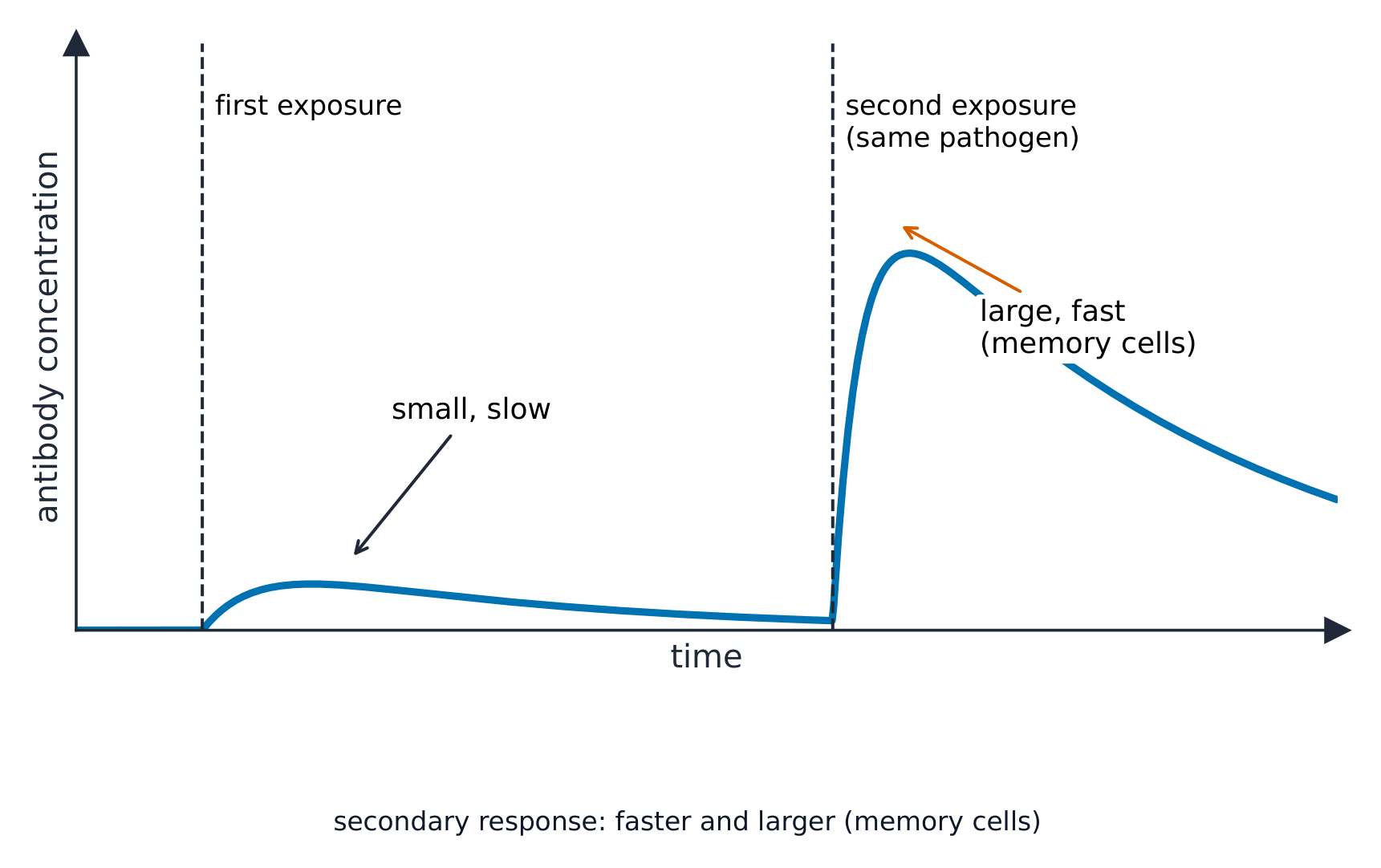
记忆细胞在感染结束后在身体里停留多年。若同样的病原体再次进入,记忆细胞启动一个次级免疫反应,它比第一次快得多、大得多。病原体在它能使你生病之前就被摧毁。这就是我们所说的长期免疫。
次级反应更快、更大,因为记忆细胞准备好了 11.2
抗体与疫苗接种

大纲
- relate the molecular structure of antibodies to their functions
- outline the hybridoma method for the production of monoclonal antibodies
- outline the principles of using monoclonal antibodies in the diagnosis of disease and in the treatment of disease
- describe the differences between active immunity and passive immunity and between natural immunity and artificial immunity
- explain that vaccines contain antigens that stimulate immune responses to provide long-term immunity
- explain how vaccination programmes can help to control the spread of infectious diseases
来源:剑桥国际大纲
一个抗体是浆细胞制造的一个 Y 形蛋白质。Y 的两个尖端是抗原结合位点(antigen-binding sites)。每个位点有一个叫可变区(variable region)的特殊形状,它只契合一个抗原,像一把锁和钥匙。
一个抗体是 Y 形的;两个尖端是结合一个特定抗原的可变区 抗体以几种方式帮助:它们粘到抗原上、把病原体聚成团使它们更容易被处理、标记病原体使吞噬细胞找到它们,并阻挡有害的毒素。
探索Inside an antibody
Tap each part. The variable tips bind one specific antigen; the constant stem is the same in every antibody.
词汇表 训练英文 中文 拼音 antibody/ˈæntɪbɒdi/ 抗体 kàng tǐ antigen-binding site/ˈæntɪdʒen ˈbaɪndɪŋ saɪt/ 抗原结合位点 kàng yuán jié hé wèi diǎn variable region/ˈveərɪəbl ˈriːdʒn/ 可变区 kě biàn qū 11.2
单克隆抗体

一个单克隆抗体(monoclonal antibody)是一种单一类型的抗体,全部相同。它们用杂交瘤(hybridoma)方法制造:
- 给一只动物一个抗原,所以它制造产生想要的抗体的 B-淋巴细胞。
- 这些 B-淋巴细胞与无止境分裂的肿瘤细胞融合。
- 融合的细胞(杂交瘤)既制造抗体又不停地分裂,产生大量的一种相同的抗体。
把一个 B-淋巴细胞与一个肿瘤细胞融合制造一个倾泻出一种相同(单克隆)抗体的杂交瘤 单克隆抗体被用于疾病的诊断(diagnosis,检测一个特定的分子,如在一个怀孕测试中)和治疗(把药物运到特定的靶细胞,如癌细胞)。

怀孕测试就是单克隆抗体在起作用。抗体被固定在 T 线上,只抓住一种分子——怀孕激素 hCG。只有当尿液里有 hCG 时,T 线才变红;C 线总会出现,用来表明测试正常运行 词汇表 训练英文 中文 拼音 monoclonal antibody/ˈmɒnəʊklɒnl ˈæntɪbɒdi/ 单克隆抗体 dān kè lóng kàng tǐ hybridoma/ˌhaɪbrɪˈdəʊmə/ 杂交瘤 zá jiāo liú diagnosis/ˌdaɪəɡˈnəʊsɪs/ 诊断 zhěn duàn 11.2
免疫的类型

免疫可以是主动的或被动的,以及天然的或人工的。
- 主动免疫(active immunity)——你自己的身体遇到一个抗原并制造它自己的抗体和记忆细胞。它启动慢但持久。
- 被动免疫(passive immunity)——现成的抗体从外面被给你。它立即起作用但不持久,因为没有记忆细胞。
- 天然免疫(natural immunity)——以一种天然的方式获得(主动:一次感染后;被动:从母亲传给婴儿的抗体)。
- 人工免疫(artificial immunity)——故意获得(主动:你的身体被促使对一个安全剂量的抗原作出反应;被动:你被注射现成的抗体)。
主动免疫(你的身体作出反应)持久;被动免疫(现成的抗体)快但短 词汇表 训练英文 中文 拼音 active immunity/ˈæktɪv ɪˈmjuːnɪti/ 主动免疫 zhǔ dòng miǎn yì passive immunity/ˈpæsɪv ɪˈmjuːnɪti/ 被动免疫 bèi dòng miǎn yì natural immunity/ˈnætʃərəl ɪˈmjuːnɪti/ 天然免疫 tiān rán miǎn yì artificial immunity/ˌɑːtɪˈfɪʃl ɪˈmjuːnɪti/ 人工免疫 rén gōng miǎn yì 11.2
疫苗接种

一个疫苗(vaccine)含有抗原——常常是一个死的或减弱的病原体,或它的一部分。抗原触发一个初级免疫反应并制造记忆细胞,所以你不用生病就获得长期免疫。
疫苗接种(vaccination)计划能控制一种疾病在一个种群中的传播。若足够多的人被接种,病原体就不能容易地从一个人传到另一个人。这甚至保护没有被接种的人,一个叫群体免疫(herd immunity)的效果。
群体免疫:当足够多的人被接种时,病原体不能到达少数没有被接种的人 例题。 把下列各项分类为主动或被动、天然或人工:(a) 婴儿从母乳中获得抗体;(b) 儿童接种麻疹疫苗;(c) 某人从水痘中康复;(d) 被蛇咬的病人被注射抗蛇毒血清。每次都问两个问题。这个人是自己产生抗体的吗?如果是,就是主动;如果是别人给的现成抗体,就是被动。这是偶然发生的还是刻意进行的?天然的,还是人工的。所以 (a) 是天然被动 - 通过天然途径获得的现成抗体;(b) 是人工主动 - 疫苗中的抗原让孩子产生自己的抗体;(c) 是天然主动 - 感染让他们产生了自己的抗体;(d) 是人工被动 - 刻意给予的现成抗体。只有主动免疫会产生记忆细胞,这正是被动免疫立刻见效、却持续时间短的原因。
探索How a vaccine works
Step through it. A vaccine triggers a primary response and memory cells, so the real pathogen meets a fast, strong defence.
词汇表 训练英文 中文 拼音 vaccine/vækˈsiːn/ 疫苗 yì miáo vaccination/ˌvæksɪˈneɪʃn/ 疫苗接种 yì miáo jiē zhǒng herd immunity/hɜːd ɪˈmjuːnɪti/ 群体免疫 qún tǐ miǎn yì 11.2
考试技巧
- 区分吞噬细胞(吞入,非特异性)和淋巴细胞:B 细胞 → 抗体(体液),T 细胞(辅助/杀伤,细胞介导)。
- 标注一个抗体(可变区、抗原结合位点)并解释凝集和中和。
- 在一个图上比较初级和次级反应——记忆细胞使次级更快、更大。
- 用每种的一个例子区分主动对被动和天然对人工免疫;解释疫苗接种和群体免疫。
-
12
能量与呼吸作用
12.1
能量

大纲
- outline the need for energy in living organisms, as illustrated by active transport, movement and anabolic reactions, such as those occurring in DNA replication and protein synthesis
- describe the features of ATP that make it suitable as the universal energy currency
- state that ATP is synthesised by: • transfer of phosphate in substrate-linked reactions • chemiosmosis in membranes of mitochondria and chloroplasts
- explain the relative energy values of carbohydrates, lipids and proteins as respiratory substrates
- state that the respiratory quotient (RQ) is the ratio of the number of molecules of carbon dioxide produced to the number of molecules of oxygen taken in, as a result of respiration
- calculate RQ values of different respiratory substrates from equations for respiration
- describe and carry out investigations, using simple respirometers, to determine the RQ of germinating seeds or small invertebrates (e.g. blowfly larvae)
来源:剑桥国际大纲
细胞需要稳定的能量(energy)供应,它们从呼吸作用(respiration)获得。能量被用于:
- 主动运输(active transport,逆一个梯度移动物质),
- 运动(例如肌肉收缩),
- 合成代谢(anabolic)反应——大分子的建造,如在 DNA 复制和蛋白质合成中。
运动期间,肌肉需要呼吸作用释放的能量的持续供应 词汇表 训练英文 中文 拼音 energy/ˈenədʒi/ 能量 néng liàng respiration/ˌrespɪˈreɪʃn/ 呼吸作用 hū xī zuò yòng active transport/ˈæktɪv ˈtrænspɔːt/ 主动运输 zhǔ dòng yùn shū anabolic/ˌænəˈbɒlɪk/ 合成代谢 hé chéng dài xiè 12.1
ATP —— 能量货币

ATP 是把能量携带到需要它的地方的分子。它由 ADP 和一个磷酸基团制成;当它再次失去那个磷酸时,它释放一小份、可用的能量爆发。ATP 很好地适合这个工作,所以我们把它叫通用能量货币:
- 它快速释放能量,以匹配一个细胞需要的小量。
- 它容易被制造和重新制造,一遍又一遍。
- 它小而可溶,所以它容易在细胞周围移动。
呼吸作用加一个磷酸以制造 ATP;细胞再次把它断开以释放能量 ATP 以两种方式制造:通过在磷酸化(phosphorylation)反应中直接转移一个磷酸基团,以及通过跨线粒体(mitochondria)和叶绿体膜的化学渗透(chemiosmosis)。
探索The ATP cycle
Step around the loop. ATP is split to release a small burst of energy, then rebuilt by respiration — over and over.
词汇表 训练英文 中文 拼音 phosphorylation/ˌfɒsfɔːrɪˈleɪʃn/ 磷酸化 lín suān huà chemiosmosis/ˌkemɪəzˈməʊsɪs/ 化学渗透 huà xué shèn tòu 12.1
呼吸底物与呼吸商

一个呼吸底物(respiratory substrate)是一个被分解以释放能量的分子。每克,脂质释放最多的能量(它们有最多的氢),蛋白质其次,而碳水化合物最少。
脂质每克释放最多的能量,然后蛋白质,然后碳水化合物 呼吸商(respiratory quotient,RQ)比较交换的气体:
$$\text{RQ} = \frac{\text{molecules of carbon dioxide produced}}{\text{molecules of oxygen taken in}}$$你可以从一个呼吸方程算出 RQ。碳水化合物给出约 1.0 的 RQ,脂质约 0.7,蛋白质约 0.9。
例题。 求葡萄糖有氧呼吸的 RQ:$\text{C}_6\text{H}_{12}\text{O}_6 + 6\text{O}_2 \rightarrow 6\text{CO}_2 + 6\text{H}_2\text{O}$。
$$\text{RQ} = \frac{\text{CO}_2 \text{ produced}}{\text{O}_2 \text{ taken in}} = \frac{6}{6} = 1.0.$$这就是为什么一个接近 $1.0$ 的 RQ 暗示生物体在呼吸碳水化合物;一个较低的 RQ(约 $0.7$)暗示它在用脂质,它每分子 $\text{CO}_2$ 需要更多的氧气。
一个呼吸计(respirometer)测量生物吸入的氧气(oxygen),如萌发(germinating)的种子或小的无脊椎动物(invertebrates),并被用来求它们的 RQ。

碱石灰吸收放出的 CO₂,所以气体体积只因被用掉的氧气而下降——珠子按那个量移入 探索Respiratory quotient lab
RQ = CO2 produced / O2 used
Change oxygen use and see how RQ compares fuels.
词汇表 训练英文 中文 拼音 respiratory substrate/rɪˈspɪrətəri ˈsʌbstreɪt/ 呼吸底物 hū xī dǐ wù respiratory quotient/rɪˈspɪrətəri ˈkwəʊʃənt/ 呼吸商 hū xī shāng respirometer/rɪspɪˈrɒmɪtə/ 呼吸计 hū xī jì oxygen/ˈɒksɪdʒn/ 氧气 yǎng qì germinate/ˈdʒɜːmɪneɪt/ 萌发 méng fā invertebrate/ɪnˈvɜːtɪbreɪt/ 无脊椎动物 wú jǐ zhuī dòng wù carbon dioxide/ˈkɑːbən daɪˈɒksaɪd/ 二氧化碳 èr yǎng huà tàn 12.2
呼吸作用

大纲
- State where each of the four stages in aerobic respiration occurs in eukaryotic cells: • glycolysis in the cytoplasm • link reaction in the mitochondrial matrix • Krebs cycle in the mitochondrial matrix • oxidative phosphorylation on the inner membrane of mitochondria
- outline glycolysis as phosphorylation of glucose and the subsequent splitting of fructose 1,6-bisphosphate (6C) into two triose phosphate molecules (3C), which are then further oxidised to pyruvate (3C), with the production of ATP and reduced NAD
- explain that, when oxygen is available, pyruvate enters mitochondria to take part in the link reaction
- describe the link reaction, including the role of coenzyme A in the transfer of acetyl (2C) groups
- outline the Krebs cycle, explaining that oxaloacetate (4C) acts as an acceptor of the 2C fragment from acetyl coenzyme A to form citrate (6C), which is converted back to oxaloacetate in a series of small steps
- explain that reactions in the Krebs cycle involve decarboxylation and dehydrogenation and the reduction of the coenzymes NAD and FAD
- describe the role of NAD and FAD in transferring hydrogen to carriers in the inner mitochondrial membrane
- explain that during oxidative phosphorylation: • hydrogen atoms split into protons and energetic electrons • energetic electrons release energy as they pass through the electron transport chain (details of carriers are not expected) • the released energy is used to transfer protons across the inner mitochondrial membrane • protons return to the mitochondrial matrix by facilitated diffusion through ATP synthase, providing energy for ATP synthesis (details of ATP synthase are not expected) • oxygen acts as the final electron acceptor to form water
- describe the relationship between the structure and function of mitochondria using diagrams and electron micrographs
- outline respiration in anaerobic conditions in mammals (lactate fermentation) and in yeast cells (ethanol fermentation)
- explain why the energy yield from respiration in aerobic conditions is much greater than the energy yield from respiration in anaerobic conditions (a detailed account of the total yield of ATP from the aerobic respiration of glucose is not expected)
- explain how rice is adapted to grow with its roots submerged in water, limited to the development of aerenchyma in roots, ethanol fermentation in roots and faster growth of stems
- describe and carry out investigations using redox indicators, including DCPIP and methylene blue, to determine the effects of temperature and substrate concentration on the rate of respiration of yeast
- describe and carry out investigations using simple respirometers to determine the effect of temperature on the rate of respiration
来源:剑桥国际大纲
有氧(aerobic)呼吸(带氧气)有四个阶段,每个在细胞里一个固定的位置:
阶段 它在哪里发生 糖酵解(glycolysis) 细胞质(cytoplasm) 连接反应(link reaction) 线粒体的基质(matrix) 克雷布斯循环(Krebs cycle) 线粒体的基质 氧化磷酸化(oxidative phosphorylation) 线粒体的内膜 四个阶段以及每个在哪里发生;还原的 NAD 和 FAD 把氢带到内膜,大部分 ATP 在那里制造 Glycolysis
葡萄糖(glucose,6 碳)首先用 2 ATP 被磷酸化,以构成果糖二磷酸(6C)。这个 6C 分子被分裂成两个丙糖磷酸分子(各 3C)。这些随即被氧化(oxidised)成丙酮酸(pyruvate,3C)。糖酵解净得 2 ATP 和一些还原的(reduced)NAD(NAD 是一个辅酶(coenzyme),一个帮助分子)。
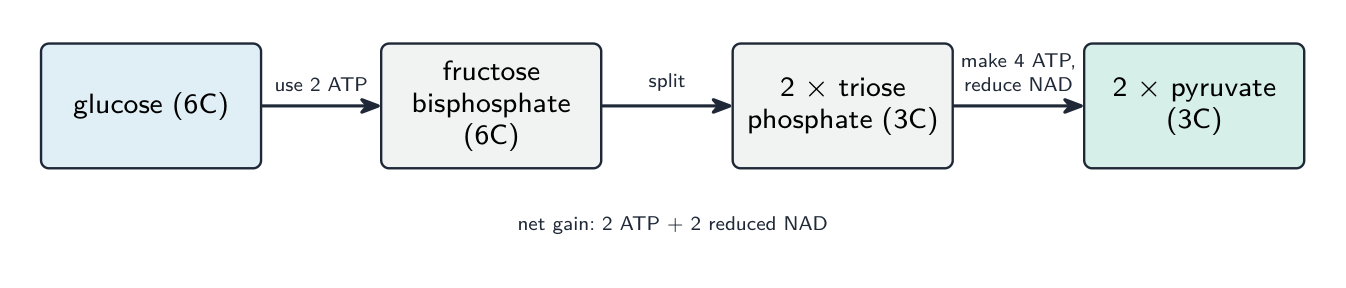
糖酵解花 2 ATP 来启动,但制造 4,所以净得 2 ATP(加还原的 NAD)——而且它不需要氧气 The link reaction
当氧气可用时,丙酮酸进入线粒体。在那里每个丙酮酸失去一个二氧化碳(carbon dioxide)并被变成一个 2 碳的乙酰基(acetyl)基团。这个基团由辅酶A(coenzyme A)携带以构成乙酰辅酶A。一些二氧化碳被释放,而 NAD 被还原。
The Krebs cycle
2C 的乙酰基基团加入一个 4 碳分子,草酰乙酸(oxaloacetate),以制造一个 6 碳分子,柠檬酸(citrate)。柠檬酸随即在一系列小步骤中被变回草酰乙酸,准备好接受下一个乙酰基基团。在这些步骤期间:
- 脱羧(decarboxylation)以二氧化碳的形式移除碳。
- 脱氢(dehydrogenation)移除氢,它还原辅酶 NAD 和 FAD。
还原的 NAD 和 FAD 随即把氢带到线粒体内膜中的载体。

每一圈释放二氧化碳(脱羧)和还原的 NAD 和 FAD(脱氢) Oxidative phosphorylation
这个阶段制造大部分的 ATP:
- 氢原子分裂成质子(protons)和有能量的电子(electrons)。
- 电子沿电子传递链(electron transport chain)传递,一路释放能量。
- 这个能量被用来把质子泵过内膜。
- 质子通过一个叫 ATP合酶(ATP synthase)的通道流回基质。这种流动提供制造 ATP 的能量(这是化学渗透)。
- 氧气是最终的电子受体:它与电子和质子结合以构成水。

电子把质子(H⁺)泵入膜间隙;它们通过 ATP 合酶流回以制造 ATP(化学渗透) The structure of mitochondria
内膜折叠成嵴(cristae),给电子传递链和 ATP 合酶一个大表面。里面的基质容纳连接反应和克雷布斯循环的物质和帮助者。

两个真实的线粒体,用电子显微镜拍摄。穿过内部的深色条纹就是嵴——正是这些折叠使电子传递链的表面如此之大 探索Glycolysis
Step through it. Glucose is split in the cytoplasm into two pyruvate, for a small net gain of ATP and reduced NAD.
探索The four stages of respiration
Step through where ATP comes from. Glucose is broken down in stages; most ATP is made at the last stage.
词汇表 训练英文 中文 拼音 mitochondria/ˌmaɪtəˈkɒndrɪə/ 线粒体 xiàn lì tǐ aerobic/eəˈrəʊbɪk/ 有氧 yǒu yǎng glycolysis/ɡlaɪˈkɒləsɪs/ 糖酵解 táng jiào jiě cytoplasm/ˈsaɪtəplæzəm/ 细胞质 xì bāo zhì link reaction/lɪŋk rɪˈækʃn/ 连接反应 lián jiē fǎn yìng matrix/ˈmeɪtrɪks/ 基质 jī zhì Krebs cycle/krebz ˈsaɪkl/ 克雷布斯循环 kè léi bù sī xún huán oxidative phosphorylation/ˈɒksɪdətɪv ˌfɒsfɔːrɪˈleɪʃn/ 氧化磷酸化 yǎng huà lín suān huà glucose/ˈɡluːkəʊs/ 葡萄糖 pú táo táng oxidise/ˈɒksɪdaɪz/ 氧化 yǎng huà pyruvate/ˈpaɪruːveɪt/ 丙酮酸 bǐng tóng suān reduce/rɪˈdjuːs/ 还原 huán yuán coenzyme/ˌkəʊˈenzaɪm/ 辅酶 fǔ méi acetyl/ˈæsɪtaɪl/ 乙酰基 yǐ xiān jī coenzyme A/ˌkəʊˈenzaɪm eɪ/ 辅酶A fǔ méi A oxaloacetate/ˈɒksələʊsɪteɪt/ 草酰乙酸 cǎo xiān yǐ suān citrate/ˈsɪtreɪt/ 柠檬酸 níng méng suān decarboxylation/dɪˌkɑːbəksɪˈleɪʃn/ 脱羧 tuō suō dehydrogenation/ˌdiːhaɪˈdrɒdʒəneɪʃn/ 脱氢 tuō qīng electron/ɪˈlektrɒn/ 电子 diàn zi electron transport chain/ɪˈlektrɒn ˈtrænspɔːt tʃeɪn/ 电子传递链 diàn zi chuán dì liàn proton/ˈprəʊtɒn/ 质子 zhì zi ATP synthase/ˌeɪ tiː ˈpiː ˈsɪnθeɪs/ ATP合酶 hé méi cristae/ˈkrɪstiː/ 嵴 jǐ 12.2
无氧呼吸

当没有氧气时,只有糖酵解能运行。为了让糖酵解继续,细胞必须用掉还原的 NAD。这通过发酵(fermentation)发生:
- 在哺乳动物中,丙酮酸被变成乳酸(lactate,乳酸发酵)。乳酸后来在氧气返回时被分解。
- 在酵母(yeast)中,丙酮酸被变成乙醇(ethanol)和二氧化碳(乙醇发酵)。
没有氧气,丙酮酸变成乳酸(哺乳动物)或乙醇(酵母);这为糖酵解再生 NAD 无氧(anaerobic)呼吸给出的能量远少于有氧呼吸。有氧呼吸也运行克雷布斯循环和氧化磷酸化,它们释放多得多的 ATP,而无氧呼吸只获得糖酵解的那一小份。
探索Why fermentation matters
Step through it. Without oxygen, fermentation regenerates NAD so glycolysis can keep making a little ATP.
词汇表 训练英文 中文 拼音 fermentation/fɜːmənˈteɪʃn/ 发酵 fā jiào lactate/ˈlækteɪt/ 乳酸 rǔ suān yeast/jiːst/ 酵母 jiào mǔ ethanol/ˈeθənɒl/ 乙醇 yǐ chún anaerobic/ˌæneəˈrəʊbɪk/ 无氧 wú yǎng 12.2
水稻与被水淹的根

水稻能在它的根在水下、那里氧气很少的情况下生长。它以三种方式适应:它在根中发育出通气组织(aerenchyma,充气的空间)以把空气带下去;根用乙醇发酵以保持制造一些 ATP;而茎生长得更快以到达水上的空气。
一个生长在水中的植物根的横切面。大的白色气隙就是通气组织——相连的气道,让氧气一路扩散到坐在缺氧泥中的根 词汇表 训练英文 中文 拼音 aerenchyma/ˈeərəntʃɪmə/ 通气组织 tōng qì zǔ zhī 12.2
研究呼吸速率
一个氧化还原指示剂(indicator)如 DCPIP 或亚甲基蓝,当它从进行呼吸作用的细胞获得氢时失去它的颜色。颜色失去得越快,酵母呼吸得越快,所以你可以测试温度或底物浓度的影响。一个呼吸计也可以被用来测量温度如何改变氧气吸收的速率。
词汇表 训练英文 中文 拼音 indicator/ˈɪndɪkeɪtə/ 指示剂 zhǐ shì jì 12.2
考试技巧
- 陈述每个阶段在哪里发生及它的 ATP 产量:糖酵解(细胞质)、连接反应 + 克雷布斯(基质)、氧化磷酸化(内膜,大部分 ATP)。
- 解释 NAD/FAD 的作用(把氢带到电子传递链)和氧气的作用(最终的电子受体)。
- RQ $=$ 产生的 CO2 $\div$ 用掉的 O2($\approx 1.0$ 碳水化合物,$0.7$ 脂质);知道一个呼吸计如何测量它。
- 无氧呼吸给出乳酸(动物)或乙醇 + CO2(酵母/植物)以及远少的 ATP(只有糖酵解)。
-
13
光合作用
13.1
作为能量转移过程的光合作用

大纲
- describe the relationship between the structure of chloroplasts, as shown in diagrams and electron micrographs, and their function
- explain that energy transferred as ATP and reduced NADP from the light-dependent stage is used during the light-independent stage (Calvin cycle) of photosynthesis to produce complex organic molecules
- state that within a chloroplast, the thylakoids (thylakoid membranes and thylakoid spaces), which occur in stacks called grana, are the site of the light-dependent stage and the stroma is the site of the light-independent stage
- describe the role of chloroplast pigments (chlorophyll a, chlorophyll b, carotene and xanthophyll) in light absorption in thylakoids
- interpret absorption spectra of chloroplast pigments and action spectra for photosynthesis
- describe and use chromatography to separate and identify chloroplast pigments (reference should be made to $R_f$ values in identification of chloroplast pigments)
- state that cyclic photophosphorylation and non-cyclic photophosphorylation occur during the light-dependent stage of photosynthesis
- explain that in cyclic photophosphorylation: • only photosystem I (PSI) is involved • photoactivation of chlorophyll occurs • ATP is synthesised
- explain that in non-cyclic photophosphorylation: • photosystem I (PSI) and photosystem II (PSII) are both involved • photoactivation of chlorophyll occurs • the oxygen-evolving complex catalyses the photolysis of water • ATP and reduced NADP are synthesised
- explain that during photophosphorylation: • energetic electrons release energy as they pass through the electron transport chain (details of carriers are not expected) • the released energy is used to transfer protons across the thylakoid membrane • protons return to the stroma from the thylakoid space by facilitated diffusion through ATP synthase, providing energy for ATP synthesis (details of ATP synthase are not expected)
- outline the three main stages of the Calvin cycle: • rubisco catalyses the fixation of carbon dioxide by combination with a molecule of ribulose bisphosphate (RuBP), a 5C compound, to yield two molecules of glycerate 3-phosphate (GP), a 3C compound • GP is reduced to triose phosphate (TP) in reactions involving reduced NADP and ATP • RuBP is regenerated from TP in reactions that use ATP
- state that Calvin cycle intermediates are used to produce other molecules, limited to GP to produce some amino acids and TP to produce carbohydrates, lipids and amino acids
来源:剑桥国际大纲
光合作用(photosynthesis)发生在叶绿体(chloroplast)里面。它的结构适合它的两个阶段:
- 里面是叫类囊体(thylakoids)的一叠叠扁平的囊。一叠类囊体是一个基粒(granum,复数 grana)。类囊体膜容纳捕光的色素,是第一阶段的场所。
- 类囊体周围的液体是基质(stroma),第二阶段的场所。
叶子是绿色的,因为它们的叶绿体充满色素叶绿素 
类囊体堆叠成基粒(第一阶段在这里发生);它们周围的基质是第二阶段发生的地方 
显微镜下,一片伊乐藻(水草)叶细胞里面的叶绿体(小的绿色盘) 探索Explore the chloroplast
Tap each part. The light-dependent stage runs on the thylakoid membranes (grana); the Calvin cycle runs in the stroma around them.
词汇表 训练英文 中文 拼音 photosynthesis/ˌfəʊtəʊˈsɪnθəsɪs/ 光合作用 guāng hé zuò yòng chloroplast/ˈklɔːrəʊplæst/ 叶绿体 yè lǜ tǐ thylakoid/ˈθaɪləkɔɪd/ 类囊体 lèi náng tǐ grana/ˈɡrɑːnə/ 基粒 jī lì stroma/ˈstrəʊmə/ 基质 jī zhì 13.1
光合作用的两个阶段

光合作用有两个相连的阶段:
- 光反应阶段(light-dependent stage)发生在类囊体中。它用光能制造 ATP 和还原的(reduced)NADP。
- 暗反应阶段(light-independent stage),也叫卡尔文循环(Calvin cycle),发生在基质中。它用来自第一阶段的 ATP 和还原的 NADP 从二氧化碳(carbon dioxide)建造复杂的有机分子。
两个阶段相连:第一个制造第二个花掉以把 CO₂ 变成糖的 ATP 和还原的 NADP 词汇表 训练英文 中文 拼音 light-dependent stage/laɪt dɪˈpendənt steɪdʒ/ 光反应阶段 guāng fǎn yìng jiē duàn reduce/rɪˈdjuːs/ 还原 huán yuán light-independent stage/laɪt ˌɪndɪˈpendənt steɪdʒ/ 暗反应阶段 àn fǎn yìng jiē duàn Calvin cycle/ˈkælvɪn ˈsaɪkl/ 卡尔文循环 kǎ ěr wén xún huán carbon dioxide/ˈkɑːbən daɪˈɒksaɪd/ 二氧化碳 èr yǎng huà tàn 13.1
叶绿体色素
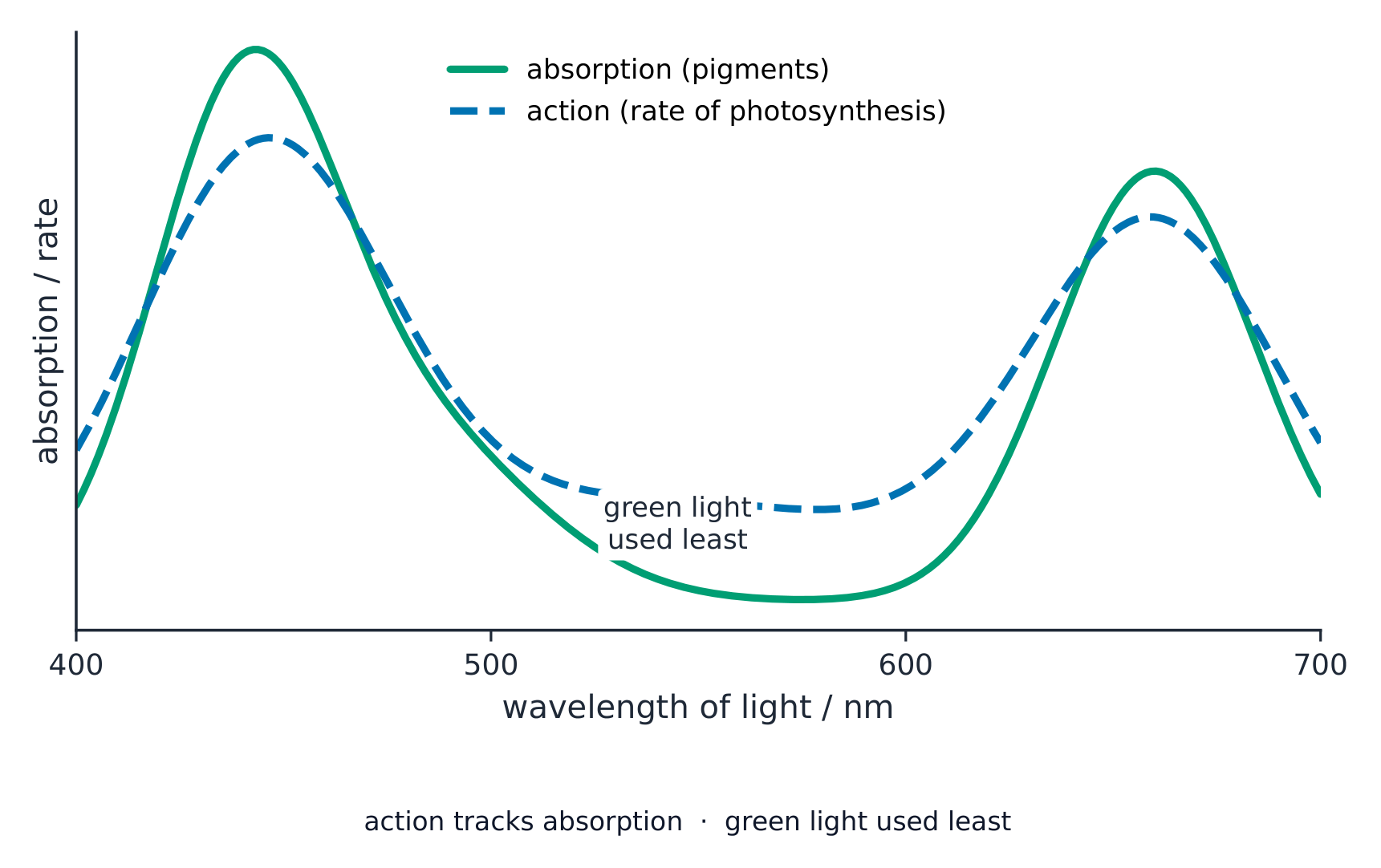
一个色素(pigment)是一个吸收光的有色物质。类囊体容纳几种一起工作以捕获尽可能多的光的色素:
- 叶绿素(chlorophyll)a 和叶绿素 b(它们主要吸收红光和蓝光),
- 胡萝卜素(carotene)和叶黄素(xanthophyll)(它们吸收其他颜色并传递能量)。
我们用两个图研究它们。一个吸收光谱(absorption spectrum)显示每种色素在每个波长吸收多少光。一个作用光谱(action spectrum)显示光合作用在每个波长进行得多快。两个图紧密匹配,这显示色素驱动光合作用。
吸收光谱和作用光谱匹配:蓝光和红光被用得最多,绿光最少 你可以用色谱法(chromatography)分离色素:色素沿纸向上行进不同的距离。每种色素由它的 比移值(Rf value,色素移动的距离除以溶剂移动的距离)识别。

每种色素沿纸向上行进它自己的距离;它的 Rf 是斑点距离除以溶剂距离 词汇表 训练英文 中文 拼音 pigment/ˈpɪɡmənt/ 色素 sè sù chlorophyll/ˌklɔːrəʊˈfɪl/ 叶绿素 yè lǜ sù carotene/ˈkærəʊtiːn/ 胡萝卜素 hú luó bo sù xanthophyll/ˈzænθəfɪl/ 叶黄素 yè huáng sù absorption spectrum/əbˈsɔːpʃn ˈspektrəm/ 吸收光谱 xī shōu guāng pǔ action spectrum/ˈækʃn ˈspektrəm/ 作用光谱 zuò yòng guāng pǔ chromatography/krəʊməˈtɒɡrəfi/ 色谱法 sè pǔ fǎ Rf value/ˌɑːˈref ˈvæljuː/ 比移值 bǐ yí zhí 13.1
光反应阶段

在类囊体中,光被用来制造 ATP。这是光合磷酸化(photophosphorylation),它有两种形式。
在循环光合磷酸化(cyclic photophosphorylation)中:
- 只用光系统(photosystem)I(PSI)。
- 发生叶绿素的光激活(photoactivation,光把它的电子(electrons)提升到一个更高的能量)。
- 只制造 ATP。
在非循环光合磷酸化(non-cyclic photophosphorylation)中:
- 光系统 I(PSI)和光系统 II(PSII)都用。
- 发生叶绿素的光激活。
- 放氧复合体(oxygen-evolving complex)执行水的光解(photolysis,被光分裂),它释放氧气(oxygen)。
- ATP 和还原的 NADP 都制造。
在非循环光合磷酸化中,光解分裂水;电子流动 PSII → PSI,制造 ATP 和还原的 NADP 在两种形式中,能量以同样的方式释放:
- 有能量的电子沿一个电子传递链(electron transport chain)传递,一路释放能量。
- 这个能量被用来把质子(protons)泵过类囊体膜。
- 质子通过 ATP合酶(ATP synthase)流回基质,而这种流动提供制造 ATP 的能量。
探索The light-dependent stage
Step through it. Light excites electrons and splits water; the result is ATP, reduced NADP and oxygen.
词汇表 训练英文 中文 拼音 photophosphorylation/ˌfəʊtəʊˌfɒsfɔːrɪˈleɪʃn/ 光合磷酸化 guāng hé lín suān huà cyclic photophosphorylation/ˈsaɪklɪk ˌfəʊtəʊˌfɒsfɔːrɪˈleɪʃn/ 循环光合磷酸化 xún huán guāng hé lín suān huà photosystem/ˌfəʊtəʊˈsɪstəm/ 光系统 guāng xì tǒng photoactivation/ˌfəʊtəʊˌæktɪˈveɪʃn/ 光激活 guāng jī huó electron/ɪˈlektrɒn/ 电子 diàn zi non-cyclic photophosphorylation/nɒn ˈsaɪklɪk ˌfəʊtəʊˌfɒsfɔːrɪˈleɪʃn/ 非循环光合磷酸化 fēi xún huán guāng hé lín suān huà oxygen-evolving complex/ˈɒksɪdʒn ɪˈvɒlvɪŋ ˈkɒmpleks/ 放氧复合体 fàng yǎng fù hé tǐ photolysis/fəʊˈtɒləsɪs/ 光解 guāng jiě oxygen/ˈɒksɪdʒn/ 氧气 yǎng qì electron transport chain/ɪˈlektrɒn ˈtrænspɔːt tʃeɪn/ 电子传递链 diàn zi chuán dì liàn proton/ˈprəʊtɒn/ 质子 zhì zi ATP synthase/ˌeɪ tiː ˈpiː ˈsɪnθeɪs/ ATP合酶 hé méi 13.1
卡尔文循环

暗反应阶段以三个主要步骤建造糖:
- 固定(fixation)——酶(enzyme)rubisco 把二氧化碳加入一个 5 碳分子,RuBP(核酮糖二磷酸)。这制造两个 3 碳化合物 GP(甘油酸 3-磷酸)的分子。
- 还原(reduction)——GP 用来自光反应阶段的还原的 NADP 和 ATP 被还原成 TP(丙糖磷酸)。
- 再生(regeneration)——大部分的 TP 被用来再生(regenerate)RuBP(用更多的 ATP),所以循环能保持运行。
固定把 CO₂ 加到 RuBP;还原用 ATP 和还原的 NADP 制造 TP;再生重造 RuBP;一些 TP 变成糖 一些 TP 离开循环以制造有用的分子。GP 能被用来制造一些氨基酸(amino acids),而 TP 能被用来制造碳水化合物(carbohydrates)、脂质(lipids)和氨基酸。
探索The Calvin cycle
Step around the cycle. CO₂ is fixed onto RuBP, reduced to sugar using the light-stage's ATP and NADP, and RuBP is regenerated.
词汇表 训练英文 中文 拼音 fixation/fɪkˈseɪʃn/ 固定 gù dìng enzyme/ˈenzaɪm/ 酶 méi regenerate/riːˈdʒenəreɪt/ 再生 zài shēng amino acid/əˈmiːnəʊ ˈæsɪd/ 氨基酸 ān jī suān carbohydrate/ˌkɑːbəʊˈhaɪdreɪt/ 碳水化合物 tàn shuǐ huà hé wù lipid/ˈlɪpɪd/ 脂质 zhī zhì 13.2
限制因素的探究

大纲
- state that light intensity, carbon dioxide concentration and temperature are examples of limiting factors of photosynthesis
- explain the effects of changes in light intensity, carbon dioxide concentration and temperature on the rate of photosynthesis
- describe and carry out investigations using redox indicators, including DCPIP and methylene blue, and a suspension of chloroplasts to determine the effects of light intensity and light wavelength on the rate of photosynthesis
- describe and carry out investigations using whole plants, including aquatic plants, to determine the effects of light intensity, carbon dioxide concentration and temperature on the rate of photosynthesis
来源:剑桥国际大纲
一个限制因素(limiting factor)是供应最短缺、拖住光合作用速率的那个。三个主要的是光照强度(light intensity)、二氧化碳****浓度(concentration)和温度(temperature)。
- 提高光照强度加速光合作用,直到某个其他因素变成限制。
- 提高二氧化碳浓度加速它,直到某个其他因素变成限制。
- 提高温度加速它,但只到一个最适值;太高酶就变性。
当速率上升时,光是限制因素;在它趋平的地方,另一个因素(CO₂ 或温度)限制它 你可以用一个氧化还原指示剂(indicator)如 DCPIP 或亚甲基蓝和一个叶绿体悬液测量光反应阶段的速率:染料随着叶绿体工作失去它的颜色,而你可以测试不同的光照强度或光波长(wavelengths)。用一整株水生植物(aquatic plant),你可以数放出的氧气气泡以比较不同条件下的速率。
例题。 一株正在稳定进行光合作用的植物突然被断绝二氧化碳供应。GP 和 RuBP 的含量会怎样变化?一步一步跟着循环走。二氧化碳是在RuBP 与它结合(由 Rubisco 催化)生成 GP 时被固定的。去掉二氧化碳,这个反应就停止了,所以 GP 不再被生成 - 但 GP 仍在被消耗,利用 ATP 和还原型 NADP 被还原成 TP。所以 GP 下降。与此同时,RuBP 仍在由 TP 再生,却不再被消耗,所以 RuBP 上升。方法始终不变:找出停下来的那个反应,然后对每种物质分别问它是否还在被生成、是否还在被消耗。如果改为撤掉光照,结果正好相反:没有 ATP 和还原型 NADP,GP 无法被还原,所以 GP 上升而 RuBP 下降。
探索What limits photosynthesis
Change light and CO₂. The rate is set by whichever factor is in shortest supply — raising the others won't help.
词汇表 训练英文 中文 拼音 limiting factor/ˈlɪmɪtɪŋ ˈfæktə/ 限制因素 xiàn zhì yīn sù light intensity/laɪt ɪnˈtensɪti/ 光照强度 guāng zhào qiáng dù concentration/ˌkɒnsənˈtreɪʃn/ 浓度 nóng dù temperature/ˈtemprɪtʃə/ 温度 wēn dù indicator/ˈɪndɪkeɪtə/ 指示剂 zhǐ shì jì wavelength/ˈweɪvleŋθ/ 波长 bō cháng aquatic plant/əˈkwætɪk plænt/ 水生植物 shuǐ shēng zhí wù 13.2
考试技巧
- 分开两个阶段:光反应(类囊体——光解、ATP、还原的 NADP、O2)和卡尔文循环(基质——CO2 被 rubisco 固定、GP → TP)。
- 读限制因素图:平台是一个不同的因素(光、CO2 或温度)限制速率的地方。
- 用 $R_f$ 值解释色谱法以识别色素。
- 把叶绿体结构与功能联系起来(类囊体堆叠用于光反应;基质用于卡尔文循环)。
-
14
稳态
14.1
哺乳动物的稳态

大纲
- explain what is meant by homeostasis and the importance of homeostasis in mammals
- explain the principles of homeostasis in terms of internal and external stimuli, receptors, coordination systems (nervous system and endocrine system), effectors (muscles and glands) and negative feedback
- state that urea is produced in the liver from the deamination of excess amino acids
- describe the structure of the human kidney, limited to: • fibrous capsule • cortex • medulla • renal pelvis • ureter • branches of the renal artery and renal vein
- Identify, in diagrams, photomicrographs and electron micrographs, the parts of a nephron and its associated blood vessels and structures, limited to: • glomerulus • Bowman’s capsule • proximal convoluted tubule • loop of Henle • distal convoluted tubule • collecting duct
- describe and explain the formation of urine in the nephron, limited to: • the formation of glomerular filtrate by ultrafiltration in the Bowman’s capsule • selective reabsorption in the proximal convoluted tubule
- relate the detailed structure of the Bowman’s capsule and proximal convoluted tubule to their functions in the formation of urine
- describe the roles of the hypothalamus, posterior pituitary gland, antidiuretic hormone (ADH), aquaporins and collecting ducts in osmoregulation
- describe the principles of cell signalling using the example of the control of blood glucose concentration by glucagon, limited to: • binding of hormone to cell surface receptor causing conformational change • activation of G-protein leading to stimulation of adenylyl cyclase • formation of the second messenger, cyclic AMP (cAMP) • activation of protein kinase A by cAMP leading to initiation of an enzyme cascade • amplification of the signal through the enzyme cascade as a result of activation of more and more enzymes by phosphorylation • cellular response in which the final enzyme in the pathway is activated, catalysing the breakdown of glycogen
- explain how negative feedback control mechanisms regulate blood glucose concentration, with reference to the effects of insulin on muscle cells and liver cells and the effect of glucagon on liver cells
- explain the principles of operation of test strips and biosensors for measuring the concentration of glucose in blood and urine, with reference to glucose oxidase and peroxidase enzymes
来源:剑桥国际大纲
负反馈:血糖 稳态(homeostasis)意味着保持身体内部的条件稳定,即使外部改变。保持温度、水和血糖等稳定,让酶和细胞始终正常工作。
一个血糖仪:稳态把血糖保持在狭窄的限度内 The principles of homeostasis
大多数稳态遵循同样的方案:
- 一个改变(一个内部或外部的刺激(stimulus))被一个受体(receptor)检测到。
- 一个协调系统传递这个消息——要么是神经系统(nervous system,用神经信号),要么是内分泌系统(endocrine system,用激素(hormones))。
- 一个效应器(effector,一块肌肉或一个腺体(gland))做出一个纠正这个改变的响应。

出汗使身体降温——温度稳态的一部分,以皮肤作为效应器 这通过负反馈(negative feedback)起作用:一个偏离正常水平的改变触发一个把它推回正常的响应。

负反馈:一个受体检测一个改变,一个效应器纠正它,返回正常 探索Homeostasis
negative feedback to a set point
Drag the disturbance. A change is corrected back to the set point — the basis of all homeostasis.
词汇表 训练英文 中文 拼音 homeostasis/ˌhəʊmiːəˈstɑːsiz/ 稳态 wěn tài stimulus/ˈstɪmjʊləs/ 刺激 cì jī receptor/rɪˈseptə/ 受体 shòu tǐ nervous system/ˈnɜːvəs ˈsɪstəm/ 神经系统 shén jīng xì tǒng endocrine system/ˈendəʊkraɪn ˈsɪstəm/ 内分泌系统 nèi fēn mì xì tǒng hormone/ˈhɔːməʊn/ 激素 jī sù effector/ɪˈfektə/ 效应器 xiào yìng qì gland/ɡlænd/ 腺体 xiàn tǐ negative feedback/ˈneɡətɪv ˈfiːdbæk/ 负反馈 fù fǎn kuì 14.1
肝脏与尿素
身体不能储存多余的氨基酸。在肝脏(liver)中,脱氨基作用(deamination)的过程从多余的氨基酸(amino acids)中移除氨基,而这被变成尿素(urea)。尿素在血液中被运到肾脏以被移除。
词汇表 训练英文 中文 拼音 liver/ˈlɪvə/ 肝脏 gān zàng deamination/ˌdiːmɪˈneɪʃn/ 脱氨基作用 tuō ān jī zuò yòng amino acid/əˈmiːnəʊ ˈæsɪd/ 氨基酸 ān jī suān urea/juːˈrɪə/ 尿素 niào sù ion/ˈaɪɒn/ 离子 lí zi 14.1
肾脏

肾脏(kidney)清洁血液并控制它的含水量。它的部分是:
- 一个外部的纤维囊(fibrous capsule),
- 一个外部区域,皮质(cortex),
- 一个内部区域,髓质(medulla),
- 一个中央空间,肾盂(renal pelvis),它收集尿液,
- 输尿管(ureter),它把尿液运到膀胱,
- 肾动脉(把血液带入)和肾静脉(把血液带出)的分支。
穿过肾脏的一个切面:血液在皮质和髓质中被清洁,尿液在离开经输尿管往下之前收集在肾盂 The nephron
每个肾脏容纳约一百万个叫肾单位(nephrons)的微小管。沿一个肾单位有:肾小球(glomerulus,一团毛细血管)、它周围的鲍曼囊(Bowman's capsule)、近曲小管(proximal convoluted tubule)、亨利环(loop of Henle)、远曲小管(distal convoluted tubule),以及集合管(collecting duct)。

超滤发生在鲍曼囊中;选择性重吸收发生在近曲小管中 Making urine
- 超滤(ultrafiltration)发生在鲍曼囊中。肾小球中的血液处于高压之下,所以水和小分子(葡萄糖(glucose)、离子(ions)、尿素)被推出到囊中,构成滤液(filtrate)。血细胞和大蛋白质太大而不能通过,所以它们留在血液中。
- 选择性重吸收(selective reabsorption)发生在近曲小管中。有用的物质被带回血液。所有的葡萄糖和大部分的水和离子在这里被重吸收。小管壁很适合这个:它的细胞有微绒毛(microvilli)以给一个大表面积,以及许多线粒体(mitochondria)以为主动运输(active transport)供能。

超滤把血细胞和蛋白质保持在血液中 探索Explore the nephron
Tap each part. Filtration happens at the top; the long tubule then reabsorbs what the body needs, leaving urine.
词汇表 训练英文 中文 拼音 kidney/ˈkɪdni/ 肾脏 shèn zàng cortex/ˈkɔːteks/ 皮质 pí zhì medulla/ˈmedʌlə/ 髓质 suǐ zhì renal pelvis/ˈriːnl ˈpelvɪs/ 肾盂 shèn yú ureter/ˈjʊəretə/ 输尿管 shū niào guǎn nephron/ˈnefrɒn/ 肾单位 shèn dān wèi glomerulus/ˈɡlɒmərjʊləs/ 肾小球 shèn xiǎo qiú Bowman's capsule/ˈbəʊmənz ˈkæpsjuːl/ 鲍曼囊 bào màn náng proximal convoluted tubule/ˈprɒksɪml ˌkɒnvəˈluːtɪd ˈtjuːbjuːl/ 近曲小管 jìn qū xiǎo guǎn loop of Henle/luːp ɒv ˈhenl/ 亨利环 hēng lì huán distal convoluted tubule/dɪˈstæl ˌkɒnvəˈluːtɪd ˈtjuːbjuːl/ 远曲小管 yuǎn qū xiǎo guǎn collecting duct/kəˈlektɪŋ dʌkt/ 集合管 jí hé guǎn ultrafiltration/ˌʊltrəfɪlˈtreɪʃn/ 超滤 chāo lǜ filtrate/ˈfɪltreɪt/ 滤液 lǜ yè selective reabsorption/sɪˈlektɪv riːbˈsɔːpʃn/ 选择性重吸收 xuǎn zé xìng zhòng xī shōu microvilli/ˈmaɪkrəʊvɪlaɪ/ 微绒毛 wēi róng máo mitochondria/ˌmaɪtəˈkɒndrɪə/ 线粒体 xiàn lì tǐ active transport/ˈæktɪv ˈtrænspɔːt/ 主动运输 zhǔ dòng yùn shū 14.1
渗透调节

渗透调节(osmoregulation)控制血液的含水量。它由大脑运行:
- 下丘脑(hypothalamus)检测血液的水势(water potential)。
- 当血液太浓时,垂体(pituitary gland)释放抗利尿激素(antidiuretic hormone,ADH)。
- ADH 通过添加叫水通道蛋白(aquaporins)的水通道使集合管对水更通透。
- 更多的水随即被重吸收回血液,所以制造更少、更浓的尿液。这是负反馈。
ADH 使集合管重吸收更多的水,通过负反馈恢复血液的含水量 探索The ADH pathway
Step through it. When the blood gets too concentrated, ADH makes the kidney save water — classic negative feedback.
词汇表 训练英文 中文 拼音 osmoregulation/ˌɒzmɔːɡjʊˈleɪʃn/ 渗透调节 shèn tòu tiáo jié hypothalamus/ˌhaɪpəʊˈθælæməs/ 下丘脑 xià qiū nǎo water potential/ˈwɔːtə pəˈtenʃl/ 水势 shuǐ shì pituitary gland/pɪˈtjuːɪtəri ɡlænd/ 垂体 chuí tǐ antidiuretic hormone/ˌæntɪˌdɪjuːˈretɪk ˈhɔːməʊn/ 抗利尿激素 kàng lì niào jī sù aquaporin/ˈækwəpɔːrɪn/ 水通道蛋白 shuǐ tōng dào dàn bái 14.1
通过细胞信号传导调控血糖

当血糖下降时,激素胰高血糖素(glucagon)被释放。它显示一个激素如何把它的消息传入一个细胞——细胞信号传递(cell signalling):
- 胰高血糖素结合到肝细胞表面的一个受体,引起一个构象变化(conformational change,受体形状的一个改变)。
- 这激活一个 G蛋白(G-protein),它开启酶腺苷酸环化酶(adenylyl cyclase)。
- 腺苷酸环化酶在细胞内部制造一个第二信使(second messenger),叫环腺苷酸(cyclic AMP,cAMP)。
- cAMP 激活蛋白激酶A(protein kinase A),它启动一个酶级联反应(enzyme cascade)——一个酶(enzyme)通过磷酸化(phosphorylation)开启下一个。
- 因为每个酶开启许多下一个的,信号被大大放大(amplified)。
- 最终的酶把糖原(glycogen)分解成葡萄糖,这提高血糖水平。
信号通过一个第二信使(cAMP)和一个酶级联反应传递——每步激活许多,所以信号被放大 Negative feedback and blood glucose
血糖由两种相互对抗的激素保持稳定:
- 当葡萄糖高时,胰岛素(insulin)使肌肉和肝细胞吸收葡萄糖并把它储存为糖原,降低水平。
- 当葡萄糖低时,胰高血糖素使肝细胞把糖原分解回葡萄糖,提高水平。

胰岛素和胰高血糖素相互对抗以保持血糖稳定 Measuring glucose
试纸(test strips)和生物传感器(biosensors)测量血液或尿液中的葡萄糖。它们用酶葡萄糖氧化酶(glucose oxidase)和过氧化物酶(peroxidase),它们与葡萄糖反应以给出一个颜色变化(或在一个生物传感器中一个电信号),它显示存在多少葡萄糖。
例题。 一个人喝了大量的水。追踪其稳态反应。血液的水势升高(负得更少)。下丘脑中的渗透压感受器察觉到这一点,于是垂体后叶释放更少的抗利尿激素。抗利尿激素减少,插入集合管膜上的水通道蛋白就更少,所以集合管对水的通透性下降。被重吸收的水减少,于是产生大量稀释的尿液,血液的水势回落到接近正常。这种回到设定点的过程正是负反馈 - 反应逆转了原来的变化。要写出感受器、激素、效应器和校正:从"喝水"直接跳到"尿多"的答案会跳过中间所有的得分点。
探索Controlling blood glucose
Push blood glucose away from its set point, then watch negative feedback bring it back: insulin lowers a high level, glucagon raises a low one.
词汇表 训练英文 中文 拼音 glucose/ˈɡluːkəʊs/ 葡萄糖 pú táo táng cell signalling/sel ˈsɪɡnəlɪŋ/ 细胞信号传递 xì bāo xìn hào chuán dì glucagon/ˈɡluːkæɡən/ 胰高血糖素 yí gāo xuè táng sù conformational change/kɒnfɔːˈmeɪʃənl tʃeɪndʒ/ 构象变化 gòu xiàng biàn huà G-protein/dʒiː ˈprəʊtiːn/ G蛋白 G dàn bái adenylyl cyclase/ˈædənɪlɪl ˈsaɪkleɪz/ 腺苷酸环化酶 xiàn gān suān huán huà méi second messenger/ˈsekənd ˈmesɪndʒə/ 第二信使 dì èr xìn shǐ cyclic AMP/ˈsaɪklɪk ˌeɪ em ˈpiː/ 环腺苷酸 huán xiàn gān suān protein kinase A/ˈprəʊtiːn ˈkɪneɪs eɪ/ 蛋白激酶A dàn bái jī méi A enzyme cascade/ˈenzaɪm kəˈskeɪd/ 酶级联反应 méi jí lián fǎn yìng enzyme/ˈenzaɪm/ 酶 méi phosphorylation/ˌfɒsfɔːrɪˈleɪʃn/ 磷酸化 lín suān huà amplification/ˌæmplɪfɪˈkeɪʃn/ 放大 fàng dà glycogen/ˈɡlaɪkədʒn/ 糖原 táng yuán insulin/ˈɪnsjuːlɪn/ 胰岛素 yí dǎo sù test strip/test strɪp/ 试纸 shì zhǐ biosensor/ˌbaɪəʊˈsensə/ 生物传感器 shēng wù chuán gǎn qì glucose oxidase/ˈɡluːkəʊs ˈɒksɪdeɪs/ 葡萄糖氧化酶 pú táo táng yǎng huà méi peroxidase/ˈperəksɪdeɪs/ 过氧化物酶 guò yǎng huà wù méi 14.2
植物的稳态

大纲
- explain that stomata respond to changes in environmental conditions by opening and closing and that regulation of stomatal aperture balances the need for carbon dioxide uptake by diffusion with the need to minimise water loss by transpiration
- explain that stomata have daily rhythms of opening and closing
- describe the structure and function of guard cells and explain the mechanism by which they open and close stomata
- describe the role of abscisic acid in the closure of stomata during times of water stress, including the role of calcium ions as a second messenger
来源:剑桥国际大纲
气孔(stomata)是一片叶子里的孔。植物打开和关闭它们以平衡两个需要:让二氧化碳(carbon dioxide)进来用于光合作用(photosynthesis),以及限制蒸腾作用(transpiration)的水分流失。气孔通常白天打开、夜间关闭,遵循一个日节律。
每个气孔由它周围两个保卫细胞(guard cells)打开和关闭:
- 要打开:保卫细胞泵入离子,所以它们的水势下降,水通过渗透(osmosis)进入。它们膨胀并弯开,打开孔。
- 要关闭:离子离开,水随之出去,保卫细胞变软,孔关闭。
保卫细胞通过吸入水并变膨胀来打开气孔;它们通过失去水并变软来关闭它 当植物缺水时(水分胁迫(water stress)),激素脱落酸(abscisic acid)被释放。它使保卫细胞失去离子和水,所以气孔关闭,节省水。在这个信号传递中,钙离子(calcium ions)在保卫细胞内部充当一个第二信使。
探索How a stoma opens
Step through it. Guard cells pump in ions, draw in water by osmosis, swell turgid and bend apart — opening the pore.
词汇表 训练英文 中文 拼音 stomata/ˈstəʊmətə/ 气孔 qì kǒng carbon dioxide/ˈkɑːbən daɪˈɒksaɪd/ 二氧化碳 èr yǎng huà tàn photosynthesis/ˌfəʊtəʊˈsɪnθəsɪs/ 光合作用 guāng hé zuò yòng transpiration/trænspəˈreɪʃn/ 蒸腾作用 zhēng téng zuò yòng guard cell/ɡɑːd sel/ 保卫细胞 bǎo wèi xì bāo osmosis/ɒzˈməʊsɪs/ 渗透 shèn tòu abscisic acid/əbˈsɪzɪk ˈæsɪd/ 脱落酸 tuō luò suān water stress/ˈwɔːtə stres/ 水分胁迫 shuǐ fèn xié pò calcium ion/ˈkælsɪəm ˈaɪɒn/ 钙离子 gài lí zi 14.2
考试技巧
- 把每个答案构造为负反馈:受体 → 协调者 → 效应器 → 纠正;命名每个部分。
- 血糖:胰岛素降低它(吸收、糖原生成),胰高血糖素提高它(糖原分解)——通过细胞信号传递解释。
- 肾脏:知道超滤(鲍曼囊)、选择性重吸收(近曲小管)以及 ADH 在渗透调节中的作用。
- 气孔在保卫细胞变得膨胀时打开(K+ 进入,水随之)。
-
15
调节与协调
15.1
哺乳动物的调节与协调

大纲
- describe the features of the endocrine system with reference to the hormones ADH, glucagon and insulin (see 14.1.8, 14.1.9 and 14.1.10)
- compare the features of the nervous system and the endocrine system
- describe the structure and function of a sensory neurone and a motor neurone and state that intermediate neurones connect sensory neurones and motor neurones
- outline the role of sensory receptor cells in detecting stimuli and stimulating the transmission of impulses in sensory neurones
- describe the sequence of events that results in an action potential in a sensory neurone, using a chemoreceptor cell in a human taste bud as an example
- describe and explain changes to the membrane potential of neurones, including: • how the resting potential is maintained • the events that occur during an action potential • how the resting potential is restored during the refractory period
- describe and explain the rapid transmission of an impulse in a myelinated neurone with reference to saltatory conduction
- explain the importance of the refractory period in determining the frequency of impulses
- describe the structure of a cholinergic synapse and explain how it functions, including the role of calcium ions
- describe the roles of neuromuscular junctions, the T-tubule system and sarcoplasmic reticulum in stimulating contraction in striated muscle
- describe the ultrastructure of striated muscle with reference to sarcomere structure using electron micrographs and diagrams
- explain the sliding filament model of muscular contraction including the roles of troponin, tropomyosin, calcium ions and ATP
来源:剑桥国际大纲
身体有两个协调系统。内分泌系统(endocrine system)在血液中发送化学激素(hormones,如 ADH、胰高血糖素和胰岛素)。神经系统(nervous system)沿神经细胞发送快速的电信号。
神经控制快而电性;激素控制慢而化学性 
人类大脑的一个扫描,神经系统的控制中心 特征 神经系统 内分泌系统 信号 电冲动(impulse) 化学激素 运输 沿神经细胞 在血液中 速度 非常快 较慢 它持续多久 短 较长 词汇表 训练英文 中文 拼音 endocrine system/ˈendəʊkraɪn ˈsɪstəm/ 内分泌系统 nèi fēn mì xì tǒng hormone/ˈhɔːməʊn/ 激素 jī sù nervous system/ˈnɜːvəs ˈsɪstəm/ 神经系统 shén jīng xì tǒng impulse/ˈɪmpʌls/ 冲动 chōng dòng 15.1
神经元

一个神经元(neurone)是一个神经细胞。有三种:
- 一个感觉神经元(sensory neurone)把冲动从一个受体运向大脑或脊髓。
- 一个运动神经元(motor neurone)把冲动运出到一个效应器,如一块肌肉(muscle)。
- 中间神经元(intermediate neurones)把感觉神经元连到运动神经元。
一个神经元有一根长纤维(轴突),冲动沿它行进。
一个运动神经元:冲动沿轴突行进,在髓鞘的间隙(郎飞结)之间跳跃 这是真实的神经元在一个染色的脑组织切片中的样子:

染成棕色的真实神经元:你可以看到胞体和把信号运到和运出每个细胞的细突起 探索Explore a motor neurone
Tap each part. The impulse travels from the cell body down the long axon to the terminals, jumping between the myelin gaps.
词汇表 训练英文 中文 拼音 neurone/ˈnjuːrəʊn/ 神经元 shén jīng yuán sensory neurone/ˈsensəri ˈnjuːrəʊn/ 感觉神经元 gǎn jué shén jīng yuán motor neurone/ˈməʊtə ˈnjuːrəʊn/ 运动神经元 yùn dòng shén jīng yuán muscle/ˈmʌsl/ 肌肉 jī ròu intermediate neurone/ˌɪntəˈmiːdɪət ˈnjuːrəʊn/ 中间神经元 zhōng jiān shén jīng yuán 15.1
感受刺激

一个感受器(sensory receptor)细胞检测一个刺激(stimulus)并在一个感觉神经元中启动一个冲动。例如,一个味蕾(taste bud)中的一个化学感受器(chemoreceptor)细胞检测食物中的化学物,而这在感觉神经元中触发一个动作电位(action potential)。
一个反射弧:刺激 → 受体 → 感觉神经元 → 中继 → 运动神经元 → 效应器 → 响应 词汇表 训练英文 中文 拼音 sensory receptor/ˈsensəri rɪˈseptə/ 感受器 gǎn shòu qì stimulus/ˈstɪmjʊləs/ 刺激 cì jī chemoreceptor/ˌkiːməʊˈreseptə/ 化学感受器 huà xué gǎn shòu qì taste bud/teɪst bʌd/ 味蕾 wèi lěi action potential/ˈækʃn pəˈtenʃl/ 动作电位 dòng zuò diàn wèi 15.1
神经冲动
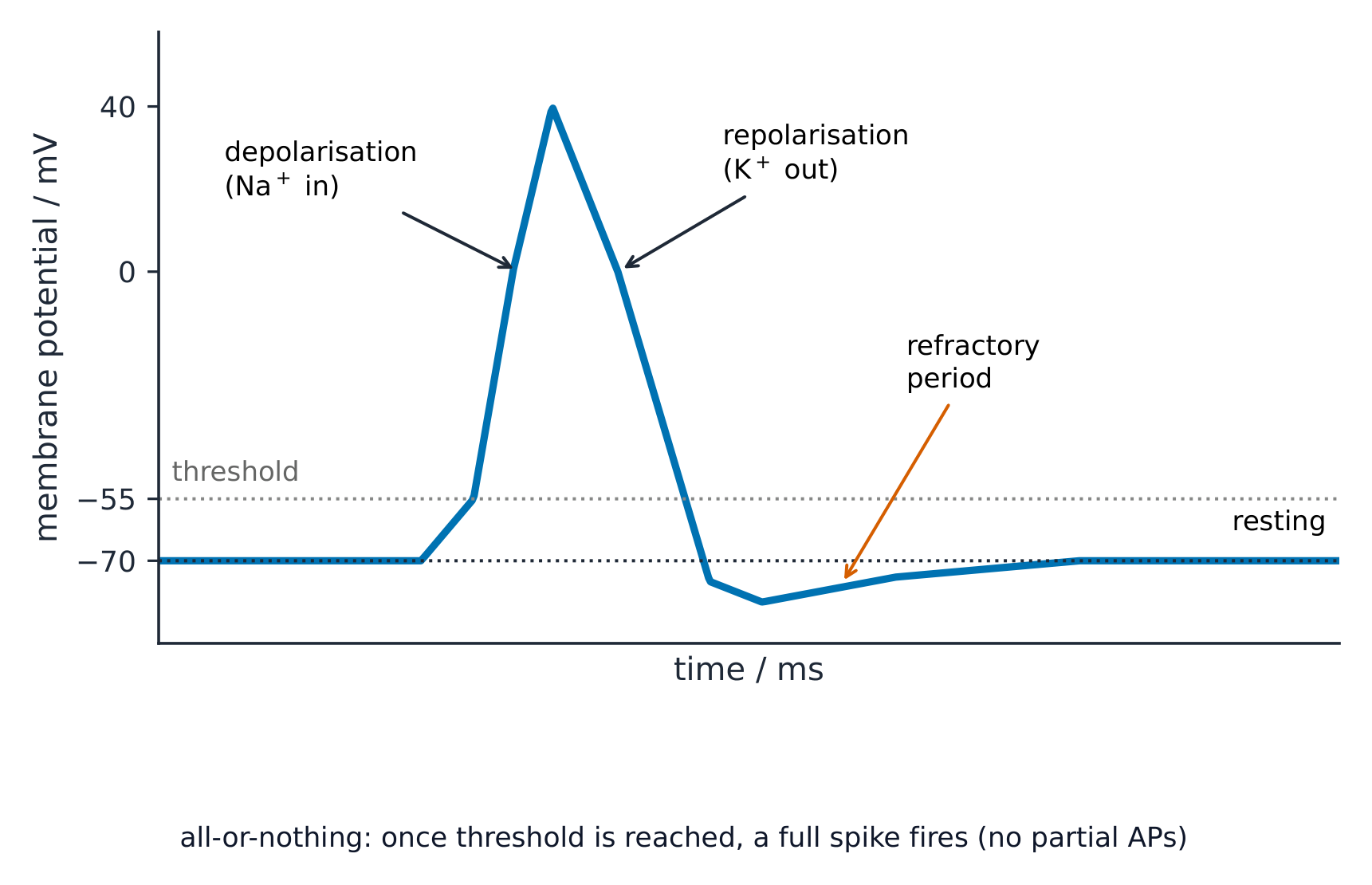
冲动是跨神经元膜的电压的一个改变。
- 静息电位(resting potential)——当没有冲动通过时,内部相对于外部是负的。这由一个把钠离子移出、钾离子移入的泵,以及膜对钾更通透来维持。
- 动作电位(action potential)——一个刺激使钠通道打开,所以钠离子涌入,内部短暂地变成正的(去极化)。然后钾通道打开,钾离子离开,而膜电位(membrane potential)返回负的(复极化)。
- 不应期(refractory period)——就在一个动作电位之后,钠通道在一小段时间内不能再次打开。这恢复静息电位并对冲动能被发送的频率设一个限制。
一个动作电位:钠进入引起去极化;钾出去引起复极化;然后一个不应期 Faster impulses: myelin
一些神经元被包在一层脂肪性的髓鞘(myelin sheath)中。冲动不能穿过髓鞘,所以它从一个间隙跳到下一个。这种跳跃,叫跳跃式传导(saltatory conduction),使冲动行进得快得多。

冲动从结跳到结——跳跃式传导——所以一个有髓神经元传导得快得多 探索The action potential
Step through one nerve impulse: a rapid depolarisation as Na⁺ enters, then repolarisation as K⁺ leaves, then recovery.
词汇表 训练英文 中文 拼音 resting potential/ˈrestɪŋ pəˈtenʃl/ 静息电位 jìng xī diàn wèi membrane potential/ˈmembreɪn pəˈtenʃl/ 膜电位 mó diàn wèi refractory period/rɪˈfræktəri ˈpɪərɪəd/ 不应期 bù yīng qī myelin sheath/ˈmaɪɪlɪn ʃiːθ/ 髓鞘 suǐ qiào saltatory conduction/ˈsɒltətəri kənˈdʌkʃn/ 跳跃式传导 tiào yuè shì chuán dǎo 15.1
突触

一个突触(synapse)是两个神经元之间的一个微小间隙。一个胆碱能突触(cholinergic synapse)像这样传递信号:
- 冲动到达并使钙离子(calcium ions)进入第一个神经元。
- 这使囊泡释放一个叫乙酰胆碱(acetylcholine)的神经递质(neurotransmitter)。
- 乙酰胆碱扩散过间隙并结合到下一个神经元上的受体。
- 这在下一个神经元中启动一个新冲动。
在一个突触处,乙酰胆碱扩散过间隙并结合受体以在下一个神经元中启动一个新冲动 探索Across a synapse
Step through it. The electrical impulse becomes a chemical one — neurotransmitter carries the signal across the gap.
词汇表 训练英文 中文 拼音 synapse/ˈsɪnæps/ 突触 tū chù cholinergic synapse/ˌkɒlɪˈnɜːdʒɪk ˈsɪnæps/ 胆碱能突触 dǎn jiǎn néng tū chù calcium ion/ˈkælsɪəm ˈaɪɒn/ 钙离子 gài lí zi neurotransmitter/ˈnjuːrətrænsmɪtə/ 神经递质 shén jīng dì zhì acetylcholine/ˈæsɪtɪlkəliːn/ 乙酰胆碱 yǐ xiān dǎn jiǎn 15.1
肌肉及其收缩方式

一个神经肌肉接头(neuromuscular junction)像一个突触,但在一个运动神经元和一块肌肉之间。
横纹肌(striated muscle)由长纤维构成。每根纤维被分成叫肌节(sarcomeres)的重复单元。里面是两种肌丝(filament):粗的(肌球蛋白)和细的(肌动蛋白)。T小管(T-tubule)系统把冲动带进纤维深处,而肌质网(sarcoplasmic reticulum)储存和释放钙离子。
"横纹"这个名字就来自这里。每一个重复的深-浅方块就是一个肌节;这些条带是粗肌丝和细肌丝以不同程度重叠形成的。肌肉收缩时,肌丝彼此滑过,每个肌节都变短 肌丝滑动模型(sliding filament model)解释收缩:
- 一个冲动使肌质网释放钙离子。
- 钙离子结合到肌钙蛋白(troponin),它使原肌球蛋白(tropomyosin)移动并露出肌动蛋白上的结合位点。
- 肌球蛋白头附着到肌动蛋白并把它向内拉,用来自 ATP 的能量。
- 细肌丝滑过粗的,所以每个肌节变短,肌肉收缩。

肌丝滑动模型:细肌动蛋白滑过粗肌球蛋白,所以肌节缩短 探索How a muscle contracts
Step through the sliding filament model — calcium uncovers the binding sites, then myosin pulls the actin inwards.
词汇表 训练英文 中文 拼音 neuromuscular junction/ˌnjuːrəˈmʌskjʊlə ˈdʒʌŋkʃn/ 神经肌肉接头 shén jīng jī ròu jiē tóu striated muscle/ˈstraɪeɪtɪd ˈmʌsl/ 横纹肌 héng wén jī sarcomere/ˈsɑːkəmɪə/ 肌节 jī jié filament/ˈfɪləmənt/ 肌丝 jī sī T-tubule/tiː ˈtjuːbjuːl/ T小管 T xiǎo guǎn sarcoplasmic reticulum/ˌsɑːkəˈplæzmɪk reˈtɪkjʊləm/ 肌质网 jī zhì wǎng sliding filament model/ˈslaɪdɪŋ ˈfɪləmənt ˈmɒdl/ 肌丝滑动模型 jī sī huá dòng mó xíng troponin/ˈtrɒpənɪn/ 肌钙蛋白 jī gài dàn bái tropomyosin/ˈtrɒpəmɪɒsɪn/ 原肌球蛋白 yuán jī qiú dàn bái 15.2
植物的调节与协调

大纲
- describe the rapid response of the Venus fly trap to stimulation of hairs on the lobes of modified leaves and explain how the closure of the trap is achieved
- explain the role of auxin in elongation growth by stimulating proton pumping to acidify cell walls
- describe the role of gibberellin in the germination of barley (see 16.3.4)
来源:剑桥国际大纲
The Venus fly trap
捕蝇草(Venus fly trap)在它陷阱状的叶子上有微小的毛。当一只昆虫触碰这些毛时,一个快速的电信号铺开,细胞快速失去水并改变形状,而陷阱猛地关闭以捕捉昆虫。
一个张开的陷阱。边缘的长刺只是把昆虫关住——真正必须被触碰才能触发信号的,是立在红色表面上那几根短而硬的触发毛 Auxin and growth
生长素(auxin)是一种使细胞长得更长(伸长(elongation)生长)的植物激素。它通过使细胞把质子(protons,氢离子)泵入细胞壁(cell wall)来做这个。这酸化(acidifies)细胞壁,它使细胞壁松弛,所以细胞能在水进入时伸展。

生长素的"酸生长":泵入壁的 H⁺ 使它松弛,所以细胞在水进入时伸展得更长 Gibberellin and germination
赤霉素(gibberellin)控制大麦(barley)种子的萌发(germination)。它开启制造淀粉酶的基因,淀粉酶随即把储存的淀粉分解成糖以喂养生长的幼苗。
例题。 解释为什么神经冲动只能单向通过突触,以及为什么髓鞘化能加快它沿轴突的传导。在突触处,装着神经递质的囊泡只存在于突触前神经元中,而受体只在突触后膜上 - 所以递质只能朝一个方向通过,这使突触成为一个单向阀。沿着有髓轴突,髓鞘绝缘了细胞膜,所以离子只能在郎飞结处通过;因此冲动是从一个结跳到下一个结(跳跃式传导),而不是依次让膜的每一部分去极化,这样快得多,消耗的 ATP 也更少。要找出造成每种效应的那个结构:囊泡和受体决定方向,绝缘和郎飞结决定速度。
探索Phototropism: bending to the light
Step through it. Auxin gathers on the shaded side, makes those cells grow longer, and the shoot bends towards the light.
词汇表 训练英文 中文 拼音 Venus fly trap/ˈviːnəs flaɪ træp/ 捕蝇草 bǔ yíng cǎo auxin/ˈɔːksɪn/ 生长素 shēng zhǎng sù elongation/iːˌlɒnˈɡeɪʃn/ 伸长 shēn cháng proton/ˈprəʊtɒn/ 质子 zhì zi cell wall/sel wɔːl/ 细胞壁 xì bāo bì acidify/əˈsɪdɪfaɪ/ 酸化 suān huà gibberellin/ˌdʒɪbəˈrelɪn/ 赤霉素 chì méi sù germination/ˌdʒɜːmɪˈneɪʃn/ 萌发 méng fā barley/ˈbɑːli/ 大麦 dà mài 15.2
考试技巧
- 解释静息电位(Na+/K+ 泵;内部更负),然后把动作电位(去极化 → 复极化)解释为全或无。
- 跳跃式传导(髓鞘、郎飞结)加速冲动;不应期使它单向和离散。
- 按顺序描述突触:Ca2+ 进入 → 囊泡融合 → 神经递质 → 受体 → 新冲动。
- 肌肉收缩遵循肌丝滑动模型(肌动蛋白、肌球蛋白、ATP、Ca2+)。
-
16
遗传
16.1
亲代向子代传递遗传信息

大纲
- explain the meanings of the terms haploid (n) and diploid (2n)
- explain what is meant by homologous pairs of chromosomes
- explain the need for a reduction division during meiosis in the production of gametes
- describe the behaviour of chromosomes in plant and animal cells during meiosis and the associated behaviour of the nuclear envelope, the cell surface membrane and the spindle (names of the main stages of meiosis, but not the sub-divisions of prophase I, are expected: prophase I, metaphase I, anaphase I, telophase I, prophase II, metaphase II, anaphase II and telophase II)
- interpret photomicrographs and diagrams of cells in different stages of meiosis and identify the main stages of meiosis
- explain that crossing over and random orientation (independent assortment) of pairs of homologous chromosomes and sister chromatids during meiosis produces genetically different gametes
- explain that the random fusion of gametes at fertilisation produces genetically different individuals
来源:剑桥国际大纲
一个二倍体(diploid)细胞(2n)有两整套染色体(chromosomes)——每个亲代一套。一个单倍体(haploid)细胞(n)只有一套。
一个人类卵细胞(卵子)——减数分裂产生的一个单倍体配子 染色体成同源染色体(homologous chromosomes)对出现:一对中的两个染色体长度相同并携带相同的基因(genes)(虽然它们可能携带这些基因的不同版本)。

一个人类核型:46 个染色体分成 23 个同源对(最后一对,X 和 Y,显示这是一个男性) 
一个同源对在相同的基因座携带相同的基因,但等位基因(版本)可能不同 配子(gametes,性细胞)必须是单倍体。若它们是二倍体,染色体数目就会每一代翻倍。所以配子由一种特殊的分裂,减数分裂(meiosis)制造,它把染色体数目减半。
减数分裂有两次分裂,一个接一个,所以有八个命名的阶段:前期 I、中期 I、后期 I 和末期 I,然后前期 II、中期 II、后期 II 和末期 II。如同有丝分裂,核膜(nuclear envelope)分解、一个纺锤体(spindle)构成,而染色体被纺锤体移动。
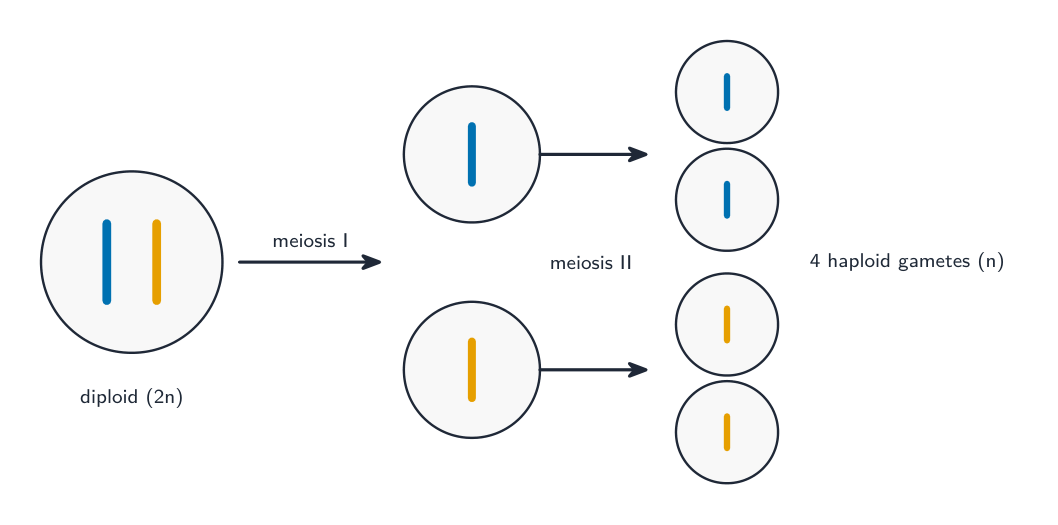
两次分裂把染色体数目减半:减数分裂 I 分离同源对,减数分裂 II 分离染色单体——给出四个单倍体配子 减数分裂以两种方式使配子彼此遗传上不同:
- 交叉互换(crossing over)——同源染色体交换匹配的片段,混合等位基因。

交叉互换:配对的染色体在一个交叉点交换匹配的节段,制造新的等位基因组合 - 自由组合(independent assortment)——各对以一个随机的顺序排列,所以每个配子得到亲代染色体的一个随机混合。

自由组合:染色体对以一个随机顺序排列,所以配子得到许多不同的混合 然后在受精(fertilisation)时,任何配子能与任何其他配子融合。这种随机融合使每个新个体遗传上不同。
探索Meiosis
Step through it. Two divisions halve the chromosome number and shuffle the alleles, giving four unique gametes.
词汇表 训练英文 中文 拼音 diploid/ˈdɪplɔɪd/ 二倍体 èr bèi tǐ chromosome/ˈkrəʊməsəʊm/ 染色体 rǎn sè tǐ haploid/ˈhæplɔɪd/ 单倍体 dān bèi tǐ homologous chromosomes/həˈmɒləɡəs ˈkrəʊməsəʊmz/ 同源染色体 tóng yuán rǎn sè tǐ gene/dʒiːn/ 基因 jī yīn gamete/ˈɡæmiːt/ 配子 pèi zi meiosis/meɪˈəʊsɪs/ 减数分裂 jiǎn shù fēn liè nuclear envelope/ˈnjuːklɪə ˈenvələʊp/ 核膜 hé mó spindle/ˈspɪndl/ 纺锤体 fǎng chuí tǐ crossing over/ˈkrɒsɪŋ ˈəʊvə/ 交叉互换 jiāo chā hù huàn independent assortment/ˌɪndɪˈpendənt əˈsɔːtmənt/ 自由组合 zì yóu zǔ hé fertilisation/ˌfɜːtɪlaɪˈzeɪʃn/ 受精 shòu jīng 16.1
遗传学的术语
你必须精确地知道这些术语:
- 一个基因是一段编码一个蛋白质(protein)的 DNA。它在一个染色体上的位置是它的基因座(locus)。
- 一个等位基因(allele)是一个基因的一个版本。
- 一个显性(dominant)等位基因即使只有一个副本存在时也显示它的效果;一个隐性(recessive)等位基因只在两个副本存在时才显示。
- 共显性(codominant)等位基因两者一起显示它们的效果。
- 基因型(genotype)是一个生物体拥有的等位基因;表现型(phenotype)是你能看到的特征。
- 纯合(homozygous)意味着两个等位基因相同;杂合(heterozygous)意味着它们不同。
- 一个测交(test cross)把一个生物体与隐性纯合子杂交以找出它未知的基因型。
探索Genetics vocabulary lab
Link each genetics word to the real feature it names.
词汇表 训练英文 中文 拼音 protein/ˈprəʊtiːn/ 蛋白质 dàn bái zhì locus/ˈləʊkəs/ 基因座 jī yīn zuò allele/əˈliːl/ 等位基因 děng wèi jī yīn dominant/ˈdɒmɪnənt/ 显性 xiǎn xìng recessive/rɪˈsesɪv/ 隐性 yǐn xìng codominant/ˈkəʊdəmɪnənt/ 共显性 gòng xiǎn xìng genotype/ˈdʒenətaɪp/ 基因型 jī yīn xíng phenotype/ˈfenətaɪp/ 表现型 biǎo xiàn xíng homozygous/ˌhɒməˈzɪɡəs/ 纯合 chún hé heterozygous/ˌhetrəˈzɪɡəs/ 杂合 zá hé test cross/test krɒs/ 测交 cè jiāo 16.1
遗传图解与杂交

你用一个遗传图显示一个杂交,常用一个庞纳特方格(Punnett square)——一个显示配子能组合的所有方式的网格。
一个 Tt × Tt 的庞纳特方格:后代是 3 高 : 1 矮(T 是显性) - 一个单基因杂交(monohybrid cross)跟踪一个基因;一个双基因杂交(dihybrid cross)一次跟踪两个基因。
- 一些基因有复等位基因(multiple alleles,种群中多于两个版本),如人类血型的等位基因。
- 在伴性遗传(sex linkage)中,基因在 X 染色体上,所以结果对男性和女性不同。
- 在连锁(linkage)中,同一个常染色体(autosome,一个非性染色体)上的基因倾向于一起遗传。
- 在上位性(epistasis)中,一个基因影响另一个基因如何被显示。

因为基因在 X 染色体上,一个携带者母亲的儿子可能色盲,而她的女儿只是携带者——一个按性别不同的结果 探索A monohybrid cross
Set each parent's genotype and read off the offspring. Crossing two heterozygotes (Aa × Aa) gives the classic 3 : 1 ratio.
词汇表 训练英文 中文 拼音 Punnett square/ˈpʌnɪt skweə/ 庞纳特方格 páng nà tè fāng gé monohybrid cross/ˈmɒnəʊhaɪbrɪd krɒs/ 单基因杂交 dān jī yīn zá jiāo dihybrid cross/daɪˈhaɪbrɪd krɒs/ 双基因杂交 shuāng jī yīn zá jiāo multiple alleles/ˈmʌltɪpl əˈliːlz/ 复等位基因 fù děng wèi jī yīn sex linkage/seks ˈlɪŋkɪdʒ/ 伴性遗传 bàn xìng yí chuán linkage/ˈlɪŋkɪdʒ/ 连锁 lián suǒ autosome/ˈɔːtəʊsəʊm/ 常染色体 cháng rǎn sè tǐ epistasis/ɪpɪˈstɑːsiz/ 上位性 shàng wèi xìng 16.1
卡方检验
卡方检验(chi-squared test)比较你实际数的结果(观察数,$O$)和你从遗传图预期的结果(预期数,$E$)。它告诉你差异是否小到足以归因于机遇,还是大到足以意味着有别的事情在发生。
你对每个组加起来观察和预期之间的平方差,除以预期:
$$\chi^2 = \sum \frac{(O - E)^2}{E}$$然后你把这个 $\chi^2$ 值与一个表里的临界值比较。你用的行由自由度(组的数目减 1)设定。若 $\chi^2$ 小于临界值,差异不显著——结果符合预期的比,而任何差异只是机遇。若 $\chi^2$ 大于临界值,差异显著,所以某个其他因素牵涉其中。
例题。 一个 $\text{Tt} \times \text{Tt}$ 杂交给出 $160$ 个后代:$114$ 个高的和 $46$ 个矮的。检验这是否符合预期的 $3:1$ 比。
预期数是 $\tfrac{3}{4} \times 160 = 120$ 个高的和 $\tfrac{1}{4} \times 160 = 40$ 个矮的。然后:
$$\chi^2 = \frac{(114 - 120)^2}{120} + \frac{(46 - 40)^2}{40} = \frac{36}{120} + \frac{36}{40} = 0.30 + 0.90 = 1.20.$$有 $2$ 个组,所以自由度 $= 2 - 1 = 1$。在 $p = 0.05$ 的临界值是 $3.84$。因为 $1.20 < 3.84$,差异不显著:结果符合一个 $3:1$ 比,而这个小差异归因于机遇。
探索Test a genetic ratio with chi-squared
This is the worked example on the page. The cross gives $\chi^2 = 1.20$ with $1$ degree of freedom, and the widget shows the critical value $3.84$ — set the statistic to $1.20$ and it falls well short of the shaded region, so the results fit the $3:1$ ratio. Drag it past $3.84$ to see what a significant departure would look like.
词汇表 训练英文 中文 拼音 chi-squared test/kaɪ skweəd test/ 卡方检验 kǎ fāng jiǎn yàn 16.2
基因在决定表现型中的作用
大纲
- explain the terms gene, locus, allele, dominant, recessive, codominant, linkage, test cross, F1, F2, phenotype, genotype, homozygous and heterozygous
- interpret and construct genetic diagrams, including Punnett squares, to explain and predict the results of monohybrid crosses and dihybrid crosses that involve dominance, codominance, multiple alleles and sex linkage
- interpret and construct genetic diagrams, including Punnett squares, to explain and predict the results of dihybrid crosses that involve autosomal linkage and epistasis (knowledge of the expected ratios for different types of epistasis is not expected)
- interpret and construct genetic diagrams, including Punnett squares, to explain and predict the results of test crosses
- use the chi-squared test to test the significance of differences between observed and expected results (the formula for the chi-squared test will be provided, as shown in the Mathematical requirements)
- explain the relationship between genes, proteins and phenotype with respect to the: • TYR gene, tyrosinase and albinism • HBB gene, haemoglobin and sickle cell anaemia • F8 gene, factor VIII and haemophilia • HTT gene, huntingtin and Huntington’s disease
- explain the role of gibberellin in stem elongation including the role of the dominant allele, Le, that codes for a functional enzyme in the gibberellin synthesis pathway, and the recessive allele, le, that codes for a non-functional enzyme
来源:剑桥国际大纲
一个基因编码一个蛋白质,而那个蛋白质影响表现型。若基因有缺陷,蛋白质有缺陷,而表现型改变:
基因 蛋白质 一个有缺陷等位基因的效果 TYR 酶(enzyme)酪氨酸酶 白化病(albinism,不制造色素) HBB 血红蛋白(haemoglobin) 镰状细胞贫血(sickle cell anaemia) F8 因子 VIII(帮助血液凝固) 血友病(haemophilia) HTT 亨廷顿蛋白 亨廷顿病(Huntington's disease) Gibberellin and stem height
在豌豆植株中,显性等位基因 Le 编码一个制造赤霉素(gibberellin)的工作的酶,所以植株通过茎伸长(elongation)长得高。隐性等位基因 le 编码一个坏掉的酶,所以制造很少的赤霉素,而植株矮。
探索From gene to phenotype
Step through it. A gene makes a protein that does a job — so a faulty allele makes a faulty protein and a changed feature.
词汇表 训练英文 中文 拼音 enzyme/ˈenzaɪm/ 酶 méi albinism/ˈælbɪnɪzəm/ 白化病 bái huà bìng haemoglobin/ˌhiːməˈɡləʊbɪn/ 血红蛋白 xuè hóng dàn bái sickle cell anaemia/ˈsɪkl sel əˈniːmɪə/ 镰状细胞贫血 lián zhuàng xì bāo pín xuè haemophilia/ˌhiːməˈfɪlɪə/ 血友病 xuè yǒu bìng Huntington's disease/ˈhʌntɪŋtnz dɪˈziːz/ 亨廷顿病 hēng tíng dùn bìng gibberellin/ˌdʒɪbəˈrelɪn/ 赤霉素 chì méi sù elongation/iːˌlɒnˈɡeɪʃn/ 伸长 shēn cháng 16.3
基因调控

大纲
- describe the differences between structural genes and regulatory genes and the differences between repressible enzymes and inducible enzymes
- explain genetic control of protein production in a prokaryote using the lac operon (knowledge of the role of cAMP is not expected)
- state that transcription factors are proteins that bind to DNA and are involved in the control of gene expression in eukaryotes by decreasing or increasing the rate of transcription
- explain how gibberellin activates genes by causing the breakdown of DELLA protein repressors, which normally inhibit factors that promote transcription
来源:剑桥国际大纲
不是所有的基因都一直开着。细胞控制它们制造哪些蛋白质。
- 结构基因(structural genes)编码有用的蛋白质如酶;调节基因(regulatory genes)控制其他基因是否开着。
- 一个可诱导酶(inducible enzyme)只在需要时才制造;一个可抑制酶(repressible enzyme)通常制造但能被关掉。
The lac operon
在一个像细菌的原核生物(prokaryote)中,一组叫乳糖操纵子(lac operon)的基因控制乳糖的消化:
- 当没有乳糖时,一个阻遏物(repressor)蛋白结合到操纵基因(operator,操纵子内一段短的控制序列)并阻挡转录(transcription),所以消化乳糖的酶不被制造。
- 当乳糖确实存在时,它结合到阻遏物并把它拉下来。转录现在能发生,而酶被制造。所以这些酶是可诱导的。
乳糖操纵子:一个阻遏物阻挡基因,直到乳糖把它拉下来,所以这些酶是可诱导的 Control in eukaryotes
在真核生物中,转录因子(transcription factors)是结合到 DNA 并通过增加或减少转录速率来控制基因表达(gene expression)的蛋白质。
赤霉素以这种方式开启基因:它引起 DELLA 蛋白阻遏物的分解。这些 DELLA 蛋白通常阻挡开启转录的因子,所以移除它们让那些基因被表达。
探索The lac operon
Step through the switch. With no lactose the genes are blocked; lactose pulls the repressor off and switches them on.
词汇表 训练英文 中文 拼音 structural gene/ˈstrʌktʃərəl dʒiːn/ 结构基因 jié gòu jī yīn regulatory gene/ˌreɡjʊˈleɪtəri dʒiːn/ 调节基因 tiáo jié jī yīn inducible enzyme/ɪnˈdjuːsɪbl ˈenzaɪm/ 可诱导酶 kě yòu dǎo méi repressible enzyme/rɪˈpresɪbl ˈenzaɪm/ 可抑制酶 kě yì zhì méi prokaryote/ˈprɒkərɪəʊt/ 原核生物 yuán hé shēng wù lac operon/læk ˈɒpərən/ 乳糖操纵子 rǔ táng cāo zòng zi repressor/rɪˈpresə/ 阻遏物 zǔ è wù transcription/trænˈskrɪpʃn/ 转录 zhuǎn lù transcription factor/trænˈskrɪpʃn ˈfæktə/ 转录因子 zhuǎn lù yīn zi gene expression/dʒiːn ekˈspreʃn/ 基因表达 jī yīn biǎo dá 16.3
考试技巧
- 完整地布置一个杂交:亲代基因型 → 配子(在圆圈里)→ 庞纳特方格 → 后代比和表现型。
- 用卡方检验比较观察与预期;自由度 $=$ 类别 $- 1$,在 $p = 0.05$ 与 $3.84$ 比较。
- 识别共显性、复等位基因、伴性遗传、上位性和连锁——每个都改变预期的比。
- 减数分裂通过交叉互换和自由组合创造变异——两者都陈述。
-
17
选择与进化
17.1
变异

大纲
- explain, with examples, that phenotypic variation is due to genetic factors or environmental factors or a combination of genetic and environmental factors
- explain what is meant by discontinuous variation and continuous variation
- explain the genetic basis of discontinuous variation and continuous variation
- use the t-test to compare the means of two different samples (the formula for the t-test will be provided, as shown in the Mathematical requirements)
来源:剑桥国际大纲
变异(variation)意味着个体之间的差异。它有三个可能的原因:
- 只有遗传因素——由你继承的等位基因(alleles)设定(例如人类血型)。
- 只有环境因素(environmental factors)——由你的周围环境设定(例如一道疤痕,或你说的语言)。
- 两者的一个组合——大多数特征,如身高和体重,取决于基因和饮食及生活方式。
带条纹的蜗牛(Cepaea nemoralis)在壳的颜色和条纹上显示惊人的变异 有两种变异模式:
- 不连续变异(discontinuous variation)——清晰、分开的组,中间什么都没有(例如血型 A、B、AB 或 O)。它通常由一个或几个基因(genes)控制,环境影响很小。
- 连续变异(continuous variation)——从一个极端到另一个极端的一个平滑范围(例如身高)。它由许多基因一起控制,加上环境。
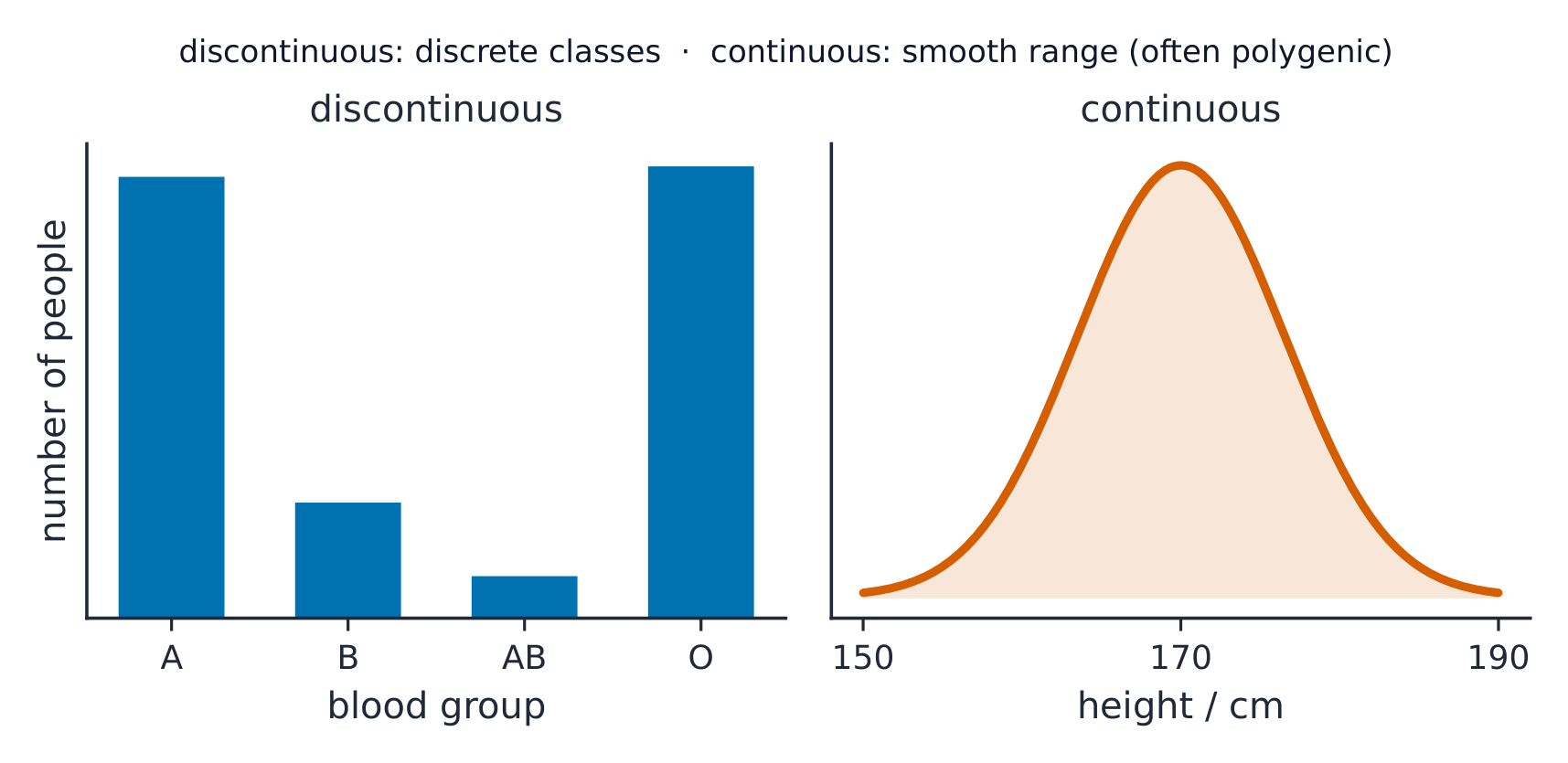
不连续变异落入分开的组;连续变异是一个平滑的范围 要比较两个样本的均值(例如阳光下和阴影下植株的身高),你用 t 检验,它告诉你差异是否大到足以是真实的,还是只是归因于机遇。
探索The t-distribution behind the t-test
The t-test compares two sample means against a critical value you look up in a t-table. This is that table made live: the value depends on the degrees of freedom (here $n_1+n_2-2$). Drag df and watch the critical value change — small samples have heavier tails, so they need a larger difference to count as real.
探索Variation type lab
Classify examples by the source and pattern of variation.
词汇表 训练英文 中文 拼音 variation/ˌveərɪˈeɪʃn/ 变异 biàn yì allele/əˈliːl/ 等位基因 děng wèi jī yīn environmental factor/enˌvaɪrənˈmentl ˈfæktə/ 环境因素 huán jìng yīn sù discontinuous variation/dɪskənˈtɪnjuːəs ˌveərɪˈeɪʃn/ 不连续变异 bù lián xù biàn yì gene/dʒiːn/ 基因 jī yīn continuous variation/kənˈtɪnjuːəs ˌveərɪˈeɪʃn/ 连续变异 lián xù biàn yì 17.2
自然选择与人工选择

大纲
- explain that natural selection occurs because populations have the capacity to produce many offspring that compete for resources; in the ‘struggle for existence’, individuals that are best adapted are most likely to survive to reproduce and pass on their alleles to the next generation
- explain how environmental factors can act as stabilising, disruptive and directional forces of natural selection
- explain how selection, the founder effect and genetic drift, including the bottleneck effect, may affect allele frequencies in populations
- outline how bacteria become resistant to antibiotics as an example of natural selection
- use the Hardy–Weinberg principle to calculate allele and genotype frequencies in populations and state the conditions when this principle can be applied (the two equations for the Hardy–Weinberg principle will be provided, as shown in the Mathematical requirements)
- describe the principles of selective breeding (artificial selection)
- outline the following examples of selective breeding: • the introduction of disease resistance to varieties of wheat and rice • inbreeding and hybridisation to produce vigorous, uniform varieties of maize • improving the milk yield of dairy cattle
来源:剑桥国际大纲
自然选择:桦尺蛾 一个种群(population)产生的后代(offspring)远多于能存活的,所以后代必须为食物和空间等资源竞争(compete)。这是"生存斗争"。最好适应(adapted)的个体最可能存活、繁殖(reproduce),并把它们的等位基因传给下一代。经过许多代,有益的等位基因在种群中变得更常见。这是自然选择(natural selection)。
该桦尺蛾显示自然选择:深色型藏在深色的、被烟熏黑的树皮上,而苍白斑点型藏在苍白的地衣上——鸟吃掉任何显眼的那个 环境条件能以三种方式推动选择:
- 稳定选择(stabilising selection)偏向平均值并移除极端(种群保持不变)。
- 定向选择(directional selection)偏向一个极端,所以均值朝那个方向移动。
- 分裂选择(disruptive selection)偏向两个极端并移除平均值。
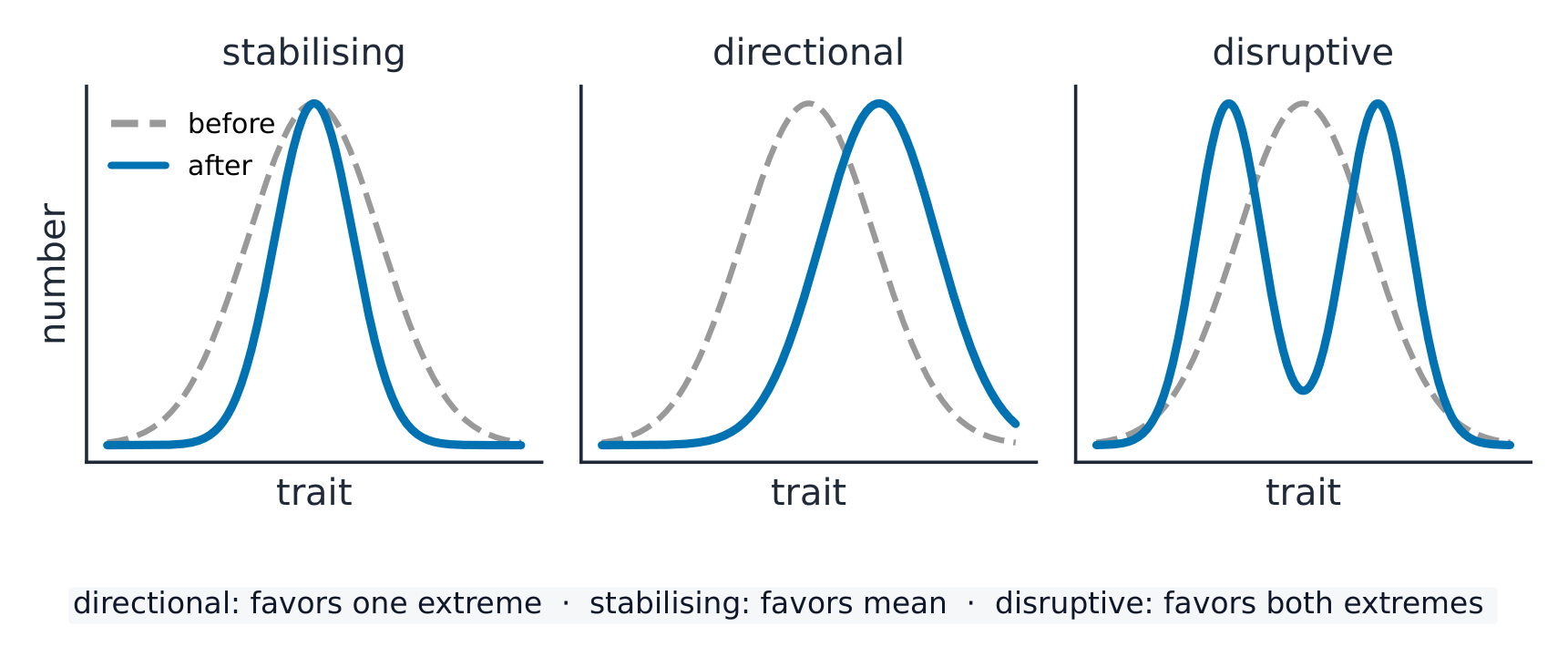
稳定收窄范围,定向移动均值,分裂把它分成两个 等位基因频率也能以其他方式改变:
- 奠基者效应(founder effect)——少数个体开始一个新种群,所以它们只携带原始群的一些等位基因。
- 遗传漂变(genetic drift)——在一个小种群中,等位基因频率一代一代地偶然改变。
- 瓶颈效应(bottleneck effect)——种群大小的一个突然下降留下少数幸存者,减少等位基因的多样性。

一个瓶颈:只有少数在一场灾难中幸存,所以恢复的种群有更少的遗传多样性 Antibiotic resistance as natural selection
一个偶然的突变(mutation)使少数细菌对一种抗生素(antibiotic)耐药。当抗生素被使用时,不耐药的细菌死亡,但耐药的存活并繁殖。随时间耐药性(resistance)在种群中传播。这是自然选择在行动。
探索Natural selection
Step through Darwin's idea: variation + a selection pressure means the best-adapted survive and pass on their alleles.
词汇表 训练英文 中文 拼音 population/ˌpɒpjʊˈleɪʃn/ 种群 zhǒng qún offspring/ˈɒfsprɪŋ/ 后代 hòu dài compete/kəmˈpiːt/ 竞争 jìng zhēng adapted/əˈdæptɪd/ 适应 shì yìng reproduce/rɪprəˈdjuːs/ 繁殖 fán zhí natural selection/ˈnætʃərəl sɪˈlekʃn/ 自然选择 zì rán xuǎn zé stabilising selection/ˈsteɪbəlaɪzɪŋ sɪˈlekʃn/ 稳定选择 wěn dìng xuǎn zé directional selection/daɪˈrekʃənl sɪˈlekʃn/ 定向选择 dìng xiàng xuǎn zé disruptive selection/dɪsˈrʌptɪv sɪˈlekʃn/ 分裂选择 fēn liè xuǎn zé founder effect/ˈfaʊndə ɪˈfekt/ 奠基者效应 diàn jī zhě xiào yìng genetic drift/dʒɪˈnetɪk drɪft/ 遗传漂变 yí chuán piāo biàn bottleneck effect/ˈbɒtəlnek ɪˈfekt/ 瓶颈效应 píng jǐng xiào yìng mutation/mjuːˈteɪʃn/ 突变 tū biàn antibiotic/ˌæntɪbaɪˈɒtɪk/ 抗生素 kàng shēng sù resistance/rɪˈzɪstəns/ 耐药性 nài yào xìng 17.2
哈迪-温伯格原理

哈迪-温伯格原理(Hardy–Weinberg principle)让你计算一个种群中的等位基因频率(allele frequencies)和基因型(genotype)频率。它只在有一个大种群、交配是随机的,以及没有突变、没有迁移和没有自然选择时才成立。
把显性等位基因的频率叫 $p$,把隐性等位基因的频率叫 $q$。只有两个等位基因,所以:
$$p + q = 1.$$基因型频率随即加起来为 1,其中 $p^2$ 是纯合显性、$2pq$ 是杂合(携带者)、$q^2$ 是纯合隐性:
$$p^2 + 2pq + q^2 = 1.$$例题。 一个隐性状况影响每 $100$ 人中的 $1$ 人。求携带者的频率。
只有纯合隐性基因型($q^2$)显示这个状况,所以 $q^2 = \tfrac{1}{100} = 0.01$,给出 $q = \sqrt{0.01} = 0.1$。然后 $p = 1 - q = 0.9$。携带者是杂合子:
$$2pq = 2 \times 0.9 \times 0.1 = 0.18.$$所以约 $18\%$ 的种群是携带者——远多于显示这个状况的 $1\%$。
Hardy–Weinberg: allele frequencies p and q give genotype frequencies p², 2pq, q² 词汇表 训练英文 中文 拼音 Hardy–Weinberg principle/ˈhɑːdi ˈwaɪnbɜːɡ ˈprɪnsɪpl/ 哈迪-温伯格原理 hā dí - wēn bó gé yuán lǐ allele frequency/əˈliːl ˈfriːkwənsi/ 等位基因频率 děng wèi jī yīn pín lǜ genotype/ˈdʒenətaɪp/ 基因型 jī yīn xíng 17.2
选择育种(人工选择)

在选择育种(selective breeding,也叫人工选择(artificial selection))中,人类(不是自然)选择哪些生物体繁殖,以便有用的特征被传下去。例子:
- 把抗病性(disease resistance)育入小麦和水稻的品种。
- 用近交(inbreeding)和杂交(hybridisation,杂交不同的品系)来制造强壮、均匀的玉米。
- 育种奶牛以改善它们的产奶产量(yield)。
选择育种:每一代只选择最好的来育种使想要的特征越来越常见 探索Selective breeding
Step through it. Humans take the role of the environment — choosing the breeders, generation after generation.
词汇表 训练英文 中文 拼音 selective breeding/sɪˈlektɪv ˈbriːdɪŋ/ 选择育种 xuǎn zé yù zhǒng artificial selection/ˌɑːtɪˈfɪʃl sɪˈlekʃn/ 人工选择 rén gōng xuǎn zé disease resistance/dɪˈziːz rɪˈzɪstəns/ 抗病性 kàng bìng xìng inbreeding/ˈɪnbriːdɪŋ/ 近交 jìn jiāo hybridisation/ˌhaɪbrɪdaɪˈzeɪʃn/ 杂交 zá jiāo yield/jiːld/ 产量 chǎn liàng 17.3
进化

大纲
- outline the theory of evolution as a process leading to the formation of new species from pre-existing species over time, as a result of changes to gene pools from generation to generation
- discuss how DNA sequence data can show evolutionary relationships between species
- explain how speciation may occur as a result of genetic isolation by: • geographical separation (allopatric speciation) • ecological and behavioural separation (sympatric speciation)
来源:剑桥国际大纲
进化(evolution)是新物种(species)从较早的物种缓慢形成,随着基因库(gene pool,一个种群中所有的等位基因)一代一代地改变。
DNA 序列(sequence)数据能显示两个物种关系有多近:它们的 DNA 序列越相似,它们越晚近共享一个共同祖先。
物种形成(speciation)发生在两个种群变得遗传上分离,所以它们不再能一起繁殖时。这种遗传隔离(isolation)能以两种方式产生:
- 异域物种形成(allopatric speciation)——种群被一个地理隔离(geographical separation)分开,如一片海或一条山脉。
- 同域物种形成(sympatric speciation)——种群生活在同一个区域,但被行为或生活方式的差异分离。
异域物种形成需要一个物理屏障;同域物种形成发生在同一个区域 探索Allopatric speciation
Step through it. A barrier splits one population; the two halves diverge until they can no longer interbreed.
词汇表 训练英文 中文 拼音 evolution/ɪvəˈluːʃn/ 进化 jìn huà species/ˈspiːsiːz/ 物种 wù zhǒng gene pool/dʒiːn puːl/ 基因库 jī yīn kù sequence/ˈsiːkwəns/ 序列 xù liè speciation/ˌspiːʃɪˈeɪʃn/ 物种形成 wù zhǒng xíng chéng isolation/ˌaɪsəˈleɪʃn/ 隔离 gé lí allopatric speciation/ˌæləˈpætrɪk ˌspiːʃɪˈeɪʃn/ 异域物种形成 yì yù wù zhǒng xíng chéng geographical separation/ˌdʒɪəˈɡræfɪkl ˌsepəˈreɪʃn/ 地理隔离 dì lǐ gé lí sympatric speciation/ˈsɪmpətrɪk ˌspiːʃɪˈeɪʃn/ 同域物种形成 tóng yù wù zhǒng xíng chéng 17.3
考试技巧
- 把自然选择解释为一个序列:变异 → 选择压力 → 更好适应的存活并繁殖 → 等位基因频率改变。
- 用哈迪-温伯格方程($p+q=1$、$p^2+2pq+q^2=1$);$q^2$ 是隐性表现型频率——一个常见的计算。
- 用每种的一个例子区分稳定、定向和分裂选择。
- 区分异域对同域物种形成(地理对生殖隔离)。
-
18
分类、生物多样性与保护
18.1
分类

大纲
- discuss the meaning of the term species, limited to the biological species concept, morphological species concept and ecological species concept
- describe the classification of organisms into three domains: Archaea, Bacteria and Eukarya
- state that Archaea and Bacteria are prokaryotes and that there are differences between them, limited to differences in membrane lipids, ribosomal RNA and composition of cell walls
- describe the classification of organisms in the Eukarya domain into the taxonomic hierarchy of kingdom, phylum, class, order, family, genus and species
- outline the characteristic features of the kingdoms Protoctista, Fungi, Plantae and Animalia
- outline how viruses are classified, limited to the type of nucleic acid (RNA or DNA) and whether this is single stranded or double stranded
来源:剑桥国际大纲
一个物种(species)可以用不止一种方式定义:
- 生物学物种概念——一个群,其成员能一起繁殖以产生可育的后代。
- 形态学物种概念——一个群,其成员看起来相似。
- 生态学物种概念——一个填补它周围环境中同样角色的群。
一个博物馆昆虫收藏:分类按共有的特征把生物分组 The three domains
分类(classification)中最大的群是三个域(domains):
- 古菌(Archaea)和细菌(Bacteria)——两者都是原核生物(prokaryotes,无细胞核)。它们看起来相似,但在它们的膜脂、它们的核糖体 RNA,以及它们细胞壁(cell walls)的构成上不同。
- 真核生物(Eukarya)——所有细胞有细胞核的生物。

这个滚烫的热泉周围每一圈颜色都是一群不同的微生物,生活在不同的温度下。像这样的古菌——在几乎没有别的生物能存活的地方繁盛——正是它们自成一个域、与普通细菌分开的线索 The taxonomic hierarchy
在真核生物域内部,生物被分入一个分类层级(taxonomic hierarchy)——一套越来越小的群:界(kingdom)、门(phylum)、纲(class)、目(order)、科(family)、属(genus)和物种。

分类层级的每个层级是一个更小、关系更近的群,以一个单一的物种结束 真核生物被分成四个界:
- 原生生物界(Protoctista)——大多是单细胞的(如阿米巴)。
- 真菌界(Fungi)——通过吸收食物取食;有几丁质的细胞壁。
- 植物界(Plantae)——通过光合作用制造它们自己的食物。
- 动物界(Animalia)——以其他生物为食。

三个域:古菌和细菌是原核生物;真核生物分成四个界 病毒不被放入这些群。它们按它们所含的核酸(nucleic acid)类型(DNA 或 RNA)以及它是单链(single-stranded)还是双链(double-stranded)来分类。
探索Species and domains lab
Classify organisms and definitions by the level they describe.
探索The taxonomic hierarchy
Step down the levels for one species — humans — from the broadest domain to the most specific species.
词汇表 训练英文 中文 拼音 species/ˈspiːsiːz/ 物种 wù zhǒng classification/ˌklæsɪfɪˈkeɪʃn/ 分类 fēn lèi domain/dəˈmeɪn/ 域 yù Archaea/ɑːˈkɪə/ 古菌 gǔ jūn Bacteria/bækˈtɪərɪə/ 细菌 xì jūn prokaryote/ˈprɒkərɪəʊt/ 原核生物 yuán hé shēng wù cell wall/sel wɔːl/ 细胞壁 xì bāo bì Eukarya/ˈjuːkərɪə/ 真核生物 zhēn hé shēng wù taxonomic hierarchy/ˌtæksəˈnɒmɪk ˈhaɪərɑːki/ 分类层级 fēn lèi céng jí kingdom/ˈkɪŋdəm/ 界 jiè phylum/ˈfaɪləm/ 门 mén class/klæs/ 纲 gāng order/ˈɔːdə/ 目 mù family/ˈfæmɪli/ 科 kē genus/ˈdʒenəs/ 属 shǔ Protoctista/ˈprəʊtəʊktɪstə/ 原生生物界 yuán shēng shēng wù jiè Fungi/ˈfʌŋɡi/ 真菌界 zhēn jùn jiè Plantae/ˈplæntiː/ 植物界 zhí wù jiè Animalia/ˌænɪˈmeɪlɪə/ 动物界 dòng wù jiè nucleic acid/njuːˈklɪɪk ˈæsɪd/ 核酸 hé suān single-stranded/ˈsɪŋɡl ˈstrændɪd/ 单链 dān liàn double-stranded/ˈdʌbl ˈstrændɪd/ 双链 shuāng liàn 18.2
生物多样性

大纲
- define the terms ecosystem and niche
- explain that biodiversity can be assessed at different levels, including: the number and range of different ecosystems and habitats, the number of species and their relative abundance, the genetic variation within each species
- explain the importance of random sampling in determining the biodiversity of an area
- describe and use suitable methods to assess the distribution and abundance of organisms in an area, limited to frame quadrats, line transects, belt transects and mark-release-recapture using the Lincoln index (the formula for the Lincoln index will be provided, as shown in the Mathematical requirements)
- use Spearman’s rank correlation and Pearson’s linear correlation to analyse the relationships between two variables, including how biotic and abiotic factors affect the distribution and abundance of species (the formulae for these correlations will be provided, as shown in the Mathematical requirements)
- use Simpson’s index of diversity (D) to calculate the biodiversity of an area, and state the significance of different values of D (the formula for Simpson’s index of diversity will be provided, as shown in the Mathematical requirements)
来源:剑桥国际大纲
一个生态系统(ecosystem)是一个区域内所有的生物连同它们非生命的周围环境。一个生态位(niche)是一个物种在它里面的特定角色和位置。
一个珊瑚礁是高生物多样性的一幅好图画——许多不同的珊瑚、鱼和其他物种生活在一起:
一个珊瑚礁是地球上生物最多样的栖息地之一:许多种珊瑚和鱼共享一个小区域 生物多样性(biodiversity)可以在三个层次上被测量:
- 不同生态系统和栖息地(habitats)的数目和范围。
- 物种的数目和它们相对的丰度(abundance,每个有多常见)。
- 每个物种内部的遗传变异。

生物多样性在三个层次上被测量:生态系统的范围、物种的数目,以及一个物种内部的遗传变异 Sampling an area
你不能数每个生物,所以你取样。随机取样(random sampling,偶然地选择位置)避免偏差并给出一幅公平的图画。有用的方法是:
- 样方(quadrats)——放置以数或估计里面物种的方形框。
- 样带(transects)——沿横过区域的一条线计数(一个线样带记录接触这条线的东西;一个带样带在一条带内计数)。
- 标志重捕法(mark-release-recapture)——对于移动的动物:捕捉、标记并释放一些,然后后来看一个新捕捉中被标记的占多少比例(林肯指数)。

样方和样带取样固定的植物;标志重捕法估计移动动物的数目 要把一个物种的分布与生物因素(biotic factors,生命)或非生物因素(abiotic factors,非生命)联系起来,你可以用 Spearman 秩或 Pearson 相关性(correlation)。要把一个区域的多样性测量为一个单一的数,你用辛普森多样性指数(Simpson's index of diversity):一个更高的值意味着更多样、通常更稳定。
例题。 捕捉 60 只蜗牛,做标记后放归。之后又捕捉到 80 只,其中 15 只带有标记。估计该种群的数量。标志重捕法假定被标记的个体已经均匀地混回群体中,所以第二次样本中被标记的比例等于整个种群中被标记的比例:
$$N = \frac{\text{first sample} \times \text{second sample}}{\text{number marked in the second}} = \frac{60 \times 80}{15} = 320$$所以大约有 320 只蜗牛。这个估计的可靠程度取决于它的假设,所以要把假设写出来:两次捕捉之间没有出生、死亡或迁移;标记既不会脱落,也不会让个体更容易被捕食者发现;并且留出了足够的混合时间。破坏其中一条,估计就随之失效 - 会招来捕食者的标记会降低重捕数,从而高估种群数量。
探索Biodiversity sampling lab
Choose the sampling method or index that matches the field question.
词汇表 训练英文 中文 拼音 ecosystem/ˈiːkəʊsɪstəm/ 生态系统 shēng tài xì tǒng niche/niːʃ/ 生态位 shēng tài wèi biodiversity/ˌbaɪəʊdaɪˈvɜːsɪti/ 生物多样性 shēng wù duō yàng xìng habitat/ˈhæbɪtæt/ 栖息地 qī xī dì abundance/əˈbʌndəns/ 丰度 fēng dù random sampling/ˈrændəm ˈsæmplɪŋ/ 随机取样 suí jī qǔ yàng quadrat/ˈkwɒdræt/ 样方 yàng fāng transect/trænˈsekt/ 样带 yàng dài mark-release-recapture/mɑːk rɪˈliːs rɪˈkæptʃə/ 标志重捕法 biāo zhì zhòng bǔ fǎ biotic factor/baɪˈɒtɪk ˈfæktə/ 生物因素 shēng wù yīn sù abiotic factor/ˌæbɪˈɒtɪk ˈfæktə/ 非生物因素 fēi shēng wù yīn sù correlation/ˌkɒrɪˈleɪʃn/ 相关性 xiāng guān xìng Simpson's index of diversity/ˈsɪmpsnz ˈɪndeks ɒv daɪˈvɜːsɪti/ 辛普森多样性指数 xīn pǔ sēn duō yàng xìng zhǐ shù 18.3
保护

大纲
- explain why populations and species can become extinct as a result of: • climate change • competition • hunting by humans • degradation and loss of habitats
- outline reasons for the need to maintain biodiversity
- outline the roles of zoos, botanic gardens, conserved areas (including national parks and marine parks), ‘frozen zoos’ and seed banks, in the conservation of endangered species
- describe methods of assisted reproduction used in the conservation of endangered mammals, limited to IVF, embryo transfer and surrogacy
- explain reasons for controlling invasive alien species
- outline the role in conservation of the International Union for Conservation of Nature (IUCN) and the Convention on International Trade in Endangered Species of Wild Fauna and Flora (CITES)
来源:剑桥国际大纲
一个物种能变得灭绝(extinct,完全死绝),因为气候变化(climate change)、竞争(常来自新物种)、人类的捕猎,或它栖息地的破坏和丧失。
我们试图保护生物多样性,因为其他物种给我们食物、药物和材料、帮助保持生态系统稳定,并本身有价值。
Ways to conserve species
- 动物园(zoos)和植物园(botanic gardens)保存并繁育濒危物种(endangered species)。
- 受保护的保护(conservation)区,如国家公园和海洋公园,保持栖息地安全。
- "冷冻动物园"储存冷冻的细胞、卵和精子,而种子库(seed banks)为未来储存种子。
保护要么是就地(在它们自己的栖息地保护物种)要么是迁地(在远离野外的地方保存并繁育它们) 对于稀有的哺乳动物,辅助生殖能提升数目:体外受精(in vitro fertilisation,IVF)、胚胎移植(embryo transfer),以及代孕(surrogacy,另一个雌性携带幼崽)。
保护主义者也控制入侵物种(invasive species),它们从别处被带入并胜过本地物种。
两个组织在全世界帮助:IUCN,它列出每个物种受威胁的程度;以及 CITES,它控制濒危动物和植物的国际贸易。
探索Conservation action lab
Follow how conservation moves from threat to protected population.
词汇表 训练英文 中文 拼音 extinct/ekˈstɪŋkt/ 灭绝 miè jué climate change/ˈklaɪmət tʃeɪndʒ/ 气候变化 qì hòu biàn huà zoo/zuː/ 动物园 dòng wù yuán botanic garden/bəˈtænɪk ˈɡɑːdn/ 植物园 zhí wù yuán endangered species/enˈdeɪndʒəd ˈspiːsiːz/ 濒危物种 bīn wēi wù zhǒng conservation/ˌkɒnsəˈveɪʃn/ 保护 bǎo hù seed bank/siːd bæŋk/ 种子库 zhǒng zi kù in vitro fertilisation/ɪn ˈvɪtrəʊ ˌfɜːtɪlaɪˈzeɪʃn/ 体外受精 tǐ wài shòu jīng embryo transfer/ˈembrɪəʊ ˈtrænsfɜː/ 胚胎移植 pēi tāi yí zhí surrogacy/səˈrɒɡəsi/ 代孕 dài yùn invasive species/ɪnˈveɪsɪv ˈspiːsiːz/ 入侵物种 rù qīn wù zhǒng 18.3
考试技巧
- 学习分类层级(域 → 界 → … → 物种)和三个域;一个物种互相交配以给出可育的后代。
- 用辛普森指数测量生物多样性(一个更高的值 = 更多样)并解释为什么高生物多样性有助于稳定性。
- 给出就地对迁地保护方法,各带一个优点。
-
19
遗传技术
19.1
遗传技术的原理

大纲
- define the term recombinant DNA
- explain that genetic engineering is the deliberate manipulation of genetic material to modify specific characteristics of an organism and that this may involve transferring a gene into an organism so that the gene is expressed
- explain that genes to be transferred into an organism may be: • extracted from the DNA of a donor organism • synthesised from the mRNA of a donor organism • synthesised chemically from nucleotides
- explain the roles of restriction endonucleases, DNA ligase, plasmids, DNA polymerase and reverse transcriptase in the transfer of a gene into an organism
- explain why a promoter may have to be transferred into an organism as well as the desired gene
- explain how gene expression may be confirmed by the use of marker genes coding for fluorescent products
- explain that gene editing is a form of genetic engineering involving the insertion, deletion or replacement of DNA at specific sites in the genome
- describe and explain the steps involved in the polymerase chain reaction (PCR) to clone and amplify DNA, including the role of Taq polymerase
- describe and explain how gel electrophoresis is used to separate DNA fragments of different lengths
- outline how microarrays are used in the analysis of genomes and in detecting mRNA in studies of gene expression
- outline the benefits of using databases that provide information about nucleotide sequences of genes and genomes, and amino acid sequences of proteins and protein structures
来源:剑桥国际大纲
重组(recombinant)DNA 是通过把来自两个不同来源的 DNA 连接在一起制成的 DNA。基因工程(genetic engineering)是对一个生物体遗传物质的蓄意改变——常常通过把一个基因(gene)转移到一个生物体中,使该基因被表达(开启以制造它的蛋白质(protein))。
一台热循环仪(PCR 机器)制造一个 DNA 样品的许多副本 要转移的基因能以三种方式获得:
- 从一个供体(donor)生物体的 DNA 中剪出,
- 从供体的 mRNA 制造,用酶逆转录酶(reverse transcriptase),
- 从核苷酸(nucleotides)化学地建造。
The tools
工具 作用 限制性内切酶(restriction endonuclease) 在一个特定的碱基序列切割 DNA,留下"黏性末端" DNA 连接酶(ligase) 把 DNA 片段连接在一起 质粒(plasmid) 一个小的细菌 DNA 环,用作一个载体(cloning vector)以把基因带入一个细胞 DNA 聚合酶(polymerase) 复制 DNA 逆转录酶 从一个 mRNA 模板制造 DNA 
一个限制性内切酶留下匹配的黏性末端;DNA 连接酶把一个基因连接到切割的 DNA 一个启动子(promoter)常常必须与基因一起被转移。启动子是让基因在它的新生物体中被转录的"开关",所以没有它基因会保持沉默。
要检查基因已进入并在工作,科学家在它旁边加一个标记基因(marker gene)——例如一个编码一个荧光(fluorescent,发光)产物的基因。若细胞发光,转移就成功了。

一个质粒充当一个载体:基因被连接进它,而重组质粒被一个细菌摄取 Gene editing
基因编辑(gene editing)是基因工程的一种精确形式。它在基因组(genome)中一个确切的位点插入、删除或替换 DNA。
Copying and sorting DNA
- 聚合酶链式反应(polymerase chain reaction,PCR)被用来克隆(clone)和扩增(amplify)DNA——制造数百万个副本。它重复加热和冷却的循环,用一个叫 Taq 聚合酶的耐热酶。

PCR 重复加热和冷却循环;每个循环把 DNA 翻倍,制造数百万个副本 - 凝胶电泳(gel electrophoresis)按长度分离 DNA 片段(fragments)。片段在一个电场中穿过一个凝胶移动,而更短的片段移动得更远,所以长度铺开成条带。

凝胶电泳:DNA 朝 + 端移动,而更短的片段行进得更远,按长度把它们分类 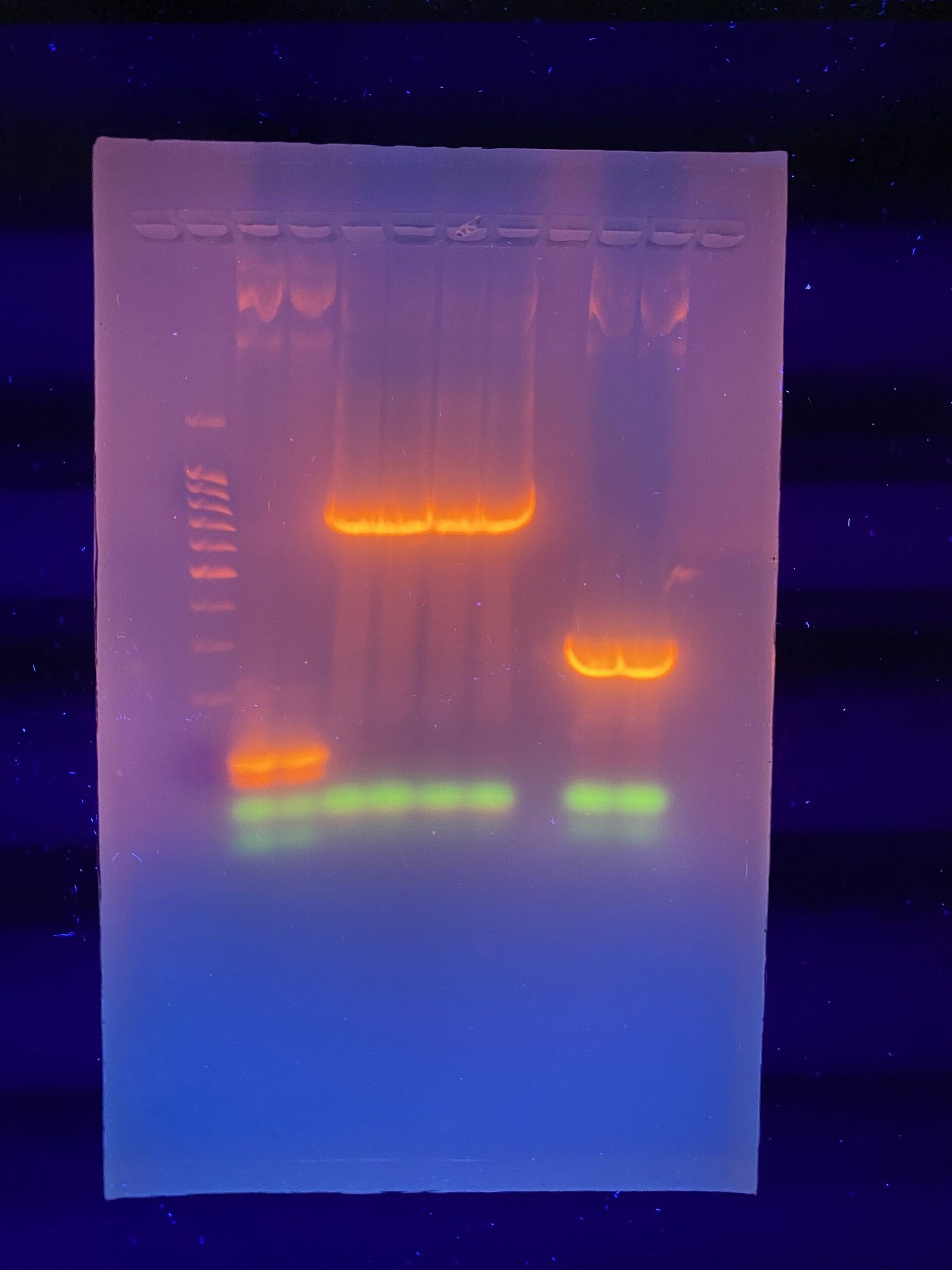
紫外光下一个真实的凝胶:左泳道是一个 DNA 阶梯,而发光的条带显示片段如何按长度分离 - 微阵列(microarrays)被用来研究整个基因组并通过捕获它们的 mRNA 来检测哪些基因开着。
- 数据库(databases)储存基因的核苷酸序列和蛋白质的氨基酸(amino acid)序列,所以任何地方的科学家都能比较它们。
探索The tools of genetic technology
Genetic engineering moves a useful gene into another organism so it makes a desired protein.
词汇表 训练英文 中文 拼音 recombinant/ˌriːˈkɒmbɪnənt/ 重组 chóng zǔ genetic engineering/dʒɪˈnetɪk ˌendʒɪˈnɪərɪŋ/ 基因工程 jī yīn gōng chéng gene/dʒiːn/ 基因 jī yīn donor/ˈdəʊnə/ 供体 gōng tǐ reverse transcriptase/rɪˈvɜːs trænˈskrɪpteɪs/ 逆转录酶 nì zhuǎn lù méi nucleotide/ˈnjuːklɪɒtaɪd/ 核苷酸 hé gān suān restriction endonuclease/rɪˈstrɪkʃn ˈendəʊnjuːklɪeɪs/ 限制性内切酶 xiàn zhì xìng nèi qiè méi ligase/ˈlɪɡeɪs/ 连接酶 lián jiē méi plasmid/ˈplæzmɪd/ 质粒 zhì lì cloning vector/ˈkləʊnɪŋ ˈvektə/ 载体 zài tǐ polymerase/ˌpɒlɪməˈreɪz/ 聚合酶 jù hé méi promoter/prəˈməʊtə/ 启动子 qǐ dòng zi marker gene/ˈmɑːkə dʒiːn/ 标记基因 biāo jì jī yīn fluorescent/flʊəˈresənt/ 荧光 yíng guāng gene editing/dʒiːn ˈedɪtɪŋ/ 基因编辑 jī yīn biān jí genome/ˈdʒiːnəʊm/ 基因组 jī yīn zǔ polymerase chain reaction/ˌpɒlɪməˈreɪz tʃeɪn rɪˈækʃn/ 聚合酶链式反应 jù hé méi liàn shì fǎn yìng clone/kləʊn/ 克隆 kè lóng amplify/ˈæmplɪfaɪ/ 扩增 kuò zēng gel electrophoresis/dʒel ɪˌlektrəʊfɔːˈriːsɪs/ 凝胶电泳 níng jiāo diàn yǒng fragment/ˈfræɡmənt/ 片段 piàn duàn microarray/ˈmaɪkrəʊəreɪ/ 微阵列 wēi zhèn liè database/ˈdeɪtəbeɪs/ 数据库 shù jù kù amino acid/əˈmiːnəʊ ˈæsɪd/ 氨基酸 ān jī suān 19.2
遗传技术在医学中的应用

大纲
- explain the advantages of using recombinant human proteins to treat disease, using the examples insulin, factor VIII and adenosine deaminase
- outline the advantages of genetic screening, using the examples of breast cancer (BRCA1 and BRCA2), Huntington’s disease and cystic fibrosis
- outline how genetic diseases can be treated with gene therapy, using the examples severe combined immunodeficiency (SCID) and inherited eye diseases
- discuss the social and ethical considerations of using genetic screening and gene therapy in medicine
来源:剑桥国际大纲
Recombinant human proteins
一个人类基因能被放入细菌或其他细胞,使它们制造一个重组人类蛋白质——人类那个的一个确切副本。这更安全、永不短缺,而且它避免使用从动物或供体取的蛋白质。例子是胰岛素(insulin,用于糖尿病(diabetes))、因子 VIII(用于血友病)和腺苷脱氨酶(用于一个有缺陷的免疫系统)。
同样的工具制造一个人类蛋白质:胰岛素基因进入细菌,它们变成活的工厂——所以这胰岛素是一个确切的人类副本、永不短缺 Genetic screening
基因筛查(genetic screening)在症状出现之前检测一个人的 DNA 里的疾病等位基因。例子是 BRCA1 和 BRCA2 等位基因(它们提高乳腺癌(breast cancer)的风险)、亨廷顿病(Huntington's disease),以及囊性纤维化(cystic fibrosis)。知道结果帮助人们对治疗和家庭做出知情的选择。
Gene therapy
基因治疗(gene therapy)通过把一个基因的一个工作副本放入患者的细胞来治疗一种遗传病。它已被用于 SCID(一种免疫系统失灵的疾病)和一些遗传性眼病。
Social and ethical questions
基因筛查和基因治疗引发顾虑:谁应当看到你的遗传结果、保险公司或雇主是否可能滥用它们、改变是否安全和永久,以及谁决定。这些伦理(ethical)和社会问题必须与好处权衡。
探索Making human insulin with GM bacteria
Step through it. The human insulin gene goes into bacteria, which then churn out exact human insulin in fermenters.
词汇表 训练英文 中文 拼音 protein/ˈprəʊtiːn/ 蛋白质 dàn bái zhì insulin/ˈɪnsjuːlɪn/ 胰岛素 yí dǎo sù diabetes/ˌdaɪəˈbiːtiːz/ 糖尿病 táng niào bìng genetic screening/dʒɪˈnetɪk ˈskriːnɪŋ/ 基因筛查 jī yīn shāi chá breast cancer/brest ˈkænsə/ 乳腺癌 rǔ xiàn ái Huntington's disease/ˈhʌntɪŋtnz dɪˈziːz/ 亨廷顿病 hēng tíng dùn bìng cystic fibrosis/ˈsɪstɪk fɪˈbrəʊsɪs/ 囊性纤维化 náng xìng xiān wéi huà gene therapy/dʒiːn ˈθerəpi/ 基因治疗 jī yīn zhì liáo ethical/ˈeθɪkl/ 伦理 lún lǐ 19.3
农业中的转基因生物

大纲
- explain that genetic engineering may help to solve the global demand for food by improving the quality and productivity of farmed animals and crop plants, using the examples of GM salmon, herbicide resistance in soybean and insect resistance in cotton
- discuss the ethical and social implications of using genetically modified organisms (GMOs) in food production
来源:剑桥国际大纲
基因工程能通过改善养殖的动物和作物来帮助喂养一个增长的世界。转基因生物(genetically modified organisms,GMOs)的例子是:
- 转基因鲑鱼(GM salmon),它长到大小更快。
- 被制造成对一种除草剂(herbicide)耐受的大豆(soybean),所以杂草能被喷洒而不伤害作物。
- 被制造成对昆虫害虫(pests)耐受的棉花(cotton),因为它制造一种杀死昆虫的蛋白质。
两株植物面对同样的昆虫。左边抗虫的转基因棉花几乎没被碰过;右边普通的棉花被啃光了——因为转基因植株在害虫取食时制造一种杀死它们的蛋白质 GMO 也引发伦理和社会问题:它们吃起来是否安全、它们对环境和野生物种有什么影响、被工程改造的基因是否可能传播,以及少数几个大公司是否应当控制食物供应。
例题。 犯罪现场取得的微量 DNA 样本必须先扩增,再与嫌疑人的进行比对。概述这两种技术及各自的作用。PCR 通过反复循环来复制 DNA:在约 $95\ °\text{C}$ 下变性使双链分开,在约 $55\ °\text{C}$ 下退火让引物结合到目标片段的两端,在约 $72\ °\text{C}$ 下延伸,由 Taq 聚合酶合成新链。每个循环使数量翻倍,所以 $n$ 个循环得到 $2^n$ 份拷贝 - 30 个循环能把一个分子变成大约十亿个。随后凝胶电泳把片段分开:DNA 因其磷酸基团而带负电,所以向阳极移动,而且较短的片段在凝胶中走得更远。条带图谱吻合就指向同一来源。之所以用 Taq 聚合酶,是因为它是热稳定的 - 普通的聚合酶在第一个循环的 $95\ °\text{C}$ 下就会变性失活。
探索How a GMO is made
Step through it — the same recombinant-DNA toolkit, now used to give a crop or microbe a brand-new useful gene.
词汇表 训练英文 中文 拼音 genetically modified organism/dʒɪˈnetɪkli ˈmɒdɪfaɪd ˈɔːɡənɪzəm/ 转基因生物 zhuǎn jī yīn shēng wù salmon/ˈsæmən/ 鲑鱼 guī yú soybean/ˈsɔɪbiːn/ 大豆 dà dòu herbicide/ˈhɜːbɪsaɪd/ 除草剂 chú cǎo jì cotton/ˈkɒtn/ 棉花 mián huā pest/pest/ 害虫 hài chóng 19.3
考试技巧
- 概述工具包:限制酶(在特定序列切割,黏性末端)、连接酶(连接)、质粒载体,以及 PCR(扩增)。
- 解释凝胶电泳:DNA 按大小分离,更小的片段行进得更远——用于基因指纹。
- 为 GMO 和基因治疗给出一个平衡的好处对顾虑。