- explain, with examples, that phenotypic variation is due to genetic factors or environmental factors or a combination of genetic and environmental factors
- explain what is meant by discontinuous variation and continuous variation
- explain the genetic basis of discontinuous variation and continuous variation
- use the t-test to compare the means of two different samples (the formula for the t-test will be provided, as shown in the Mathematical requirements)
选择与进化
A-Level 生物 · 第 17 主题
 8:23
8:23
Variation and Evolution
In the early eighteen hundreds, almost every peppered moth in England was pale and speckled, which hid it beautifully on lichen-covered bark. Then the…
英文讲解 · 内嵌中英文字幕
17.1
变异

大纲
来源:剑桥国际大纲
变异(variation)意味着个体之间的差异。它有三个可能的原因:
- 只有遗传因素——由你继承的等位基因(alleles)设定(例如人类血型)。
- 只有环境因素(environmental factors)——由你的周围环境设定(例如一道疤痕,或你说的语言)。
- 两者的一个组合——大多数特征,如身高和体重,取决于基因和饮食及生活方式。
有两种变异模式:
- 不连续变异(discontinuous variation)——清晰、分开的组,中间什么都没有(例如血型 A、B、AB 或 O)。它通常由一个或几个基因(genes)控制,环境影响很小。
- 连续变异(continuous variation)——从一个极端到另一个极端的一个平滑范围(例如身高)。它由许多基因一起控制,加上环境。
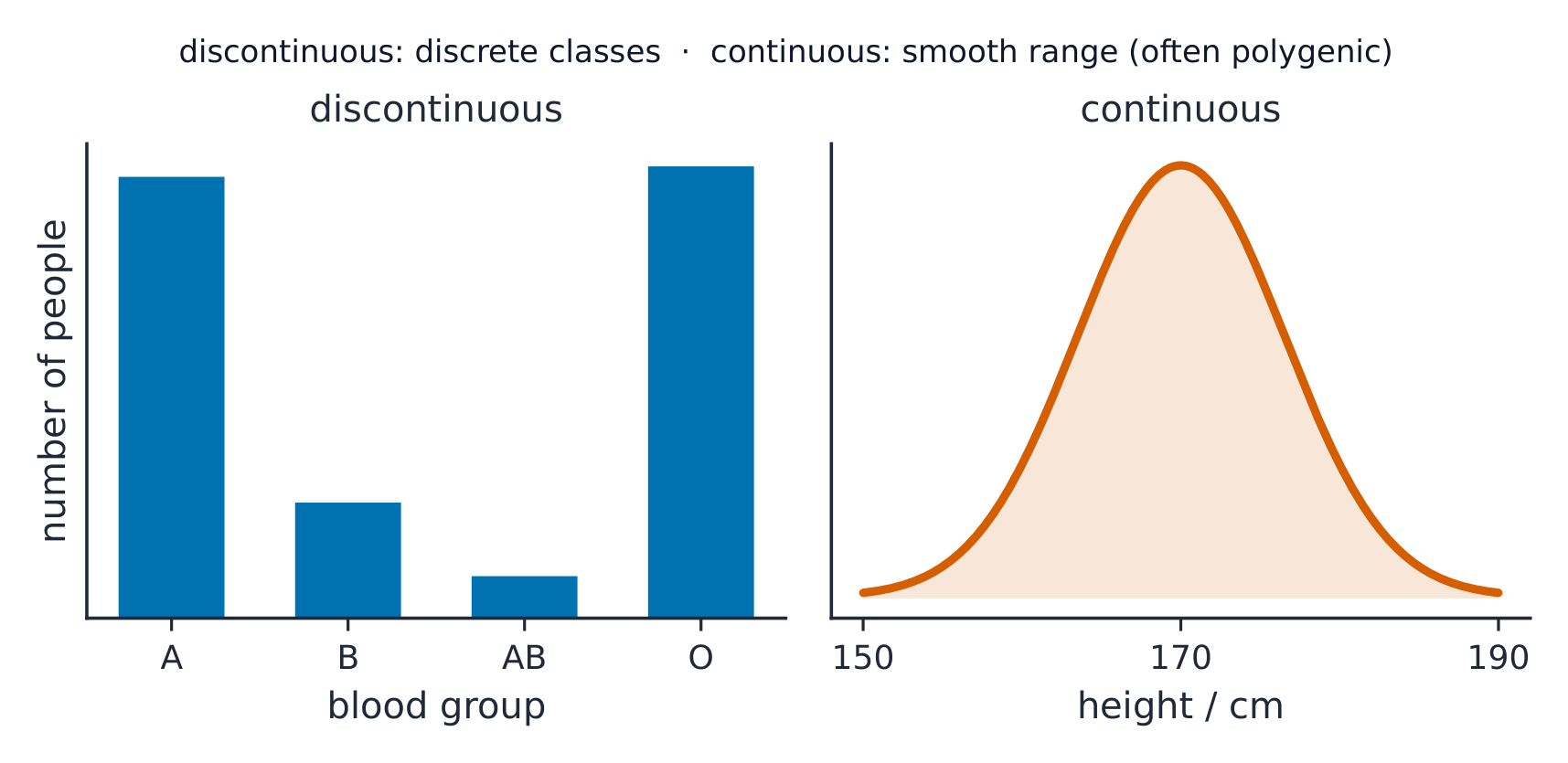
要比较两个样本的均值(例如阳光下和阴影下植株的身高),你用 t 检验,它告诉你差异是否大到足以是真实的,还是只是归因于机遇。
探索
The t-distribution behind the t-test
The t-test compares two sample means against a critical value you look up in a t-table. This is that table made live: the value depends on the degrees of freedom (here $n_1+n_2-2$). Drag df and watch the critical value change — small samples have heavier tails, so they need a larger difference to count as real.
探索
Variation type lab
Classify examples by the source and pattern of variation.
词汇表
训练
| 英文 | 中文 | 拼音 |
|---|---|---|
| variation/ˌveərɪˈeɪʃn/ | 变异 | biàn yì |
| allele/əˈliːl/ | 等位基因 | děng wèi jī yīn |
| environmental factor/enˌvaɪrənˈmentl ˈfæktə/ | 环境因素 | huán jìng yīn sù |
| discontinuous variation/dɪskənˈtɪnjuːəs ˌveərɪˈeɪʃn/ | 不连续变异 | bù lián xù biàn yì |
| gene/dʒiːn/ | 基因 | jī yīn |
| continuous variation/kənˈtɪnjuːəs ˌveərɪˈeɪʃn/ | 连续变异 | lián xù biàn yì |
17.2
自然选择与人工选择

大纲
- explain that natural selection occurs because populations have the capacity to produce many offspring that compete for resources; in the ‘struggle for existence’, individuals that are best adapted are most likely to survive to reproduce and pass on their alleles to the next generation
- explain how environmental factors can act as stabilising, disruptive and directional forces of natural selection
- explain how selection, the founder effect and genetic drift, including the bottleneck effect, may affect allele frequencies in populations
- outline how bacteria become resistant to antibiotics as an example of natural selection
- use the Hardy–Weinberg principle to calculate allele and genotype frequencies in populations and state the conditions when this principle can be applied (the two equations for the Hardy–Weinberg principle will be provided, as shown in the Mathematical requirements)
- describe the principles of selective breeding (artificial selection)
- outline the following examples of selective breeding: • the introduction of disease resistance to varieties of wheat and rice • inbreeding and hybridisation to produce vigorous, uniform varieties of maize • improving the milk yield of dairy cattle
来源:剑桥国际大纲
一个种群(population)产生的后代(offspring)远多于能存活的,所以后代必须为食物和空间等资源竞争(compete)。这是"生存斗争"。最好适应(adapted)的个体最可能存活、繁殖(reproduce),并把它们的等位基因传给下一代。经过许多代,有益的等位基因在种群中变得更常见。这是自然选择(natural selection)。
环境条件能以三种方式推动选择:
- 稳定选择(stabilising selection)偏向平均值并移除极端(种群保持不变)。
- 定向选择(directional selection)偏向一个极端,所以均值朝那个方向移动。
- 分裂选择(disruptive selection)偏向两个极端并移除平均值。
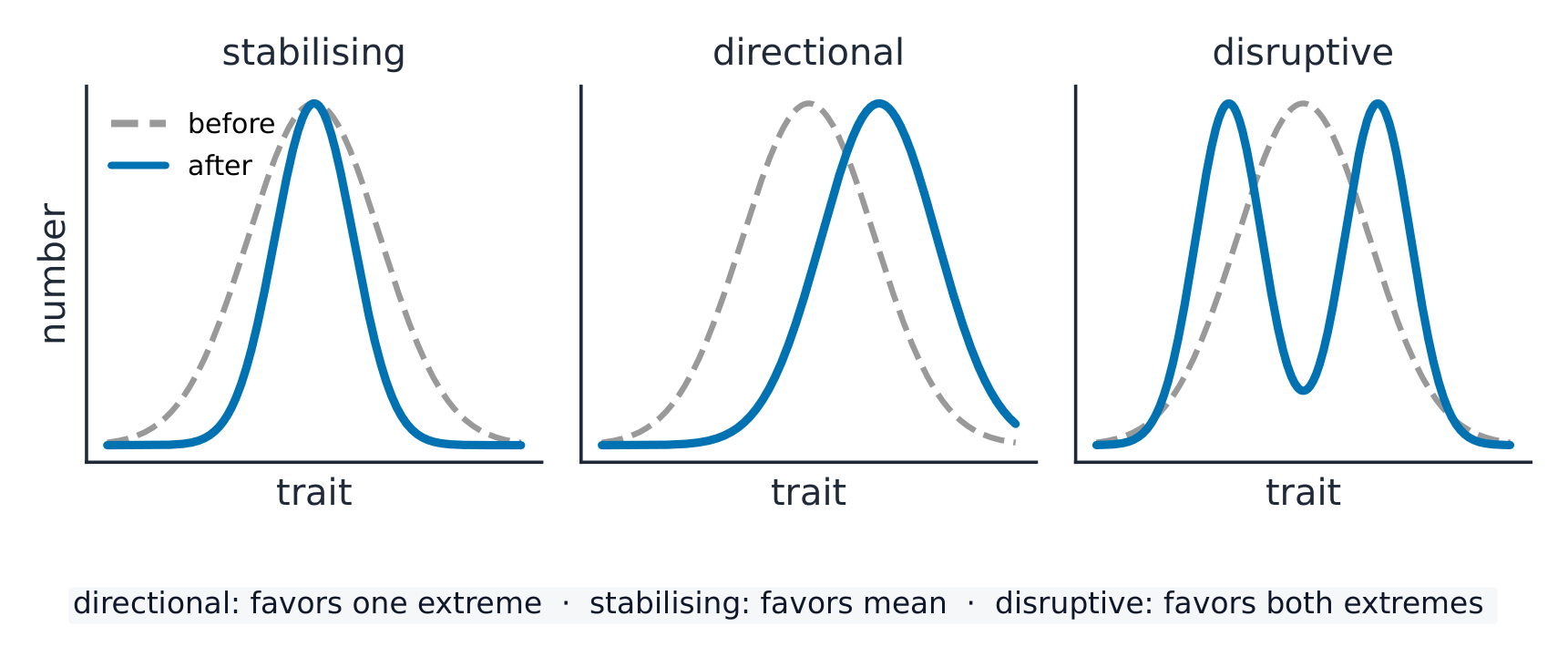
等位基因频率也能以其他方式改变:
- 奠基者效应(founder effect)——少数个体开始一个新种群,所以它们只携带原始群的一些等位基因。
- 遗传漂变(genetic drift)——在一个小种群中,等位基因频率一代一代地偶然改变。
- 瓶颈效应(bottleneck effect)——种群大小的一个突然下降留下少数幸存者,减少等位基因的多样性。

Antibiotic resistance as natural selection
一个偶然的突变(mutation)使少数细菌对一种抗生素(antibiotic)耐药。当抗生素被使用时,不耐药的细菌死亡,但耐药的存活并繁殖。随时间耐药性(resistance)在种群中传播。这是自然选择在行动。
探索
Natural selection
Step through Darwin's idea: variation + a selection pressure means the best-adapted survive and pass on their alleles.
词汇表
训练
| 英文 | 中文 | 拼音 |
|---|---|---|
| population/ˌpɒpjʊˈleɪʃn/ | 种群 | zhǒng qún |
| offspring/ˈɒfsprɪŋ/ | 后代 | hòu dài |
| compete/kəmˈpiːt/ | 竞争 | jìng zhēng |
| adapted/əˈdæptɪd/ | 适应 | shì yìng |
| reproduce/rɪprəˈdjuːs/ | 繁殖 | fán zhí |
| natural selection/ˈnætʃərəl sɪˈlekʃn/ | 自然选择 | zì rán xuǎn zé |
| stabilising selection/ˈsteɪbəlaɪzɪŋ sɪˈlekʃn/ | 稳定选择 | wěn dìng xuǎn zé |
| directional selection/daɪˈrekʃənl sɪˈlekʃn/ | 定向选择 | dìng xiàng xuǎn zé |
| disruptive selection/dɪsˈrʌptɪv sɪˈlekʃn/ | 分裂选择 | fēn liè xuǎn zé |
| founder effect/ˈfaʊndə ɪˈfekt/ | 奠基者效应 | diàn jī zhě xiào yìng |
| genetic drift/dʒɪˈnetɪk drɪft/ | 遗传漂变 | yí chuán piāo biàn |
| bottleneck effect/ˈbɒtəlnek ɪˈfekt/ | 瓶颈效应 | píng jǐng xiào yìng |
| mutation/mjuːˈteɪʃn/ | 突变 | tū biàn |
| antibiotic/ˌæntɪbaɪˈɒtɪk/ | 抗生素 | kàng shēng sù |
| resistance/rɪˈzɪstəns/ | 耐药性 | nài yào xìng |
17.2
哈迪-温伯格原理

哈迪-温伯格原理(Hardy–Weinberg principle)让你计算一个种群中的等位基因频率(allele frequencies)和基因型(genotype)频率。它只在有一个大种群、交配是随机的,以及没有突变、没有迁移和没有自然选择时才成立。
把显性等位基因的频率叫 $p$,把隐性等位基因的频率叫 $q$。只有两个等位基因,所以:
$$p + q = 1.$$
基因型频率随即加起来为 1,其中 $p^2$ 是纯合显性、$2pq$ 是杂合(携带者)、$q^2$ 是纯合隐性:
$$p^2 + 2pq + q^2 = 1.$$
例题。 一个隐性状况影响每 $100$ 人中的 $1$ 人。求携带者的频率。
只有纯合隐性基因型($q^2$)显示这个状况,所以 $q^2 = \tfrac{1}{100} = 0.01$,给出 $q = \sqrt{0.01} = 0.1$。然后 $p = 1 - q = 0.9$。携带者是杂合子:
$$2pq = 2 \times 0.9 \times 0.1 = 0.18.$$
所以约 $18\%$ 的种群是携带者——远多于显示这个状况的 $1\%$。
词汇表
训练
| 英文 | 中文 | 拼音 |
|---|---|---|
| Hardy–Weinberg principle/ˈhɑːdi ˈwaɪnbɜːɡ ˈprɪnsɪpl/ | 哈迪-温伯格原理 | hā dí - wēn bó gé yuán lǐ |
| allele frequency/əˈliːl ˈfriːkwənsi/ | 等位基因频率 | děng wèi jī yīn pín lǜ |
| genotype/ˈdʒenətaɪp/ | 基因型 | jī yīn xíng |
17.2
选择育种(人工选择)

在选择育种(selective breeding,也叫人工选择(artificial selection))中,人类(不是自然)选择哪些生物体繁殖,以便有用的特征被传下去。例子:
- 把抗病性(disease resistance)育入小麦和水稻的品种。
- 用近交(inbreeding)和杂交(hybridisation,杂交不同的品系)来制造强壮、均匀的玉米。
- 育种奶牛以改善它们的产奶产量(yield)。
探索
Selective breeding
Step through it. Humans take the role of the environment — choosing the breeders, generation after generation.
词汇表
训练
| 英文 | 中文 | 拼音 |
|---|---|---|
| selective breeding/sɪˈlektɪv ˈbriːdɪŋ/ | 选择育种 | xuǎn zé yù zhǒng |
| artificial selection/ˌɑːtɪˈfɪʃl sɪˈlekʃn/ | 人工选择 | rén gōng xuǎn zé |
| disease resistance/dɪˈziːz rɪˈzɪstəns/ | 抗病性 | kàng bìng xìng |
| inbreeding/ˈɪnbriːdɪŋ/ | 近交 | jìn jiāo |
| hybridisation/ˌhaɪbrɪdaɪˈzeɪʃn/ | 杂交 | zá jiāo |
| yield/jiːld/ | 产量 | chǎn liàng |
17.3
进化

大纲
- outline the theory of evolution as a process leading to the formation of new species from pre-existing species over time, as a result of changes to gene pools from generation to generation
- discuss how DNA sequence data can show evolutionary relationships between species
- explain how speciation may occur as a result of genetic isolation by: • geographical separation (allopatric speciation) • ecological and behavioural separation (sympatric speciation)
来源:剑桥国际大纲
进化(evolution)是新物种(species)从较早的物种缓慢形成,随着基因库(gene pool,一个种群中所有的等位基因)一代一代地改变。
DNA 序列(sequence)数据能显示两个物种关系有多近:它们的 DNA 序列越相似,它们越晚近共享一个共同祖先。
物种形成(speciation)发生在两个种群变得遗传上分离,所以它们不再能一起繁殖时。这种遗传隔离(isolation)能以两种方式产生:
- 异域物种形成(allopatric speciation)——种群被一个地理隔离(geographical separation)分开,如一片海或一条山脉。
- 同域物种形成(sympatric speciation)——种群生活在同一个区域,但被行为或生活方式的差异分离。
探索
Allopatric speciation
Step through it. A barrier splits one population; the two halves diverge until they can no longer interbreed.
词汇表
训练
| 英文 | 中文 | 拼音 |
|---|---|---|
| evolution/ɪvəˈluːʃn/ | 进化 | jìn huà |
| species/ˈspiːsiːz/ | 物种 | wù zhǒng |
| gene pool/dʒiːn puːl/ | 基因库 | jī yīn kù |
| sequence/ˈsiːkwəns/ | 序列 | xù liè |
| speciation/ˌspiːʃɪˈeɪʃn/ | 物种形成 | wù zhǒng xíng chéng |
| isolation/ˌaɪsəˈleɪʃn/ | 隔离 | gé lí |
| allopatric speciation/ˌæləˈpætrɪk ˌspiːʃɪˈeɪʃn/ | 异域物种形成 | yì yù wù zhǒng xíng chéng |
| geographical separation/ˌdʒɪəˈɡræfɪkl ˌsepəˈreɪʃn/ | 地理隔离 | dì lǐ gé lí |
| sympatric speciation/ˈsɪmpətrɪk ˌspiːʃɪˈeɪʃn/ | 同域物种形成 | tóng yù wù zhǒng xíng chéng |
17.3
考试技巧
- 把自然选择解释为一个序列:变异 → 选择压力 → 更好适应的存活并繁殖 → 等位基因频率改变。
- 用哈迪-温伯格方程($p+q=1$、$p^2+2pq+q^2=1$);$q^2$ 是隐性表现型频率——一个常见的计算。
- 用每种的一个例子区分稳定、定向和分裂选择。
- 区分异域对同域物种形成(地理对生殖隔离)。
本主题的互动课程
逐步学习,并即时检测练习。