- state that enzymes are globular proteins that catalyse reactions inside cells (intracellular enzymes) or are secreted to catalyse reactions outside cells (extracellular enzymes)
- explain the mode of action of enzymes in terms of an active site, enzyme–substrate complex, lowering of activation energy and enzyme specificity, including the lock-and-key hypothesis and the induced-fit hypothesis
- investigate the progress of enzyme-catalysed reactions by measuring rates of formation of products using catalase and rates of disappearance of substrate using amylase
- outline the use of a colorimeter for measuring the progress of enzyme-catalysed reactions that involve colour changes
酶
A-Level 生物 · 第 3 主题
 13:51
13:51
Enzymes
Inside every cell, thousands of chemical reactions happen every second — far faster than they ever could on their own. The secret is a special kind of protein…
英文讲解 · 内嵌中英文字幕
3.1
酶的作用机制

大纲
来源:剑桥国际大纲
酶(enzymes)是球状蛋白质(globular proteins)——一种带圆形、可溶形状的蛋白质(protein)。它们是生物催化剂:它们催化(catalyse,加速)生物中的化学反应,而且它们不被消耗,所以每个酶一遍又一遍地工作。
酶在两个地方工作:
- 细胞内(intracellular)的酶在制造它们的细胞(cell)内部工作。一个例子是过氧化氢酶(catalase),它分解有害的过氧化氢。
- 细胞外(extracellular)的酶被分泌(secreted,送出)以在细胞外工作。一个例子是淀粉酶(amylase),它被释放到肠道以消化(digest)淀粉(starch)。
词汇表
训练
| 英文 | 中文 | 拼音 |
|---|---|---|
| enzyme/ˈenzaɪm/ | 酶 | méi |
| globular protein/ˈɡlɒbjʊlə ˈprəʊtiːn/ | 球状蛋白质 | qiú zhuàng dàn bái zhì |
| protein/ˈprəʊtiːn/ | 蛋白质 | dàn bái zhì |
| catalyse/ˈkætəlaɪz/ | 催化 | cuī huà |
| intracellular/ˌɪntrəˈseljʊlə/ | 细胞内 | xì bāo nèi |
| cell/sel/ | 细胞 | xì bāo |
| catalase/ˈkætəleɪz/ | 过氧化氢酶 | guò yǎng huà qīng méi |
| extracellular/ˌekstrəˈseljʊlə/ | 细胞外 | xì bāo wài |
| secrete/sɪˈkriːt/ | 分泌 | fēn mì |
| amylase/ˈæmɪleɪz/ | 淀粉酶 | diàn fěn méi |
| digest/ˈdaɪdʒest/ | 消化 | xiāo huà |
| starch/stɑːtʃ/ | 淀粉 | diàn fěn |
3.1
酶如何起作用

每个酶有一个叫活性位点(active site)的特殊口袋。它作用的分子是它的底物(substrate)。底物嵌入活性位点以构成一个酶底物复合物(enzyme–substrate complex)。然后反应发生,而产物(products)离开,腾出活性位点给下一个底物。
Specificity
一个酶是专一的:它通常只作用于一个底物。这是因为活性位点的形状与那个底物而非其他的形状是互补(complementary,契合)的。我们把这叫专一性(specificity)。
两个思想解释底物如何契合:
- 锁钥学说(lock-and-key hypothesis)——活性位点是一个固定的形状,只有一个带匹配形状的底物才契合,像一把钥匙在一把锁里。
- 诱导契合学说(induced-fit hypothesis)——活性位点起初不完全是正确的形状。当底物结合时,活性位点稍微改变形状以紧紧地包住它。这个思想更好地符合证据。
Lowering activation energy
每个反应需要一小"推"能量来开始,叫活化能(activation energy)。一个酶降低活化能。这让反应在细胞的正常温度(temperature)下快速进行,而不需要高热。

探索
The catalytic cycle
Step through the cycle. The enzyme binds its substrate, the reaction happens, the products leave — and the same enzyme is free to go again.
词汇表
训练
| 英文 | 中文 | 拼音 |
|---|---|---|
| active site/ˈæktɪv saɪt/ | 活性位点 | huó xìng wèi diǎn |
| substrate/ˈsʌbstreɪt/ | 底物 | dǐ wù |
| enzyme–substrate complex/ˈenzaɪm ˈsʌbstreɪt ˈkɒmpleks/ | 酶底物复合物 | méi dǐ wù fù hé wù |
| product/ˈprɒdʌkt/ | 产物 | chǎn wù |
| complementary/ˌkɒmplɪˈmentəri/ | 互补 | hù bǔ |
| specificity/ˌspesɪˈfɪsɪti/ | 专一性 | zhuān yī xìng |
| lock-and-key hypothesis/lɒk ænd kiː haɪˈpɒθəsɪs/ | 锁钥学说 | suǒ yuè xué shuō |
| induced-fit hypothesis/ɪnˈdjuːst fɪt haɪˈpɒθəsɪs/ | 诱导契合学说 | yòu dǎo qì hé xué shuō |
| activation energy/ˌæktɪˈveɪʃn ˈenədʒi/ | 活化能 | huó huà néng |
3.1
测量反应速率

你可以用两种方式跟踪一个酶反应:
- 测量产物制造得多快。用过氧化氢酶,氧气是一个产物,所以你收集气体并随时间测量它的体积。
- 测量底物消失得多快。用淀粉酶,你取出样品并用碘测试;随着淀粉被用尽,蓝黑色褪去。
一个比色计(colorimeter)使这个精确。它让光穿过管子并测量吸收了多少光,所以一个颜色变化变成一个你可以画图的数字。
反应速率(rate of reaction)在开始时最陡(存在最多的底物),所以初速率(在时间零的斜率)是最公平的比较值。
例题。 在一个过氧化氢酶反应的头 $20$ 秒里,收集了 $16\ \text{cm}^3$ 的氧气。估计反应速率。
$$\text{rate} = \frac{\text{volume of product}}{\text{time}} = \frac{16}{20} = 0.8\ \text{cm}^3\,\text{s}^{-1}.$$
因为反应在开始时最快,在这个短的早期区间上测量给出一个接近初速率的值;在一个更长的时间上取平均会包括较慢的后期阶段并低估它。
词汇表
训练
| 英文 | 中文 | 拼音 |
|---|---|---|
| colorimeter/ˌkʌləˈrɪmɪtə/ | 比色计 | bǐ sè jì |
| rate of reaction/reɪt ɒv rɪˈækʃn/ | 反应速率 | fǎn yìng sù lǜ |
3.2
影响酶活性的因素

大纲
- investigate and explain the effects of the following factors on the rate of enzyme-catalysed reactions: • temperature • pH (using buffer solutions) • enzyme concentration • substrate concentration • inhibitor concentration
- explain that the maximum rate of reaction ($V_{\text{max}}$) is used to derive the Michaelis–Menten constant ($K_{\text{m}}$), which is used to compare the affinity of different enzymes for their substrates
- explain the effects of reversible inhibitors, both competitive and non-competitive, on enzyme activity
- investigate the difference in activity between an enzyme immobilised in alginate and the same enzyme free in solution, and state the advantages of using immobilised enzymes
来源:剑桥国际大纲
Temperature
随着温度上升,分子获得更多的动能(kinetic energy)并更频繁地碰撞(collide),所以速率上升。但在最适温度(optimum temperature)之上,酶开始变性(denature):热打断保持它形状的键,所以活性位点改变并不再契合底物。然后速率快速下降。
pH
每个酶有一个最适 pH。若 pH 离它移动太远,酶变性而速率下降。要公平地研究 pH,你用一个缓冲液(buffer solution)保持它稳定。

Enzyme concentration
在有大量底物时,更多的酶意味着更多的活性位点,所以速率与酶浓度成正比地上升。
Substrate concentration
起初,加更多的底物加速反应。但一旦每个活性位点都忙碌,加更多就没有区别了——速率在一个最大值趋平。
Inhibitor concentration
一个抑制剂(inhibitor)是一个减慢一个酶的分子。存在的抑制剂越多,速率越低。
探索
How temperature changes enzyme activity
Drag the temperature slider. Activity rises to an optimum, then crashes as the enzyme denatures and its active site loses shape.
词汇表
训练
| 英文 | 中文 | 拼音 |
|---|---|---|
| temperature/ˈtemprɪtʃə/ | 温度 | wēn dù |
| kinetic energy/kɪˈnetɪk ˈenədʒi/ | 动能 | dòng néng |
| collide/kəˈlaɪd/ | 碰撞 | pèng zhuàng |
| optimum temperature/ˈɒptɪməm ˈtemprɪtʃə/ | 最适温度 | zuì shì wēn dù |
| denature/ˈdenətʃə/ | 变性 | biàn xìng |
| buffer solution/ˈbʌfə səˈluːʃn/ | 缓冲液 | huǎn chōng yè |
| inhibitor/ɪnˈhɪbɪtə/ | 抑制剂 | yì zhì jì |
3.2
最大反应速率与米氏常数
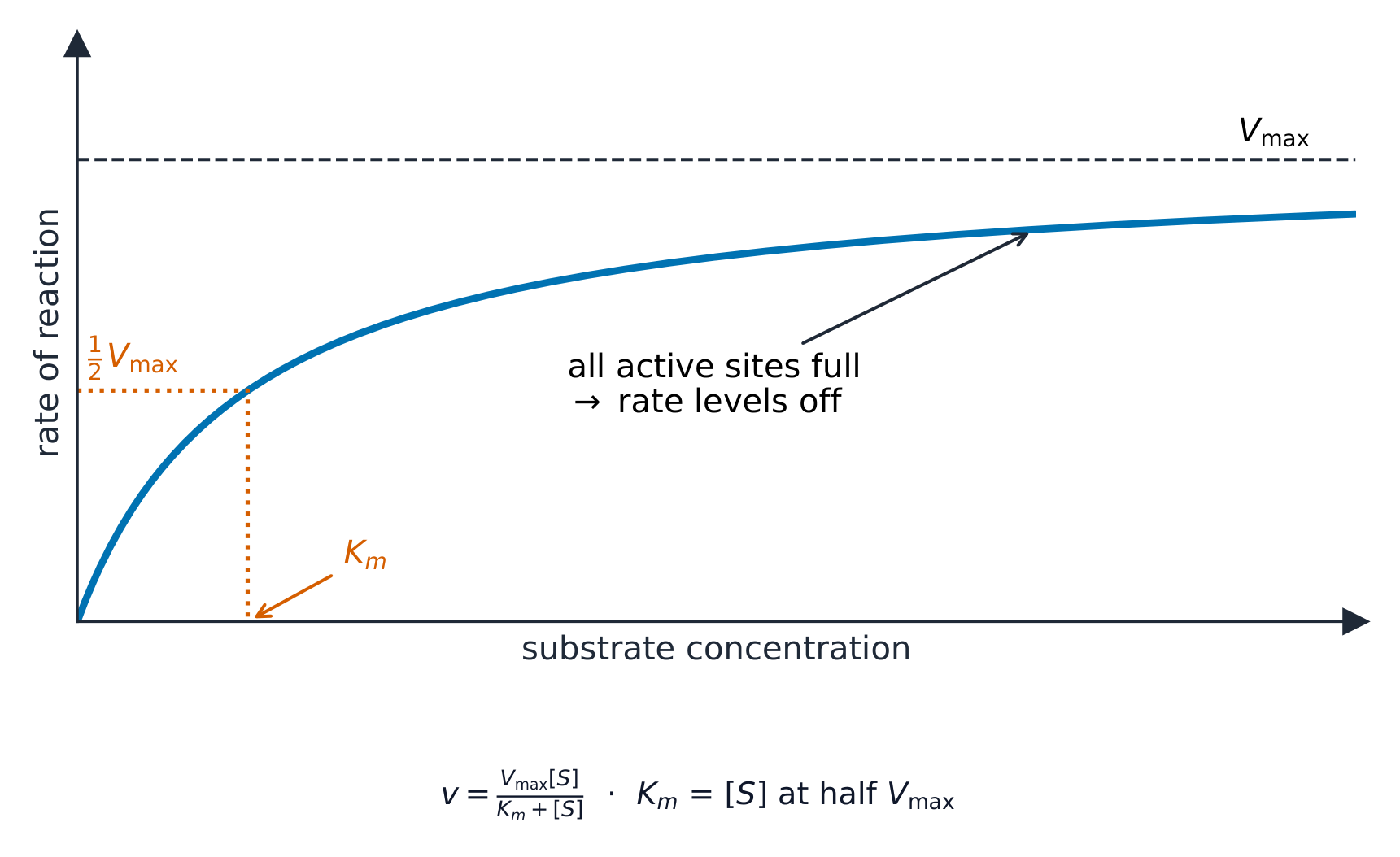
趋平的速率,当所有活性位点都满时,是最大速率,写成 $V_{\text{max}}$。
米氏常数(Michaelis–Menten constant,$K_{\text{m}}$)是给出 $V_{\text{max}}$ 一半的底物浓度。它告诉你关于酶对它底物的亲和力(affinity,拉力):
- 一个低的 $K_{\text{m}}$ 意味着酶在一个低底物浓度就达到半速,所以它有一个高亲和力。
- 一个高的 $K_{\text{m}}$ 意味着一个低亲和力。
所以 $K_{\text{m}}$ 让你比较不同的酶多强地抓住它们的底物。
探索
Substrate concentration and Vmax
Add more substrate: the rate climbs, then plateaus at $V_{max}$ once every active site is busy. $K_m$ is the substrate concentration that gives half of $V_{max}$.
词汇表
训练
| 英文 | 中文 | 拼音 |
|---|---|---|
| Michaelis–Menten constant/ˈmaɪkəliz ˈmentn ˈkɒnstənt/ | 米氏常数 | mǐ shì cháng shù |
| affinity/əˈfɪnɪti/ | 亲和力 | qīn hé lì |
3.2
可逆抑制剂
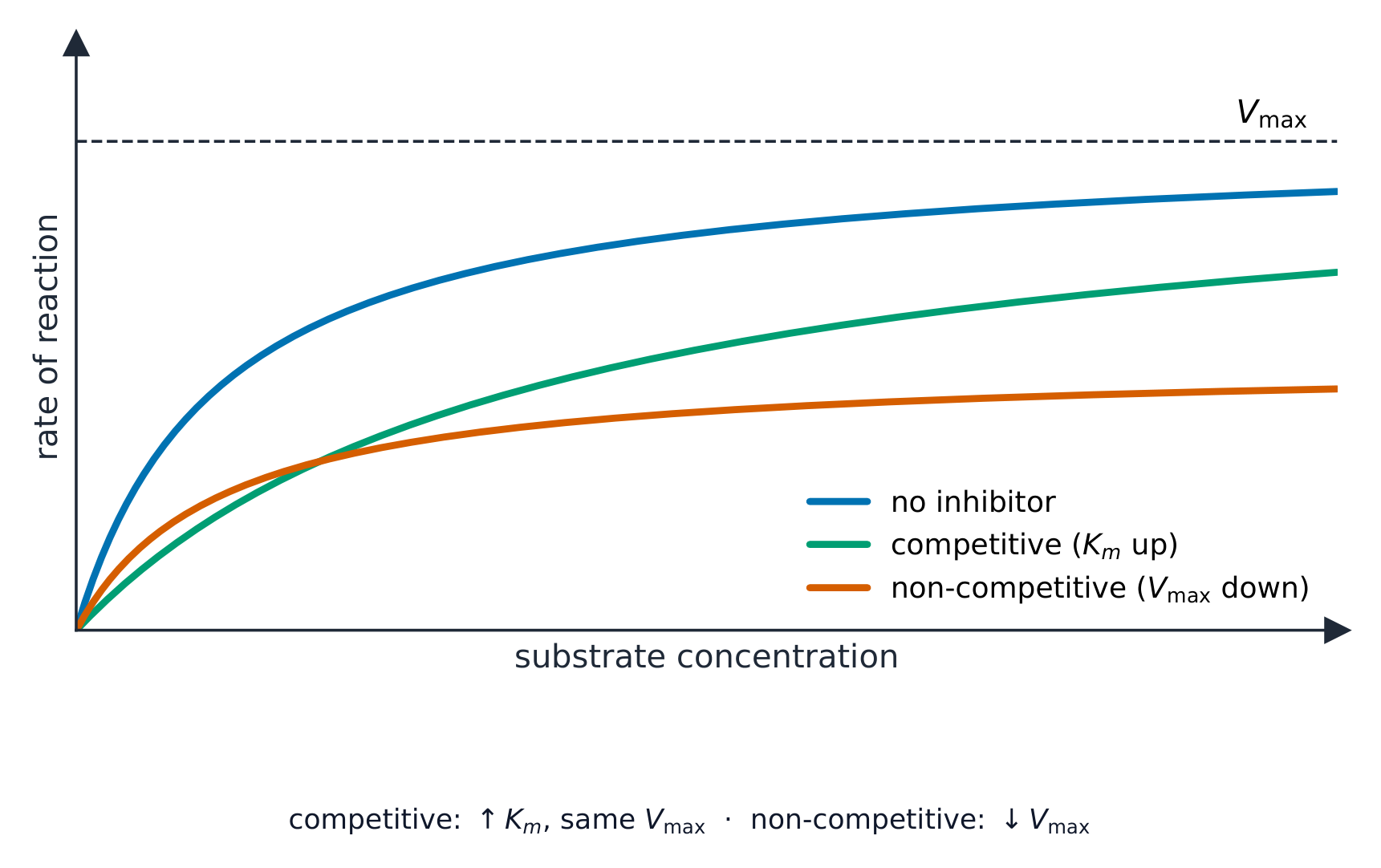
一些抑制剂是可逆(reversible)的:它们能再次离开酶。有两种类型。
| 类型 | 它在哪里结合 | 加更多底物的效果 | 对 $V_{\text{max}}$ 和 $K_{\text{m}}$ 的效果 |
|---|---|---|---|
| 竞争性抑制剂(competitive inhibitor) | 在活性位点(它有一个与底物相似的形状) | 更多底物胜过它,所以它的效果被减少 | $V_{\text{max}}$ 不变;$K_{\text{m}}$ 上升 |
| 非竞争性抑制剂(non-competitive inhibitor) | 在另一个位点,改变活性位点的形状 | 加更多底物没有帮助 | $V_{\text{max}}$ 下降;$K_{\text{m}}$ 不变 |
词汇表
训练
| 英文 | 中文 | 拼音 |
|---|---|---|
| reversible/rɪˈvɜːsɪbl/ | 可逆 | kě nì |
| competitive inhibitor/kəmˈpetɪtɪv ɪnˈhɪbɪtə/ | 竞争性抑制剂 | jìng zhēng xìng yì zhì jì |
| non-competitive inhibitor/nɒn kəmˈpetɪtɪv ɪnˈhɪbɪtə/ | 非竞争性抑制剂 | fēi jìng zhēng xìng yì zhì jì |
3.2
固定化酶

一个固定化酶(immobilised enzyme)被固定在原位——例如,被困在海藻酸盐(alginate)的小珠里面——而不是在溶液中自由漂浮。底物溶液流过这些珠。
一个自由的酶通常工作得快一点,因为底物能容易地到达它。但固定化酶有大的实际优势:
- 酶不被冲走,所以它能一遍又一遍地使用。
- 产物是纯的——它不与酶混合。
- 酶更稳定,所以它更好地经受温度和 pH 的变化。
- 过程可以连续运行,底物流入、产物流出。

词汇表
训练
| 英文 | 中文 | 拼音 |
|---|---|---|
| immobilised enzyme/ɪˈməʊbəlaɪzd ˈenzaɪm/ | 固定化酶 | gù dìng huà méi |
| alginate/ˈældʒɪneɪt/ | 海藻酸盐 | hǎi zǎo suān yán |
3.2
考试技巧
- 用诱导契合模型解释酶的作用(活性位点围绕底物塑形)——现在比锁钥更受青睐。
- 在最适温度之上酶变性(氢键和三级结构断裂)——写"变性",绝不写"死了"或"被杀死"。
- 区分抑制剂:竞争性结合活性位点(被更多底物克服,同样的 $V_{max}$);非竞争性在别处结合(更低的 $V_{max}$)。
- 用初速率(时间零处的切线)比较速率——最公平的量度,在底物变成限制之前。
本主题的互动课程
逐步学习,并即时检测练习。