Mode of action of enzymes
Introduced| English | Meaning |
|---|---|
| enzyme/ˈenzaɪm/ | A biological catalyst that increases the rate of a reaction without being used up overall. |
| catalyst/ˈkætəlɪst/ | A substance that increases a reaction rate without being used up overall. |
| intracellular/ˌɪntrəˈseljʊlə/ | Located or occurring inside a cell. |
| extracellular/ˌekstrəˈseljʊlə/ | Located or occurring outside cells. |
| active site/ˈæktɪv saɪt/ | The region of an enzyme where a substrate binds and the reaction is catalysed. |
| substrate/ˈsʌbstreɪt/ | A substance on which an enzyme acts. |
| complementary/ˌkɒmplɪˈmentəri/ | Having matching features that allow specific pairing, such as the bases in DNA. |
| induced fit/ɪnˈdjuːst fɪt/ | induced fit |
| activation energy/ˌæktɪˈveɪʃn ˈenədʒi/ | The minimum energy that reacting particles need for a successful reaction. |
Enzymes 酶: nature's catalysts 催化剂
- Most reactions in a cell would be far too slow to keep you alive.
- Enzymes speed them up — by millions of times — without being used up.
- They are globular proteins, and their shape is everything.
Which best describes an enzyme?
Difficulty 1/5 · 100 coins + a small bonus on first completion today
Enzymes are globular protein catalysts: they speed reactions and are not used up, so each one works again and again.
Where enzymes work
- Intracellular 细胞内 enzymes work inside the cell that made them — e.g. catalase, which breaks down harmful hydrogen peroxide.
- Extracellular 细胞外 enzymes are secreted to work outside the cell — e.g. amylase, released into the gut to digest starch.
- Either way, an enzyme is a catalyst: it speeds a reaction and is not used up, so it works again and again.

Yeast enzymes ferment sugar, giving off bubbles of carbon dioxide.
Select all the correct statements about where enzymes work.
Difficulty 2/5 · 140 coins + a small bonus on first completion today
Catalase is intracellular and amylase is extracellular. Extracellular means it works outside the cell, so the third statement is false.
The active site 活性位点 and specificity
- Each enzyme has a pocket called the active site. The molecule it acts on is the substrate 底物.
- The substrate binds to form an enzyme–substrate complex; the reaction happens, then the products leave and free the site.
- An enzyme is specific — its active site is complementary 互补 to just one substrate's shape, and no other.

Biological washing powders contain enzymes that digest food and blood stains.
Match each term to its meaning.
Difficulty 2/5 · 140 coins + a small bonus on first completion today
The substrate binds in the active site to form the enzyme–substrate complex; the reaction makes the product, which is then released.
An enzyme is specific because:
Difficulty 1/5 · 100 coins + a small bonus on first completion today
Specificity comes from the active site's shape being complementary to one substrate and no other.
The catalytic cycle
- The substrate slots into the active site, forming an enzyme–substrate complex.
- Bonds are strained, the reaction happens, and the products are released.
- The enzyme is left unchanged — free to bind again, thousands of times a second.
The catalytic cycle
Step through the cycle. The enzyme binds its substrate, the reaction happens, the products leave — and the same enzyme is free to go again.
Put the steps of the catalytic cycle in order.
Difficulty 3/5 · 200 coins + a small bonus on first completion today
Bind → react → release → reset. The enzyme is unchanged, so it repeats the cycle thousands of times a second.
Lock-and-key vs induced fit 诱导契合
- Lock-and-key: the active site is a fixed shape; only a substrate with the matching shape fits, like a key in a lock.
- Induced fit: the active site is not quite the right shape at first — when the substrate binds, the site moulds around it for a tight grip.
- Induced fit matches the evidence better.

The lock-and-key and induced-fit models of how a substrate fits the active site
In the induced-fit model the active site is completely rigid and never changes shape.
Difficulty 1/5 · 100 coins + a small bonus on first completion today
That describes lock-and-key. In induced fit the active site moulds around the substrate as it binds — a tighter grip that fits the evidence better.
The specific molecule that an enzyme acts on is called its ______.
Difficulty 1/5 · 100 coins + a small bonus on first completion today
The substrate binds in the active site, where the enzyme converts it into product.
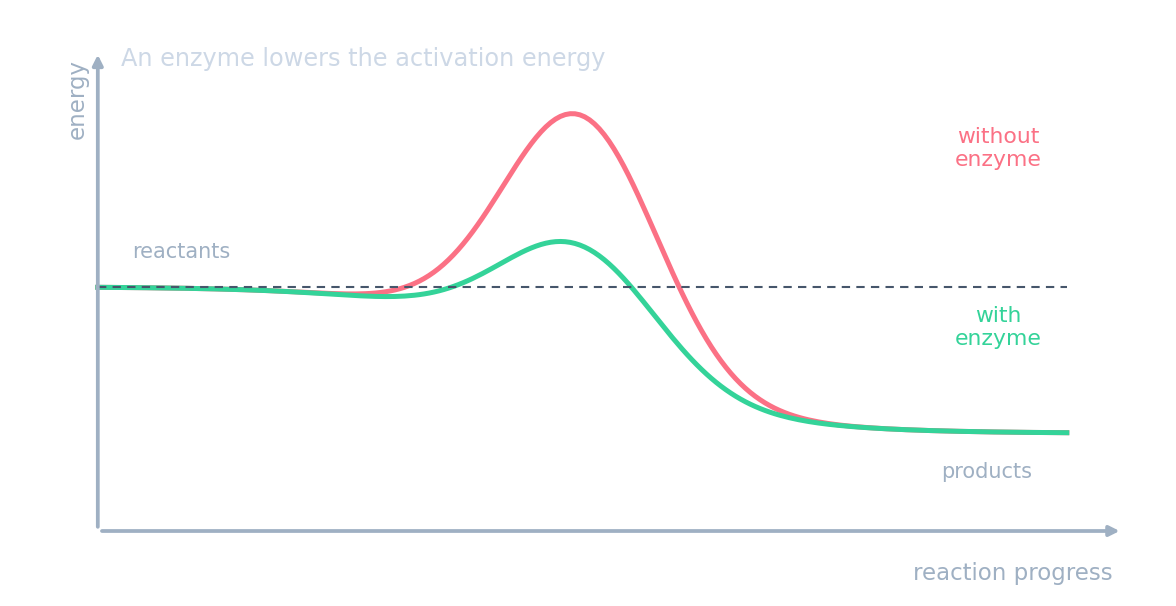
Lowering activation energy 活化能
- Every reaction needs a starting "push" of energy — the activation energy.
- An enzyme lowers the activation energy, so the reaction can run fast at the cell's normal temperature instead of needing high heat.
How does an enzyme speed up a reaction?
Difficulty 1/5 · 100 coins + a small bonus on first completion today
Enzymes lower the activation energy, so the reaction proceeds quickly at normal cell temperatures.
You've got it
- enzymes = globular protein catalysts; not used up; intracellular (catalase) or extracellular (amylase)
- active site + substrate → enzyme–substrate complex → products leave
- specific: active site is complementary to one substrate (lock-and-key / induced fit)
- enzymes work by lowering the activation energy