Factors that affect enzyme action
Introduced| English | Meaning |
|---|---|
| colorimeter/ˌkʌləˈrɪmɪtə/ | An instrument that measures how much light of a selected wavelength band a sample absorbs or transmits. |
| initial rate/ɪˈnɪʃl reɪt/ | The rate of a reaction or process measured at or very near its beginning. |
| optimum/ˈɒptɪməm/ | The condition or value at which a process performs best under the stated criteria. |
| denature/ˈdenətʃə/ | To alter a biological molecule's structure enough to disrupt its normal function, without necessarily breaking its primary covalent structure. |
| buffer/ˈbʌfə/ | A substance or solution that limits changes in pH when small amounts of acid or base are added. |
| inhibitor/ɪnˈhɪbɪtə/ | inhibitor |
What changes an enzyme's speed
- Change the conditions and you change how fast an enzyme works.
- First, you need a fair way to measure the rate.
- Then we'll see how temperature, pH and concentration each affect it.
Measuring the rate
- Follow how fast product forms (e.g. collect the oxygen gas from catalase) or how fast substrate disappears (e.g. the iodine colour fading as amylase digests starch).
- A colorimeter 比色计 turns a colour change into an exact number you can plot.
- The reaction is fastest at the start (most substrate present), so the initial rate 初始速率 — the slope at time zero — is the fairest value to compare.
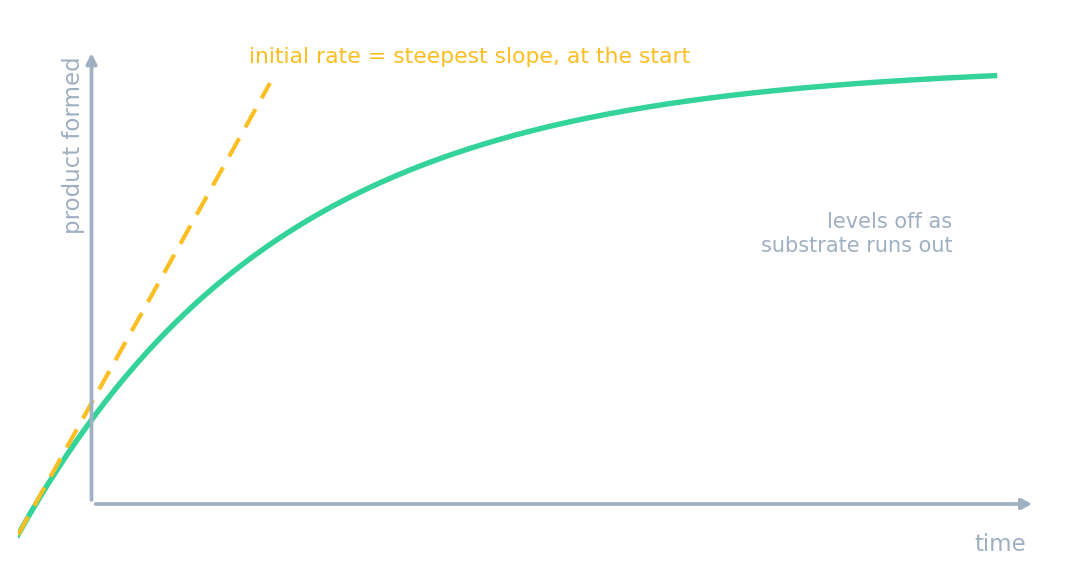
The initial rate — the slope at the very start — is the fairest value to compare.
Why is the initial rate (slope at time zero) the fairest value to compare?
Difficulty 1/5 · 100 coins + a small bonus on first completion today
At the start the most substrate is present, so the rate is highest and not yet limited by substrate running out.
Temperature
- Heating gives molecules more kinetic energy, so they collide more often — the rate rises.
- But past the optimum 最适, the heat breaks the bonds holding the enzyme's shape: it denatures 变性, the active site no longer fits, and the rate crashes.
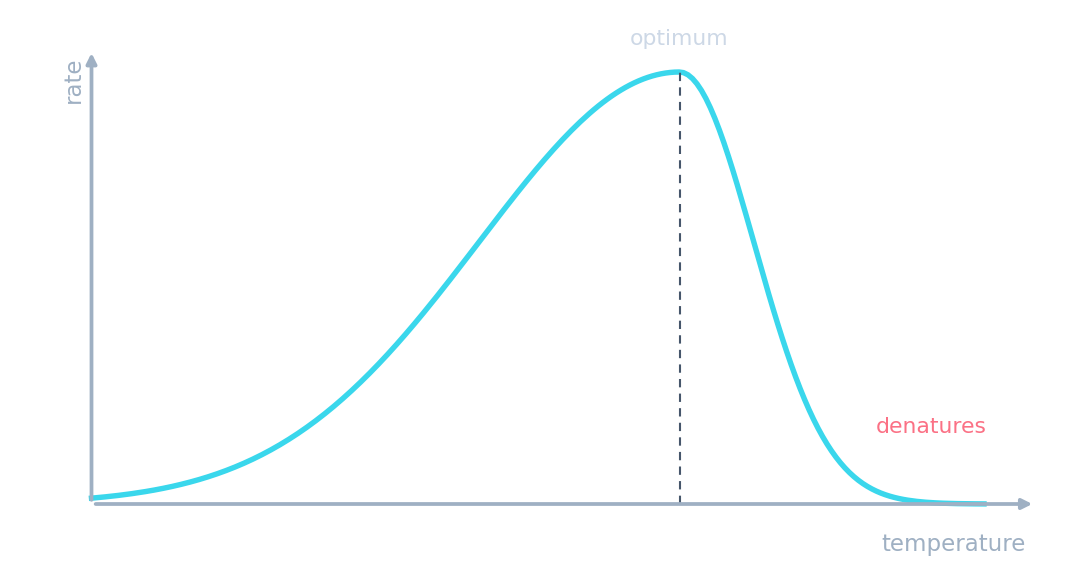
Temperature: warm, then too hot
rate peaks at the optimum
Drag the temperature. Warming speeds it up — until too hot denatures the enzyme and activity crashes past the optimum.
As temperature rises from cold to very hot, put the events in order.
Difficulty 3/5 · 200 coins + a small bonus on first completion today
Warming first speeds collisions (rate climbs to the optimum); past it the enzyme denatures and the rate crashes.
Above the optimum temperature, the rate falls steeply because the enzyme:
Difficulty 1/5 · 100 coins + a small bonus on first completion today
Heat breaks the bonds holding the enzyme's shape; the active site changes and can no longer bind the substrate.
pH
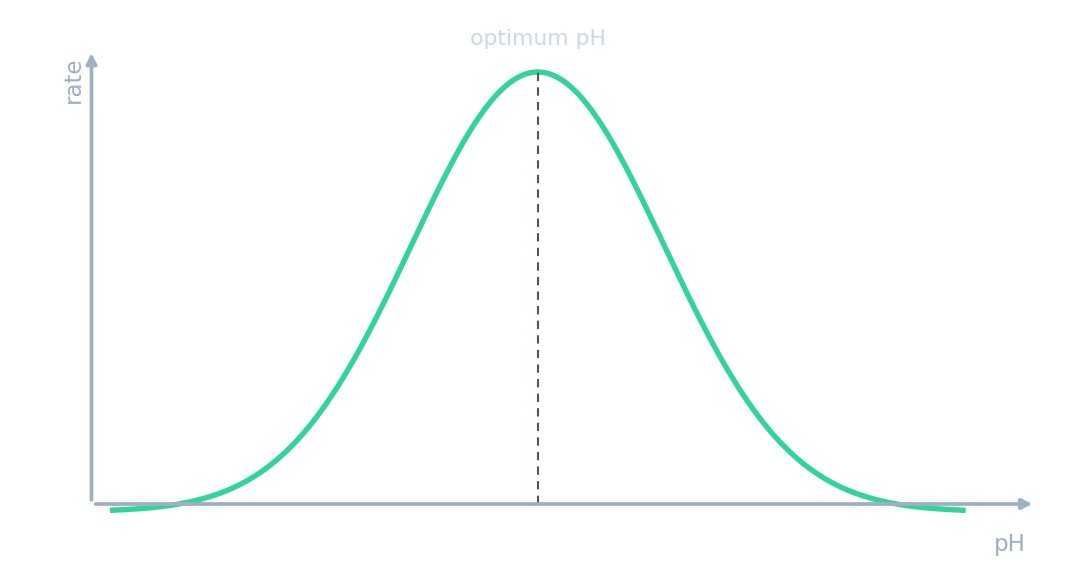
- Each enzyme has an optimum pH. Move too far either side and it denatures, so the rate drops.
- To study pH fairly, hold it steady with a buffer 缓冲液 solution.
To stop pH changing while you vary temperature, keep it constant with a ______ solution.
Difficulty 1/5 · 100 coins + a small bonus on first completion today
A buffer resists pH change, so pH stays controlled while temperature is the only variable.
Enzyme and substrate concentration
- More enzyme (with substrate to spare) means more active sites, so the rate rises in proportion.
- More substrate speeds things up at first — but once every active site is busy, adding more makes no difference and the rate levels off.
- More inhibitor 抑制剂 lowers the rate.
- Explore it below: drag the substrate slider and watch the rate climb, then flatten once every active site is full.
Substrate concentration: rate then plateau
rate = Vmax·[S] / (Km + [S])
Drag the substrate. The rate climbs, then levels off once every active site is busy — adding more substrate then does nothing.
Match each change to its effect on the rate.
Difficulty 2/5 · 140 coins + a small bonus on first completion today
More enzyme adds active sites; once sites are saturated, extra substrate does nothing; extreme heat or pH denatures the enzyme.
Adding more substrate eventually stops increasing the rate because:
Difficulty 1/5 · 100 coins + a small bonus on first completion today
Once all active sites are occupied, the rate is at its maximum; more substrate cannot be processed any faster.
With plenty of substrate, doubling the enzyme concentration has no effect on the rate.
Difficulty 1/5 · 100 coins + a small bonus on first completion today
False. With substrate to spare, more enzyme means more active sites, so doubling the enzyme concentration roughly doubles the rate.
You've got it
- measure the initial rate (steepest, at the start) for a fair comparison; a colorimeter makes colour exact
- temperature: rises to the optimum, then denatures and crashes
- pH: bell curve about the optimum pH; use a buffer to keep it steady
- enzyme ↑ → rate ↑ (proportional); substrate ↑ → levels off when all sites are full
Write from denaturation at 70 degrees
- An enzyme works faster as temperature rises from 10 to 30 degrees.
- At 70 degrees the reaction stops and cooling does not restore it.
What has happened to the enzyme at 70 degrees?
Too much heat unfolds the protein.
What happens to the enzyme at 70 degrees?
Difficulty 1/5 · 100 coins + a small bonus on first completion today
The active site loses its shape.